
Personal Liability for Executors Who Pay Other Debts Before IRS Tax Debt
If you are acting as executor or administrator of an estate, there is a federal rule you need to know abaout before you pay a single other debt or distribute a single asset: the government's claim generally comes first, and paying other creditors ahead of a known IRS debt can make you personally liable for it.
This is not a rule most people learn about until they are already deep into administering an estate. I want to walk through exactly what it requires and, more importantly, how to avoid triggering it.

TLDR:
- Under 31 U.S.C. 3713, when an estate does not have enough assets to pay all debts, the federal government's claim generally must be paid before other creditors or beneficiaries.
- If you, as executor, pay another debt or distribute assets ahead of a known or reasonably knowable federal tax debt, and the estate is insolvent, you can become personally liable for the unpaid tax, up to the value of what you improperly paid out.
- This liability generally requires the estate to have been insolvent at the time of the payment or distribution, and requires that you had actual or constructive knowledge of the tax debt.
- Confirming the estate's tax filing status and any known liabilities before paying other creditors or distributing assets is the most direct way to avoid this exposure.
- Form 5495 can be used to request formal discharge from personal liability once the estate's tax matters are resolved.
- This article covers federal executor liability. California probate procedure interacts with, but does not replace, this federal rule - see the companion post on federal versus California treatment.
The Rule Itself
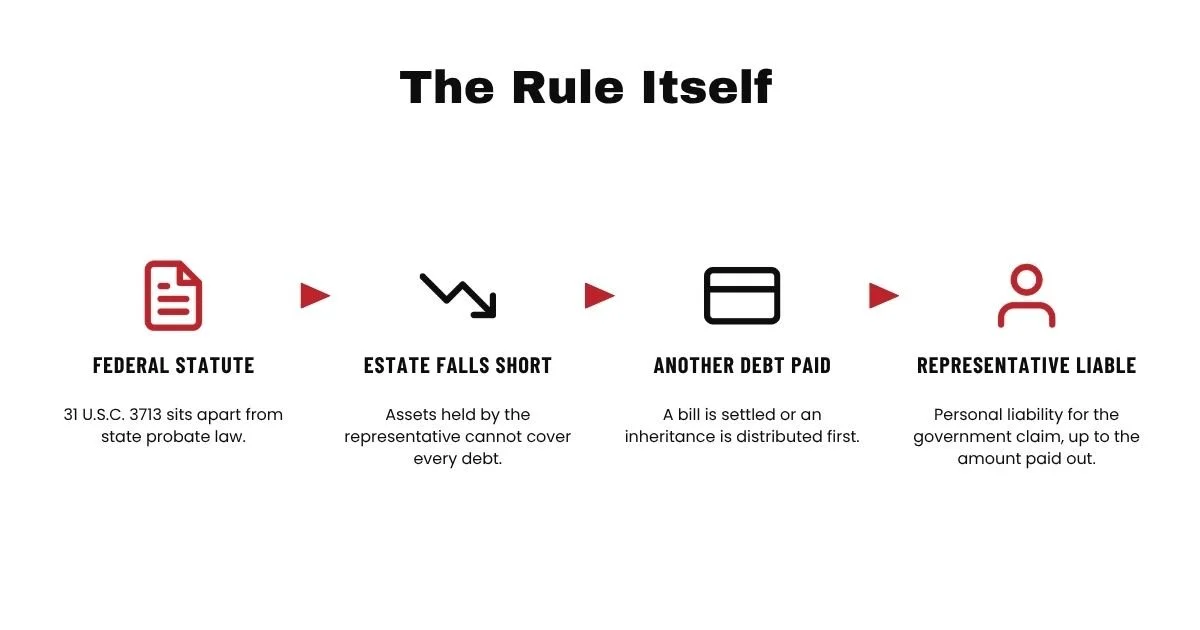
31 U.S.C. 3713 is a federal statute, separate from state probate law, that gives the federal government priority when a debtor's assets are not enough to cover all debts. For a deceased person's estate
specifically, this priority applies when the assets in the custody of the executor or administrator are not enough to pay all of the decedent's debts.
The personal liability piece comes from a separate subsection: a representative of a person or an estate who pays any part of a debt of that person or estate before paying a claim of the government is liable, to the extent of that payment, for the government's unpaid claim.
In plain terms: if you pay a credit card bill, a funeral expense beyond what qualifies for priority treatment, or distribute an inheritance to a beneficiary, before addressing a known IRS debt, and it turns out the estate did not have enough assets to cover everything, you can be personally on the hook for the tax debt, up to whatever amount you paid out improperly.
What Triggers Personal Liability, Specifically
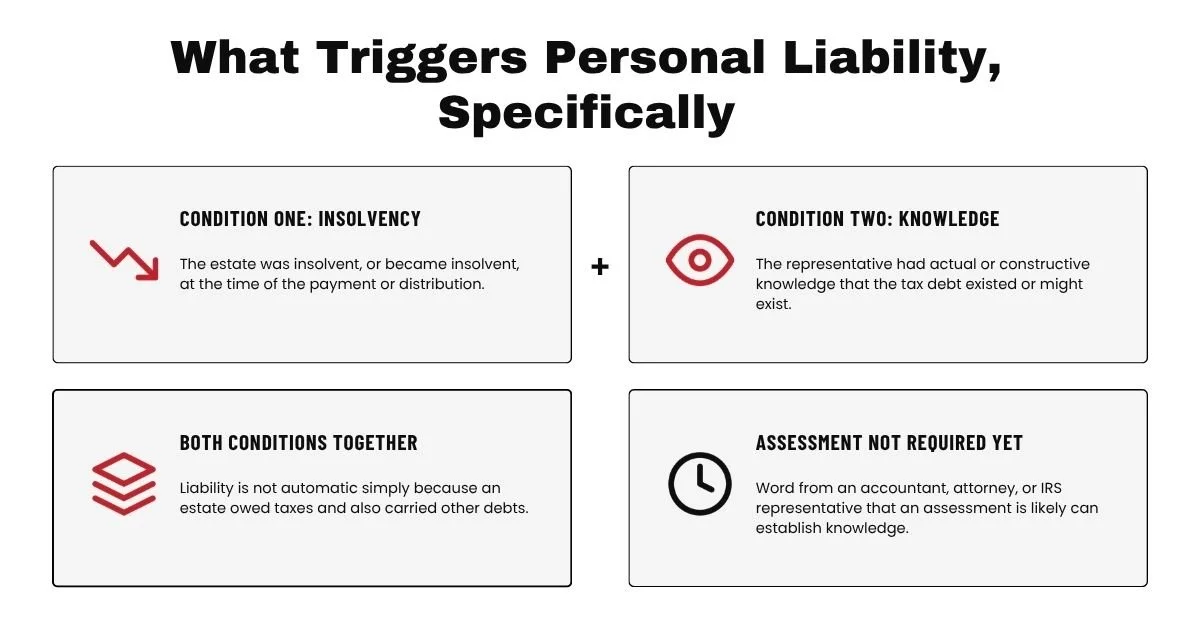
This liability is not automatic just because an estate owed taxes and also had other debts. Based on the statute and IRS guidance, two conditions generally need to be true:
1. The estate was insolvent, or became insolvent, at the time of the payment or distribution
2. You, as the representative, had actual or constructive knowledge that the tax debt existed or might exist
Notably, the tax debt does not necessarily need to have been formally assessed by the IRS yet for the knowledge requirement to be met. If an accountant, attorney, or IRS representative told you an assessment was likely, that can be enough to establish knowledge.
How to Protect Yourself Before You Pay Anything
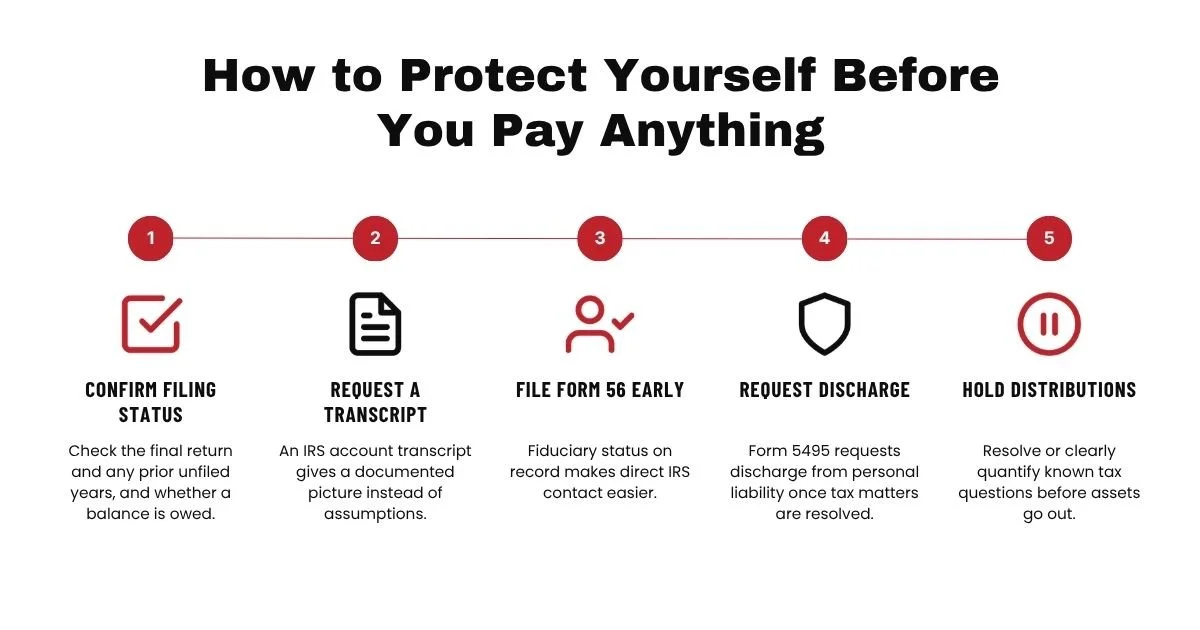
I want this section to be genuinely practical, not just a description of the risk. Based on the framework above, here is what generally reduces or eliminates this exposure:
Confirm Filing Status First
Before paying any other creditor, confirm whether the decedent's final return and any prior unfiled years have actually been filed, and whether a balance is owed. This connects directly to our companion post on who is responsible for filing a deceased person's unfiled returns. An unknown filing status is exactly the kind of gap that can later be characterized as constructive knowledge you should have acted on.
Request a Transcript
Pulling the decedent's IRS account transcript generally gives you a factual, documented picture of what is or is not owed, rather than relying on assumptions.
File Form 56 Early
Establishing your fiduciary status with the IRS early, covered in depth in our companion Form 56 post, generally makes it easier to communicate directly with the IRS and get accurate account information before distributing assets.
Consider Requesting Discharge From Personal Liability
Once the estate's tax matters appear resolved, an executor can file Form 5495 to request formal discharge from personal liability under IRC Sections 2204 or 6905. The IRS then generally has a defined window to notify the executor of any amount still due.
Do Not Distribute Assets Before Resolving Known Tax Questions
This is the most direct protective step of all. If you know, or have any reason to suspect, that a tax debt exists, resolving or at minimum clearly quantifying that debt before distributing remaining assets is generally the safest sequence.
What This Does Not Mean
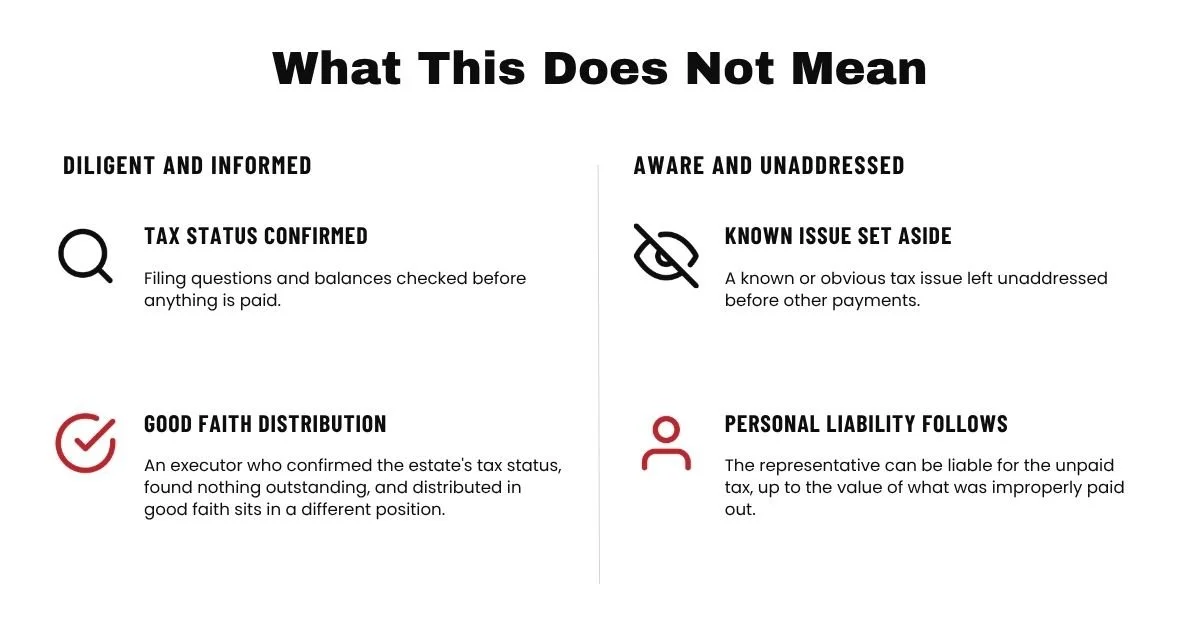
I want to be careful not to overstate this rule into something more frightening than it actually is.
This liability generally requires both insolvency and knowledge. An executor who reasonably and diligently confirmed the estate's tax status, found nothing outstanding, and distributed assets in good faith is in a meaningfully different position than one who ignored a known or obvious tax issue.
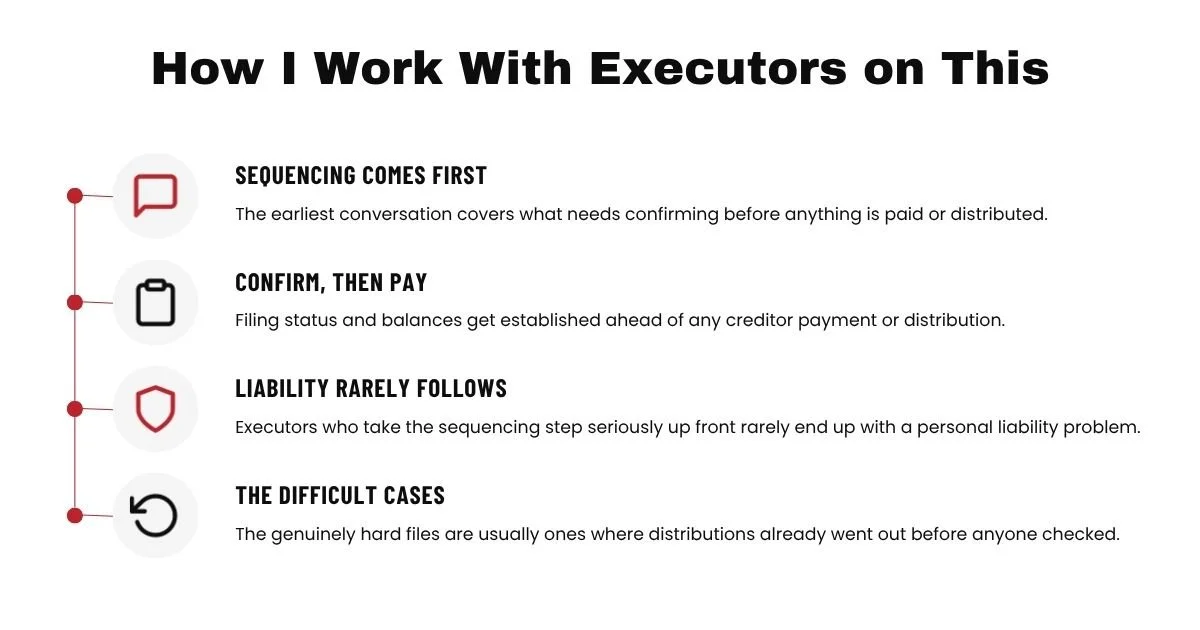
How I Work With Executors on This
When I work with someone acting as executor, one of the earliest conversations I have is about sequencing: what needs to be confirmed before anything gets paid or distributed.
In my experience, executors who take this step seriously up front rarely end up with a personal liability problem. The cases that become genuinely difficult are usually ones where distributions already went out before anyone checked.
Frequently Asked Questions
-
Potentially, but generally only if the estate was insolvent and you knew
or reasonably should have known about the debt when you paid other
creditors or distributed assets ahead of it.
-
The knowledge requirement matters significantly here, and this is
exactly the scenario most executors are worried about.
-
Confirming filing status, pulling an account transcript, filing Form 56
early, and resolving known tax questions before distributing assets are the most direct protective steps.
-
Certain expenses may receive different treatment under priority rules.
-
Yes, generally through Form 5495, which requests discharge from personal liability once the estate's tax matters are addressed.
If You Are Currently Acting as Executor
If you are in the middle of administering an estate and are not sure whether it is safe to start distributing assets, this is exactly the kind of situation worth confirming before you act rather than after.
I offer a free case review to help you confirm the estate's actual tax status and think through the safest sequence for resolving debts and distributing assets.