

IRS Tax Relief for Self Employed Taxpayers
If you are self employed and owe the IRS, resolving the problem usually requires more than choosing a monthly payment.
You may need to address unfiled tax returns, reconstruct business income and expenses, correct estimated tax payments, respond to collection notices, and document both your household finances and business activity.
Semper Tax Relief helps independent contractors, sole proprietors, consultants, gig workers, real estate professionals, service providers, and other self employed taxpayers understand their IRS accounts and evaluate the resolution options supported by their circumstances.
Do I qualify for tax relief? Find out with a free case review.
Call today: 24 Hours / 7 Days a Week or book online.
✔ Confidential ✔ No Pressure ✔ Personalized
I am Sergio Melendez, JD, EA. I have worked in the tax profession since 2005 and regularly represent self employed taxpayers dealing with unfiled returns, Schedule C tax debt, estimated tax problems, IRS liens, bank levies, Revenue Officers, and collection financial reviews.
The first step is to determine what you owe, why you owe it, which returns remain unfiled, whether the IRS filed a Substitute for Return, and what you can realistically afford after necessary personal and business expenses.
Tax relief does not mean that every self employed taxpayer qualifies for a settlement or reduction. The available options depend on your filing compliance, current estimated payments, income, expenses, assets, equity, collection status, and ability to pay.
Why Self Employed Taxpayers Fall Behind With the IRS
Employees generally have federal income tax and payroll taxes withheld from each paycheck.
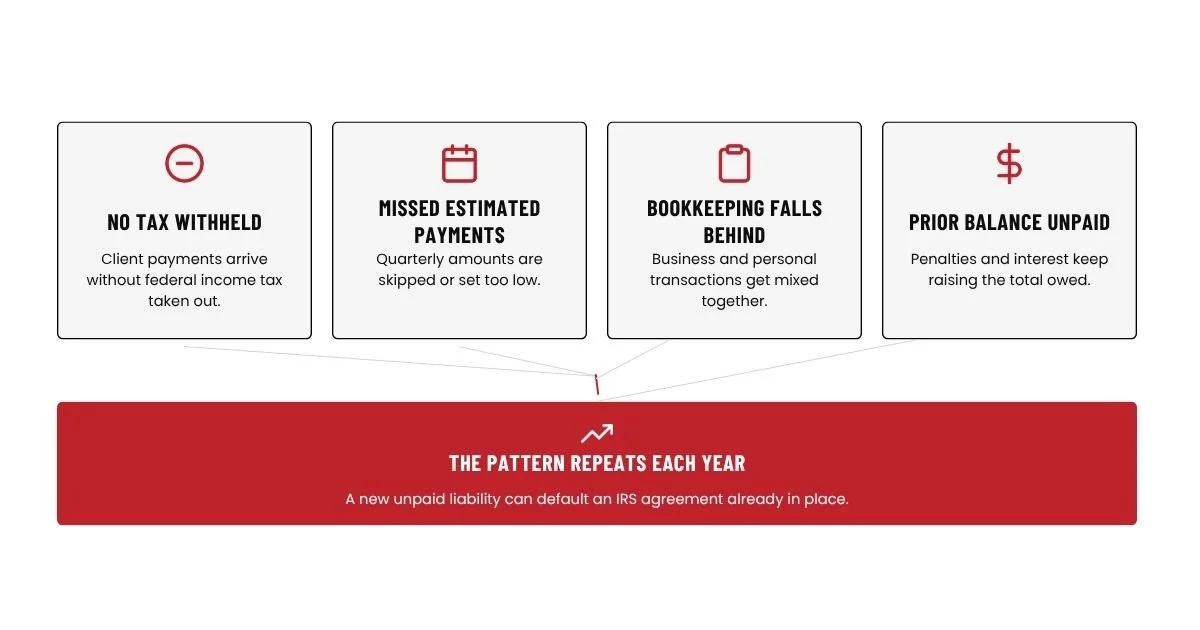
Self employed taxpayers usually receive payments without federal income tax withholding. They may need to make estimated tax payments during the year and pay both income tax and self employment tax when filing their annual return.
A tax problem can develop when:
Estimated tax payments are missed or too low
Business income increases without a corresponding increase in tax payments
The taxpayer uses current income to cover older business expenses
Bookkeeping falls behind
Business and personal transactions are mixed
Forms 1099 do not match the taxpayer’s records
Business expenses are not tracked
Several tax returns remain unfiled
A prior year balance remains unpaid
Penalties and interest increase the amount owed
A business experiences an unexpected decline in revenue
The taxpayer cannot afford both current taxes and older IRS debt
The problem can repeat each year unless the cause is corrected.
An IRS payment arrangement for an older balance may default if a new tax liability develops. That is why current compliance is part of nearly every long term resolution strategy.
Who Is Considered Self Employed?
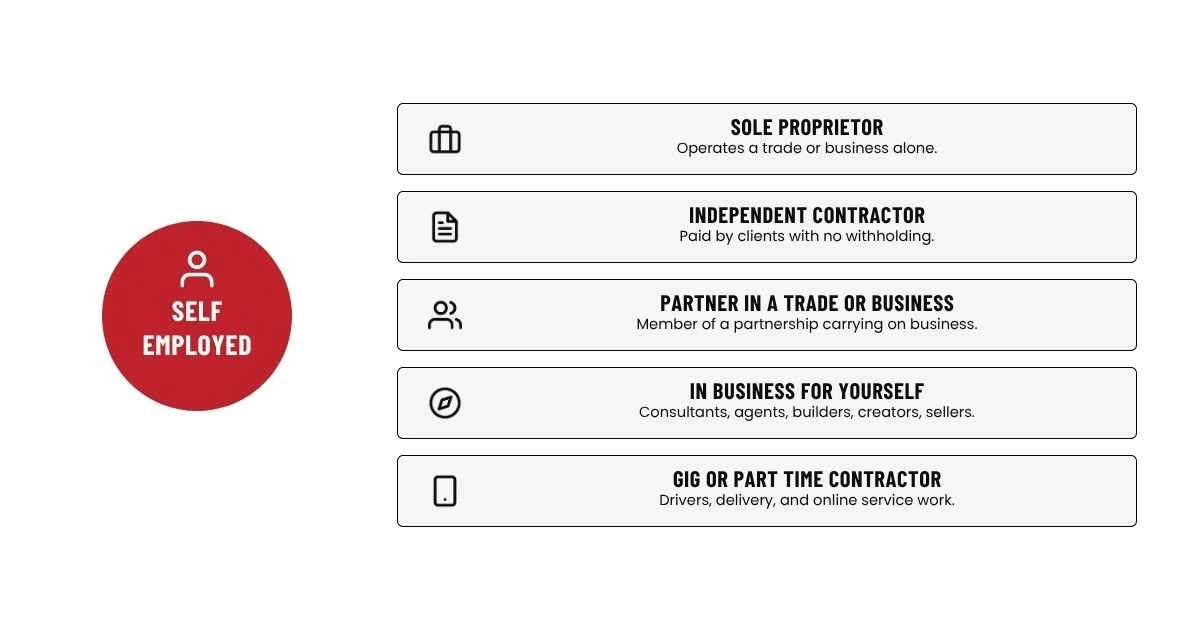
The IRS generally treats a person as self employed when that person:
Operates a trade or business as a sole proprietor
Works as an independent contractor
Is a member of a partnership that carries on a trade or business
Is otherwise in business for himself or herself
Earns income through part time or gig work as an independent contractor
Examples can include:
Consultants
Real estate agents
Mortgage professionals
Construction contractors
Designers
Content creators
Drivers and delivery workers
Online sellers
Personal service providers
Medical and legal professionals
Insurance agents
Sales representatives
Home service businesses
Freelancers
Owners of single member LLCs treated as disregarded entities
The tax reporting rules can differ for sole proprietors, partners, S corporation shareholders, and owners of other entities.
A person may call themselves self employed even when part of the tax debt belongs to a corporation, partnership, or LLC. The taxpayer and business accounts should be reviewed separately before selecting a resolution.
What Taxes Do Self Employed People Pay?
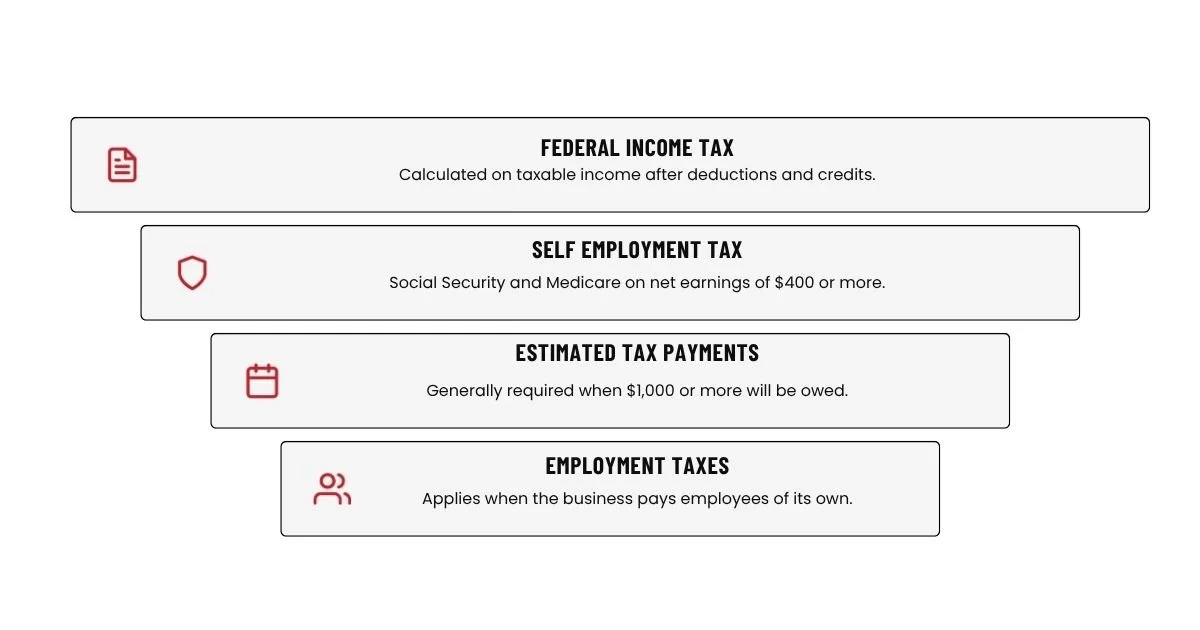
A self employed taxpayer may owe several different types of federal tax.
Federal Income Tax
Federal income tax is calculated based on taxable income after applying the rules for business income, other income, adjustments, deductions, and credits.
Self Employment Tax
Self employment tax generally covers Social Security and Medicare taxes on net earnings from self employment.
A sole proprietor generally reports business income and expenses on Schedule C. If total net earnings from self employment are $400 or more, Schedule SE is generally used to calculate self employment tax.
Estimated Tax Payments
Self employed individuals, sole proprietors, partners, and S corporation shareholders may need to make estimated tax payments when they expect to owe at least $1,000 after subtracting withholding and refundable credits.
The calculation also considers the taxpayer’s expected current year tax, prior year tax, income level, withholding, and other circumstances.
Estimated tax payments generally address both income tax and self employment tax. They are payments toward an expected annual liability, not separate quarterly tax returns.
Employment Taxes
Unpaid employment taxes can create risks for the business and certain responsible individuals. Payroll tax debt should be reviewed separately because trust fund taxes, federal tax deposits, and the Trust Fund Recovery Penalty may apply.
Common IRS Problems for Self Employed Taxpayers
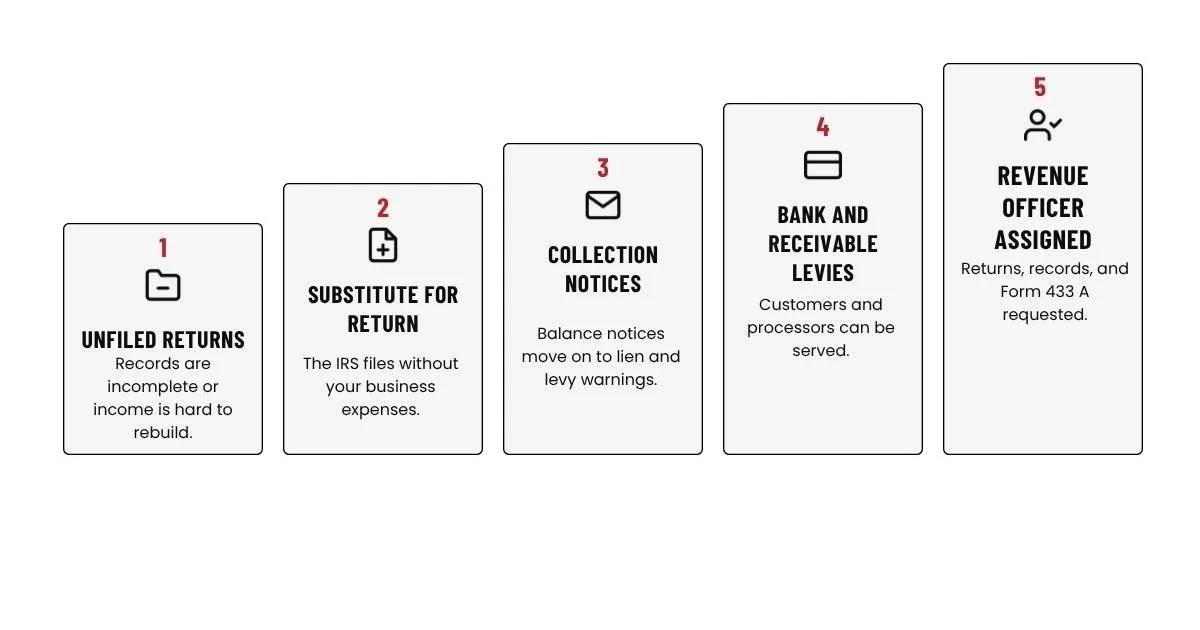
Years of Unfiled Tax Returns
Self employed taxpayers may fall behind because their records are incomplete, income is difficult to reconstruct, or they expect a tax balance they cannot pay.
The IRS may require delinquent returns before approving many collection alternatives.
The number of returns that must be filed depends on the filing requirement, IRS enforcement history, account status, potential refunds, and facts of the case. The commonly discussed six year filing practice is an administrative guideline, not a universal promise that older returns never need to be filed.
IRS Substitute for Return Assessment
When a required return is not filed, the IRS may prepare a Substitute for Return using income reported by third parties.
An IRS prepared return may not include all allowable business expenses, cost basis, deductions, credits, dependents, or the most favorable filing status.
A taxpayer may generally still file an accurate delinquent return. The IRS will review the return and may adjust the assessment to the correct figures.
Filing a return does not guarantee that the balance will decrease or that collection will automatically stop.
Unpaid Estimated Taxes
Missing estimated payments can leave a self employed taxpayer with a large balance when the annual return is filed.
The taxpayer may also owe an estimated tax penalty. Paying the entire annual balance by the return deadline does not necessarily remove a penalty caused by required estimated payments being made late during the year.
Schedule C Income and Expense Disputes
The IRS may question Schedule C income, expenses, mileage, home office costs, contract labor, equipment, advertising, insurance, and other deductions.
Business expenses must be supported and must satisfy the tax rules that apply to the expense.
A Form 1099 does not determine net taxable profit by itself. The taxpayer must still maintain records supporting the expenses used to calculate net profit.
IRS Collection Notices
An unpaid balance may lead to notices requesting payment and warning about possible collection action.
Depending on the notice history, the IRS may file a federal tax lien or levy property after satisfying applicable legal and procedural requirements.
Bank Levies and Accounts Receivable Levies
The IRS may levy a self employed taxpayer’s bank account or serve a levy on a customer, payment processor, or other person who owes money to the taxpayer.
A levy on a customer or accounts receivable can interfere with current business operations.
Requesting a payment arrangement does not automatically release a levy. The account, collection stage, financial condition, and levy procedures must be reviewed.
IRS Revenue Officer Assignment
A Revenue Officer may be assigned to a case involving a larger balance, repeated noncompliance, business activity, missing returns, or other collection concerns.
The Revenue Officer may request returns, bank records, business information, asset details, and Form 433-A.
Deadlines from a Revenue Officer should be taken seriously, but the taxpayer retains the right to representation and applicable appeal procedures.
What Must Happen Before Requesting Tax Relief?
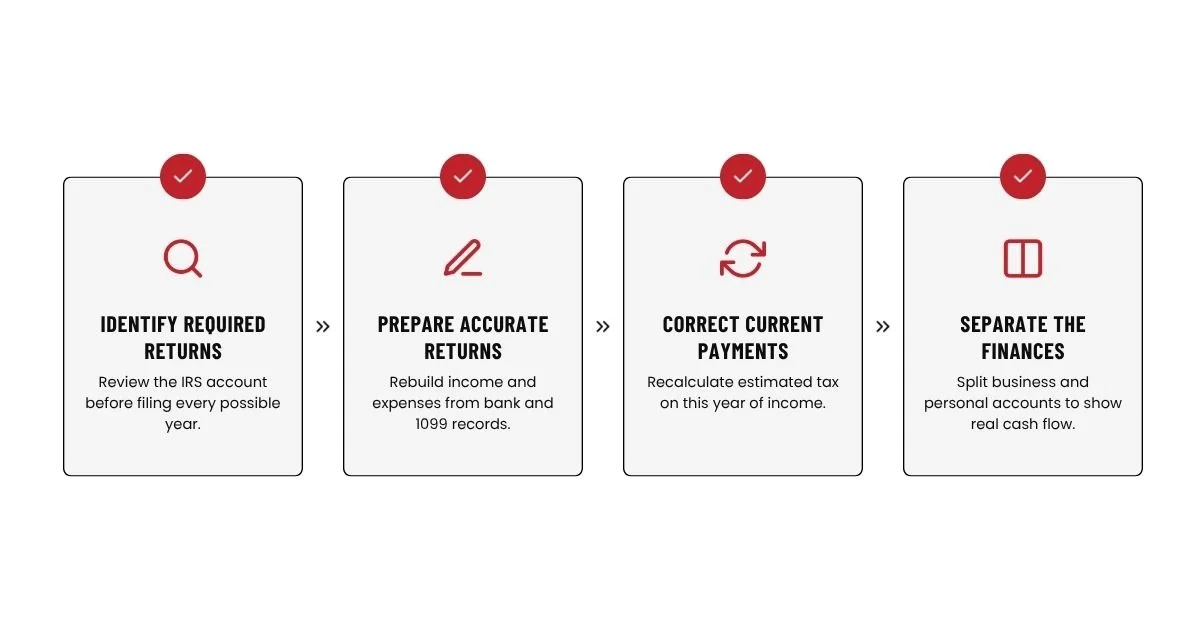
Most IRS tax debt resolutions begin with filing and current payment compliance.
Determine Which Returns Must Be Filed
The IRS account should be reviewed to identify:
Required returns that remain unfiled
Returns filed but not processed
Substitute for Return assessments
Years with potential refunds or credits
Years for which the IRS is actively requesting a return
Individual and business filing requirements
The taxpayer should not automatically file every possible year without reviewing the account. However, ignoring required returns can prevent the IRS from considering a resolution.
Prepare Accurate Tax Returns
Self employed returns should report income and qualifying business expenses based on available records.
When bookkeeping is incomplete, records may need to be reconstructed using:
Bank statements
Payment processor reports
Forms 1099
Customer records
Invoices
Receipts
Mileage logs
Credit card statements
Prior year returns
IRS Wage and Income Transcripts
Reconstruction must be reasonable and supported. Estimates without a factual basis should not be treated as documented business expenses.
Correct Current Estimated Tax Payments
A self employed taxpayer who is required to make estimated payments generally needs to become current before requesting many long term resolution options.
The payment amount should be calculated using current income and expected annual tax rather than automatically repeating an amount from an older year.
If the taxpayer or spouse also receives wages, increasing federal withholding may be an alternative or supplement to estimated payments.
Separate Business and Personal Finances
Separate accounts can make it easier to:
Track income
Document expenses
Prepare accurate returns
Calculate estimated taxes
Complete IRS financial statements
Demonstrate actual business cash flow
Separating accounts does not change tax liability by itself, but it can improve the quality of the records used in the resolution process.
How the IRS Evaluates a Self Employed Taxpayer’s Finances
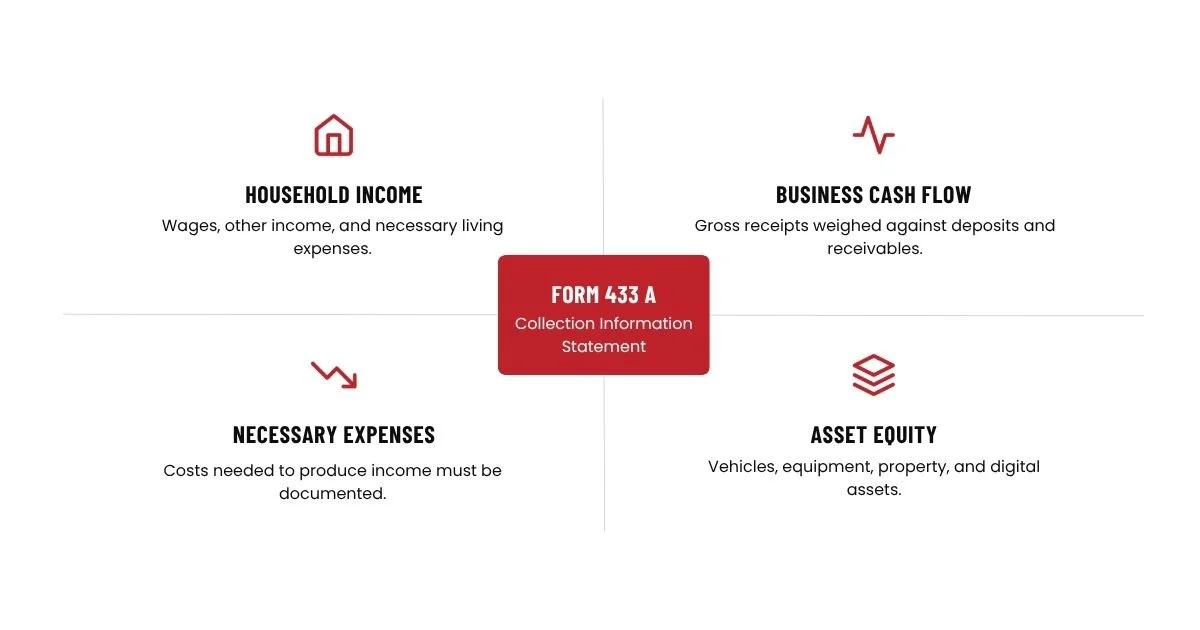
A self employed taxpayer may need to disclose both personal finances and business activity.
The current Form 433-A directs self employed individuals to complete sections concerning:
Personal information
Employment and other income
Bank and investment accounts
Digital assets
Real property
Vehicles and other assets
Credit and financing
Business ownership and operations
Business assets
Accounts receivable
Business income
Business expenses
Household expenses
The IRS may compare the financial statement with tax returns, bank statements, payment processor reports, public records, and other information.
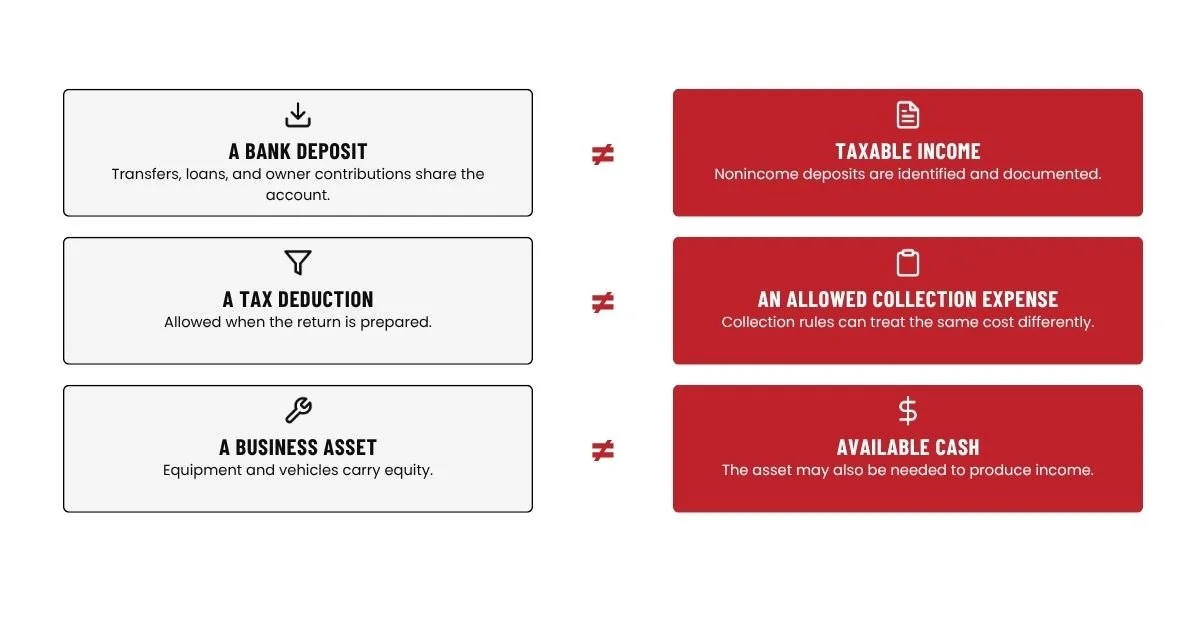
Business Income Is Not the Same as Gross Deposits
The IRS may review gross receipts, returns, bank deposits, and accounts receivable to understand the business’s income.
Transfers, loans, owner contributions, and other nonincome deposits should be identified and documented.
Business Expenses Must Be Necessary and Supported
The IRS may allow expenses needed to produce income, but it can question expenses that appear personal, excessive, undocumented, or unnecessary.
The tax deduction rules and IRS collection expense rules are not always identical. An expense deductible on a tax return is not automatically allowed in full when the IRS calculates collection ability.
Business Assets May Affect the Resolution
Equipment, vehicles, inventory, accounts receivable, real property, digital assets, and ownership interests can affect the IRS analysis.
An asset used in the business may still have equity considered by the IRS. However, the effect of forcing a sale on the taxpayer’s ability to produce income may also need to be addressed.
IRS Tax Relief Options for Self Employed Taxpayers
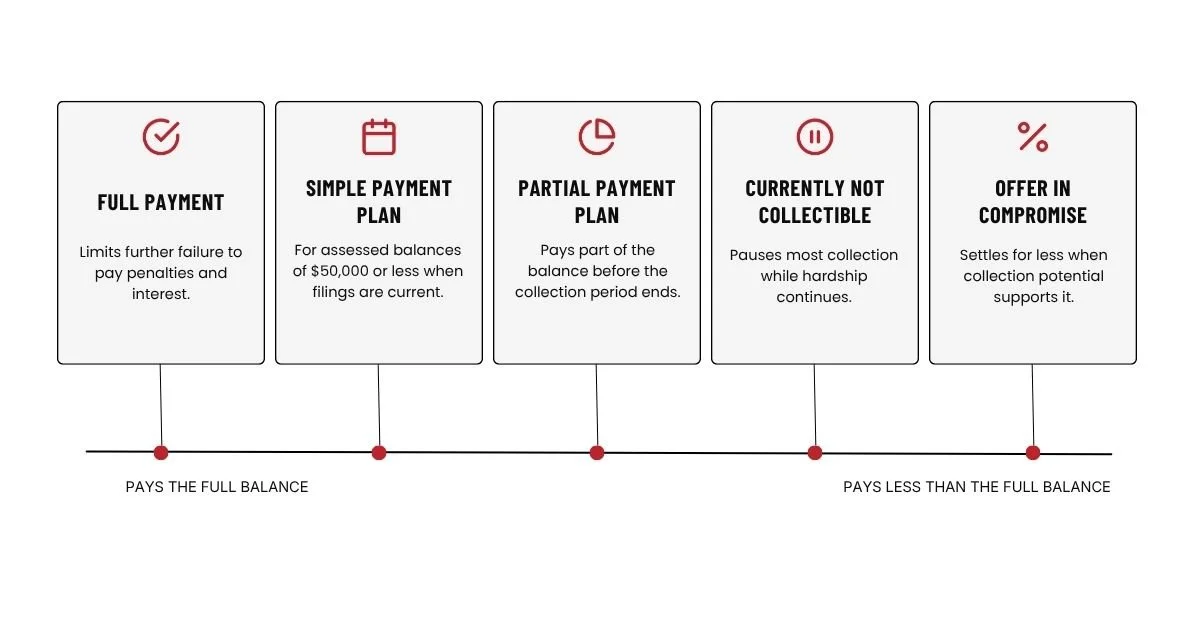
The appropriate option depends on the balance, filing compliance, current estimated payments, income, expenses, assets, collection period, and ability to pay.
Full Payment
Paying the verified balance in full generally limits additional failure to pay penalties and interest.
Before making a large payment, the taxpayer should confirm the balances, tax periods, assessments, payments, credits, and remaining collection period.
IRS Simple Payment Plan
A qualifying individual may be eligible for an IRS Simple Payment Plan when the assessed total balance of tax, penalties, and interest is $50,000 or less and filing and payment requirements are current.
The proposed payment must generally satisfy the liability before the applicable Collection Statute Expiration Date.
A Simple Payment Plan does not reduce the underlying tax. Penalties and interest may continue, and future compliance is required.
Financially Analyzed Installment Agreement
A taxpayer who does not qualify for a Simple Payment Plan may still qualify for another installment agreement.
The IRS may require Form 433-A, supporting documents, and a detailed review of personal and business finances.
The IRS may consider whether the taxpayer can:
Pay from available cash
Borrow against assets
Sell assets
Reduce expenses
Increase the proposed monthly payment
Pay the balance within the collection period
Approval and payment terms depend on the financial information and applicable procedures.
Partial Payment Installment Agreement
A Partial Payment Installment Agreement may be considered when the taxpayer cannot pay the entire liability before the collection period expires.
The IRS may periodically review the taxpayer’s financial condition and increase payments if the ability to pay improves.
Penalties and interest generally continue. The unpaid amount does not automatically expire if events suspend or extend the collection period.
Currently Not Collectible Status
The IRS may place an account in Currently Not Collectible status when payment would prevent the taxpayer from meeting necessary living expenses.
CNC status temporarily suspends most collection activity, but it does not eliminate the debt. Penalties and interest continue, tax refunds may be applied to the balance, and a federal tax lien may remain or be filed.
The IRS may later review the taxpayer’s ability to pay.
An Offer in Compromise may allow a qualifying taxpayer to settle an IRS liability for less than the full amount owed.
The IRS considers:
Ability to pay
Income
Personal and business expenses
Asset equity
Business value
Collection potential
Filing compliance
Current estimated payments
A self employed taxpayer generally uses Form 433-A OIC to disclose personal and business financial information.
An Offer in Compromise is not approved merely because the taxpayer owes a large balance, had a bad year, or wants a lower payment. The proposed offer generally must reflect what the IRS believes it can reasonably collect.
Filing an offer does not guarantee acceptance. It also suspends the IRS collection period while the offer and certain related appeal periods are pending.
Penalty Relief
Some penalties may qualify for removal or reduction through First Time Abatement, reasonable cause, a statutory exception, or correction of an IRS error.
Eligibility depends on the penalty, tax year, compliance history, and supporting facts.
Penalty relief does not generally remove the underlying income or self employment tax. Interest related to an abated penalty may be adjusted, but interest on the underlying tax generally remains.
Correcting an Incorrect Tax Assessment
If the balance is based on an incorrect return, Substitute for Return, audit adjustment, duplicated income, missing cost basis, or misapplied payment, correcting the assessment may be more appropriate than requesting a financial hardship program.
The correct procedure could involve:
Filing a delinquent return
Filing an amended return
Requesting Substitute for Return reconsideration
Requesting audit reconsideration
Responding to an IRS notice
Correcting an information return
Tracing a missing payment
Requesting an administrative appeal
The procedure depends on how the balance arose and which review rights remain available.
How Semper Tax Relief Can Help
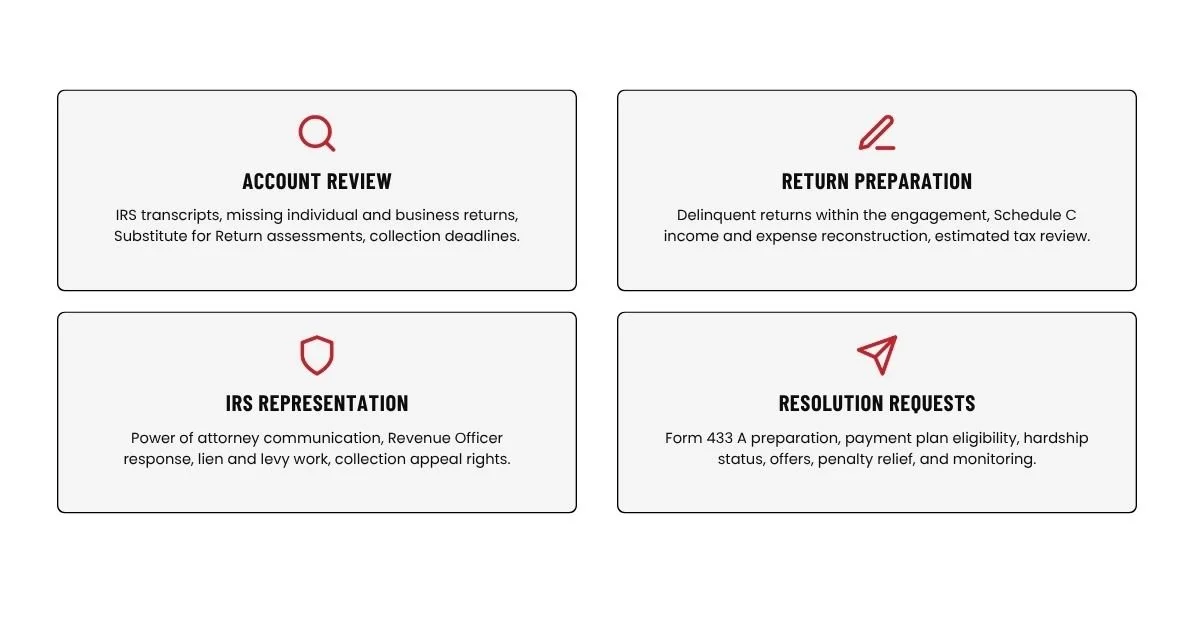
Semper Tax Relief can review the taxpayer’s IRS account, filing history, business activity, and collection status before recommending a strategy.
Our services may include:
Obtaining and reviewing IRS transcripts
Identifying missing individual and business tax returns
Reviewing Substitute for Return assessments
Preparing delinquent returns within the engagement
Reconstructing Schedule C income and expenses
Reviewing estimated tax compliance
Communicating with the IRS under a valid power of attorney
Responding to an IRS Revenue Officer
Preparing Form 433-A or another required financial statement
Organizing financial supporting documents
Reviewing payment plan eligibility
Evaluating Currently Not Collectible status
Evaluating an Offer in Compromise
Reviewing penalty relief
Addressing liens and levies
Evaluating collection appeal rights
Monitoring the IRS resolution request
The available services depend on the account, records, deadlines, and terms of the engagement.
Semper Tax Relief cannot guarantee that the IRS will reduce the debt, approve a payment arrangement, accept an offer, remove penalties, release a levy, or place an account in hardship status.
Our Self Employed Tax Debt Resolution Process
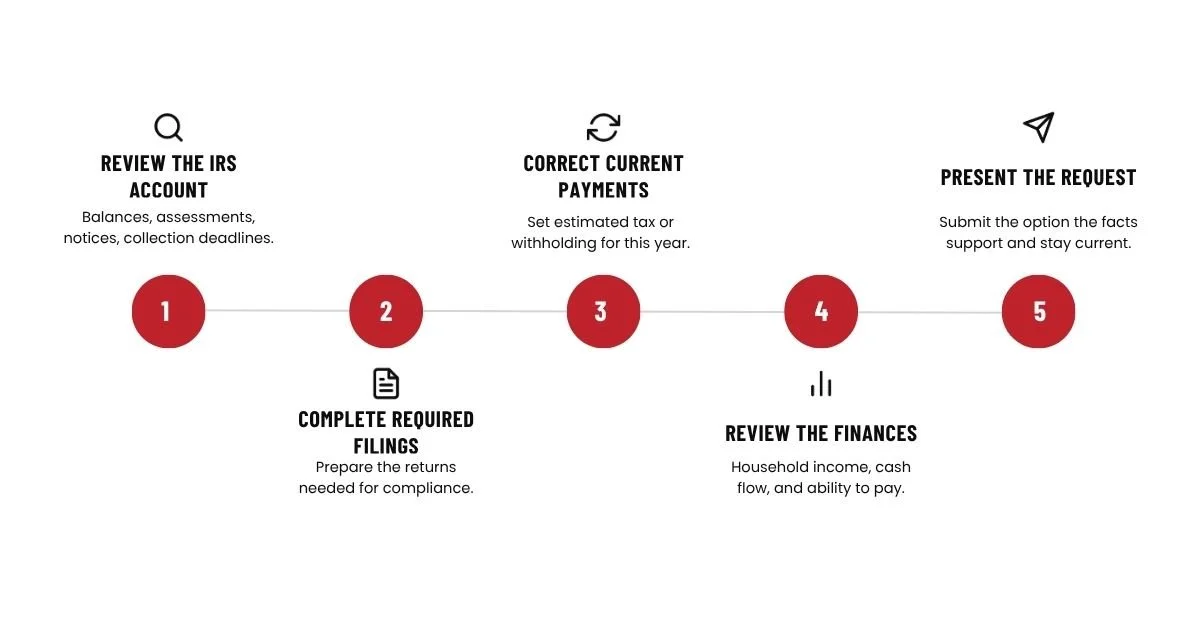
Step 1: Review the IRS Account
We identify balances, tax years, assessments, penalties, missing returns, Substitute for Return assessments, collection notices, and collection deadlines.
Step 2: Complete Required Tax Filings
We identify the returns required for compliance and prepare the agreed tax returns using the available records.
Step 3: Correct Current Estimated Tax Payments
We review current income and discuss the estimated tax payments or withholding needed to avoid another balance.
Step 4: Review Personal and Business Finances
We examine household income, necessary living expenses, business cash flow, business expenses, assets, debts, and ability to pay.
Step 5: Compare Available Resolution Options
We compare the options supported by the facts, which may include a payment plan, Partial Payment Installment Agreement, Currently Not Collectible status, Offer in Compromise, penalty relief, correction of an assessment, or another procedure.
Step 6: Present the Request to the IRS
When retained for representation, we prepare and submit the applicable request, communicate with the assigned IRS function, and provide supporting information within the engagement.
Step 7: Maintain Future Compliance
The taxpayer must continue filing returns and making required estimated tax payments or withholding payments.
A new unpaid liability can cause a pending or approved resolution to be returned, rejected, terminated, or defaulted.
Why Work With Semper Tax Relief?
Self employed tax debt requires an understanding of both the IRS collection process and the taxpayer’s business.
A monthly bank deposit does not always represent taxable income. A tax deduction is not always treated the same way during an IRS collection analysis. A business asset can have value while also being necessary to produce income.
Those distinctions matter.
I review the taxpayer’s IRS account, returns, business records, household finances, assets, and collection status before recommending a resolution.
Semper Tax Relief assists self employed taxpayers throughout the United States using secure document exchange, telephone appointments, electronic signatures, and IRS power of attorney procedures.
Our goal is to explain what the IRS is doing, address filing and current payment requirements, and present a realistic resolution request based on the taxpayer’s actual circumstances.
Frequently Asked Questions About Self Employed IRS Tax Relief
-
Yes, a self employed taxpayer may qualify for an installment agreement.
The available plan depends on the balance, filing compliance, current estimated payments, financial information, and ability to pay. Penalties and interest may continue during the agreement.
-
The IRS generally requires filing compliance before approving many resolution options. The exact years required should be determined from the account and applicable IRS filing requirements. The IRS administrative practice commonly associated with six years is not an unconditional rule for every taxpayer.
-
The IRS may levy a bank account or certain payments owed to a taxpayer after applicable legal and procedural requirements are satisfied. Whether a levy can be released depends on the facts, financial condition, collection status, and proposed resolution.
-
Business expenses must be substantiated. Other reliable records may sometimes help reconstruct an expense, but estimates without a reasonable factual basis may be rejected. The available records should be reviewed before preparing the return.
-
No. A single member LLC treated as a disregarded entity generally reports its business activity on the owner’s individual return. State law liability protection does not separate the owner from federal income and self employment tax reported personally.
Different rules can apply to corporations, partnerships, and employment tax liabilities.
-
Yes, if the taxpayer satisfies the applicable eligibility requirements and the financial facts support the offer. The IRS considers personal and business income, expenses, assets, equity, filing compliance, and current estimated payments. Acceptance is not guaranteed.
-
No. CNC status temporarily delays most collection activity when the taxpayer cannot pay because of financial hardship. The debt remains, penalties and interest continue, and the IRS may review the taxpayer’s finances later.
-
The taxpayer may need to improve bookkeeping, calculate estimated tax payments, increase wage withholding, separate business and personal accounts, reduce expenses, or set aside part of each customer payment for taxes.
The correct amount depends on current income and the taxpayer’s complete tax situation.
Request a Self Employed Tax Debt Review
If you are self employed and owe the IRS, the first step is to understand the account before selecting a resolution.
I can review your IRS balances, missing returns, Schedule C activity, estimated payments, collection notices, personal finances, business cash flow, and available records to help determine what options may be available.
A case review does not guarantee that the IRS will reduce the balance, accept a settlement, approve a payment plan, remove penalties, release a levy, or delay collection. It provides an opportunity to identify the tax problem and develop a strategy based on your actual financial circumstances.
Contact Semper Tax Relief to request a confidential Free Case Review.