

Need help with IRS Tax Problems?
IRS Tax Relief Solutions for Individuals and Businesses
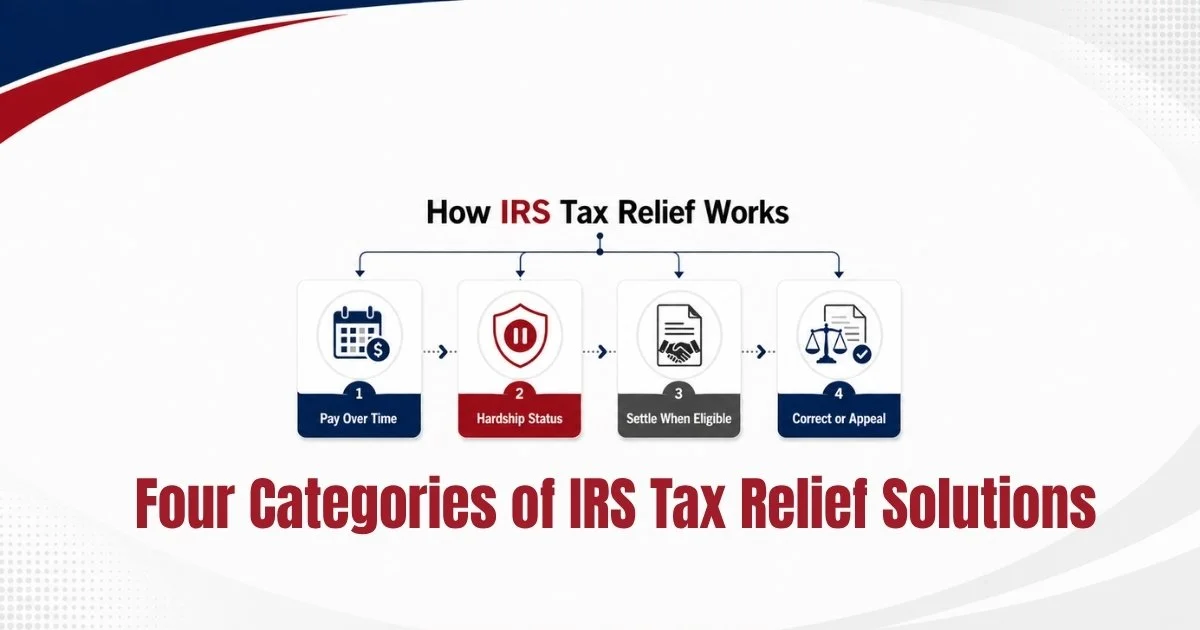
If you owe the IRS, have unfiled tax returns, received a levy notice, or believe the balance is wrong, there may be more than one way to address the problem. IRS tax relief is not one program. It is a group of payment options, hardship protections, settlement procedures, appeals, and methods for correcting an inaccurate assessment.
How IRS Tax Relief Works
The IRS does not approve relief based only on how much you owe. The agency may review whether all required returns have been filed, whether current taxes are being paid, how much disposable income is available, what assets could be used to pay the debt, and how much time remains in the collection period. Some cases are resolved with a monthly payment. Others may qualify for temporary hardship status, a settlement, penalty relief, or an appeal. If the assessed balance is wrong, the first step may be correcting the liability rather than negotiating how to pay it. No firm can responsibly select the right option based on the balance alone. The recommendation should come only after a review of account transcripts, financial information, deadlines, and the taxpayer's goals.

I am Sergio Melendez, JD, EA. My team and I review the tax years involved, filing compliance, income, necessary living expenses, assets, collection deadlines, and the notices the IRS has issued. We use those facts to identify which options are realistic and which ones are not. A good tax relief strategy should answer three questions: Is the balance correct? What can the IRS legally collect? Which available resolution fits your financial situation and long-term goals?
IRS Tax Debt Resolution Options
These are the principal collection alternatives for taxpayers who agree that a balance is owed but cannot pay it immediately.
Offer in Compromise
An offer in compromise may allow an eligible taxpayer to settle an IRS liability for an agreed amount. The IRS generally evaluates ability to pay, income, expenses, and asset equity. Filing compliance, current payment compliance, complete financial disclosure, and accurate calculations are essential. An offer is not appropriate for every taxpayer.
IRS Installment Agreement
An installment agreement allows an approved taxpayer to pay an IRS balance over time. The available terms depend on the amount owed, the type of tax, collection deadlines, and the taxpayer's compliance history. Some agreements use streamlined criteria. Others require financial disclosure and negotiation.
Currently Not Collectible Status
The IRS may report an account as currently not collectible when payment would prevent the taxpayer from meeting necessary living expenses. Collection activity is generally paused, but the balance remains due, interest and penalties may continue, refunds may be applied to the debt, and the IRS may review the taxpayer's finances later.
Partial Payment Installment Agreement
A partial payment installment agreement may permit monthly payments that are lower than the amount needed to pay the balance in full before the collection period ends. Financial disclosure is generally required, and the IRS may review the agreement periodically. The result depends on the collection statute and any events that suspend it.
Solutions for IRS Collection Action
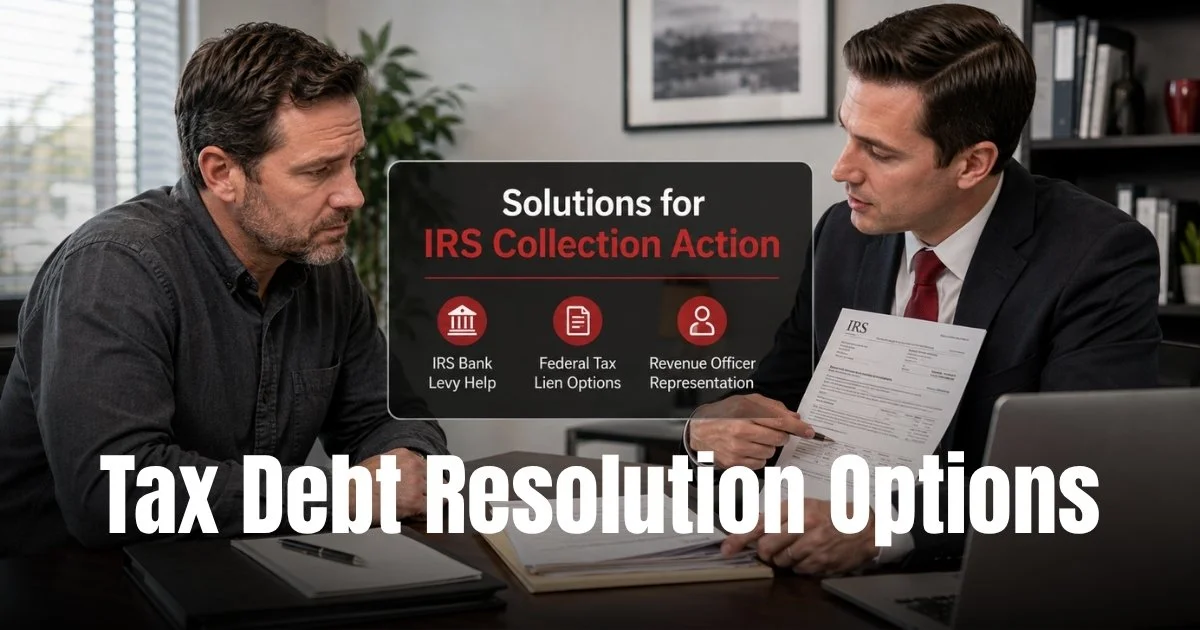
Collection notices and levies require attention to deadlines, procedural rights, current compliance, and the resolution that will address the underlying balance.
IRS Wage Levy Help
An IRS wage levy is generally continuous. The amount exempt from levy is determined by IRS exemption tables and the information provided to the employer. A case review should address both the active levy and the unresolved tax periods so the collection problem does not simply return.
IRS Bank Levy Help
A bank generally holds funds subject to an IRS levy for 21 days before sending them to the IRS. That period creates a limited opportunity to review ownership, procedural issues, economic hardship, and available collection alternatives. A release is not automatic, so early action matters.
Federal Tax Lien Options
A Notice of Federal Tax Lien alerts creditors that the government claims an interest in a taxpayer's property and rights to property. Depending on the facts, options may include withdrawal, discharge, subordination, appeal, or resolution of the underlying liability
IRS Revenue Officer Representation
A Revenue Officer handles certain collection cases that need direct attention. Representation may include confirming filing compliance, responding to information requests, preparing financial statements, addressing deadlines, and proposing an appropriate resolution.
Ways to Correct or Challenge an IRS Balance

If the assessed amount is inaccurate, the correct strategy may involve a response, reconsideration, amended return, identity theft claim, innocent spouse request, or appeal.
CP2000 Response and Reconsideration
A CP2000 generally proposes changes after IRS information matching identifies a discrepancy. It is a proposal, not a final bill. A response may explain the difference, correct the reported income, and claim related basis or expenses when supported.
Audit Defense and Audit Reconsideration
Audit representation helps organize records, explain disputed items, and protect procedural rights. If an audit closed before information that could change the result was considered, audit reconsideration may be available in qualifying cases.
Innocent Spouse Relief
A spouse or former spouse may request relief from joint liability under federal law. The IRS may consider innocent spouse relief, separation of liability, or equitable relief based on the return, relationship history, knowledge, economic hardship, and other facts.
Penalty Abatement
Penalty relief may be available through first-time abatement, reasonable cause, statutory exceptions, or correction of an IRS error. Eligibility varies by penalty and tax period. Removing a penalty does not automatically remove the underlying tax or related interest.
Business Tax Relief Solutions
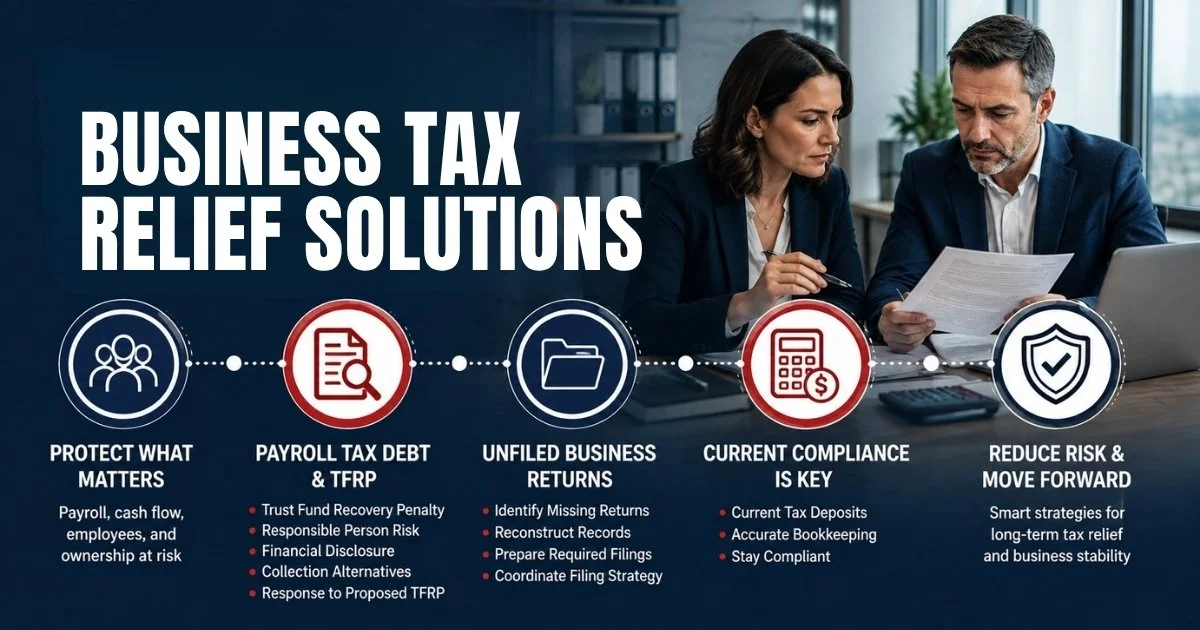
Business tax problems can place payroll, cash flow, employees, and ownership at risk. The strategy should address missing returns, current federal tax deposits, accurate bookkeeping, collection demands, and any potential personal assessment against responsible individuals.
Payroll Tax Debt and Trust Fund Recovery Penalty
When payroll taxes are unpaid, the IRS may pursue the business and investigate whether responsible individuals willfully failed to collect, account for, or pay the trust fund taxes. Representation may include establishing current compliance, preparing financial disclosure, proposing collection alternatives, and responding to the proposed Trust Fund Recovery Penalty.
Unfiled Business Tax Returns
A business generally needs to file required returns before the IRS will approve a long term-collection resolution. We can identify missing returns, reconstruct records, prepare required filings, and coordinate the filing work with the collection strategy.

Get a Confidential Tax Relief Case Review
You do not need to guess which IRS program applies to you. Start with a confidential review of the notices, tax years, filing history, and collection status. We will explain the realistic next steps and the information needed to evaluate your case.
IRS Tax Resolution Frequently Asked Questions
-
There is no single best program. The right option depends on whether the balance is accurate, filing compliance, income, expenses, assets, tax type, collection deadlines, and the taxpayer's goals.
-
Sometimes. An offer in compromise or a partial payment installment agreement may result in less than full payment in qualifying cases. Eligibility and the final outcome depend on IRS rules and the taxpayer's verified facts.
-
Not in every situation. Certain timely appeals and pending collection alternatives can limit collection activity, but the effect depends on the procedure, timing, tax period, and any exceptions. Immediate review is important when a levy is threatened or active.
-
The IRS generally requires filing compliance before approving most long term collection alternatives. The required filing years depend on the account and IRS procedures, so the filing history should be reviewed before returns are prepared.
-
Interest and applicable penalties generally continue to accrue until the balance is paid or otherwise resolved. An approved agreement can organize repayment, but it does not freeze the account balance.
-
Penalty relief may be available under first time abatement, reasonable cause, statutory exceptions, or correction of an IRS error. The rules differ by penalty, and supporting facts may be required.
-
The IRS generally has ten years from assessment to collect, but several events can suspend or extend that period. Each tax period can have a different collection statute expiration date.
-
An authorized representative can communicate with the IRS within the scope of a valid power of attorney. Representation before the IRS is limited to eligible practitioners and the matters listed on the authorization.