

IRS Tax Debt After a Taxpayer Dies
Semper Tax Relief helps individuals, families, and small business owners resolve IRS tax debt, unfiled tax returns, audits, levies, liens, and state tax problems
Do I qualify for tax relief? Find out with a free case review.
Call today: 24 Hours / 7 Days a Week or book online.
✔ Confidential ✔ No Pressure ✔ Personalized
IRS tax debt does not automatically disappear when a taxpayer dies.
The personal representative may need to identify unpaid balances, file the deceased taxpayer’s final income tax return, file missing prior returns, determine whether an estate income tax return is required, and address valid federal tax claims before distributing estate assets.
However, a child, relative, or beneficiary does not automatically become personally responsible for the deceased person’s IRS debt merely because they inherited property or were named in a will.
Responsibility depends on several factors, including:
• Whether the deceased taxpayer filed individual or joint returns
• Whether a surviving spouse is jointly liable
• Whether an estate was opened
• Which assets became part of the estate
• Whether a federal tax lien existed
• Whether assets passed outside probate
• Whether estate property was distributed before federal tax claims were addressed
• Whether the personal representative knew or should have known about the federal tax liability
• Whether the recipient may have transferee or other liability
Semper Tax Relief helps executors, administrators, surviving spouses, trustees, and family members review a deceased taxpayer’s IRS account and determine what filing, payment, collection, or relief procedures may apply.
I am Sergio Melendez, JD EA. I have worked in the tax profession since 2005 and represent taxpayers and authorized fiduciaries before the IRS in tax debt, unfiled return, collection, audit, and tax resolution matters.
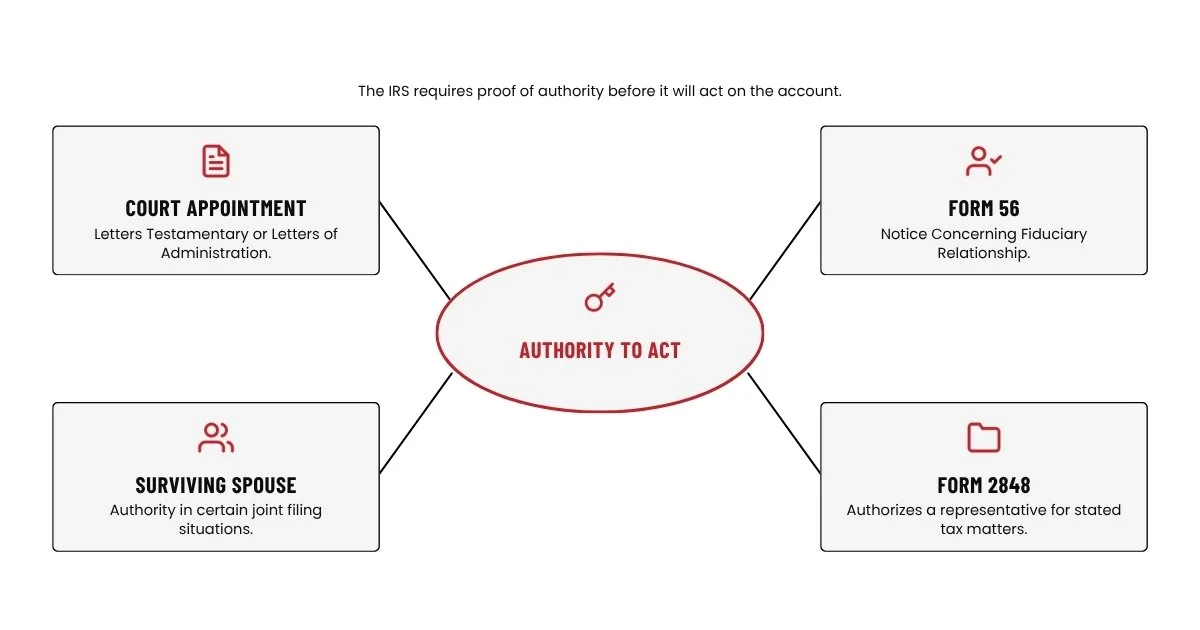
The first step is to identify who has legal authority to act and separate the deceased taxpayer’s obligations from the estate’s obligations and any surviving spouse’s liability.
Does IRS Tax Debt Go Away When Someone Dies?
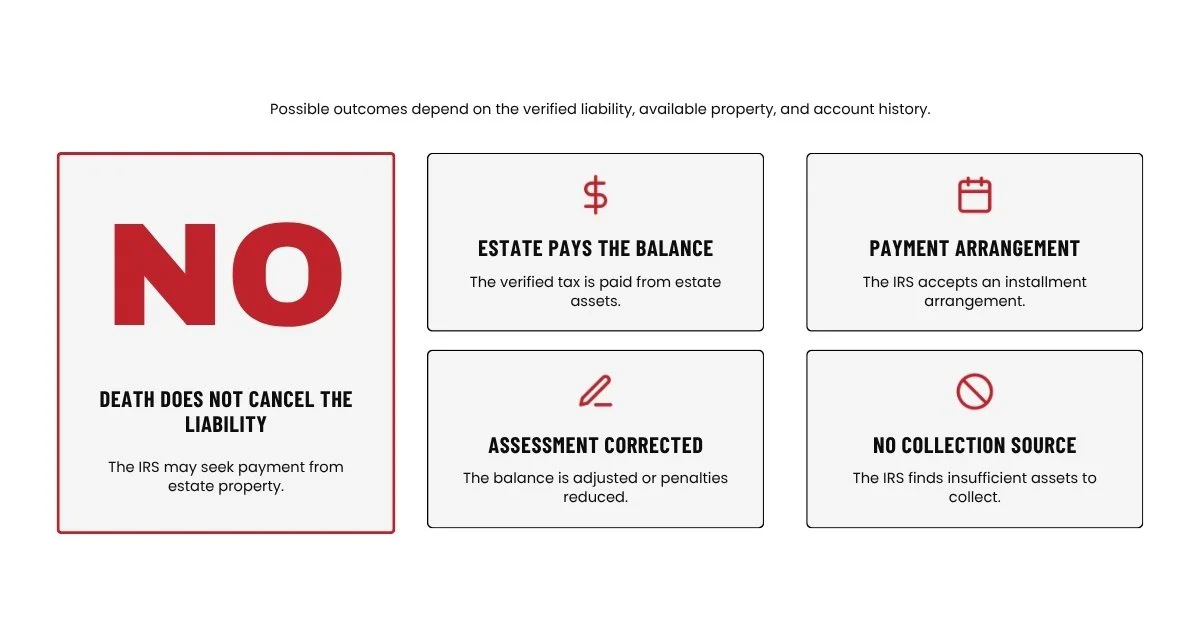
No. Death does not automatically cancel a valid federal tax liability.
The IRS may seek payment from property belonging to the deceased taxpayer or the estate, subject to applicable collection, lien, probate, and priority rules.
The available assets and legal responsibility should be reviewed before anyone makes a payment or distributes property.
Possible outcomes can include:
• The estate pays the verified tax balance
• The IRS accepts an installment arrangement
• An assessment is corrected
• Penalties are reduced when a valid basis exists
• A qualifying settlement request is considered
• The IRS determines that there are insufficient assets for further collection
• A surviving spouse requests relief from qualifying joint liability
• The IRS pursues estate property, liened property, a fiduciary, or a transferee when legally permitted
None of these outcomes is automatic. The correct result depends on the liability, account history, available property, prior transfers, and applicable law.
Who Can Act for a Deceased Taxpayer?
IRS audit reconsideration allows a taxpayer to ask the IRS to reevaluate an audit assessment after the original examination has closed.
It is not a new audit requested simply because the taxpayer disagrees with the result.
The request should identify:
• The tax year or period involved
• The specific audit adjustments being disputed
• Why the adjustment is believed to be incorrect
• What information the IRS did not previously consider
• Which documents support the taxpayer’s position
• What correction the taxpayer is requesting
The IRS generally focuses on new or previously unconsidered information. Sending the same documents and explanation reviewed during the original examination may not provide a basis for reconsideration.
Tax Returns That May Be Required After Death
Several different tax returns may need to be considered.

Final Individual Income Tax Return
The deceased taxpayer’s final individual income tax return is generally prepared using Form 1040 or Form 1040 SR.
The final return generally reports income received or constructively received from the beginning of the year through the date of death.
The return is generally due at the same time it would have been due if the taxpayer had remained alive. An extension may be available under the ordinary filing rules.
The person signing the return depends on whether a personal representative has been appointed and whether a surviving spouse is filing jointly.
Prior Unfiled Individual Returns
If the deceased taxpayer failed to file required returns for earlier years, the personal representative may need to prepare and file those returns.
The required years should be identified by reviewing:
• IRS filing records
• Wage and Income Transcripts
• Prior returns
• Available income documents
• Business records
• The estate’s records
• IRS notices and assessments
The personal representative should not assume that death eliminates an outstanding filing requirement.
Estate Income Tax Return
A deceased taxpayer’s estate is a separate taxable entity.
Form 1041 may be required to report income received by the estate after death, deductions, gains, losses, distributions to beneficiaries, and the estate’s income tax liability.
Income reported on the final Form 1040 and income reported by the estate must be separated based on when the income was received, the taxpayer’s accounting method, and the character of the income.
Federal Estate Tax Return
Form 706 is different from the deceased taxpayer’s final Form 1040 and the estate’s Form 1041.
Form 706 addresses federal estate tax and related reporting. It is required only when the applicable filing rules are met or when another permitted election makes filing appropriate.
This service page focuses primarily on unresolved federal income tax, filing, and collection matters. A federal estate tax return may require separate estate tax analysis.
Unfiled Returns and IRS Substitute for Return Assessments

A deceased taxpayer may have missing returns or IRS prepared Substitute for Return assessments.
The IRS may have calculated tax using Forms W 2, Forms 1099, investment sales, retirement distributions, and other information reported by third parties.
An IRS prepared return may not include every deduction, credit, business expense, filing status, or cost basis adjustment supported by the facts.
The fiduciary may be able to file an accurate delinquent return and ask the IRS to adjust the assessment.
Filing a return does not guarantee that the tax will decrease. The completed return may reduce the balance, leave it substantially unchanged, or show additional tax.
If a Notice of Deficiency or another time sensitive notice was issued, the procedural deadline should be reviewed separately. Preparing a delinquent return does not automatically extend a court or appeal deadline.
Is a Surviving Spouse Responsible for the IRS Debt?
A surviving spouse is not automatically responsible for every separate tax debt owed by the deceased spouse. Responsibility depends on how the returns were filed and whether another basis for liability exists.

Joint Tax Returns
Spouses who file a joint federal income tax return are generally jointly and individually responsible for the tax, penalties, and interest associated with that return.
The IRS may seek payment from the surviving spouse even when the income or tax problem primarily involved the deceased spouse.
H3: Separate Tax Returns
A surviving spouse is generally not personally liable merely because the deceased spouse owed tax on a separately filed return.
However, jointly owned property, community property, federal tax liens, estate distributions, and state law can affect the analysis.
Innocent Spouse Relief
A surviving spouse may qualify to request relief from joint liability under one of the applicable innocent spouse provisions.
Depending on the facts, this may include:
• Separation of liability
• Equitable relief
The IRS considers the type of understatement or underpayment, knowledge, marital history, economic circumstances, significant benefit, compliance, and other factors.
Relief is not automatic and filing deadlines may apply.
Is an Heir or Beneficiary Personally Responsible?
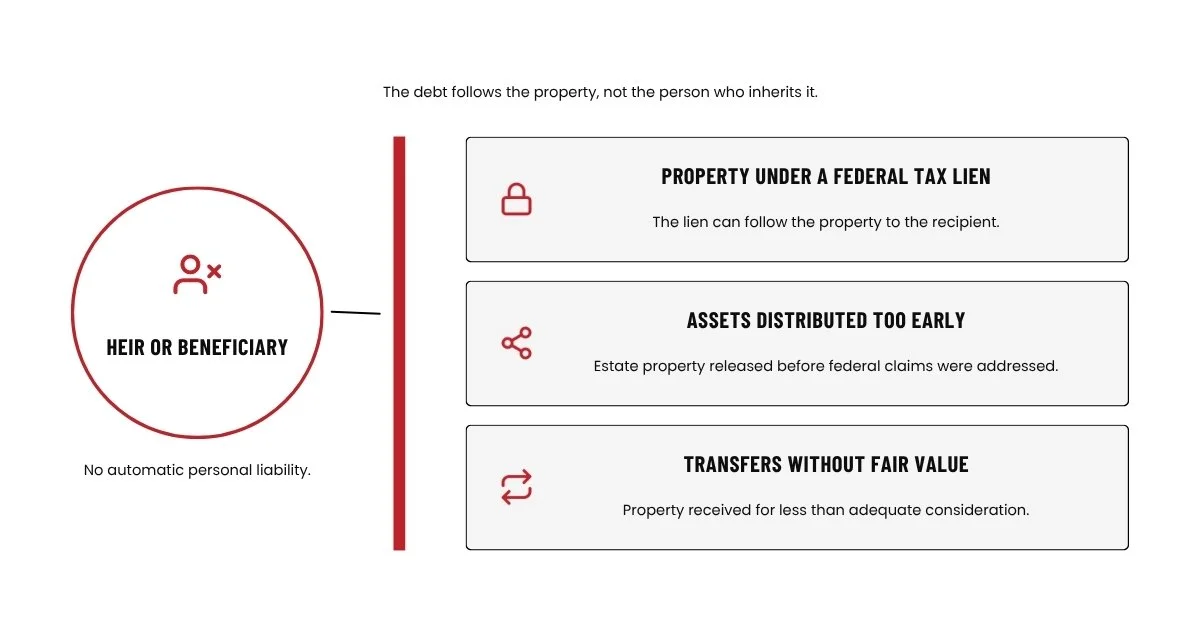
An heir or beneficiary does not automatically inherit personal responsibility for the deceased taxpayer’s IRS debt.
However, inherited property and estate distributions can be affected by a valid federal tax claim.
Potential concerns include:
• Property subject to a federal tax lien
• Estate assets distributed before federal claims were addressed
• Transfers made while the taxpayer was alive
• Property received without adequate consideration
• Transferee liability
• Fiduciary liability
• State probate and creditor rules
The IRS may pursue property or recipients when a legal basis exists. The recipient’s exposure can depend on the value of property received and the applicable liability theory.
A beneficiary should not assume that receiving property makes them personally liable for the entire tax balance. They also should not assume that inherited property is free from an existing federal tax lien.
Federal Tax Liens and Property After Death

A federal tax lien generally attaches to a taxpayer’s property and rights to property after assessment, notice and demand, and failure to pay.
Death does not automatically release an existing federal tax lien.
A lien can affect:
• Real estate
• Financial accounts
• Business interests
• Personal property
• Property sales
• Refinancing
• Distributions from an estate
• Certain property passing to another person
The effect of the lien depends on ownership, state property law, timing, lien filing, transfers, and other creditor interests.
Possible lien procedures may include:
• Paying the secured balance
• Requesting a payoff
• Requesting a discharge of specific property
• Requesting subordination
• Requesting withdrawal when the requirements are met
• Disputing whether the lien attaches to particular property
A lien discharge removes specified property from the effect of the lien when the IRS approves the request. It does not necessarily remove the tax liability or release the lien from other property.
Personal Liability Risks for an Executor or Fiduciary

An executor is not automatically personally responsible for every tax debt owed by the deceased taxpayer.
However, a fiduciary can create personal exposure by distributing or paying estate assets without properly addressing debts owed to the United States.
When an estate is insolvent, federal law generally gives qualifying debts owed to the United States priority over many other claims.
A personal representative may face liability when:
• The estate was insolvent or became insolvent through distributions
• The fiduciary knew about the federal tax debt
• The fiduciary should have known about the debt after reasonable inquiry
• Estate property was distributed or lower priority debts were paid first
• The payment deprived the United States of funds otherwise available for the tax debt
Potential liability is generally connected to the amount improperly distributed or paid rather than automatically equaling every dollar the deceased taxpayer owed.
Priority questions can be technical. Certain claims and administrative expenses may have different treatment. The executor should coordinate federal tax analysis with qualified probate or estate counsel before distributing an estate that may be insolvent.
Requesting IRS Records for a Deceased Taxpayer

An executor, administrator, or personal representative may need IRS records before determining what must be filed or paid.
Records may include:
• Tax return transcripts
• Account transcripts
• Wage and Income Transcripts
• Copies of filed returns
• Balance payoff information
• Collection notices
• Assessment dates
• Collection expiration information
The IRS generally requires proof of death and proof that the requesting person has authority to manage the deceased taxpayer’s affairs.
Depending on the request, this may include:
• The deceased taxpayer’s name
• Last known address
• Social Security number
• A copy of the death certificate
• Court appointment documents
• Form 56
The requirements can differ depending on whether the person requests a transcript, return copy, payoff, or other protected tax information.
Forms That May Help an Executor Complete the Estate

Form 4810 Request for Prompt Assessment
The IRS ordinarily has a statutory period to assess additional income tax after a return is filed.
A qualifying personal representative may use Form 4810 to request prompt assessment of certain taxes owed by the deceased taxpayer or estate.
A valid prompt assessment request generally reduces the assessment period to 18 months from the date the IRS receives the request.
Form 4810 does not apply to the federal estate tax return and does not automatically eliminate an existing tax balance.
The request must be properly submitted separately from other documents.
Form 5495 Request for Discharge From Personal Liability
A qualifying executor may use Form 5495 to request discharge from personal liability for certain income, gift, and estate taxes.
The request is generally made after the applicable returns have been filed.
The IRS generally has nine months after receiving the request to notify the executor of the amount due. If the amount identified is paid, or if the IRS does not respond within the applicable period, the executor may receive the discharge provided by law.
This discharge has limitations. The IRS may still pursue estate property remaining in the executor’s possession or control.
Form 5495 should not be treated as a substitute for identifying and paying known federal tax liabilities before distributing property.
Options for Addressing a Deceased Taxpayer’s IRS Debt
The available option depends on the verified liability, estate assets, surviving liable parties, federal tax liens, collection period, and authority of the fiduciary.
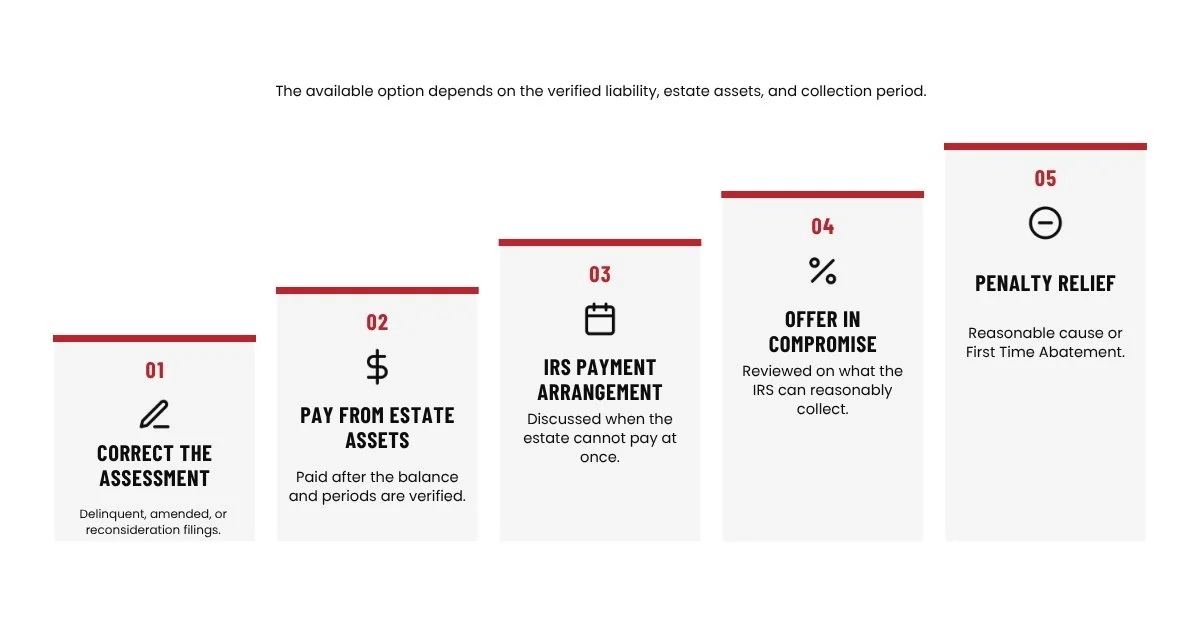
Correct an Inaccurate Assessment
If the balance is incorrect, the appropriate response may involve:
• Filing an original delinquent return
• Correcting an IRS Substitute for Return
• Filing an amended return
• Requesting audit reconsideration
• Correcting cost basis
• Tracing missing payments
• Addressing identity theft
• Requesting innocent spouse relief
• Filing an administrative appeal
The correct procedure depends on how the tax was assessed and which review rights remain.
Pay the Verified Balance From Estate Assets
The personal representative may pay a valid tax balance from available estate assets, subject to probate administration, federal priority, secured claims, and other applicable law.
Before payment, the representative should verify the tax periods, assessments, payments, credits, penalties, interest, and payoff amount.
IRS Payment Arrangement
A fiduciary may discuss payment options with the IRS when the estate cannot immediately pay the verified balance.
Availability depends on the remaining estate assets, expected property sales, administration period, tax type, collection period, and authority of the fiduciary.
An installment arrangement does not reduce the underlying tax. Penalties and interest may continue.
Offer in Compromise
An Offer in Compromise may be considered in some deceased taxpayer or estate situations.
The IRS will examine the liability, estate assets, property transferred to others, collection rights, equity, and amount it can reasonably collect.
A lack of cash does not by itself establish eligibility when the estate holds property or the IRS has rights against transferees, fiduciaries, surviving liable parties, or liened assets.
The fiduciary must have authority to submit and bind the estate to an offer. Acceptance is not guaranteed.
Penalty Relief
Penalty relief may be available based on:
• Reasonable cause
• First Time Abatement when applicable
• A statutory exception
• An IRS error
• Another recognized basis
Death or illness may be relevant, but relief depends on timing, facts, compliance history, responsibility for filing, and steps taken after the event.
Penalty relief does not generally remove the underlying tax.
Collection Determination When the Estate Has No Assets
When the estate has no assets and no responsible surviving party or other collection source exists, the IRS may determine that further collection is not currently productive.
That determination does not automatically cancel the assessment. The IRS may review later discovered property, transfers, liens, or other sources of collection within the legal collection period.
Tax Debt Involving a Deceased Business Owner
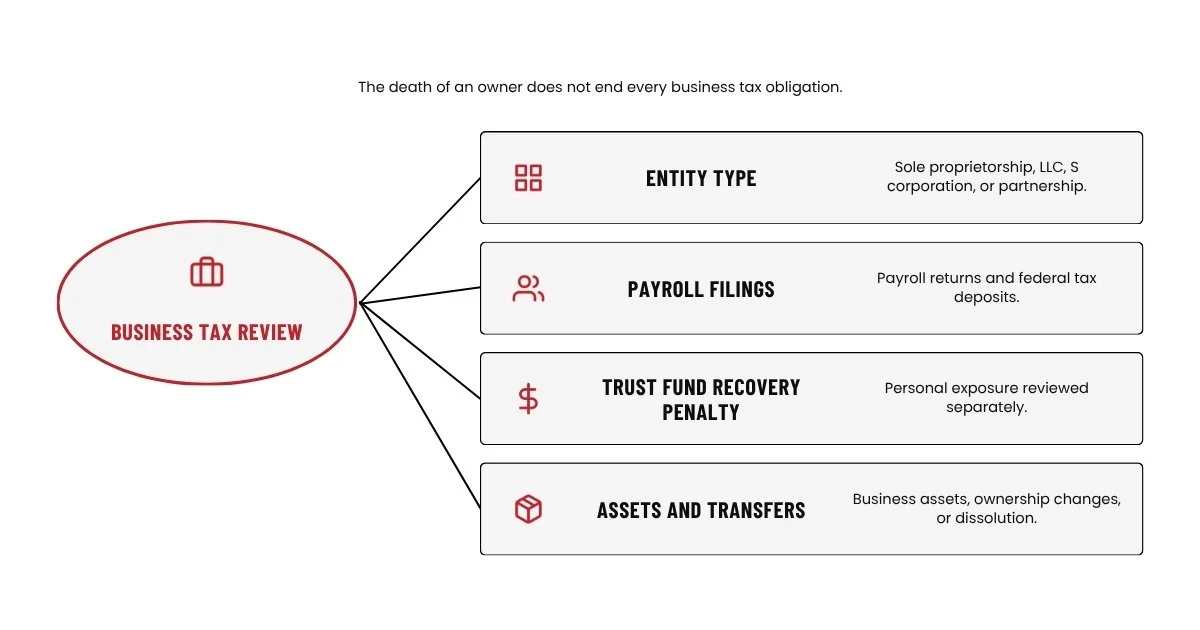
A deceased taxpayer may have operated:
• A sole proprietorship
• A single member LLC
• An S corporation
• A C corporation
• A partnership
• A business with employees
The death of the owner does not automatically terminate every business tax obligation.
The fiduciary may need to review:
• Final Schedule C activity
• Business income received before and after death
• Payroll tax returns
• Federal tax deposits
• Information returns
• Entity income tax returns
• Business assets
• Ownership transfers
• Trust Fund Recovery Penalty exposure
• Dissolution or continued operation
The taxpayer’s personal liability and the entity’s liability should be reviewed separately.
How Semper Tax Relief Can Help
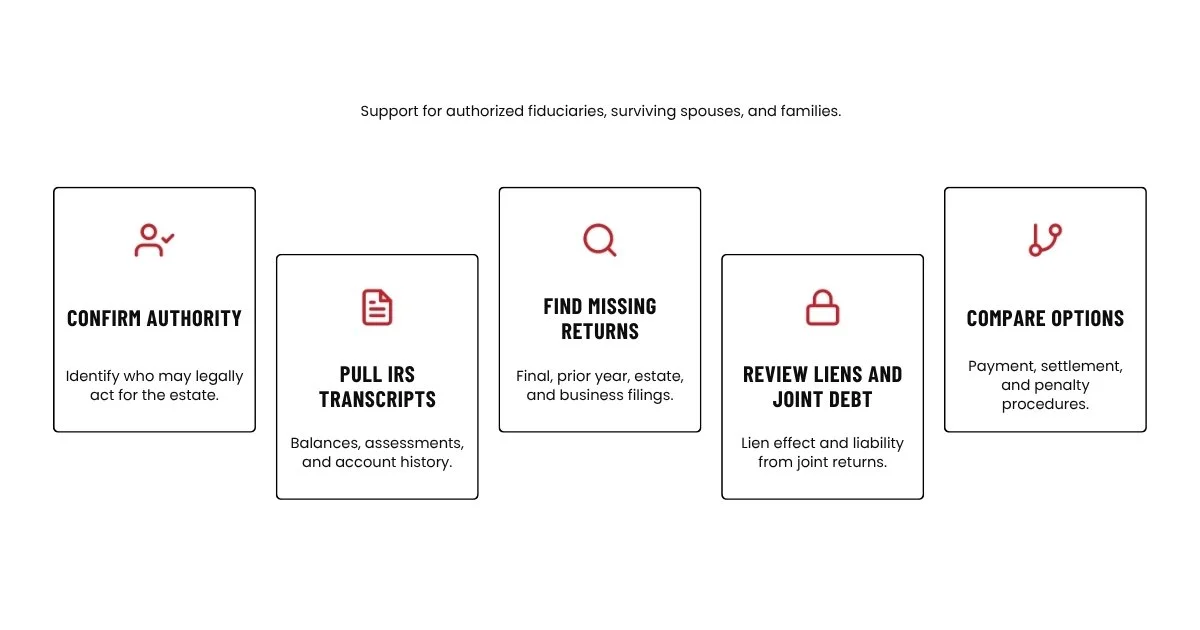
Semper Tax Relief can assist an authorized fiduciary, surviving spouse, or other qualifying person with federal tax matters involving a deceased taxpayer.
Our services may include:
• Confirming who has authority to act
• Preparing or reviewing Form 56
• Obtaining and reviewing IRS transcripts
• Identifying unpaid balances and assessment dates
• Identifying missing tax returns
• Preparing final and prior individual returns within the engagement
• Coordinating estate Form 1041 preparation when included
• Reviewing IRS Substitute for Return assessments
• Reviewing joint tax liabilities
• Evaluating innocent spouse relief
• Communicating with the IRS under proper authorization
• Reviewing federal tax liens
• Evaluating payment or settlement options
• Reviewing penalty relief
• Preparing Form 4810 when appropriate
• Preparing Form 5495 when appropriate
• Addressing IRS collection notices
• Coordinating with probate or estate counsel when legal issues fall outside federal tax representation
The services depend on the fiduciary’s authority, type of tax, estate assets, account history, records, deadlines, and scope of the engagement.
Semper Tax Relief cannot guarantee that the IRS will reduce the balance, accept a settlement, remove penalties, release a lien, approve a payment arrangement, or determine that no further collection is available.
Our Deceased Taxpayer IRS Debt Review Process
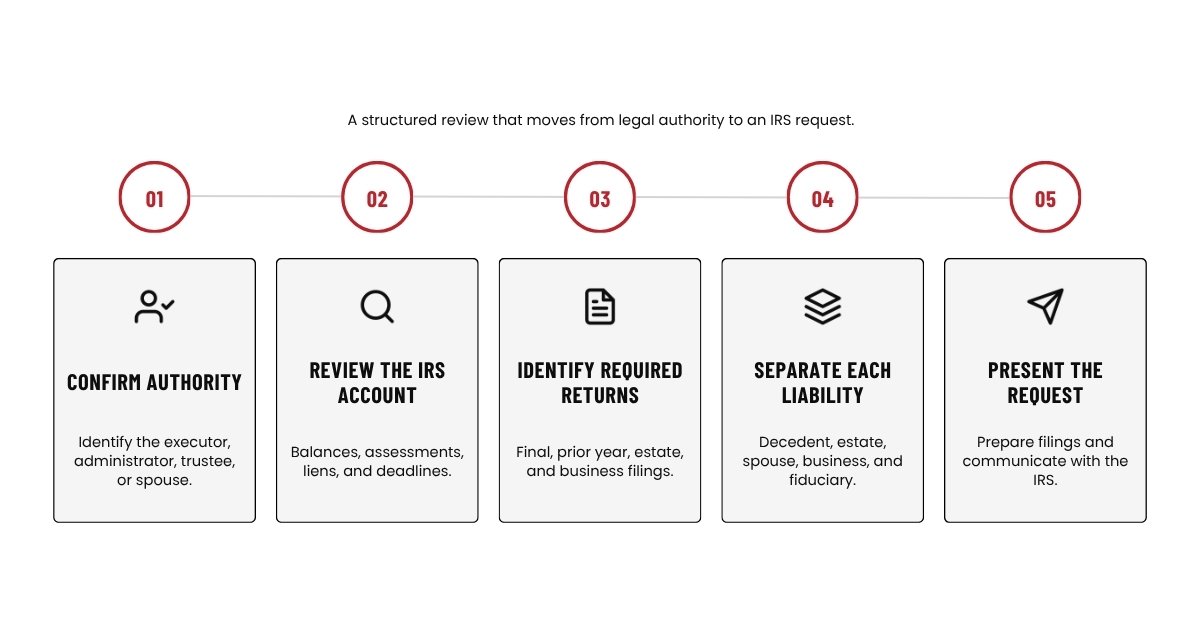
Step 1: Confirm Authority
We identify the executor, administrator, trustee, surviving spouse, or other person legally permitted to act.
Step 2: Review the IRS Account
We identify balances, tax years, assessments, payments, liens, collection activity, missing returns, and important deadlines.
Step 3: Identify Required Returns
We review the deceased taxpayer’s final return, prior unfiled returns, and possible estate or business filing requirements.
Step 4: Review Estate Assets and Distributions
We review available information concerning estate property, secured debts, prior distributions, jointly owned property, and possible federal tax claims.
Step 5: Separate Each Potential Liability
We distinguish between:
• The deceased taxpayer’s liability
• A joint liability involving a surviving spouse
• The estate’s income tax liability
• A business entity’s liability
• Potential fiduciary liability
• Potential transferee liability
Step 6: Compare Available Procedures
We evaluate filing, correction, payment, settlement, penalty, innocent spouse, lien, and collection options supported by the facts.
Step 7: Present the Request to the IRS
When retained, we prepare the applicable federal tax filings or requests, communicate with the IRS, and provide supporting information within the engagement.
Why Work With Semper Tax Relief?

A deceased taxpayer’s IRS problem can involve income tax, estate administration, property ownership, liens, joint returns, missing filings, and fiduciary responsibility at the same time.
The family should know:
• What the deceased person actually owed
• Which returns remain unfiled
• Which assets belong to the estate
• Whether a surviving spouse is liable
• Whether a lien affects property
• Whether assets can be distributed
• Which IRS procedure applies
I review the federal tax account before recommending a strategy.
Semper Tax Relief can work with authorized fiduciaries and families throughout the United States through secure document exchange, telephone appointments, electronic signatures, and IRS authorization procedures.
Our goal is to identify the tax obligations, explain the collection risks, and help the authorized person address the IRS matter without making promises before the account and estate information are reviewed.
Frequently Asked Questions About IRS Tax Debt After Death
-
No. Valid federal tax debt does not automatically disappear. The IRS may seek payment from estate assets or other legally responsible parties. Whether the IRS can collect depends on the assets, liens, joint liability, transfers, collection period, and other facts.
-
Children do not automatically become personally responsible merely because they are heirs. However, inherited property may be subject to a federal tax lien, and a beneficiary may face limited exposure under transferee or other liability rules when the legal requirements are met.
-
A surviving spouse may be responsible for tax from a joint return. The spouse is not automatically responsible for tax reported only on the deceased spouse’s separate return. Property ownership, community property, liens, and other laws may still affect the analysis.
-
A court appointed personal representative generally files and signs the final return. If none has been appointed, a surviving spouse filing jointly or the person in charge of the deceased person’s property may have filing responsibility.
-
Potentially. A fiduciary may face personal liability when estate assets are distributed or lower priority claims are paid while a debt due to the United States remains unpaid and the fiduciary knew or should have known about it. Liability depends on the specific facts and applicable priority rules.
-
An estate or authorized fiduciary may discuss payment arrangements when the balance cannot be paid immediately. Availability and terms depend on estate assets, expected administration, the collection period, and the IRS’s ability to collect.
-
Possibly. The IRS will consider estate assets, transfers, liens, responsible parties, and reasonable collection potential. An estate does not qualify merely because it lacks available cash, and the fiduciary must have authority to submit the offer.
-
Distributing assets before identifying and addressing federal tax claims can expose the fiduciary or recipients to additional problems. The executor should review the IRS account and coordinate with qualified probate or estate counsel before making distributions.
Request a Deceased Taxpayer IRS Debt Review
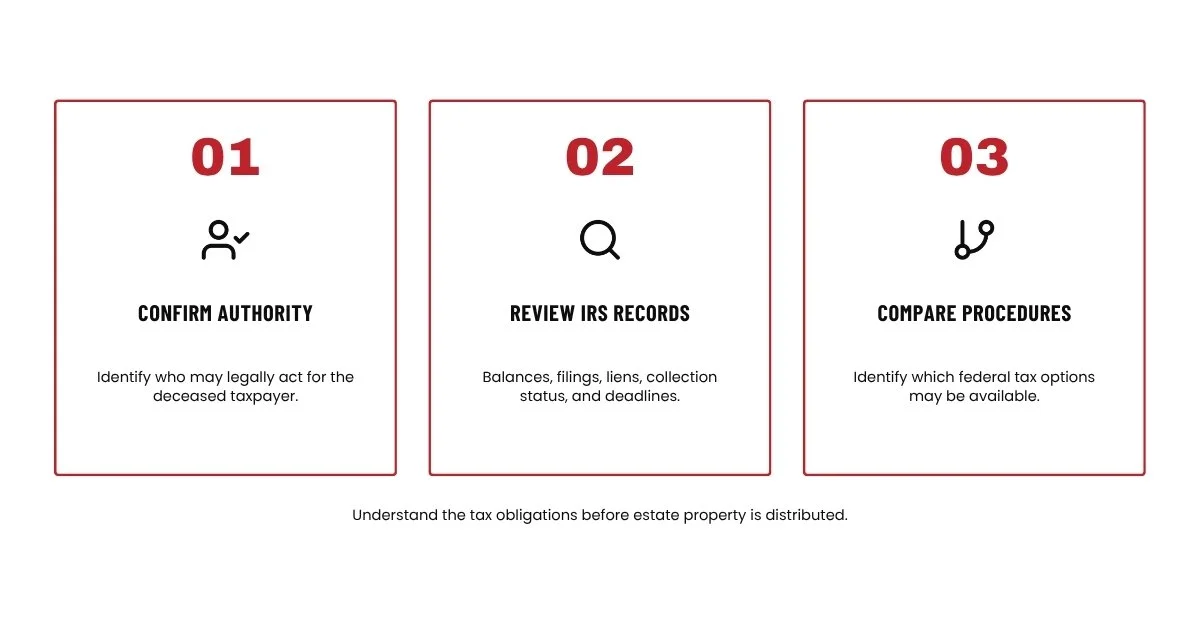
If a family member died with unfiled returns, IRS notices, tax debt, a federal tax lien, or unresolved business taxes, the first step is to identify who has authority to act and what the IRS records show.
I can review the deceased taxpayer’s IRS account, filing history, joint liabilities, collection status, estate information, and available records to help determine which federal tax procedures may be available.
A case review does not guarantee that the IRS will reduce the balance, remove penalties, release a lien, accept a settlement, approve a payment arrangement, or end collection.
It provides an opportunity to understand the tax obligations before estate property is distributed or important response periods expire.
Contact Semper Tax Relief to request a confidential Free Case Review.