

Unfiled Federal Estate Tax Returns
If someone has died and the estate never filed Form 706, the first question is whether a federal estate tax return was actually required.
Form 706 is not the deceased person's final income tax return.
It is also not the income tax return filed by the estate after death.
Those are three separate federal tax filings.
Form 1040 generally reports the deceased person's final individual income tax.
Form 1041 generally reports income earned by an estate or trust after death.
Form 706 reports federal estate tax and certain generation skipping transfer tax issues arising from the transfer of property at death.
For a U.S. citizen or resident who died in 2026, Form 706 is generally required when the gross estate, plus adjusted taxable gifts and applicable specific exemption, exceeds $15,000,000.
A Form 706 may also need to be filed when the estate is below that amount if the executor wants to transfer a deceased spouse's unused exclusion to the surviving spouse through a portability election.
I help executors and families determine whether Form 706 was required, identify estate assets, organize date of death values, review prior taxable gifts, prepare the federal estate tax return, evaluate portability, review penalties and interest, and address related IRS estate tax issues.
Do I qualify for tax relief? Find out with a free case review.
Call today: 24 Hours / 7 Days a Week or book online.
✔ Confidential ✔ No Pressure ✔ Personalized
I am Sergio Melendez, JD, EA. I have worked in the tax profession since 2005 and represent individuals and businesses before the IRS as an Enrolled Agent.
The first step is determining what filing requirement actually applies to the estate.
Form 706, Form 1041, and the Final Form 1040 Are Different Returns

This distinction should be established before any estate return is prepared.
FORM 1040 │ FINAL INDIVIDUAL INCOME TAX RETURN
Generally reports the deceased person's income through the applicable final tax year.
FORM 1041 │ ESTATE OR TRUST INCOME TAX RETURN
Generally reports income earned by the estate or trust after death.
FORM 706 │ FEDERAL ESTATE TAX RETURN
Reports the value of property included in the gross estate, applicable deductions, prior taxable gifts, federal estate tax, portability, and certain generation skipping transfer tax matters.
An estate can need more than one of these returns.
Form 706 Is a Transfer Tax Return
Federal estate tax is imposed on the transfer of the taxable estate.
The tax is calculated from the value of the estate and the applicable federal estate tax rules rather than from annual income.
That makes Form 706 fundamentally different from Form 1040 and Form 1041.
Form 1041 Can Be Required Even When Form 706 Is Not
A relatively modest estate may be far below the federal estate tax filing threshold but still earn enough income after death to require Form 1041.
For example, an estate may receive:
• Interest
• Dividends
• Rental income
• Business income
• Investment income
That income tax filing question is separate from whether Form 706 is required.
Who Must File a Federal Estate Tax Return?

For a U.S. citizen or resident, the filing threshold depends on the year the person died.
It should not be determined using today's exclusion amount if the death occurred in an earlier year.
Current IRS thresholds include:
YEAR OF DEATH │ FORM 706 FILING THRESHOLD
2024 │ $13,610,000
2025 │ $13,990,000
2026 │ $15,000,000
For a person who died in another year, the filing threshold for that year should be used.
The Filing Test Includes More Than Property Owned at Death
The Form 706 filing test generally considers:
Gross estate
Adjusted taxable gifts made after 1976
Applicable specific exemption amounts
This means an estate valued below the annual exclusion amount can still have a filing requirement when the deceased person made substantial lifetime taxable gifts.
The Gross Estate Can Include More Than Probate Property
Federal estate tax concepts are not limited to assets passing through probate.
Depending on ownership and applicable tax rules, the gross estate can potentially include:
Real estate
Bank accounts
Brokerage accounts
Stocks and bonds
Retirement accounts
Business interests
Life insurance proceeds
Jointly owned property
Trust interests
Annuities
Certain lifetime transfers
Property subject to certain powers of appointment
The probate inventory alone should therefore not automatically be treated as the Form 706 gross estate.
Nonresident Noncitizens Follow Different Rules
The $15,000,000 2026 threshold discussed above applies to U.S. citizens and residents for federal estate tax purposes.
A decedent who was neither a U.S. citizen nor domiciled in the United States can instead have a Form 706 NA filing requirement involving U.S. situated property.
The general Form 706 NA filing threshold is substantially different and is generally $60,000 of applicable U.S. situated assets plus the relevant adjusted taxable gifts and specific exemption amounts.
Treaties can also change the analysis.
International estate tax cases should therefore be reviewed separately.
Form 706 May Be Filed for Portability Even When No Estate Tax Is Due
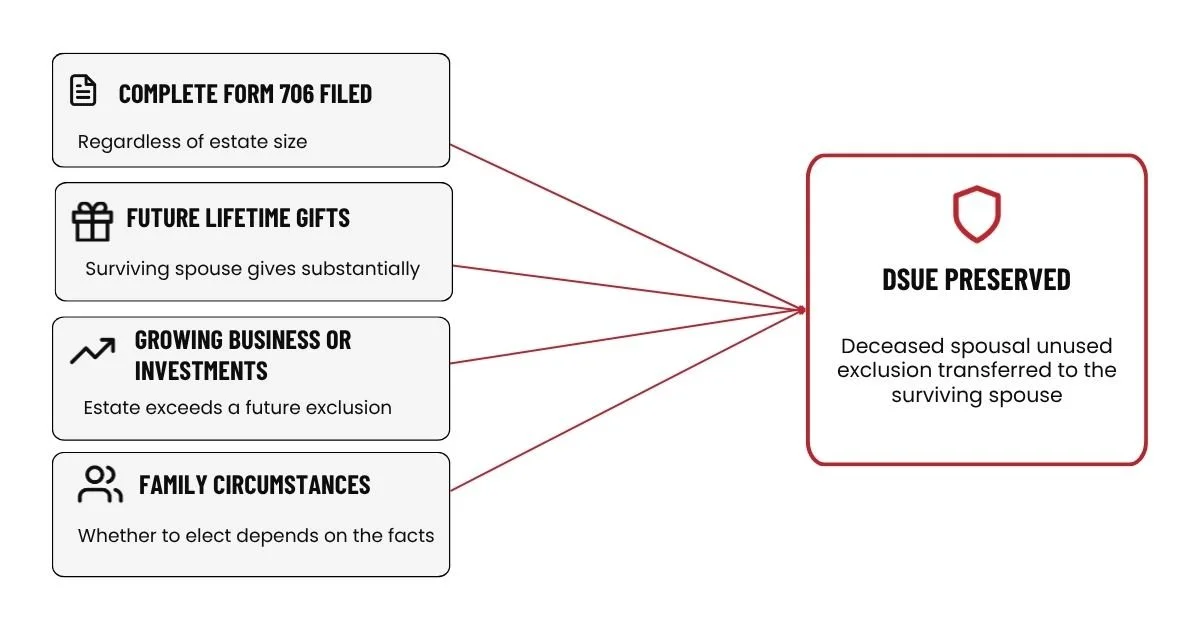
A married couple can have an important reason to file Form 706 even when the first spouse's estate is well below the federal estate tax threshold.
The reason is portability.
Portability allows a surviving spouse to potentially use a deceased spouse's unused federal estate and gift tax exclusion.
The amount transferred is called the deceased spousal unused exclusion, commonly abbreviated DSUE.
Portability Requires an Estate Tax Return
A portability election is generally made by filing a complete Form 706 for the deceased spouse.
The election can be made regardless of the size of the estate.
For an estate that otherwise has no Form 706 filing requirement, portability may therefore be the only reason the return is filed.
Why Portability Can Matter Later
A surviving spouse may later:
•Make substantial lifetime gifts
Own a growing business
Acquire additional property
Receive an inheritance
Experience significant investment growth
Die with an estate exceeding the future federal exclusion
Preserving a deceased spouse's unused exclusion can therefore have value even when federal estate tax is not currently due.
Whether portability should be elected depends on the family's circumstances.
What If the Estate Missed the Portability Deadline?
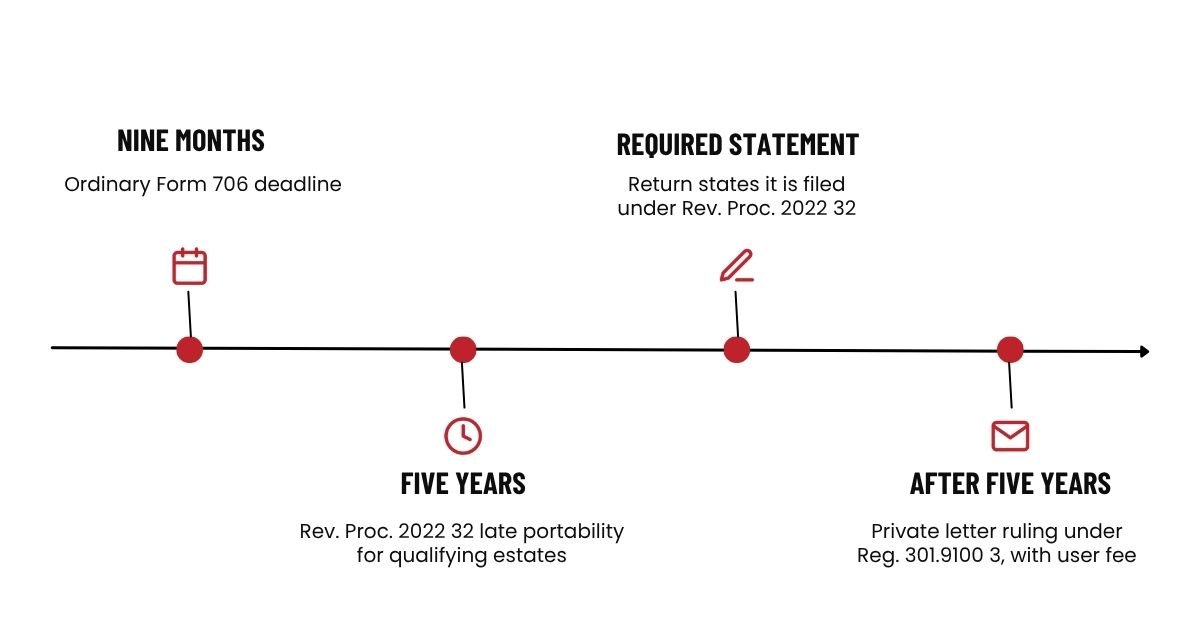
A missed ordinary Form 706 deadline does not necessarily mean the portability election is permanently lost.
Current IRS guidance provides a simplified late portability procedure under Revenue Procedure 2022 32 for qualifying estates.
The Five Year Portability Procedure
An estate that was not otherwise required to file Form 706 under the federal estate tax filing threshold may potentially make a late portability election by filing Form 706 on or before the fifth anniversary of the decedent's death.
The return must satisfy the requirements of Revenue Procedure 2022 32.
The procedure does not apply merely because any Form 706 is late.
It is specifically intended for qualifying estates that were not otherwise required to file Form 706 and are seeking portability relief.
The Form 706 Needs a Specific Portability Statement
Current IRS instructions require a qualifying return filed under this procedure to state that it is being filed under Revenue Procedure 2022 32 to elect portability.
The filing should be prepared carefully because portability depends on the completed estate tax return and calculation of the DSUE amount.
What If More Than Five Years Have Passed?
An estate filing only for portability that misses the Revenue Procedure 2022 32 period may potentially seek relief through the private letter ruling procedures under Treasury Regulation Section 301.9100 3.
That procedure is more involved and can require a user fee and a detailed IRS submission.
Eligibility should be reviewed before assuming late portability relief remains available.
When Is Form 706 Due?
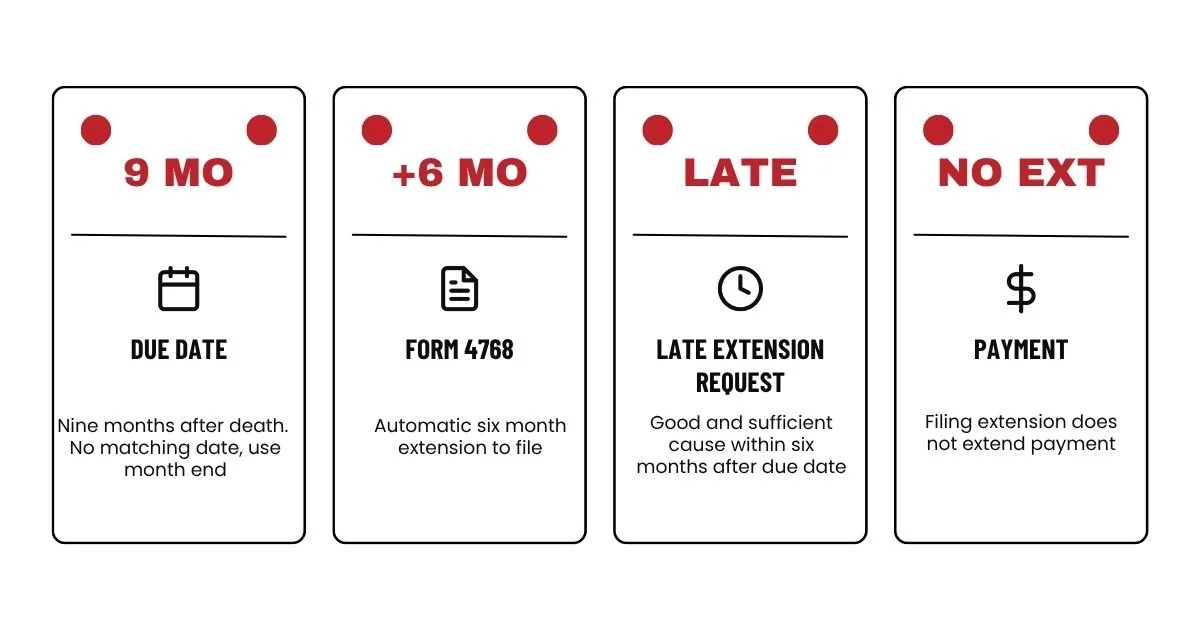
Form 706 is generally due nine months after the date of death.
For example, if a person died January 10, the ordinary filing deadline would generally be October 10.
If there is no corresponding date in the ninth month, the IRS uses the last day of that month.
Weekend and federal holiday rules can also affect the exact filing date.
Form 4768 Can Provide an Automatic Six Month Filing Extension
An executor can generally use Form 4768 to request an automatic six month extension of time to file Form 706.
The extension request generally must be filed by the original nine month deadline.
An explanation is generally not required for the ordinary automatic filing extension.
A Late Extension Request May Sometimes Be Considered
An executor who did not timely request the automatic extension may potentially request an extension for good and sufficient cause during the six month period following the original due date.
The executor must explain why the automatic extension was not requested timely and why filing by the original deadline was impossible or impractical.
Approval depends on the IRS requirements and facts.
An Extension to File Does Not Automatically Extend the Time to Pay
This is important.
Estate tax is generally due nine months after the date of death.
A six month extension to file Form 706 does not automatically provide six additional months to pay the estate tax.
Form 4768 can also be used to request certain extensions of time to pay, but payment relief follows separate rules and is subject to IRS approval where required.
Estate Assets Generally Need Date of Death Values

Preparing Form 706 generally requires identifying the property included in the gross estate and establishing its fair market value.
Unless an alternate valuation election applies, estate property is generally valued as of the date of death.
Common Estate Assets
A Form 706 project can involve:
Personal residence
Rental property
Commercial property
Vacant land
Bank accounts
Certificates of deposit
Brokerage accounts
Stocks
Bonds
Retirement accounts
Closely held business interests
Partnership interests
LLC interests
Life insurance
Annuities
Notes receivable
Vehicles
Valuable personal property
Trust interests
Foreign property
The correct Form 706 schedule depends on the type of asset.
Appraisals Can Be Important
Marketable securities and bank accounts may have readily available values.
Other assets can require qualified valuation work.
Examples can include:
Real estate
Closely held businesses
Partnership interests
LLC interests
Artwork
Collectibles
Other valuable property without a public market
The return should include supporting valuation information when required.
Valuation Is a Major Audit Issue
Estate tax liability can depend heavily on asset values.
The current Form 706 instructions also provide substantial valuation understatement penalties in qualifying cases.
Valuation positions should therefore be based on supportable facts and appropriate appraisal evidence rather than estimates chosen simply to reduce the estate value.
Alternate Valuation May Be Available in Certain Estates
The executor can sometimes elect an alternate valuation date under Internal Revenue Code Section 2032.
The election is not available simply because an asset declined in value.
Both Tests Generally Need to Be Met
The alternate valuation election generally must reduce:
The value of the gross estate
and
The combined estate and applicable GST tax attributable to the property
The election generally applies to the estate as a whole rather than being selected only for individual assets.
The Alternate Date Is Generally Six Months After Death
Property still held six months after death is generally valued at that later date.
Property sold, distributed, exchanged, or otherwise disposed of during the six month period can instead use the applicable earlier disposition date under the federal rules.
The election should be reviewed carefully before Form 706 is filed.
Lifetime Taxable Gifts Can Affect the Form 706 Filing Requirement

The estate tax filing analysis does not end with the property owned on the date of death.
Lifetime taxable gifts can affect both:
Whether Form 706 must be filed
The estate tax calculation
Prior Forms 709 Are Important
Form 709 is the federal gift and generation skipping transfer tax return.
When the deceased person previously filed Forms 709, those returns should generally be gathered for Form 706 preparation.
They can help establish:
Taxable gifts
Gift splitting
Prior use of exclusion
Gift tax paid
GST allocations
Prior valuation positions
Current Form 706 instructions recommend attaching available previously filed Forms 709 as exhibits when applicable.
Missing Gift Tax Returns May Need Separate Review
If the estate discovers substantial lifetime gifts that should have been reported but no Form 709 was filed, the gift tax filing issue may need to be addressed separately.
That can affect the Form 706 calculation.
Deductions Can Reduce the Taxable Estate
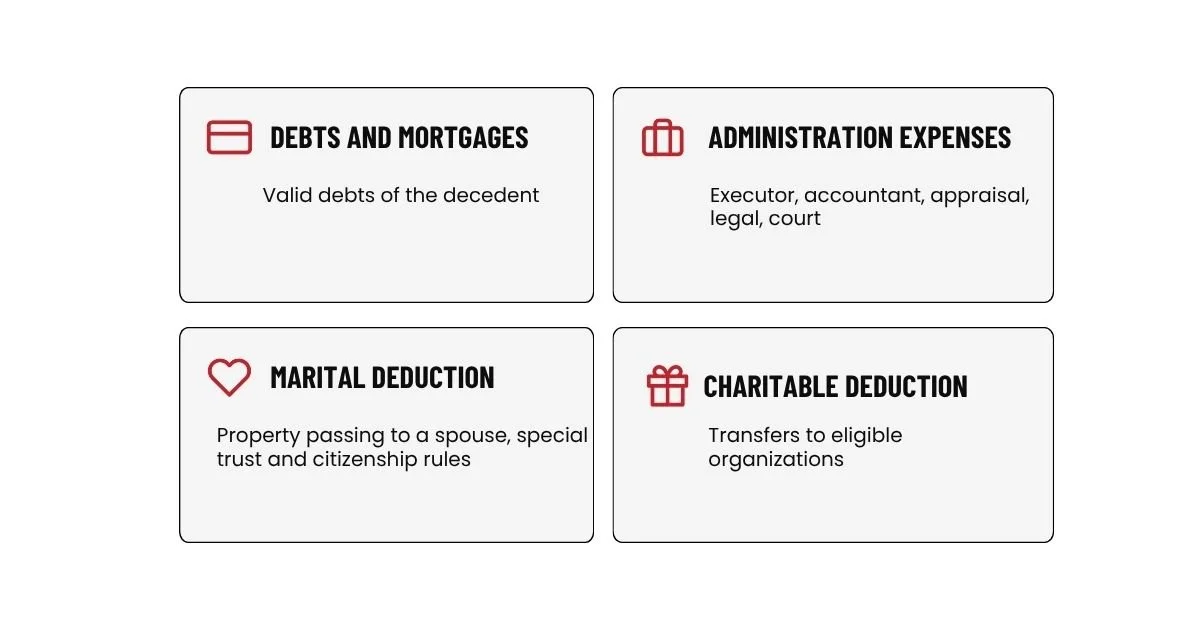
The gross estate is not necessarily the amount subject to federal estate tax.
Applicable deductions can reduce the taxable estate.
Debts and Mortgages
Qualifying debts of the deceased person can potentially be deductible.
That can include certain:
Mortgages
Loans
Other valid debts
The debt must satisfy the applicable estate tax rules.
Administration Expenses
Qualifying administration expenses can include items such as:
Executor expenses
Accountant fees
Appraisal fees
Certain legal fees
Court costs
Certain asset preservation or sale expenses
The expense generally needs to relate to administration of the estate and satisfy the federal deduction requirements.
Marital Deduction
Qualifying property passing to a surviving spouse may be eligible for the federal estate tax marital deduction.
Special rules can apply to trusts, terminable interests, QTIP property, and a surviving spouse who is not a U.S. citizen.
Charitable Deduction
Qualifying property transferred to eligible charitable organizations can potentially produce an estate tax charitable deduction.
The actual transfer and organization should satisfy the applicable federal requirements.
Generation Skipping Transfer Tax Can Be Part of Form 706

The full name of Form 706 includes generation skipping transfer tax because certain transfers at death can trigger Chapter 13 GST rules.
A direct skip can involve a transfer to a person two or more generations below the deceased person, such as certain transfers to grandchildren, or to certain trusts.
Not every estate has a GST issue.
GST Planning and Reporting Can Affect Trust Transfers
When an estate includes:
Generation skipping trusts
Direct transfers to grandchildren
Existing dynasty trusts
Previously allocated GST exemption
Prior taxable gifts involving GST planning
the executor should review the federal GST reporting rules as part of Form 706 preparation.
Prior Forms 709 and trust documents can be particularly important.
What Penalties and Interest Can Apply to a Late Form 706?

A late estate tax return can involve both a filing penalty and a payment penalty when tax remains unpaid.
Failure to File
The general federal Failure to File penalty is generally 5 percent of unpaid tax for each month or part of a month the return remains late.
The general maximum is 25 percent.
Coordination rules apply when Failure to File and Failure to Pay penalties both apply during the same month.
Failure to Pay
The general Failure to Pay penalty generally begins at one half of 1 percent of unpaid tax for each month or part of a month the balance remains unpaid.
The general maximum is 25 percent.
The rate can change in certain collection circumstances.
Interest Continues on Unpaid Estate Tax
Federal interest generally begins on unpaid estate tax after the applicable payment deadline and continues until the liability is paid.
IRS interest rates change quarterly.
Reasonable Cause Can Provide Penalty Relief
Current Form 706 instructions specifically recognize reasonable cause relief from the late filing penalty.
The current instructions also tell executors who receive a penalty notice after filing Form 706 to provide the reasonable cause explanation in response to the notice rather than attaching that explanation to the original return.
Penalty relief depends on the facts.
It should not be assumed merely because estate administration was difficult.
Federal Estate Tax Liens Can Affect Estate Property
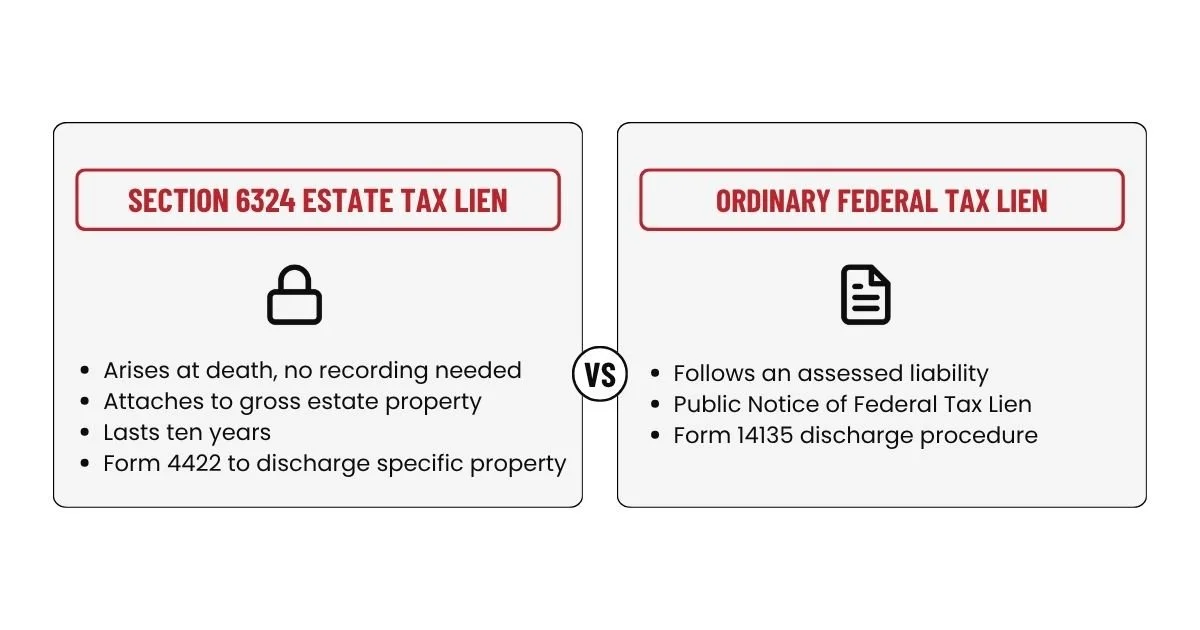
Form 706 cases have a special federal lien rule that is different from an ordinary Notice of Federal Tax Lien for income tax debt.
If there is a federal estate tax filing requirement, the general estate tax lien under Internal Revenue Code Section 6324 can attach automatically to property included in the gross estate.
The IRS does not need to record a public Notice of Federal Tax Lien for this statutory estate tax lien to arise.
The General Estate Tax Lien Can Last Ten Years
Current IRS collection guidance states that the Section 6324 estate tax lien generally begins on the date of death and lasts ten years.
The lien can affect property included in the gross estate even when that property is not part of the probate estate.
Property Sales Can Require Special IRS Procedures
If estate property subject to the federal estate tax lien needs to be sold, the transaction should be reviewed before closing.
An executor or administrator appointed and acting in the United States can generally use Form 4422 to request discharge of specific property from the estate tax lien.
That is different from the Form 14135 procedure commonly associated with discharging property from an ordinary assessed federal tax lien.
The type of federal lien matters.
Form 8971 May Be Required After Form 706
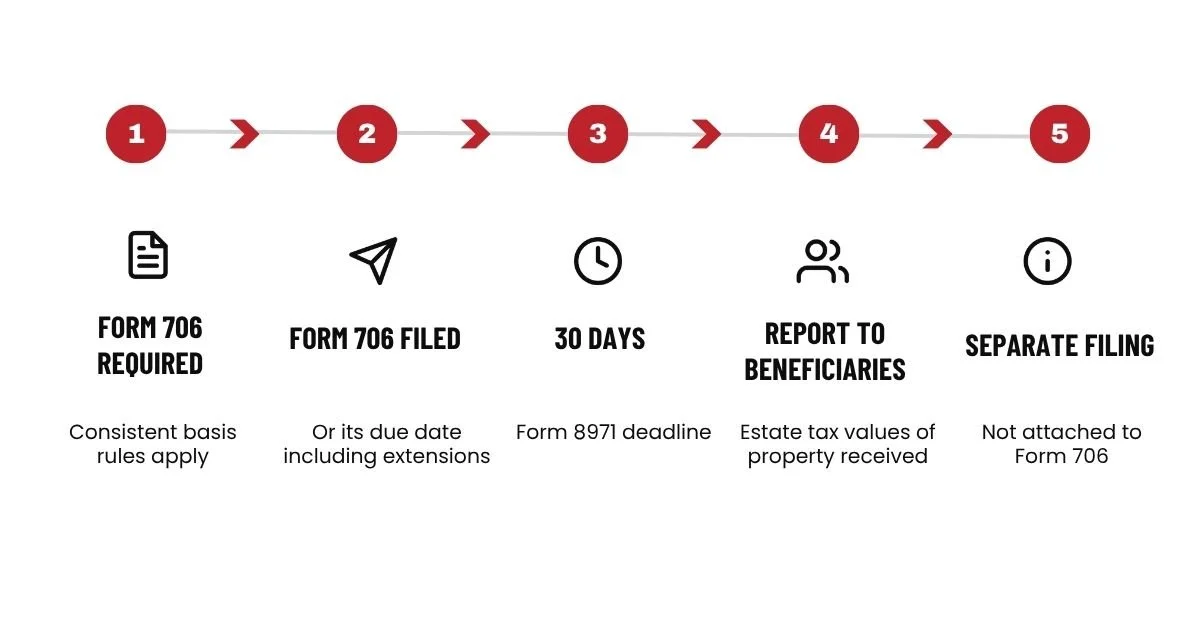
Certain estates required to file Form 706 also have consistent basis reporting requirements.
Form 8971, Information Regarding Beneficiaries Acquiring Property From a Decedent, can be required when the federal rules apply.
The estate may need to report estate tax values to both:
The IRS
Beneficiaries receiving applicable estate property
Current Form 706 instructions generally require Form 8971 within 30 days after the Form 706 due date, including extensions, or within 30 days after Form 706 is filed when it is filed late, subject to the detailed Form 8971 rules.
This is a separate filing.
It is not attached to Form 706.
The Executor Has Specific Federal Tax Responsibilities
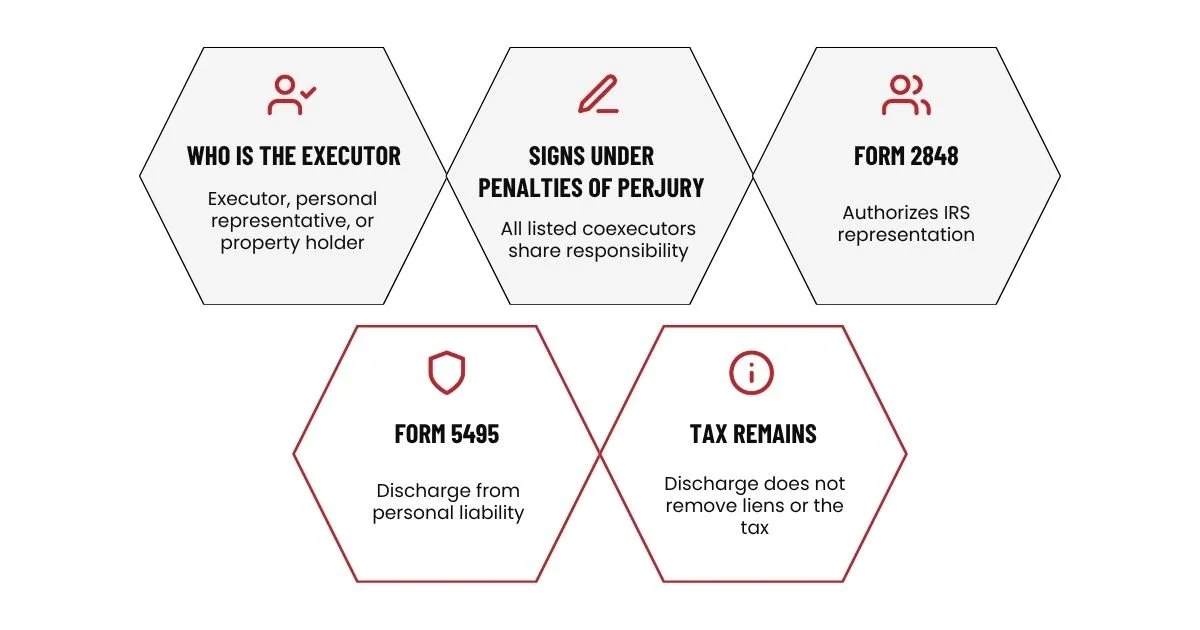
For Form 706 purposes, the term executor can include:
Executor
Personal representative
Administrator
If no formally appointed executor exists, federal tax law can treat a person in actual or constructive possession of estate property as an executor for certain federal estate tax purposes.
The Executor Signs Form 706
The executor filing Form 706 signs the return under penalties of perjury.
When several executors are listed, the current instructions state that all listed executors can have responsibility for the return as filed, even though one coexecutor may sign the return.
Form 2848 Can Authorize IRS Representation
An executor can use Form 2848 to authorize an eligible representative to act before the IRS for the estate tax matter.
As an Enrolled Agent, I can represent the estate before the IRS within the scope of the federal authorization.
Form 5495 May Be Relevant Before Closing the Estate
An executor can potentially use Form 5495 to request discharge from personal liability for certain income, gift, and estate taxes.
That procedure does not erase the underlying tax or automatically remove estate tax liens.
It addresses the fiduciary's personal liability under the applicable federal rules.
What Documents Are Commonly Needed for a Delinquent Form 706?

Estate tax return preparation can require substantial documentation.
Useful records can include:
Death certificate
Will
Trust agreements
Trust amendments
Court appointment documents
Letters testamentary
Letters of administration
Prior Form 1040 returns
Prior Forms 709
Prior estate planning documents
Prenuptial or marital property agreements
Real estate appraisals
Business valuations
Brokerage statements
Bank statements
Retirement account statements
Life insurance statements
Form 712
Annuity documents
Partnership agreements
LLC agreements
Corporate ownership records
Stock certificates
Loan documents
Mortgage statements
Notes receivable
Debt records
Funeral expense records
Executor expense records
Legal and accounting invoices
Charitable bequest documentation
Beneficiary information
Prior gift records
Records of property transferred before death
Foreign asset information
IRS notices
Estate Records May Need to Be Reconstructed
A delinquent Form 706 can be difficult when years have passed since the death.
Records may need to be obtained from:
Banks
Brokerage firms
Insurance companies
Property appraisers
Business accountants
Prior tax professionals
Trustees
Beneficiaries
County property records
Probate files
Prior gift tax filings
The objective is to reconstruct the estate as it existed on the applicable valuation date.
Our Process for Unfiled Federal Estate Tax Returns

I use a structured review because Form 706 combines tax law, asset valuation, lifetime gift history, and estate administration.
Step 1, Confirm the Decedent's Federal Estate Tax Status
I review:
Citizenship
Domicile
Date of death
Surviving spouse
Executor or personal representative
This determines which federal estate tax rules and return may apply.
Step 2, Determine the Filing Threshold for the Year of Death
I apply the federal threshold for the actual year of death.
For example:
2024 │ $13,610,000
2025 │ $13,990,000
2026 │ $15,000,000
Earlier years require their own threshold.
Step 3, Identify the Gross Estate
We identify the property potentially included for federal estate tax purposes.
That includes probate and applicable nonprobate assets.
If the business filings are incomplete, we organize the available financial records and prepare the required Form 568 returns.
Step 4, Review Lifetime Taxable Gifts
Prior Forms 709 and lifetime transfer records are reviewed to determine whether adjusted taxable gifts affect:
The filing requirement
The estate tax calculation
Portability
GST reporting
Step 5, Establish Estate Asset Values
We organize date of death values and obtain or review appraisals where required.
Alternate valuation is considered only when the federal requirements support the election.
Step 6, Review Estate Deductions
Potential deductions can include:
Debts
Mortgages
Administration expenses
Marital deduction
Charitable deduction
Other applicable estate tax deductions
Step 7, Review Portability
When there is a surviving spouse, I determine whether:
Portability was timely elected
A late election may still be available
Revenue Procedure 2022 32 applies
Another late election procedure may need consideration
Step 8, Prepare Form 706 and Required Schedules
The estate tax return is prepared using the forms and federal rules applicable to the decedent's date of death.
Step 9, Address Estate Tax, Penalties, and Interest
If the return produces estate tax due, I review:
Payments
Extensions
Penalties
Interest
Reasonable cause
Applicable estate tax payment provisions
Step 10, Review Related Estate Tax Procedures
Depending on the case, additional procedures can involve:
Form 8971
Estate tax lien issues
Property discharge requests
Form 5495
Estate tax transcripts
Estate tax closing letter requests
Related Form 1041 filings
Related final Form 1040 filings
Common Mistakes With Unfiled Form 706 Returns
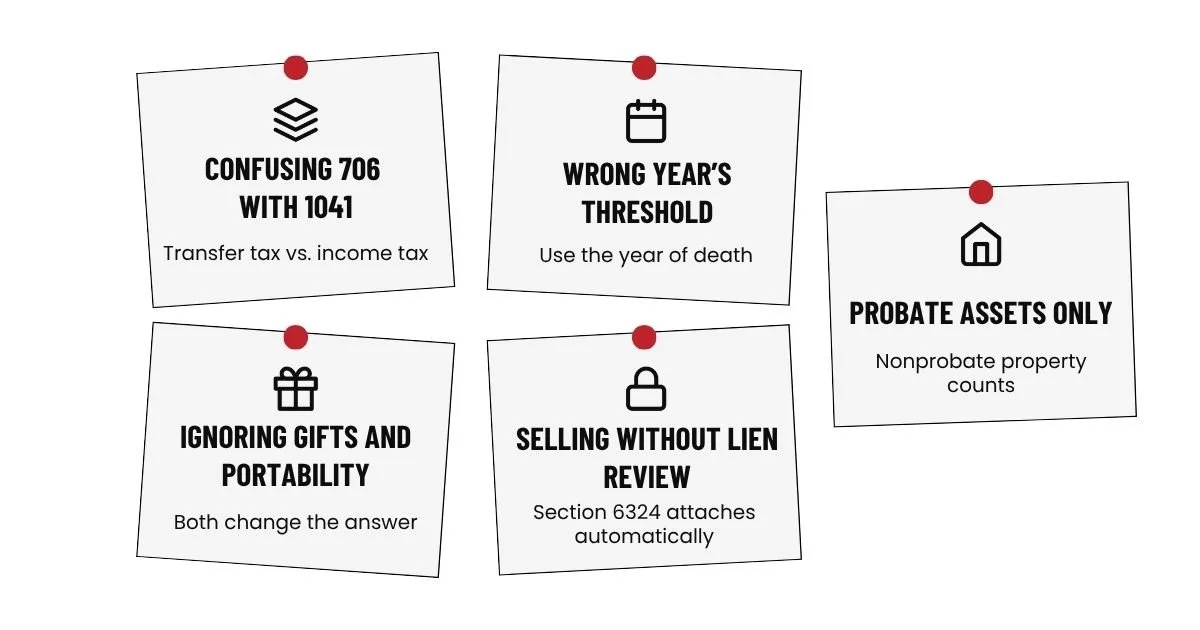
Confusing Form 706 With Form 1041
Form 706 is an estate transfer tax return.
Form 1041 is generally an income tax return for an estate or trust.
Using the Current Estate Tax Threshold for an Older Death
The filing threshold is based on the year the person died.
Looking Only at Probate Assets
Federal gross estate rules can include nonprobate property.
Ignoring Lifetime Gifts
Adjusted taxable gifts can affect both filing and tax calculations.
Ignoring Portability Because the Estate Is Below the Filing Threshold
An estate can have no ordinary Form 706 requirement and still benefit from filing for portability.
Assuming Portability Is Lost After Nine Months
Qualifying estates may have late election procedures, including the current five year Revenue Procedure 2022 32 process.
Using Informal Estimates for Major Assets
Estate tax valuations can be examined by the IRS.
Real estate and closely held business interests often require professional appraisal work.
Selling Estate Property Without Reviewing the Estate Tax Lien
The Section 6324 estate tax lien can arise automatically and can affect property transactions.
Assuming a Filing Extension Is Also a Payment Extension
Those are separate federal procedures.
Why Work With Semper Tax Relief for a California LLC Revivor?

A delinquent federal estate tax return can involve several issues at once.
I review:
Filing threshold
Year of death
Gross estate
Prior taxable gifts
Form 709 history
Portability
DSUE
Real estate
Investment assets
Business interests
Life insurance
Trust property
Date of death values
Alternate valuation
Deductions
GST issues
Estate tax liens
Penalties
Interest
Related Form 1041 issues
I am Sergio Melendez, JD, EA.
I have worked in the tax profession since 2005 and represent individuals and businesses before the IRS as an Enrolled Agent.
My Juris Doctor degree is an educational credential.
My authority to represent taxpayers before the IRS comes from my Enrolled Agent credential.
Semper Tax Relief provides tax preparation and federal tax representation.
Probate litigation, will interpretation, trust disputes, beneficiary disputes, property ownership disputes, estate planning, and other legal matters should be handled by appropriate legal counsel when required.
The objective is to determine whether Form 706 was required, reconstruct the estate using supportable records, evaluate available elections, prepare the federal estate tax filing, and address related IRS tax issues.
Results depend on the estate's assets, valuations, gift history, deductions, filing deadlines, executor authority, IRS procedures, and applicable federal tax law.
Frequently Asked Questions About Unfiled Federal Estate Tax Returns
-
For a U.S. citizen or resident who died in 2026, Form 706 is generally required when the gross estate, plus adjusted taxable gifts and applicable specific exemption, exceeds $15,000,000.
The threshold depends on the year of death.
For comparison, the threshold was $13,990,000 for 2025 deaths and $13,610,000 for 2024 deaths.
-
Form 706 is generally a federal estate transfer tax return based on property transferred at death.
Form 1041 generally reports income earned by an estate or trust.
An estate can need both returns.
The deceased person's final Form 1040 is another separate filing.
-
Possibly.
For a 2026 death, an estate below the ordinary $15,000,000 filing threshold may still file Form 706 to elect portability of the deceased spouse's unused exclusion to a surviving spouse.
Other specialized filing situations can also apply.
-
Potentially.
Revenue Procedure 2022 32 provides a simplified procedure for qualifying estates that were not otherwise required to file Form 706 and file for portability on or before the fifth anniversary of the decedent's death.
Other IRS relief procedures may need to be considered when the simplified procedure is unavailable.
-
The estate should first determine whether the return was actually required and reconstruct the gross estate, prior taxable gifts, deductions, and valuations.
A late filing can involve estate tax, interest, and penalties when tax was due.
Reasonable cause may provide penalty relief when the requirements are satisfied.
If portability was the reason for filing, the late election procedures should be reviewed separately.
-
Not necessarily.
Publicly traded securities and bank accounts can often be valued using readily available financial information.
Real estate, closely held businesses, partnership interests, valuable personal property, and other assets without readily available market prices may require professional appraisal support.
-
When a federal estate tax filing requirement exists, the Section 6324 estate tax lien generally arises automatically at death and does not need to be publicly recorded to be valid.
Current IRS guidance states that the general estate tax lien lasts ten years from the date of death.
Property transactions should therefore be reviewed carefully when Form 706 is required.
-
Yes.
I can help evaluate the Form 706 filing requirement, review the year of death threshold, organize estate and gift records, prepare the federal estate tax return, evaluate portability, review penalties and interest, and represent the estate before the IRS within my authority as an Enrolled Agent.
Related probate or estate legal issues may require separate legal counsel.
Get a Free Federal Estate Tax Filing Case Review
If you believe Form 706 should have been filed, start by reviewing the date of death, estate assets, prior gifts, and whether there was a surviving spouse.
I can review:
Year of death
Applicable estate tax filing threshold
Gross estate
Nonprobate assets
Prior Forms 709
Lifetime taxable gifts
Portability
DSUE
Late portability election procedures
Real estate values
Business interests
Investment accounts
Retirement accounts
Life insurance
Trust interests
Estate debts
Administration expenses
Marital deduction issues
Charitable deduction issues
GST reporting
Form 4768
Estate tax penalties
Interest
Estate tax liens
Form 8971
Related Form 1041 issues
You do not need to determine on your own whether the estate exceeded the federal filing threshold.
Bring the death certificate, will or trust documents, financial statements, prior Forms 709, asset information, IRS notices, and valuation records currently available.
I can help determine whether Form 706 was required, whether a portability filing should be considered, and what federal tax steps remain.