

Unfiled California Form 568 SMLLC Returns
A California single member LLC can have a separate Form 568 filing requirement even when the business is disregarded for federal income tax purposes.
That is one of the most common reasons I see California LLC owners fall behind.
The owner may have reported the business income and expenses correctly on federal Schedule C and the California personal income tax return, but no one filed Form 568 for the LLC itself.
California generally does not disregard the separate existence of the LLC for purposes of:
Form 568 filing
The $800 annual LLC tax
The California LLC fee when applicable
Several years of missing Form 568 returns can therefore create separate FTB filing periods, annual tax assessments, fees, penalties, interest, and eventually collection or suspension problems.
I help California SMLLC owners determine which Form 568 returns were required, reconstruct the information needed to prepare them, calculate applicable California LLC tax and fees, file the delinquent returns, and review what remains on the FTB account after the filings process.
Do I qualify for tax relief? Find out with a free case review.
Call today: 24 Hours / 7 Days a Week or book online.
✔ Confidential ✔ No Pressure ✔ Personalized
I am Sergio Melendez, JD, EA. I have worked in the tax profession since 2005 and represent taxpayers in federal and California tax matters.
The first step is determining what should have been filed.
Who We Help With Missing California Form 568 Returns
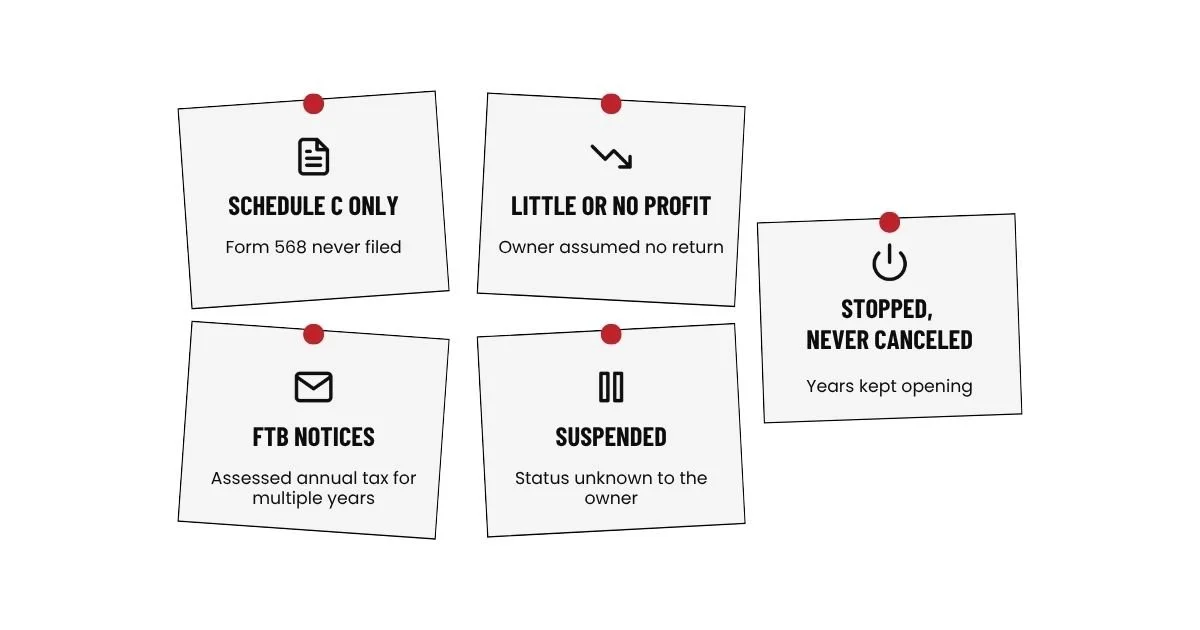
This service is intended for owners of single member LLCs that have fallen behind with California filing requirements.
Common situations include:
The owner filed Schedule C but never filed Form 568
Several years of Form 568 returns are missing
The LLC had little or no profit and the owner assumed no California return was required
The LLC stopped operating but was never formally canceled
The business changed accountants or bookkeepers
The FTB sent a missing return notice
The FTB assessed annual LLC tax for multiple years
California LLC fees were never calculated
The business records are several years behind
The LLC is suspended
The owner does not know whether the LLC is still active
The LLC was formed in California but never operated
The LLC operates both inside and outside California
The owner changed the LLC's federal tax classification
Before preparing returns, I confirm the entity status and tax classification for each year.
Does a California Single Member LLC Have to File Form 568?
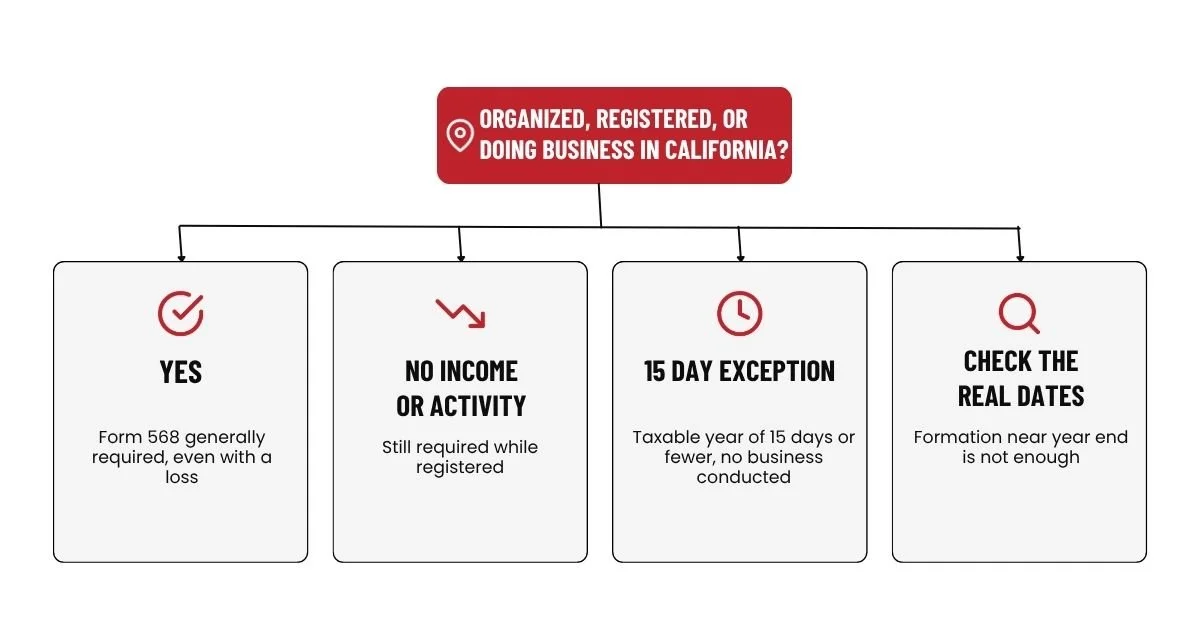
California generally requires an SMLLC to file Form 568 when the LLC is:
• Organized in California
• Registered with the California Secretary of State
• Doing business in California
• Otherwise subject to the California LLC filing requirements
The filing requirement can exist even when the SMLLC is disregarded for income tax purposes.
A Short Taxable Year Exception Can Apply
California provides a limited exception when both of the following are true:
The LLC's taxable year was 15 days or fewer
The LLC did not conduct business in California during that period
This exception should be reviewed from the actual formation and business dates.
It should not be applied simply because the LLC was formed near the end of the year.
No Business Profit Does Not Automatically Remove the Filing Requirement
An owner should not assume Form 568 is unnecessary merely because:
The business had a loss
The business had very little income
No money was distributed
The owner reported everything on Schedule C
The LLC did not owe personal income tax
The LLC had no employees
An LLC that remains registered in California can still have a Form 568 filing requirement even when it is not actively conducting business and has no California source income.
Form 568 Due Dates Depend on Who Owns the SMLLC

The filing deadline can change depending on the type of owner.
This is important when reconstructing older returns because not every SMLLC has the same original filing date.
SMLLC Owned by an Individual or Other Non Pass Through Entity
For an SMLLC owned by an individual or another qualifying non pass through entity, Form 568 is generally due by the 15th day of the fourth month after the close of the taxable year.
For a calendar year return, that is generally April 15.
The extended filing deadline is generally the 15th day of the tenth month after the close of the year.
For a calendar year return, that is generally October 15.
SMLLC Owned by an S Corporation
An SMLLC owned by an S corporation generally has an original Form 568 due date of the 15th day of the third month after year end.
Its extended filing date is generally the 15th day of the ninth month.
SMLLC Owned by a Partnership
An SMLLC owned by a partnership or another entity treated as a partnership generally has an original return due by the 15th day of the third month after year end.
Its extended filing date is generally the 15th day of the tenth month.
The ownership structure therefore needs to be confirmed before determining whether a historical return was actually late.
California Gives an Automatic Extension to File Form 568
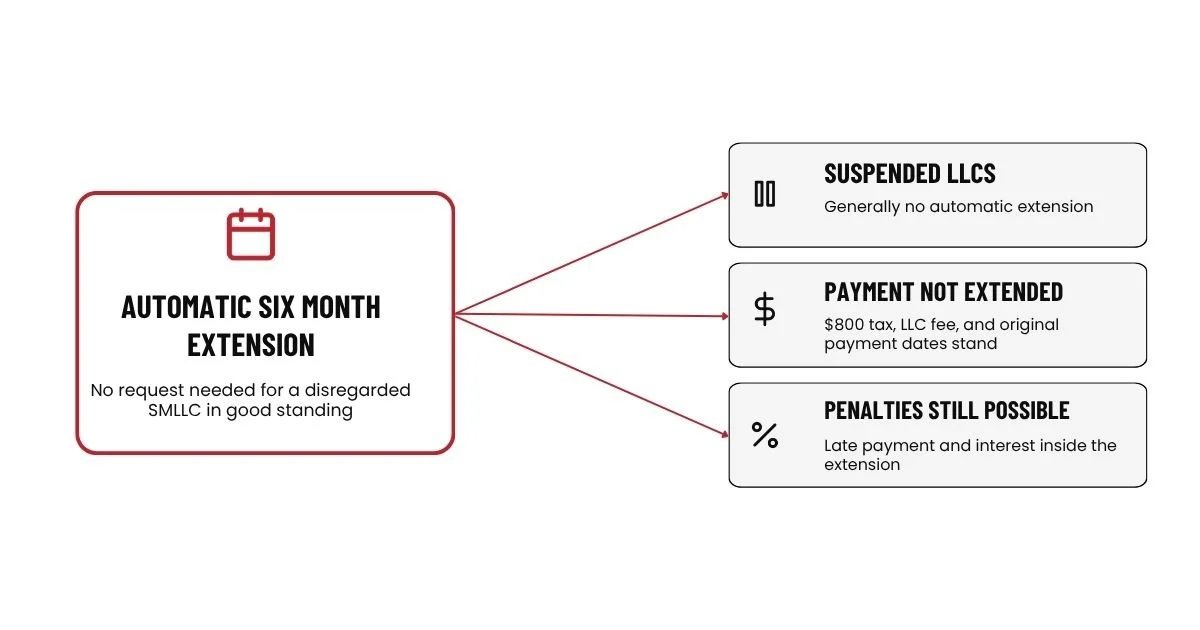
California generally provides an automatic filing extension rather than requiring the LLC to submit a separate extension request.
For a disregarded SMLLC owned by an individual, the extension is generally six months.
The LLC generally needs to be in good standing to receive the automatic extension.
A Suspended LLC May Not Have the Same Extension Protection
The current Form 568 instructions state that the automatic extension is generally unavailable when the LLC is suspended or forfeited.
If an old Form 568 was filed after the original due date while the LLC was suspended, the penalty calculation should be reviewed carefully.
The Extension Does Not Extend the Time to Pay
The automatic filing extension applies to the return.
It generally does not extend the payment deadline for:
The $800 annual LLC tax
The applicable California LLC fee
Other amounts required by the original payment date
A return can therefore be filed within the extended filing period and still have late payment penalties or interest.
The $800 Annual LLC Tax Is Separate From Filing Form 568

California generally imposes an $800 annual tax on an LLC that is organized, registered, or doing business in California.
The annual tax is generally due by the 15th day of the fourth month after the beginning of the taxable year.
For a calendar year LLC, the normal payment date is April 15.
The annual tax is generally paid using FTB 3522 rather than waiting until Form 568 is filed.
The Temporary First Year Exemption Has Expired
California previously provided a temporary first year exemption for certain LLCs for tax years beginning from 2021 through 2023.
That provision has expired.
A new California LLC beginning business in 2026 should not assume its first $800 annual tax is automatically waived.
The Annual Tax Can Apply Even When the Business Lost Money
The $800 annual tax generally does not depend on the LLC's net business profit.
An LLC can therefore have:
A Schedule C loss
No owner distribution
Little business activity
and still have an annual California LLC tax obligation.
Form 568 Also Calculates the California LLC Fee
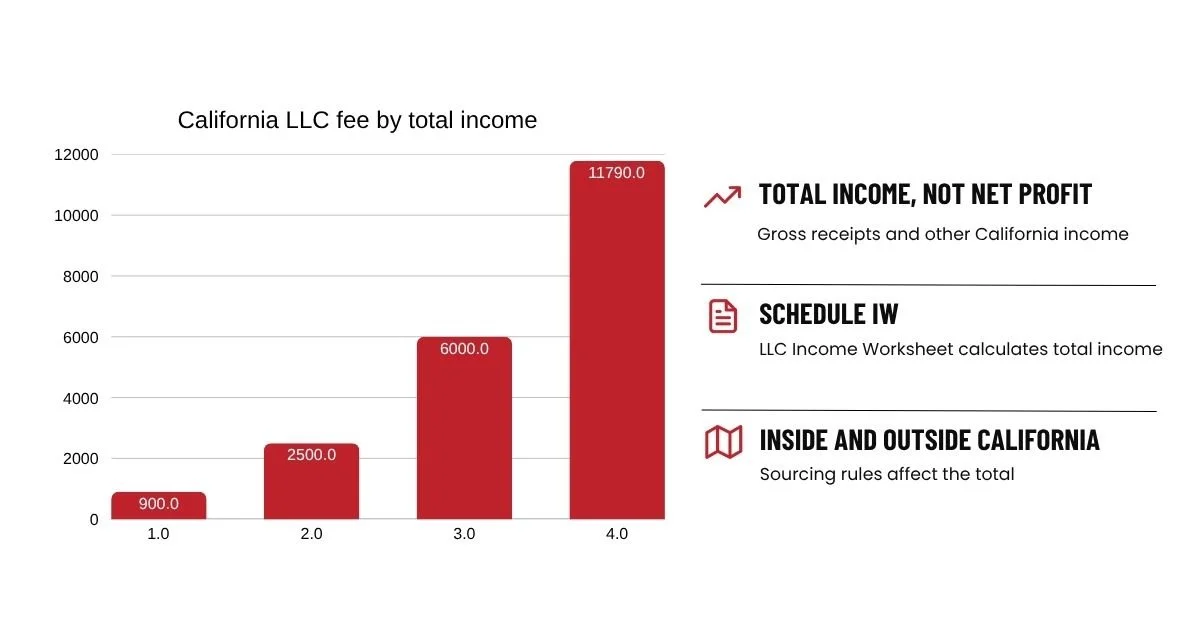
The California LLC fee is separate from the $800 annual tax.
The fee applies when California total income reaches the applicable threshold.
The current fee levels are:
California total income from $250,000 through $499,999
$900
California total income from $500,000 through $999,999
$2,500
California total income from $1,000,000 through $4,999,999
$6,000
California total income of $5,000,000 or more
$11,790
The LLC Fee Is Not Based on Schedule C Net Profit
The California fee uses total income determined under the applicable Form 568 sourcing rules.
It is not simply calculated from the net profit on Schedule C.
That means the business records need to establish gross receipts and other applicable California income, not just the final net income figure.
Schedule IW Is Important for a Disregarded SMLLC
A disregarded SMLLC generally completes Schedule IW, LLC Income Worksheet.
Schedule IW is used to calculate the LLC's California total income for purposes of the LLC fee.
For an individually owned SMLLC, the information can draw from the owner's federal business schedules, including Schedule C and other applicable schedules.
When the business operates both inside and outside California, sourcing and allocation rules may affect the total California income calculation.
Does a Single Member LLC File Schedule K 1 With Form 568?

A disregarded single member LLC generally does not issue a Schedule K 1 to its sole owner merely because Form 568 is filed.
That is different from a multiple member LLC taxed as a partnership.
What a Typical Disregarded SMLLC Files
Current FTB instructions generally require a disregarded SMLLC to complete:
Form 568, Side 1
Form 568, Side 2
Form 568, Side 3
Schedule IW on Side 7
Applicable payment information
The owner information and consent section identifies the ultimate owner.
Schedules B and K Can Be Required for Larger Amounts
Current Form 568 instructions require additional Schedules B and K when specified income, loss, or distributive payment amounts reach the current $3 million reporting thresholds.
That does not convert the SMLLC into a partnership.
It is an additional California reporting requirement.
The applicable schedules should be determined from the actual financial amounts for each year.
What Penalties Can Apply to a Late Form 568?
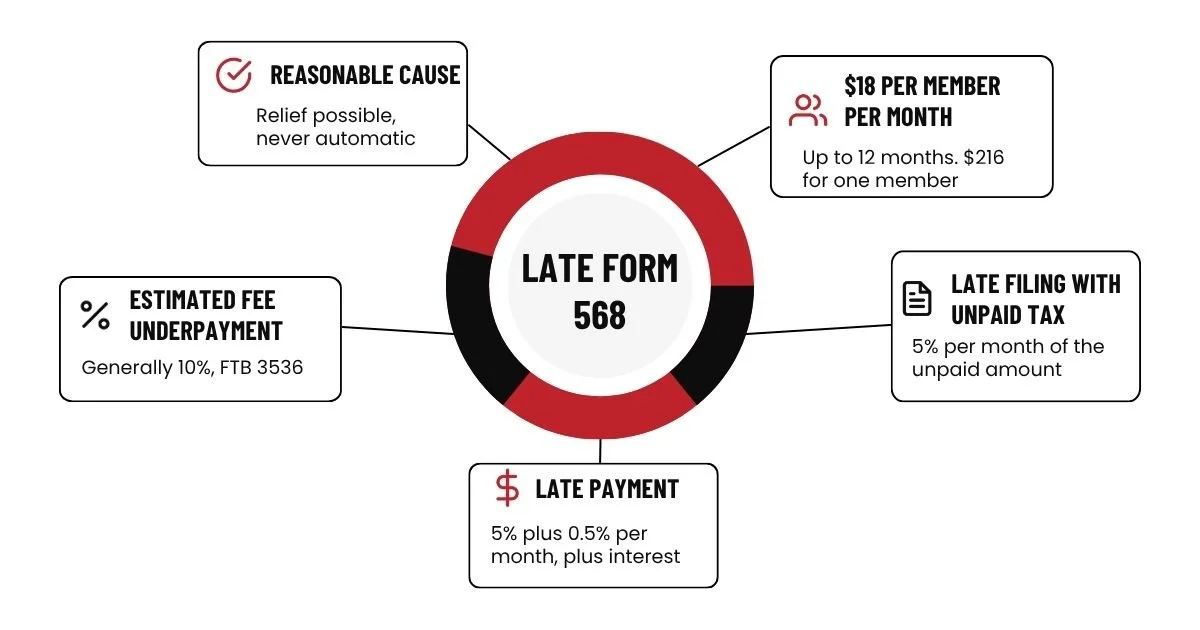
Several California penalties can arise from one missing return.
The penalty needs to be identified before deciding whether relief can be requested.
$18 Per Member Filing Requirement Penalty
California can assess a penalty when an LLC required to file Form 568:
Fails to file timely, including extensions
Files a return that does not include required information
The current penalty is generally $18 multiplied by the number of members during any part of the taxable year for each month or part of a month the failure continues.
The maximum period is 12 months.
For a typical one member SMLLC, that can generally reach $216 for a particular return.
A Separate Late Filing Penalty Can Apply When Tax Is Unpaid
When Form 568 is filed after the extended filing deadline and applicable tax or fees remain unpaid, a separate late filing penalty can apply.
The general calculation can reach 5 percent of the unpaid amount for each month or part of a month the return remains unfiled, subject to the applicable maximum.
Late Payment Penalties Can Also Apply
The general California late payment penalty begins at 5 percent of the unpaid amount.
An additional one half of 1 percent can generally apply for each month or part of a month the amount remains unpaid, subject to the statutory maximum.
Interest can also continue.
Estimated LLC Fee Penalties Can Apply
An LLC expecting to owe the California LLC fee generally estimates and pays that fee during the taxable year using FTB 3536.
An underpayment of the estimated LLC fee can generally result in a 10 percent penalty, subject to applicable exceptions.
Reasonable Cause May Be Available
Certain filing and payment penalties can be reduced or removed when the taxpayer establishes reasonable cause under the applicable California rules.
The analysis should focus on:
What prevented timely compliance
How long the problem lasted
What actions the owner took
When the problem was discovered
How quickly compliance was restored
Penalty relief is not automatic.
What Happens When the FTB Shows Missing Form 568 Returns?
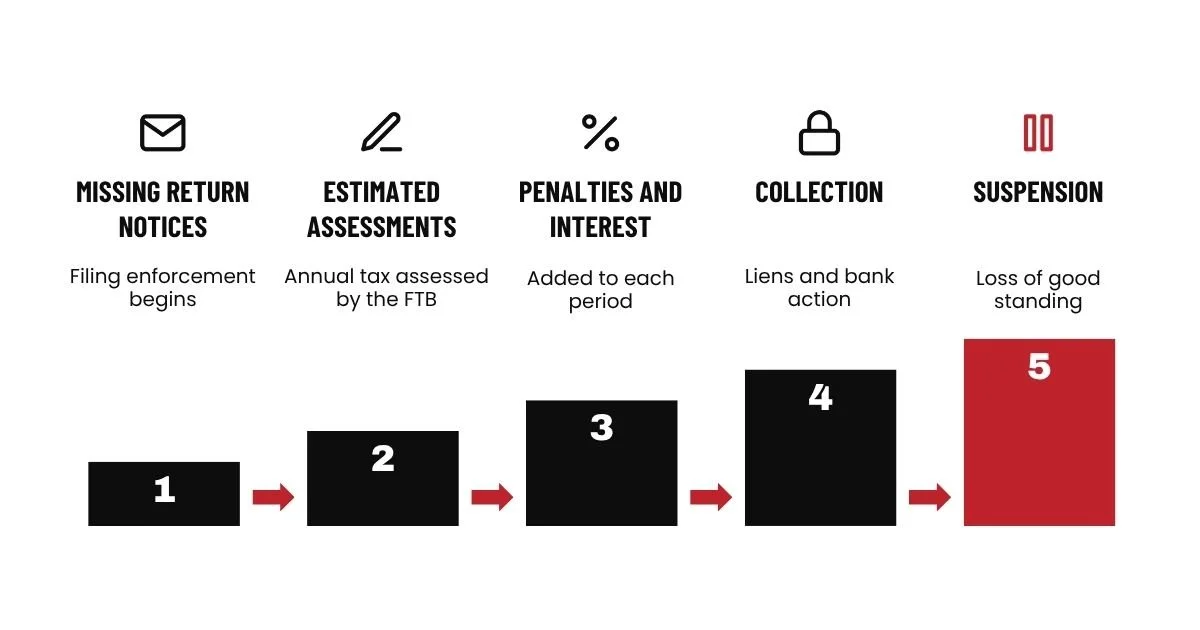
The FTB maintains filing requirement records for California business entities.
When the agency expects Form 568 but has no return, the account can remain delinquent.
Over time, that can lead to:
Missing return notices
Filing enforcement
Estimated assessments
Annual tax assessments
Penalties
Interest
Collection activity
Suspension
The response should depend on whether the return was actually required.
Do Not File a Return for a Period That Was Not Required Without Reviewing the Facts
There are situations where the FTB filing requirement can be incorrect or needs to be updated.
For example:
The LLC was canceled
The entity changed tax classification
A short year exception applied
The LLC never conducted business and completed a qualifying cancellation
The FTB has the wrong entity information
Before filing every period appearing on a notice, I review the California Secretary of State history and the FTB account.
How Many Years of Missing Form 568 Returns Need to Be Filed?

There is no responsible answer based only on the number of years that have passed.
I review each tax period from the entity's formation through the date it was properly canceled, changed classification, or otherwise ended its Form 568 requirement.
That can include reviewing:
Date the LLC was formed
California registration date
Date business began
Federal tax classification
California tax classification
Secretary of State status
Prior Forms 568
Annual tax payments
Date business ended
Cancellation documents
Stopping Business Does Not Automatically Stop Form 568 Requirements
An owner may say:
"I closed the business five years ago."
The next question is whether the LLC itself was properly canceled.
California generally requires LLCs to continue filing and paying annual tax until the appropriate closing requirements are completed.
That makes the entity history just as important as the business bank records.
What If the LLC Never Made Any Money?
A Form 568 filing review may still be required.
The question is not simply whether the business earned a profit.
I review:
Whether the LLC was organized in California
Whether it remained registered
Whether it conducted business
Whether it qualified for a short taxable year exception
Whether it was properly canceled
An inactive LLC can still have filing and annual tax requirements if the entity remained open.
An LLC Formed but Never Operated May Have Cancellation Options
California provides several cancellation procedures depending on the circumstances.
A domestic LLC formed recently that never operated may qualify for a short form cancellation when the statutory requirements are met.
Certain older domestic entities may qualify for FTB voluntary administrative cancellation when the specific requirements are satisfied.
Those procedures should be reviewed before assuming every open year must be handled exactly the same way.
What Records Are Needed to File Old Form 568 Returns?

The records depend on the business and the number of missing years.
Useful documents can include:
Articles of Organization
California Secretary of State records
EIN confirmation
Prior Forms 568
Federal Forms 1040
Schedule C
California Forms 540
Bank statements
Credit card statements
Profit and loss statements
General ledger
Sales reports
Forms 1099
Merchant processor records
Rental records
Investment records
Asset sale records
Payroll records
Annual LLC tax payments
Forms FTB 3522
Forms FTB 3536
FTB notices
MyFTB account information
Business closure documents
Cancellation filings
Several Years of Bookkeeping May Need to Be Reconstructed
Schedule IW and the California LLC fee can depend on the business's total California income.
If the books are incomplete, I may need to reconstruct the financial activity from bank statements, accounting records, merchant reports, federal tax filings, and other available documents.
The return should reflect the actual business activity rather than a guessed income figure.
Our Process for Filing Unfiled California Form 568 Returns
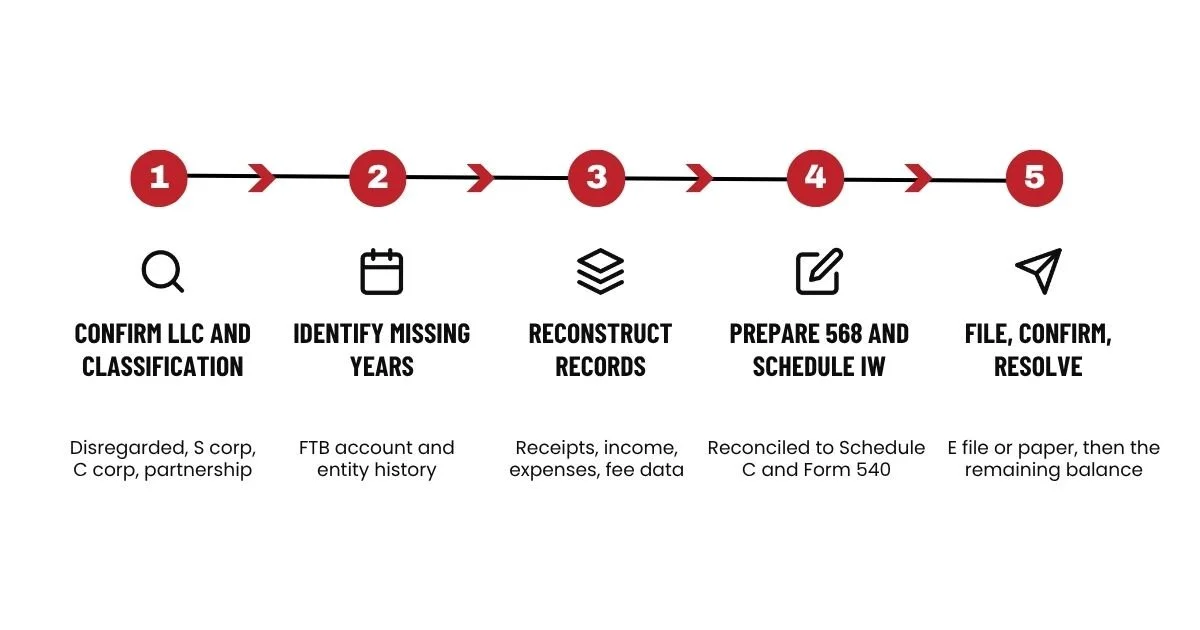
I use a year by year process because the filing requirement, owner, business activity, and California fee can change.
Step 1, Confirm the LLC
I review:
Legal LLC name
California Secretary of State number
EIN
Formation date
Registration date
Current status
Owner
Step 2, Confirm the Tax Classification
I determine whether the LLC was:
Disregarded
Taxed as an S corporation
Taxed as a C corporation
Taxed as a partnership
This determines which California return should actually have been filed.
Step 3, Identify the Missing Form 568 Years
I compare the FTB account, California entity history, prior returns, and owner filings.
I do not assume every year appearing open on an old checklist requires the same response.
Step 4, Reconstruct the Financial Records
We organize:
Gross receipts
Other income
Business expenses
California source income
LLC fee information
Annual tax payments
Step 5, Reconcile With the Owner's Tax Return
For a disregarded individually owned SMLLC, I compare Form 568 information with:
Federal Schedule C
Other federal schedules
California Form 540
The filings should reflect the same underlying business activity while applying the correct California reporting rules.
Step 6, Prepare Schedule IW and Required Form 568 Sections
The SMLLC return is prepared using the forms and rules applicable to each tax year.
Additional schedules are prepared when the applicable reporting thresholds or facts require them.
Step 7, Calculate Annual Tax and LLC Fee
I review:
Annual LLC tax already paid
LLC fee due
Estimated fee payments
Credits
Other account payments
The goal is to avoid paying an amount twice when prior payments are already sitting on the FTB account.
Step 8, File Through the Proper FTB Procedure
California generally requires business returns prepared using tax preparation software to be filed electronically.
The current FTB business e file system supports original and amended returns for the current year and the prior two tax years.
Older delinquent years may require paper filing or another FTB accepted filing procedure.
The filing method is reviewed year by year.
Step 9, Confirm FTB Processing
After filing, I review whether:
The return posted
Payments were applied correctly
Penalties were assessed
Annual tax balances remain
LLC fees remain
Additional FTB notices were generated
Step 10, Address the Remaining FTB Problem
Once filing compliance is restored, the next issue may be:
Payment
Payment plan
Penalty relief
Offer in Compromise
FTB collection
Suspension
Revivor
Cancellation
That becomes a separate FTB resolution analysis.
What If the Missing Form 568 Returns Create a Large FTB Balance?

Do not delay required returns simply because you cannot immediately pay everything the LLC may owe.
Filing and payment are separate compliance obligations.
After the correct returns process, the available California procedures can be reviewed using the actual balance.
Possible procedures may include:
Full payment
FTB business payment plan
Provisional Payment Plan when applicable
Offer in Compromise
Penalty relief
Liability correction
Another FTB collection procedure supported by the facts
The correct option depends on the amount owed, business status, filing compliance, assets, income, and ability to pay.
What If the SMLLC Is Suspended?
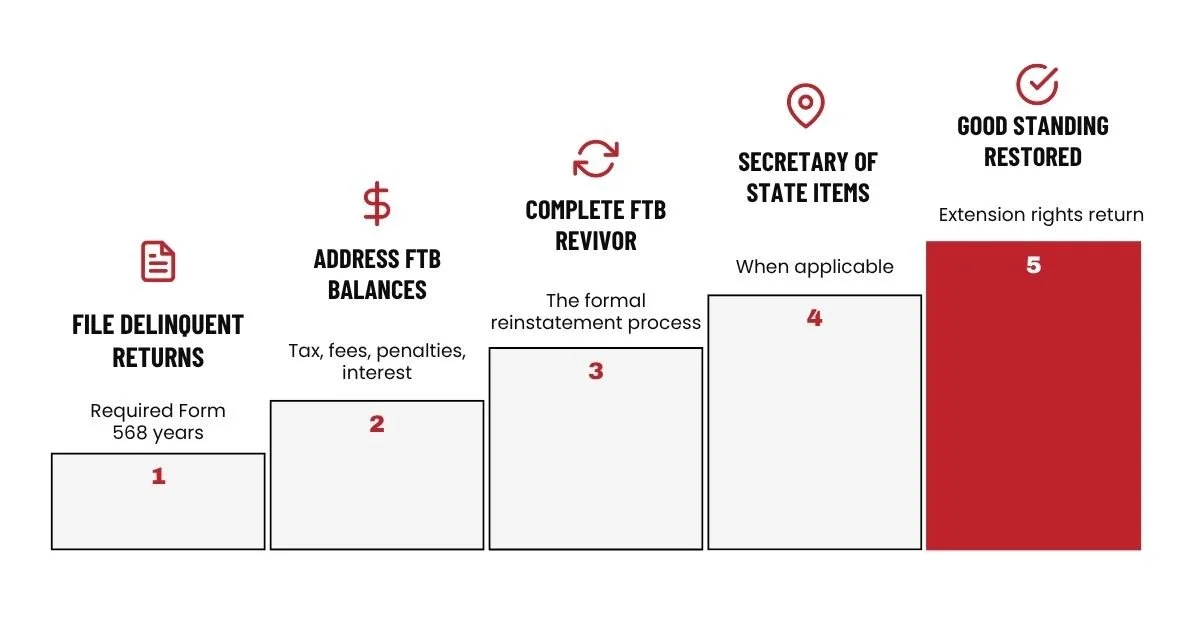
A California LLC can be suspended when required returns are not filed or taxes, fees, penalties, or interest remain unpaid.
A suspended entity can lose important California rights, powers, and privileges.
Filing Form 568 Is Part of Revivor, but It May Not Be the Only Step
Restoring good standing can require:
Filing required delinquent returns
Addressing FTB balances
Completing the applicable FTB revivor process
Addressing Secretary of State requirements when applicable
Simply submitting the missing Form 568 returns does not necessarily reactivate the business immediately.
Suspension Can Affect the Filing Extension
A suspended or forfeited LLC may not qualify for the normal automatic filing extension.
That is another reason the historical entity status should be reviewed when calculating late filing penalties.
What If the LLC Should Have Been Canceled Years Ago?
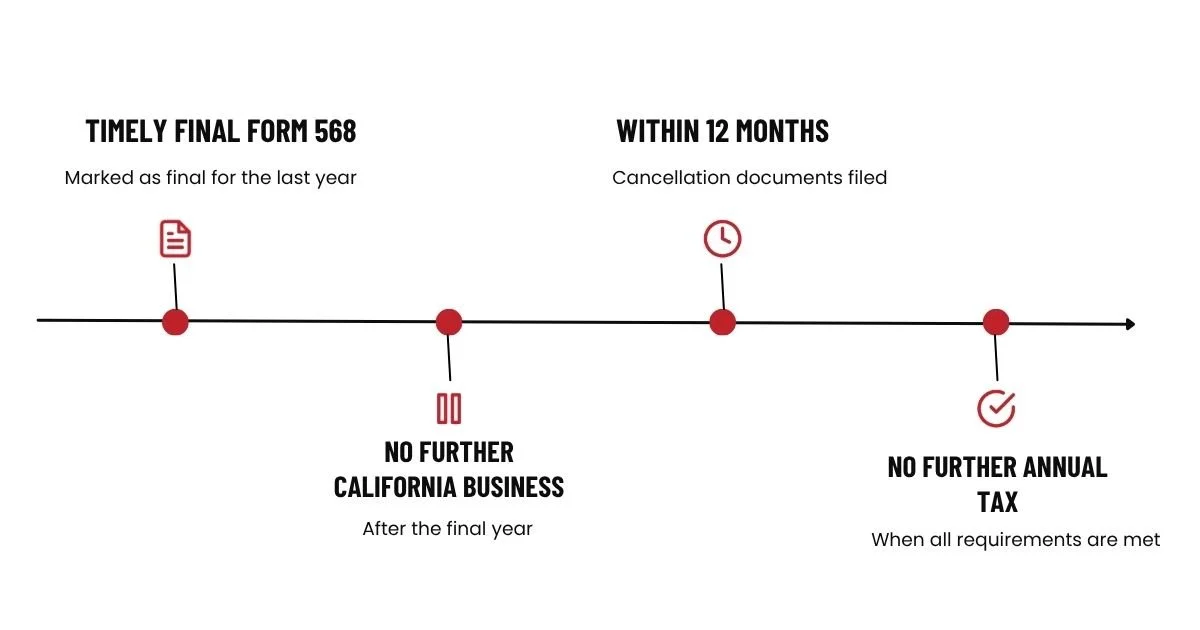
An LLC that permanently stops operating should review the final Form 568 and Secretary of State cancellation requirements.
California generally continues the annual tax until the appropriate cancellation papers are filed.
A Final Form 568 Is Part of the Closing Process
The final tax year should generally be identified as the final return.
The FTB instructions also require the appropriate California closing procedures.
Timing the Cancellation Can Prevent Another Tax Year From Opening
Current FTB instructions explain that the effective date of the California cancellation can stop future annual LLC tax assessments.
If the cancellation occurs after another taxable year begins, another return and another $800 annual tax can potentially become due.
The Twelve Month Cancellation Rule Can Matter
Current California instructions provide that a subsequent annual tax generally will not be assessed when all applicable requirements are met, including:
A timely final Form 568 for the preceding taxable year
No California business after that final year
Proper California cancellation documents filed within 12 months of the timely final return
The exact cancellation path should be coordinated with the entity's status.
Common Mistakes With California Form 568
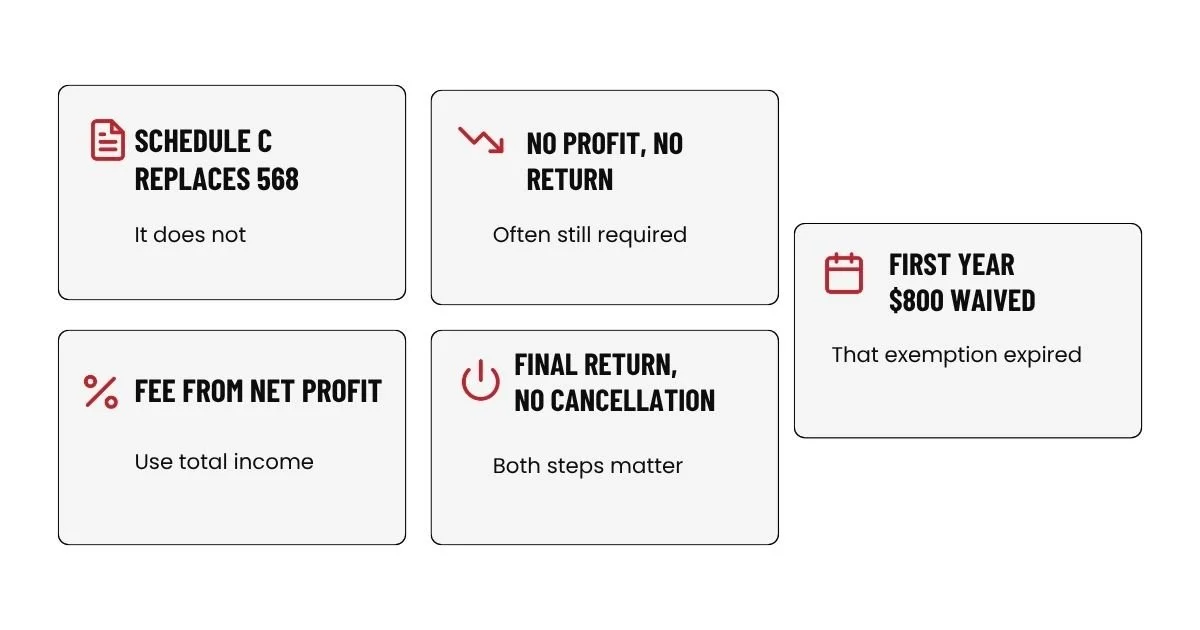
Assuming Schedule C Replaces Form 568
It does not.
The owner's federal income tax reporting and the California LLC filing requirement are separate.
Assuming No Profit Means No Return
Form 568 can still be required even when the business had a loss.
Assuming the First Year $800 Tax Is Still Waived
The temporary first year exemption expired after qualifying tax years beginning before 2024.
Calculating the LLC Fee From Net Profit
The fee is based on California total income under the applicable Form 568 rules.
Issuing a Schedule K 1 to the Sole Owner Without Reviewing the SMLLC Rules
A disregarded SMLLC generally does not issue itself a Schedule K 1 merely because it files Form 568.
Ignoring Schedule IW
Schedule IW is generally required for a disregarded SMLLC and is used to determine California total income for the LLC fee.
Filing Every Open Year Without Checking Entity Status
Formation, cancellation, tax classification, and suspension can change what should actually be filed.
Filing the Return but Ignoring Payments Already Made
Annual tax and estimated LLC fee payments should be reconciled with the FTB account.
Filing a Final Return Without Canceling the Entity
A final Form 568 and California Secretary of State cancellation serve different purposes.
Both can matter.
Why Work With Semper Tax Relief for Missing Form 568 Returns?

A multi year Form 568 filing project can involve both tax preparation and California entity compliance.
I review:
California LLC status
Federal tax classification
Form 568 filing history
Schedule C reporting
Schedule IW
California total income
Annual LLC tax
LLC fees
FTB notices
Penalties
Payments
Suspension
Final return requirements
Cancellation history
I am Sergio Melendez, JD, EA.
I have worked in the tax profession since 2005.
My Juris Doctor degree is an educational credential.
My federal authority to represent taxpayers before the IRS comes from my Enrolled Agent credential.
California FTB representation is handled through the applicable California Power of Attorney procedures.
The objective is to determine which returns are actually required, prepare them using supportable records, confirm what the FTB account shows after processing, and then address any remaining California tax problem.
Results depend on the LLC's classification, formation and cancellation dates, owner, business activity, financial records, California income, filing history, payments, and applicable FTB rules.
Frequently Asked Questions About Unfiled California Form 568 Returns
-
Generally, yes.
California requires a disregarded SMLLC to file Form 568 when the applicable California LLC filing requirements are met.
The owner may report the business activity on federal Schedule C while the LLC separately files Form 568 with the FTB.
-
Possibly, and often yes.
The Form 568 filing requirement can exist because the LLC is organized, registered, or doing business in California.
The requirement does not depend only on whether the business generated a profit.
The entity status and activity for the year should be reviewed.
-
California can impose a filing requirement penalty of $18 per member for each month or part of a month the failure continues, for up to 12 months.
For a one member SMLLC, that can generally reach $216 for a return.
Separate late filing, late payment, estimated fee, interest, and other penalties may also apply depending on the account.
-
A disregarded SMLLC generally does not issue a Schedule K 1 to its sole owner simply because it files Form 568.
Instead, the SMLLC generally completes the required Form 568 sections, owner information and consent, and Schedule IW.
Additional Schedules B and K can be required when current reporting thresholds are reached.
-
California generally grants a qualifying disregarded SMLLC an automatic filing extension.
For an individually owned calendar year SMLLC, the extended filing deadline is generally October 15.
The extension does not extend the deadlines for the annual LLC tax or applicable LLC fee.
A suspended or forfeited entity may not qualify for the automatic extension.
-
California business e file currently supports original and amended business returns for the current year and prior two tax years.
Older delinquent returns may require paper filing or another FTB accepted procedure.
The filing method should be confirmed for each tax year.
-
Stopping business activity does not automatically cancel the California LLC.
I review when business activity ended, whether final returns were filed, whether Secretary of State cancellation was completed, and what later years the FTB still expects.
A final filing and cancellation strategy may be needed.
-
Yes.
I can review the entity history, federal classification, FTB account, owner tax returns, financial records, annual tax payments, and cancellation status to determine which Form 568 returns need to be prepared.
If bookkeeping is incomplete, the records may need to be reconstructed before the returns and LLC fee calculations can be completed.
Get a Free California Form 568 Filing Case Review
If your single member LLC has missing California returns, start with the entity history rather than guessing how many Form 568 returns need to be filed.
I can review:
California Secretary of State status
LLC formation date
LLC cancellation history
Federal tax classification
Missing Form 568 years
Schedule C filings
Schedule IW
California total income
$800 annual LLC tax
California LLC fees
FTB payments
Late filing penalties
Late payment penalties
FTB notices
Suspension
Final return requirements
Related owner tax problems
You do not need to have every year of bookkeeping completed before requesting the review.
Bring the FTB notices, prior returns, bank records, Schedule C returns, California LLC documents, and bookkeeping records currently available.
I can help determine what should be filed and what needs to happen next.