
IRS Private Collection Agency Tax Debt Help
Our IRS Tax Power of Attorney Representatives in Orange County eliminate tax problems so that you can live your best life!
Specializing in Stopping & Settling Tax Problems
Do I Qualify for the Best Tax Relief? Find out with a Free Case Review
Call or Book Online (24 Hours /7 Days a week)
✔ 100% Confidential ✔No Sales Pressure ✔Personalized Strategy
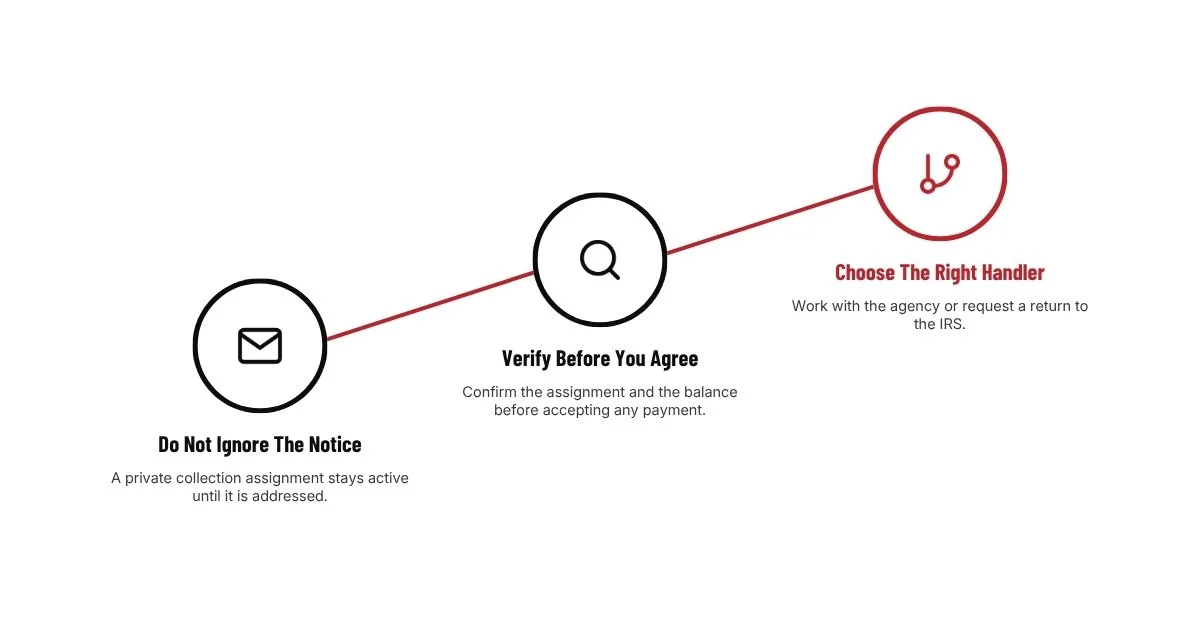
If you received a letter stating that your tax debt was assigned to a private collection agency, you still owe the debt to the Internal Revenue Service. The private company is contacting you as an IRS contractor, but it does not have all the authority or resolution options available to the IRS.
You should verify that the assignment is legitimate before discussing your account or providing information. You should also understand whether working with the collection agency is appropriate for your financial circumstances.
I am Sergio Melendez, a tax attorney and enrolled agent. I have worked in tax resolution since 2005. At Semper Tax Relief, my team and I help taxpayers verify private collection assignments, understand the underlying tax liability, evaluate payment and resolution options, and determine whether the account should remain with the collection agency or be returned to the IRS.
Why Did the IRS Send My Tax Debt to a Private Collection Agency?

Federal law requires the IRS to use private collection agencies for certain outstanding tax debts that the IRS considers inactive.
An account may be treated as inactive when the IRS has not assigned it to an employee for collection, has been unable to locate or contact the taxpayer, or has not had meaningful contact with the taxpayer or an authorized representative for an extended period.
Assignment to a private collection agency does not mean that the debt was sold. The tax is still owed to the United States government, and the IRS remains responsible for the account.
The assignment also does not mean that the balance is correct. Before entering a payment arrangement, it may be necessary to review the tax periods, assessments, penalties, payments, collection deadlines, and any missing returns associated with the account.
Which Private Collection Agencies Work With the IRS?
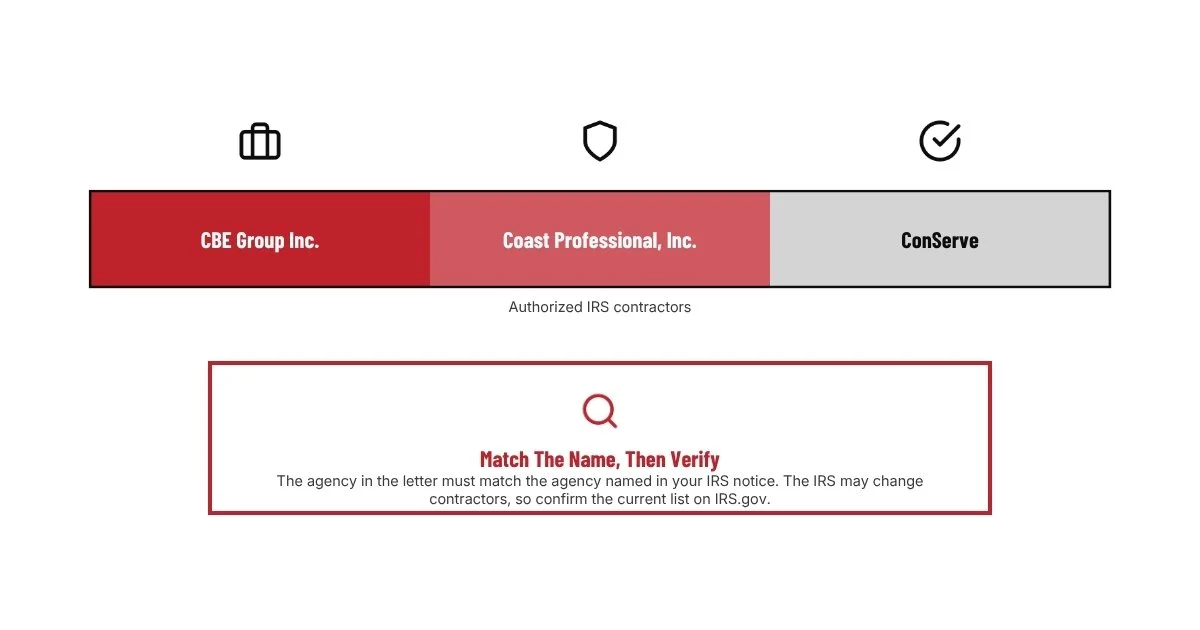
The IRS currently identifies the following private collection agencies as authorized contractors:
• CBE Group Inc.
• Coast Professional, Inc.
• ConServe
The collection agency identified in your letter should match the agency named in the IRS notice you received.
The IRS may change its contractors. Always verify the current list on IRS.gov and compare it with your notice before communicating with anyone claiming to collect federal tax debt.
How to Verify an IRS Private Collection Notice
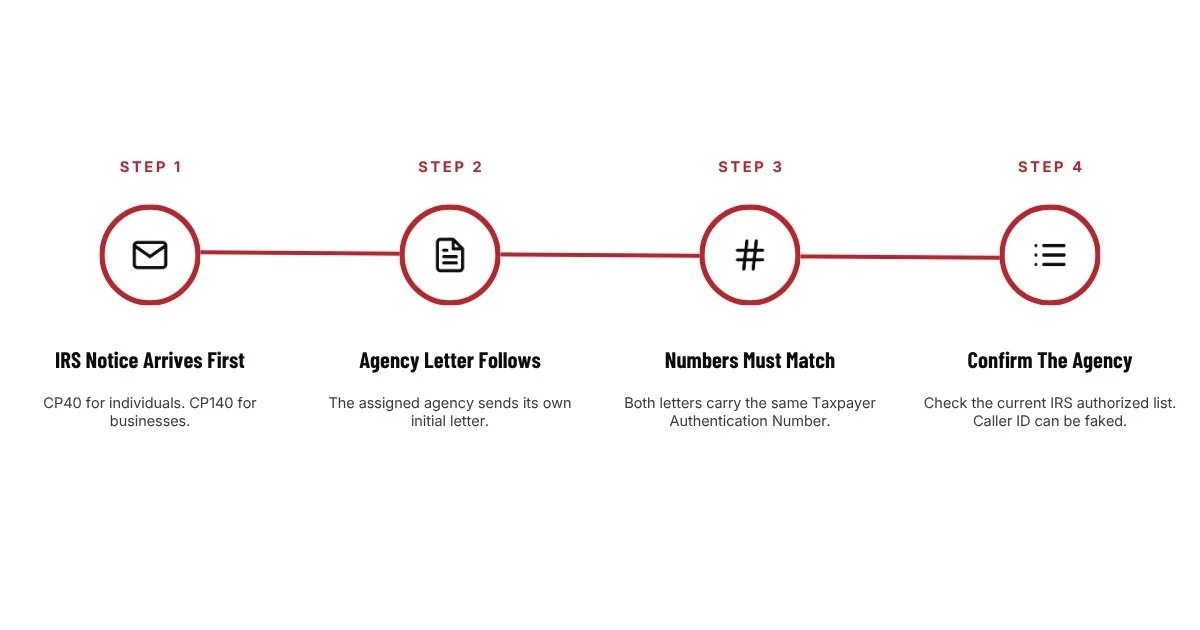
Before a private collection agency calls you, the IRS should send an assignment notice.
Individual taxpayers generally receive Notice CP40. Business taxpayers may receive Notice CP140. The assigned private collection agency should then send its own initial contact letter.
The IRS notice and the collection agency letter should contain the same Taxpayer Authentication Number. This number allows you and the collection agency representative to verify each other’s identity.
A legitimate private collection assignment generally includes:
• A notice from the IRS identifying the assigned agency.
• A separate letter from the private collection agency.
• A matching Taxpayer Authentication Number in both letters.
• Contact from one of the agencies currently authorized by the IRS.
• Instructions requiring payments to be made to the IRS, not to the collection company.
An IRS account transcript may also show that the account was referred to a private collection agency.
Do not rely only on caller identification. Telephone numbers and caller names can be manipulated by scammers.
What Can an IRS Private Collection Agency Do?
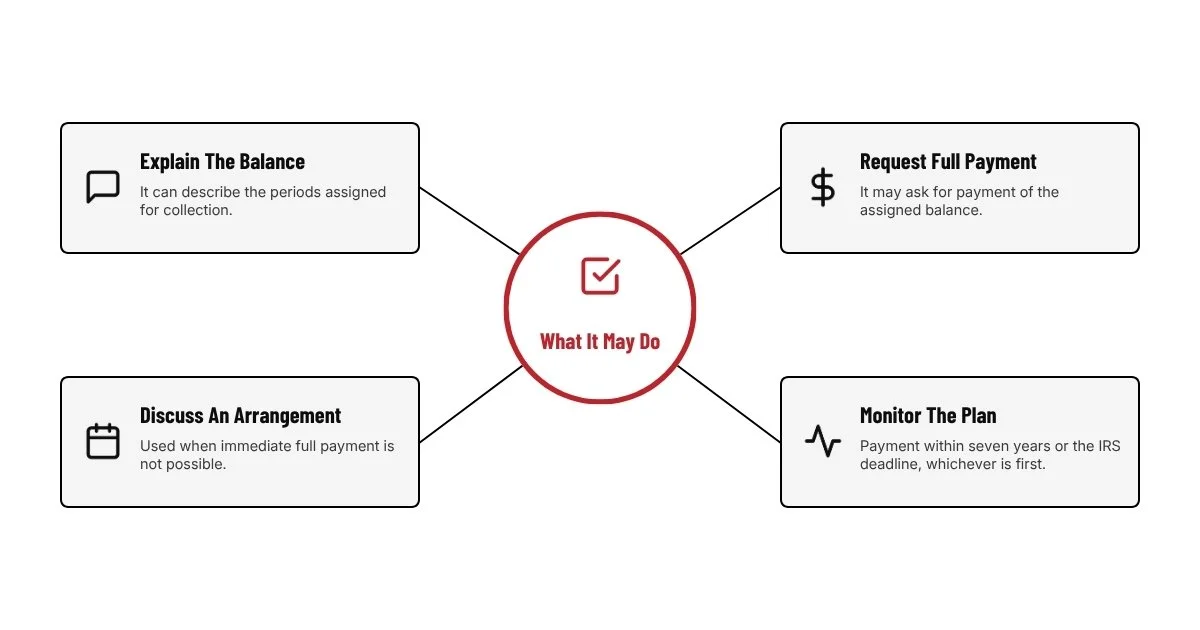
An authorized private collection agency may contact you about the assigned tax balance and discuss how you intend to pay it.
The agency may:
• Explain the balance assigned to it for collection.
• Request full payment of the assigned balance.
• Discuss a payment arrangement when immediate full payment is not possible.
• Establish and monitor an arrangement intended to pay the debt within the permitted time.
• Provide information about making payments directly to the IRS.
A private collection agency may generally arrange payments that would pay the assigned balance in full within seven years or before the applicable IRS collection deadline, whichever occurs first.
Before agreeing to a monthly payment, you should determine whether it is affordable and whether another IRS resolution may be more appropriate.
What Can a Private Collection Agency Not Do?
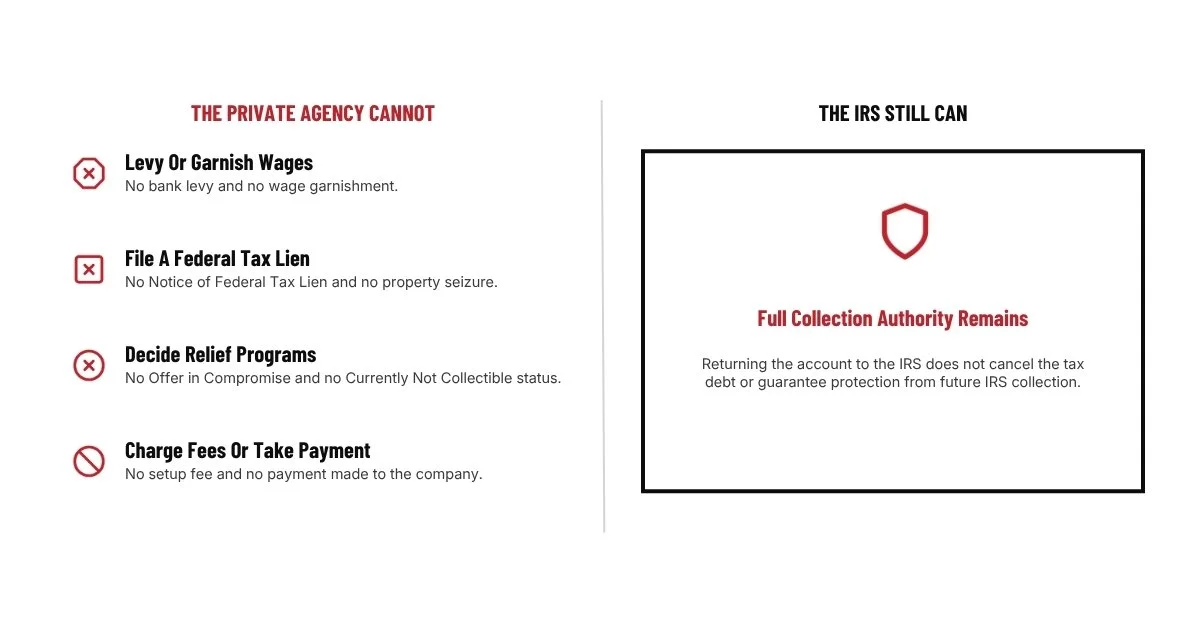
An IRS private collection agency has limited authority.
A private collection agency cannot:
• Issue a tax levy.
• Garnish your wages.
• seize money from your bank account.
• File a Notice of Federal Tax Lien.
• Seize your home, vehicle, or business property.
• Issue an IRS summons.
• Accept or reject an Offer in Compromise.
• Approve Currently Not Collectible status.
• Make final decisions about disputed tax liabilities.
• Report your federal tax debt to a credit reporting agency.
• Charge you a fee for establishing a payment arrangement.
• Require you to make payment directly to the private collection agency.
Although the private agency cannot take these enforcement actions, the IRS retains its collection authority. Having the account returned to the IRS does not cancel the tax debt or guarantee protection from future IRS collection.
Make Every Tax Payment Directly to the IRS
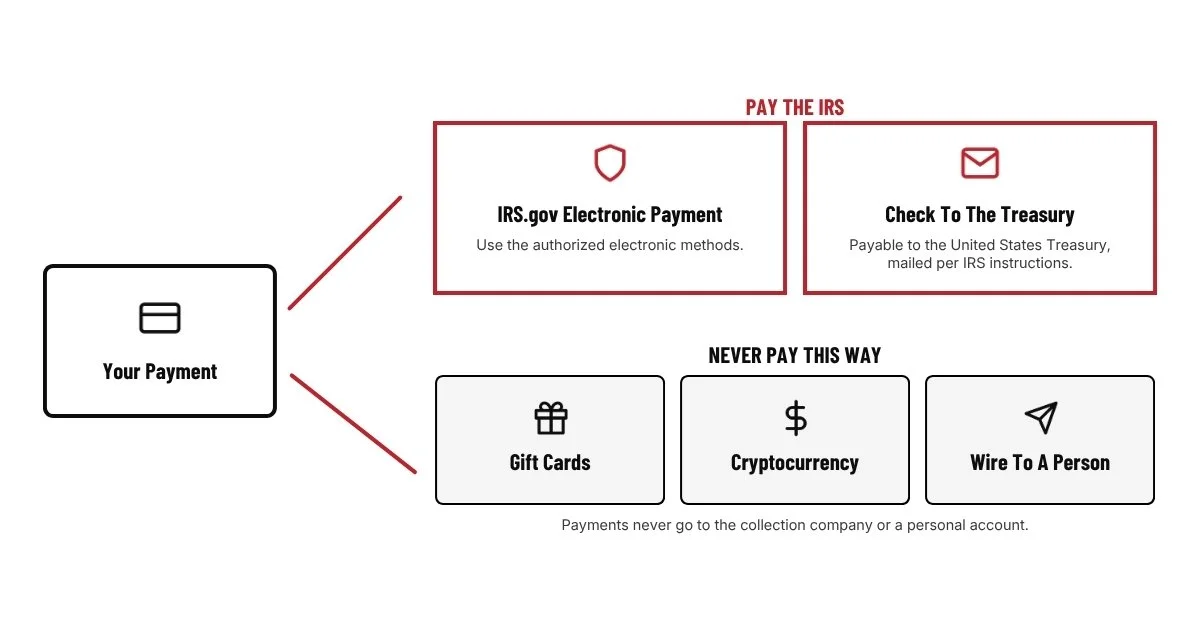
Payments must be made to the IRS, not to the private collection agency or an individual representative.
The IRS provides authorized electronic payment methods through IRS.gov. If paying by check, the payment should be made payable to the United States Treasury and mailed according to official IRS instructions.
A legitimate IRS contractor will not demand payment using:
• Gift cards.
• Cryptocurrency.
• Wire transfers to an individual.
• Payment to the private collection company.
• Payment to a personal account.
• Threats of immediate arrest or deportation.
If a caller uses threats, demands unusual payment methods, or cannot complete the authentication process, do not provide personal or financial information.
Can I Have My Account Returned to the IRS?

You are not required to continue working with the assigned private collection agency.
If you do not want the agency to contact you, you may submit a written request asking the agency to return the account to the IRS. The request should be sent directly to the private collection agency using a verifiable delivery method, and you should retain a complete copy.
Returning the account to the IRS does not:
• Remove the tax liability.
• Stop penalties or interest from continuing where applicable.
• Approve a payment plan.
• Place the account in Currently Not Collectible status.
• Approve an Offer in Compromise.
• Prevent the IRS from pursuing future collection.
The return request changes who is handling the account. A separate resolution strategy may still be required.
When Returning the Account to the IRS May Make Sense

A private collection agency primarily seeks full payment or a payment arrangement that will pay the assigned balance within the permitted period. It cannot evaluate or approve several important IRS resolution programs.
Requesting that the account be returned to the IRS may be appropriate when:
• You cannot afford the payment requested by the collection agency.
• Paying the requested amount would prevent you from meeting necessary living expenses.
• You may qualify for Currently Not Collectible status.
• You want the IRS to consider an Offer in Compromise.
• You dispute part or all of the underlying tax liability.
• Payments were not properly credited.
• Returns must be prepared or corrected.
• You need penalty relief considered.
• You believe the collection deadline may be approaching or has expired.
• You qualify for an exclusion from the private collection program.
• Your situation requires an IRS determination that the collection agency cannot make.
The correct decision depends on your account history, financial condition, filing compliance, collection deadlines, and long term objectives.
Accounts That May Be Excluded From Private Collection
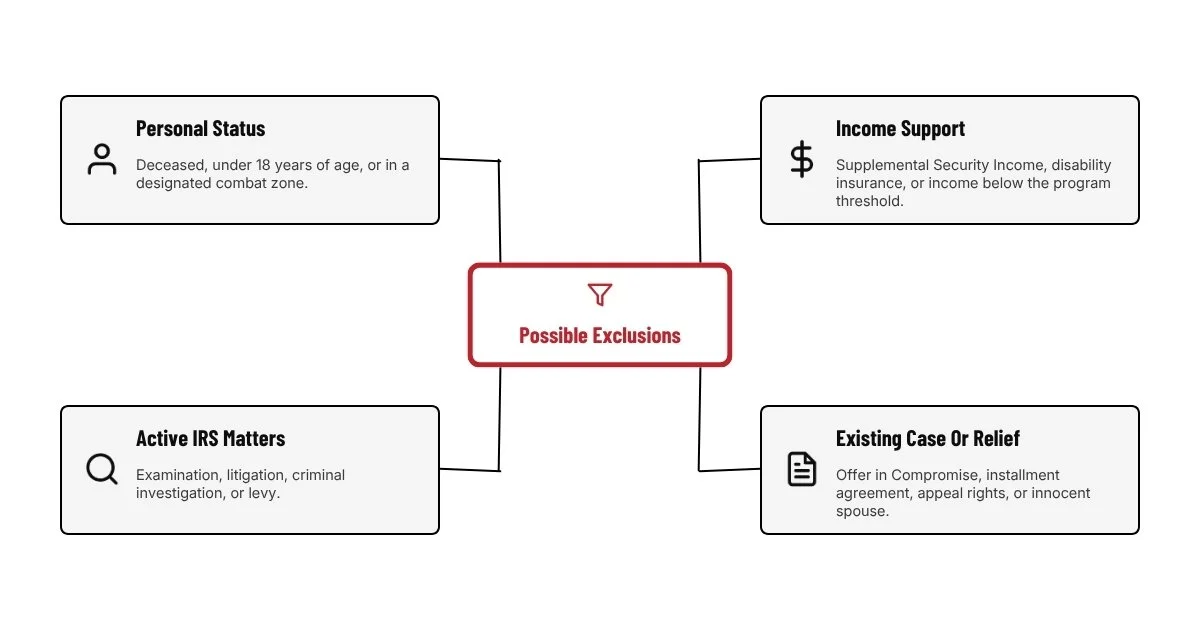
The IRS states that certain accounts are excluded from assignment to private collection agencies.
These exclusions may apply when a taxpayer is:
• Deceased.
• Under 18 years of age.
• In a designated combat zone.
• A victim of tax related identity theft.
• Receiving Supplemental Security Income.
• Receiving Social Security Disability Insurance.
• Below the applicable income threshold established for the program.
• Currently under examination, litigation, criminal investigation, or levy.
• Subject to a pending or active Offer in Compromise.
• Subject to an installment agreement.
• Subject to certain appeal rights.
• Involved in an innocent spouse case.
• Requesting applicable collection relief in a presidentially declared disaster area.
Eligibility depends on the taxpayer’s current circumstances and IRS records. If an account appears to have been assigned incorrectly, the supporting information should be documented and presented through the proper channel.
Your Tax Debt Should Be Reviewed Before You Agree to Pay

A collection agency’s payment request is based on the balance assigned by the IRS. It is not a complete legal or financial analysis of your case.
Before committing to a payment arrangement, I may review:
• The tax years included in the assigned balance.
• The original tax assessments.
• Additional assessments made by the IRS.
• Penalties and accrued interest.
• Payments and credits posted to the account.
• Unfiled tax returns.
• Substitute for Return assessments.
• Existing federal tax liens.
• Prior installment agreements.
• Offer in Compromise history.
• Collection Statute Expiration Dates.
• Your current income, expenses, assets, and liabilities.
This review helps determine whether the assigned balance appears accurate and which resolution paths may be available.
Resolution Options After a Private Collection Assignment
Depending on the facts of the case, potential options may include:
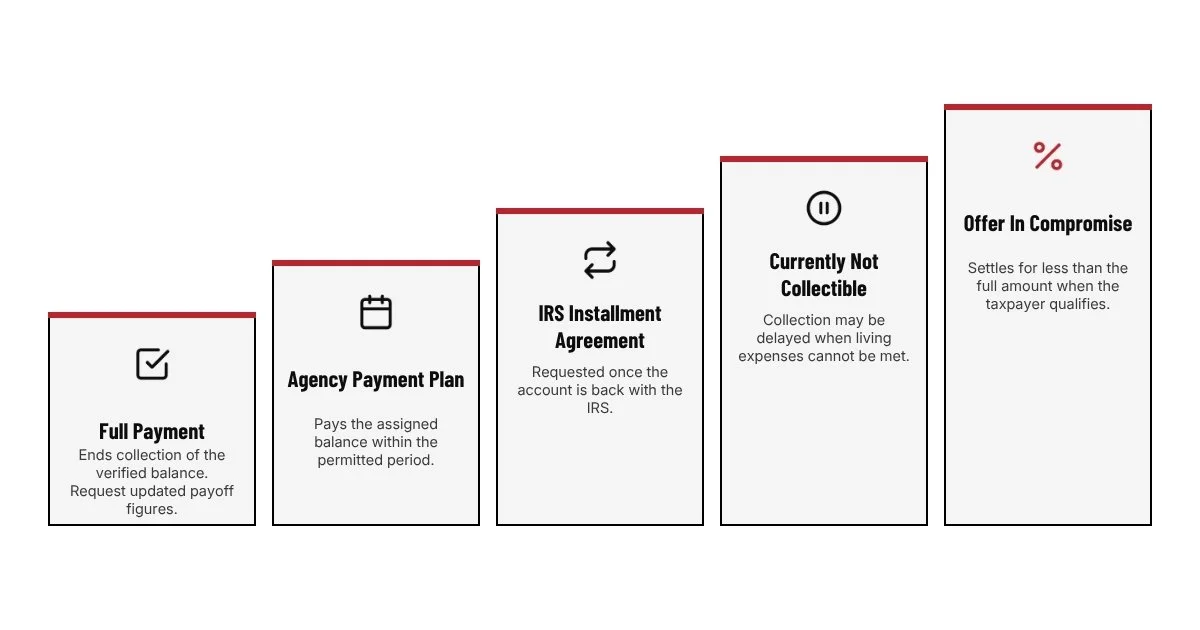
Full Payment
Paying the verified balance in full generally ends collection of that balance. Updated payoff information should be obtained because penalties and interest may continue until the account is fully paid.
Payment Arrangement
A private collection agency may establish and monitor an arrangement designed to pay the assigned balance within the permitted period. The payment should be affordable and evaluated against other available options.
IRS Installment Agreement
If the account is returned to the IRS, the taxpayer may request an installment agreement. Approval, payment terms, filing requirements, financial disclosure, and possible lien consequences depend on the taxpayer’s circumstances and IRS procedures.
Currently Not Collectible Status
Taxpayers who cannot pay necessary living expenses may ask the IRS to consider temporarily delaying collection. The IRS may require financial documentation. Interest and penalties generally continue, and the IRS may review the taxpayer’s financial condition later.
Offer in Compromise
An Offer in Compromise may allow an eligible taxpayer to resolve a tax liability for less than the full amount owed. Qualification is not based only on the size of the balance. The IRS evaluates ability to pay, income, expenses, assets, filing compliance, and other requirements.
Penalty Relief
Some taxpayers may qualify for penalty relief based on reasonable cause, administrative criteria, or another recognized basis. Penalty relief is not automatic, and interest is generally reduced only when the related penalty or tax is adjusted.
Liability Review or Correction
If the balance resulted from an incorrect return, an IRS prepared return, missing information, identity theft, or an improperly applied payment, a separate correction or dispute procedure may be necessary.
How Semper Tax Relief Can Help
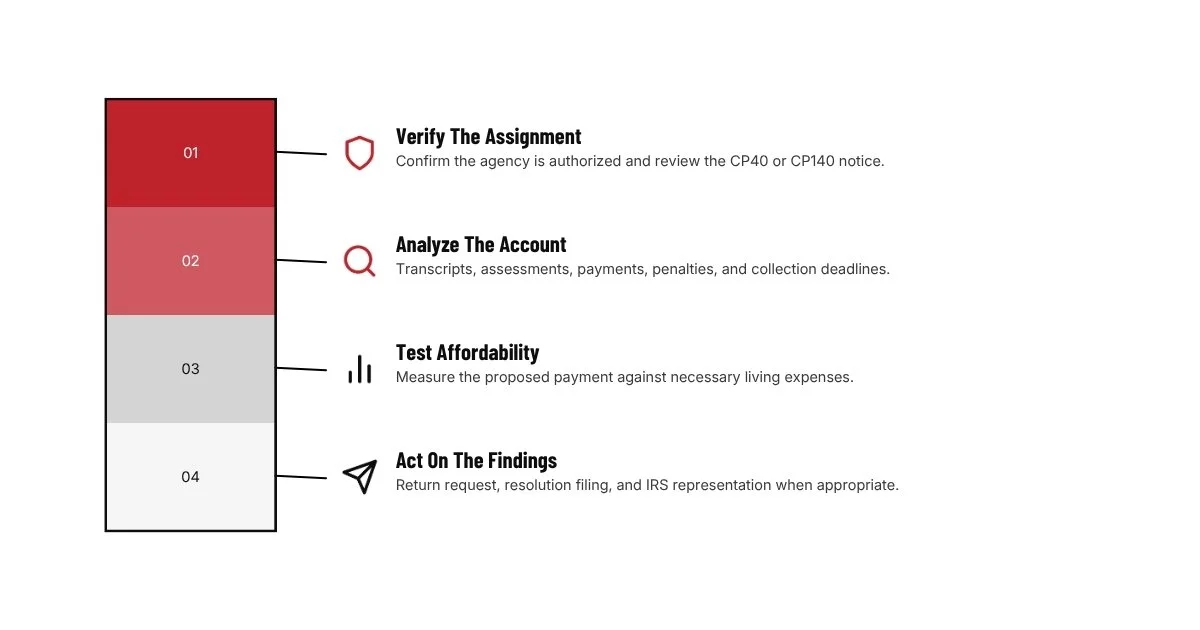
My team and I can evaluate both the private collection assignment and the underlying IRS account.
Our services may include:
• Verifying that the collection agency is authorized by the IRS.
• Reviewing the CP40, CP140, or other collection notice.
• Obtaining and analyzing IRS account transcripts.
• Confirming the tax periods and balances involved.
• Identifying missing returns or compliance problems.
• Reviewing payments, penalties, and assessments.
• Evaluating the IRS collection deadlines.
• Determining whether a private collection exclusion may apply.
• Assessing the affordability of a proposed payment arrangement.
• Preparing a written request to return the account to the IRS when appropriate.
• Evaluating installment agreement, hardship, Offer in Compromise, penalty relief, or liability correction options.
• Representing you before the IRS when representation is authorized and appropriate.
The objective is not merely to stop collection calls. It is to understand the entire account and develop a legally supportable path for addressing the tax debt.
Our IRS Private Collection Review Process
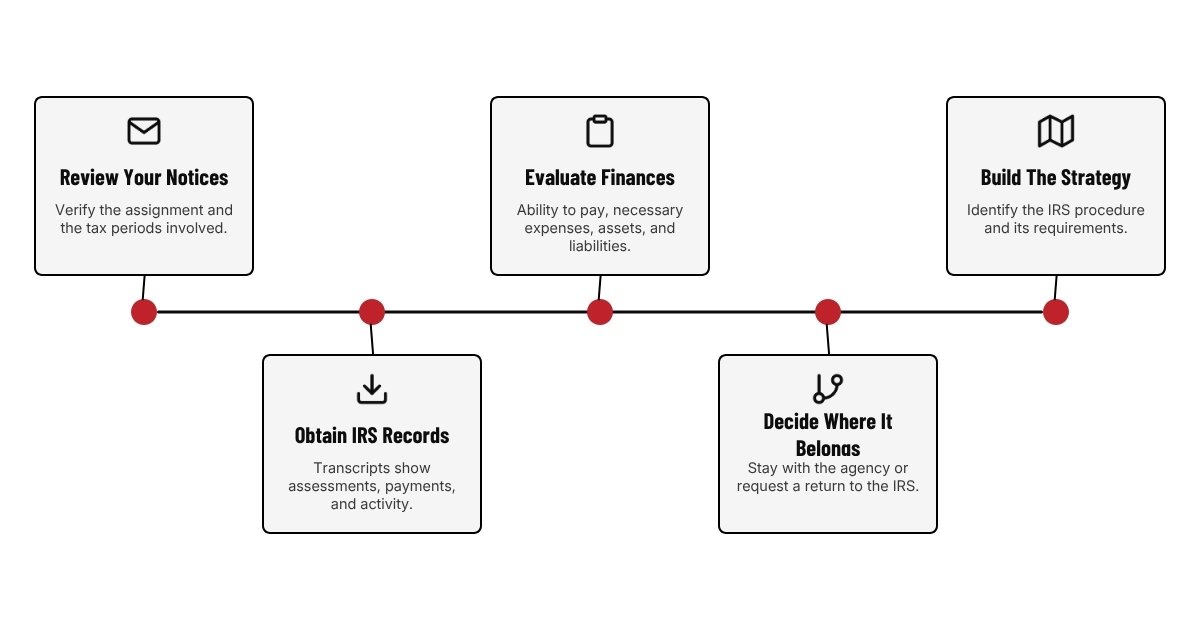
Step 1, Review Your Notices
We review the IRS notice and the private collection agency’s letter to verify the assignment and identify the tax periods involved.
Step 2, Obtain IRS Account Information
When authorized, we obtain available IRS transcripts and account information to examine assessments, payments, penalties, filing status, and collection activity.
Step 3, Evaluate Your Financial Circumstances
We review your ability to pay, necessary expenses, assets, liabilities, and other facts relevant to potential resolution options.
Step 4, Determine Where the Account Should Be Handled
We evaluate whether it is appropriate to work with the private collection agency or request that the account be returned to the IRS.
Step 5, Develop the Resolution Strategy
If additional action is required, we identify the appropriate IRS procedure and explain its requirements, limitations, and likely next steps.
Why Work With Semper Tax Relief?
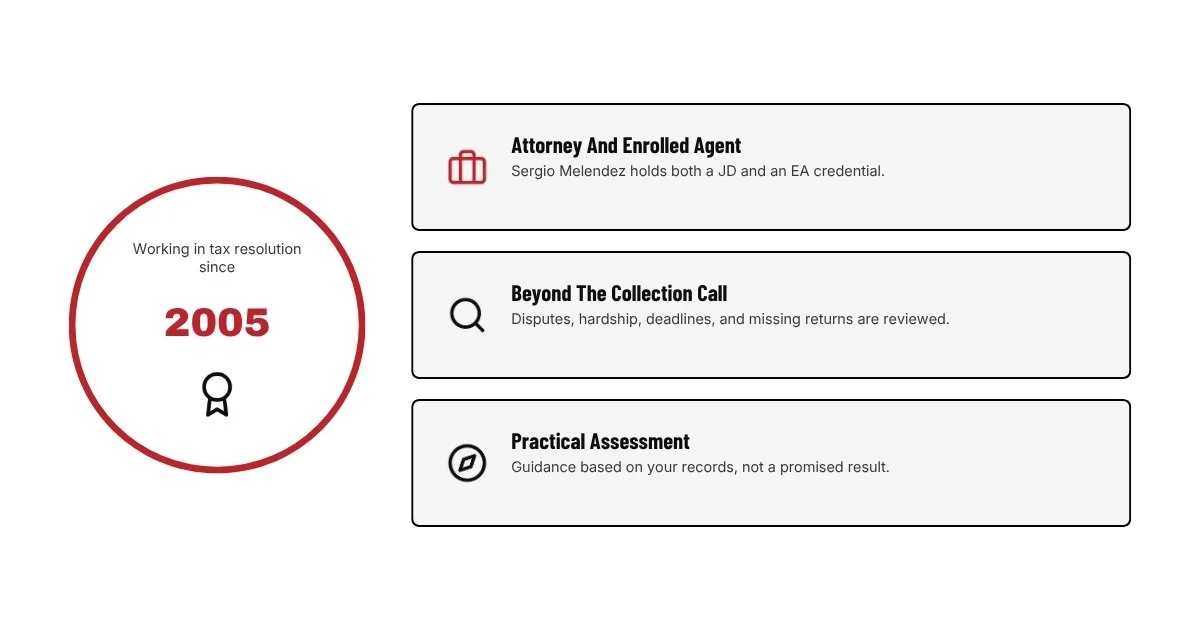
I have worked in tax resolution since 2005. As both a tax attorney and an enrolled agent, I approach private collection cases by looking beyond the collection call.
A payment arrangement may be appropriate for some taxpayers. For others, it may be unaffordable or may overlook a dispute, hardship condition, expired collection period, missing return, or another resolution opportunity.
I will explain what the private agency can do, what it cannot do, and what may happen if the account returns to the IRS. You will receive a practical assessment based on your records and circumstances, not a promise of a predetermined result.
Frequently Asked Questions About IRS Private Collection Agencies
-
Yes. Federal law requires the IRS to assign certain inactive tax debts to authorized private collection agencies. The tax remains owed to the federal government.
-
The IRS should first send Notice CP40 or CP140. The private collection agency should then send its own letter. Both letters should contain a matching Taxpayer Authentication Number. You should also confirm that the agency is on the current IRS list.
-
No. A private collection agency cannot issue a levy, garnish wages, seize property, or file a Notice of Federal Tax Lien. The IRS retains its legal collection authority.
-
The agency may help establish and monitor a payment arrangement. All payments must be made to the IRS. Do not make checks payable to the collection company or send money to an individual representative.
-
No. A private collection agency cannot accept or reject an Offer in Compromise. If an offer or another IRS determination is appropriate, the account may need to be handled directly by the IRS.
-
Yes. You may submit a written request asking the private collection agency to stop contacting you and return the account to the IRS. The debt will remain due, and the IRS may resume collection activity.
-
No. Returning the account to the IRS does not eliminate the liability or automatically stop accruals. Penalties and interest generally continue as provided by law unless the underlying tax or penalty is adjusted or fully paid.
-
Do not agree to a payment that prevents you from paying necessary living expenses. Your financial condition should be reviewed to determine whether an affordable payment, Currently Not Collectible status, an Offer in Compromise, or another IRS option may be available.
Get Help With an IRS Private Collection Notice
A private collection notice should not be ignored, but you should not agree to a payment before understanding the account and your options.
Semper Tax Relief can review the assignment, verify the balance, evaluate your financial circumstances, and determine whether working with the private agency or returning the account to the IRS is the more appropriate next step.