

Reinstate a Suspended California SMLLC
If your California single member LLC shows as suspended, the first step is determining who suspended it and why.
A California LLC can be suspended by the Franchise Tax Board, the California Secretary of State, or both agencies at the same time.
The correction depends on the cause.
An FTB suspension can result from missing tax returns or unpaid taxes, fees, penalties, and interest.
A Secretary of State suspension commonly involves a missing Statement of Information.
California generally calls the process of restoring the business a revivor.
For an FTB suspended LLC, the standard revivor process generally requires:
Filing all required past due tax returns
Paying the outstanding FTB balances
Completing the applicable Certificate of Revivor request
For an LLC, the primary revivor form is FTB 3557 LLC, Application for Certificate of Revivor, Limited Liability Company.
I help California SMLLC owners identify the exact suspension, prepare missing Form 568 returns, review FTB balances, address payment and penalty issues, coordinate Secretary of State requirements, and prepare the tax side of the revivor process.
Do I qualify for tax relief? Find out with a free case review.
Call today: 24 Hours / 7 Days a Week or book online.
✔ Confidential ✔ No Pressure ✔ Personalized
I am Sergio Melendez, JD, EA. I have worked in the tax profession since 2005 and represent taxpayers in federal and California tax matters.
Do not assume that simply paying one bill automatically restores the LLC.
The entire account and entity status should be reviewed.
Why Was My California LLC Suspended?
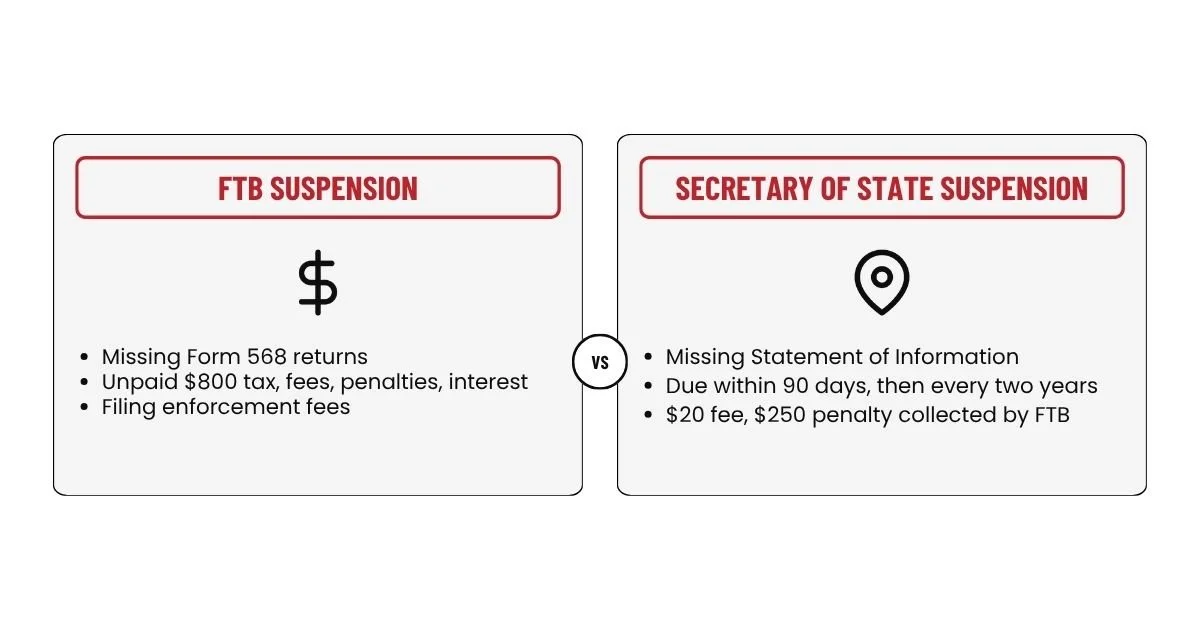
California LLC suspension generally falls into two categories.
The first is an FTB suspension.
The second is a Secretary of State suspension.
An entity can have both.
Franchise Tax Board Suspension
The FTB states that a business can generally be suspended when it fails to:
File required tax returns
Pay taxes
Pay penalties
Pay fees
Pay interest
For a disregarded single member LLC, common problems include:
Missing Form 568 returns
Unpaid $800 annual LLC tax
Unpaid California LLC fees
Late filing penalties
Late payment penalties
Interest
Filing enforcement fees
The FTB account should be reviewed before assuming which item caused the suspension.
Secretary of State Suspension
The Secretary of State can suspend an LLC for failing to file the required Statement of Information.
California LLCs generally file an initial Statement of Information within 90 days after registration and then every two years.
The current filing fee is generally $20.
Failure to file can also result in a $250 penalty collected by the FTB on behalf of the Secretary of State.
Your LLC Can Be Suspended by Both Agencies
An LLC may have:
FTB SUSPENDED
SOS SUSPENDED
or
SOS AND FTB SUSPENDED
The steps are different depending on the status.
That is why I begin with a current Secretary of State business search and FTB account review.
What Happens When a California SMLLC Is Suspended?
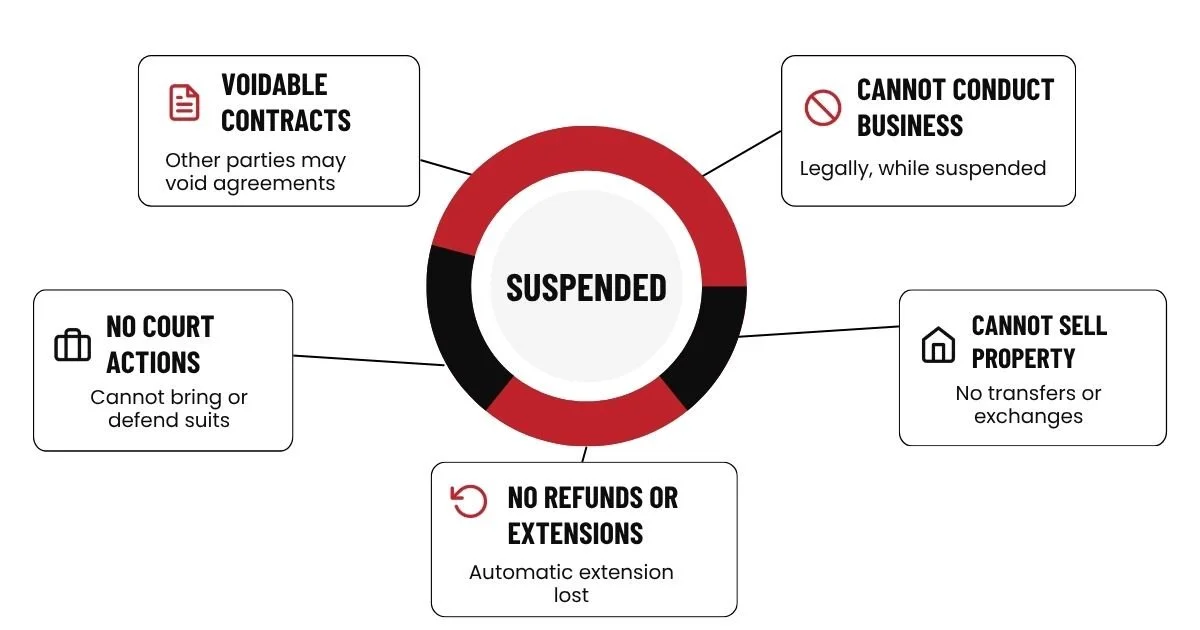
Suspension is more than a warning notice.
The FTB states that a suspended business loses important rights, powers, and privileges.
Current FTB guidance lists restrictions that can include the inability to:
Legally conduct business
Sell, transfer, or exchange real property
Receive the normal automatic tax filing extension
Receive a tax refund
Start or continue certain FTB protests
Legally dissolve or cancel the business
Bring or defend a business action in court
Maintain certain appeals before the Office of Tax Appeals
Maintain the right to use the business name
These consequences can become important when the LLC needs to close a transaction, enforce a contract, obtain financing, sell property, or wind down the business.
Contracts Can Create Additional Risk During Suspension
California FTB guidance also explains that contracts entered into while an LLC is suspended or forfeited can be voidable at the request of another party to the contract.
Revivor may address certain contract voidability issues when the applicable requirements are satisfied.
Contract enforcement and litigation questions are legal matters.
If those issues are important to the business, the owner should also obtain advice from California legal counsel.
Step 1, Determine Who Suspended the LLC
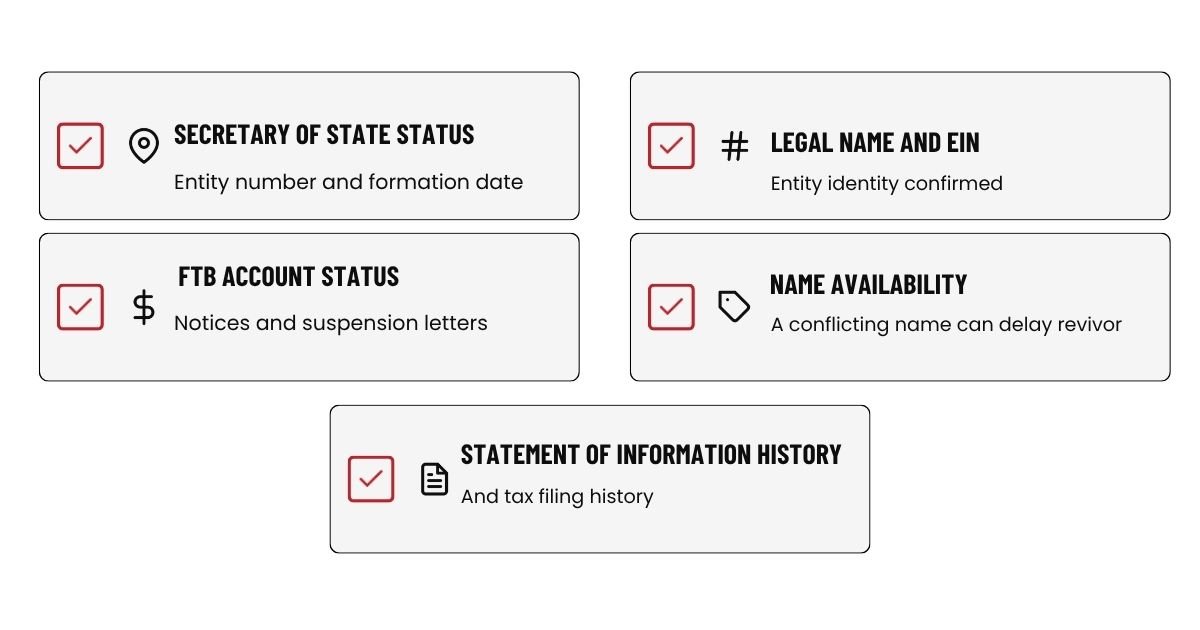
Before preparing tax returns or sending payments, I identify the exact business status.
I review:
California Secretary of State entity status
FTB account status
LLC legal name
Secretary of State entity number
EIN
Formation date
Statement of Information history
Tax filing history
FTB notices
Suspension notices
This prevents the owner from correcting one agency problem while leaving the other suspension unresolved.
Check Whether the LLC Name Is Still Available
California law requires the entity name to satisfy current Secretary of State naming requirements before the FTB Certificate of Revivor is issued.
A suspended business can lose practical protection over its name.
If another entity has obtained a conflicting name, the revivor process can require a name change or another Secretary of State solution.
That issue should be identified early because it can delay the restoration process.
Step 2, File Missing Form 568 Returns

For a disregarded California SMLLC, missing Form 568 returns are one of the most common causes of FTB suspension.
California generally requires a disregarded SMLLC to file Form 568 even though the owner may report the business income and expenses on federal Schedule C.
The LLC filing requirement and the owner's individual tax return are separate.
How Many Form 568 Returns Need to Be Filed?
I review the entity history from:
Formation
California registration
Beginning of business operations
through
Proper cancellation
Tax classification change
or another event ending the Form 568 filing requirement
An owner should not assume that the LLC stopped having filing requirements simply because business activity stopped.
If the entity remained open, additional filing years may have continued.
Suspended LLCs Do Not Receive the Normal Automatic Filing Extension
The FTB specifically states that suspended LLCs do not receive the normal automatic extension to file.
That can affect penalty calculations on historical returns.
For each missing period, I review the original filing due date, entity status, payments, and applicable penalties.
Step 3, Determine the FTB Balance Required for Revivor
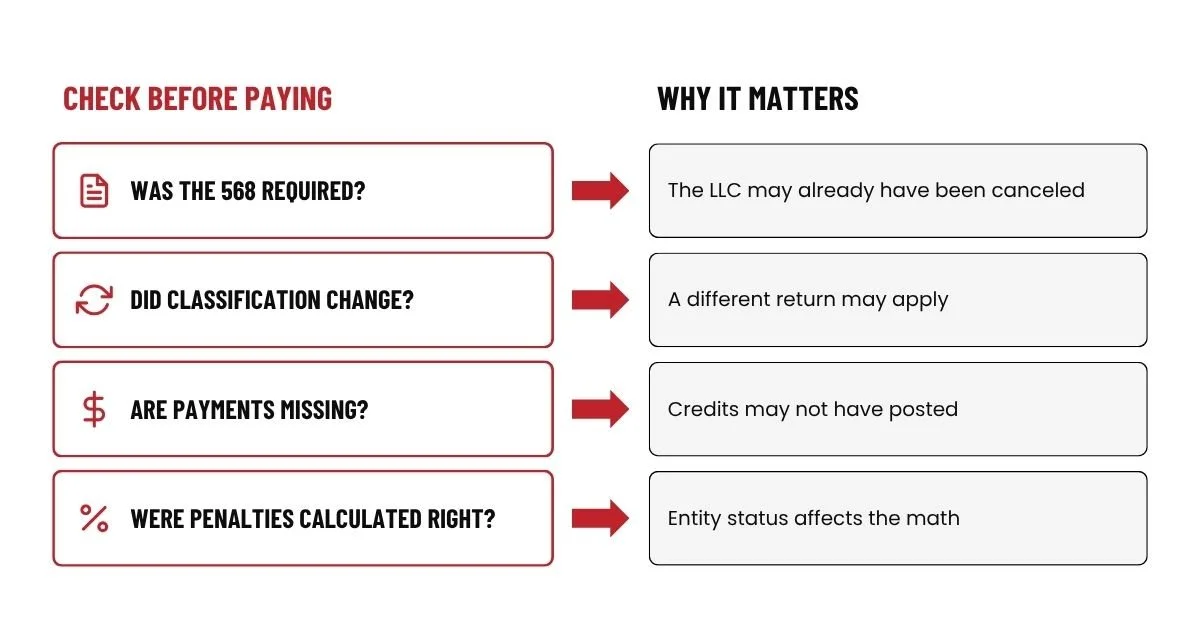
The standard FTB revivor procedure generally requires payment of outstanding balances.
That can include:
$800 annual LLC tax
California LLC fees
Late filing penalties
Late payment penalties
Statement of Information penalties
Filing enforcement fees
Collection fees
Interest
The amount should be verified against the current FTB account before payment.
Do Not Assume Every FTB Assessment Is Correct
Before paying several years of assessments, I review whether:
The Form 568 filing requirement was correct
The LLC was already canceled
A tax classification changed
Payments are missing from the account
Annual LLC tax was assessed for an incorrect period
The entity qualified for an applicable cancellation procedure
Penalties were calculated correctly
The objective is to establish the correct compliance balance before completing the revivor.
Step 4, Address Secretary of State Statement of Information Problems

If the Secretary of State suspended the LLC because a Statement of Information was not filed, the business needs to address that requirement separately.
California LLCs generally file the Statement of Information:
Within 90 days after initial registration
Every two years thereafter
The current Secretary of State filing fee is generally $20.
Current 2026 Online Access Rules Changed
Effective August 1, 2026, the California Secretary of State requires User Access for Statement of Information filings through bizfile Online.
The filing option is available to users after the required entity access has been established.
This is a current procedural change that did not apply to older California filing systems.
The $250 Statement of Information Penalty Is Separate
Failure to timely file the Statement of Information can result in a $250 penalty.
The FTB collects that penalty on behalf of the Secretary of State.
However, the Secretary of State controls requests concerning waiver of the Statement of Information penalty.
That penalty should therefore be distinguished from ordinary FTB tax penalties.
Step 5, Submit the California LLC Revivor Request
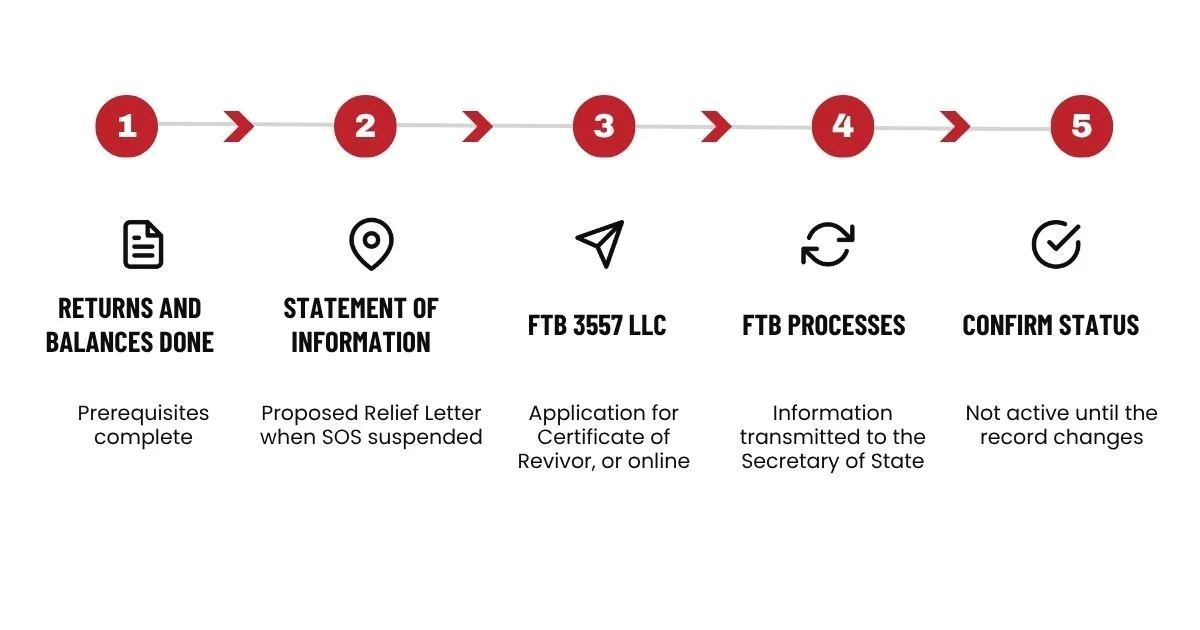
Once the required returns and balances are addressed, the LLC can request revivor.
For an LLC, the applicable FTB form is generally:
FTB 3557 LLC
Application for Certificate of Revivor, Limited Liability Company
The FTB currently also provides an online Certificate of Revivor application.
A Secretary of State Suspension Requires Additional Coordination
When the Secretary of State suspension is involved, the entity generally first addresses the current Statement of Information requirement.
The Secretary of State can issue a Proposed Relief Letter.
The business then submits the applicable Certificate of Revivor request with the required information to the FTB.
The entity remains suspended until both agency requirements are satisfied.
The Revivor Is Not Complete Until the Status Changes
Submitting Form 3557 LLC is not the same thing as already being active.
The status should be confirmed after FTB processing and transmission of the revivor information to the Secretary of State.
California law provides that the FTB transmits the revived taxpayer information to the Secretary of State after revivor.
What If the LLC Cannot Pay the Entire FTB Balance?
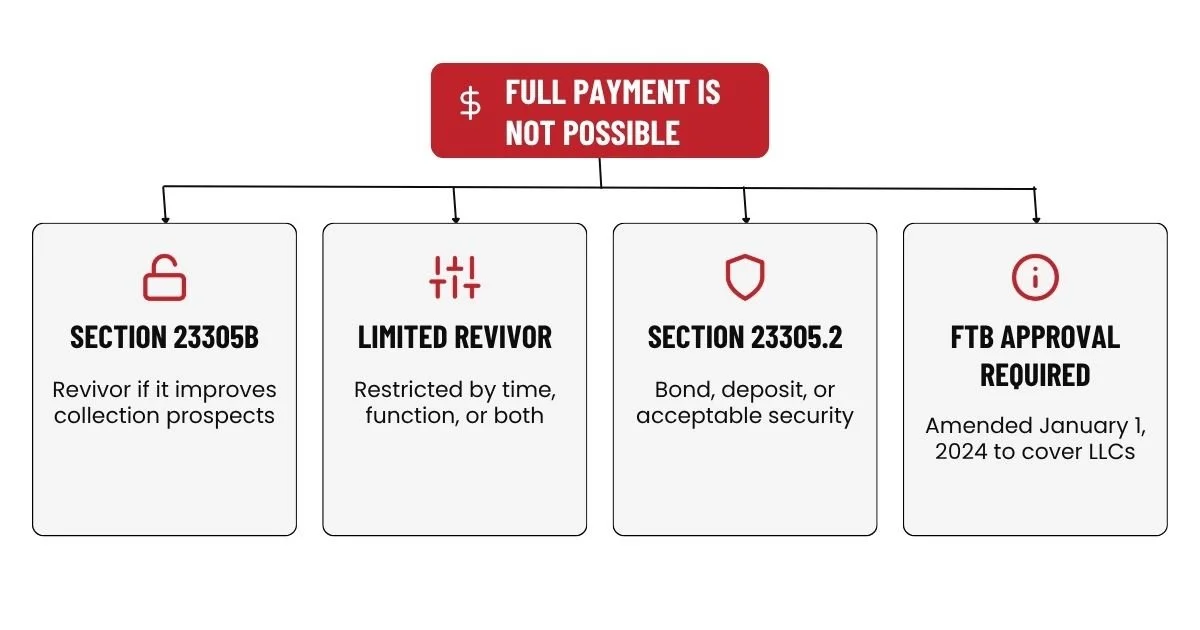
The standard FTB public revivor instructions state that the entity must pay all past due balances.
However, California law now provides limited exceptions that can be important in the right case.
Conditional Revivor May Be Available
California Revenue and Taxation Code Section 23305b allows the FTB to revive a taxpayer without full payment when the FTB determines that revivor will improve the prospects of collecting the full amount due.
The FTB can limit the revivor:
By time
By the functions the business may perform
Or both
The FTB can suspend the entity again if it determines the revivor has not improved collection prospects.
This is discretionary relief.
It should not be treated as an automatic alternative to paying the balance.
This Rule Changed for LLCs
The conditional revivor statute was amended effective January 1, 2024.
The law now uses the broader term taxpayer.
That change expanded the statutory framework beyond the older rules that treated certain disregarded or partnership classified LLCs differently from corporations.
For a suspended SMLLC that needs to operate in order to generate funds to pay the FTB, this provision may be worth reviewing with the agency.
Security May Provide Another Statutory Route
California Revenue and Taxation Code Section 23305.2 also provides a separate mechanism involving:
An assumption of liability
A bond
A deposit
Other security acceptable to the FTB
When the statutory requirements are met, this can permit revivor without the ordinary full payment requirement.
These procedures are specialized.
They require FTB acceptance and should not be presented as routine payment plan substitutes.
Does an FTB Payment Plan Automatically Revive the LLC?
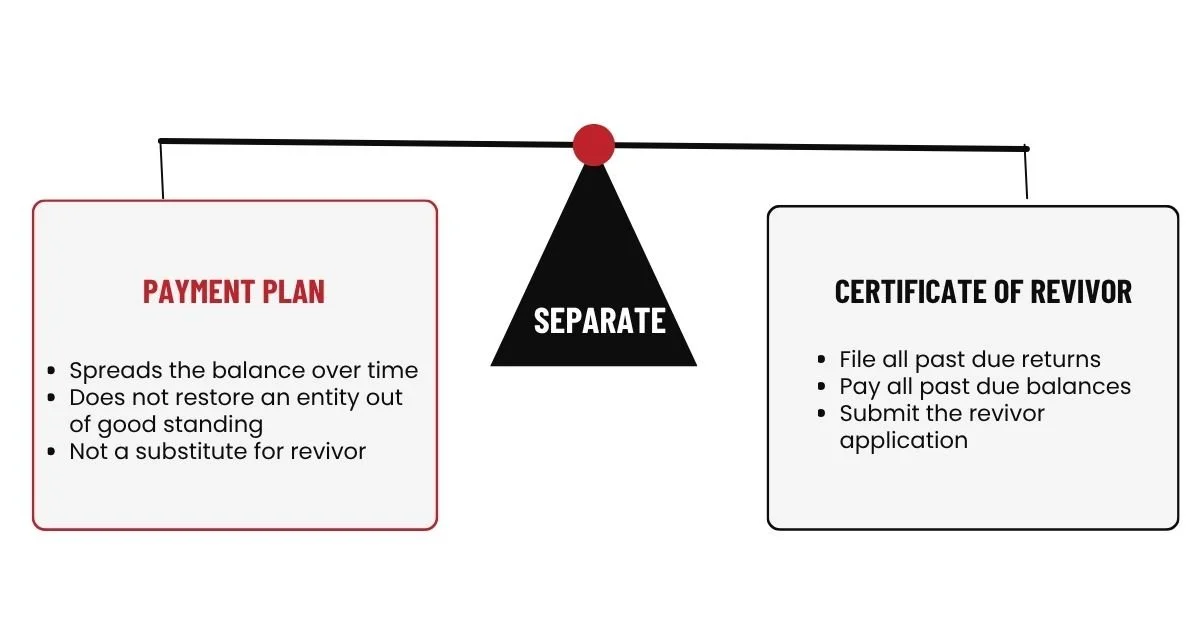
No.
An FTB payment plan and a Certificate of Revivor are separate procedures.
The FTB expressly warns that payment through an installment agreement does not automatically restore a business that is already not in good standing.
The business must separately satisfy the applicable revivor requirements.
Standard Revivor Generally Calls for the Balance to Be Addressed
For the ordinary revivor route, the FTB directs the taxpayer to:
File all past due returns
Pay all past due balances
Submit the revivor application
If full payment is not possible, the conditional revivor or security provisions may need to be reviewed rather than assuming a normal payment plan alone will restore the LLC.
Can the FTB Expedite a California LLC Revivor?
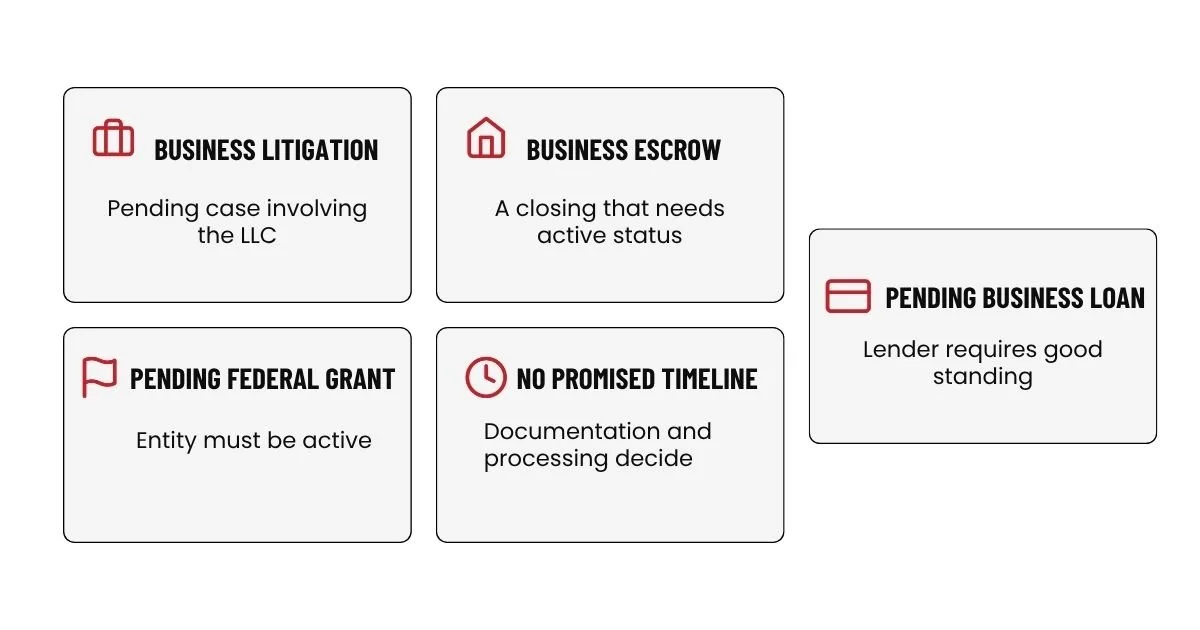
The FTB provides a walk through revivor process for certain qualifying business situations.
Current FTB guidance identifies qualifying situations that can include:
Business litigation
Business escrow
A pending business loan
A pending federal grant
The underlying business transaction must generally involve the suspended entity rather than only the individual owner.
The FTB also requires current supporting documents for a walk through request.
Expedited Revivor Is Not Available Just Because the Owner Wants Faster Processing
The business needs to meet the qualifying circumstances and documentation requirements.
I do not recommend promising a specific revivor processing time.
The timing depends on the account, filing compliance, payments, agency processing, Secretary of State issues, and whether additional documents are requested.
What If the Suspended LLC Needs to Sell or Refinance Property

A suspended LLC can face significant problems when real estate or another major business transaction is pending.
Current FTB guidance states that a suspended business cannot sell, transfer, or exchange real property while suspended.
This can make revivor a priority when an LLC has:
A pending escrow
Property being sold
A refinance
A business loan involving real estate
Another property transaction requiring active entity status
An FTB walk through revivor may be worth reviewing when qualifying business escrow or loan circumstances exist.
Property ownership, contracts, title questions, and legal consequences should also be reviewed with the appropriate legal and escrow professionals.
What If the LLC Is Suspended but the Owner Wants to Close It?

A suspended California LLC generally cannot simply file cancellation documents and walk away.
The current FTB guidance states that a suspended entity must generally be revived before it can legally cancel through the ordinary process.
That usually requires:
Filing delinquent tax returns
Addressing FTB balances
Completing the revivor process
Filing the applicable Secretary of State termination
California Has a Voluntary Administrative Cancellation Program
A qualifying domestic LLC that stopped doing business or never conducted business and has no remaining assets may potentially qualify for California's voluntary administrative cancellation procedure.
The current FTB application for a domestic LLC is Form 3716 PC.
Under that program, the FTB reviews whether:
Required returns were filed through the date business stopped
Applicable taxes, penalties, and interest through that period were addressed
The entity has remaining assets
If the program requirements are satisfied, qualified taxes, interest, fees, and penalties for later periods may potentially be abated.
This is a specialized cancellation procedure.
It is different from reviving an LLC that intends to continue operating.
Administrative Cancellation Notices Should Not Be Ignored
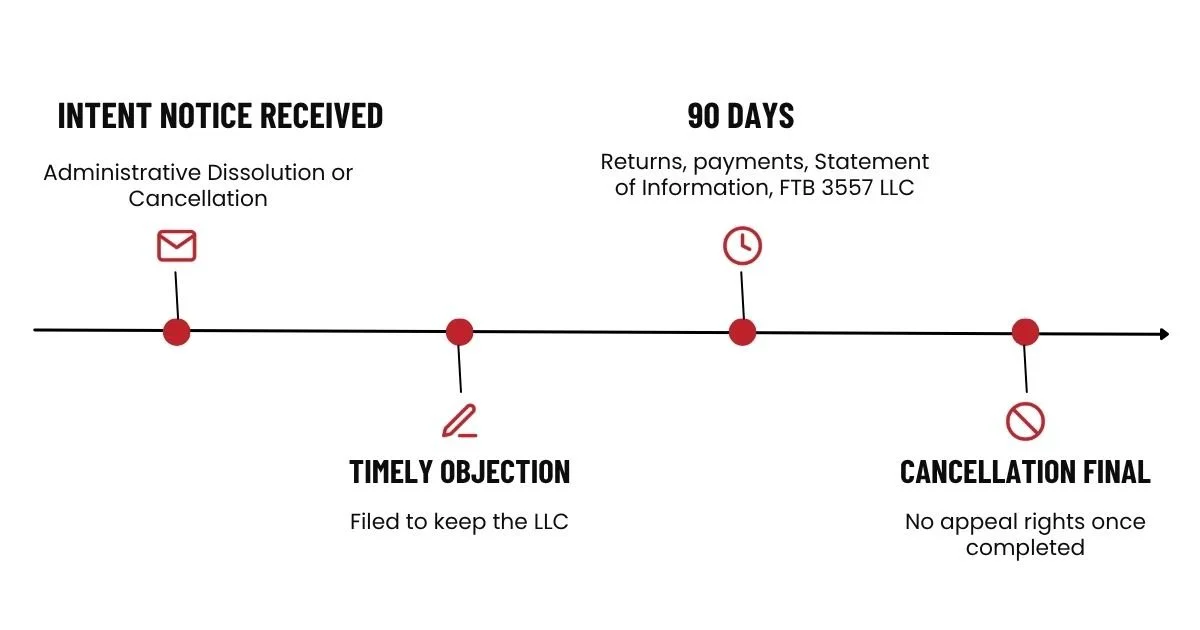
California can also administratively cancel qualifying inactive domestic LLCs.
If the FTB sends an Administrative Dissolution or Cancellation Intent Notice and the owner wants to keep the LLC, the response deadline matters.
Current FTB procedures provide that when the business timely objects, it generally has 90 days after the FTB receives the objection to complete the revivor requirements.
Those requirements can include:
Filing all tax returns
Paying taxes, fees, penalties, and interest
Filing a current Statement of Information
Completing other requirements
Filing FTB 3557 LLC
If the administrative cancellation becomes final, the FTB states there are no appeal rights from the completed administrative cancellation.
The notice date should therefore be reviewed immediately.
What Records Are Needed to Reinstate a Suspended California SMLLC?

You do not need every record organized before beginning the review.
Useful records can include:
FTB suspension notice
Secretary of State suspension notice
Articles of Organization
Secretary of State entity number
EIN confirmation
Statements of Information
Prior Forms 568
Federal Schedule C returns
California individual tax returns
Forms FTB 3522
Forms FTB 3536
FTB account statements
MyFTB account information
Bank statements
Profit and loss statements
Business closure records
Property escrow documents
Loan documents
Business litigation documents
Cancellation documents
Previous payment plan documents
State tax lien notices
If several years of Form 568 filings are missing, business bookkeeping may need to be reconstructed before the revivor requirements can be completed.
Our California SMLLC Revivor Process
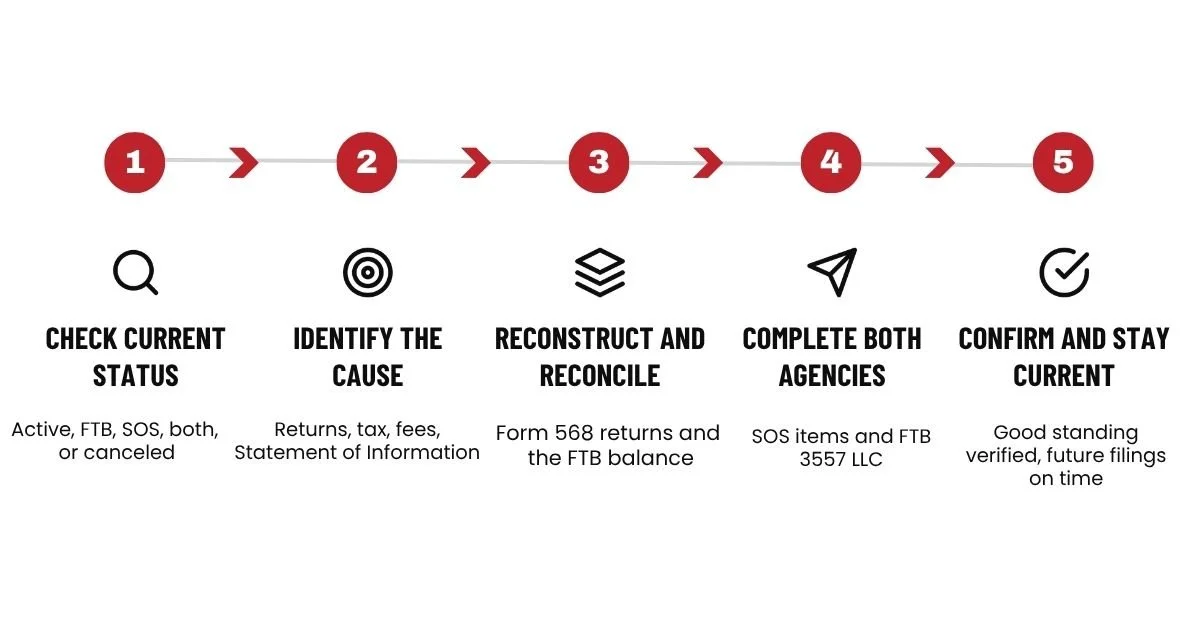
I use a structured process because suspension can involve tax, Secretary of State filings, and business status at the same time.
Step 1, Check the Current Business Status
I identify whether the entity is:
Active
FTB suspended
SOS suspended
SOS and FTB suspended
Canceled
Otherwise not in good standing
Step 2, Identify the Cause of Suspension
I review:
Missing Form 568 returns
Annual LLC tax
LLC fees
Penalties
Interest
Statement of Information
Secretary of State penalties
Other FTB requirements
Step 3, Reconstruct Missing Tax Records
If the business filings are incomplete, we organize the available financial records and prepare the required Form 568 returns.
Step 4, Review the FTB Balance
I reconcile:
Tax assessments
Payments
Penalties
Fees
Interest
Credits
Collection costs
Step 5, Evaluate How the Balance Will Be Addressed
The normal route generally requires payment of the outstanding FTB balance.
If full payment is not possible, I review whether a statutory conditional revivor or another applicable procedure should be discussed with the FTB.
Step 6, Complete Secretary of State Requirements
When required, the current Statement of Information and related Secretary of State issues are addressed.
Step 7, Submit the Revivor Request
The applicable FTB 3557 LLC revivor request is prepared or submitted through the current FTB revivor process.
Step 8, Confirm Good Standing
I verify that the entity status actually changes after the agencies process the revivor.
Step 9, Address Current Compliance
After revivor, the business should remain current with:
Form 568
Annual LLC tax
Applicable LLC fee
Statement of Information
Owner tax obligations
The goal is to keep the LLC from being suspended again.
FTB Power of Attorney for a Suspended LLC
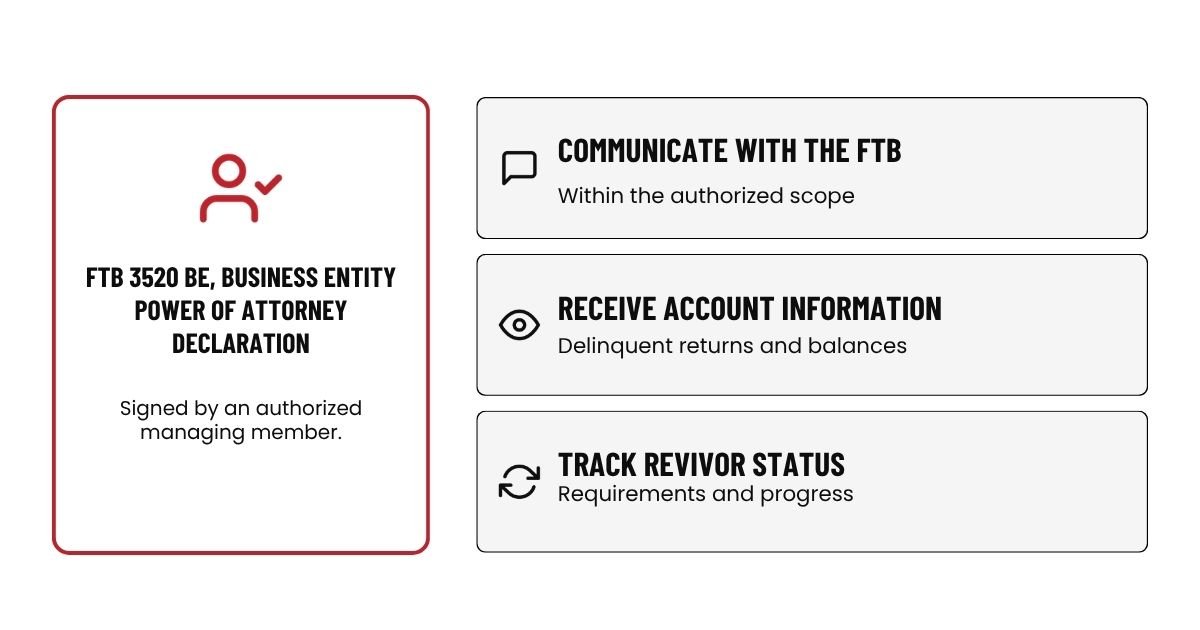
California uses its own Power of Attorney procedure.
For a business entity, the current form is:
FTB 3520 BE
Business Entity or Group Nonresident Power of Attorney Declaration
This authorization allows an approved representative to communicate with the FTB, receive confidential information, and represent the business before the agency within the authorized scope.
An authorized managing member can generally sign the business entity Power of Attorney for an LLC.
When I represent a suspended SMLLC, I use the FTB account information to confirm the delinquent returns, balances, suspension requirements, and current revivor status.
Common Mistakes When Trying to Reinstate a Suspended California LLC

Paying the $800 Tax but Ignoring Missing Form 568 Returns
The revivor process generally requires both filing and payment compliance.
Filing Form 568 but Ignoring the Secretary of State
An SOS suspension can remain even after tax returns are filed.
Filing the Statement of Information but Ignoring FTB Suspension
A current Statement of Information does not automatically clear unpaid FTB tax requirements.
Assuming an FTB Payment Plan Automatically Restores Good Standing
A payment agreement and revivor are separate procedures.
Trying to Cancel the LLC While It Is Still Suspended
The normal California termination process generally requires the entity to address the suspension first.
Continuing to Sign New Contracts Without Reviewing Suspension
California law can create contract enforceability issues during suspension.
Legal advice may be appropriate before entering or attempting to enforce important agreements.
Ignoring Whether the LLC Name Is Still Available
Revivor can be delayed if the entity name no longer satisfies Secretary of State requirements.
Assuming There Is a Fixed Revivor Processing Time
Processing depends on the entity's compliance, agency workload, payment posting, Secretary of State requirements, and whether an expedited process applies.
Reviving an LLC That Should Instead Be Closed
If the business permanently stopped operating years ago and has no assets, administrative cancellation or another closing procedure may be more appropriate than reviving it to continue business.
Why Work With Semper Tax Relief for a California LLC Revivor?

A suspended California SMLLC can involve several different problems at the same time.
I review:
FTB suspension
Secretary of State suspension
Form 568 filing compliance
Annual LLC tax
LLC fees
Statement of Information
FTB penalties
Secretary of State penalties
Interest
FTB account balances
Conditional revivor considerations
Certificate of Revivor
Current business status
Cancellation alternatives
Current tax compliance
I am Sergio Melendez, JD, EA.
I have worked in the tax profession since 2005.
My Juris Doctor degree is an educational credential.
My federal authority to represent taxpayers before the IRS comes from my Enrolled Agent credential.
California FTB representation is handled through the applicable California Power of Attorney procedure.
Semper Tax Relief provides tax preparation and tax agency representation.
Legal questions involving litigation, contract enforceability, ownership disputes, corporate governance, or other legal rights should be handled by appropriate California legal counsel.
Results depend on the reason for suspension, filing history, FTB balances, entity classification, Secretary of State status, business name availability, financial circumstances, and applicable California law and agency procedures.
Frequently Asked Questions About Reinstating a Suspended California SMLLC
-
The FTB generally suspends a business when it fails to meet California tax requirements.
That can include failing to file Form 568 or failing to pay taxes, penalties, fees, or interest.
The actual account should be reviewed because several delinquent periods can exist at the same time.
-
The standard FTB procedure generally requires the LLC to file all past due tax returns, pay past due balances, and submit the applicable revivor request.
For an LLC, the applicable form is generally FTB 3557 LLC.
California law also contains limited procedures that may permit revivor without ordinary full payment when the applicable statutory requirements are met.
-
H3: What is the difference between FTB suspended and SOS suspended?
FTB suspension generally involves California tax filing or payment requirements.
Secretary of State suspension commonly results from failure to file a required Statement of Information.
An LLC can be suspended by both agencies at the same time.
Each agency's requirements need to be addressed.
-
Possibly, but this is not the ordinary revivor procedure.
California Revenue and Taxation Code Section 23305b allows the FTB discretion to revive a taxpayer without full payment when the agency determines that revivor will improve collection prospects.
Section 23305.2 also contains a procedure involving acceptable security.
These are specialized statutory procedures and FTB approval is required.
-
No.
A payment plan and revivor are separate procedures.
FTB guidance specifically warns that paying through a payment agreement does not automatically restore an entity already out of good standing.
-
Possibly, but a suspended entity generally cannot use the ordinary termination procedure until its status is addressed.
A qualifying domestic LLC that stopped doing business or never operated and has no remaining assets may potentially qualify for California's voluntary administrative cancellation procedure.
The facts should be reviewed before deciding whether revivor or cancellation is the better approach.
-
There is no single processing time that applies to every case.
The timing depends on missing returns, payments, Secretary of State requirements, FTB processing, business name issues, and whether additional documentation is required.
The FTB also offers a walk through revivor process for certain qualifying business litigation, escrow, loan, and federal grant situations.
-
I can help with the tax compliance and FTB representation portions of the matter, including reviewing the FTB account, preparing missing tax returns, analyzing balances, preparing the revivor request, and coordinating applicable Secretary of State compliance items.
If the suspension creates litigation, contract, ownership, or other legal issues, separate California legal counsel may also be appropriate.
Get a Free California SMLLC Revivor Case Review
If your California single member LLC is suspended, start by determining which agency suspended it and what requirements remain open.
I can review:
FTB suspension status
Secretary of State status
Missing Form 568 returns
$800 annual LLC tax
California LLC fees
FTB penalties
Statement of Information penalties
FTB balances
Current payments
Certificate of Revivor requirements
FTB 3557 LLC
Conditional revivor considerations
Business name issues
Pending escrow or loan concerns
Administrative cancellation alternatives
Current tax compliance
You do not need to know the exact reason for suspension before requesting the review.
Bring the FTB notices, Secretary of State notices, prior Form 568 returns, LLC records, and financial information currently available.
I can help determine what needs to be filed, what needs to be paid or otherwise addressed, and what administrative steps remain before the LLC can return to good standing.