

IRS Collection Appeals Representation
If you disagree with an IRS levy, federal tax lien filing, seizure, installment agreement decision, or another qualifying collection action, you may have the right to request review by the IRS Independent Office of Appeals.
The correct appeal depends on the notice, collection action, tax periods involved, procedural stage, and deadline. The three primary collection appeal procedures are:
Collection Due Process hearing, commonly called a CDP hearing
Equivalent Hearing
Collection Appeals Program, commonly called CAP
These procedures are not interchangeable. They have different deadlines, issues that may be considered, collection protections, and rights following the Appeals decision.
Do I qualify for tax relief? Find out with a free case review.
Call today: 24 Hours / 7 Days a Week or book online.
✔ Confidential ✔ No Pressure ✔ Personalized
I am Sergio Melendez, JD, EA. I have worked in the tax profession since 2005 and regularly represent individuals and businesses facing IRS collection matters, including liens, levies, Revenue Officer cases, payment plan disputes, Collection Due Process hearings, and Collection Appeals Program requests.
Semper Tax Relief can review your notice, IRS account, appeal deadline, collection status, and proposed resolution to help determine which appeal procedure may be available.
An appeal does not automatically remove a lien, release a levy, reduce the tax balance, or produce approval of a collection alternative. The outcome depends on the applicable law, procedural history, filing compliance, financial information, and facts of the case.
What Is an IRS Collection Appeal?
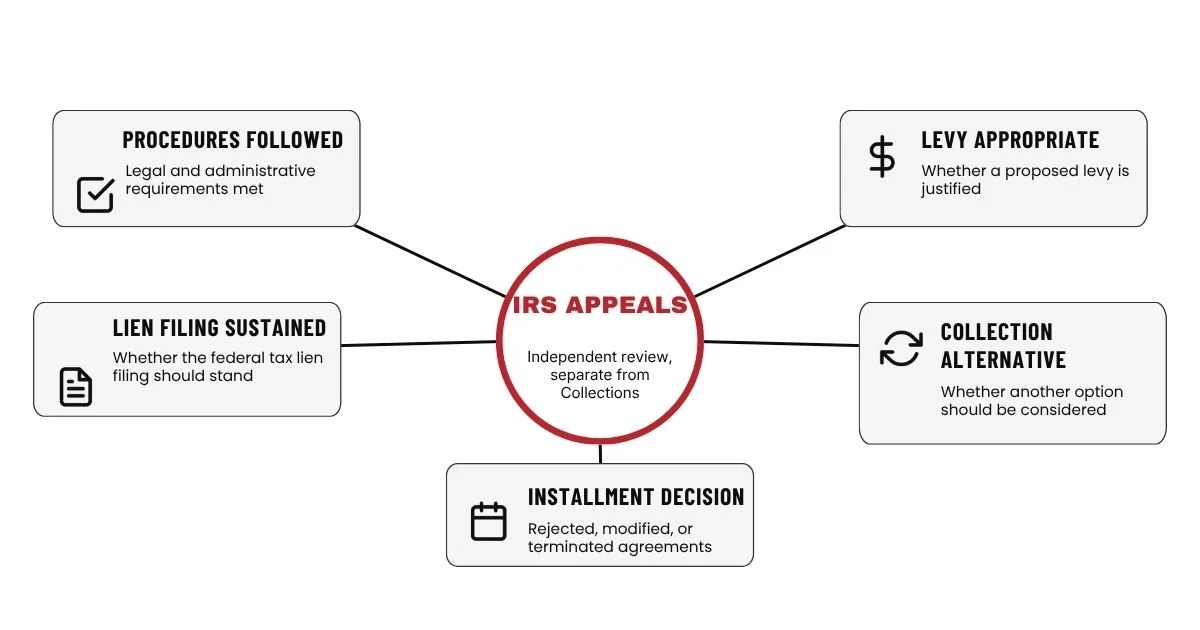
An IRS collection appeal asks the IRS Independent Office of Appeals to review a collection action or decision made by an IRS collection employee or office.
Appeals is separate from the IRS collection function that made the disputed decision. Its role is to review the matter independently and attempt to resolve the dispute without litigation when possible.
Depending on the procedure and circumstances, Appeals may review:
Whether the IRS followed legal and administrative procedures
Whether a proposed levy is appropriate
Whether a federal tax lien filing should be sustained
Whether a collection alternative should be considered
Whether an installment agreementwas improperly rejected, modified, or terminated
Whether the IRS properly denied certain lien-related requests
Whether the taxpayer may challenge the underlying liability
Whether the collection action appropriately balances efficient tax collection with the taxpayer’s legitimate concerns
Not every disagreement qualifies for every type of collection appeal. The notice and procedural history must be reviewed before selecting the appeal.
IRS Collection Actions That May Be Appealed
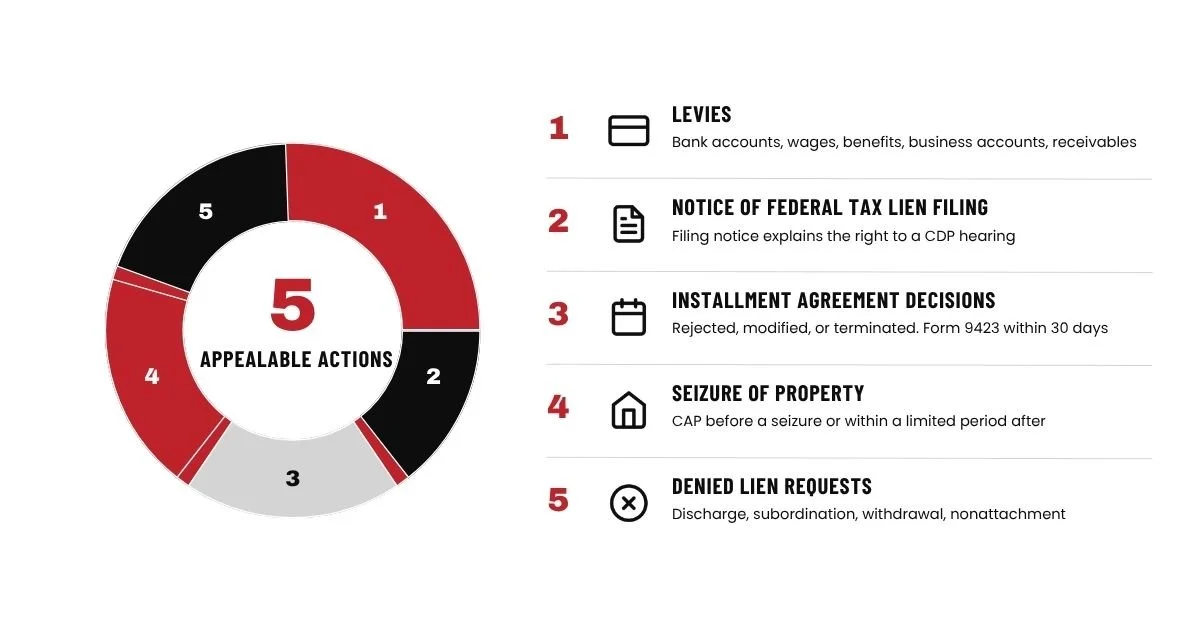
Collection appeal rights may be available for several IRS actions and decisions.
Proposed or Issued IRS Levies
A levy is a legal seizure of property or rights to property.
Depending on the circumstances, an IRS levy may reach:
Bank accounts
Wages
Social Security benefits
Business accounts
Accounts receivable
Certain retirement assets
Other property or income sources
A taxpayer may receive Collection Due Process rights before certain levy actions. CAP may also be available before or after certain levy actions.
Requesting an appeal does not guarantee a levy release. The available remedy depends on the appeal procedure, timing, financial circumstances, and whether the IRS followed the required procedures.
Notice of Federal Tax Lien Filing
A federal tax lien is the government’s legal claim against property and rights to property after a tax liability arises and remains unpaid following demand.
When the IRS files a Notice of Federal Tax Lien, it generally must provide notice of the filing and explain the right to request a Collection Due Process hearing.
Appeals may review whether the filing requirements were satisfied and whether a collection alternative or lien remedy should be considered.
A CDP hearing does not automatically withdraw or release the lien. Lien withdrawal, release, discharge, and subordination are separate remedies with different legal requirements.
Installment Agreement Decisions
CAP may be available when the IRS:
Rejects a proposed installment agreement
Proposes to modify an installment agreement
Modifies an installment agreement
Proposes to terminate an installment agreement
Terminates an installment agreement
An installment agreement appeal should explain why the taxpayer disagrees and provide a realistic proposal supported by the account and financial circumstances.
The deadline for appealing an installment agreement decision may be stated in the applicable notice. Form 9423 instructions generally direct taxpayers to submit an appeal of a rejected, modified, or terminated installment agreement within 30 calendar days.
Seizure of Property
CAP may be available before a seizure or within a limited period after a seizure.
Seizure procedures can involve especially short response periods. The exact deadline should be confirmed from the notice, IRS instructions, and current collection stage.
Denied Lien Requests
CAP may be available following the denial of certain requests involving:
Discharge of specific property from a federal tax lien
Subordination of the federal tax lien
Withdrawal of a Notice of Federal Tax Lien
A certificate of nonattachment
These appeals address the IRS decision on the requested lien remedy. They do not automatically invalidate the underlying tax liability.
Requests for Return of Levied Property
CAP may be available after the IRS disallows certain taxpayer or third-party requests for the return of levied or wrongfully levied property.
These cases can involve separate administrative and judicial deadlines. A person claiming an ownership interest should not assume that filing a general collection appeal preserves every possible remedy.
Collection Due Process Hearing
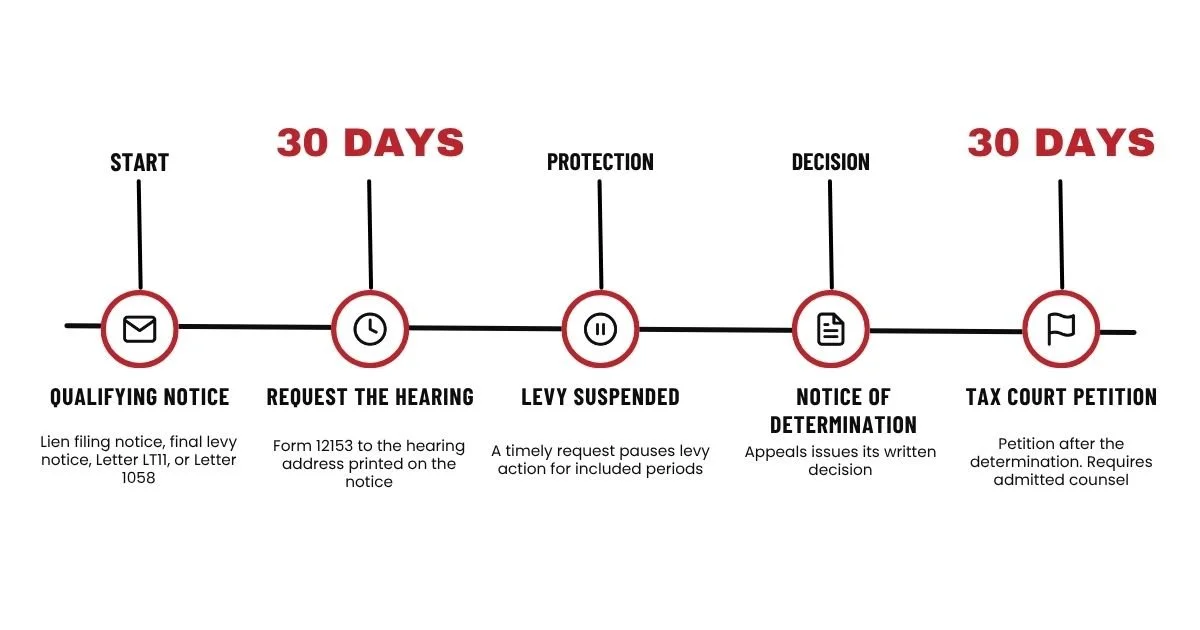
A Collection Due Process hearing is a formal collection appeal available after the IRS issues a qualifying notice offering CDP rights.
Common notices include:
Notice of Federal Tax Lien Filing and Your Right to a Hearing
Final Notice of Intent to Levy and Notice of Your Right to a Hearing
Letter LT11
Letter 1058
Certain notices involving jeopardy levies
Certain post-levy CDP notices
Certain notices involving a levy on a state tax refund
The notice should state whether CDP rights are available and provide the deadline for requesting a hearing.
CDP Hearing Deadline
A taxpayer generally has 30 days from the date of the qualifying notice to request a timely CDP hearing.
The deadline printed on the notice should be followed. The request is generally submitted using Form 12153, Request for a Collection Due Process or Equivalent Hearing, to the address shown for requesting a hearing on the notice.
The appeal request should not automatically be sent to an IRS payment address or another office. Sending it to the wrong location can delay processing and create a dispute over timeliness.
What Can Be Raised During a CDP Hearing?
Depending on the facts, a taxpayer may ask Appeals to consider:
Currently Not Collectible status
A partial payment installment agreement
A lien withdrawal, discharge, or subordination request
Whether the IRS followed required procedures
Whether the collection action is unnecessarily intrusive
Whether payments or credits were applied correctly
An alternative method of resolving the balance
Appeals generally needs sufficient financial information to evaluate a collection alternative. This may require Form 433-A, Form 433-F, Form 433-B, supporting financial records, filed tax returns, and proof of current withholding, estimated payments, or federal tax deposits.
Merely listing a collection alternative on Form 12153 does not establish eligibility or require Appeals to approve it.
Can You Challenge the Tax Balance in a CDP Hearing?
The underlying tax liability may generally be challenged during a CDP hearing only in limited circumstances, including when the taxpayer did not receive a statutory notice of deficiency and did not otherwise have a prior opportunity to dispute the liability.
A CDP hearing is not a second opportunity to relitigate every previously disputed assessment.
If the underlying liability cannot be challenged through CDP, another procedure may need to be considered, such as audit reconsideration, a refund claim after payment, an amended return where appropriate, or an Offer in Compromise based on doubt as to liability.
Collection During a Timely CDP Hearing
A timely CDP request generally suspends levy action for the tax periods included in the hearing while the proceeding and applicable judicial review remain pending.
This protection is subject to statutory exceptions. It also does not necessarily prevent every IRS collection-related action. For example, a federal tax lien may remain in place, interest and penalties may continue, and the IRS can continue addressing tax periods that are not covered by the hearing.
A timely CDP request also suspends the running of the IRS collection period for the liabilities included in the proceeding. This can extend the date by which the IRS must collect the tax.
Tax Court Review After a CDP Hearing
After a timely CDP hearing, Appeals generally issues a Notice of Determination.
If the taxpayer disagrees with the determination, a petition may generally be filed with the United States Tax Court within 30 days after the determination.
Semper Tax Relief provides IRS administrative representation. Representation before the United States Tax Court requires a practitioner who is admitted to practice before that court. If litigation becomes appropriate, separate legal counsel or another qualified representative may be required.
Equivalent Hearing After Missing the CDP Deadline
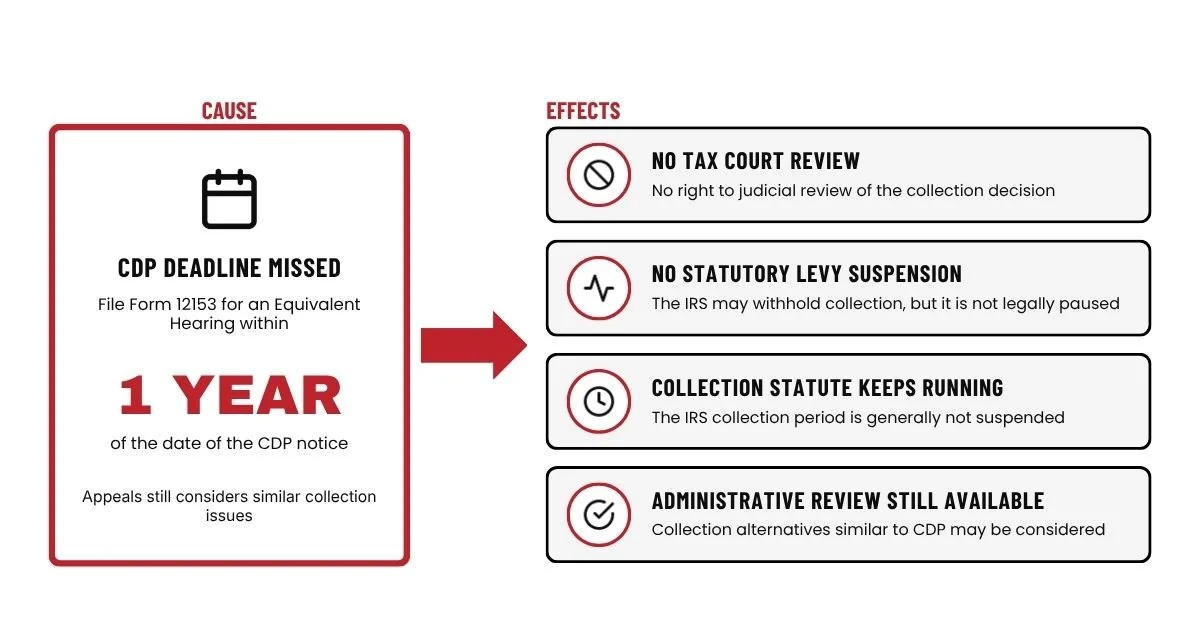
A taxpayer who misses the deadline for a timely CDP hearing may be able to request an Equivalent Hearing.
An Equivalent Hearing is generally requested using Form 12153 within one year after the date of the CDP notice.
An Equivalent Hearing may allow Appeals to consider collection issues and alternatives similar to those considered during a CDP hearing. However, it does not provide all the same legal protections.
Important differences include:
An Equivalent Hearing does not generally provide a right to Tax Court review of the collection decision
It does not provide the same statutory suspension of levy action as a timely CDP request
It generally does not suspend the IRS collection statute
The IRS may withhold certain collection activity while an Equivalent Hearing is being considered, depending on internal procedures and circumstances, but the taxpayer should not assume that collection is legally suspended.
Missing the CDP deadline can therefore affect both procedural protection and judicial review.
Collection Appeals Program
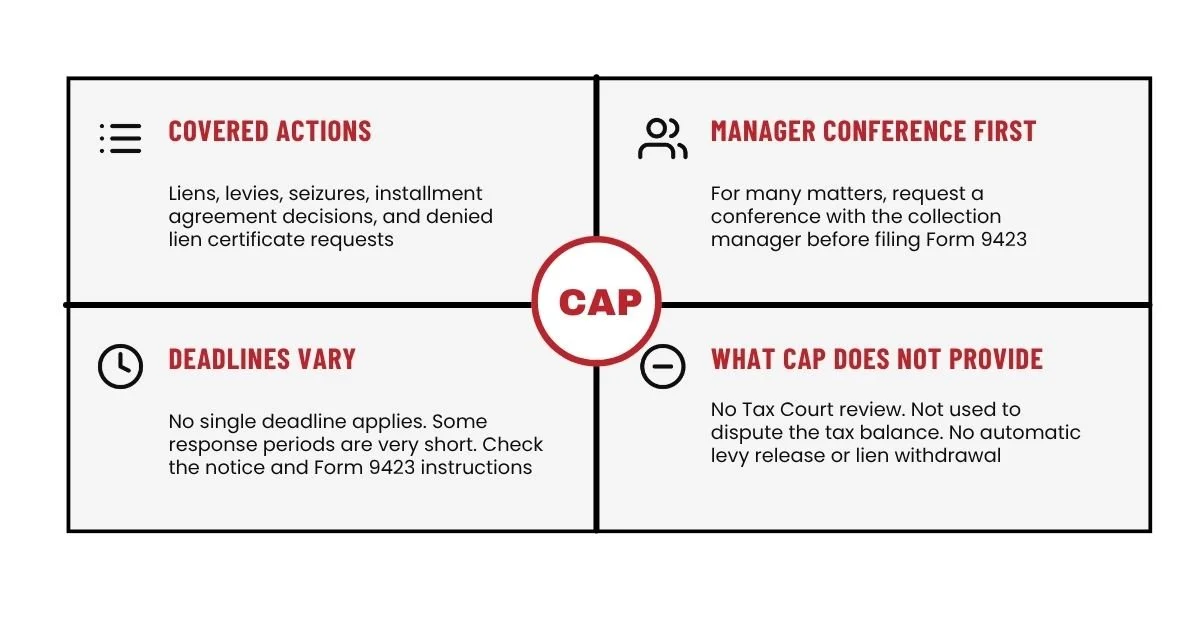
The Collection Appeals Program provides an administrative review of many IRS collection actions and decisions.
CAP is generally faster and narrower than a CDP hearing. It focuses on whether the collection action or decision was appropriate under the circumstances and applicable procedures.
Collection Actions Covered by CAP
CAP may be available for:
A proposed or filed Notice of Federal Tax Lien
A proposed or issued levy
A proposed or completed seizure
Rejection of an installment agreement
Proposed modification or actual modification of an installment agreement
Proposed termination or actual termination of an installment agreement
Denial of a lien discharge
Denial of lien subordination
Denial of lien withdrawal
Denial of a certificate of nonattachment
Certain denials involving return of levied property
Certain third party property claims
The availability and deadline depend on the collection action and procedural stage.
Manager Conference Before CAP
For many CAP matters, the taxpayer must first request a conference with the collection employee’s manager.
If the disagreement is not resolved with the manager, Form 9423, Collection Appeal Request, may be submitted to the collection office involved in the action.
A managerial conference is not generally required for certain installment agreement decisions, although requesting one may still be useful.
CAP Deadlines Can Vary
There is no single universal deadline that applies to every CAP request.
The timing can depend on whether the matter involves:
A lien
A levy
A seizure
A lien certificate request
Return of levied property
Some deadlines can be very short. The notice, collection action, current Form 9423 instructions, and applicable IRS procedures should be reviewed immediately.
What CAP Does Not Provide
CAP does not provide all the rights available through a timely CDP hearing.
Generally:
CAP does not provide United States Tax Court review of the Appeals decision
CAP is not normally used to dispute the underlying tax liability
CAP does not automatically provide consideration of every collection alternative
CAP does not automatically release a levy or withdraw a lien
The Appeals decision under CAP is generally binding on the taxpayer and the IRS concerning the issue reviewed.
CDP Versus Equivalent Hearing Versus CAP
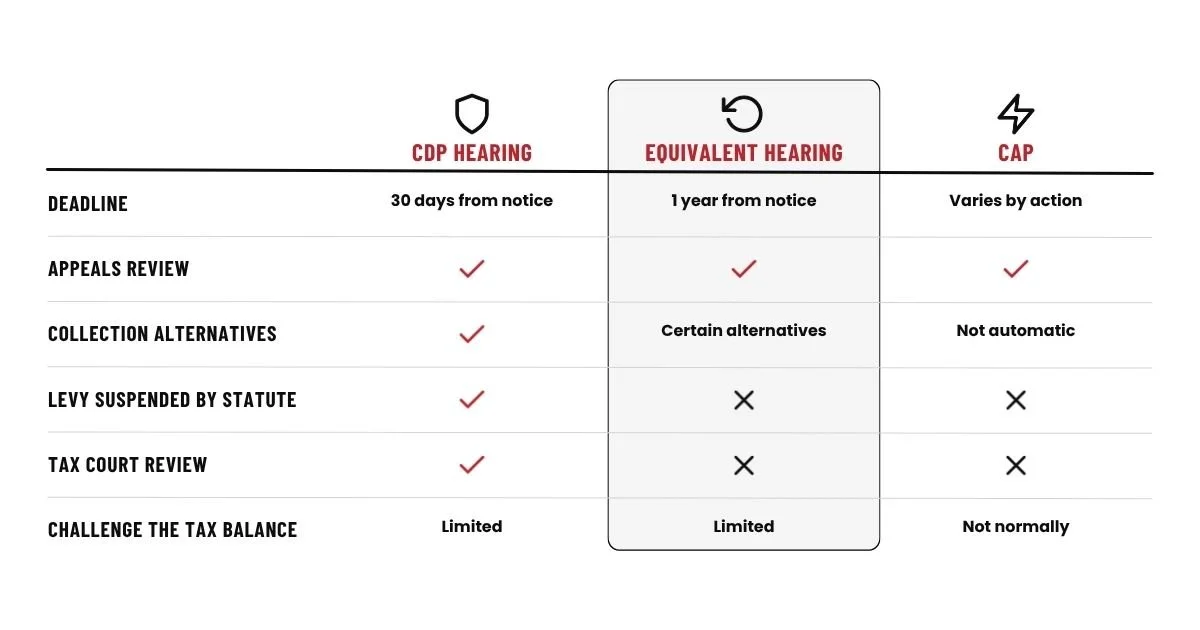
Collection Due Process Hearing
A CDP hearing may be the appropriate procedure when a qualifying notice was received and the deadline remains open.
It can provide:
Appeals review
Consideration of qualifying collection alternatives
Limited review of the underlying liability
General suspension of levy action for included periods
A right to petition the United States Tax Court after the determination
Equivalent Hearing
An Equivalent Hearing may be available when the CDP deadline was missed but the request is made within the applicable one-year period.
It can provide:
Appeals review
Consideration of certain collection alternatives
An opportunity to address collection concerns
It generally does not provide the same statutory collection suspension or right to Tax Court review.
CAP may be useful when the dispute involves a specific collection action or installment agreement decision.
It can provide:
Review of many lien, levy, seizure, and installment agreement decisions
A potentially faster administrative determination
Review before or after certain collection actions
CAP generally does not provide Tax Court review or a broad opportunity to challenge the underlying tax balance.
What the IRS Reviews During a Collection Appeal
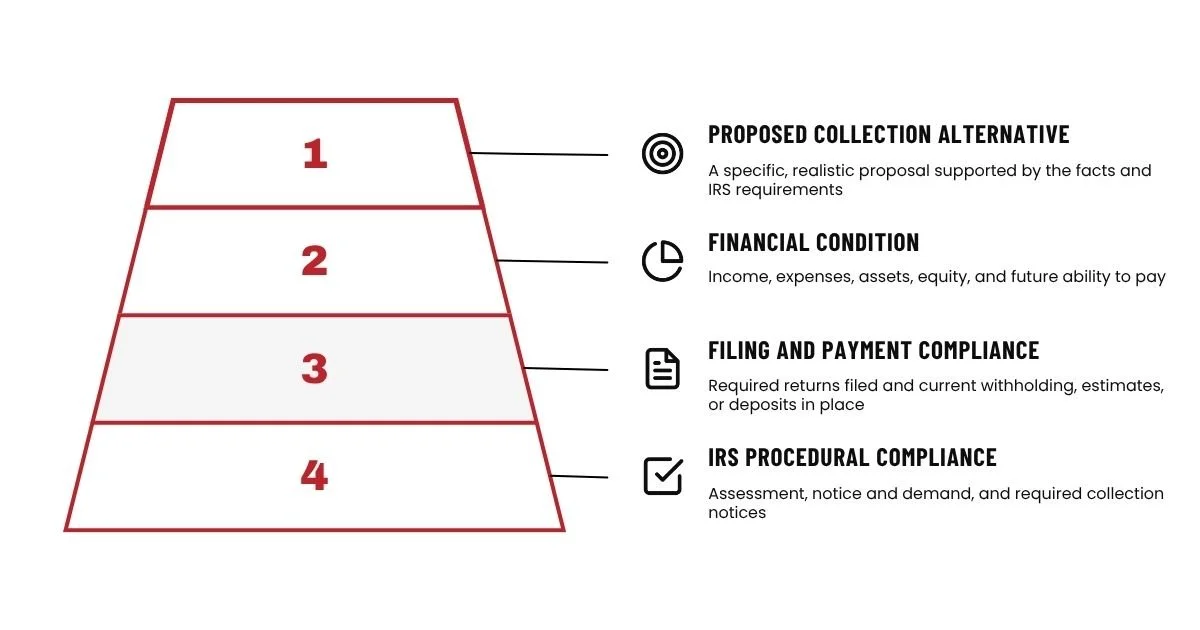
The IRS Independent Office of Appeals may review several areas during a collection appeal.
IRS Procedural Compliance
Appeals may verify whether the IRS satisfied applicable legal and administrative requirements.
This can include reviewing whether assessments were made, notice and demand were issued, the taxpayer received the required collection notice, and the assigned employee followed applicable procedures.
Tax Filing and Payment Compliance
A taxpayer requesting a collection alternative generally must address required tax returns and remain current with applicable withholding, estimated payments, or federal tax deposits.
Appeals may decline to consider or approve a collection alternative when the taxpayer continues creating new tax debt or has not filed required returns.
Financial Condition
When the taxpayer requests a payment or hardship-based option, Appeals may review:
Income
Household or business expenses
Bank accounts
Asset equity
Accounts receivable
Retirement accounts
Real property
Business interests
Ability to borrow
Future ability to pay
The required financial form depends on the taxpayer and requested alternative.
Proposed Collection Alternative
The taxpayer should identify a specific and realistic alternative.
Depending on the case, this might include:
A monthly installment agreement
A partial payment installment agreement
Full payment through a property transaction
Lien discharge or subordination
Another appropriate proposal
The proposal must be supported by the facts and applicable IRS requirements.
Common IRS Collection Appeal Mistakes
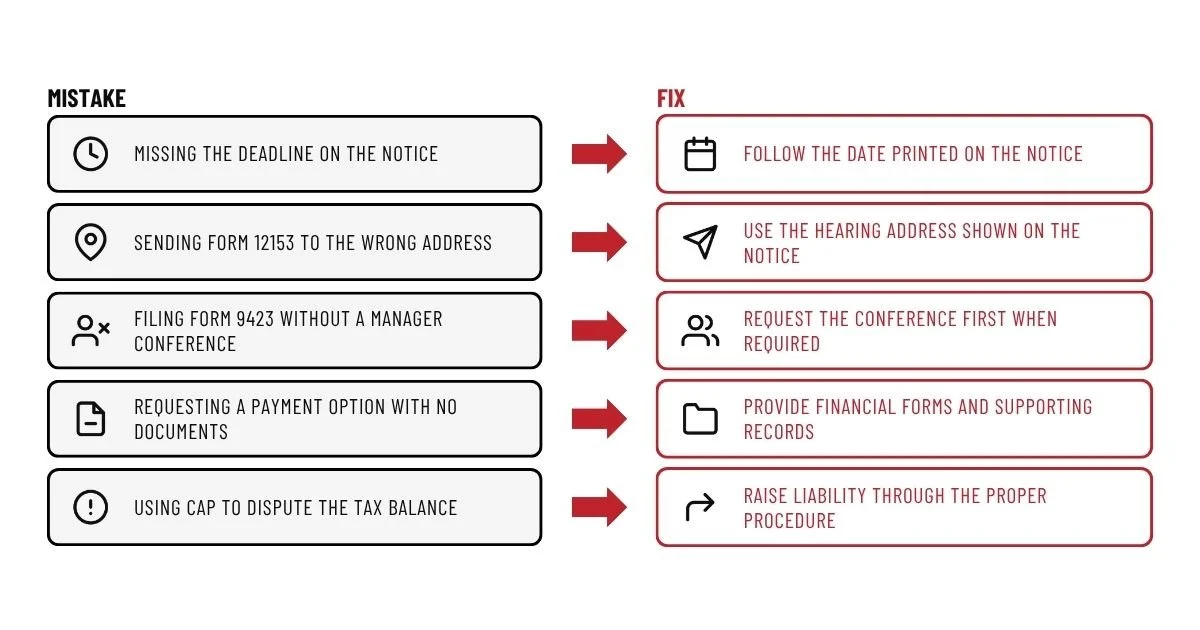
Appeal rights can be weakened by avoidable errors.
Common mistakes include:
Missing the deadline shown on the notice
Sending Form 12153 to the wrong IRS address
Filing Form 9423 without first requesting a manager conference when one is required
Assuming every CAP request has the same deadline
Failing to identify all tax periods and collection notices involved
Providing a vague explanation of the disagreement
Requesting a payment option without financial documents
Remaining behind on required tax returns
Continuing to create new tax liabilities
Using CAP to dispute the underlying tax balance
Assuming an Equivalent Hearing provides the same rights as a timely CDP hearing
Assuming the appeal automatically releases an existing levy
Ignoring communications from the Appeals officer
The appeal should explain what action is disputed, why the taxpayer disagrees, what alternative is proposed, and what records support the request.
How Semper Tax Relief Can Help With an IRS Collection Appeal

Semper Tax Relief can review the collection matter and provide administrative representation based on the terms of the engagement.
Our work may include:
Reviewing the IRS notice and appeal deadline
Obtaining and reviewing IRS account transcripts
Identifying the collection actions and tax periods involved
Comparing CDP, Equivalent Hearing, CAP, and other procedures
Preparing Form 12153
Preparing Form 9423
Requesting a collection manager conference
Communicating with IRS Collections and Appeals
Preparing financial disclosure forms
Organizing supporting financial documents
Evaluating installment agreement eligibility
Evaluating an Offer in Compromise
Evaluating Currently Not Collectible status
Reviewing lien discharge, withdrawal, or subordination options
Addressing filing and current payment compliance
Presenting the requested collection alternative
Responding to questions or document requests from Appeals
Reviewing the Appeals determination or decision
The correct strategy depends on the notice, deadline, tax history, financial information, prior appeal opportunities, and current collection status.
Representation does not guarantee that Appeals will reverse the collection action or approve the requested alternative.
Our IRS Collection Appeal Process
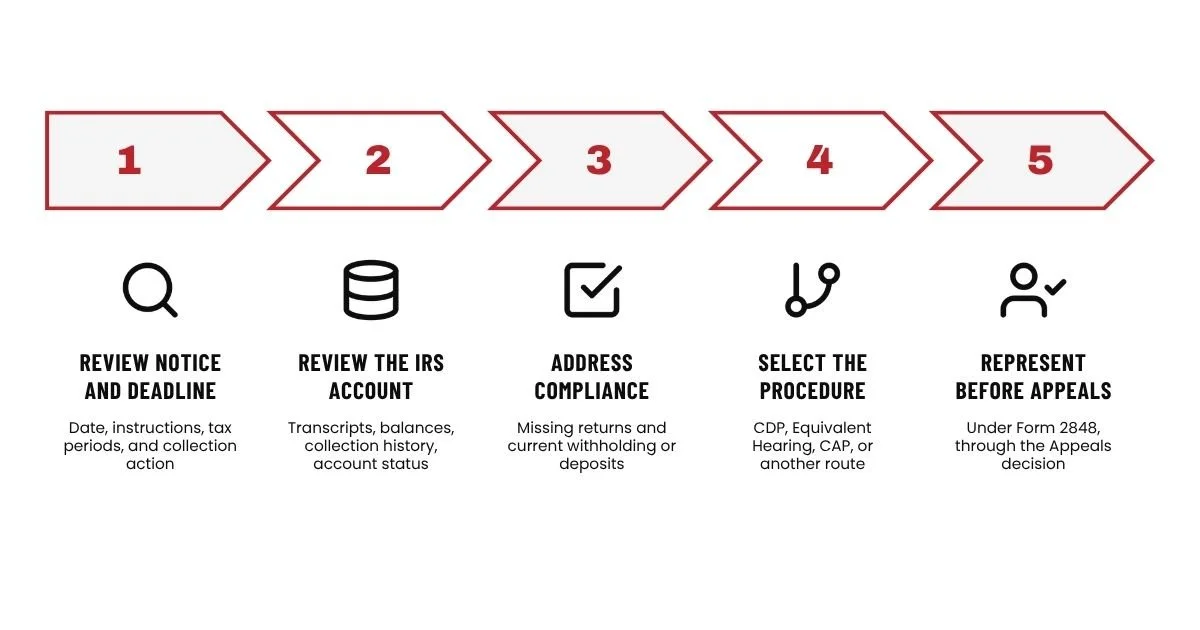
Step 1: Review the Notice and Deadline
We review the notice, date, response instructions, tax periods, and collection action.
This determines whether CDP, Equivalent Hearing, CAP, or another procedure may be available.
Step 2: Review the IRS Account
We obtain or review available IRS transcripts, balances, assessments, collection history, prior appeal opportunities, and account status.
Step 3: Address Compliance
We determine whether required returns are missing and whether current withholding, estimated tax payments, or federal tax deposits need to be corrected.
Step 4: Select the Appeal Procedure
We compare the available procedures and determine which one fits the collection action and timing.
More than one procedure may appear relevant, but filing the wrong request can affect the issues considered and rights available afterward.
Step 5: Prepare the Appeal and Supporting Record
We prepare the applicable form, explanation, financial information, proposed resolution, and supporting documents within the scope of the engagement.
Step 6: Represent the Taxpayer Before Appeals
After a valid Form 2848 is filed, we can communicate with the IRS and participate in the administrative appeal as an authorized representative.
Step 7: Review the Appeals Decision
We review the Appeals determination or decision, explain the result, and identify the next administrative step that may be available.
If Tax Court litigation or another judicial procedure is being considered, separate review by a practitioner admitted to the applicable court may be necessary.
Why Work With Semper Tax Relief?
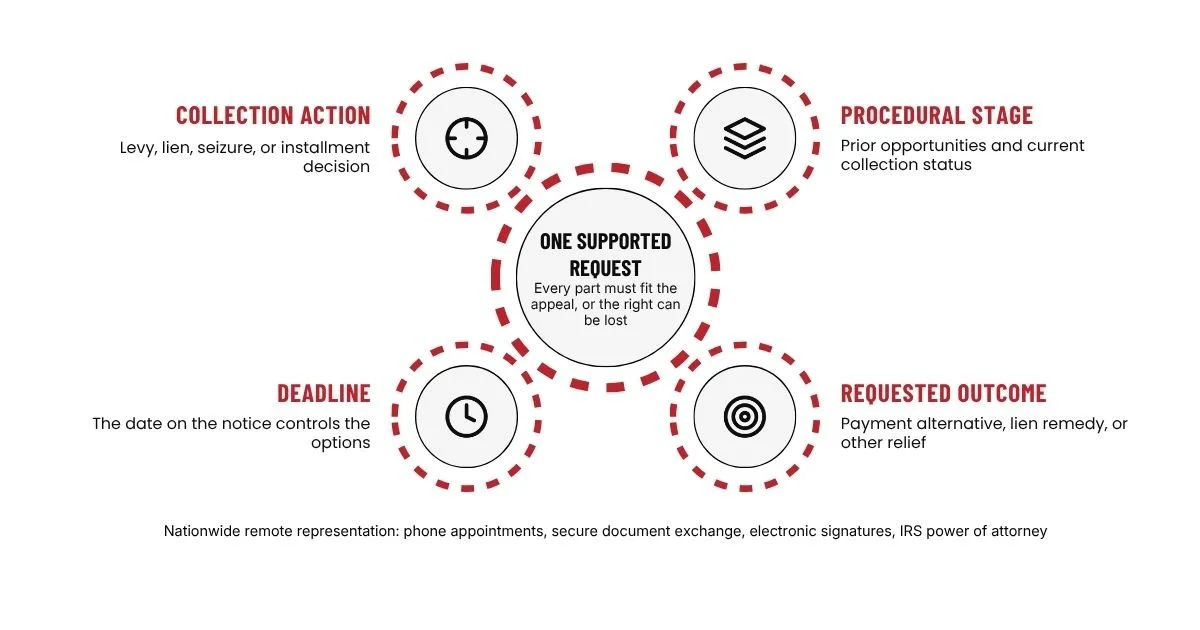
An IRS collection appeal requires more than completing a form.
The appeal must match the collection action, procedural stage, deadline, and requested outcome. A taxpayer seeking a payment alternative may also need filing compliance, current payments, a financial statement, supporting records, and a proposal that fits IRS requirements.
I review the broader tax problem before recommending an appeal.
Semper Tax Relief represents individuals, self-employed taxpayers, and businesses in IRS administrative collection matters throughout the United States. Remote representation may be handled through telephone appointments, secure document exchange, electronic signatures, and IRS power of attorney procedures.
Our goal is to identify the available appeal rights, explain the limitations, and present a supported request based on the taxpayer’s actual circumstances.
Frequently Asked Questions About IRS Collection Appeals
-
You generally have 30 days from the date of a qualifying CDP notice. Use the deadline and submission instructions printed on your notice.
A late request may qualify for an Equivalent Hearing, but it generally will not provide the same collection protections or Tax Court review rights.
-
A timely CDP request generally suspends levy action for the tax periods included in the hearing while the proceeding remains pending, subject to exceptions.
It does not automatically remove a lien, reverse a completed levy, stop collection for other periods, or prevent penalties and interest from continuing. -
Only in limited circumstances. You may generally challenge the underlying liability when you did not receive a statutory notice of deficiency and did not otherwise have a prior opportunity to dispute it. The complete procedural history must be reviewed.
-
You may be able to request an Equivalent Hearing within one year after the date of the CDP notice. An Equivalent Hearing can provide administrative review, but it generally does not provide the same statutory suspension of collection or the right to petition the Tax Court.
-
Form 12153 is used to request a Collection Due Process or Equivalent Hearing after receiving a qualifying notice. Form 9423 is used for the Collection Appeals Program involving certain liens, levies, seizures, installment agreement decisions, and related collection actions.
-
Yes. CAP may be available after the IRS rejects, modifies, proposes to modify, terminates, or proposes to terminate an installment agreement. The request must be submitted within the applicable deadline and should explain the disagreement and proposed solution.
-
Appeals may consider qualifying collection alternatives during a CDP or Equivalent Hearing. The taxpayer must satisfy the applicable filing, payment, financial, and program requirements. Requesting an option does not guarantee its approval.
-
Semper Tax Relief may provide administrative representation before the IRS under a valid Form 2848 and the terms of the engagement. Representation before the United States Tax Court is separate and requires a practitioner admitted to practice before that court.
Request an IRS Collection Appeal Review
If you received a final levy notice, federal tax lien filing notice, installment agreement rejection, Revenue Officer decision, or another collection notice, the first step is to identify the appeal rights and deadline.
I can review the notice, IRS account, collection status, procedural history, and proposed resolution to help determine whether a CDP hearing, Equivalent Hearing, CAP request, or another procedure may be available.
A case review does not guarantee that the IRS will suspend collection, release a levy, withdraw a lien, approve a payment arrangement, reduce the balance, or reverse its decision. It provides an opportunity to understand the procedure, preserve available rights, and prepare a strategy supported by the facts.
Contact Semper Tax Relief to request a confidential free case review.