

IRS Substitute for Return Reconsideration and Replacement Help
If you did not file a required federal income tax return, the IRS may use information reported by employers, banks, investment companies, payment processors, and other third parties to calculate and assess a tax balance against you.
This is commonly called an IRS Substitute for Return, SFR, or Automated Substitute for Return.
An IRS prepared return may not reflect the correct filing status or include every deduction, credit, dependent, business expense, or basis adjustment you may be entitled to claim. However, that does not mean every SFR assessment is incorrect or that filing your own return will always reduce the balance.
Semper Tax Relief can review the IRS assessment, prepare the missing tax return, identify available supporting records, and help determine the correct procedure for requesting an account adjustment or reconsideration.
Do I qualify for tax relief? Find out with a free case review.
Call today: 24 Hours / 7 Days a Week or book online.
✔ Confidential ✔ No Pressure ✔ Personalized
I am Sergio Melendez, JD, EA. I have worked in the tax profession since 2005 and regularly assist taxpayers with unfiled returns, IRS prepared returns, disputed assessments, collection notices, and related tax debt.
The appropriate response depends on whether the IRS is still proposing the assessment, has already assessed the tax, has started collection, or issued a notice carrying Tax Court or appeal rights.
What Is an IRS Substitute for Return?

An IRS Substitute for Return is a return prepared by the IRS when it believes a taxpayer was required to file but did not file.
The IRS can use information available in its records, including:
Form W-2 wages
Form 1099 NEC nonemployee compensation
Interest and dividend income
Retirement distributions
Investment sales
Payment processor reports
Mortgage information
Other income reported under the taxpayer’s identification number
The IRS uses this information to calculate a proposed tax liability. If the taxpayer does not respond during the notice process, the IRS may assess the proposed tax, penalties, and interest.
The IRS prepared return satisfies certain assessment and collection purposes for the government. It does not generally satisfy the taxpayer’s obligation to file their own required return.
Why an IRS Prepared Return May Be Higher Than the Correct Tax

The IRS prepares an SFR using the information available to it. That information may show income received without providing every fact needed to calculate the correct tax.
Depending on the tax year and taxpayer’s circumstances, the IRS prepared calculation may not properly reflect:
The taxpayer’s correct filing status
A qualifying spouse or dependent
Business expenses related to Schedule C income
Cost basis for stocks, digital assets, or other property sold
Rental property expenses and depreciation
Retirement distribution exceptions or rollover information
Adjustments to income
Itemized deductions
Tax credits
Tax payments not properly credited
Income reported under the wrong taxpayer identification number
Corrected Forms W 2 or 1099
This is why an IRS SFR assessment should be compared with a properly prepared return and supporting records.
Filing a taxpayer prepared return does not guarantee a lower balance. The completed return could reduce the assessment, leave it substantially unchanged, or reveal additional tax depending on the correct income, deductions, credits, payments, and filing status.
How the IRS Substitute for Return Process Works

The exact sequence may vary, but an individual SFR case commonly develops through several stages.
The IRS Identifies a Missing Return
The IRS receives information showing that a taxpayer may have had a filing requirement but cannot locate a filed return for that year.
The IRS may send notices asking the taxpayer to file, explain why no return is required, or provide additional information.
The IRS Calculates a Proposed Tax
If the taxpayer does not respond, the IRS may calculate a proposed tax based on available income information.
At this stage, the amount may still be proposed rather than finally assessed.
The IRS Issues CP3219N
CP3219N is a Notice of Deficiency involving a missing return. It is commonly called a 90-day letter.
The notice generally provides 90 days from its date to petition the United States Tax Court. The period is generally 150 days when the notice is addressed to a person outside the United States.
The deadline printed on the notice must be reviewed immediately. The IRS cannot extend the deadline for filing a Tax Court petition.
Filing a delinquent return with the IRS does not extend the Tax Court deadline.
The IRS Assesses the Tax
If the taxpayer does not timely resolve the proposed assessment or petition the Tax Court, the IRS may assess the tax, penalties, and interest.
After assessment and notice and demand for payment, the account may proceed through the IRS collection process.
IRS Collection May Begin
An unpaid SFR assessment may result in:
IRS collection notices
A Notice of Federal Tax Lien
A bank levy
A wage levy
A state tax refund levy
Assignment to an IRS Revenue Officer
Other collection activity permitted by law
The collection action and available response depend on the notices issued, deadlines, tax periods, and account status.
Responding Before the IRS Assesses the Proposed Tax
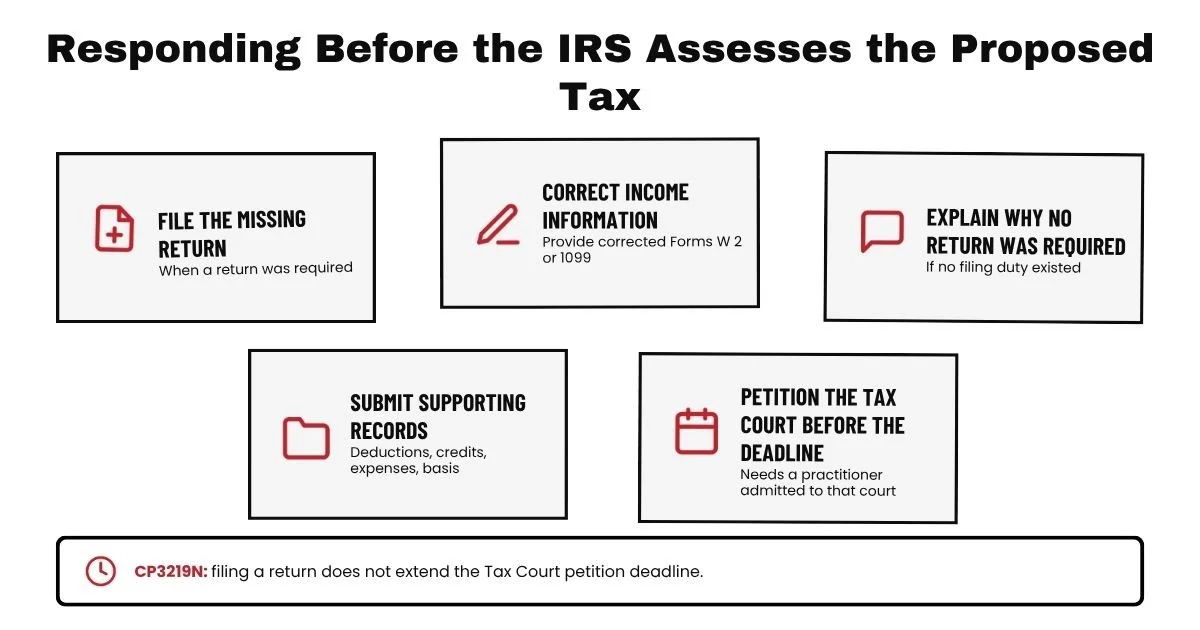
If you receive an SFR proposal or CP3219N, responding before the assessment is generally better than waiting for the IRS to complete the assessment and begin collection.
A response may include:
Filing the missing tax return
Correcting income information
Providing corrected Forms W 2 or 1099
Explaining why no return was required
Submitting records supporting deductions, credits, expenses, or basis
Filing a petition with the United States Tax Court before the deadline
The correct response depends on the notice and whether you agree with the proposed amount.
If you receive CP3219N, preparing and submitting a return does not extend the deadline for filing a Tax Court petition. The petition deadline should be considered separately from the IRS return submission.
Semper Tax Relief provides administrative representation before the IRS. Representation in the United States Tax Court requires a practitioner admitted to practice before that court. Separate legal counsel or another qualified representative may be necessary if litigation is being considered.
Correcting an IRS Substitute for Return After Assessment

If the IRS has already assessed tax based on an SFR, you can generally still file your own delinquent return.
The IRS states that it will generally adjust the account to reflect the correct figures when it accepts and processes the taxpayer’s return.
This process is sometimes described as replacing the Substitute for Return. More precisely, the taxpayer files the required delinquent return and asks the IRS to reconsider or adjust the assessment based on the correct return information.
The return should be:
Complete
Signed
Prepared for the correct tax year
Consistent with available income information
Supported by records for deductions, credits, expenses, and basis
Submitted according to the instructions applicable to the account
The IRS may request additional documentation before accepting adjustments shown on the return.
An incomplete or unsupported return may be rejected for reconsideration or processed without every requested change.
What Is SFR Reconsideration?
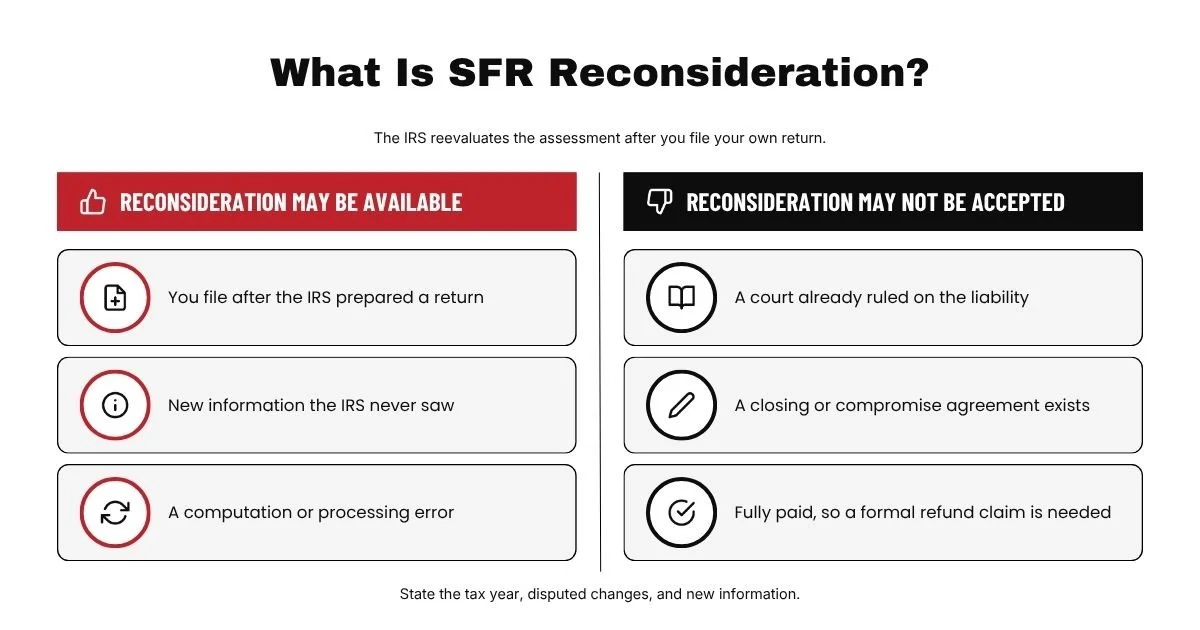
SFR reconsideration is an administrative process through which the IRS reevaluates an assessment after a taxpayer files a return following an IRS prepared return.
The broader audit reconsideration process may be available when:
The taxpayer files a return after the IRS completed a return
The taxpayer presents information the IRS did not previously consider
The taxpayer believes the IRS made a computational or processing error
The assessed liability remains unpaid or a tax credit was denied
A reconsideration request should identify the tax year, disputed changes, and new information being presented.
The IRS may not accept reconsideration in certain circumstances, including when:
A court entered a final determination concerning the liability
The taxpayer entered into certain closing or compromise agreements
The disputed amount was fully paid and a formal refund claim is required
The request does not provide new information or a valid basis for reconsideration
The appropriate procedure must be selected based on the account history.
Records That May Be Needed to Correct an SFR Assessment

The necessary records depend on the taxpayer’s income and requested changes.
Wage and Income Records
These may include:
Forms W-2
Forms 1099
Retirement distribution statements
Interest and dividend statements
Brokerage statements
IRS Wage and Income Transcripts
Corrected information returns
An IRS transcript can help identify information reported to the IRS, but it may not contain every detail needed to prepare an accurate return.
A self employed taxpayer may need:
Bank statements
Payment processor reports
Profit and loss information
Receipts
Mileage records
Equipment records
Insurance expenses
Advertising expenses
Contractor payment records
Other records supporting ordinary and necessary business expenses
When properly supported business expenses exist, reported gross receipts should not automatically be treated as net taxable business income.
The taxpayer must still substantiate expenses claimed on the delinquent return.
Investment and Property Records
A taxpayer with investment or property sales may need:
Purchase records
Brokerage statements
Closing statements
Cost basis reports
Records of improvements
Digital asset transaction histories
Prior depreciation records
A Form 1099 may report gross sales proceeds without complete cost basis information. The IRS cannot apply basis it does not have.
Family and Credit Information
Depending on the tax year, records may be needed to support:
Filing status
Dependents
Child related credits
Education credits
Retirement savings credits
Premium tax credit calculations
Other available tax benefits
Eligibility must be established under the rules applicable to the specific year.
Does Filing Your Own Return Stop IRS Collection?
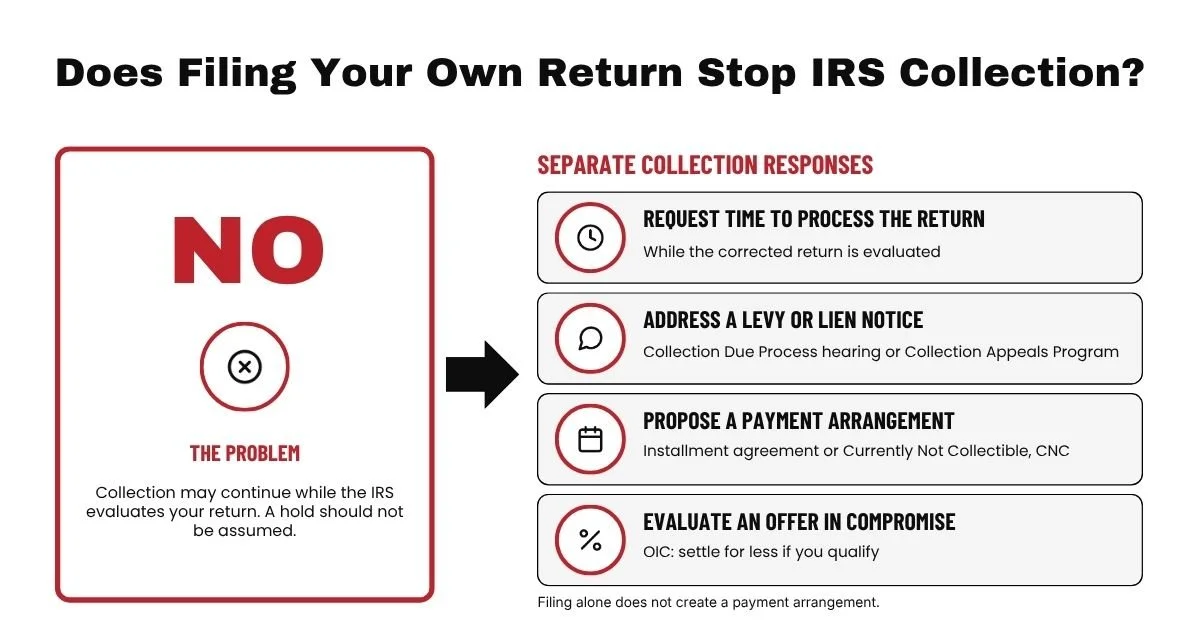
No. Preparing or submitting a delinquent return after an SFR assessment does not automatically stop IRS collection.
IRS procedures indicate that collection may continue until the IRS receives and evaluates the required return and supporting documentation. A collection hold may be available in some circumstances, but it should not be assumed.
If collection activity has started, a separate collection response may be necessary.
Depending on the account, this could involve:
Requesting time for the IRS to process the return
Addressing a levy or lien notice
Requesting a Collection Due Process hearing
Requesting a Collection Appeals Program review
Proposing an installment agreement
Requesting Currently Not Collectible status
Evaluating an Offer in Compromise
Requesting another applicable collection alternative
Each option has separate requirements and limitations. Filing the missing return addresses filing compliance and the assessed amount. It does not by itself establish a payment arrangement for any remaining balance.
What Happens to Penalties and Interest?
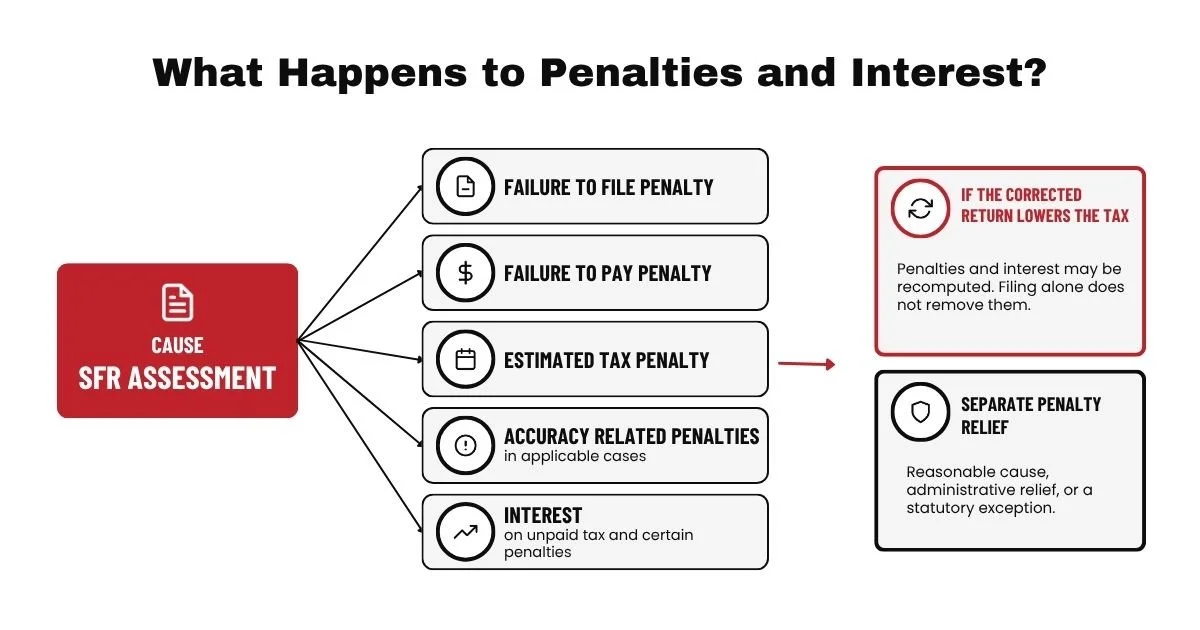
An SFR assessment may include penalties and interest.
Potential additions can include:
Failure to File Penalty
Failure to Pay Penalty
Estimated Tax Penalty
Accuracy related penalties in applicable cases
Interest on unpaid tax and certain penalties
Filing a delinquent return does not automatically remove penalties or interest.
If the corrected return reduces the underlying tax, related penalties and interest may be recomputed based on the adjusted liability.
Separate penalty relief may be available when the taxpayer qualifies under reasonable cause, administrative relief, a statutory exception, or another applicable provision.
Reasonable cause depends on the facts and circumstances. A taxpayer generally must show that they exercised ordinary care and prudence but were nevertheless unable to comply.
Penalty relief should not be requested until the penalties, tax years, compliance history, and supporting facts have been reviewed.
Can You Still Receive a Refund From an Unfiled Return?

Possibly, but strict time limits apply.
The deadline for claiming a federal tax credit or refund is generally the later of:
Three years from the date the return was filed
Two years from the date the tax was paid
Additional rules limit the amount that can be refunded based on when the tax was paid. Withholding and estimated tax payments are generally treated as paid on the original return due date.
A taxpayer filing several years late may lose the ability to receive a refund of withholding or estimated payments, even though the return still must be filed.
Exceptions may apply in limited circumstances, including certain disaster relief, combat zone, financial disability, bad debt, or worthless security situations.
A potential refund should be reviewed year by year. Filing a delinquent return does not guarantee that a refund remains legally available.
How an SFR Affects IRS Assessment and Collection Deadlines
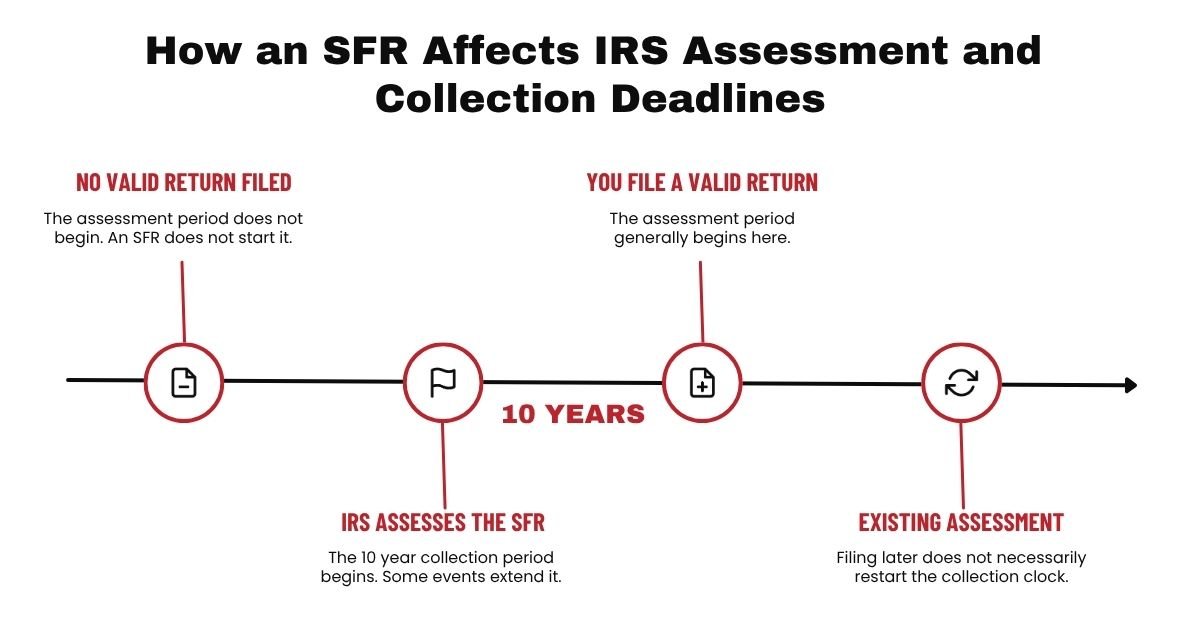
When a taxpayer does not file a valid required return, the ordinary assessment period generally does not begin.
An IRS prepared Substitute for Return does not start the taxpayer’s ordinary assessment period. If the taxpayer later files a valid return, the applicable assessment period generally begins from that filing, subject to exceptions.
The IRS collection period is different.
When the IRS assesses tax based on a Substitute for Return, the general 10 year collection period begins from the assessment date. Certain events can suspend or extend the collection period.
Filing a delinquent return after the SFR does not necessarily restart the collection period for the existing assessment. However, an additional assessment resulting from the filed return may have its own assessment and collection consequences.
IRS transcripts and account history should be reviewed before making assumptions about any expiration date.
Resolution Options After the SFR Is Corrected
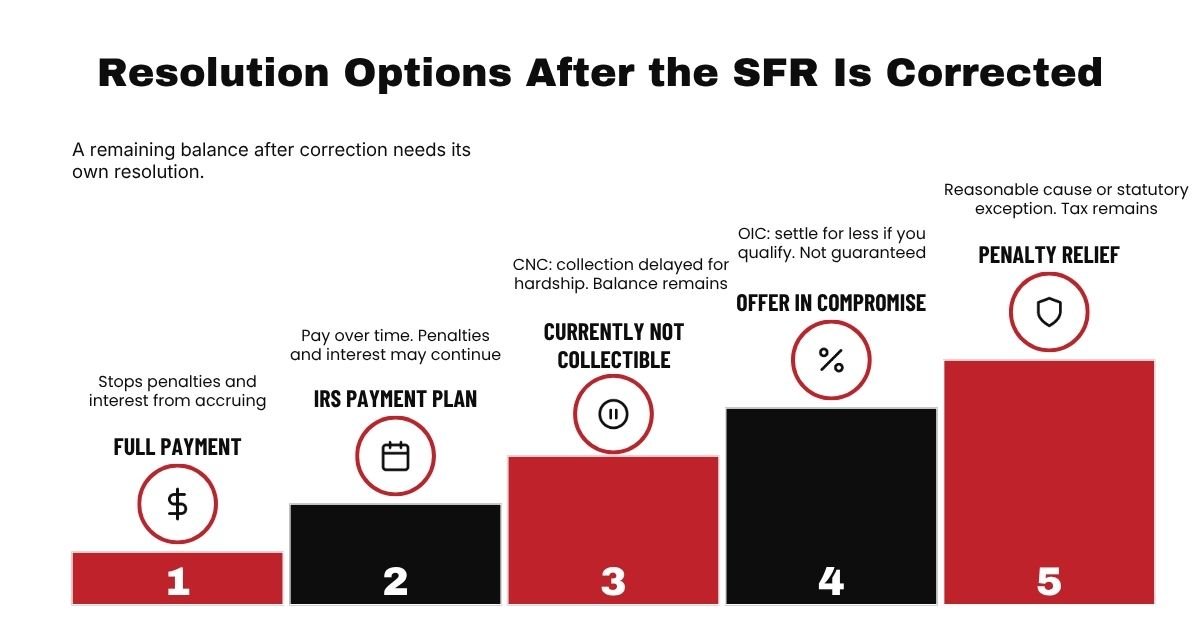
After the IRS processes the taxpayer’s return, the account may show:
No remaining balance
A reduced balance
The same balance
An increased balance
A credit that can be applied to another eligible tax period
A refund, if legally available
If a balance remains, the taxpayer may need a separate tax debt resolution.
Depending on the circumstances, possible options may include:
Full Payment
Paying the verified balance can prevent additional failure to pay penalties and interest from continuing to accrue.
An installment agreement may allow the taxpayer to pay an eligible balance over time.
A payment plan does not generally reduce the underlying tax, and penalties and interest may continue. Filing compliance and current tax payments are generally required.
The IRS may temporarily delay collection when the taxpayer demonstrates that payment would create qualifying financial hardship.
The balance remains due, penalties and interest may continue, and the IRS may review the taxpayer’s finances later.
A qualifying taxpayer may be able to settle an IRS balance for less than the full amount owed through an Offer in Compromise.
The IRS reviews income, expenses, assets, equity, compliance, and ability to pay. Filing an offer does not guarantee acceptance.
Penalty removal or reduction may be available when the taxpayer meets the requirements for reasonable cause, administrative relief, a statutory exception, or another recognized basis.
Penalty relief generally does not remove the underlying tax.
How Semper Tax Relief Can Help
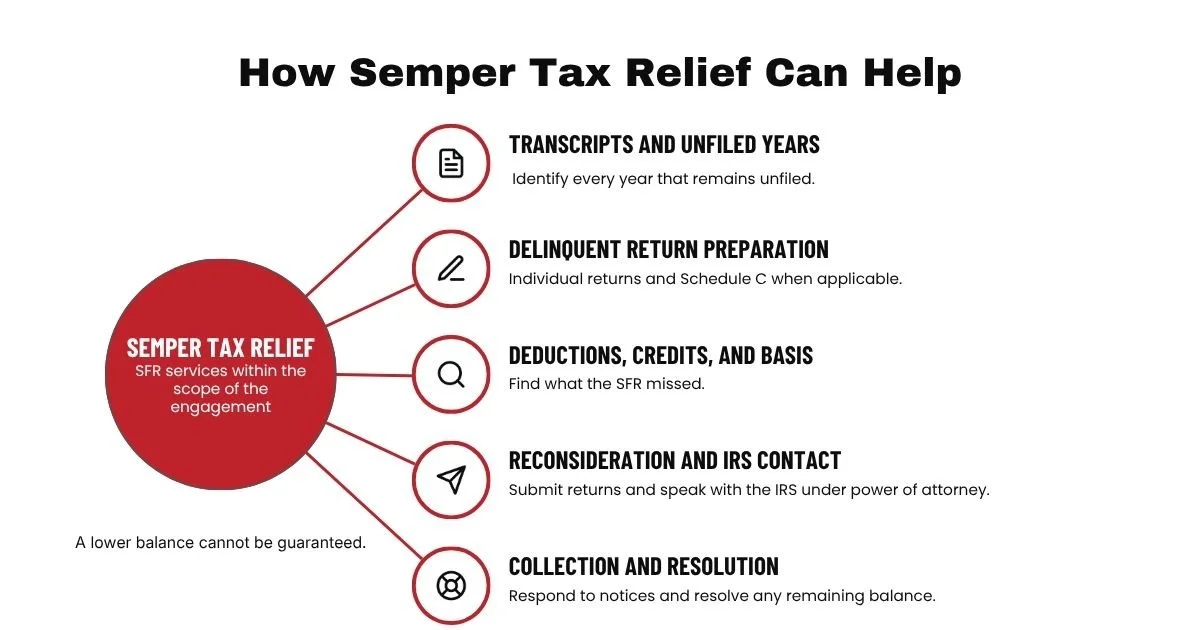
Semper Tax Relief can assist with the SFR assessment, missing return, collection problem, or related resolution based on the scope of the engagement.
Our services may include:
Obtaining and reviewing IRS account transcripts
Obtaining available Wage and Income Transcripts
Identifying which tax years remain unfiled
Reviewing SFR assessments and IRS notices
Comparing third party income records with taxpayer records
Preparing delinquent individual income tax returns
Preparing Schedule C business activity when applicable
Identifying available deductions, credits, expenses, and basis
Submitting returns for SFR reconsideration
Communicating with the IRS under a valid power of attorney
Responding to IRS requests for documentation
Monitoring account adjustments
Addressing related collection notices
Evaluating payment and resolution options for any remaining balance
The tax return must be based on accurate information and supported by available records. Semper Tax Relief cannot guarantee that the IRS will accept every claimed adjustment or reduce the balance.
Our IRS Substitute for Return Review Process
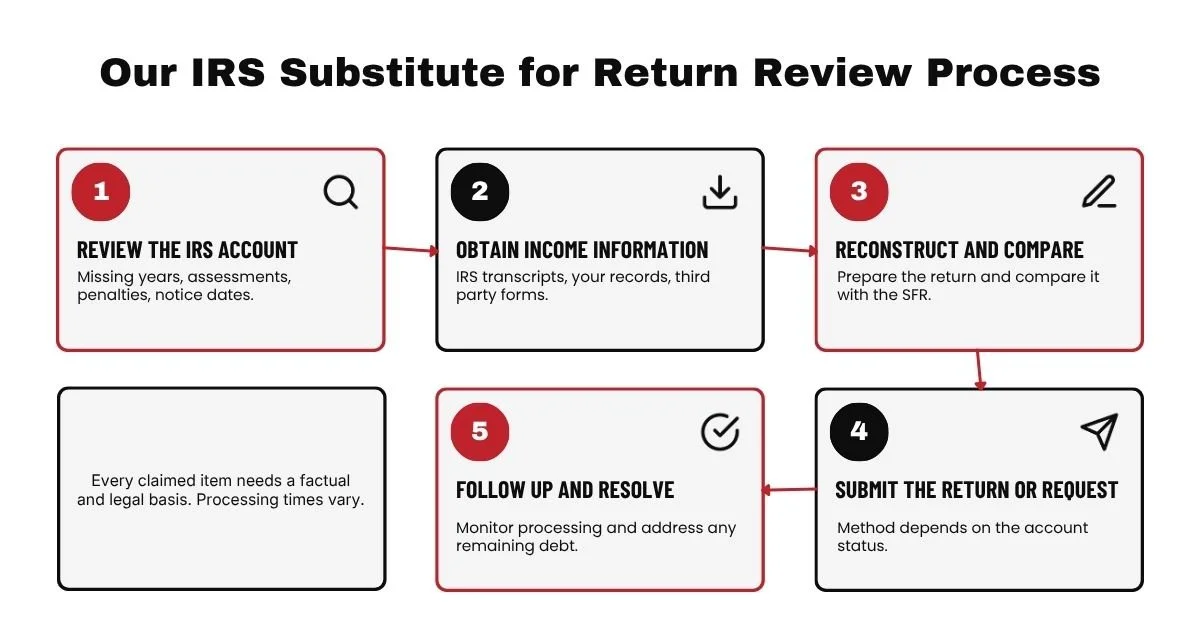
Step 1: Review the IRS Account
We identify the missing tax years, SFR assessments, proposed assessments, penalties, collection activity, and important notice dates.
Step 2: Obtain Available Income Information
We review available Wage and Income Transcripts, account transcripts, taxpayer records, and third party forms.
Step 3: Reconstruct the Tax Return
We prepare the delinquent return using the available income, deduction, expense, basis, dependent, and credit information.
Any claimed item must have a reasonable factual and legal basis.
Step 4: Compare the Return With the SFR Assessment
We compare the taxpayer prepared return with the IRS assessment to determine what changes are being requested.
Step 5: Submit the Correct Return or Reconsideration Request
The filing method and destination depend on whether the IRS is still proposing the tax, has already assessed it, assigned the account for collection, or requested a particular response.
Step 6: Follow Up With the IRS
Within the scope of the engagement, we monitor processing, respond to document requests, and review resulting account adjustments.
Processing times vary based on the age of the return, IRS workload, account condition, and whether additional review is required.
Step 7: Address Any Remaining Tax Debt
If the corrected account still has a balance, we review the available payment and resolution options.
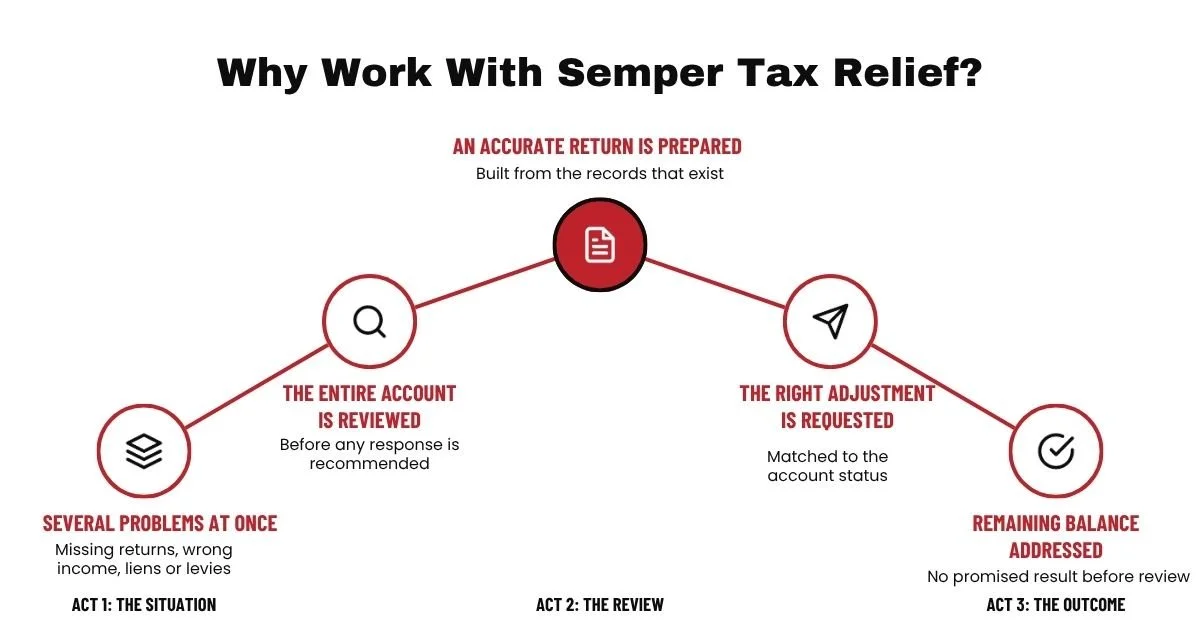
Why Work With Semper Tax Relief?
An SFR case can involve several problems at once:
Missing tax returns
Incomplete financial records
Incorrect income information
Missing business expenses
Unreported cost basis
IRS penalties and interest
Collection notices
Tax liens or levies
Several years of tax debt
I review the entire IRS account before recommending a response.
Semper Tax Relief assists individuals, families, self employed taxpayers, and business owners throughout the United States. Cases may be handled remotely through secure document exchange, telephone appointments, electronic signatures, and IRS power of attorney procedures.
Without promising a result before the records are reviewed, our goal is to determine what the IRS assessed, prepare an accurate return, request the appropriate adjustment, and address any remaining balance.
Frequently Asked Questions About IRS Substitute for Return Help
-
No. An IRS prepared Substitute for Return allows the IRS to calculate and assess tax when a required return was not filed. It does not generally satisfy your obligation to file your own return.
-
Generally, yes. The IRS states that it is still in your interest to file your own required return and will generally adjust the account to reflect the correct figures. The return must be accurate, complete, and supported.
-
It may, but a reduction is not guaranteed. The result depends on the correct income, filing status, deductions, business expenses, basis, credits, and payments. In some cases, the corrected balance may remain the same or increase.
-
The correct filing method depends on how the IRS processed the SFR and the account’s procedural status. Because an IRS prepared SFR is not always treated like a taxpayer filed original return, the taxpayer may need to submit a signed delinquent Form 1040 rather than automatically using Form 1040 X. The account and notice instructions should be reviewed before filing.
-
No. Filing a delinquent return does not extend the deadline to petition the United States Tax Court. The deadline shown on CP3219N must be considered separately.
-
Collection does not automatically stop merely because a delinquent return or reconsideration request is being prepared. A collection hold may be available after sufficient documentation is received, but it should not be assumed. A separate collection response may be necessary.
-
You may claim qualifying business expenses supported by the tax law and your records. The IRS may request documentation. Personal expenses and unsupported amounts cannot be treated as business deductions.
-
Yes. We can review the account year by year, identify filing requirements, prepare required returns within the scope of the engagement, and evaluate any remaining tax debt. The result may differ for each tax year.
Request an IRS Substitute for Return Review
If the IRS prepared a tax return for you, the assessed balance may not reflect the complete facts of your tax situation.
I can review the IRS account, available income information, missing returns, SFR assessments, penalties, and collection status to help determine what needs to be filed and which response procedure may be available.
A case review does not guarantee that the IRS will reduce the assessment, remove penalties, stop collection, issue a refund, or accept every item claimed on the return. It provides an opportunity to understand the account and prepare a response based on accurate records.
Contact Semper Tax Relief to request a confidential Free Case Review.