

High Balance IRS Tax Debt Help
Owing the IRS more than $50,000 or $100,000 can create a more involved collection problem, but the size of the balance does not determine the resolution by itself.
The correct strategy depends on:
Why the tax is owed
Which tax years are involved
Whether all required returns have been filed
When each balance was assessed
Your current income and necessary expenses
The value and equity of your assets
Your ability to borrow or sell property
Whether the account is assigned to a Revenue Officer
Whether the IRS has filed a federal tax lien
Whether levy notices or appeal rights have been issued
How much time remains in the IRS collection period
Semper Tax Relief helps individuals, self-employed taxpayers, and business owners review substantial IRS balances and evaluate the payment, hardship, settlement, correction, and appeal options supported by their circumstances.
Do I qualify for tax relief? Find out with a free case review.
Call today: 24 Hours / 7 Days a Week or book online.
✔ Confidential ✔ No Pressure ✔ Personalized
I am Sergio Melendez, JD, EA. I have worked in the tax profession since 2005 and focus my practice on IRS collection matters, unfiled returns, tax debt resolution, liens, levies, Revenue Officer cases, financial hardship reviews, and Offers in Compromise.
A large IRS balance does not automatically qualify someone for a settlement. It also does not automatically mean that the IRS will levy property, assign a Revenue Officer, or revoke a passport. Each action and resolution has separate legal and procedural requirements.
What Is Considered High Balance IRS Tax Debt?

There is no single universal IRS definition of high balance tax debt for every collection purpose.
Different balance levels matter for different procedures.
For example:
Individual taxpayers who owe $50,000 or less in assessed tax, penalties, and interest may generally qualify for an IRS Simple Payment Plan when filing and payment requirements are current.
Individuals who owe more than $50,000 may still qualify for an installment agreement, but the IRS may require a financial statement, supporting documents, and a lien determination.
A taxpayer whose qualifying seriously delinquent federal tax debt exceeds the annual passport certification threshold may face passport consequences after the additional statutory requirements are met.
The balance can affect which IRS collection function handles the account, but a particular amount does not guarantee assignment to a Revenue Officer.
The complete IRS account should be reviewed instead of relying on one balance threshold.
Why Large IRS Tax Debt Requires a Detailed Review

A large balance may involve several tax years, different assessment dates, and more than one type of tax.
The account may include:
Individual income tax
Self employment tax
Business income tax
Trust Fund Recovery Penalty assessments
Audit assessments
Substitute for Return assessments
Civil penalties
Failure to File Penalties
Failure to Pay Penalties
Estimated tax penalties
Accrued interest
Each tax period can have a different assessment date, collection expiration date, notice history, and procedural posture.
A single resolution may cover several periods, but those periods should still be reviewed individually.
The First Questions to Answer
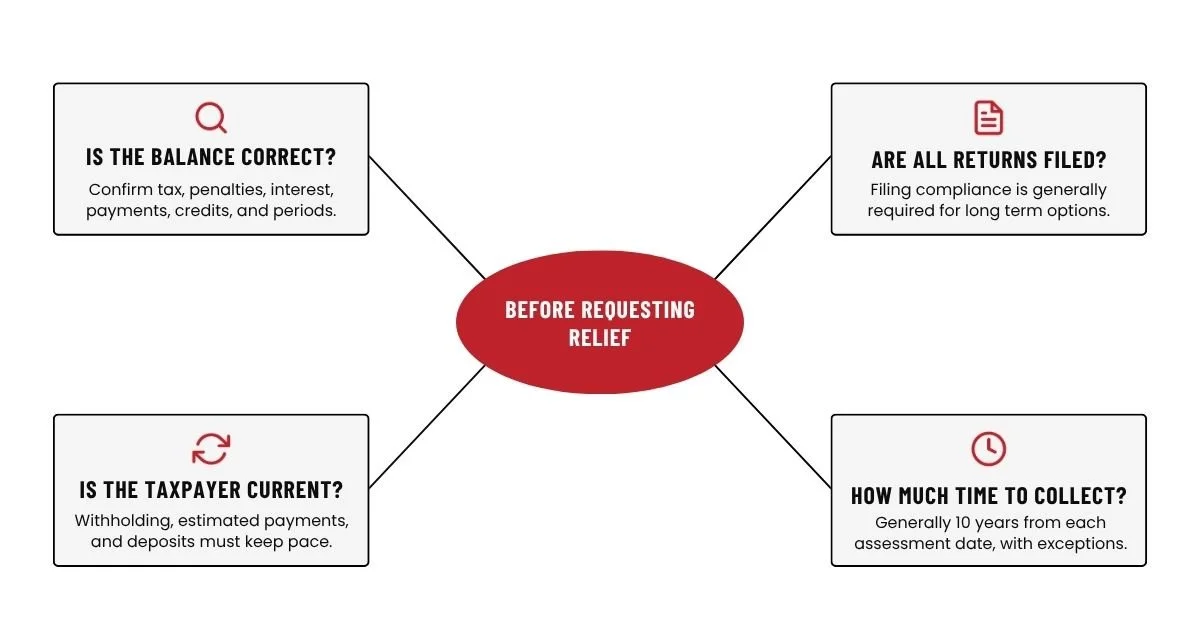
Before requesting tax relief, Semper Tax Relief reviews several core questions.
Is the IRS Balance Correct?
The first step is confirming the assessed tax, penalties, interest, payments, credits, and tax periods.
A large balance may be affected by:
An audit assessment
Unreported cost basis
Duplicated income
Disallowed business expenses
An incorrect filing status
A missing payment
A payment applied to the wrong tax year
Identity theft
An unprocessed amended return
A prior spouse’s income or tax issue
If the assessment is incorrect, correcting the liability may be more appropriate than immediately requesting a payment or hardship program.
Are All Required Tax Returns Filed?
The IRS generally requires filing compliance before approving many long-term resolution options.
The account should be reviewed for:
Unfiled individual income tax returns
Unfiled business returns
Unfiled employment tax returns
Returns filed but not processed
Substitute for Return assessments
Current estimated tax or federal tax deposit requirements
Filing every older year is not automatically required in every case. The filing requirement depends on the law, IRS procedures, account history, and facts.
Is the Taxpayer Current Now?
A taxpayer requesting a resolution generally needs to prevent another balance from developing.
This may require:
Correcting wage withholding
Making estimated tax payments
Making current federal tax deposits
Filing current returns on time
Improving bookkeeping
Separating business and personal finances
A new unpaid tax liability can cause a proposed or approved resolution to be returned, rejected, terminated, or defaulted.
How Much Time Does the IRS Have to Collect?
The IRS generally has 10 years from the assessment date to collect a federal tax liability.
Each assessment can have a separate Collection Statute Expiration Date.
Certain events can suspend or extend the collection period, including:
A pending installment agreement request and certain appeal periods
A pending Offer in Compromise and certain appeal periods
A timely Collection Due Process hearing
Bankruptcy
Certain periods spent continuously outside the United States
The collection dates should be calculated from IRS account records. The age of the tax year alone does not establish when the collection period expires.
IRS Collection Risks With a Large Tax Balance
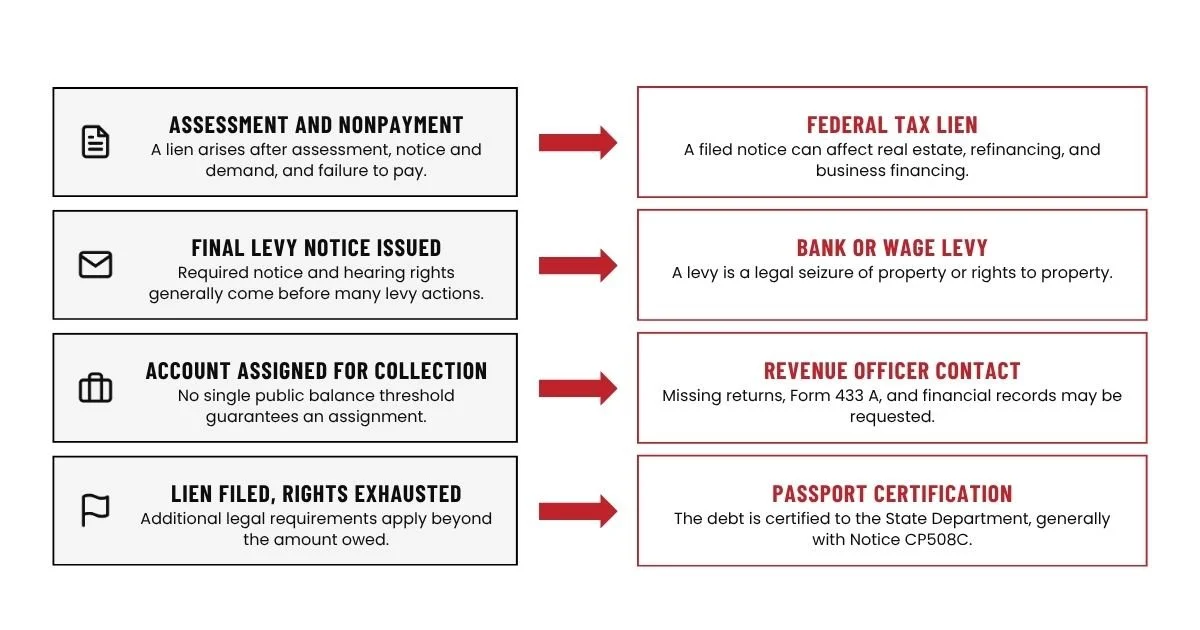
A larger balance can increase concern about collection, but enforcement is based on more than the amount owed.
Federal Tax Lien
A federal tax lien arises after assessment, notice and demand, and failure to pay.
The IRS may file a Notice of Federal Tax Lien to provide public notice of its claim against property and rights to property.
A filed notice can affect:
Real estate transactions
Refinancing
Business financing
Accounts receivable
Property sales
Other creditor relationships
Entering a payment plan does not automatically withdraw a Notice of Federal Tax Lien.
Lien release, withdrawal, discharge, subordination, and nonattachment are separate procedures with different requirements.
IRS Bank or Wage Levy
A levy is a legal seizure of property or rights to property.
Depending on the circumstances, the IRS may levy:
Bank accounts
Wages
Retirement accounts
Social Security benefits
Rental income
Commissions
Business accounts
Accounts receivable
Other property or income
The IRS generally must assess the tax, send notice and demand for payment, issue the required final levy notice, and provide applicable hearing rights before many levy actions.
Exceptions and special levy procedures may apply.
A high balance alone does not mean a levy is immediate. The notice history and collection status must be reviewed.
Revenue Officer Assignment
A Revenue Officer is an IRS collection employee who may be assigned to work directly on a delinquent account.
The IRS does not assign every high balance case to a Revenue Officer, and no single public balance threshold guarantees an assignment.
When a Revenue Officer is involved, the taxpayer may be asked to provide:
Missing tax returns
Form 433-A
Form 433-B
Bank statements
Pay records
Business financial statements
Accounts receivable
Asset valuations
Loan applications
Proof of current estimated payments
Proof of current federal tax deposits
The Revenue Officer may also set response deadlines and consider collection action if the account remains unresolved.
Passport Certification
The IRS may certify qualifying seriously delinquent tax debt to the United States Department of State.
For 2026, the indexed threshold is $66,000. The amount includes qualifying assessed tax, penalties, and interest.
Exceeding $66,000 does not automatically result in certification. The debt must meet additional legal requirements. Generally, the IRS must have filed a Notice of Federal Tax Lien and the related administrative rights must have lapsed or been exhausted, or the IRS must have issued a levy.
Certain debts and account conditions are excluded from certification. These can include qualifying debts being timely paid through an approved installment agreement or accepted Offer in Compromise, accounts in qualifying Currently Not Collectible status, certain pending requests, bankruptcy, and timely requested Collection Due Process hearings involving a levy.
If the IRS certifies the debt, it generally sends Notice CP508C.
The State Department may deny a passport application or renewal and may revoke or limit an existing passport after receiving certification.
How the IRS Reviews Ability to Pay
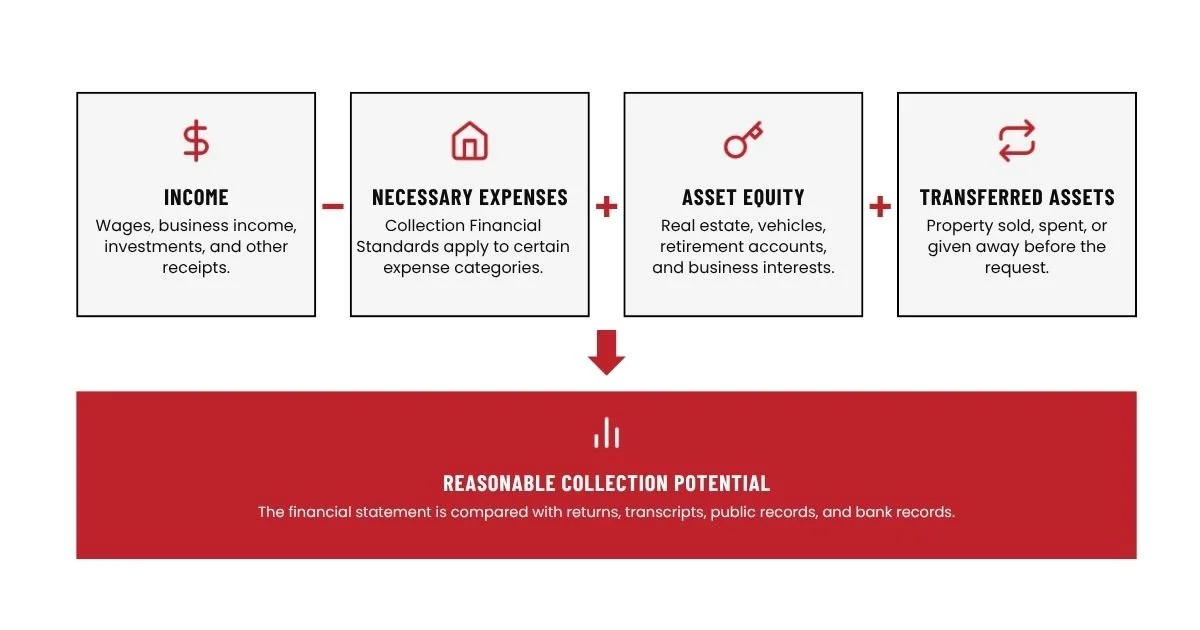
A taxpayer with a substantial balance may need to provide detailed financial information.
Individuals and self-employed taxpayers may be asked to complete Form 433-A or Form 433-F. Businesses may be asked to complete Form 433-B.
The IRS may review:
Wages and other income
Business income
Bank accounts
Investments
Digital assets
Retirement accounts
Real estate
Vehicles
Business interests
Accounts receivable
Life insurance cash value
Household expenses
Business expenses
Available credit
Recent transfers
Property held by other people or entities
The IRS may compare the financial statement with tax returns, transcripts, public records, credit information, bank records, and other available sources.
Necessary Living Expenses
The IRS uses Collection Financial Standards when evaluating certain living expenses.
Some expenses are measured under national or local standards. Other expenses may be allowed based on the taxpayer’s actual circumstances and whether they are necessary for health, welfare, or production of income.
An expense shown on a bank statement is not automatically allowed in full.
Asset Equity
The IRS may consider the taxpayer’s equity in real estate, vehicles, investments, retirement accounts, business assets, and other property.
An asset does not always need to be sold. The IRS may consider:
Whether the asset has realizable equity
Whether a loan is available
Whether selling it would create hardship
Whether it is necessary to produce income
Whether another collection alternative would provide a better result
The treatment depends on the requested resolution and facts.
Dissipated or Transferred Assets
The IRS may review property that was sold, transferred, spent, or given away before the resolution request.
Transfers to family members, large discretionary spending, or the use of available funds for other purposes can affect the financial analysis.
Not every prior transaction is treated as a dissipated asset. The timing, purpose, value, and use of funds must be reviewed.
Resolution Options for High Balance IRS Tax Debt
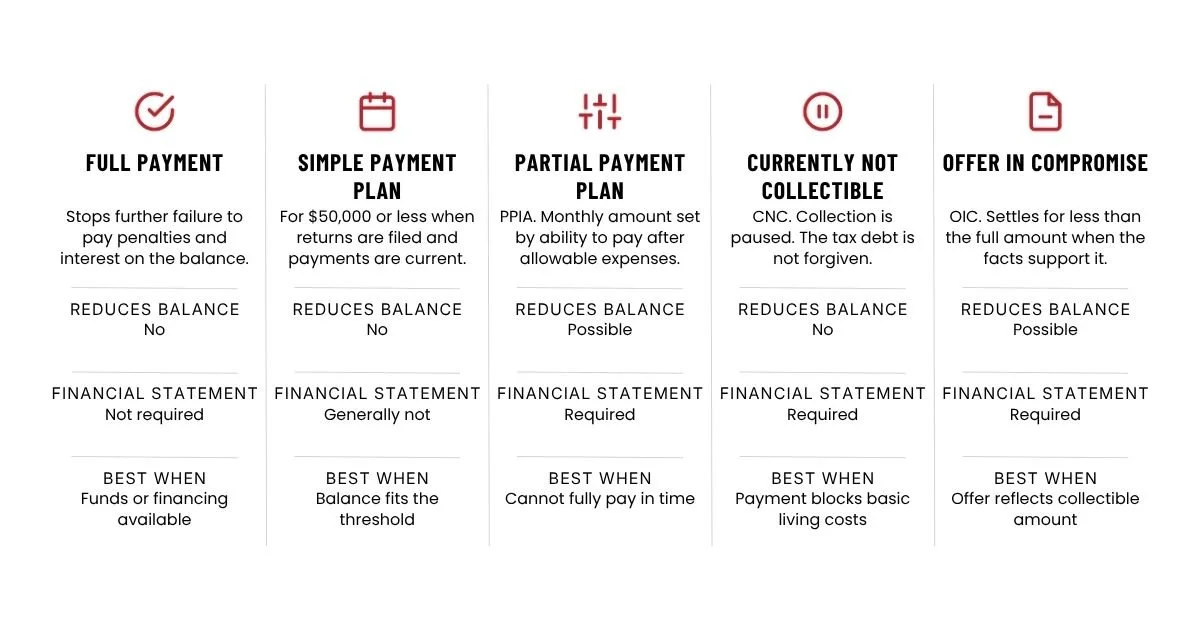
The best option is not determined by the balance alone.
Full Payment
Paying the verified balance in full generally stops additional failure to pay penalties and interest from accruing on that balance.
Before making a substantial payment, the taxpayer should confirm:
The correct tax periods
Assessment amounts
Payment application
Available credits
Whether any part of the assessment is disputed
Collection Statute Expiration Dates
A taxpayer may also consider whether financing or an asset transaction is more manageable than an extended IRS arrangement.
Short Term Payment Plan
An individual who owes less than $100,000 in combined tax, penalties, and interest may qualify to request a short-term payment plan if the balance can be paid within 180 days.
A short-term plan does not reduce the liability. Penalties and interest may continue until the balance is paid.
IRS Simple Payment Plan
An individual taxpayer who owes $50,000 or less in assessed tax, penalties, and interest may generally qualify for a Simple Payment Plan when all required returns have been filed and current payment requirements are satisfied.
The proposed payments must generally satisfy the assessed liability by the Collection Statute Expiration Date.
A taxpayer who owes more than $50,000 may consider whether paying the balance below the threshold is financially appropriate. However, reducing the balance does not guarantee approval if other requirements are not satisfied.
Financially Analyzed Installment Agreement
A taxpayer who does not qualify for a Simple Payment Plan may still qualify for another installment agreement.
The IRS may require a complete financial statement and supporting documents.
The IRS can review whether the taxpayer can:
Pay from available cash
Borrow against assets
Sell property
Reduce expenses
Increase monthly payments
Fully pay before the collection period expires
An installment agreement does not reduce the underlying tax. Penalties and interest generally continue, and the taxpayer must remain compliant.
Partial Payment Installment Agreement
A Partial Payment Installment Agreement may be considered when the taxpayer cannot fully pay the balance before the collection period expires.
The monthly payment is based on the taxpayer’s ability to pay after allowable expenses.
The IRS generally reviews Partial Payment Installment Agreements at least once every two years. If the taxpayer’s financial condition improves, the payment may increase.
A PPIA does not automatically guarantee that the remaining balance will expire. Events that suspend or extend the collection period can affect how long the IRS has to collect.
The IRS may place an account in Currently Not Collectible status when payment would prevent the taxpayer from meeting necessary living expenses.
CNC status temporarily suspends most collection activity. It does not forgive the tax debt.
While the account is in CNC status:
Penalties and interest may continue
Tax refunds may be applied to the balance
A federal tax lien may remain or be filed
The IRS may review the taxpayer’s finances later
The financial facts must support the hardship request.
Offer in Compromise
An Offer in Compromise may allow a qualifying taxpayer to settle an IRS liability for less than the full amount owed.
The IRS reviews:
Ability to pay
Income
Expenses
Asset equity
Business value
Future collection potential
Filing compliance
Current estimated payments or federal tax deposits
A large tax balance does not establish OIC eligibility. A taxpayer with substantial income or asset equity may be expected to pay more, even when the IRS balance is very high.
The IRS generally will not accept an offer based on doubt as to collectibility unless the offered amount reflects what it believes can reasonably be collected, subject to applicable exceptions.
Filing an OIC suspends the collection statute while the offer and certain appeal periods are pending.
Correcting or Challenging the Assessment
When the balance is inaccurate, the proper strategy may involve correcting the tax before selecting a collection alternative.
Possible procedures include:
Filing a delinquent return
Replacing an IRS Substitute for Return
Filing an amended return
Responding to a CP2000 notice
Requesting audit reconsideration
Correcting cost basis
Addressing identity theft
Tracing missing payments
Requesting innocent spouse relief
Filing an administrative appeal
The appropriate procedure depends on how the tax was assessed and which review rights remain available.
Penalty relief may be available through First Time Abatement, reasonable cause, a statutory exception, or correction of an IRS error.
Eligibility depends on the penalty, tax periods, compliance history, and supporting facts.
Penalty relief does not remove the underlying tax. Removing a penalty may also adjust related interest.
IRS Appeals for High Balance Collection Cases
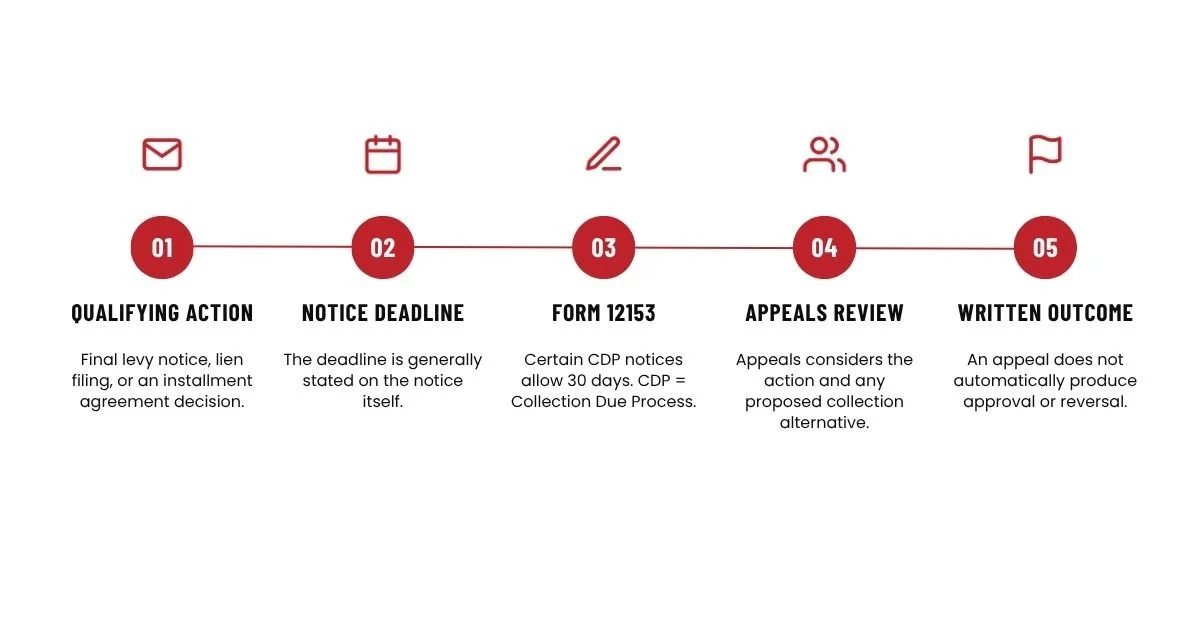
A taxpayer may have appeal rights when the IRS:
Issues a final notice of intent to levy
Files a Notice of Federal Tax Lien
Rejects an installment agreement
Proposes to modify or terminate an installment agreement
Denies certain lien requests
Takes another qualifying collection action
A timely Collection Due Process hearing may allow the taxpayer to request Appeals review and propose collection alternatives.
The deadline is stated on the notice. Certain CDP notices generally provide 30 days to request a hearing using Form 12153.
A Collection Appeals Program request may be available for other collection disputes. CAP procedures and deadlines depend on the collection action and procedural stage.
An appeal does not automatically produce approval of a resolution or reversal of the collection action.
How Semper Tax Relief Can Help
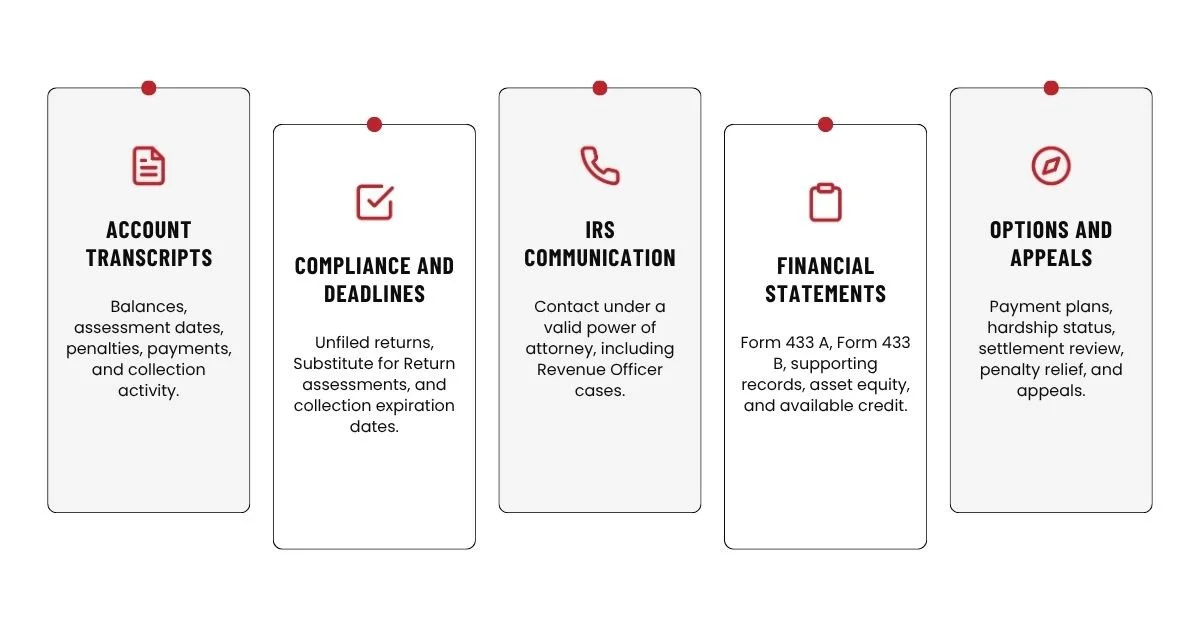
Semper Tax Relief can review the entire IRS account before recommending a strategy.
Our services may include:
Obtaining and reviewing IRS account transcripts
Confirming balances and assessment dates
Identifying Collection Statute Expiration Dates
Reviewing unfiled returns
Reviewing Substitute for Return or audit assessments
Evaluating IRS notices and collection deadlines
Communicating with the IRS under a valid power of attorney
Responding to an IRS Revenue Officer
Preparing Form 433-A, Form 433-B, or another financial statement
Organizing supporting financial records
Reviewing asset equity and available credit
Evaluating payment plan options
Evaluating a Partial Payment Installment Agreement
Evaluating Currently Not Collectible status
Evaluating an Offer in Compromise
Reviewing penalty relief
Addressing federal tax liens and levies
Preparing an administrative collection appeal
Reviewing passport certification issues
The services provided depend on the taxpayer’s account, records, deadlines, and the scope of the engagement.
Semper Tax Relief cannot guarantee that the IRS will reduce the balance, approve a settlement, accept a payment plan, remove penalties, release a levy, withdraw a lien, or reverse passport certification.
Our High Balance IRS Tax Debt Review Process
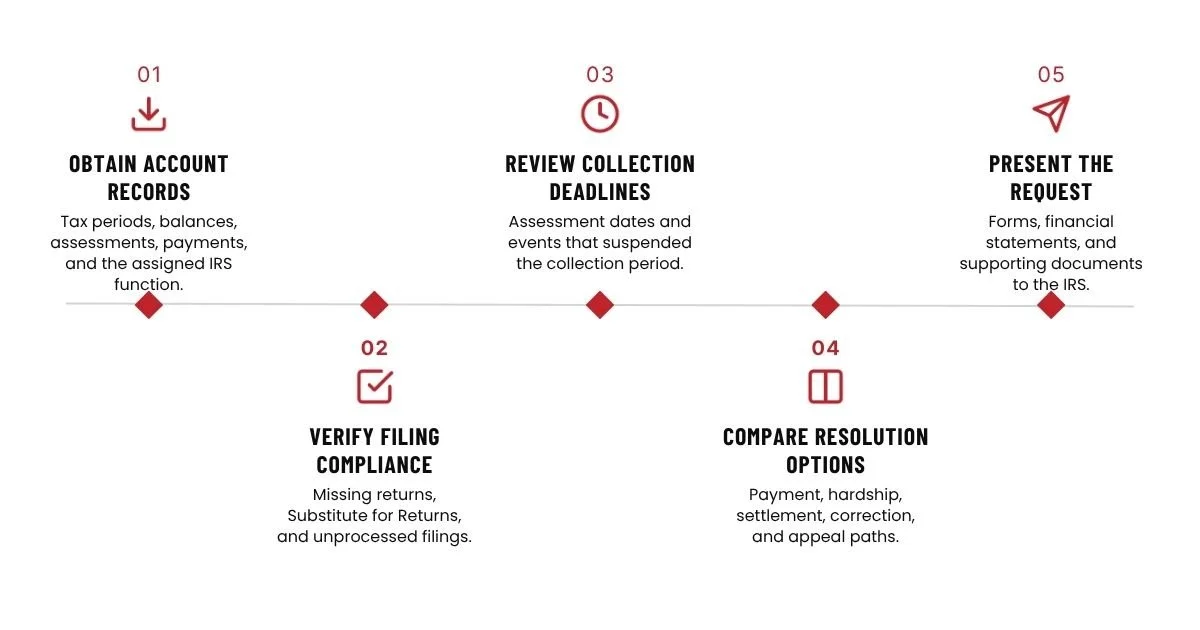
Step 1: Obtain the IRS Account Records
We identify the tax periods, balances, assessments, penalties, payments, collection activity, and assigned IRS function.
Step 2: Verify Filing Compliance
We determine whether required returns are missing, whether the IRS prepared any Substitute for Returns, and whether filed returns remain unprocessed.
Step 3: Review Collection Deadlines
We identify available assessment and collection dates, including events that may have suspended or extended the IRS collection period.
Step 4: Review Income, Expenses, and Assets
We review household or business income, necessary expenses, bank accounts, real estate, vehicles, investments, retirement accounts, business interests, debts, and available equity.
Step 5: Compare Resolution Options
We compare the payment, hardship, settlement, correction, and appeal options supported by the taxpayer’s facts.
Step 6: Present the Request
When retained for representation, we prepare the applicable forms, financial statements, explanation, and supporting documents and communicate with the assigned IRS function.
Step 7: Maintain Future Compliance
The taxpayer must continue filing returns and making required withholding, estimated tax payments, or federal tax deposits.
A new balance can affect a pending or approved resolution.
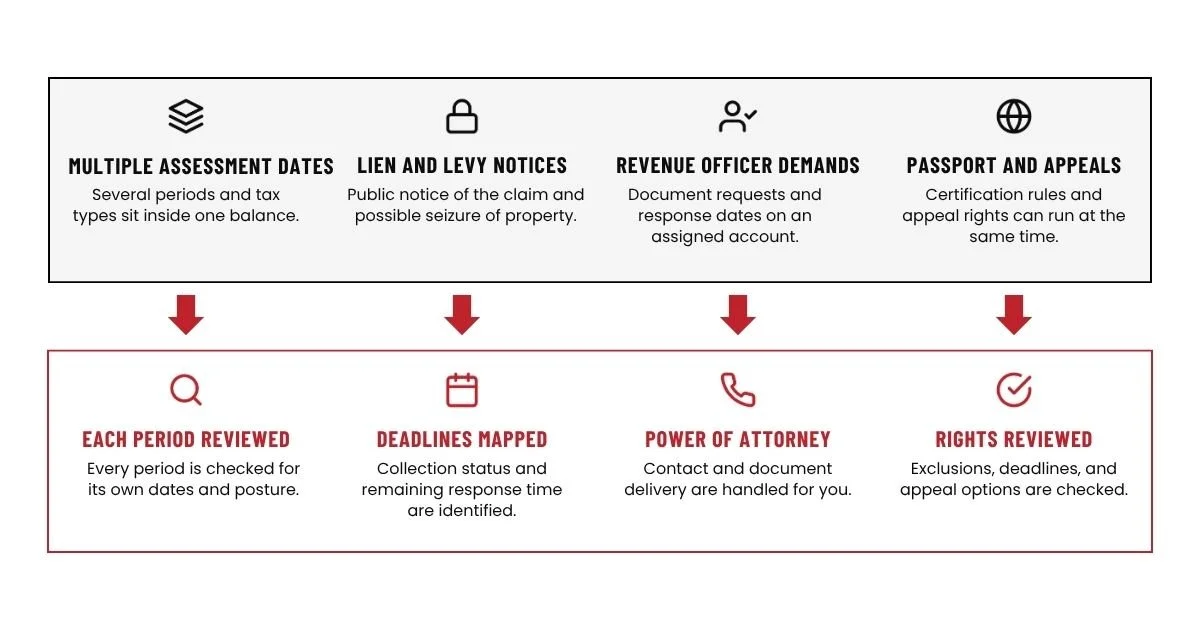
Why Work With Semper Tax Relief?
High balance tax debt can involve several IRS procedures at the same time.
A taxpayer may need to address:
Missing returns
Multiple assessment dates
A levy notice
A Revenue Officer
Asset equity
Business interests
Passport concerns
Collection appeals
A long term payment or settlement proposal
I review the complete account before recommending an option.
Semper Tax Relief represents individuals, self-employed taxpayers, and businesses throughout the United States through secure document exchange, telephone appointments, electronic signatures, and IRS power of attorney procedures.
Our goal is to explain the collection risk, identify realistic options, and present a supported request without making promises before the financial and procedural facts are reviewed.
Frequently Asked Questions About High Balance IRS Tax Debt
-
Owing more than $50,000 can remove a taxpayer from the general individual Simple Payment Plan criteria. The taxpayer may still qualify for another installment agreement, but financial disclosure, supporting documents, and a lien determination may be required.
-
The IRS will still review the account based on filing compliance, income, expenses, assets, collection status, and ability to pay. A balance above $100,000 does not automatically result in a levy, Revenue Officer assignment, or settlement. It can limit simplified payment options and require a more detailed financial analysis.
-
Possibly, but there is no single public balance threshold that guarantees Revenue Officer assignment. The IRS also considers the type of tax, collection history, missing returns, business activity, assets, and other enforcement factors
-
Yes, taxpayers who owe more than $50,000 may still qualify for an installment agreement. The IRS may require Form 433 A or another financial statement and supporting documents. The payment amount depends on the ability to pay and collection period.
-
The 2026 seriously delinquent tax debt threshold is more than $66,000. Exceeding that amount alone is not enough. The debt and collection activity must satisfy additional statutory requirements, and several exclusions can prevent or postpone certification.
-
Possibly. Eligibility depends on income, expenses, asset equity, business value, filing compliance, current payments, and reasonable collection potential. The size of the debt alone does not determine qualification.
-
Federal levy authority can reach many types of property, subject to legal restrictions and procedural requirements. Seizure of a principal residence requires additional procedures and judicial approval. Retirement account levy decisions also involve specific considerations. A large balance alone does not mean either asset will automatically be taken.
-
The IRS generally has 10 years from assessment to collect, but each tax period can have a different expiration date. Offers, installment agreement requests, CDP proceedings, bankruptcy, and other events may suspend or extend the collection period. The dates must be calculated from the account history.
Request a High Balance IRS Tax Debt Review
If you owe the IRS more than $50,000 or $100,000, the first step is to understand the full account before selecting a resolution.
I can review your IRS balances, assessment dates, missing returns, collection notices, liens, levies, financial condition, assets, and remaining collection period to help determine what options may be available.
A case review does not guarantee that the IRS will reduce the balance, accept an Offer in Compromise, approve a payment plan, remove penalties, release a levy, withdraw a lien, delay collection, or reverse passport certification.
It provides an opportunity to understand the risks and develop a strategy based on the actual IRS account and financial facts.
Contact Semper Tax Relief to request a confidential Free Case Review.