

Unfiled Form 1041 Trust and Estate Tax Returns
If an estate or trust should have filed Form 1041 but several years have passed without a return, the first step is determining which filing periods were actually required.
Form 1041 is not the deceased taxpayer's personal Form 1040.
It is the federal income tax return used by estates and many trusts to report income, deductions, gains, losses, distributions, and the income tax liability of the estate or trust.
A missing Form 1041 can also affect beneficiaries because Schedule K 1 may be required to report income, deductions, credits, and other tax information allocated to them.
I help executors, administrators, trustees, and other fiduciaries determine which Form 1041 returns are missing, reconstruct the income and expenses, prepare the required returns and beneficiary schedules, address IRS notices and penalties, and evaluate any tax balance that results.
Do I qualify for tax relief? Find out with a free case review.
Call today: 24 Hours / 7 Days a Week or book online.
✔ Confidential ✔ No Pressure ✔ Personalized
I am Sergio Melendez, JD, EA. I have worked in the tax profession since 2005 and represent taxpayers before the IRS as an Enrolled Agent.
You do not need to know whether the estate or trust owes tax before beginning the review.
We first determine what should have been filed.
Who Needs Help With an Unfiled Form 1041?
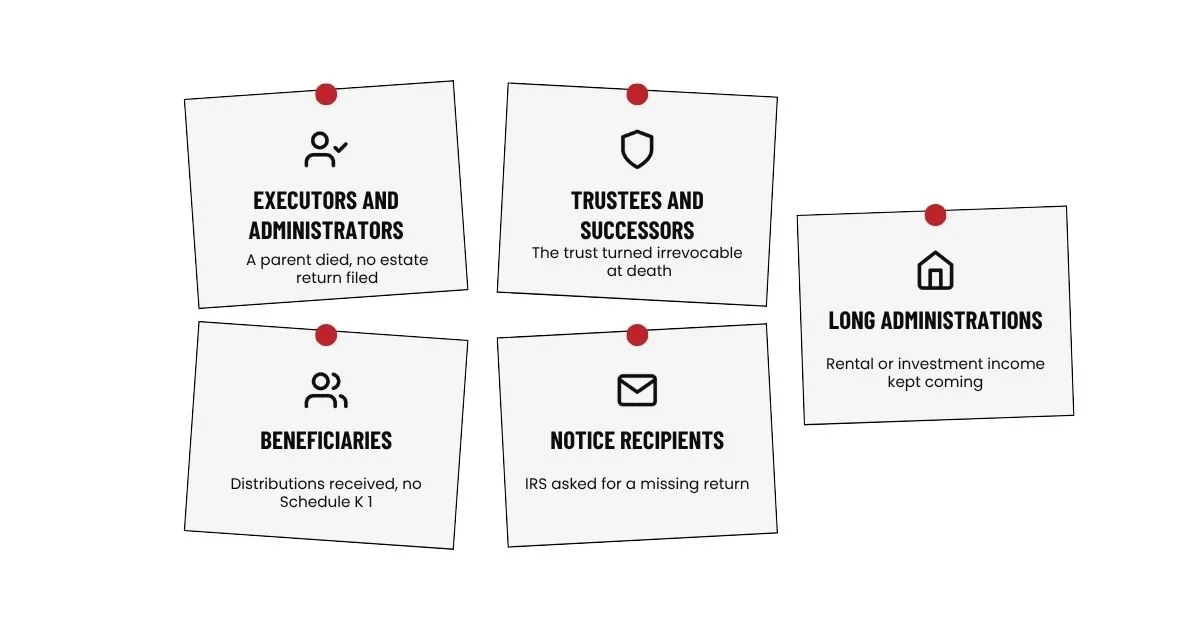
This service is for fiduciaries dealing with missing federal income tax returns for an estate or trust.
That can include:
Executors
Administrators
Personal representatives
Trustees
Successor trustees
Family members handling an estate
Professional fiduciaries
Beneficiaries helping locate missing tax records
Common situations include:
A parent died and no estate income tax returns were filed
Estate administration continued for several years
Rental property continued producing income after death
Investment accounts remained open in the estate
A trust became irrevocable after the grantor died
The trustee did not realize the trust had a filing requirement
Beneficiaries received distributions but no Schedule K 1
Prior fiduciaries failed to complete the tax filings
The estate or trust received an IRS notice for a missing return
Records changed hands between executors or trustees
What Is IRS Form 1041?
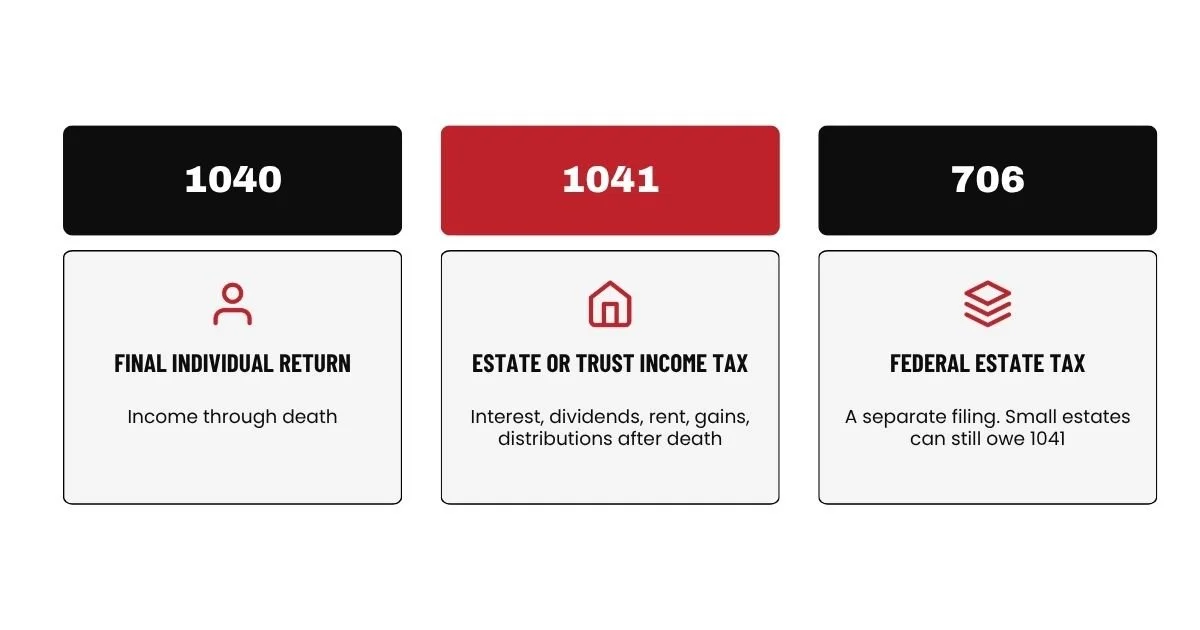
Form 1041, U.S. Income Tax Return for Estates and Trusts, is used by a fiduciary to report certain income tax information for a domestic estate, trust, or bankruptcy estate.
The return can report:
Interest
Dividends
Business income
Rental income
Capital gains and losses
Other income received by the estate or trust
Administration expenses
Certain deductions
Distributions to beneficiaries
Income retained by the estate or trust
Federal income tax liability
The tax treatment depends on the type of estate or trust and how income and distributions are handled.
Form 1041 Is Different From the Final Form 1040
A deceased taxpayer's final Form 1040 generally reports the individual's income through the applicable period ending with death.
Form 1041 generally addresses income belonging to the estate after death.
For example, interest received by an estate bank account after death may belong on Form 1041 rather than the decedent's final individual return.
The timing and character of the income need to be reviewed carefully because income cannot simply be assigned to whichever return is more convenient.
Form 1041 Is Also Different From Form 706
Form 1041 is an income tax return.
Form 706 is the federal estate tax return used when the federal estate tax filing requirements apply or when another permitted election, such as portability, makes filing appropriate.
An estate can be far below the federal estate tax threshold and still have a Form 1041 filing requirement.
These are separate federal tax filings.
When Does an Estate Have to File Form 1041?
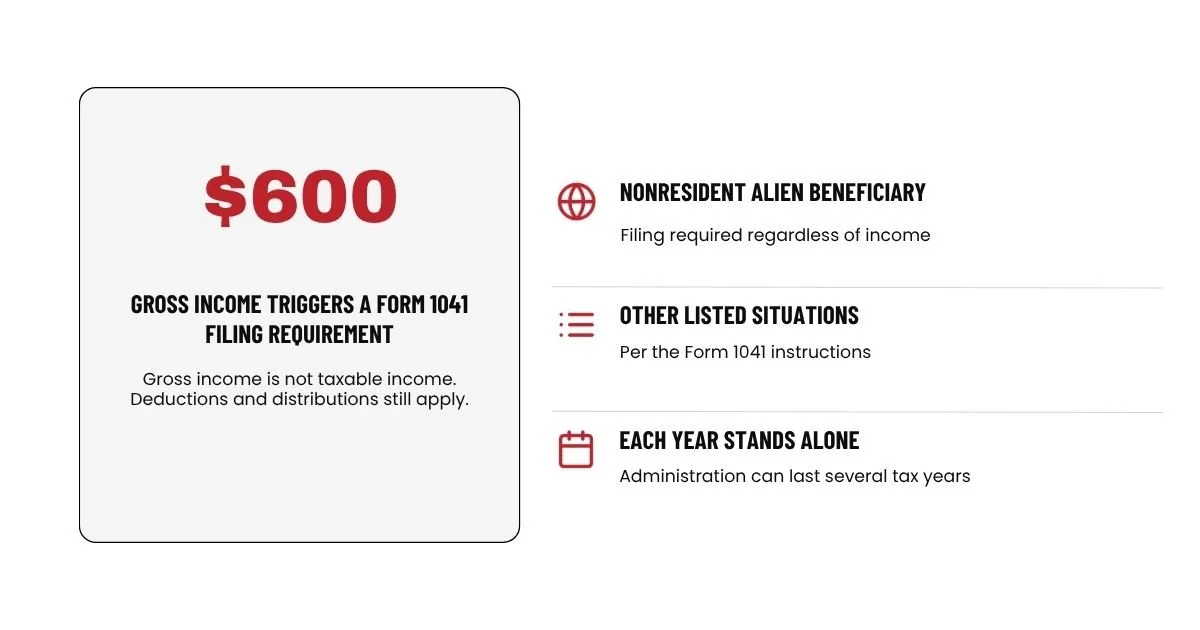
A fiduciary generally must file Form 1041 for a domestic decedent's estate when the estate has:
Gross income of $600 or more for the tax year
A beneficiary who is a nonresident alien
Certain other reporting situations identified in the Form 1041 instructions
That $600 figure refers to gross income.
It does not mean that an estate owes tax whenever it receives $600.
The estate may have deductions, distributions, losses, or other tax items that affect taxable income and the final tax calculation.
An Estate Can Exist for Several Tax Years
Probate and estate administration do not always finish within one year.
An estate may continue receiving rental income, dividends, interest, business income, or proceeds from other assets while administration continues.
Each tax year must be reviewed separately.
If the estate met the Form 1041 filing requirement in multiple years, several delinquent returns may need to be prepared.
When Does a Trust Have to File Form 1041?
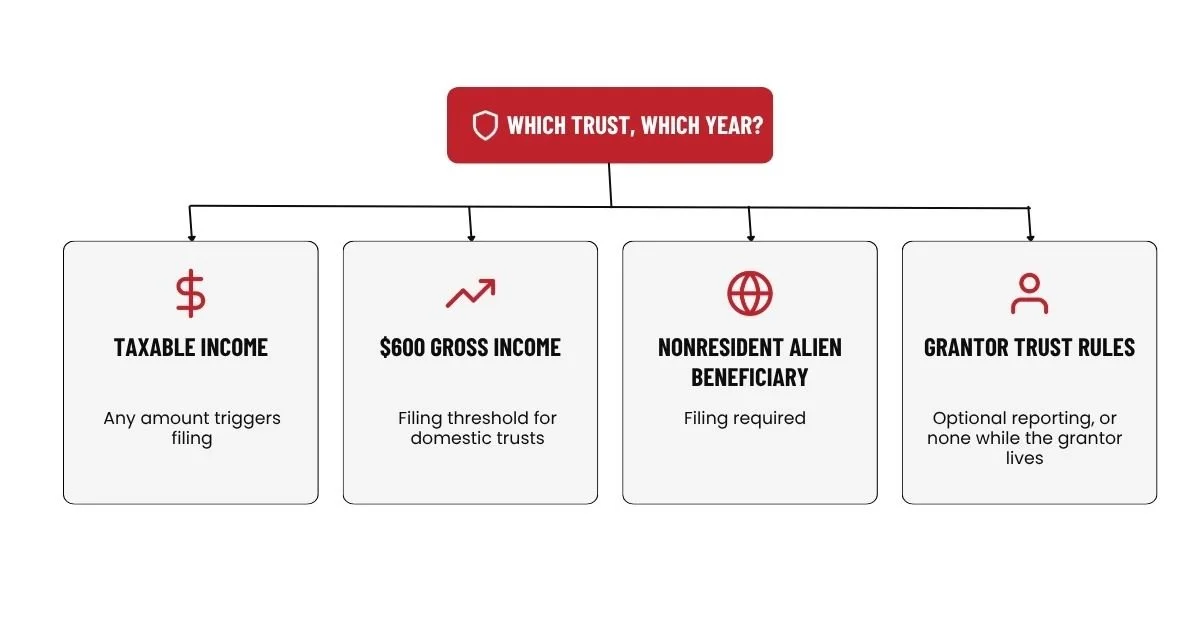
The filing rules for a domestic trust are different from the estate rules.
A domestic trust taxable under Internal Revenue Code section 641 generally must file Form 1041 when it has:
Any taxable income for the year
Gross income of $600 or more
A beneficiary who is a nonresident alien
Certain other reporting situations described in the Form 1041 instructions
The trust classification matters.
Not Every Revocable Living Trust Files a Traditional Form 1041
A common mistake is assuming that every trust automatically files its own income tax return.
A revocable living trust is generally treated as a grantor trust while the grantor is alive.
Income is typically treated as belonging directly to the grantor for federal income tax purposes.
Certain grantor trusts can also use IRS optional reporting methods instead of filing a traditional Form 1041 showing taxable amounts.
That changes after death in many cases.
A formerly revocable trust can become irrevocable, and its filing requirements should be reviewed again.
Grantor Trust Rules Can Change the Filing Method
Some grantor trusts may report using an optional method rather than a traditional Form 1041.
Other grantor trusts file Form 1041 with special attachments.
A trust that is only partly treated as a grantor trust may have both grantor and non-grantor reporting.
Before filing several years of late returns, I first determine what type of trust existed during each year and whether Form 1041 was actually required.
What Happens to a Living Trust After the Grantor Dies?

This is one of the most common Form 1041 problems I review.
A revocable living trust may have been reported under the grantor's Social Security number while the grantor was alive.
After death, the federal tax reporting can change.
The trustee may need to obtain an EIN and determine whether a Form 1041 filing requirement begins.
The trust document, date of death, assets, income, beneficiaries, and estate administration all matter.
A Section 645 Election May Affect the Filing Structure
A qualified revocable trust and the related estate may sometimes make an election under Internal Revenue Code section 645.
The election allows a qualifying revocable trust to be treated and taxed as part of the related estate for federal income tax purposes during the applicable election period.
IRS Form 8855 is used to make that election.
The election is not automatic.
It should be reviewed before preparing delinquent returns because it can affect the tax year, filing structure, and relationship between the estate and trust.
Does an Estate or Trust Need Its Own EIN?
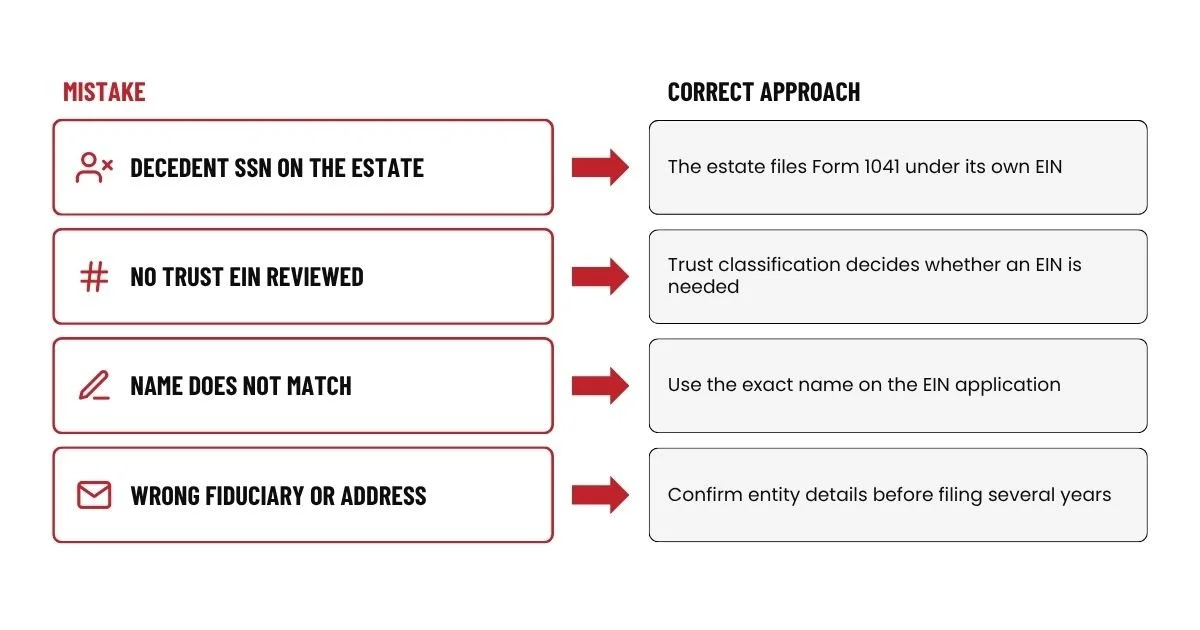
Usually, an estate that must file Form 1041 needs its own Employer Identification Number.
The IRS states that an estate EIN is used when filing Form 1041.
A trust may also require its own EIN depending on the trust classification and reporting method.
Do not use the deceased person's Social Security number as the estate's EIN.
The Name Should Match the EIN Application
The Form 1041 instructions direct the fiduciary to use the exact name of the estate or trust that was used when applying for the EIN.
Mismatches involving the entity name, EIN, trustee, executor, or address can create IRS processing problems.
When I prepare missing returns, I confirm the entity information before filing several years under an incorrect taxpayer identification number.
What Tax Year Should an Estate Use?
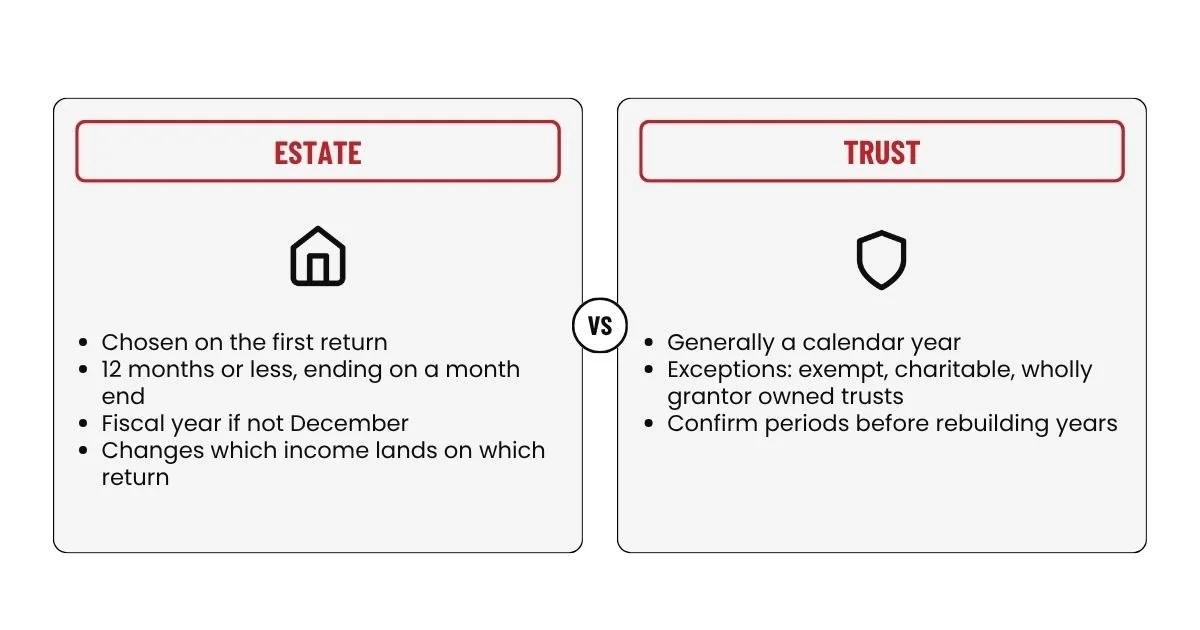
An estate has more flexibility than most trusts when selecting its tax year.
When the first estate income tax return is filed, the executor or administrator can generally choose an estate tax period of 12 months or less ending on the last day of a month.
If the estate selects a month other than December as its year end, it generally adopts a fiscal tax year.
This can materially affect which income and distributions belong on each return.
Trusts Generally Use a Calendar Year
Most trusts generally must use a calendar tax year.
Exceptions exist for certain exempt trusts, charitable trusts, and trusts treated as wholly owned by a grantor.
This distinction matters when reconstructing several missing years.
The correct filing periods should be determined before preparing the returns.
When Is Form 1041 Due?
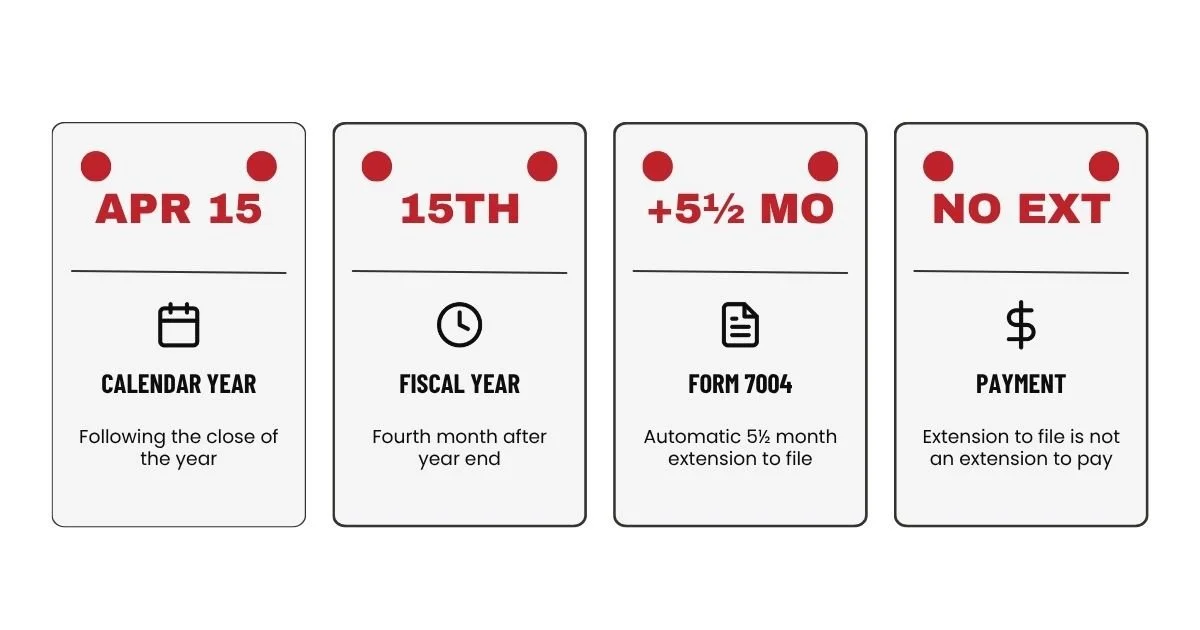
For a calendar year estate or trust, Form 1041 is generally due April 15 following the close of the year.
For a fiscal year estate or trust, the return is generally due by the 15th day of the fourth month after the close of the tax year.
If the due date falls on a Saturday, Sunday, or legal holiday, the filing deadline moves to the next business day.
Form 7004 Can Extend the Filing Deadline
A qualifying estate or trust can use Form 7004 to request an automatic extension of time to file Form 1041.
Current IRS Form 7004 instructions provide most estates and trusts filing Form 1041 an automatic 5½ month extension.
The extension must generally be requested by the original due date.
An Extension to File Does Not Extend the Time to Pay
This distinction is important.
Form 7004 gives additional time to file the return.
It does not generally extend the deadline for paying the tax.
Tax remaining unpaid after the original due date can still result in interest and applicable penalties.
What Happens If Form 1041 Was Never Filed?
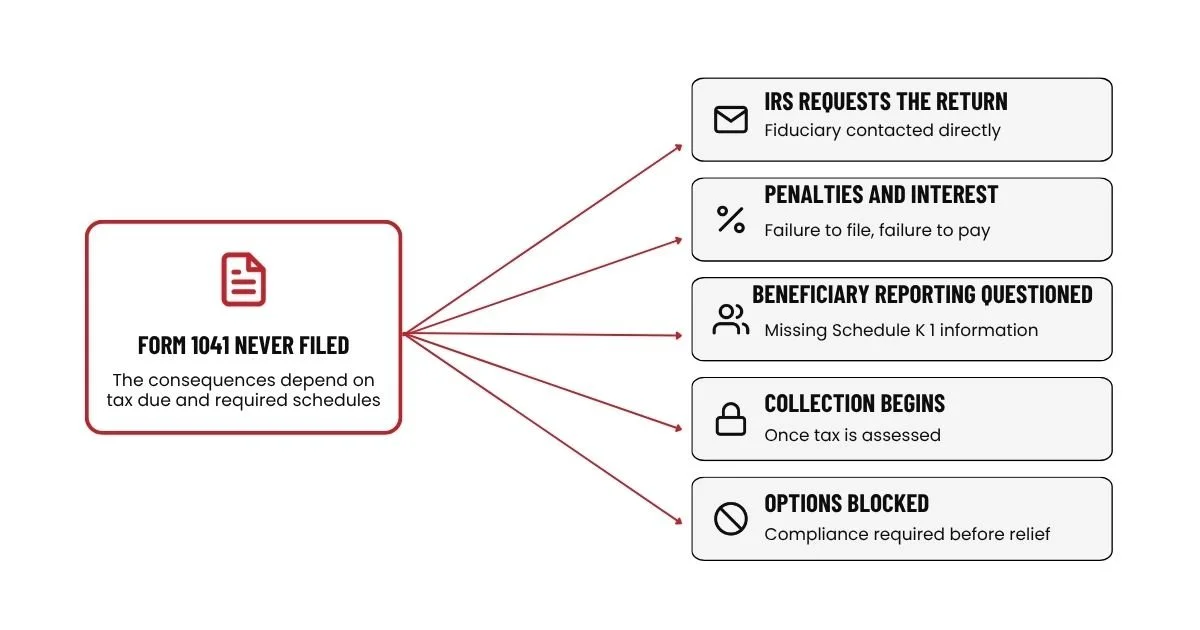
Ignoring a missing fiduciary return can create several separate problems.
The IRS may:
Request the missing return
Assess failure to file penalties
Assess failure to pay penalties when tax remains unpaid
Charge interest
Question beneficiary reporting
Request missing Schedule K 1 information
Begin collection after tax is assessed
Contact the fiduciary for missing returns
Require the estate or trust to become filing compliant before considering certain collection requests
The consequences depend on whether the return showed tax due and what other information was required.
Form 1041 Late Filing Penalties
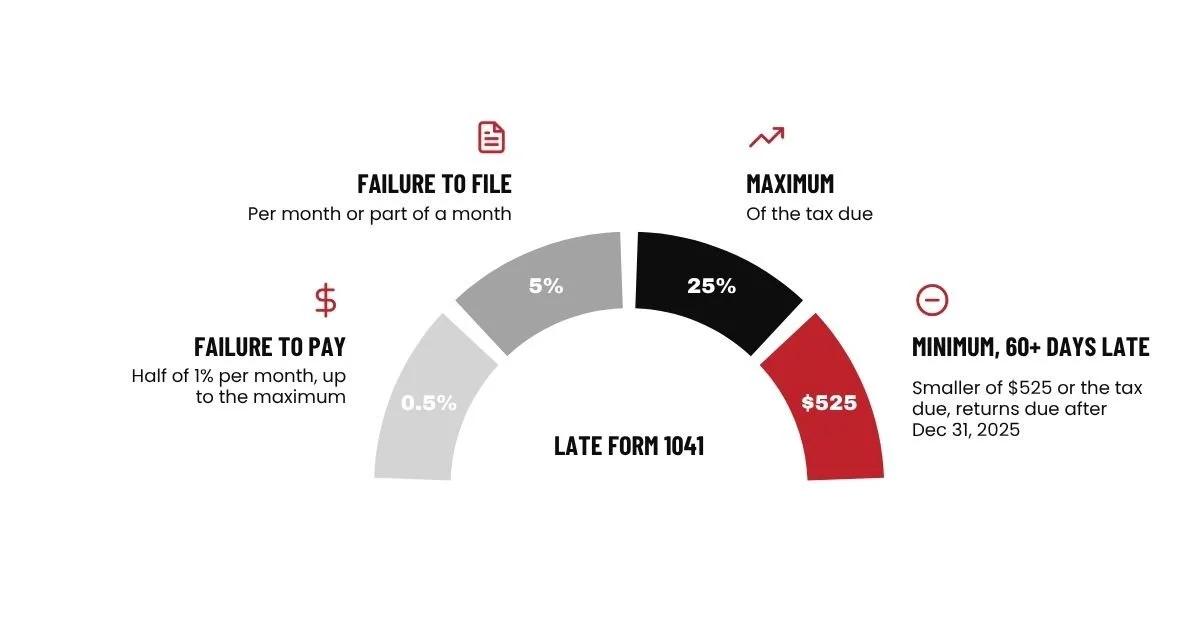
For a late Form 1041 with tax due, the current IRS instructions provide a failure to file penalty generally equal to 5 percent of the unpaid tax for each month or part of a month the return is late.
The penalty can continue up to 25 percent of the tax due.
For returns more than 60 days late, a minimum penalty can apply.
For returns due after December 31, 2025, the current minimum is the smaller of $525 or the tax due.
The IRS can also assess a late payment penalty generally equal to one half of 1 percent of unpaid tax for each month or part of a month it remains unpaid, up to the applicable maximum.
Interest can continue on unpaid tax and certain penalties.
Reasonable Cause May Provide Penalty Relief
The IRS instructions state that the failure to file penalty will not be imposed when the fiduciary can establish that the late filing was due to reasonable cause.
That does not mean every late estate or trust return qualifies.
The reason for the delay, actions of the fiduciary, record availability, health issues, death or incapacity of a prior fiduciary, professional advice, and other facts may need to be reviewed.
Penalty relief should be evaluated after the returns and account history are known.
Missing Schedule K 1 Forms Can Create a Separate Problem
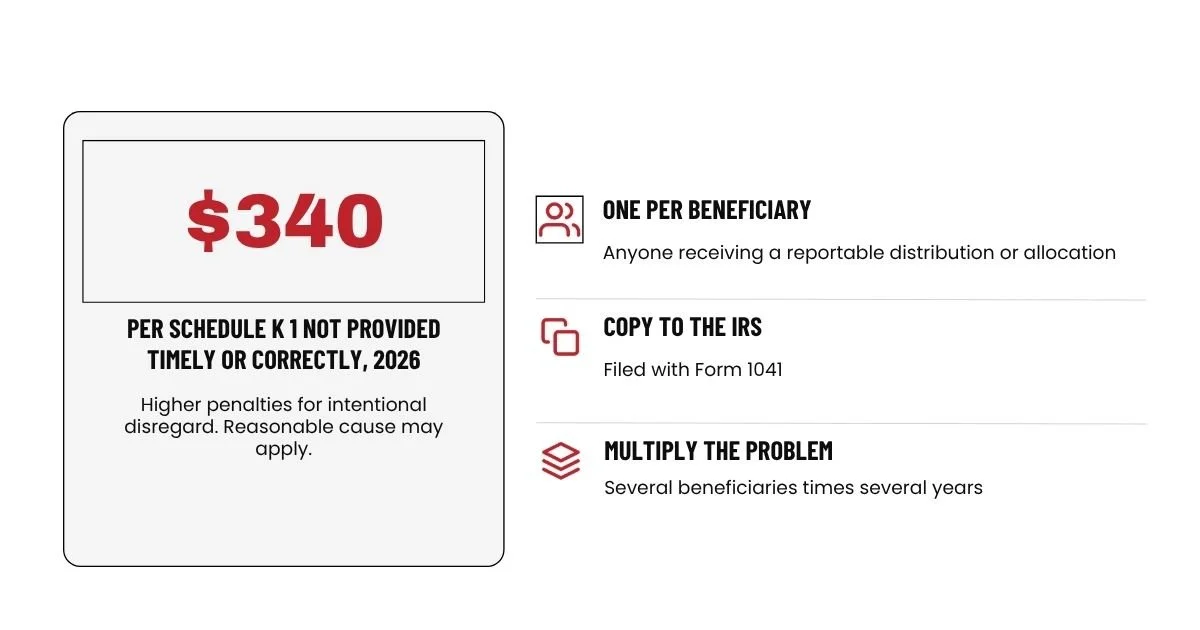
Schedule K 1 is used to report a beneficiary's share of income, deductions, credits, and other tax information from an estate or trust.
The fiduciary generally must provide Schedule K 1 to each beneficiary who receives a distribution or allocation that requires reporting.
A copy is also included with the Form 1041 filed with the IRS.
Late or Incorrect Schedule K 1 Forms Can Carry Penalties
For information returns due in 2026, the current Form 1041 instructions provide that a $340 penalty may apply for each required Schedule K 1 that is not provided timely or does not contain the required correct information.
Higher penalties can apply for intentional disregard.
Reasonable cause may prevent the penalty when the requirements are met.
A case involving several beneficiaries and several missing tax years should therefore be reviewed before assuming that the only issue is the Form 1041 itself.
How Missing Form 1041 Returns Can Affect Beneficiaries
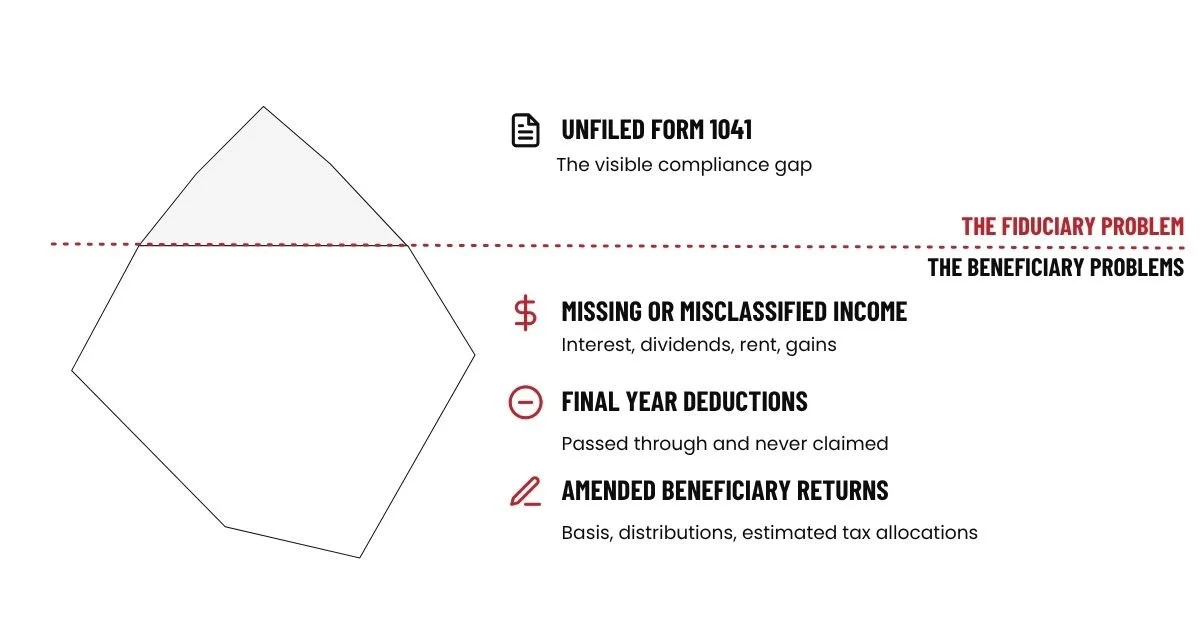
An unfiled estate or trust return can create problems beyond the fiduciary.
Beneficiaries may need Schedule K 1 information to file their own federal income tax returns correctly.
A late Form 1041 can therefore reveal that prior beneficiary returns also need attention.
Possible issues include:
Missing income
Incorrect income classifications
Capital gains or losses
Interest or dividend income
Rental or business income
Deductions passed through in a final year
Estimated tax allocations
Basis or distribution questions
Amended beneficiary returns
I review the Form 1041 problem first, then identify whether corrected or late Schedule K 1 forms create another filing issue for the beneficiaries.
What Records Are Needed to File Old Form 1041 Returns?
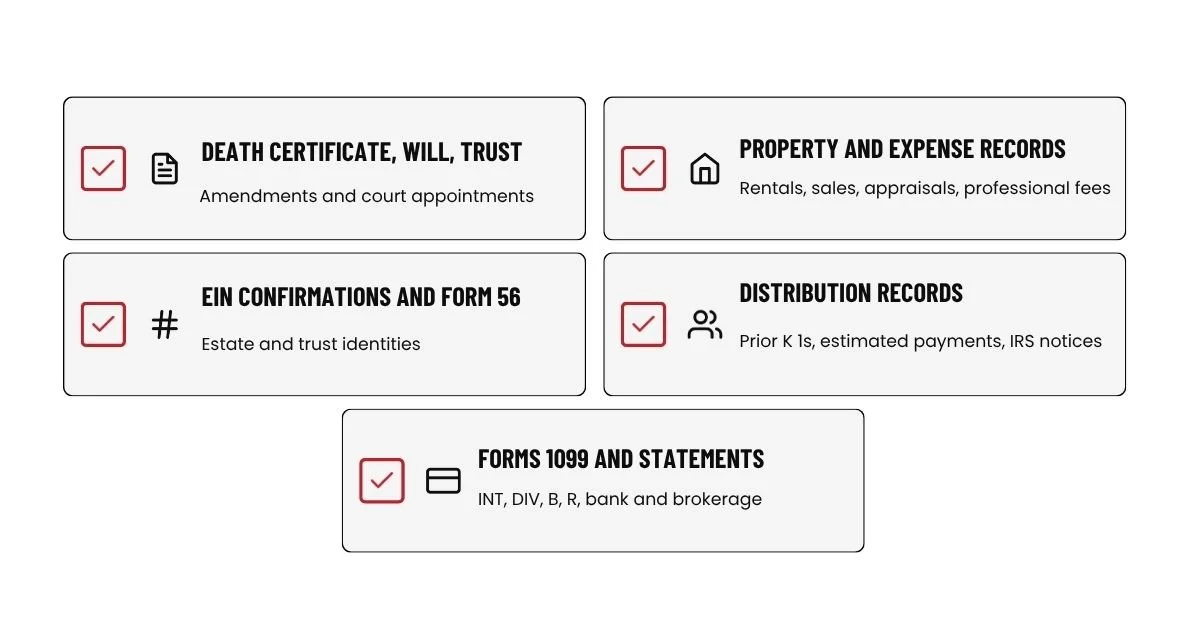
Do not wait until every document has been found before beginning the review.
Start with what is available.
Useful documents may include:
Death certificate
Will
Trust agreement
Amendments to the trust
Court appointment documents
Letters testamentary
Letters of administration
Estate EIN confirmation
Trust EIN confirmation
Form 56
Prior Forms 1040
Prior Forms 1041
Forms 1099 INT
Forms 1099 DIV
Forms 1099 B
Forms 1099 R
Schedules K 1 received by the estate or trust
Bank statements
Brokerage statements
Rental property records
Business records
Closing statements
Appraisals
Property sale documents
Administration expenses
Professional fee statements
Records of distributions to beneficiaries
Prior beneficiary Schedules K 1
Estimated tax payments
IRS notices
IRS transcripts
Old Records May Need to Be Reconstructed
If several years have passed, the original fiduciary may no longer have every tax document.
Records can sometimes be reconstructed using financial institutions, brokerage records, property records, accounting files, beneficiary records, prior returns, and IRS information.
The reconstruction should be based on actual evidence.
The goal is not to estimate numbers simply to get a return filed.
Our Process for Filing Unfiled Form 1041 Tax Returns
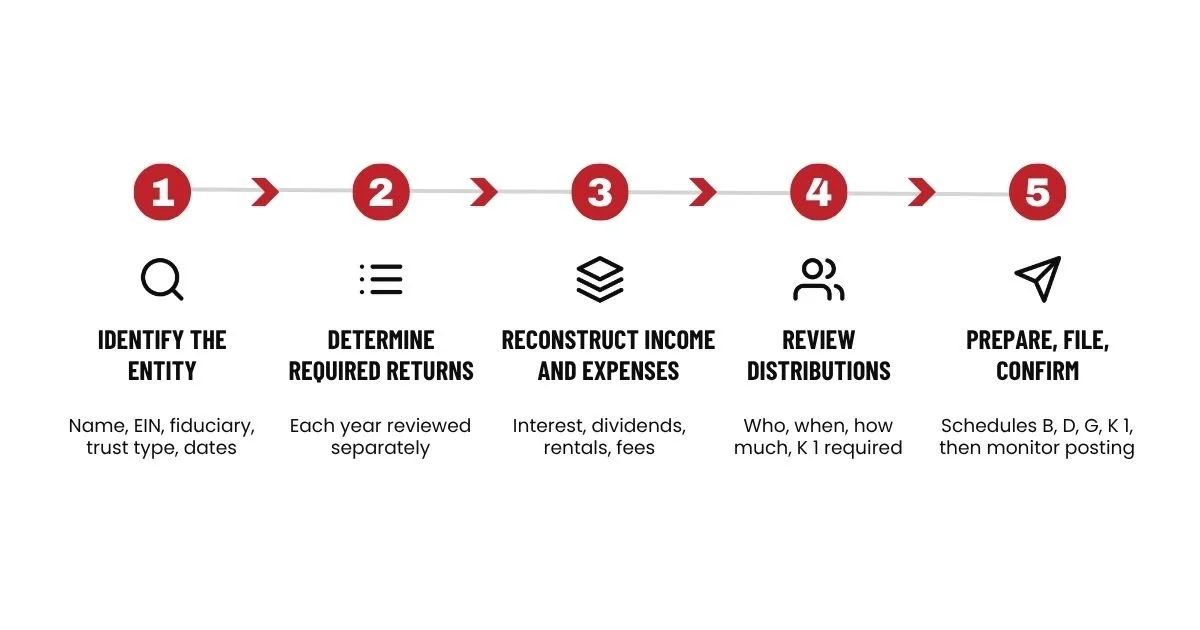
I use a year by year approach because one filing decision can affect the next return and the beneficiaries.
Step 1, Identify the Estate or Trust
I first determine:
Name of the entity
EIN
Fiduciary
Type of estate or trust
Date the estate or trust began
Date of death when applicable
Whether the trust was revocable or irrevocable
Whether grantor trust rules applied
Step 2, Determine Which Returns Were Required
I review each year separately.
For an estate, that includes reviewing gross income, beneficiaries, and the chosen accounting period.
For a trust, that includes taxable income, gross income, beneficiaries, and the trust classification.
I do not automatically prepare a Form 1041 merely because a calendar year passed.
Step 3, Reconstruct Income and Expense
We organize the available records for:
Interest
Dividends
Investments
Rental income
Business income
Capital transactions
Administration expenses
Professional fees
Property expenses
Other applicable deductions
Step 4, Review Beneficiary Distributions
Distributions affect the tax calculation.
We review:
Who received distributions
When distributions occurred
Amounts distributed
Property distributed
Whether income was required to be distributed
Whether Schedule K 1 reporting is required
Step 5, Prepare the Form 1041 Returns
Each return is prepared using the law and forms applicable to the particular tax year.
Where required, the return may include:
Schedule B
Schedule D
Schedule G
Schedule K 1
Other applicable schedules and attachments
Step 6, Prepare Missing Schedule K 1 Forms
Beneficiary reporting is reviewed along with the fiduciary return.
When prior beneficiary returns may be affected, the fiduciary and beneficiary issues are separated so each taxpayer can determine the appropriate next filing step.
Step 8, Confirm Processing
Submitting a return is not the final step.
I monitor the IRS account to confirm that the returns post correctly and that payments, penalties, and notices match the filed returns.
Step 9, Address Any Tax Debt
If the completed returns create unpaid federal tax, the filing problem and collection problem become separate parts of the case.
We can then evaluate the available IRS procedures based on the estate or trust's actual balance and financial circumstances.
Estimated Tax After the Missing Returns Are Filed

Once prior returns are brought current, the fiduciary should determine whether estimated tax payments are required for the current year.
For 2026, an estate or trust generally may need estimated income tax payments when it expects to owe at least $1,000 after applicable withholding and credits and the other estimated tax requirements are met.
There are important exceptions.
For example, a decedent's estate is generally exempt from estimated tax requirements for tax years ending before two years after the decedent's death.
A qualifying trust treated as owned by the decedent and receiving the residue of the estate can also have a similar temporary exception when the IRS requirements are met.
Current compliance should be reviewed after the delinquent returns are prepared.
What If the Late Form 1041 Returns Show Tax Due?

The first objective is establishing the correct tax.
Once that amount is known, the next step depends on the taxpayer and available assets.
Potential procedures may include:
Payment from estate or trust funds
An IRS payment arrangement when available
Penalty relief
Correction of an inaccurate assessment
Offer in Compromise consideration when the requirements are met
Another IRS collection alternative supported by the facts
The IRS may treat estate or trust liabilities differently from ordinary individual income tax debt.
The existence of estate or trust assets, beneficiary distributions, fiduciary duties, tax liens, and collection rights should be reviewed before choosing a resolution.
Filing Form 1041 does not by itself qualify the estate or trust for tax relief.
Form 56 and IRS Representation
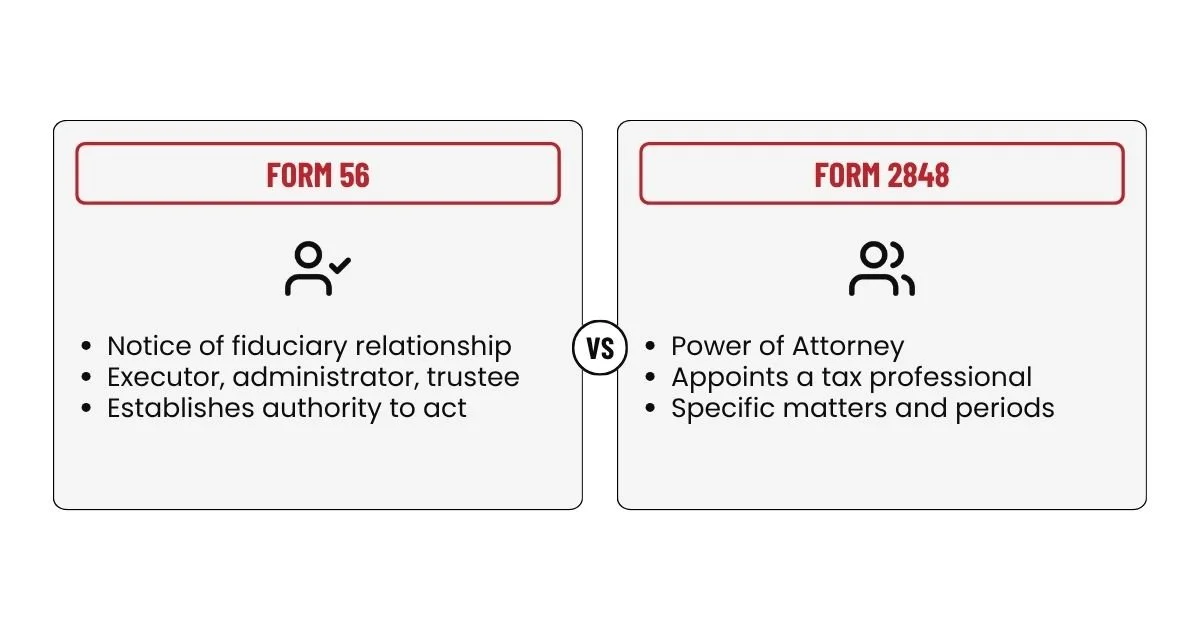
A fiduciary relationship and a tax power of attorney are different.
IRS Form 56 is used to notify the IRS that a fiduciary relationship has been created or terminated.
This can establish that an executor, administrator, trustee, or other fiduciary has authority to act for the estate or trust.
Form 2848 is different.
Form 2848 allows a taxpayer or authorized fiduciary to appoint an eligible tax professional to represent the taxpayer before the IRS for specified tax matters and periods.
When I represent an estate or trust before the IRS, I review both the fiduciary authority and the tax representation authorization before communicating about protected tax information.
When Can the Final Form 1041 Be Filed?
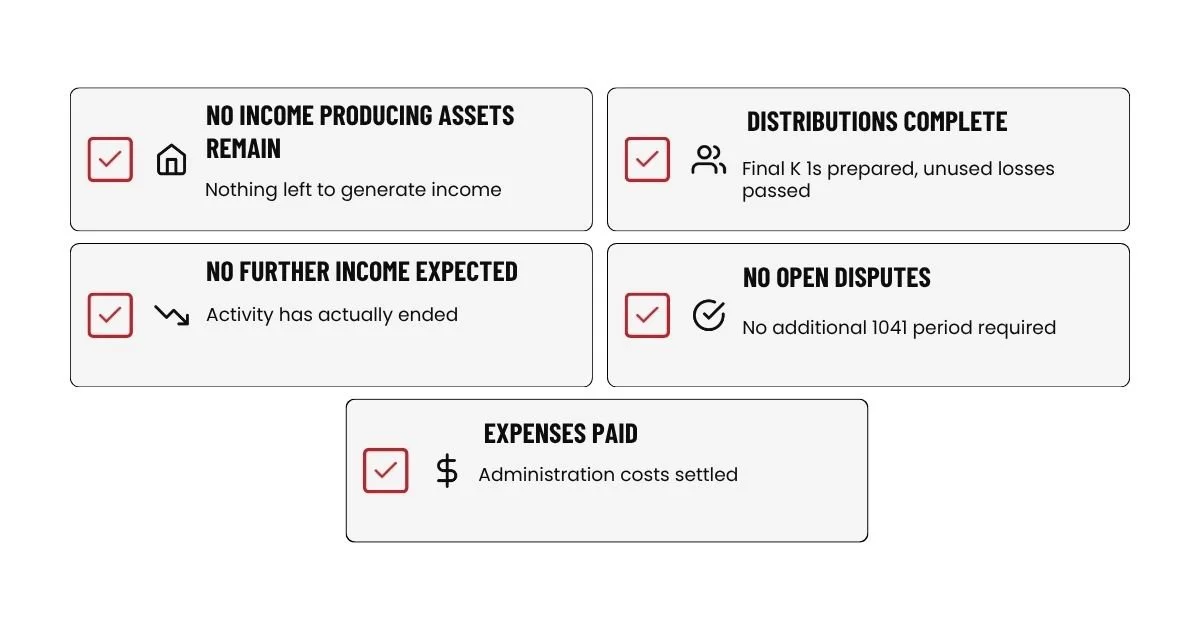
An estate or trust should not continue filing returns indefinitely after administration has actually ended.
When the estate or trust terminates and the final tax period has been completed, the fiduciary can identify the Form 1041 as the final return.
Final beneficiary Schedules K 1 may also be required.
The final year can involve special tax items, including certain unused deductions or losses that may pass to beneficiaries when the applicable rules are met.
Before marking a return final, I review whether:
Income producing assets remain
Additional income is expected
Propey remains in the estate or trust
Administration expenses remain unpaid
Beneficiary distributions remain open
Tax disputes remain unresolved
Another Form 1041 period will be required
Common Mistakes With Late Form 1041 Returns
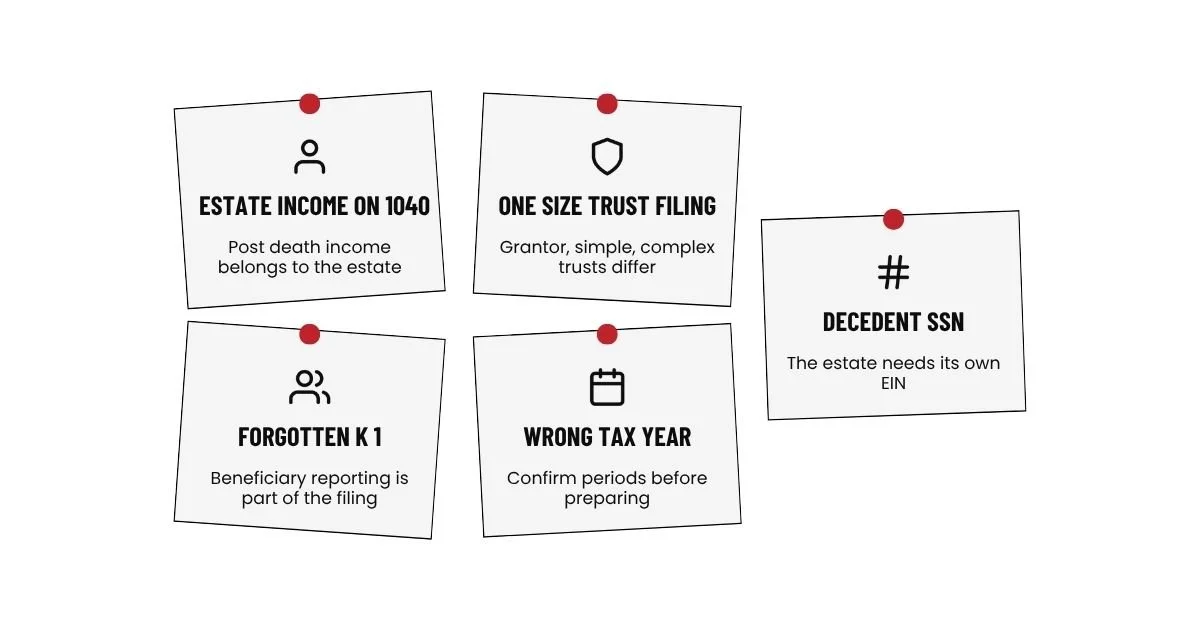
Reporting Estate Income on the Decedent's Form 1040
Income after death may belong to the estate rather than the deceased taxpayer.
The timing needs to be reviewed.
Assuming Every Trust Files the Same Way
Grantor trusts, simple trusts, complex trusts, electing small business trusts, qualified revocable trusts, and other trust structures can have different reporting requirements.
Using the Decedent's Social Security Number for the Estate
An estate filing Form 1041 generally uses its own EIN.
Forgetting Schedule K 1
Beneficiary reporting is part of the Form 1041 filing process when distributions or allocations require it.
Using the Wrong Tax Year for an Estate
An estate may adopt a qualifying fiscal year.
Several delinquent returns should not be prepared until the correct accounting periods are identified.
Assuming an Extension Also Extended Payment
Form 7004 generally extends filing time.
It does not automatically extend the time to pay tax.
Filing the Final Return Too Early
The fiduciary should confirm that the estate or trust has actually reached its final tax period before checking the final return box.
Ignoring the IRS Account After Filing
A filed return still needs to process.
The IRS account should be checked for posting, penalties, payments, and remaining balances.
Why Work With Semper Tax Relief for Unfiled Form 1041 Returns?
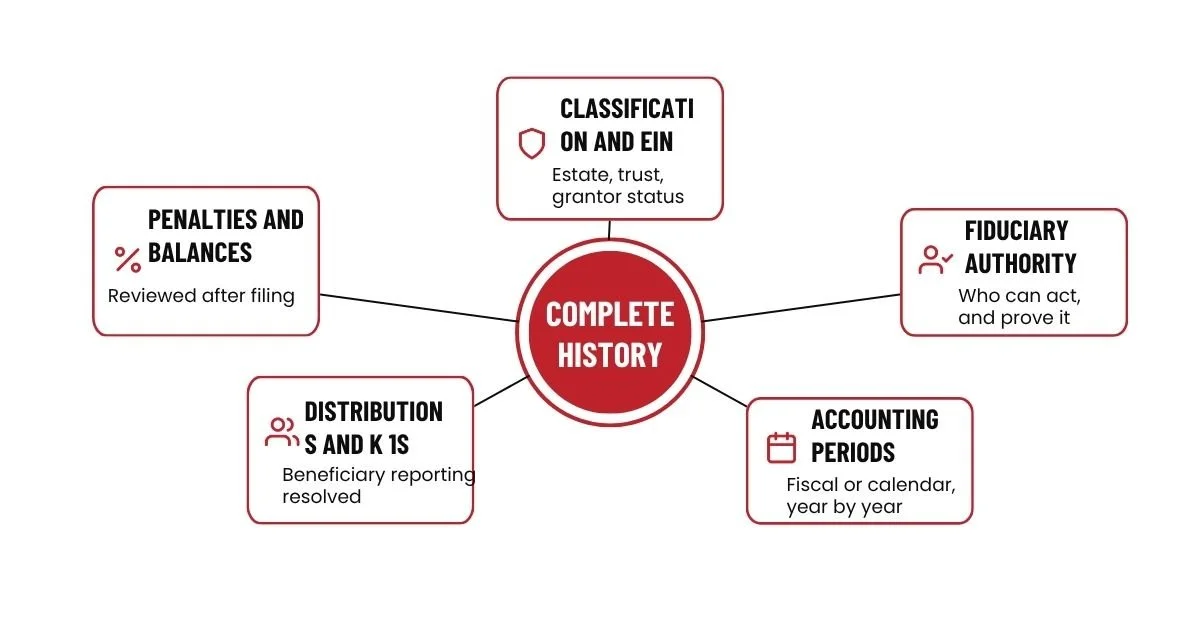
Form 1041 cases often begin with tax preparation but can become IRS compliance or collection matters.
I review the complete filing history rather than preparing one isolated return without looking at the years around it.
That includes:
Estate or trust classification
EIN
Fiduciary authority
Accounting periods
Income records
Administration expenses
Beneficiary distributions
Schedule K 1 requirements
Missing returns
IRS notices
Penalties
Existing IRS balances
Current filing requirements
Final return considerations
I am Sergio Melendez, JD, EA.
I have worked in the tax profession since 2005 and represent taxpayers before the IRS as an Enrolled Agent.
My Juris Doctor degree is an educational credential.
My authority to represent taxpayers before the IRS comes from my Enrolled Agent credential.
Results depend on the estate or trust classification, income, records, beneficiaries, distributions, fiduciary authority, tax years, applicable tax law, and IRS procedures.
Frequently Asked Questions About Unfiled Form 1041 Tax Returns
-
No.
A domestic decedent's estate generally must file Form 1041 when it has gross income of $600 or more for the tax year, has a nonresident alien beneficiary, or meets another specific reporting requirement.
An estate can therefore exist without having a Form 1041 filing requirement for every year.
-
No.
The answer depends on the trust classification and income.
A domestic trust taxable under section 641 generally files when it has any taxable income, gross income of $600 or more, a nonresident alien beneficiary, or another applicable filing requirement.
Grantor trusts can follow different reporting procedures.
-
The fiduciary should first identify which returns were required and reconstruct the income, expenses, and distributions.
Late returns with unpaid tax can be subject to failure to file penalties, failure to pay penalties, and interest.
Late or missing Schedule K 1 forms can create additional information reporting penalties.
Penalty relief may be considered when the applicable requirements are satisfied.
-
Yes.
The filing obligation and payment obligation are separate.
The return should generally be filed even when full payment cannot be made.
After the correct liability is established, available payment or collection procedures can be reviewed.
-
Form 1041 is an income tax return for an estate or trust.
Form 706 is the federal estate tax return.
An estate can have a Form 1041 filing requirement even when it is far below the federal estate tax threshold.
-
When the applicable distribution and allocation rules require beneficiary reporting, the fiduciary prepares Schedule K 1 showing the beneficiary's share of income, deductions, credits, and other tax information.
A late Form 1041 can therefore affect beneficiary tax returns.
-
Generally, yes.
A decedent's estate filing Form 1041 generally uses an EIN rather than the deceased taxpayer's Social Security number.
The EIN and estate name should match IRS records.
-
Yes.
The current fiduciary can begin by gathering the records that are available.
I can help identify the missing filing periods, review the estate or trust classification, reconstruct available income and expense information, prepare the required returns, and determine what IRS issues remain after filing.
The current fiduciary's legal authority should be confirmed before accessing protected IRS information or acting for the estate or trust.
Get a Free Form 1041 Filing Case Review
If an estate or trust has several years of missing income tax returns, do not begin by guessing which forms should have been filed.
Start by identifying the entity, fiduciary, tax years, income, and distributions.
I can review:
Whether Form 1041 was required
Which years are missing
Estate or trust classification
EIN information
Fiscal year or calendar year reporting
Grantor trust issues
Section 645 election considerations
Income records
Administration expenses
Beneficiary distributions
Missing Schedule K 1 forms
IRS notices
Late filing penalties
Existing tax balances
Current estimated tax requirements
Final return considerations
You do not need to have every record before requesting the review.
Bring the trust or estate documents, IRS notices, prior tax returns, financial records, and beneficiary information currently available.
I can help determine what needs to be filed and what should happen next.