

IRS Business Payment Plan Representation
If your business owes the IRS but cannot pay the entire balance immediately, an IRS business payment plan may allow the business to repay qualifying tax debt over time.
The right payment arrangement depends on more than the total amount owed.
I review the type of business tax, whether the company is still operating, whether payroll taxes are involved, which returns have been filed, whether current federal tax deposits are being made, the IRS collection status, the business cash flow, available assets, and how much time remains for the IRS to collect the liability.
The IRS substantially changed its payment plan procedures for businesses in 2026.
Qualifying businesses may now use the IRS Simple Payment Plan procedures. Other businesses may still qualify for an installment agreement but may need to provide Form 433 B and supporting financial information.
Do I qualify for tax relief? Find out with a free case review.
Call today: 24 Hours / 7 Days a Week or book online.
✔ Confidential ✔ No Pressure ✔ Personalized
I am Sergio Melendez, JD, EA. I have worked in the tax profession since 2005 and represent individuals and businesses before the IRS as an Enrolled Agent.
I can review the IRS account, determine what type of payment plan may be available, prepare the financial information when required, present the proposal to the IRS, and represent the business during the IRS review.
Who We Help With IRS Business Payment Plans
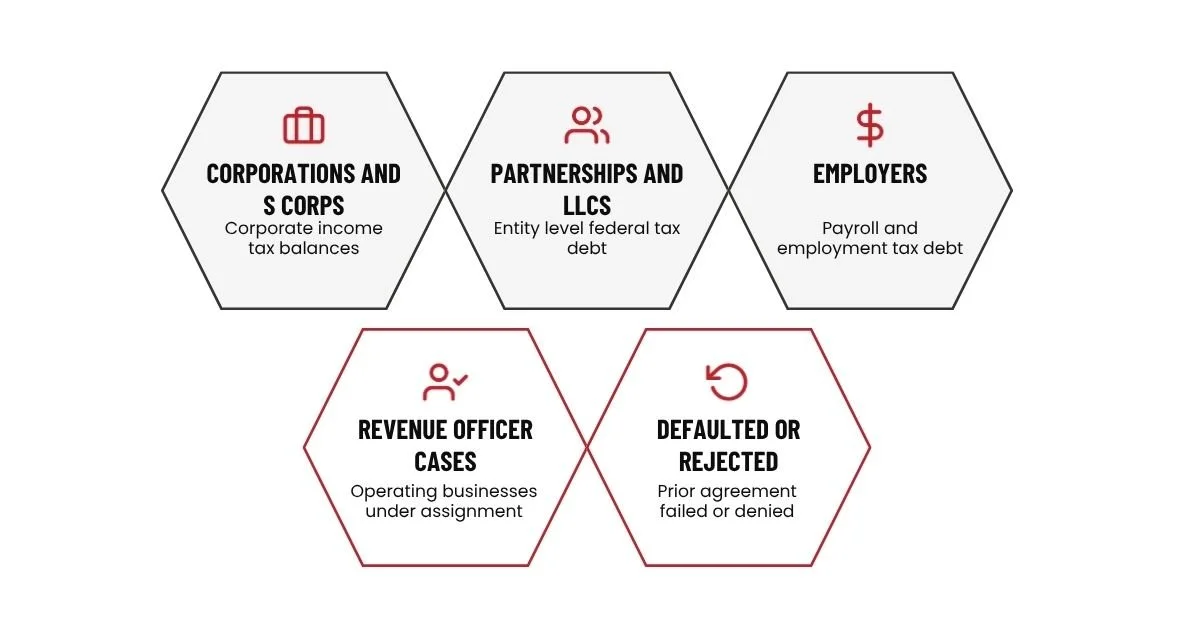
This service is designed for businesses that owe federal taxes and need time to pay.
That can include:
Corporations
S corporations
Partnerships
Limited liability companies
Employers with payroll tax debt
Businesses with corporate income tax debt
Businesses owing employment taxes
Businesses with federal tax penalties
Operating businesses assigned to an IRS Revenue Officer
Businesses that have defaulted on a prior installment agreement
Businesses whose payment plan request was rejected
A sole proprietor may have both individual and business tax issues.
For example, income tax arising from Schedule C is generally part of the owner's individual Form 1040 account.
Payroll tax liabilities for employees can instead appear on a business tax account.
Those debts should be identified before choosing the payment plan procedure.
What Is an IRS Business Payment Plan?
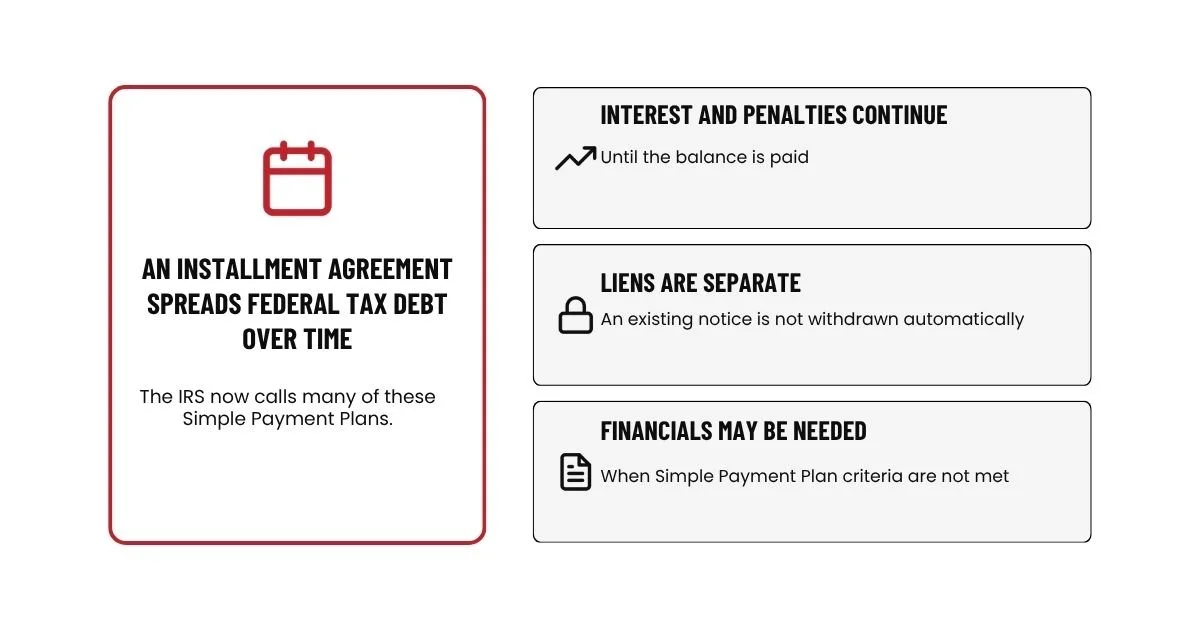
An IRS payment plan, also called an installment agreement, allows a taxpayer to make payments toward federal tax debt over an extended period.
The IRS now uses the term Simple Payment Plan for many qualifying individual and business taxpayers.
A business that does not meet the Simple Payment Plan criteria may still qualify for another installment agreement after providing financial information.
An installment agreement does not reduce the underlying tax merely because payments are made monthly.
Interest and applicable penalties generally continue until the liability is paid.
The agreement also does not automatically remove an existing Notice of Federal Tax Lien.
IRS Business Payment Plan Rules Changed in 2026
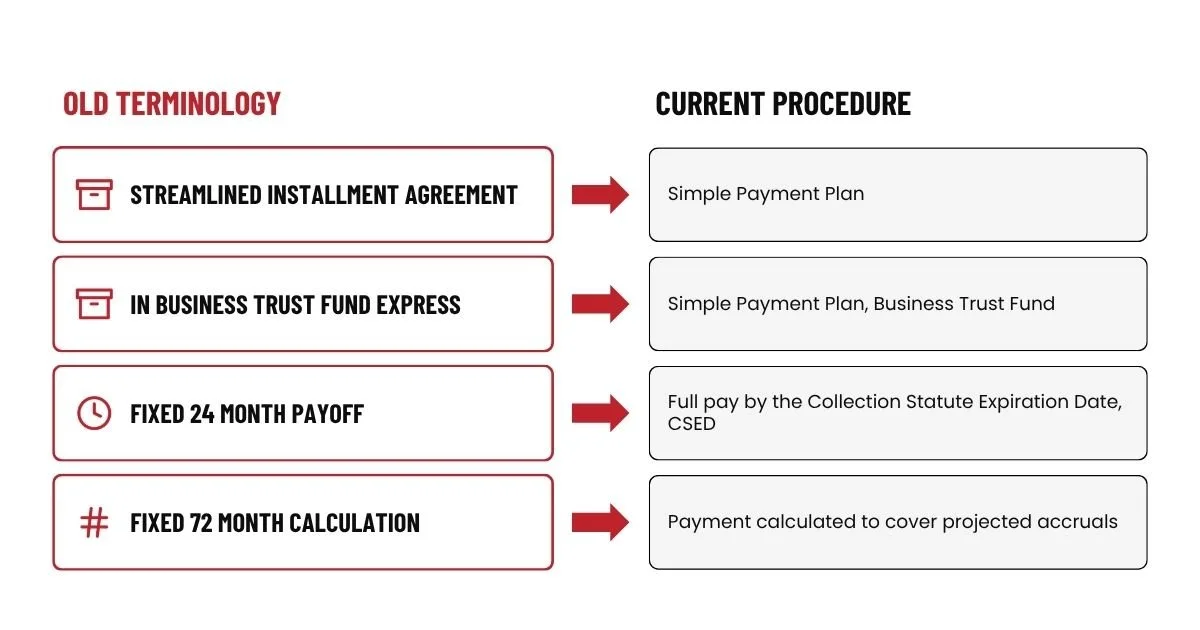
The IRS substantially revised its installment agreement procedures on July 21, 2026.
The change is especially important for businesses because older materials may still refer to:
Streamlined Installment Agreements
In Business Trust Fund Express Installment Agreements
Fixed 24 month terms for certain payroll tax agreements
Fixed 72 month payment calculations
The current IRS procedures replace much of that terminology with Simple Payment Plans.
The Old 24 Month Business Trust Fund Rule Was Removed
The IRS Internal Revenue Manual previously used the term In Business Trust Fund Express Installment Agreement.
Effective July 21, 2026, the IRS renamed this procedure Simple Payment Plan, Business Trust Fund.
The IRS also removed the previous requirement that the qualifying trust fund tax liability be paid within 24 months.
Under the current procedure, the payment must instead be calculated to fully pay the liability, including projected accruals, by the applicable Collection Statute Expiration Date.
This change can materially affect the monthly payment calculation for qualifying businesses.
Simple Payment Plans for Businesses Without Trust Fund Taxes
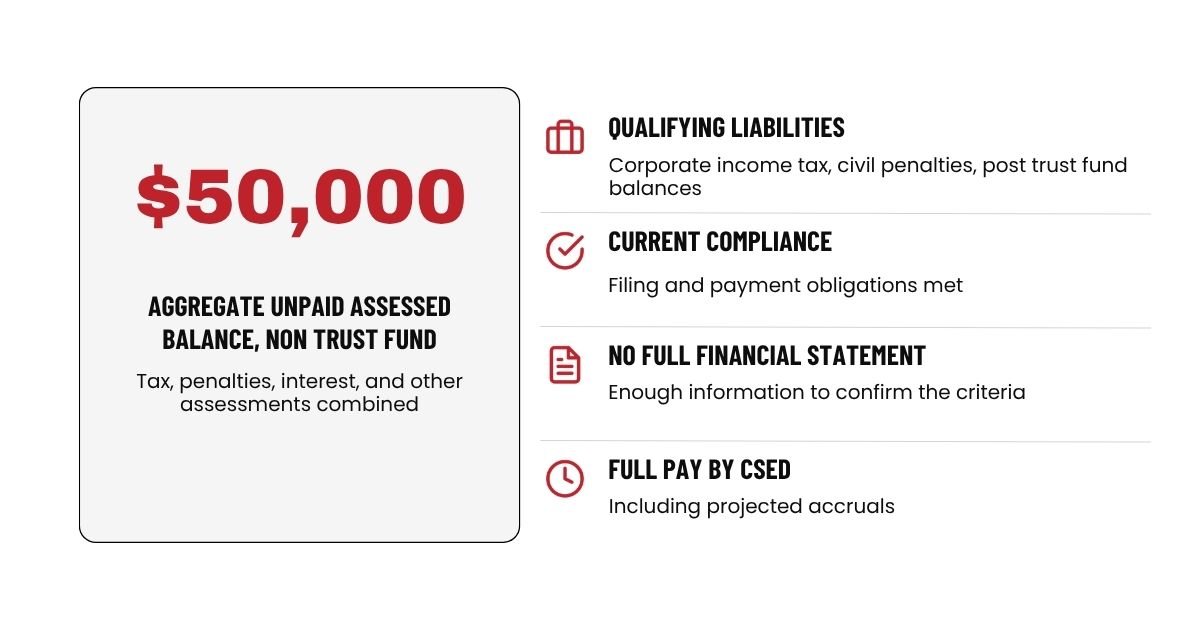
A qualifying business with non trust fund federal tax debt may generally qualify for a Simple Payment Plan when the aggregate unpaid assessed balance is $50,000 or less.
Examples of business non trust fund liabilities can include:
Corporate income tax
Certain civil penalties
Employment tax liabilities after the trust fund portion has already been paid, leaving only non trust fund tax, penalties, or interest
The qualifying balance generally includes assessed tax, assessed penalties, assessed interest, and other assessments.
The business must also be current with required filing and payment obligations.
A Full Financial Statement May Not Be Required
One benefit of a qualifying Simple Payment Plan is that the IRS generally does not require a complete Collection Information Statement.
The business still needs to provide enough information for the IRS to determine that the requirements are satisfied.
The proposed payments must fully pay the liability, including projected accruals, within the remaining IRS collection period.
A business that does not meet these criteria may still qualify for another installment agreement.
Simple Payment Plans for Businesses With Payroll or Trust Fund Taxes

Operating businesses with unpaid trust fund taxes follow different criteria.
Under the July 2026 IRS rules, a Simple Payment Plan, Business Trust Fund, may generally be granted when the aggregate unpaid assessed balance is $25,000 or less and the other IRS requirements are met.
The business can pay the balance down before the agreement is granted if doing so brings the qualifying assessed balance to $25,000 or less.
The payment amount must be sufficient to fully pay the applicable liability by the Collection Statute Expiration Date.
Payroll Tax Compliance Still Matters
A business cannot simply put old payroll tax debt into a payment plan while continuing to create new payroll tax debt.
The IRS requires filing and current payment compliance.
For an employer, that generally means:
Filing required employment tax returns
Making current federal tax deposits
Addressing current payroll withholding
Filing other required business tax returns
Making applicable estimated tax payments when required
A payment toward an old Form 941 balance does not replace a current federal tax deposit.
The two obligations must be treated separately.
A Financial Statement Is Generally Not Required for a Qualifying Simple Business Trust Fund Plan
For a business meeting the current Simple Payment Plan, Business Trust Fund requirements, the IRS generally does not require a full financial statement.
The IRS does, however, document certain banking and accounts receivable information and verifies current filing and payment compliance.
If the business does not qualify for the simplified procedure, a full financial review may be required.
What If the Business Owes More Than the Simple Payment Plan Limit?

Owing more than $25,000 or $50,000 does not automatically mean a business cannot obtain an installment agreement.
It usually means more financial analysis is required.
For an operating business with trust fund tax debt that does not qualify for the simplified procedure, the IRS may review the company's ability to pay using Form 433 B, Collection Information Statement for Businesses.
The IRS may also review supporting financial records.
The IRS Reviews Ability to Pay
The IRS does not determine a larger business payment plan solely by asking what monthly payment the owner would prefer.
The financial analysis can include:
Cash
Bank accounts
Accounts receivable
Inventory
Equipment
Vehicles
Real estate
Investments
Available credit
Business income
Operating expenses
Loans
Related entities
Payments to owners
Current tax obligations
Monthly cash flow
If the IRS determines that the business can fully pay the liability from available assets or current income, it may request more than the monthly payment originally proposed.
What Is IRS Form 433 B?
Form 433 B is the IRS Collection Information Statement for Businesses.
The IRS released a revised Form 433 B in June 2026.
The form is used when the IRS needs detailed financial information concerning a business.
Form 433 B can be important when the business does not qualify for a simplified payment plan or when a Revenue Officer needs a financial analysis.
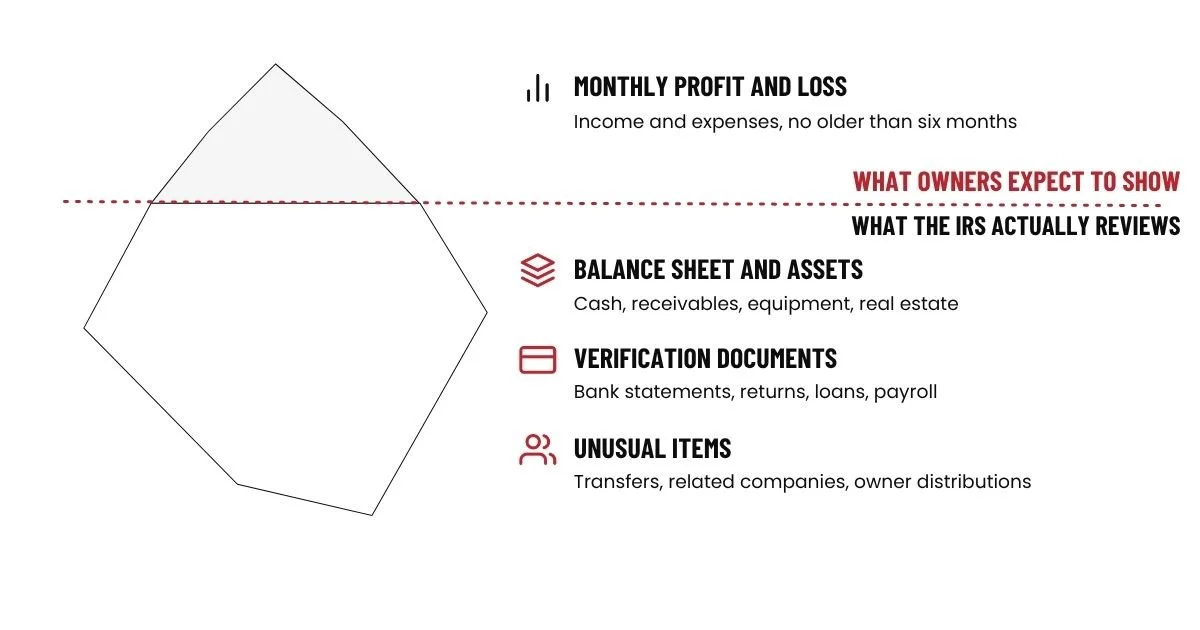
Form 433 B Is More Than a Monthly Budget
The IRS financial review is not limited to monthly profit and loss.
It may examine the business balance sheet, cash, bank accounts, assets, accounts receivable, liabilities, income, operating expenses, and other financial resources.
Current IRS financial analysis guidance states that financial information should generally reflect information no older than the prior six months.
The IRS may verify the information using:
Business bank statements
Tax returns
Profit and loss statements
Balance sheets
Accounts receivable reports
Loan statements
Asset records
Payroll records
Other available financial documents
The business should be prepared to explain unusual deposits, transfers, related companies, significant expenses, and owner distributions.
A Profit and Loss Statement Does Not Automatically Replace the Entire Financial Review
The IRS may use a business income statement or balance sheet as part of the financial analysis.
Current IRS guidance allows a business financial statement to substitute for the income and expense portion of the Collection Information Statement in appropriate cases.
That does not mean the IRS loses the ability to review assets or request supporting information.
The complete financial picture still matters.
Can the Business Afford the Proposed Monthly Payment?
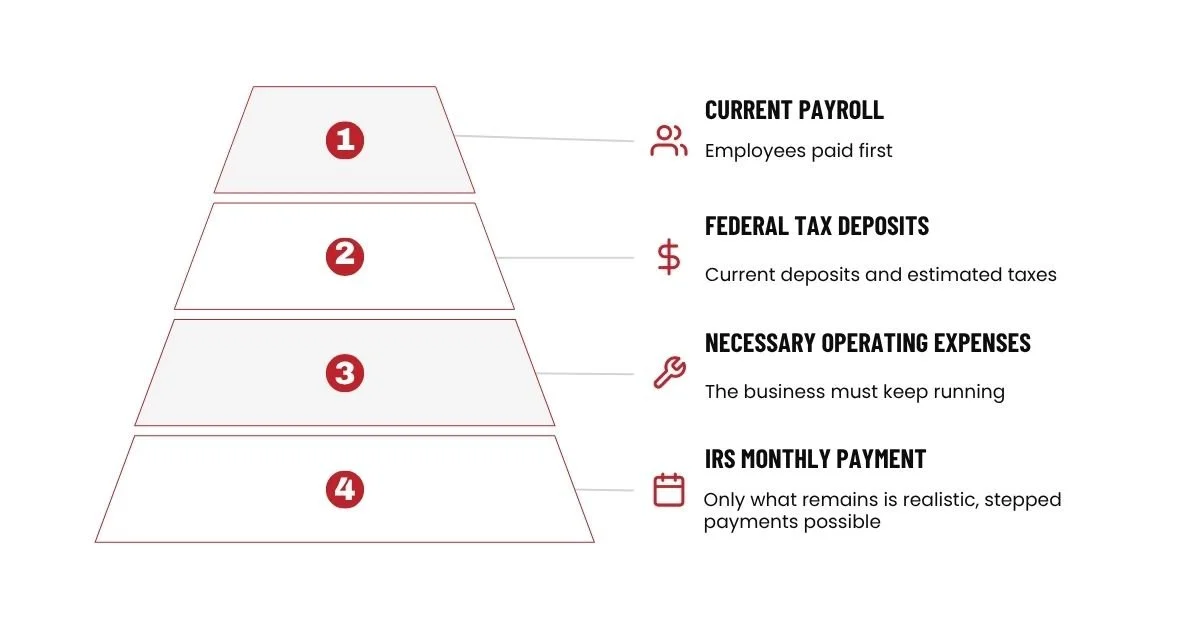
A realistic installment agreement has to accomplish two things at the same time.
The business has to remain current with its ongoing taxes and make the agreed payment toward the old balance.
That makes cash flow analysis important.
Current Taxes Come Before the Old Payment Plan Problem
For an operating business, I first look at whether it can pay:
Current payroll
Current federal tax deposits
Current estimated taxes when applicable
Necessary operating expenses
The proposed IRS monthly payment
A business that cannot keep current while paying old tax debt may need a different strategy.
Entering an installment agreement with a payment that causes the business to miss next month's federal tax deposit can create another default rather than fixing the problem.
Increasing Payments May Sometimes Be Considered
IRS financial analysis guidance recognizes that business cash flow can change.
In appropriate circumstances, a payment arrangement may take improving business cash flow into account.
Any stepped or changing payment proposal still needs to satisfy applicable IRS requirements and should be supported by realistic financial information.
What Documents May Be Needed for a Business Payment Plan?
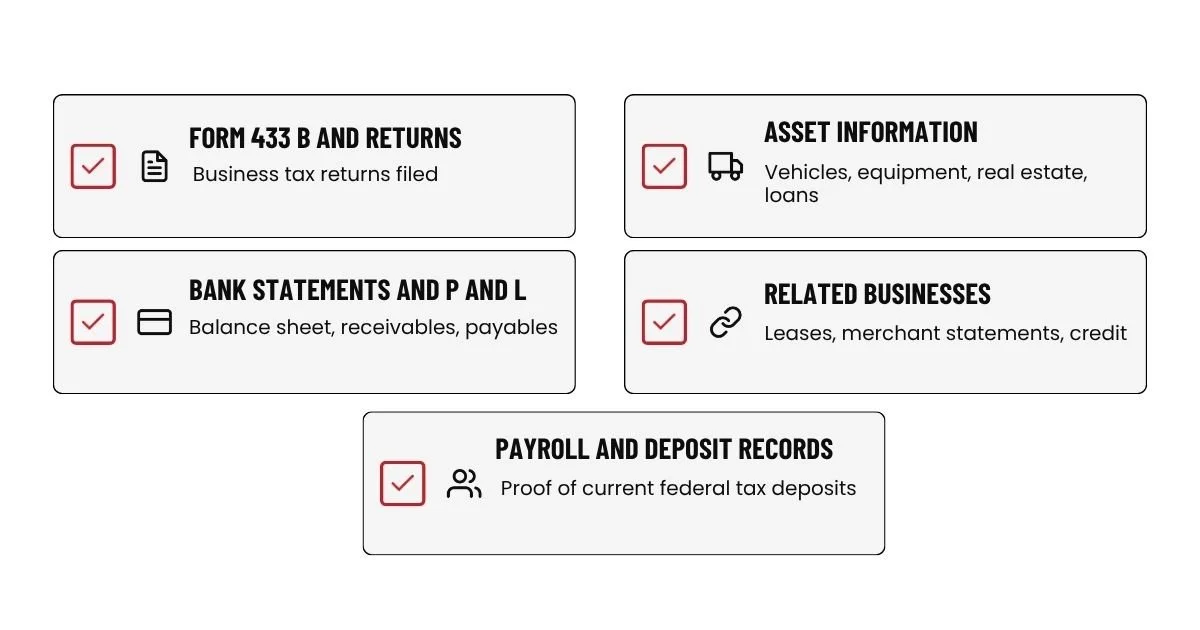
The documents depend on the amount owed, tax type, collection status, and type of agreement requested.
A business financial review may require:
Form 433 B
Recent business bank statements
Current profit and loss statement
Current balance sheet
Accounts receivable report
Accounts payable information
Payroll reports
Federal tax deposit records
Business tax returns
Asset information
Vehicle information
Equipment information
Real estate information
Loan statements
Lease agreements
Merchant processing statements
Business credit information
Proof of current estimated tax payments
Proof of current federal tax deposits
Records concerning related businesses
If a Revenue Officer provides a specific document request, that request should be reviewed separately rather than assuming every case requires the same paperwork.
Payroll Tax Payment Plans Require Additional Review
Payroll tax debt is different from ordinary corporate income tax debt because part of the liability may consist of taxes withheld from employees.
These are trust fund taxes.
The IRS may separately investigate whether one or more individuals should be assessed the Trust Fund Recovery Penalty.
A Business Payment Plan Does Not Automatically Eliminate Trust Fund Recovery Penalty Exposure
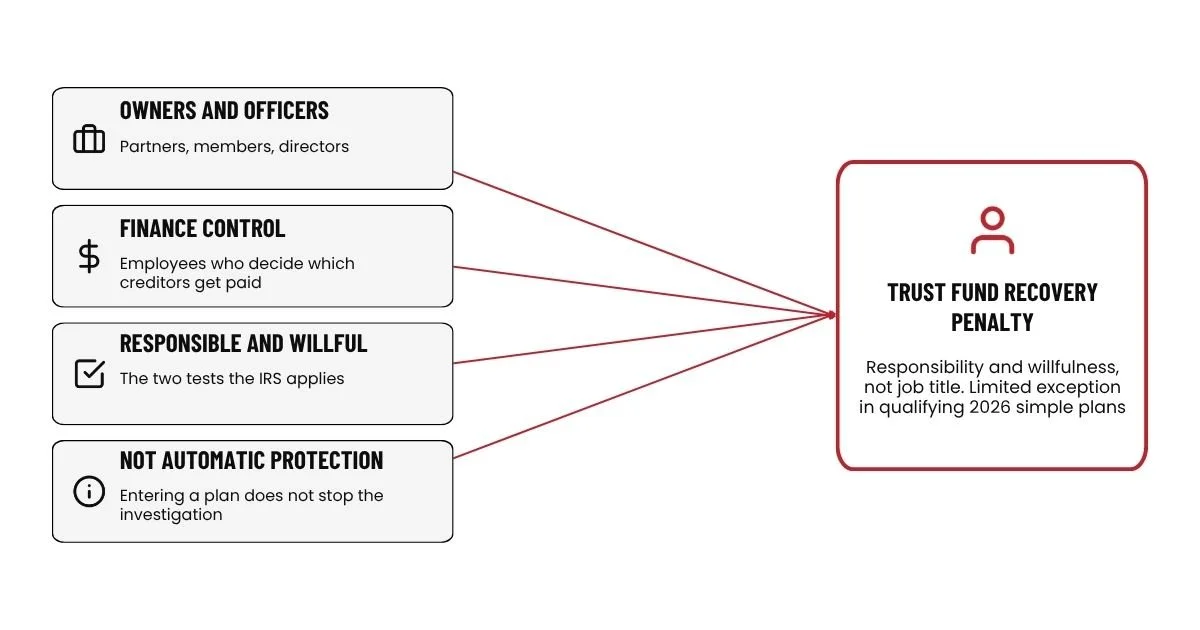
The Trust Fund Recovery Penalty can potentially be assessed against a person the IRS determines was responsible for collecting, accounting for, or paying over the trust fund taxes and who willfully failed to do so.
Possible responsible persons can include:
Business owners
Corporate officers
Partners
LLC members
Directors
Employees with control over business finances
Other individuals with authority over the payment of creditors
The analysis focuses on actual responsibility and conduct, not just job title.
The 2026 Simple Business Trust Fund Procedure Has a Limited TFRP Exception
Under current IRS procedures, a Trust Fund Recovery Penalty determination may not be required in certain qualifying Simple Payment Plan, Business Trust Fund cases.
That exception is conditional.
The business must satisfy the applicable balance, payment, timing, and procedural requirements.
A business owner should not assume that entering a payment plan automatically prevents the IRS from investigating or assessing the Trust Fund Recovery Penalty.
Can the IRS File a Federal Tax Lien During a Business Payment Plan?

A payment plan and a federal tax lien are separate issues.
For qualifying Simple Payment Plans, the IRS may not require a lien filing determination as part of establishing the agreement.
However, current IRS procedures still permit a Notice of Federal Tax Lien in some circumstances when the IRS determines that filing is needed to protect the government's interest.
Factors can include prior defaults or a history of repeatedly accumulating unpaid trust fund taxes.
If a Notice of Federal Tax Lien already exists, establishing a payment plan does not automatically withdraw it.
Lien release, withdrawal, discharge, and subordination are separate procedures with separate requirements.
What Happens to IRS Collection While a Payment Plan Request Is Pending?

Federal law provides important collection restrictions while a qualifying installment agreement request is pending.
With statutory exceptions, the IRS is generally prohibited from levying while an installment agreement proposal is pending.
Additional levy restrictions can apply for 30 days after rejection and while a timely appeal of an installment agreement rejection or proposed termination is being considered.
These rules should not be described as a guarantee that every collection action stops.
A federal tax lien may still exist or be filed when applicable.
Interest and penalties may continue.
Other tax periods or liabilities not covered by the request may also require separate attention.
If a levy has already occurred, requesting a Simple Payment Plan in connection with a levy release can require a different financial review.
What If an IRS Revenue Officer Is Assigned?
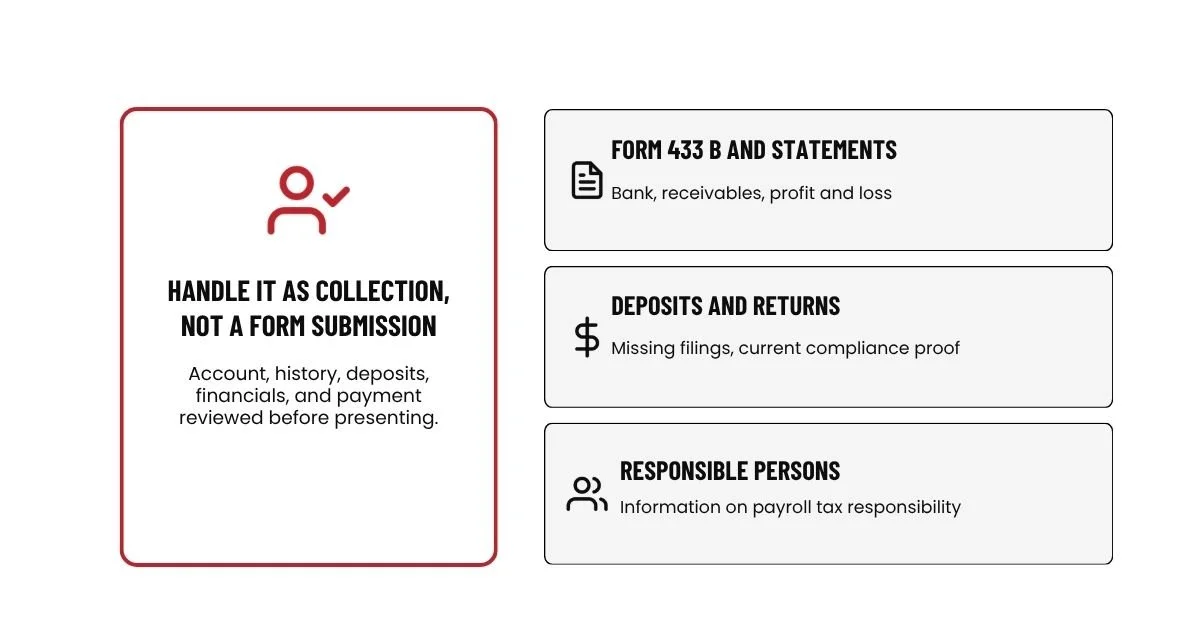
An IRS Revenue Officer can request a detailed review of the business finances and current tax compliance.
The Revenue Officer may ask for:
Form 433 B
Business bank statements
Accounts receivable
Profit and loss statements
Asset records
Payroll information
Missing business tax returns
Federal tax deposit records
Proof of current compliance
Information concerning responsible persons for payroll taxes
A Revenue Officer case should be handled as a collection case, not simply as a form submission.
I review the account, collection history, current deposits, financial information, and proposed payment amount before presenting the request.
What Happens If the IRS Rejects the Business Payment Plan?
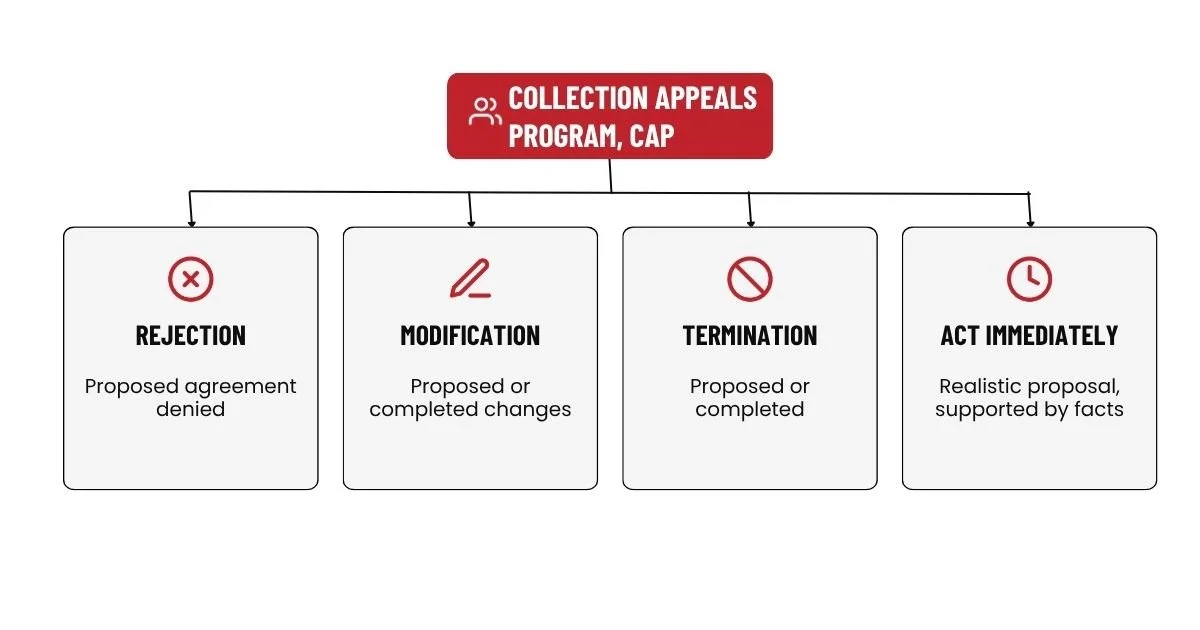
A business may have administrative appeal rights if the IRS rejects a proposed installment agreement.
The Collection Appeals Program, commonly called CAP, can be available for:
Rejection of an installment agreement
Proposed modification of an installment agreement
Modification of an agreement
Proposed termination
Termination of an agreement
The appeal should explain why the IRS decision should be reconsidered and should present a realistic payment proposal supported by the available facts and financial information.
Appeal deadlines can be short.
The applicable IRS notice and current appeal instructions should be reviewed immediately.
What Can Cause an IRS Business Payment Plan to Default?
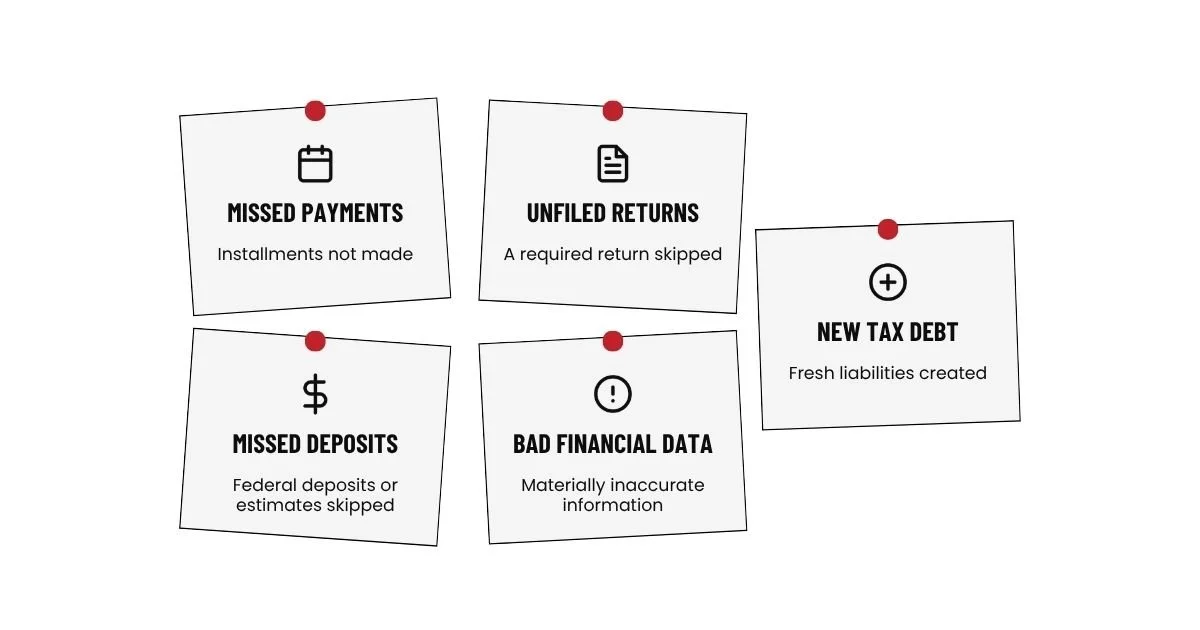
Getting the agreement approved is only part of the process.
The business needs to remain compliant while the agreement is in effect.
Problems can arise when the business:
Misses installment payments
Fails to file a required return
Creates new unpaid tax liabilities
Fails to make current federal tax deposits
Fails to make required estimated tax payments
Provides materially inaccurate financial information
Does not comply with applicable agreement terms
The IRS monitors operating business agreements for current filing and payment compliance.
A business that continues accumulating payroll tax debt can face additional collection activity even though it previously obtained an installment agreement.
IRS Business Payment Plan Versus Other Tax Debt Options
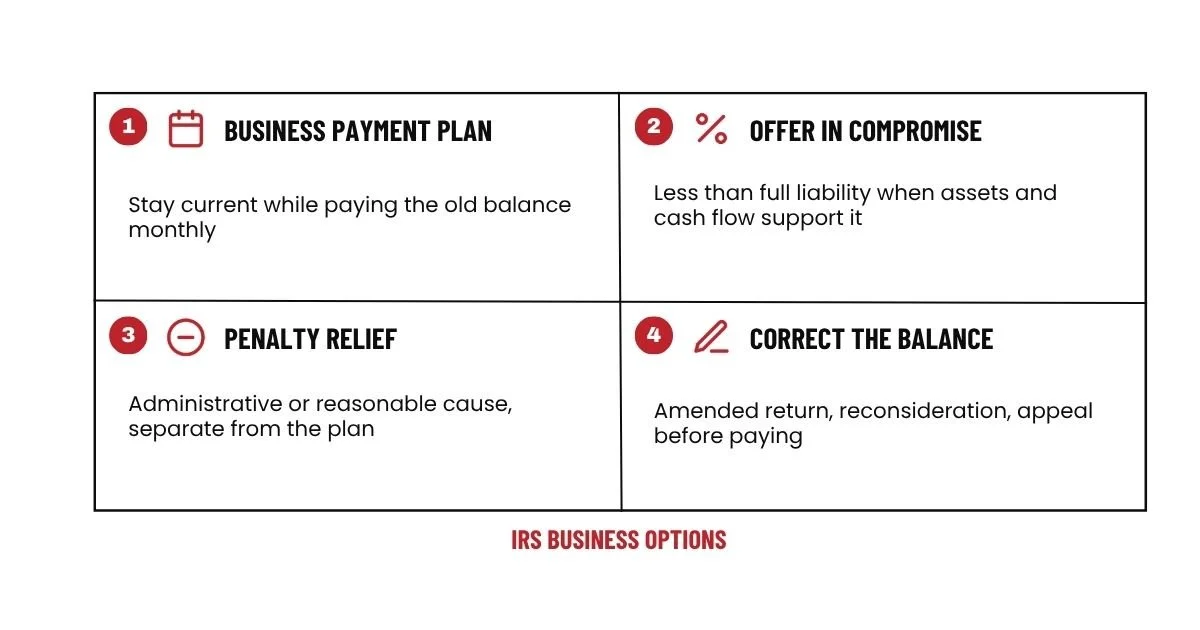
A payment plan is one IRS collection option.
It is not automatically the right option for every business.
Business Payment Plan
A payment plan may make sense when the business can remain current and can make monthly payments toward the old balance.
Offer in Compromise
An Offer in Compromise may be considered when the business meets the applicable IRS requirements and the financial analysis supports an offer for less than the full liability.
Operating businesses require careful asset and cash flow analysis.
Qualification is not based only on the size of the tax debt.
Penalty Relief
Certain penalties may qualify for administrative relief or reasonable cause relief.
Penalty relief is separate from the payment arrangement.
Correcting the Tax Balance
If the underlying IRS assessment is incorrect, agreeing to repay it may not be the best first step.
An amended return, audit reconsideration, missing return, appeal, or another liability procedure may need to be considered first.
The correct balance should be established before deciding how it will be paid.
Our IRS Business Payment Plan Representation Process
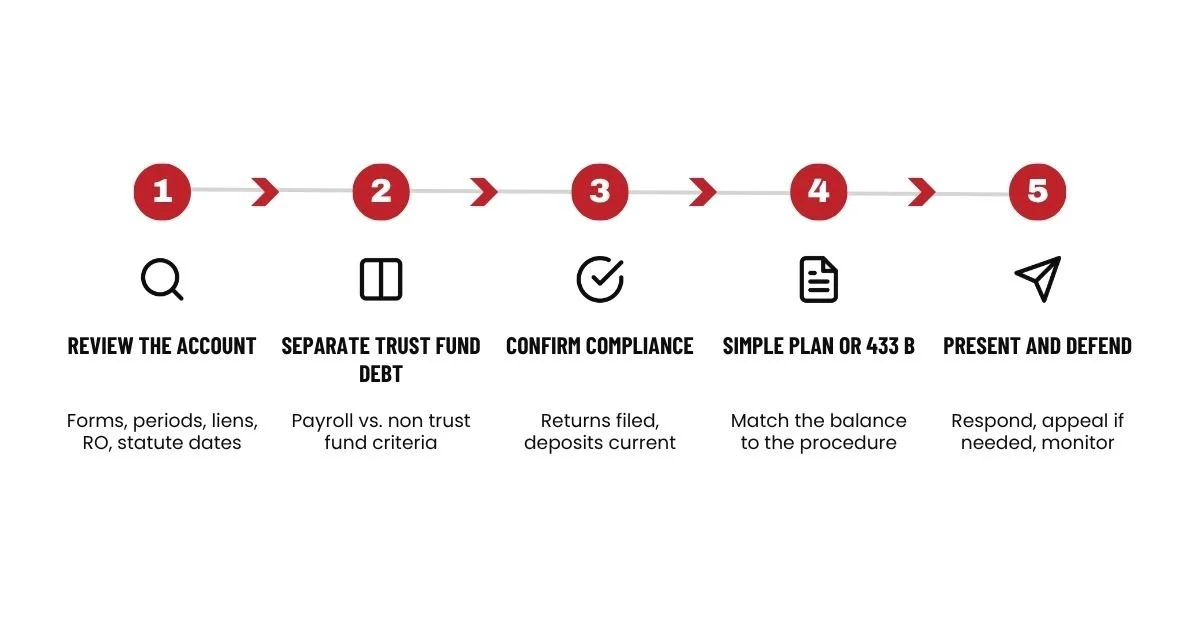
I use a structured process because the payment amount should come after the account and current compliance are understood.
Step 1, Review the IRS Business Account
I identify:
Tax forms involved
Tax periods
Current balances
Assessed penalties and interest
Missing returns
Collection notices
Federal tax liens
Revenue Officer assignment
Collection statute dates
Step 2, Separate Trust Fund and Non Trust Fund Tax Debt
This determines which business payment plan criteria may apply.
Payroll tax debt requires a different review than corporate income tax or other non trust fund business tax.
Step 3, Confirm Filing Compliance
Required returns generally need to be filed before a long term installment agreement can be granted.
If business returns are missing, those filings may need to be completed first.
Step 4, Confirm Current Tax Payments
For an operating business, I verify whether current obligations are being met.
That can include:
• Federal tax deposits
Current payroll withholding
Corporate estimated tax payments
Other current tax obligations
Step 5, Determine Whether a Simple Payment Plan Applies
I compare the assessed balance and tax type with the current IRS Simple Payment Plan requirements.
A qualifying business may be able to establish an agreement without a full financial statement.
Step 6, Prepare Form 433 B When Required
When the simplified procedure does not apply, I review the business assets, income, expenses, accounts receivable, liabilities, and cash flow.
Supporting financial documents are organized with the proposed payment.
Step 7, Present the Payment Proposal
I represent the business before the IRS for the authorized tax periods and present the payment plan supported by the applicable rules and financial information.
Step 8, Address IRS Questions or Changes
If the IRS requests additional information or proposes a different payment amount, I review the basis for that position and respond with supporting documentation when appropriate.
Step 9, Review Appeal Rights if the Proposal Is Rejected
If the IRS rejects, modifies, or proposes to terminate the agreement, I review whether CAP or another collection appeal procedure is available.
Step 10, Monitor Future Compliance
The business needs to stay current after approval.
I emphasize the current payroll deposit, estimated tax, and filing requirements that can affect the agreement.
Why Work With Semper Tax Relief for a Business Payment Plan?

Business installment agreements are different from setting up a routine individual payment plan.
An operating business may have:
Payroll obligations
Trust fund taxes
Responsible person exposure
Accounts receivable
Business assets
Current federal tax deposits
Employees
Cash flow fluctuations
Federal tax liens
A Revenue Officer assigned
Several business tax forms
I review those issues together before presenting a monthly payment.
I am Sergio Melendez, JD, EA.
I have worked in the tax profession since 2005 and represent individuals and businesses before the IRS as an Enrolled Agent.
My Juris Doctor degree is an educational credential.
My authority to represent taxpayers before the IRS comes from my Enrolled Agent credential.
The objective is to determine whether the business qualifies for a current IRS Simple Payment Plan or whether a financial based installment agreement should be prepared.
Results depend on the business tax liability, tax type, filing compliance, federal tax deposits, financial condition, assets, collection statute, IRS collection status, and applicable agency rules.
Frequently Asked Questions About IRS Business Payment Plans
-
Yes, qualifying businesses may be able to repay federal tax debt through an installment agreement.
The IRS now offers Simple Payment Plans to qualifying business taxpayers.
Businesses that do not meet the simplified criteria may still qualify for another installment agreement after providing financial information.
-
The answer depends on the type of business tax.
A qualifying business without trust fund tax liabilities may generally qualify with an aggregate assessed balance of $50,000 or less.
An operating business with trust fund liabilities may generally qualify for a Simple Payment Plan, Business Trust Fund, when the assessed balance is $25,000 or less and the other requirements are met.
Different rules can apply to an out of business sole proprietor.
-
Not under the current July 21, 2026 Simple Payment Plan, Business Trust Fund procedures.
The IRS removed the previous 24 month payoff requirement.
The current simplified procedure requires the payment calculation to fully pay the liability, including projected accruals, by the applicable Collection Statute Expiration Date.
Older IRS forms or webpages may still contain earlier terminology because the 2026 change occurred during the tax year.
-
No.
A qualifying Simple Payment Plan generally does not require a full Collection Information Statement.
When the business does not meet the simplified requirements, Form 433 B may be required so the IRS can review the company's ability to pay.
-
Required returns generally need to be filed before a long term installment agreement can be granted.
For payroll tax cases, the business must also address current federal tax deposits.
A business that continues accumulating new payroll liabilities may not qualify for the proposed agreement.
-
Potentially.
The IRS can investigate whether an individual was responsible for collecting, accounting for, or paying trust fund taxes and willfully failed to do so.
If the requirements are met, the IRS may assess the Trust Fund Recovery Penalty against that individual.
A business installment agreement does not automatically eliminate that possibility.
-
No.
An installment agreement and a federal tax lien are separate matters.
A qualifying Simple Payment Plan can affect whether a lien determination is required, but an existing Notice of Federal Tax Lien is not automatically withdrawn merely because a payment plan begins.
-
Potentially, yes.
The IRS Collection Appeals Program can review certain installment agreement rejections, modifications, and terminations.
The notice and deadline should be reviewed immediately because appeal periods can be limited.
Get a Free IRS Business Payment Plan Case Review
If your business owes the IRS and cannot pay the balance in full, the first step is determining what type of tax debt is involved and whether the business is currently compliant.
I can review:
Business tax balances
Payroll tax debt
Trust fund and non trust fund liabilities
Missing business tax returns
Current federal tax deposits
Revenue Officer assignment
Federal tax liens
Simple Payment Plan eligibility
Form 433 B requirements
Business assets
Accounts receivable
Cash flow
Proposed monthly payment
Trust Fund Recovery Penalty concerns
Rejected or defaulted payment plans
Collection appeal rights
You do not need to determine the correct installment agreement before requesting the review.
I can review the IRS account and business finances and help determine what payment arrangement may be available.