

IRS Trust and Estate Tax Debt Relief
When an estate or trust owes the IRS, the first question is not simply how much tax is due.
The first question is whose tax debt it is.
An estate tax problem can involve the deceased person's individual income taxes, income tax owed separately by the estate, income tax owed by a trust, federal estate tax, or possible liability involving a fiduciary or beneficiary who received or distributed assets.
Those liabilities follow different rules.
I help executors, administrators, trustees, personal representatives, beneficiaries, and families determine what the IRS account actually involves before deciding how to address it.
Do I qualify for tax relief? Find out with a free case review.
Call today: 24 Hours / 7 Days a Week or book online.
✔ Confidential ✔ No Pressure ✔ Personalized
I am Sergio Melendez, JD, EA. I have worked in the tax profession since 2005 and represent individuals and businesses before the IRS as an Enrolled Agent.
My review may include IRS transcripts, Form 1040 liabilities of the deceased taxpayer, Forms 1041 filed by an estate or trust, federal estate tax filings, IRS notices, tax liens, estate assets, prior distributions, and the fiduciary's authority to act.
The objective is to identify the correct taxpayer, the correct liability, and the available IRS procedure before additional estate assets are distributed.
What Does It Mean When a Trust or Estate Owes the IRS?
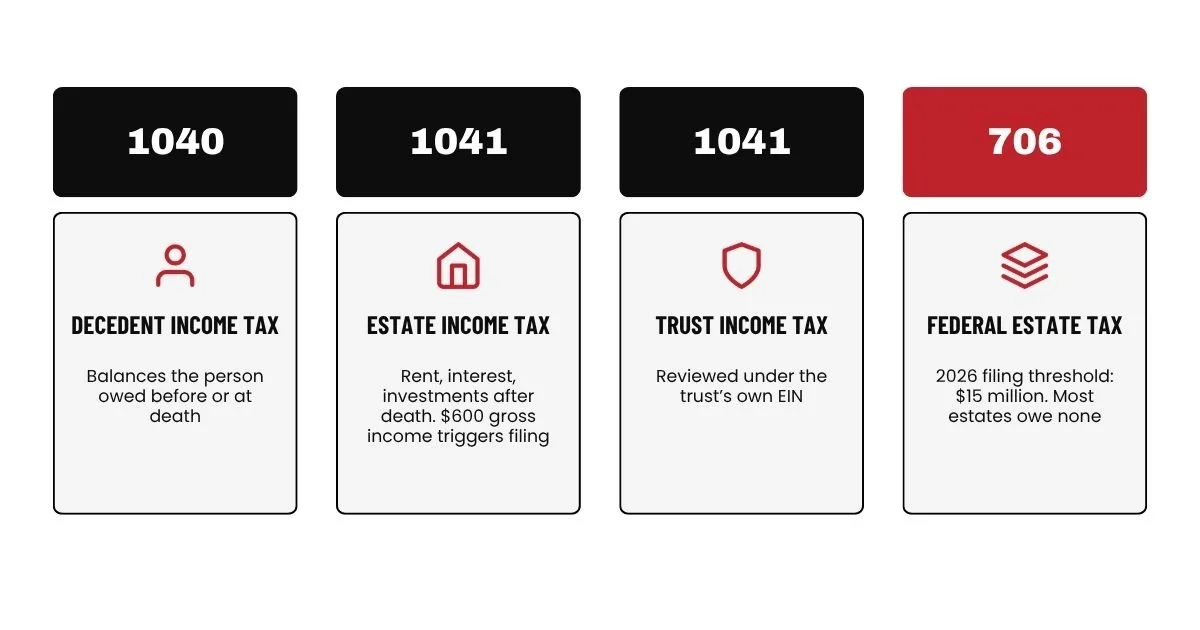
The phrase "estate owes the IRS" can describe several different tax problems.
Those distinctions matter because an executor should not assume that every IRS balance belongs to the estate itself.
Why the Type of IRS Tax Debt Matters

Before negotiating with the IRS, I identify the tax form and taxpayer connected to each balance.
A case may involve:
• Form 1040, individual income tax owed by the decedent
• Form 1041, estate income tax
• Form 1041, trust income tax
• Form 706, federal estate tax
• Penalties and interest related to those liabilities
• A tax assessment created through an IRS examination
• A federal tax lien
• A collection action against estate or trust property
• Potential transferee liability involving distributed property
• Potential fiduciary liability involving the executor, administrator, or trustee
A resolution that may work for one type of liability may not be appropriate for another.
For example, special federal estate tax payment provisions exist for qualifying Form 706 liabilities that are different from an ordinary individual IRS payment plan.
Executor and Trustee Duties When the IRS Is Owed Money

A fiduciary is someone acting on behalf of another person or entity.
For IRS purposes, a fiduciary can include an:
Executor
Administrator
Trustee
Personal representative
Guardian
Receiver
Conservator
A fiduciary should determine whether federal tax obligations exist before completing distributions and closing the estate or trust.
IRS Form 56 Notifies the IRS of the Fiduciary Relationship
IRS Form 56, Notice Concerning Fiduciary Relationship, is used to notify the IRS that a fiduciary relationship has been created or terminated.
The IRS revised Form 56 and its instructions in June 2026.
The fiduciary should be prepared to provide evidence supporting the authority to act.
Form 56 is particularly important because the IRS needs to know who has authority to act for the deceased taxpayer, estate, or trust.
Form 56 Is Different From Form 2848
Form 56 establishes the fiduciary relationship.
Form 2848 is the IRS Power of Attorney form used to authorize an eligible tax representative to act for the taxpayer on specified federal tax matters.
When I represent an estate or trust, the fiduciary generally acts on behalf of the taxpayer and can authorize my IRS representation for the applicable tax forms and periods.
Can an Executor Become Personally Liable for Estate Tax Debt?

Potentially.
This is one of the most important issues to review before an estate distributes its remaining assets.
Federal law gives the United States priority in certain insolvent estates.
Under 31 U.S.C. Section 3713, when a deceased debtor's estate does not have enough property to pay all debts, qualifying claims of the United States receive statutory priority.
A representative who pays certain lower priority debts or distributes property before satisfying a federal claim can potentially become personally liable to the extent of those payments.
Personal Liability Is Not Automatic
Being named executor does not automatically make you personally responsible for every tax the deceased taxpayer owed.
The IRS looks at the actual facts.
Important questions can include:
Did a federal tax claim exist?
Did the fiduciary know or have reason to know that the claim existed?
What estate assets were under the fiduciary's control?
Was the estate insolvent or rendered unable to pay the federal claim?
Were assets distributed to beneficiaries?
Were other creditors paid first?
Did another creditor have legally superior priority?
How much property was distributed or paid?
IRS estate collection guidance states that fiduciary liability under the federal priority statute can be limited to the amount improperly paid or distributed, or the remaining federal liability, whichever is less.
This is a fact specific analysis.
Do Not Distribute the Last Estate Assets Before Reviewing IRS Debt
If an estate has unresolved federal tax obligations, distributing the remaining cash or property can create problems that are much harder to correct later.
Before final distributions, I recommend confirming:
Required returns have been filed
Known IRS assessments have been reviewed
Current IRS balances are understood
Potential additional assessments have been considered
Tax liens have been reviewed
Available estate assets have been identified
The priority of significant claims has been considered
Any request for discharge from personal liability has been evaluated
Can a Beneficiary Become Liable for Unpaid Estate Taxes?
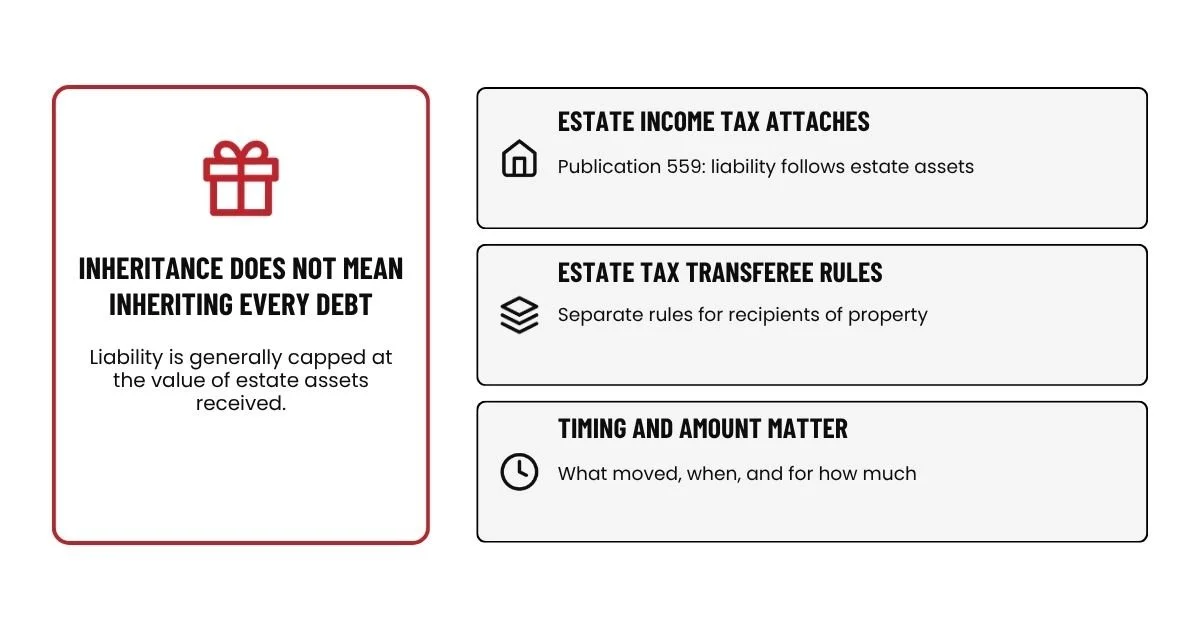
Receiving an inheritance does not automatically make a beneficiary personally responsible for every tax debt of the deceased taxpayer.
However, federal tax liability can follow distributed property in some circumstances.
IRS Publication 559 explains that the income tax liability of an estate attaches to estate assets.
If estate income or property is distributed without payment of tax that should have been paid by the estate, a beneficiary can potentially have liability up to the value of estate assets received.
Estate tax also has separate transferee rules that can apply to recipients of estate property.
That means the timing and amount of distributions matter.
When the estate owes the IRS, I review what property has already been transferred before assuming the IRS can collect only from assets still sitting in the estate account.
IRS Tax Liens and Estate Property
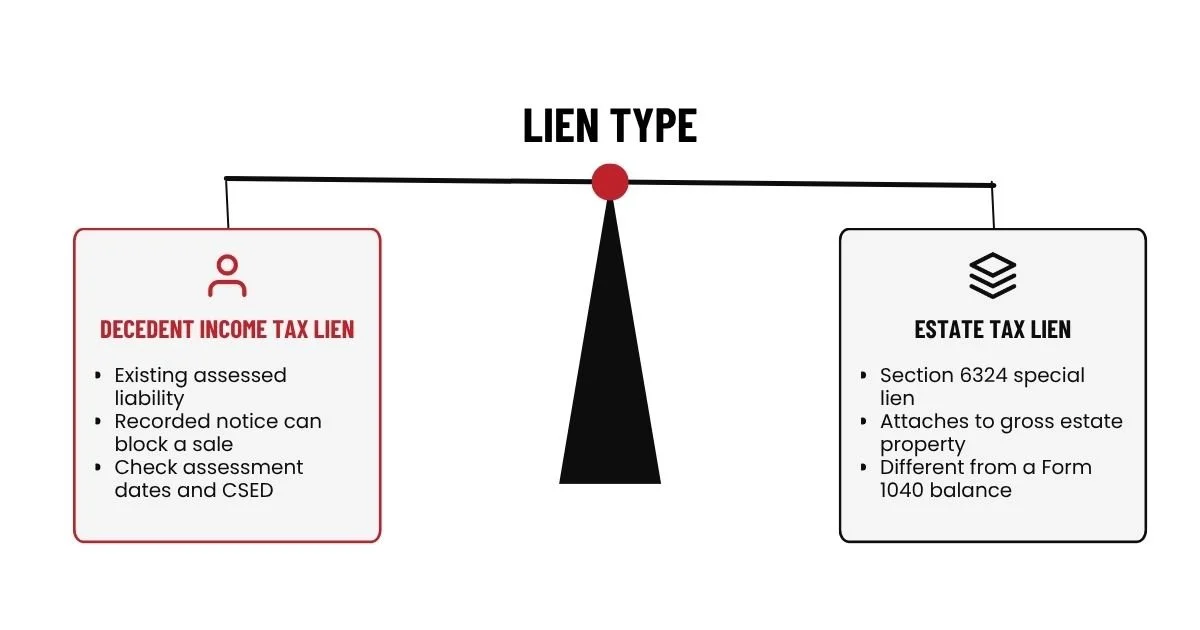
Federal tax liens require careful review in estate cases because the applicable lien depends on the type of federal tax.
Existing Federal Tax Liens Against the Deceased Taxpayer
If the deceased taxpayer had an assessed federal tax liability, an existing federal tax lien may affect property that became part of the estate.
A recorded Notice of Federal Tax Lien can also affect a proposed sale or transfer of property.
The lien, property ownership, assessment dates, and remaining collection period should be reviewed before closing a transaction.
Federal Estate Tax Has Special Lien Rules
Federal estate tax under Form 706 follows special lien provisions.
The Internal Revenue Manual specifically addresses the estate tax lien under Internal Revenue Code Section 6324 and collection from estate and trust assets.
These rules are different from treating the case as an ordinary Form 1040 balance.
When an estate wants to sell, transfer, or refinance property affected by a federal lien, the specific lien and property transaction should be reviewed before closing.
What IRS Collection Options May Be Available to an Estate or Trust?
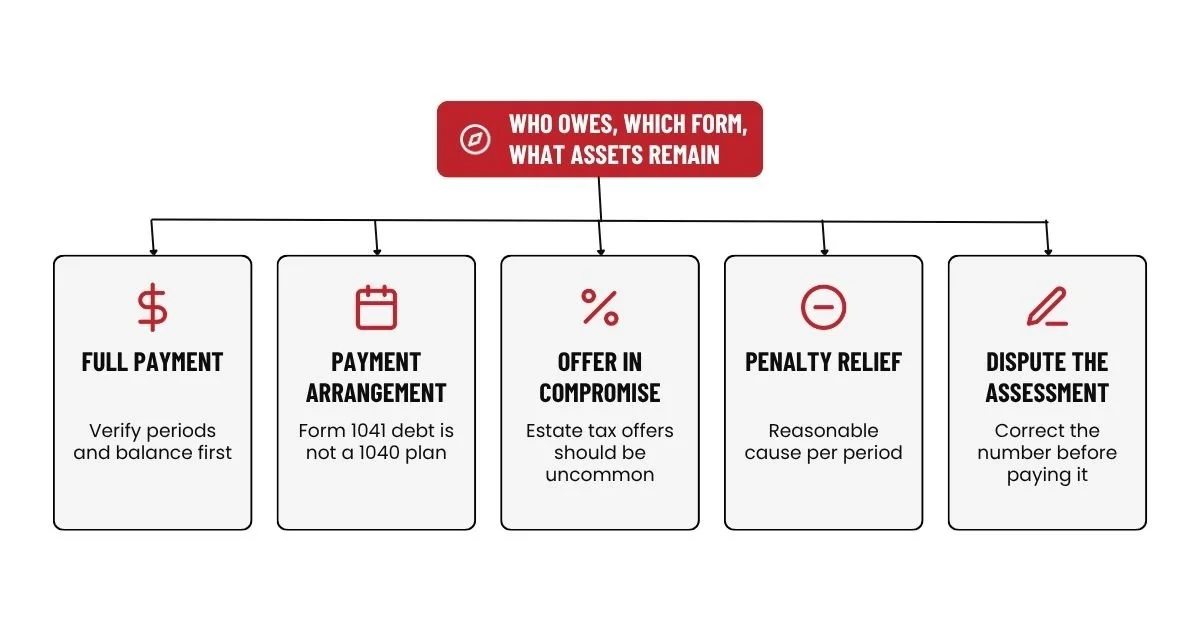
There is no single IRS tax relief program that automatically applies because the taxpayer is an estate or trust.
The available procedure depends on:
Who owes the tax
The tax form involved
The amount due
Estate or trust assets
Cash available
Prior distributions
Tax liens
Collection statutes
Filing compliance
Future income
Applicable federal priority rules
Full Payment From Estate or Trust Assets
When sufficient liquid assets exist, paying an accurate liability can be the most direct solution.
Before making payment, I review the tax periods, current balance, posted payments, penalties, and whether the assessment appears correct.
The executor should also consider other legally superior claims and estate administration requirements.
IRS Payment Arrangement
When immediate full payment is not possible, an IRS payment arrangement may sometimes be considered.
The appropriate procedure depends on the taxpayer and tax type.
A Form 1041 income tax liability should not automatically be treated as if it were an individual Form 1040 payment plan.
The IRS may request financial information concerning the estate or trust, including available cash, property, receivables, income, liabilities, and distributions.
Offer in Compromise
An Offer in Compromise may be available for qualifying federal tax liabilities.
The IRS reviews collectibility, available assets, income, legal liability, and other applicable factors.
Estate tax requires additional caution.
The Internal Revenue Manual specifically permits an Offer in Compromise involving Form 706 estate tax, but states that these offers should be uncommon because special estate tax liens and collection rights can give the government strong access to estate assets.
An Offer in Compromise should therefore be evaluated from the actual estate balance sheet rather than assumed to be available because an estate lacks cash.
Penalty Relief
Some estate or trust penalties may qualify for relief when the applicable IRS requirements are met.
For example, reasonable cause may apply to certain late filing or late payment penalties when the facts support the request.
Penalty relief does not automatically remove the underlying tax or all interest.
The specific penalty and tax period must be reviewed separately.
Disputing an Incorrect Assessment
If the IRS balance is wrong, a payment program may not be the correct first step.
The proper procedure could instead involve:
Filing a missing return
Correcting a return
Providing documentation
Responding to an examination
Requesting reconsideration
Filing a claim for refund when appropriate
Raising an available appeal
Challenging a transferee or fiduciary assessment
The procedure depends on how the tax was assessed and which administrative or judicial rights remain available.
Special Payment Rules for Federal Estate Tax
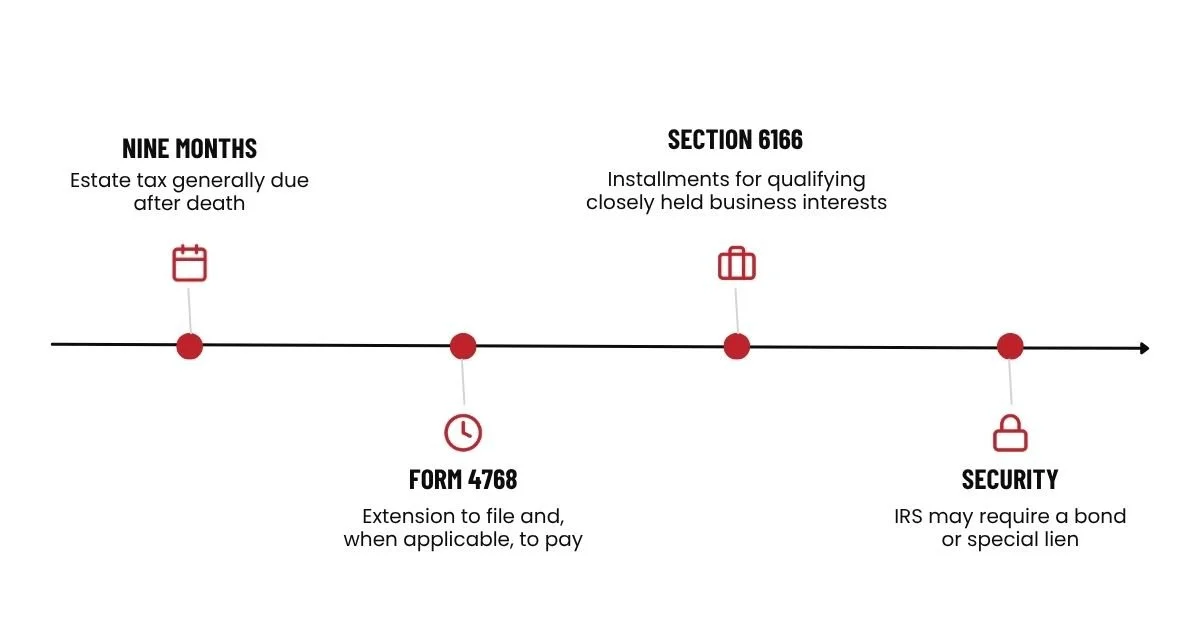
Form 706 estate tax has payment rules that are different from ordinary income tax collection.
The tax is generally due within nine months after the decedent's death.
Form 4768 can be used to request an extension of time to file and, when applicable, an extension of time to pay estate tax.
Section 6166 for Certain Closely Held Businesses
An estate containing a qualifying interest in a closely held business may potentially elect installment treatment for part of the federal estate tax under Internal Revenue Code Section 6166.
This is not an ordinary IRS installment agreement.
The estate must meet specific statutory requirements.
The amount eligible for deferral is limited to the portion attributable to the qualifying closely held business interest.
The IRS may also require security through a bond or special lien.
Because Section 6166 has detailed qualification, election, payment, interest, and acceleration rules, it should be reviewed separately from general IRS collection alternatives.
Form 4810 and Closing the Estate's Federal Tax Exposure
A fiduciary may want greater certainty before finishing administration of an estate.
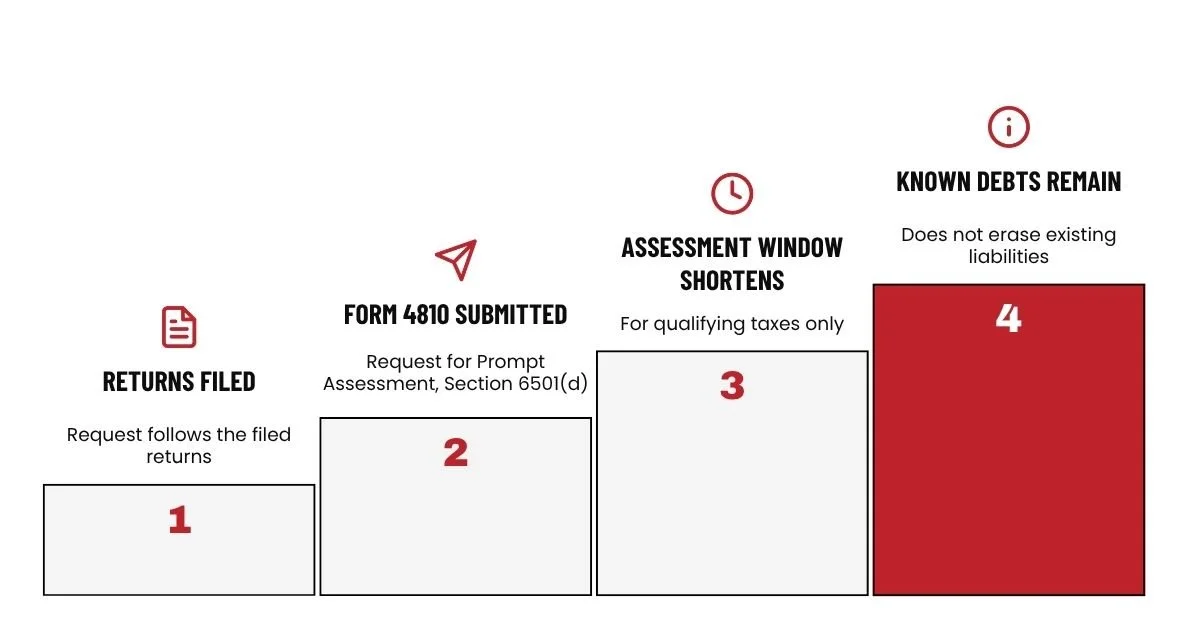
IRS Form 4810, Request for Prompt Assessment Under Internal Revenue Code Section 6501(d), can be used by a fiduciary representing a decedent's estate to request prompt assessment of certain taxes.
This procedure can shorten the period in which qualifying additional tax may be assessed.
It does not eliminate known tax liabilities and does not apply universally to every potential federal tax issue.
A request should be coordinated with the returns already filed and the fiduciary's plan for closing the estate.
Form 5495 and Discharge From Personal Liability
IRS Form 5495 can be important for executors and fiduciaries preparing to finish estate administration.
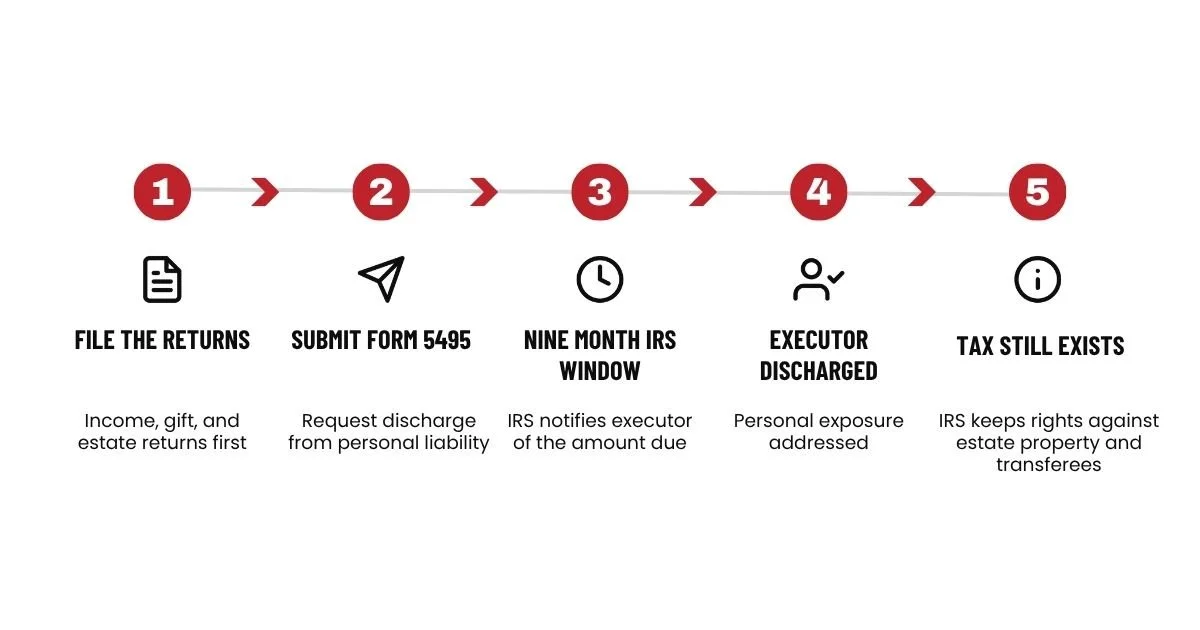
The form is used to request discharge from personal liability for certain income, gift, and estate taxes.
The request is generally made after the applicable returns have been filed.
IRS Publication 559 explains that an executor can request discharge from personal liability for a decedent's income, gift, and estate taxes.
The IRS generally has nine months after receiving a qualifying executor request to notify the executor of the amount due.
Different statutory timing can apply to certain trustees.
A Discharge Does Not Mean the Tax Disappears
A discharge from the fiduciary's personal liability is not the same thing as eliminating the underlying federal tax.
The IRS may still have collection rights against estate property, transferees, or other parties depending on the circumstances.
That distinction is important when deciding whether an estate is ready for final distribution.
What Documents Should an Executor or Trustee Gather?
The first case review does not require a perfectly organized estate file.
Start with what you have.
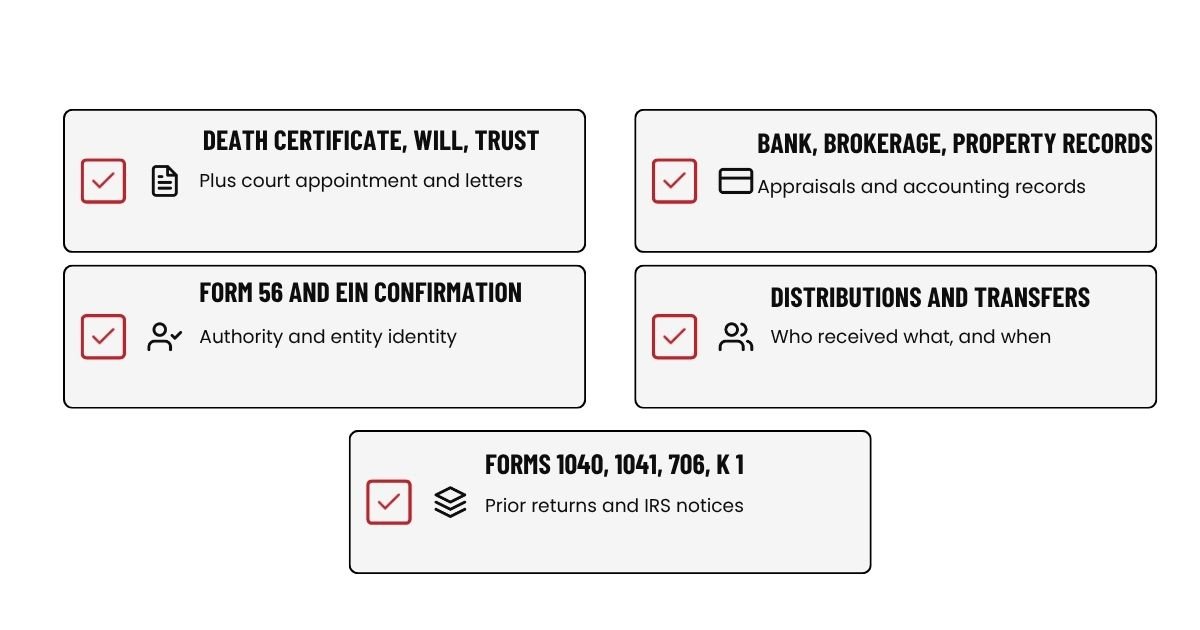
Useful documents can include:
Death certificate
Will
Trust agreement
Court appointment documents
Letters testamentary
Letters of administration
IRS Form 56
Estate or trust EIN confirmation
Prior Form 1040 returns
Form 1041 returns
Form 706 when applicable
Schedule K 1 forms
IRS notices
IRS transcripts
Bank statements
Brokerage statements
Property records
Appraisals
Estate accounting records
Trust accounting records
Lists of creditors
Records of distributions to beneficiaries
Records of property transfers
Closing statements
Proof of IRS payments
Correspondence with prior tax professionals
The most important information may be the timeline.
I want to know when the taxpayer died, when the fiduciary was appointed, when returns were filed, when IRS notices were received, when assets were sold, and when distributions were made.
Our IRS Trust and Estate Tax Debt Relief Process
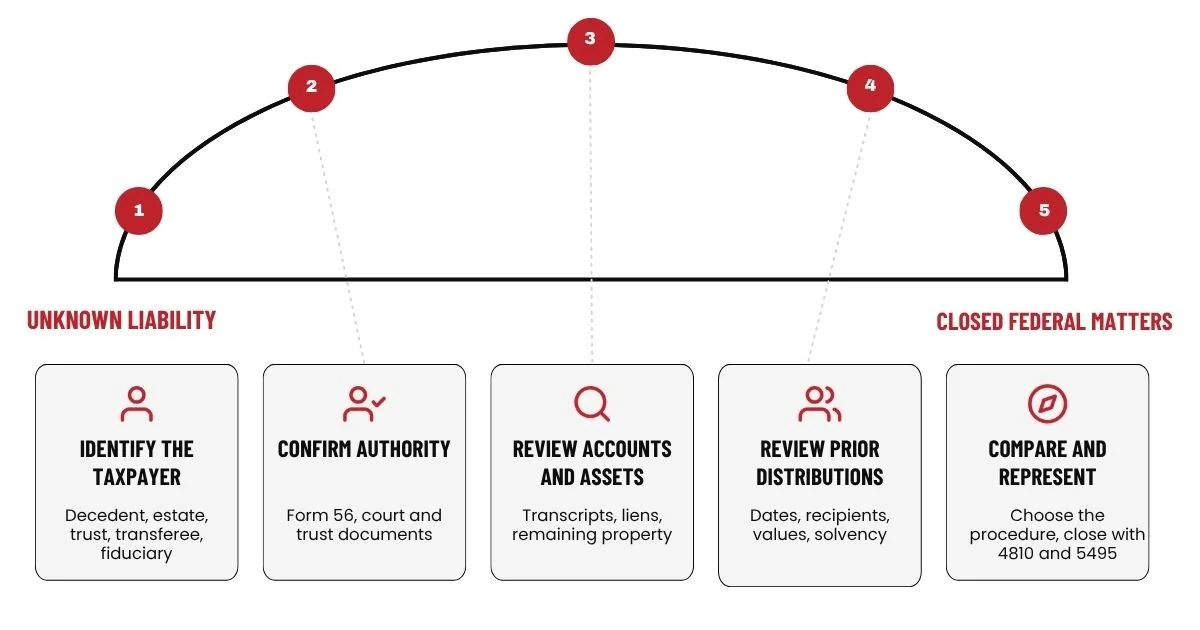
Trust and estate cases should be handled in an organized sequence.
Step 1, Identify the Taxpayer
I determine whether the IRS debt belongs to:
The deceased individual
The estate
A trust
A beneficiary or transferee
A fiduciary
One case can involve more than one taxpayer.
Step 2, Confirm Authority
We review who has authority to act for the deceased taxpayer, estate, or trust.
That may involve Form 56, court documents, trust documents, and other proof of fiduciary authority.
Step 3, Review IRS Accounts and Tax Returns
I review available IRS transcripts and returns to identify:
Tax periods
Assessments
Missing returns
Payments
Penalties
Interest
IRS notices
Collection status
Existing tax liens
Step 4, Review Estate or Trust Assets
The IRS collection strategy can depend heavily on what assets remain.
We may review:
Cash
Real estate
Investments
Business interests
Receivables
Life insurance payable to the estate
Trust assets
Property previously distributed
Other property rights
Step 5, Review Prior Distributions
If money or property has already been distributed, I review:
Date of distribution
Recipient
Property transferred
Value at transfer
IRS debt known at the time
Other creditors paid
Estate solvency
This is particularly important when fiduciary or transferee exposure is a concern.
Step 6, Compare the IRS Procedures
Once the liability and assets are understood, I can help evaluate which procedure may apply.
That could include payment, a payment arrangement, an Offer in Compromise, penalty relief, a liability correction, an appeal, an estate tax payment provision, or another applicable IRS procedure.
Step 7, Represent the Fiduciary Before the IRS
When engaged for IRS representation, I can communicate with the IRS within the scope of the authorization, submit supporting documents, address collection issues, and present the requested resolution.
Step 8, Plan for Closing the Federal Tax Matters
Before final estate administration is completed, we can review whether Forms 4810, 5495, additional returns, final payments, transcript verification, or other closing procedures should be considered.
Trust and Estate Tax Debt Relief Is Different From Deceased Taxpayer Tax Debt Help

These two services are related, but they target different problems.
A deceased taxpayer tax debt case focuses primarily on taxes owed personally by someone who died.
This page addresses the broader problem where a trust or estate itself owes tax, assets have been distributed, a fiduciary may face exposure, or several federal tax liabilities overlap.
A single estate can require both reviews.
For example, a deceased taxpayer may have owed prior Form 1040 income tax while the estate later generates rental income and separately owes Form 1041 income tax.
Those are separate taxpayer accounts and should be tracked separately.
Common Mistakes When an Estate or Trust Owes the IRS

Assuming Death Cancels IRS Tax Debt
Existing federal tax liabilities can remain collectible from estate assets after the taxpayer dies.
The account needs to be reviewed rather than assumed closed.
Confusing the Decedent With the Estate
The deceased person's Form 1040 account and the estate's Form 1041 account are different taxpayers for federal income tax purposes.
Distributing Assets Before Checking IRS Balances
An early distribution can become a serious issue when insufficient assets remain to pay a federal claim.
Assuming Beneficiaries Can Never Have Exposure
Beneficiary and transferee liability can arise in some circumstances when estate assets are distributed before applicable taxes are paid.
Paying Every Creditor Before Reviewing Federal Priority
When an estate is insolvent, federal priority rules can affect which claims should be paid first.
State probate procedures and federal priority law both need to be considered.
Treating Form 706 Tax Like Ordinary Income Tax Debt
Federal estate tax has special lien, extension, and installment provisions.
Closing the Estate Before Addressing Potential Additional Assessments
Forms 4810 and 5495 may be worth reviewing before the fiduciary considers the federal tax portion of the administration complete.
Why Work With Semper Tax Relief?
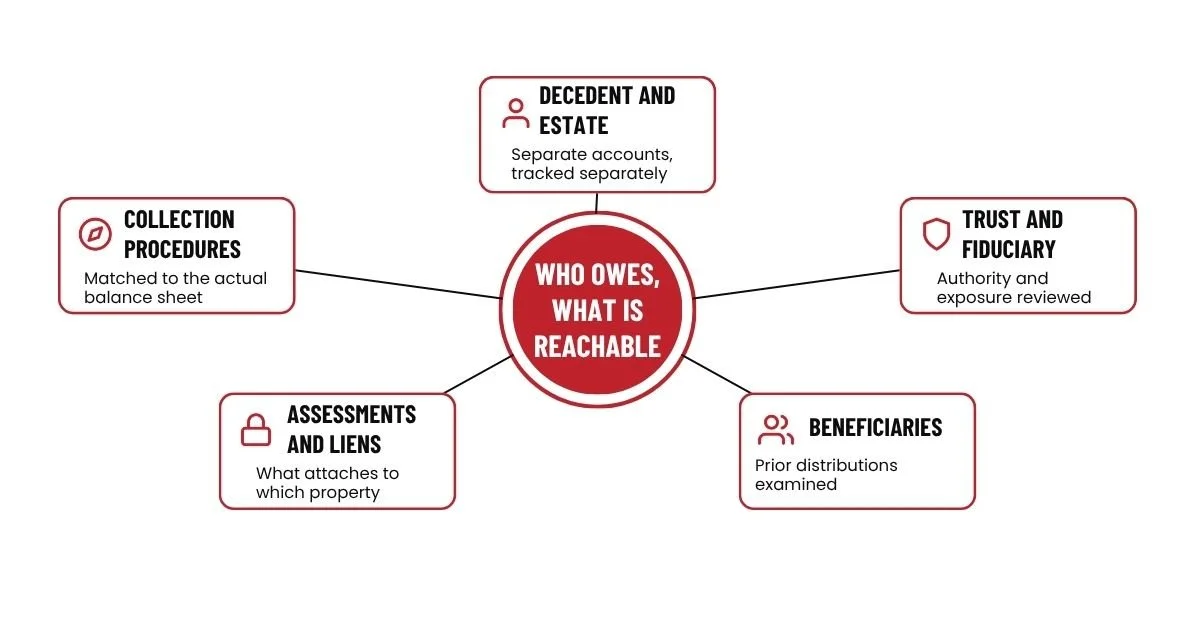
Estate and trust collection cases require more than looking at one IRS balance.
I review the relationship between:
The deceased taxpayer
The estate
The trust
The fiduciary
Beneficiaries
IRS assessments
Federal tax liens
Remaining assets
Prior distributions
Filing compliance
Available collection procedures
I am Sergio Melendez, JD, EA.
I have worked in the tax profession since 2005 and represent taxpayers before the IRS as an Enrolled Agent.
My Juris Doctor degree is an educational credential.
My authority to represent taxpayers before the IRS comes from my Enrolled Agent credential.
I do not assume that an executor is personally liable merely because the estate owes tax.
I also do not assume that the estate automatically qualifies for a settlement or payment arrangement.
The first objective is to determine exactly who owes the tax and what property the IRS can legally pursue.
Results depend on the taxpayer, tax type, estate or trust assets, prior distributions, filing history, available records, federal collection law, state law where relevant, and applicable IRS procedures.
Frequently Asked Questions About IRS Trust and Estate Tax Debt Relief
-
No.
A taxpayer's death does not automatically cancel an assessed federal tax liability.
The IRS may look to estate assets and other legally available collection sources.
The executor or personal representative should review the IRS account before making final estate distributions.
-
Not automatically.
However, federal law can create personal exposure when an insolvent estate has a federal claim and the fiduciary distributes assets or pays lower priority creditors before satisfying the government's claim.
The facts, knowledge of the federal claim, solvency, asset control, payment priority, and amount distributed all matter.
-
A beneficiary does not automatically inherit every federal tax liability of the deceased person.
However, IRS rules can create transferee or beneficiary exposure in some situations involving distributed estate property or unpaid estate income tax.
The potential exposure can depend on the type of tax and value of property received.
-
Form 1040 reports the deceased individual's income through the applicable final tax year.
Form 1041 generally reports income belonging to the estate or trust after death.
The estate generally uses its own EIN.
The two returns can create separate federal tax liabilities.
-
No.
For a U.S. citizen or resident who dies in 2026, the federal estate tax filing threshold is $15 million under the applicable calculation involving the gross estate and adjusted taxable gifts.
A Form 706 may also be filed to make a portability election for a surviving spouse even when the estate would otherwise be below the filing threshold.
Other special filing rules can apply.
-
Possibly.
The available arrangement depends on the type of tax, estate assets, collection status, and other facts.
Federal estate tax also has special statutory payment provisions, including potential extensions and Section 6166 treatment for qualifying closely held business interests.
An ordinary individual installment agreement should not automatically be assumed to apply.
-
An Offer in Compromise may be available for certain qualifying liabilities.
The IRS specifically recognizes that an offer can be submitted involving Form 706 estate tax.
However, IRS internal guidance states that estate tax offers should be uncommon because special estate tax liens and collection rights can give the government strong access to estate assets.
Eligibility and the offer amount depend on the actual facts and available assets.
-
This should be reviewed carefully before distribution.
A fiduciary can create additional risk when assets are distributed while a federal tax claim remains unpaid, particularly when the estate is insolvent or the distribution prevents full payment of the government claim.
I recommend reviewing the IRS account, available assets, creditors, and applicable priority rules before the estate makes final distributions.
Get a Free Trust and Estate IRS Tax Debt Case Review
If an estate or trust owes the IRS, start by identifying the taxpayer and the tax.
I can review:
IRS balances owed by the deceased taxpayer
Form 1041 estate tax balances
Form 1041 trust tax balances
Form 706 federal estate tax
IRS notices
Missing tax returns
Tax liens
Estate and trust assets
Prior beneficiary distributions
Potential fiduciary exposure
Potential transferee issues
Payment options
Offer in Compromise considerations
Penalty relief
Form 4810
Form 5495
IRS representation needs
You do not need to determine the correct tax relief program before requesting the review.
Bring the IRS notices, estate or trust records, tax returns, and information concerning assets and distributions that you currently have.
I can help identify what the IRS account shows and what procedures may be available based on the facts.