
How Many Years of Unfiled Tax Returns Does the IRS Actually Require
If you have not filed in a while, this is usually the question underneath every other question. Not "will I get in trouble," but "how far back do I actually have to go."
There is a real, specific answer here, straight from IRS internal policy, and I want to walk through exactly what it says and, just as important, what it does not say.

TLDR;
- The IRS generally enforces filing compliance for the last six years, under a policy known as Policy Statement 5-133.
- This is an administrative policy, not a law, and the IRS can require more or fewer years depending on the specific facts of a case.
- The six-year period is generally calculated starting with the most recently due tax year and counting back six years from there.
- This policy governs filing enforcement. It does not change or shorten how many years the IRS can go back to assess tax once a return is filed, and it does not apply to fraud.
- A return with a refund due generally must be filed within 3 years of its original due date to claim that refund, a separate and much shorter window.
- This article covers individual filing compliance. Business filing compliance and California FTB filing requirements can differ - see the callouts below.
The Six-Year Rule, Straight From IRS Policy
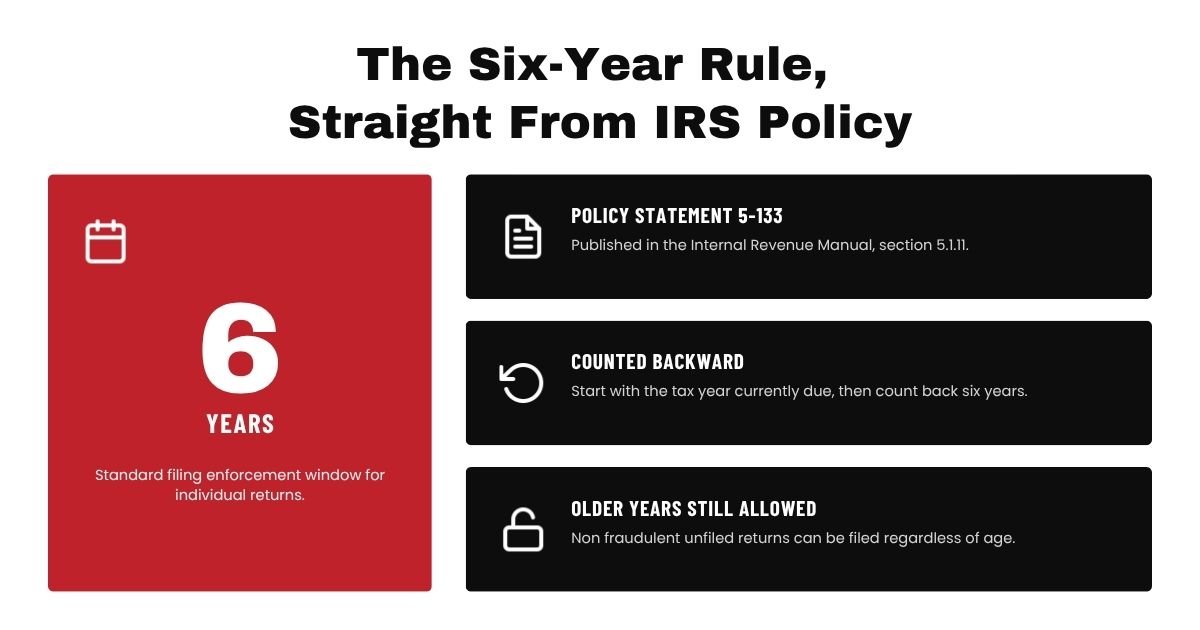
The IRS's own Internal Revenue Manual states this directly. Under Policy Statement 5-133, referenced in IRM 5.1.11, delinquency procedures are normally enforced for a six-year period.
The six-year window is generally calculated by starting with the tax year currently due and counting back six years from there.
The manual is also explicit that all non-fraudulent unfiled returns can still be requested and filed by the taxpayer regardless of how old the delinquency is.
The six-year figure describes what the IRS will typically enforce, not a ceiling on what you are legally allowed, or in some cases required, to file.

This Is a Policy, Not a Law, and It Has Exceptions
I want to be precise about this distinction, because it gets blurred a lot in how this topic is discussed online. Policy Statement 5-133 is internal IRS guidance on enforcement discretion.
It is not a statute, and it does not limit the IRS's legal authority to assess or collect on older unfiled years. The IRS's own guidance lists specific factors that can lead to enforcing more or fewer than six years, including:
- The taxpayer's prior history of noncompliance
- Whether the unfiled income involves illegal sources
- The effect on voluntary compliance more broadly
- The anticipated revenue relative to the time and effort required to determine the tax due
- Special circumstances specific to a particular taxpayer, industry, or type of tax involved.
Any deviation from the standard six-year period, in either direction, generally requires managerial approval within the IRS.
What This Policy Does Not Do
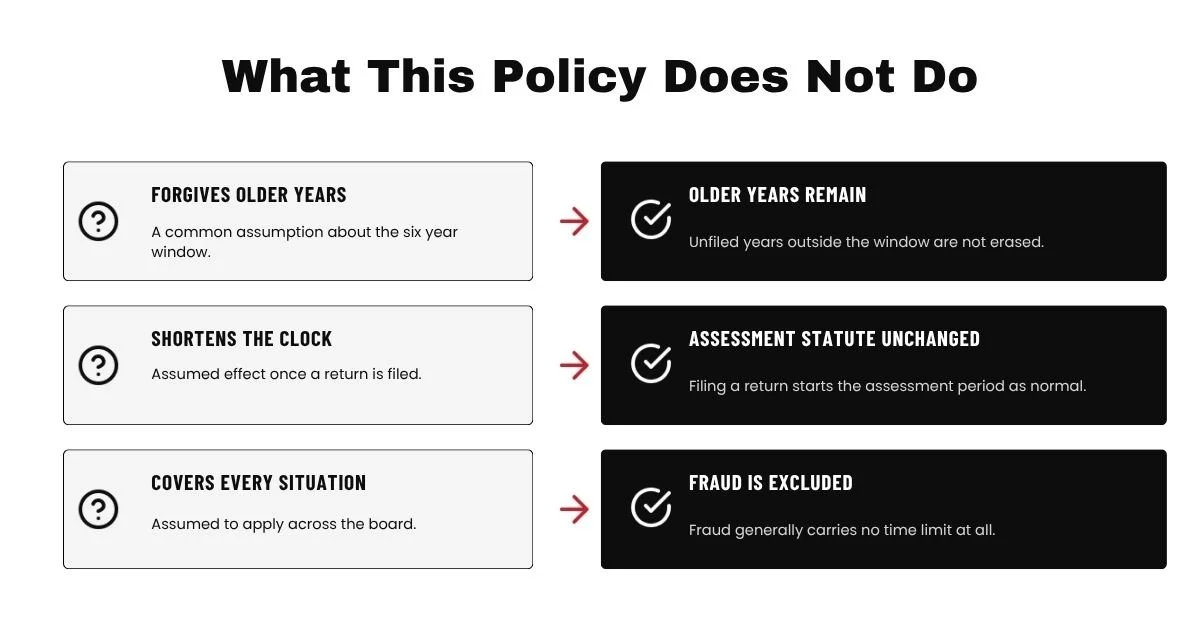
This is where I see the most confusion, so I want to state it plainly. Policy Statement 5-133 governs filing enforcement discretion.
It does not:
- Forgive or erase older unfiled years
- Replace or shorten the assessment statute once a return is actually filed
- Apply to fraud, where there is generally no time limit at all.
In practical terms, filing your last six years may satisfy the IRS's active enforcement expectation and bring you back into filing compliance.
It does not necessarily mean older years are permanently off the table, particularly if a Revenue Officer later determines there is a specific reason to go back further.
The Separate, Shorter Refund Deadline
There is a completely different deadline that trips people up here, and it works against you rather than for you.
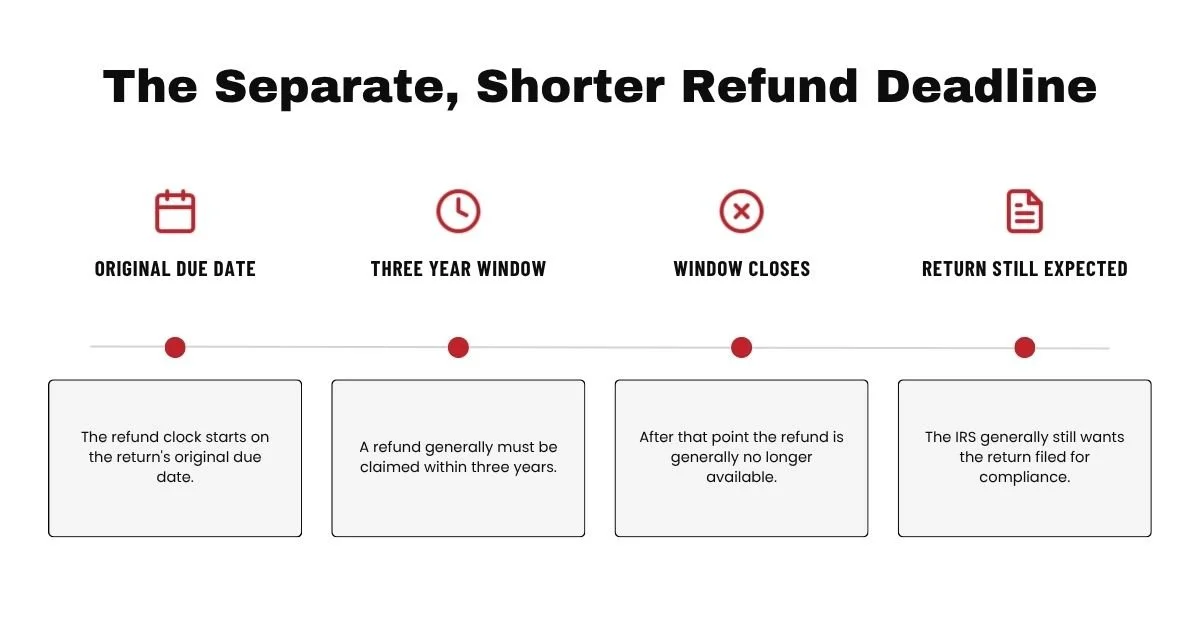
If an old unfiled return would have resulted in a refund, you generally only have 3 years from that return's original due date to file and actually claim it. This means someone catching up on six years of unfiled returns may find that a refund from year one or two of that period is no longer collectible, even though the IRS still generally wants that return filed as part of getting into compliance.

Federal vs California - Do Not Assume the Same Rules Apply
Everything above describes IRS policy on individual federal filing enforcement. California's Franchise Tax Board has its own filing compliance expectations, and they do not automatically mirror the federal six-year policy.
If you have unfiled years with both the IRS and California, getting into federal compliance does not automatically resolve state filing compliance, and the two should be addressed as related but separate tracks.
A Note on Business Filing Compliance
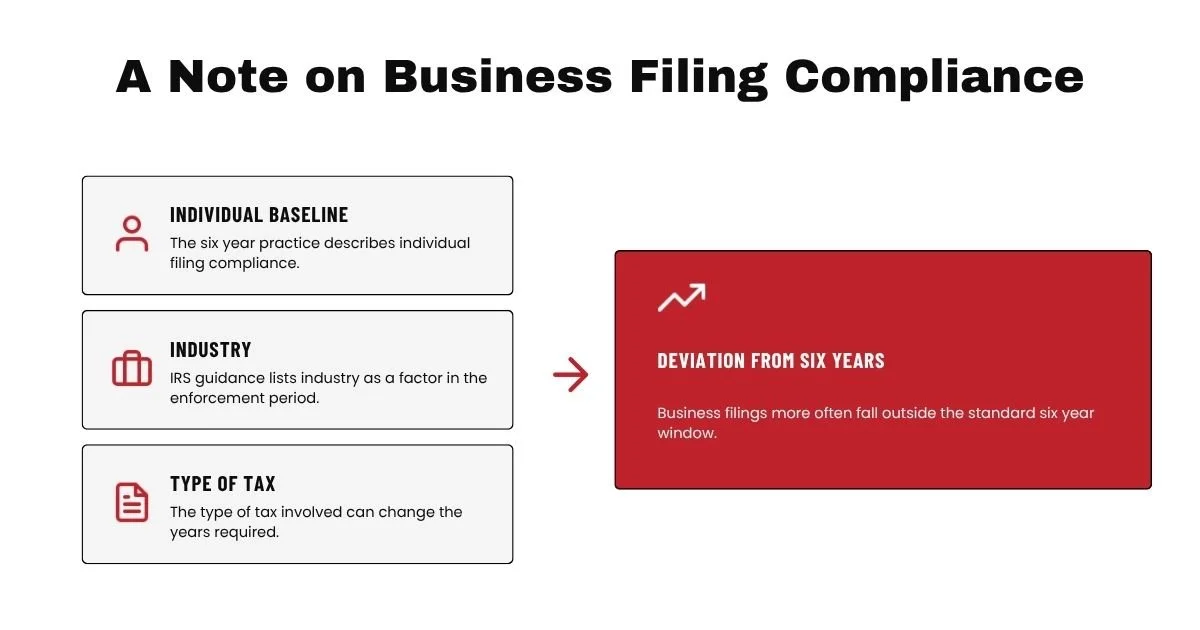
This post focuses on individual returns. Business unfiled returns, in my experience, are more often subject to a deviation from the standard six-year window, since the IRS's own guidance specifically lists "industry" and "type of tax" as factors that can extend enforcement.

How I Approach Unfiled Return Cases
When someone comes to me with multiple years of unfiled returns, my first step is always the same: pull the account transcripts for every year to see exactly what the IRS already knows, what may have already been assessed through a Substitute for Return, and what the actual filing gap looks like.
From there, the six-year guideline is a starting point for planning, not an assumption I make without checking the specific facts of the case first.
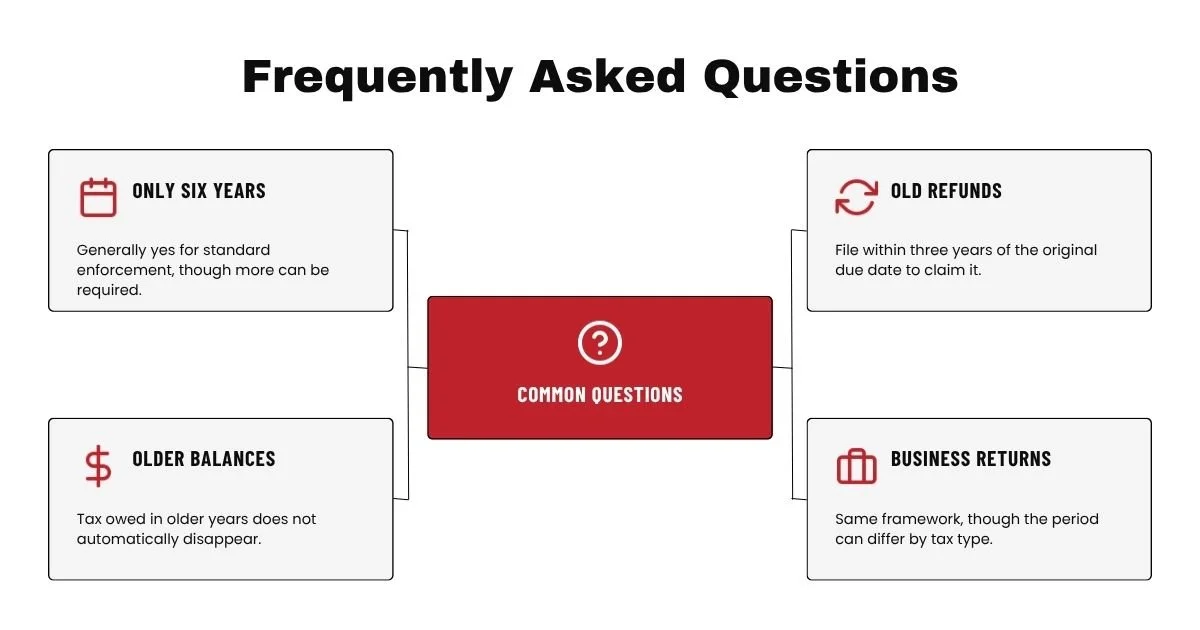
Frequently Asked Questions
-
Generally yes, for standard IRS enforcement purposes, but this is IRS discretion, not a legal ceiling. Specific facts, like a history of noncompliance or a large anticipated balance in an older year, can lead the IRS to require more.
-
The debt itself generally does not disappear, and depending on the situation, the IRS may still pursue it, particularly if a return was never filed for that year, since the assessment clock generally does not start until a return exists.
-
Only if you file within 3 years of that return's original due date. After that window closes, the refund is generally no longer available even if you file the return afterward.
-
No. It generally satisfies the IRS's standard filing enforcement expectation, but it does not erase what may be owed for years outside that window if the IRS later has reason to look further back. Is the six-year rule the same for business returns? The same policy framework applies, but the specific enforcement period for a business may differ based on factors like industry and tax type.
Getting Back Into Compliance Starts With Knowing the Real Number
The six-year figure is a genuinely useful planning benchmark, but it only works as a benchmark once you know your actual filing history and what the IRS already has on record for you.
Guessing at that number without checking transcripts first is how people either over-file years that were not required or under-file years that actually were.
I offer a free case review that includes pulling your transcripts and mapping out exactly what your real filing gap looks like.