

IRS Payroll Tax Debt Relief for Businesses
IRS payroll tax debt can place your business, its bank accounts, its property, and certain responsible individuals at risk.
If your business has unpaid Form 941 employment taxes, missing payroll tax returns, late federal tax deposits, or an IRS Revenue Officer assigned to the account, Semper Tax Relief can review the problem and help determine which response or payment options may be available.
Do I qualify for tax relief? Find out with a free case review.
Call today: 24 Hours / 7 Days a Week or book online.
✔ Confidential ✔ No Pressure ✔ Personalized
I am Sergio Melendez, JD, EA. I earned my Juris Doctor degree and am federally licensed as an Enrolled Agent with unlimited representation rights before the IRS. I have worked in the tax profession since 2005 and regularly represent businesses dealing with IRS collection matters, payroll tax debt, unfiled employment tax returns, federal tax liens, levies, and potential Trust Fund Recovery Penalty assessments.
The first step is to determine exactly what the business owes, which tax periods are involved, whether all required returns have been filed, and whether the business is making its current federal tax deposits.
A payroll tax resolution does not automatically reduce the amount owed or prevent every collection action. The available options depend on the business’s filing compliance, current deposits, cash flow, assets, collection status, and ability to make payments.
What Is IRS Payroll Tax Debt?
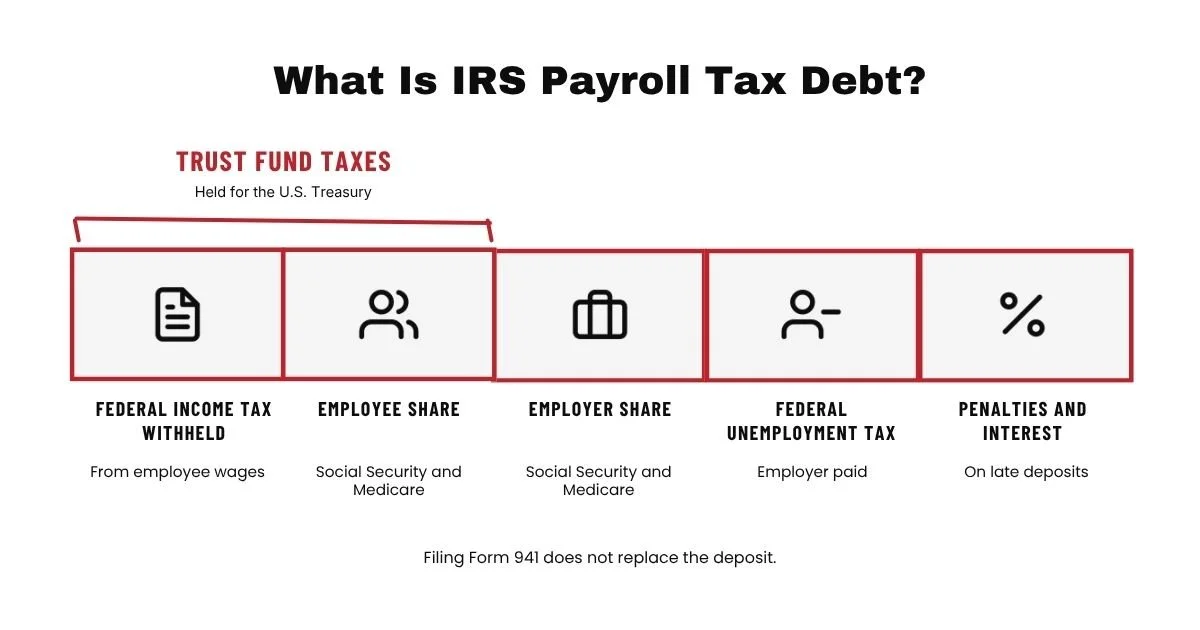
Payroll tax debt develops when a business does not properly deposit or pay federal employment taxes.
Employment taxes can include:
Federal income tax withheld from employee wages
The employee’s share of Social Security and Medicare taxes
The employer’s share of Social Security and Medicare taxes
Federal unemployment tax
Penalties and interest added to unpaid or late deposits
The income tax, Social Security tax, and Medicare tax withheld from an employee’s wages include trust fund taxes. The business holds those amounts until they are deposited with the United States Treasury.
The IRS generally treats unpaid payroll taxes more seriously than ordinary business income tax debt because part of the money was withheld from employees.
Filing Form 941 does not satisfy the separate federal tax deposit requirement. A business must report its employment taxes and make the required deposits according to its applicable deposit schedule.
Warning Signs That Your Payroll Tax Problem Is Escalating
A payroll tax problem should be reviewed as soon as the business becomes aware of a missed return, deposit, or payment.
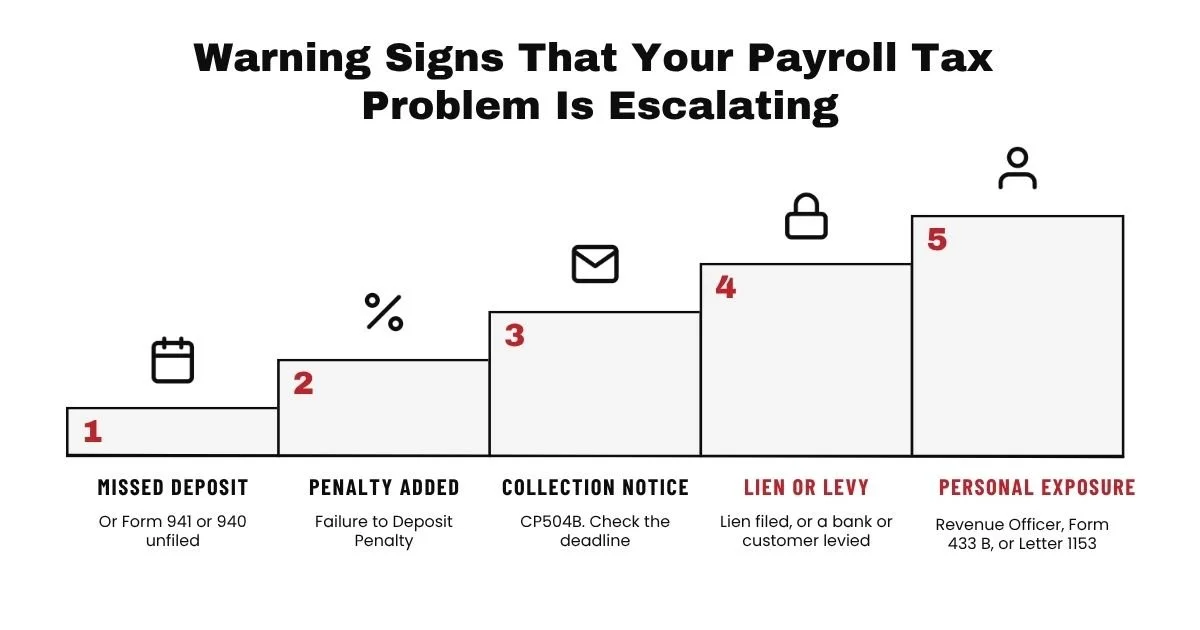
Warning signs may include:
• The business missed one or more federal tax deposits
Form 941 or Form 940 has not been filed
The IRS added a Failure to Deposit Penalty
The business received CP504B or another collection notice
The IRS filed a Notice of Federal Tax Lien
A bank, customer, or payment processor received an IRS levy
An IRS Revenue Officer contacted the business
The IRS requested Form 433 B or financial records
The IRS scheduled an interview concerning personal responsibility
An owner or officer received Letter 1153 proposing the Trust Fund Recovery Penalty
The notice or contact should be reviewed carefully because different collection and appeal procedures can have different deadlines.
Receiving a collection notice does not necessarily mean that a levy has already occurred. However, ignoring the notice may allow the case to progress to more serious collection activity.
What Can the IRS Do When Payroll Taxes Remain Unpaid?
The IRS may pursue the business for unpaid employment taxes through its collection process. The exact action depends on the account, notices issued, deadlines, assigned collection unit, and other circumstances.
File a Federal Tax Lien
The IRS may file a Notice of Federal Tax Lien to provide public notice of the federal government’s legal claim against the business’s property.
A lien can affect business assets, accounts receivable, financing, property sales, and other transactions. Paying or arranging the debt does not always produce immediate lien withdrawal. Release, withdrawal, discharge, and subordination are separate procedures with different requirements.
Levy Business Property and Accounts
After the applicable notice and procedural requirements are satisfied, the IRS may levy property or rights to property.
Depending on the facts, this may include:
Business bank accounts
Accounts receivable
Customer payments
Merchant processor payments
Certain equipment or other business property
A request to release or modify a levy requires a review of the levy, collection status, business finances, and available procedural options. A payment proposal alone does not guarantee that the IRS will release a levy.
Assign an IRS Revenue Officer
The IRS may assign a Revenue Officer to investigate and collect the payroll tax debt.
A Revenue Officer may request:
Missing employment tax returns
Bank statements
Accounts receivable reports
Profit and loss statements
Payroll records
Asset information
Form 433 B, Collection Information Statement for Businesses
Proof of current federal tax deposits
The Revenue Officer may also investigate whether the Trust Fund Recovery Penalty should be proposed against one or more individuals.
Consider Collection Against Responsible Individuals
The IRS may investigate whether certain individuals should be held personally responsible for the unpaid trust fund portion of the employment taxes.
This process is separate from collection against the business.

Can a Business Owner Become Personally Liable?
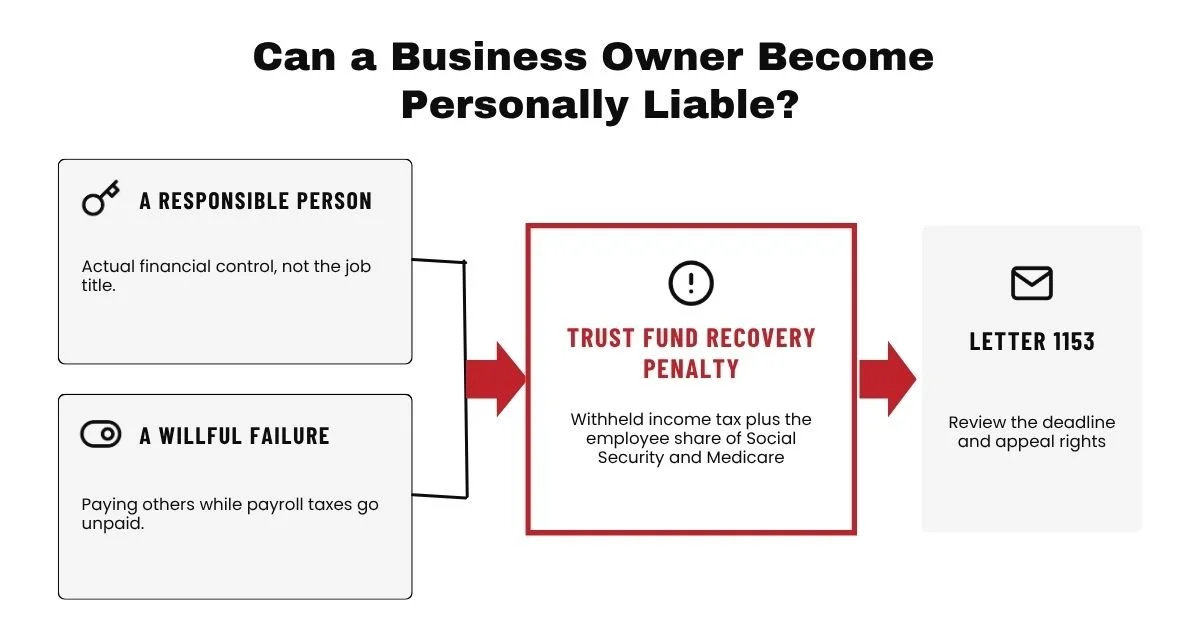
Yes. The IRS may assess the Trust Fund Recovery Penalty against a person who was responsible for collecting, accounting for, or paying trust fund taxes and who willfully failed to collect or pay them.
A responsible person may include:
A business owner
A corporate officer
A director or shareholder
A partner or LLC member
An employee with control over business finances
A person authorized to decide which creditors were paid
Certain third party payroll providers or responsible individuals within those providers
A job title alone does not determine responsibility. The IRS examines actual authority, financial control, check signing power, decision making, knowledge of the unpaid taxes, and the person’s ability to direct payments.
For this purpose, willfulness does not necessarily require fraud or an intent to steal. Paying other creditors while knowing payroll taxes remain unpaid may support a finding of willfulness.
The amount of the Trust Fund Recovery Penalty generally equals the unpaid trust fund portion, which includes withheld federal income taxes and the employee share of Social Security and Medicare taxes. It does not generally include the employer’s matching share.
Before assessment, the IRS generally provides a written proposal. A person who receives Letter 1153 should review the deadline and appeal rights stated in the letter immediately.
What Must Happen Before Requesting Payroll Tax Relief?
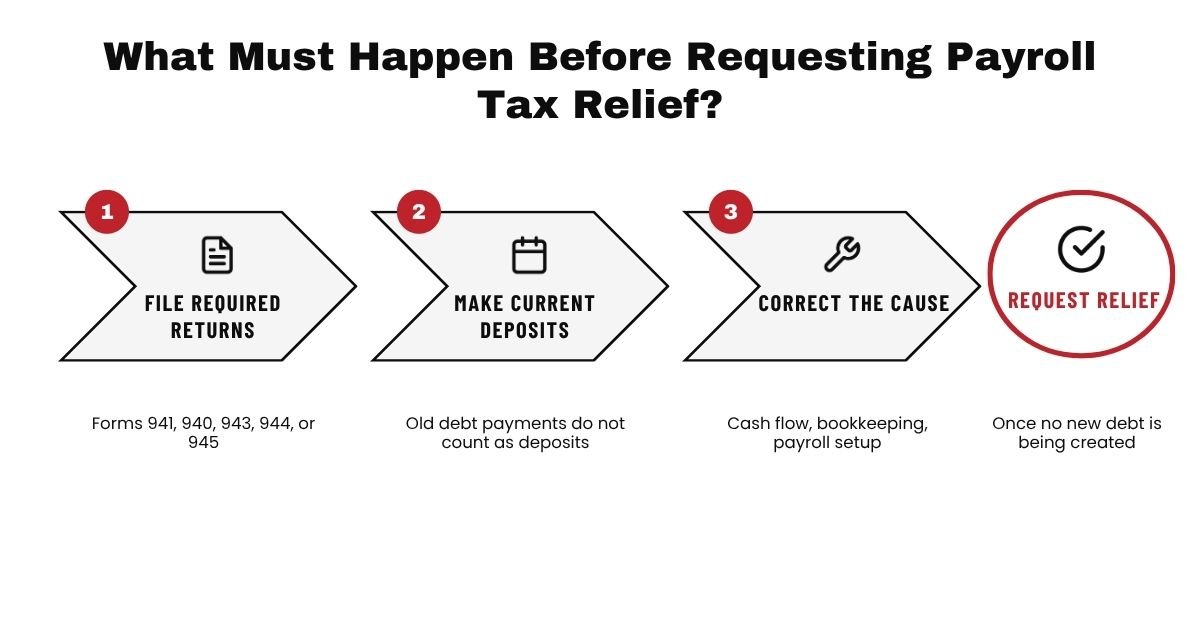
Most long term payroll tax resolutions begin with current compliance.
File Required Payroll Tax Returns
The business should identify and prepare any required Forms 941, 940, 943, 944, or 945 that remain unfiled.
The required forms depend on the business, its employees, and the type of tax involved.
If the IRS prepared an employment tax return for the business, the assessment should be compared with the business’s payroll records before determining the appropriate response.
Make Current Federal Tax Deposits
An operating business generally must make its current federal tax deposits while addressing the older payroll tax balance.
The required deposit schedule may be monthly or semiweekly. Certain employers can also become subject to the next day deposit rule.
A payment toward old payroll tax debt does not replace a current federal tax deposit. The business must distinguish between current deposits and payments applied to older liabilities.
Correct the Cause of the Payroll Tax Problem
A payment arrangement may fail if the business continues creating new payroll tax debt.
Before proposing a resolution, we may need to identify why the business fell behind. Common causes include:
Inadequate cash flow
Incorrect deposit scheduling
Poor bookkeeping
Payroll service problems
Using withheld taxes for operating expenses
Missing or inaccurate payroll records
Unprofitable operations
Failure to reduce expenses when revenue declined
The business may need changes to its payroll system, bookkeeping, cash flow controls, staffing, or operating budget before a long term proposal is realistic.
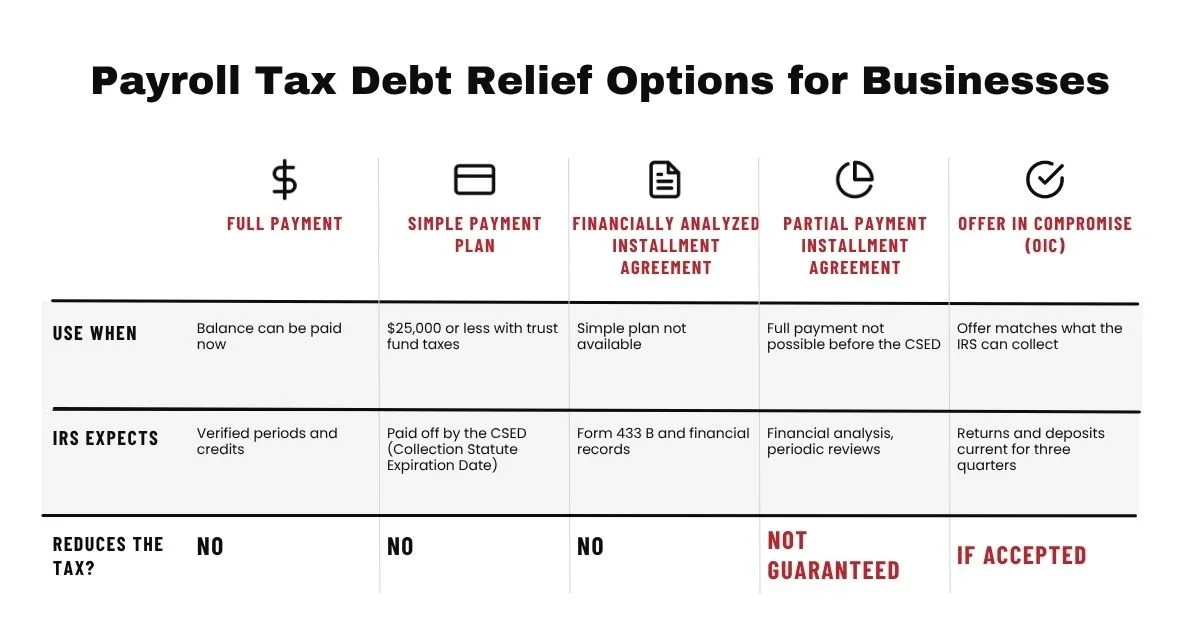
Payroll Tax Debt Relief Options for Businesses
The appropriate option depends on the amount owed, whether the business is operating, filing compliance, current deposits, asset equity, cash flow, and the remaining IRS collection period.
Full Payment
Paying the verified balance in full may limit additional interest and penalty accruals and avoid the cost of a longer payment arrangement.
Before making a large payment, the business should confirm the tax periods, assessments, credits, deposits, and payment application.
IRS Simple Payment Plan for Businesses
A qualifying business may be able to use an IRS Simple Payment Plan.
Under current IRS guidance, a business with trust fund taxes may generally qualify when it owes $25,000 or less in assessed tax, penalties, and interest and is current with filing and payment requirements.
Businesses without trust fund taxes may have a higher qualifying balance. An out of business sole proprietorship may also be subject to different criteria.
The proposed payments generally must satisfy the assessed liability by the applicable Collection Statute Expiration Date.
A Simple Payment Plan does not reduce the underlying tax. Penalties and interest may continue, and the business must remain compliant.
Financially Analyzed Installment Agreement
A business that does not qualify for a Simple Payment Plan may still be considered for another installment agreement.
The IRS may require:
Form 433 B
Bank statements
Profit and loss statements
Accounts receivable information
Loan documents
Asset values
Proof of operating expenses
Current payroll deposit records
The IRS may review whether the business can borrow, sell assets, reduce expenses, or make a larger monthly payment.
Approval is not automatic. The payment amount must be supported by the business’s financial information and applicable collection procedures.
Partial Payment Installment Agreement
A partial payment installment agreement may be considered when the business cannot fully pay the liability before the collection period expires.
The IRS may require a detailed financial analysis and can periodically review the business’s ability to pay. Payments, interest, and penalties generally continue while the agreement remains active.
This option does not guarantee that the unpaid balance will expire. Events that suspend or extend the collection period may affect how long the IRS has to collect.
Offer in Compromise
An Offer in Compromise may allow a qualifying business to settle an IRS liability for less than the full balance.
The IRS reviews the business’s ability to pay, income, expenses, assets, and equity. An operating employer must generally have filed its required returns and made the required federal tax deposits for the current quarter and the two preceding quarters before applying.
An Offer in Compromise is not available merely because the business owes a large balance or cannot pay immediately. The IRS generally expects an offer to reflect what it believes can reasonably be collected.
An open bankruptcy proceeding generally prevents the IRS from considering an Offer in Compromise.
Temporary Collection Delay
The IRS may temporarily delay certain collection activity when immediate payment would create a qualifying financial hardship.
This does not eliminate the tax debt. Penalties and interest may continue, a lien may remain or be filed, and the IRS may review the business’s finances again.
Temporary collection delay can be difficult for an operating business that continues to incur payroll tax obligations. Current deposits and the business’s ability to operate without creating new tax debt remain central concerns.
Penalty Relief
Some payroll related penalties may qualify for removal or reduction when the business can establish reasonable cause and show that it acted with ordinary care and prudence.
Lack of funds by itself generally does not establish reasonable cause. The IRS considers the facts, events affecting compliance, steps taken to prevent the failure, and how quickly the business corrected the problem.
Penalty relief does not remove the underlying employment tax. Interest may remain, and relief is not guaranteed.
How Semper Tax Relief Can Help
Semper Tax Relief provides IRS representation and payroll tax resolution services based on the facts of the business’s case.
Our work may include:
Obtaining and reviewing IRS account transcripts
Identifying tax periods, balances, penalties, and collection activity
Determining which payroll tax returns remain unfiled
Reviewing whether payments and deposits were applied correctly
Communicating with the IRS under a valid power of attorney
Responding to an IRS Revenue Officer
Preparing or reviewing collection financial statements
Evaluating payment plan eligibility
Evaluating whether an Offer in Compromise may be appropriate
Reviewing potential penalty relief
Addressing federal tax liens and levies
Preparing for a Trust Fund Recovery Penalty interview
Reviewing a proposed personal assessment
Evaluating available appeal procedures
The specific services depend on the engagement and the condition of the business’s records. Representation does not guarantee approval of a resolution request or prevent the IRS from taking action permitted by law.
Our Payroll Tax Debt Resolution Process
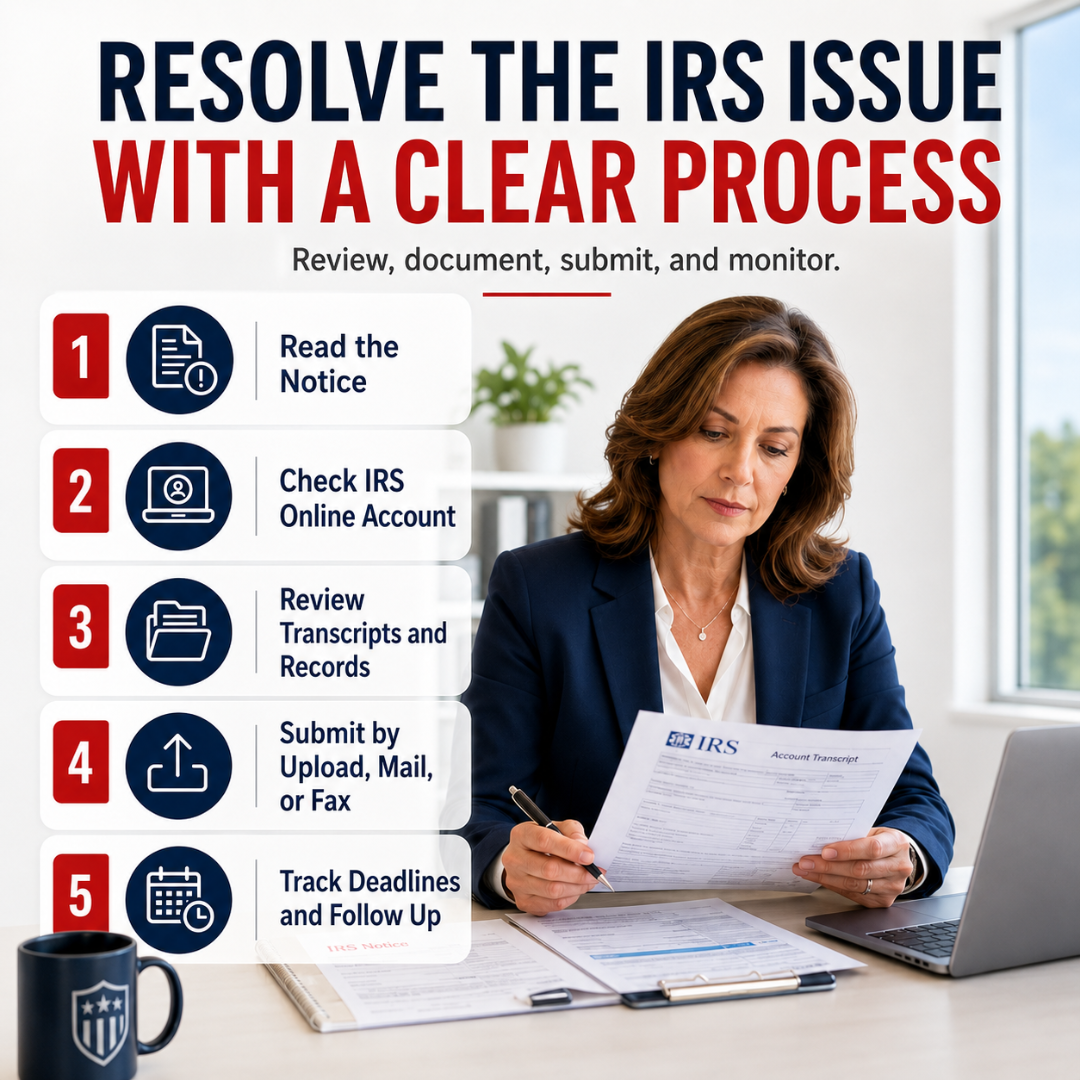
We begin by identifying the employment tax periods, balances, assessments, penalties, payments, notices, and collection status.
We also determine whether the account is assigned to automated collections, a Revenue Officer, or another collection function.
Step 1: Review the IRS Account
Step 2: Address Missing Returns and Current Deposits
We identify missing payroll tax returns and confirm whether the operating business is making current federal tax deposits.
If the business continues falling behind, we review the cause and discuss what must change before requesting a long term resolution.
Step 3: Review Business Finances
When financial disclosure is required, we review cash flow, bank activity, accounts receivable, assets, debts, payroll, operating expenses, and the business’s ability to make payments.
Step 4: Compare Available Options
We compare the payment and resolution options supported by the business’s facts.
This may involve full payment, a Simple Payment Plan, a financially analyzed installment agreement, a partial payment arrangement, an Offer in Compromise, penalty relief, an appeal, or another appropriate procedure.
Step 5: Present the Request to the IRS
When retained for representation, we prepare and submit the applicable request, communicate with the assigned IRS employee, provide supporting information, and respond to additional requests within the scope of the engagement.
Step 6: Maintain Compliance
The business must continue filing required returns and making current federal tax deposits.
A new unpaid liability can cause the IRS to reject, return, terminate, or default a proposed or approved resolution.
Why Work With Semper Tax Relief?
Payroll tax cases can involve more than negotiating a monthly payment.
The business may be dealing with missing returns, incorrect assessments, deposit penalties, cash flow problems, a Revenue Officer, business levies, federal tax liens, and possible personal liability at the same time.
I review the entire IRS problem before recommending a strategy.
Semper Tax Relief can work with businesses throughout the United States through secure document exchange, telephone appointments, electronic signatures, and IRS power of attorney procedures. The availability of remote representation depends on the matter and the terms of the engagement.
Our goal is to explain what the IRS is doing, identify realistic options, and help the business present a supported request without making promises before the account and financial facts are reviewed.

Frequently Asked Questions About Payroll Tax Debt Relief
-
An operating business may qualify for a payment plan if it satisfies the applicable requirements. The IRS generally expects required returns to be filed and current federal tax deposits to be made. The payment terms depend on the balance, collection period, financial information, and type of agreement.
-
The IRS can take collection actions that may seriously affect a business, including liens, levies, summonses, and seizures when legal and procedural requirements are met. Whether a particular action could prevent continued operations depends on the business’s assets, cash flow, collection status, and response. A notice does not automatically mean the business will be closed.
-
Potentially. Limited liability under state business law does not necessarily prevent the IRS from assessing the Trust Fund Recovery Penalty.
The IRS must determine that the individual was responsible for the trust fund taxes and acted willfully. -
Yes. The IRS may assess more than one responsible person when the legal requirements are met. The government cannot retain more than the total trust fund amount, but each assessed person may face collection until the liability is satisfied.
-
Some penalties may qualify for relief based on reasonable cause, statutory provisions, administrative relief, or an IRS error. Relief depends on the specific penalty and facts. Financial difficulty alone generally does not establish reasonable cause.
-
A qualifying business may submit an Offer in Compromise involving employment tax debt. The IRS reviews the business’s ability to pay, income, expenses, assets, equity, compliance, and federal tax deposits. Filing an offer does not guarantee acceptance.
-
No. Closing the business does not automatically remove the business’s tax liability. The IRS may continue collection against business assets and may investigate responsible individuals for the trust fund portion. The available options can change after the business stops operating.
-
Read the correspondence, identify the response date, preserve payroll and financial records, and avoid ignoring the request. You may represent the business yourself or retain an authorized tax professional. If a representative is retained, a valid power of attorney is generally required before that person can represent the business before the IRS.
Request a Payroll Tax Debt Case Review
Payroll tax debt rarely improves when new deposits continue to be missed or IRS requests go unanswered.
I can review the business’s IRS account, payroll tax returns, current deposits, collection status, and financial circumstances to help determine what response or resolution options may be available.
A case review does not guarantee that the IRS will approve a payment arrangement, reduce penalties, accept a settlement, release a levy, or decline to assess personal liability. It provides an opportunity to identify the problem, understand the risks, and develop a strategy based on the business’s actual records.
Contact Semper Tax Relief to request a confidential Free Case Review