

Unfiled C Corporation Tax Returns
If your corporation has not filed Form 1120 for one or more years, the filing problem belongs to the corporation itself.
That distinction matters.
A C corporation is generally a separate federal income tax taxpayer from its shareholders.
The corporation reports its income, expenses, gains, losses, deductions, credits, and federal income tax liability on Form 1120.
The owners separately report their personal wages, dividends, distributions, stock transactions, and other applicable items on their own tax returns.
Filing a shareholder's Form 1040 does not replace a missing corporate Form 1120.
I help business owners determine which corporate returns are missing, review the IRS filing requirements, obtain available business transcripts, reconstruct the corporate books, prepare delinquent Forms 1120, address IRS notices and penalties, and evaluate the corporate tax debt that remains after the correct returns are processed.
Do I qualify for tax relief? Find out with a free case review.
Call today: 24 Hours / 7 Days a Week or book online.
✔ Confidential ✔ No Pressure ✔ Personalized
I am Sergio Melendez, JD, EA. I have worked in the tax profession since 2005 and represent individuals and businesses before the IRS as an Enrolled Agent.
You do not need to know how much the corporation will ultimately owe before beginning the review.
The first objective is establishing the correct filing history and tax liability.
Who We Help With Unfiled C Corporation Tax Returns

This service is for corporations that should have filed Form 1120 but have one or more missing federal income tax returns.
That can include:
Closely held corporations
Small business corporations
Professional corporations taxed as C corporations
Corporations with one shareholder
Corporations with several shareholders
LLCs that elected C corporation tax treatment
Corporations that changed accountants
Corporations with several years of unfinished bookkeeping
Corporations that stopped operating without completing final filings
Corporations receiving IRS nonfiler notices
Corporations with an IRS prepared return
Corporations with both missing returns and existing IRS tax debt
Corporations assigned to IRS Collection
Before preparing several years of returns, I confirm the corporation's federal filing requirement and tax classification for each period.
How a C Corporation Filing Is Different From the Owners' Tax Returns

A C corporation generally pays federal income tax as a separate taxpayer.
That makes its filing structure different from a sole proprietorship, partnership, or S corporation.
The Corporation Files Form 1120
Form 1120 reports the corporation's:
Gross receipts
Cost of goods sold
Other income
Compensation
Business expenses
•Interest
Taxes
Depreciation
Gains and losses
Credits
Assets and liabilities when applicable
Federal corporate income tax liability
The return is filed using the corporation's EIN.
Shareholders File Their Own Tax Returns
A shareholder's Form 1040 is separate.
Depending on the facts, the shareholder may personally report items such as:
Wages
Dividends
Capital gains or losses
Other shareholder income
Those personal filings do not satisfy the corporation's filing obligation
A C Corporation Does Not Normally Issue Schedule K 1 Like an S Corporation
A C corporation generally does not pass its ordinary business income through to its shareholders using Schedule K 1.
That is a major distinction from an S corporation.
If the business actually elected S corporation treatment, the filing history should be reviewed before preparing Form 1120 because the correct federal return may instead be Form 1120 S.
Who Must File Form 1120?
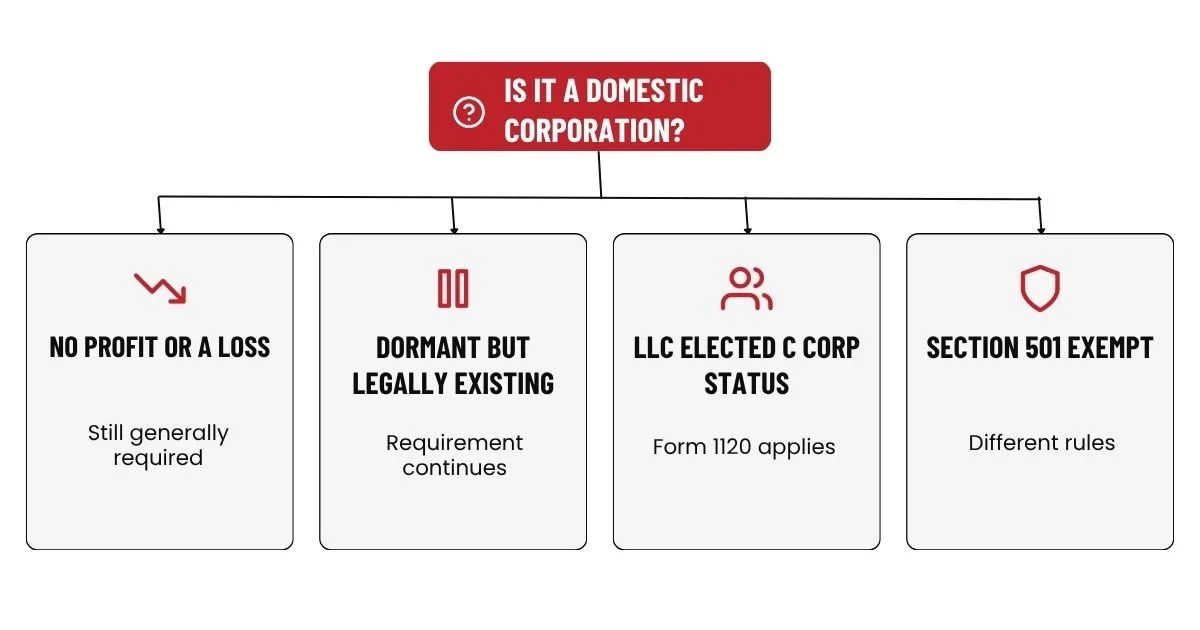
Current IRS instructions state that, unless exempt under Internal Revenue Code Section 501, all domestic corporations generally must file a federal income tax return whether or not they have taxable income.
A domestic C corporation generally files Form 1120 unless it is required or elects to file another specialized corporate return.
An Inactive Corporation May Still Have to File
An owner may tell me:
"The corporation did not make any money."
That does not automatically eliminate the Form 1120 filing requirement.
A corporation can still have a filing obligation when:
There was no profit
The business operated at a loss
There were no dividends
There were few transactions
Business operations temporarily stopped
The corporation was dormant but continued to legally exist
The legal status of the corporation and federal tax classification need to be reviewed.
An LLC Can Also Have a Form 1120 Filing Requirement
An eligible LLC may elect to be treated as a corporation for federal income tax purposes.
When an LLC elects C corporation classification, Form 1120 can become its federal income tax return.
I therefore confirm the IRS entity classification rather than assuming that every entity called an LLC should file Schedule C or a partnership return.
When Is Form 1120 Due?
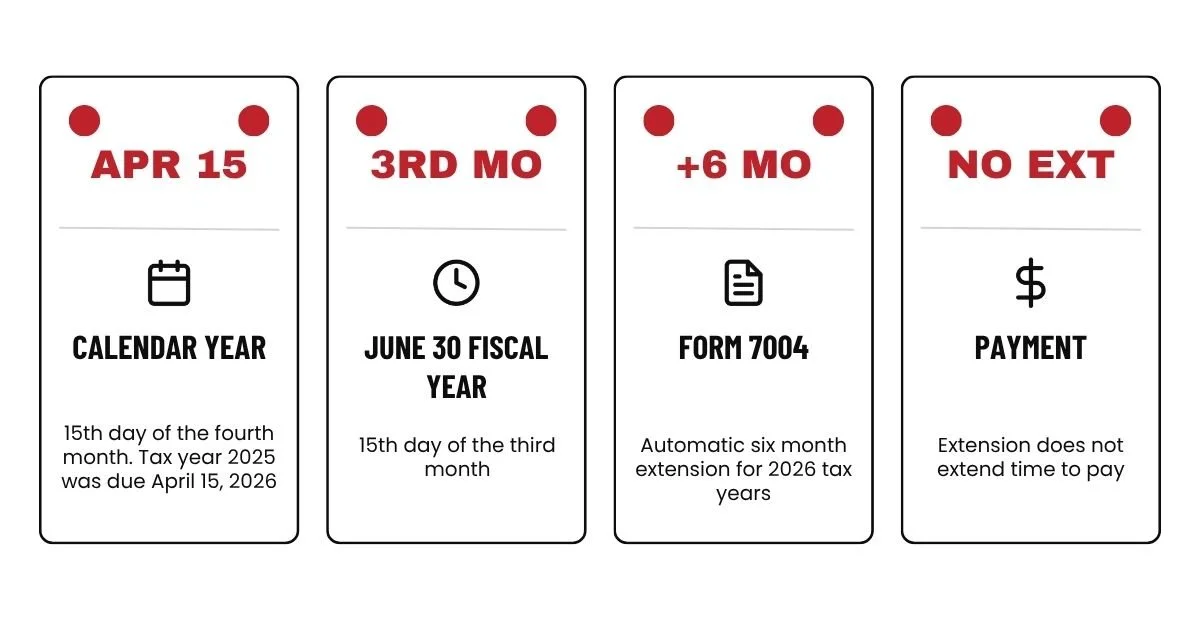
A corporation generally files Form 1120 by the 15th day of the fourth month after the end of its tax year.
For a calendar year C corporation, that generally means April 15.
For example, a calendar year 2025 Form 1120 was generally due April 15, 2026.
Different rules apply to corporations with a fiscal year ending June 30.
Those corporations generally file by the 15th day of the third month following the close of the tax year.
Form 7004 Can Extend the Filing Deadline
Form 7004 is generally used to request an automatic extension of time to file Form 1120.
The normal extension period is generally six months.
A special transition rule continues to apply to certain C corporations with tax years ending June 30 and beginning before January 1, 2026.
For tax years beginning in 2026, the automatic extension period is generally six months.
An Extension to File Does Not Normally Extend the Time to Pay
Extending Form 1120 does not generally give the corporation additional time to pay the tax due.
Tax remaining unpaid after the original payment deadline can continue to generate interest and applicable penalties.
What Happens When the IRS Finds a Missing Form 1120?

The IRS maintains business filing requirement records based on the corporation's EIN and entity information.
If the system expects a Form 1120 and does not receive one, the IRS may begin a business return delinquency process.
The Corporation May Receive CP259
CP259 is an IRS business return delinquency notice.
It tells the business that IRS records show a required return has not been filed for the tax period listed on the notice.
The business can generally respond by:
Filing the required return
Explaining why the return was not required
Correcting an incorrect IRS filing requirement
The notice should be reviewed before responding.
Additional Missing Return Notices May Follow
The IRS can send additional reminders or correspondence when a required return remains missing.
The particular notice controls:
What the IRS believes is missing
Which tax period is involved
Where the response should be sent
The response deadline
If the corporation has already filed the return, I compare the submitted return with the IRS account before sending another copy.
Can the IRS Prepare Form 1120 for the Corporation?

Yes.
Internal Revenue Code Section 6020(b) gives the IRS authority to prepare certain tax returns when a taxpayer fails to file a required return.
IRS Examination procedures also provide for Substitute for Return processing when the IRS determines that a return should have been filed.
The IRS Prepared Return Uses Information Available to the Government
The IRS may develop the corporate tax liability using information available in its records.
That can include information concerning:
Income
Prior returns
Reported transactions
IRS account information
Payments
Other available evidence
The IRS is not preparing the return as the corporation's tax adviser.
Corporate Expenses May Not Automatically Be Included
Current IRS examination guidance states that the IRS has no legal requirement to allow business expense deductions, including cost of goods sold, when preparing a Substitute for Return under Section 6020(b).
However, actual taxpayer information and documentation supporting business expenses may be considered.
That distinction is important.
Waiting for the IRS to prepare the corporate return can produce a tax calculation that does not reflect the complete corporate books.
Filing the Corporation's Own Return Still Matters
If the IRS already established an SFR or proposed corporate tax assessment, the corporation can still need to prepare its own complete delinquent Form 1120.
The appropriate submission procedure depends on whether:
The tax is still proposed
An assessment has already posted
Examination controls the period
Collection controls the account
The corporation has appeal rights
Filing the corporation's return does not automatically guarantee that the IRS will accept every deduction or reduce the assessment.
Filing a Missing Form 1120 Does Not Automatically Stop IRS Collection

This point should be clear before a delinquent return is submitted.
If the IRS has already assessed a corporate tax liability, simply filing another Form 1120 does not automatically stop:
Collection notices
Federal tax lien activity
Levy action
Revenue Officer activity
Other lawful collection procedures
The return filing and collection problem may need to be handled at the same time.
When an IRS assessment has already been made, I review whether a collection hold or another administrative procedure should be requested while the delinquent return is being considered.
Any hold depends on the IRS account and agency procedures.
It should not be assumed.
What Are the Late Filing Penalties for Form 1120 in 2026?

A corporation that files Form 1120 after the filing deadline, including a valid extension when applicable, can face a Failure to File penalty.
The penalty is generally 5 percent of the unpaid tax for each month or part of a month the return remains late.
The general maximum is 25 percent of the unpaid tax.
The 2026 Minimum Late Filing Penalty Is $525
For a Form 1120 required to be filed in 2026 and filed more than 60 days late, the minimum Failure to File penalty is generally the smaller of:
$525
or
The tax due
The penalty may not apply when the corporation establishes reasonable cause under the applicable IRS rules.
Failure to Pay Is a Separate Penalty
A corporation that does not pay tax when due can generally face a Failure to Pay penalty of one half of 1 percent of unpaid tax for each month or part of a month the amount remains unpaid.
The general maximum is 25 percent.
When Failure to File and Failure to Pay penalties apply during the same month, coordination rules can affect the total amount assessed.
Interest Can Continue
Interest generally accrues on unpaid federal corporate income tax.
Interest can also apply to certain penalties.
The IRS interest rate changes quarterly.
New 2026 Automatic Penalty Relief Can Apply to Form 1120

The IRS introduced Automatic Exemption from Penalty, or AEP, during summer 2026.
Form 1120 is specifically included among the eligible return types.
For eligible original returns beginning with tax year 2025, qualifying corporations can receive automatic relief from certain penalties during return processing.
Prior Compliance Matters
For annual returns, AEP generally requires the taxpayer to have timely filed the applicable return and timely paid the tax due for the prior three years.
The original return must also meet the applicable AEP filing timing requirements.
Current IRS guidance generally requires an eligible original return to be filed within three years of its original due date.
AEP Can Apply to Failure to File and Failure to Pay
For an eligible Form 1120, AEP can prevent qualifying Failure to File and Failure to Pay penalties from being assessed.
It does not eliminate:
The underlying corporate income tax
Interest
Estimated tax penalties that are not covered
Every other possible corporate penalty
Reasonable Cause Remains Available
A corporation that does not qualify for AEP may still request penalty relief based on reasonable cause when the facts support it.
Reasonable cause should be evaluated separately for each penalty and tax year.
IRS Business Transcripts Can Help Reconstruct the Filing History
The IRS expanded its Business Tax Account and business transcript tools.
A qualifying designated official of a C corporation can currently access the corporation's Business Tax Account.
Available information can include:
IRS account balances
Payment history
Tax transcripts
Tax compliance reports
IRS notices and letters
Business profile information
Business Tax Account Transcripts
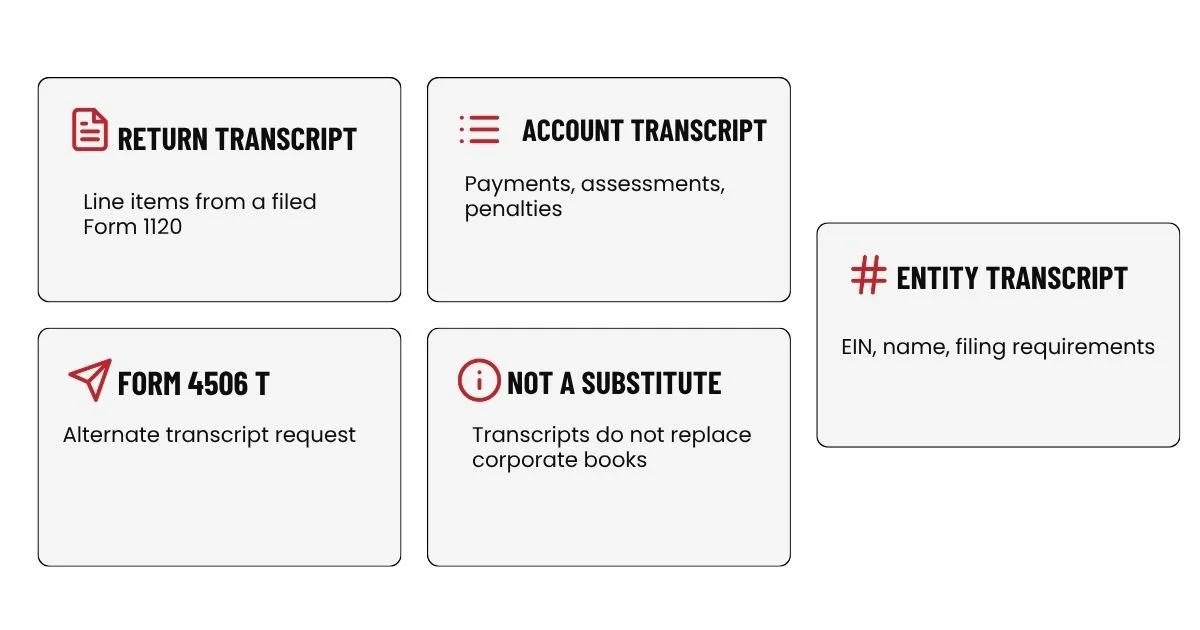
The IRS currently offers several types of business transcripts.
These include:
Form 1120 tax return transcript
Tax account transcript
Record of account transcript
Business entity transcript
An entity transcript can help confirm:
EIN
Business name
IRS filing requirements
Other entity information in IRS records
A Missing Return Will Not Have a Normal Return Transcript
If Form 1120 was never filed, there generally will not be a normal taxpayer filed return transcript for that year.
The account transcript and entity transcript can still help identify:
Whether the IRS expected the return
Payments
Assessments
Penalties
IRS account activity
Filing requirement information
Form 4506 T Can Also Be Used
Business tax transcripts can also be requested using Form 4506 T or through IRS business transcript procedures.
Transcripts are useful research tools.
They do not replace the corporation's accounting records.
What Records Are Needed to Prepare Old Form 1120 Returns?

The corporation's own books and records are usually the foundation of an accurate delinquent return.
Useful records can include:
Prior Forms 1120
EIN records
Articles of Incorporation
Corporate ownership records
Business bank statements
Business credit card statements
Merchant processor statements
Sales records
Customer invoices
Forms 1099 received
Forms 1099 issued
Payroll records
Forms W 2 and W 3
• Forms 941
General ledger
Profit and loss statements
Balance sheets
Accounts receivable
Accounts payable
Inventory records
Cost of goods sold records
Equipment purchases
Depreciation schedules
Vehicle records
Loan statements
Corporate credit card statements
Shareholder loan records
Officer compensation records
Dividend and distribution records
Estimated corporate tax payments
IRS notices
IRS business transcripts
The exact records depend on what the corporation did during each year.
Catch Up Bookkeeping May Be Required Before Filing Form 1120

A C corporation return should be based on corporate books that can be reconciled to the underlying records.
When bookkeeping stopped several years ago, those records may need to be reconstructed first.
Corporate Income Needs to Be Reconciled
The bookkeeping review can involve:
Bank deposits
Sales reports
Merchant processing
Accounts receivable
Customer invoices
Other corporate receipts
Not every deposit is necessarily taxable corporate revenue.
Transfers, loan proceeds, shareholder contributions, refunds, and other transactions should be identified separately.
Corporate Expenses Need Support
Business expenses may need to be reconstructed from:
Bank statements
Credit card statements
Vendor records
Receipts
Invoices
Payroll
Loan records
Asset purchase documents
A bank payment alone does not always establish the business purpose of the transaction.
Shareholder Transactions Should Be Separated
Closely held corporations often have transactions involving their owners.
Those can include:
Shareholder loans
Capital contributions
Distributions
Reimbursements
Officer compensation
Personal expenses paid by the corporation
Those transactions should not simply be classified as ordinary business expenses without review.
Corporate Balance Sheets Matter When Filing Several Years

Form 1120 is not always just a profit and loss return.
Depending on the corporation's size and reporting requirements, balance sheet and book to tax reconciliation schedules may also need to be completed.
The Form 1120 instructions state that Schedule L balance sheets should agree with the corporation's books and records.
Year End Balances Should Connect From One Return to the Next
Balance sheet accounts can include:
Cash
Accounts receivable
Inventory
Investments
Equipment
Accumulated depreciation
Loans
Accounts payable
Shareholder loans
Capital stock
Additional paid in capital
Retained earnings
The ending balance for one year should generally connect logically with the beginning balance of the next.
That is why several unfiled corporate returns are better approached as one coordinated filing project.
Smaller Corporations Can Have Simplified Reporting
Current Form 1120 instructions provide a balance sheet reporting exception for certain corporations with total receipts and total assets below $250,000 when the other requirements are met.
Larger corporations can have additional financial statement reconciliation requirements.
The correct schedules depend on the corporation's actual size and facts.
What If the Corporation Was Inactive or Closed Years Ago?

This is a common issue in corporate nonfiler cases.
An owner may have closed the bank account and stopped doing business but never completed the corporate tax closing process.
Inactivity Does Not Automatically End the Federal Filing Requirement
Current IRS instructions generally require domestic corporations to file Form 1120 whether or not taxable income exists.
If the corporation continued to legally exist, simply having no business activity may not have ended the federal corporate filing obligation.
A Dissolved Corporation Generally Files a Final Form 1120
A corporation that has dissolved generally files Form 1120 by the 15th day of the fourth month after the date of dissolution.
The final return box should be properly identified.
Form 966 Can Also Be Required
When a corporation adopts a resolution or plan to dissolve or liquidate its stock, Form 966, Corporate Dissolution or Liquidation, can be required.
Current IRS instructions generally require Form 966 within 30 days after adoption of the resolution or plan.
State corporate dissolution requirements are separate from the federal Form 1120 and Form 966 requirements.
The corporate records and legal entity status should therefore be reviewed together.
How Many Years of Unfiled Form 1120 Returns May Need to Be Filed?

The IRS delinquent return enforcement policy generally provides that filing enforcement will normally cover six years.
That is an administrative enforcement policy.
It is not an automatic cancellation of every older corporate filing requirement.
The IRS instructs employees to request all nonfraudulent unfiled returns and can enforce more or fewer years depending on the facts and applicable approval procedures.
Older Corporate Returns Can Still Matter
An older Form 1120 can affect later years through items such as:
Net operating losses
Capital losses
Depreciation
Asset basis
Retained earnings
Corporate tax credits
Shareholder transactions
Carryovers
IRS assessments
Previously reported balance sheet amounts
I review the complete corporate history before deciding where the filing project should begin.
Electronic Filing Rules Can Apply to Delinquent Form 1120 Returns

Corporations can generally electronically file Form 1120 and its related forms and schedules.
Current IRS rules require corporations filing 10 or more returns of any type during the calendar year to electronically file Form 1120, subject to applicable exceptions and waiver procedures.
The 10 return count can include:
Income tax returns
Employment tax returns
Excise tax returns
Information returns
The filing method for an older delinquent return should be determined based on the tax year, IRS electronic filing availability, mandatory electronic filing rules, and any specific instructions from the IRS employee handling the account.
Our Process for Filing Unfiled C Corporation Tax Returns

I use a structured year by year process because the corporate books, balance sheets, and tax carryovers can connect several missing returns.
Step 1, Confirm the Corporate Filing Requirement
I review:
Legal entity
EIN
Federal tax classification
Tax year
IRS filing requirement
Whether an S corporation election ever applied
Whether the corporation remains active
Step 2, Identify the Missing Form 1120 Years
I review the IRS business account and available transcripts to determine:
Which returns posted
Which years are missing
Whether the IRS prepared a return
Whether tax assessments already exist
Whether IRS Collection is active
Step 3, Gather and Reconstruct Corporate Records
We organize the available:
Bank records
Accounting files
Income records
Expenses
Payroll
Assets
Loans
Shareholder transactions
Prior returns
When the books are incomplete, catch up bookkeeping may be required.
Step 4, Prepare Corporate Financial Statements
I review or reconstruct the:
Profit and loss statement
Balance sheet
General ledger
Supporting schedules
This helps the returns remain consistent from year to year.
Step 5, Reconcile Payroll and Officer Compensation
When the corporation had employees or officers receiving compensation, payroll reporting should be compared with:
Forms W 2
Forms 941
Payroll registers
Officer compensation
Corporate deductions
Step 6, Prepare Form 1120
Each return is prepared using the forms and tax law applicable to that particular tax year.
Applicable schedules, depreciation, carryovers, credits, and other corporate tax items are included when supported by the records.
Step 7, File Through the Correct IRS Channel
When the IRS has already issued a nonfiler notice, established an SFR, opened an examination, or assigned a Revenue Officer, the return submission procedure may differ from an ordinary current return.
I review who controls the tax period before submitting the return.
Step 8, Confirm IRS Processing
After filing, I review the account to determine:
Whether Form 1120 posted
Whether tax changed
Whether existing SFR assessments were adjusted
Whether payments were applied correctly
What penalties remain
What corporate balance remains due
Step 9, Review Penalty Relief
When applicable, I review:
Automatic Exemption from Penalty
Reasonable cause
Other applicable penalty relief provisions
Penalty relief is evaluated from the actual corporate filing and payment history.
Step 10, Address the Corporate Tax Debt
Once the correct liability is known, the filing problem becomes a collection problem.
At that point, I evaluate the available IRS business tax debt procedures.
Filing Compliance Comes Before Many IRS Business Collection Options
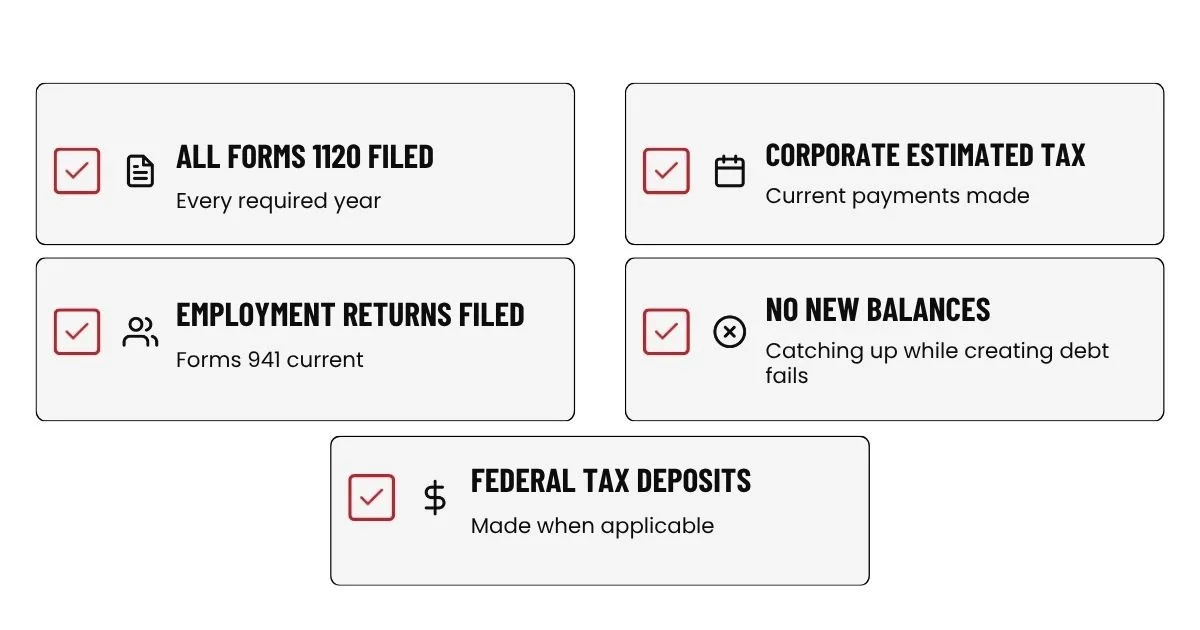
Current IRS collection procedures require business taxpayers to establish filing and current payment compliance before an installment agreement is granted.
For a C corporation, that can mean:
All required Form 1120 returns filed
Required employment tax returns filedCurrent federal tax deposits made when applicable
• Current corporate estimated tax payments made when applicable
A corporation that catches up six old returns but immediately creates a new tax balance may still have a compliance problem.
What If the Filed Form 1120 Returns Create Corporate Tax Debt?

Once the returns are processed, I review the corporate IRS balance separately from the filing project.
Possible procedures can include several options.
Full Payment
If the corporation has sufficient cash or available resources, paying the verified balance can be the most direct resolution.
Before payment, the tax periods, assessments, credits, penalties, and payment history should be confirmed.
IRS Business Payment Plan
Under current 2026 IRS procedures, qualifying business taxpayers with non trust fund liabilities may generally qualify for a Simple Payment Plan when the assessed tax, penalties, interest, and other qualifying assessments total $50,000 or less.
The corporation must satisfy the applicable filing and current payment requirements.
The proposed payments must also full pay the qualifying liability and projected accruals within the applicable IRS collection period.
A corporation outside those simplified criteria may still qualify for another installment agreement after financial review.
Form 433 B Financial Review
Collection Information Statement for Businesses.
The IRS can review:
Cash
Bank accounts
Accounts receivable
Assets
Equipment
Real estate
Loans
Income
Operating expenses
Business cash flow
Other financial resources
The appropriate payment proposal should reflect the corporation's actual financial condition.
Offer in Compromise
A C corporation may potentially submit an Offer in Compromise when the applicable IRS requirements are met.
For a business Offer in Compromise, the IRS uses Form 433 B OIC to review the corporation's financial circumstances.
The corporation generally needs to:
File all required returns
Make required current estimated tax payments
Make current federal tax deposits when applicable
Meet the other Offer in Compromise requirements
The IRS does not accept every corporate offer.
Qualification depends on the liability, assets, income, expenses, ability to pay, and other applicable circumstances.
Penalty Relief
Penalties can be reviewed separately after the correct return and balance are established.
A qualifying corporation may receive AEP, reasonable cause relief, or another applicable form of penalty abatement.
Penalty relief does not automatically remove the underlying corporate tax or interest.
Correcting an Incorrect IRS Assessment
If the IRS balance does not reflect the correct corporate liability, the proper procedure may be to correct the assessment before negotiating how it will be paid.
That can involve:
Filing the delinquent return
Responding to Examination
Providing supporting records
Requesting reconsideration
Filing an amended return
Using an available administrative appeal
The correct procedure depends on how the tax was assessed.
Common Mistakes With Unfiled C Corporation Returns

Reporting Corporate Income on the Owner's Schedule C
A C corporation is generally a separate federal taxpayer.
The corporation's business activity should not simply be placed on the shareholder's Schedule C because Form 1120 is late.
Filing Form 1120 Without Confirming the Tax Classification
If an S corporation election was in effect, Form 1120 may be the wrong return.
Assuming an Inactive Corporation Has No Filing Requirement
Domestic corporations generally continue to have a Form 1120 filing obligation while they legally exist unless another rule applies.
Preparing Several Years Without Reconstructing the Books
Corporate financial statements can carry balances from one year into the next.
The years should be reconciled together.
Ignoring Shareholder Loans and Distributions
Transactions with shareholders can affect both the corporate books and shareholder tax treatment.
Assuming an IRS Prepared Return Is the Final Answer
A Section 6020(b) return can be based on incomplete information.
The corporation's actual books and records should be compared with the IRS assessment.
Assuming Filing Automatically Removes Penalties
Filing the return addresses filing compliance.
Penalty relief requires separate qualification.
Assuming Filing Automatically Creates a Payment Plan
A payment agreement is a separate IRS collection procedure.
The corporation must meet the applicable requirements.
Why Work With Semper Tax Relief for Unfiled C Corporation Returns?

A corporate nonfiler case can involve tax preparation, bookkeeping, IRS Examination, and IRS Collection at the same time.
I review the entire corporate account rather than treating each Form 1120 as an isolated tax return.
That includes:
Corporate filing requirements
IRS business transcripts
Corporate tax classification
Income
Expenses
Balance sheets
Payroll
Assets
Depreciation
Shareholder transactions
Corporate estimated tax
IRS Substitute for Return assessments
IRS notices
Penalties
Corporate tax debt
Current compliance
I am Sergio Melendez, JD, EA.
I have worked in the tax profession since 2005 and represent individuals and businesses before the IRS as an Enrolled Agent.
My Juris Doctor degree is an educational credential.
My authority to represent taxpayers before the IRS comes from my Enrolled Agent credential.
The objective is to determine which returns are required, rebuild supportable corporate records, file accurate Forms 1120, establish the correct federal tax balance, and then evaluate what IRS procedure is supported by the corporation's financial and compliance facts.
Results depend on the corporation's filing history, tax classification, business records, assets, liabilities, shareholders, IRS assessments, current compliance, financial circumstances, and applicable IRS rules.
Frequently Asked Questions About Unfiled C Corporation Tax Returns
-
Generally, yes.
Current IRS instructions state that all domestic corporations generally must file an income tax return whether or not they have taxable income unless an exception applies.
A corporation should not assume that no business activity or no profit automatically eliminates the filing requirement.
-
A corporation can generally face a Failure to File penalty equal to 5 percent of unpaid tax for each month or part of a month the return remains late, up to 25 percent.
For a return required to be filed in 2026 and more than 60 days late, the minimum penalty is generally the smaller of $525 or the tax due.
Penalty relief may apply when the corporation qualifies.
-
Yes.
The IRS can use its authority under Internal Revenue Code Section 6020(b) and its nonfiler procedures to establish a Substitute for Return when a required corporate return remains unfiled.
The IRS is not legally required to allow all business expenses when preparing that return, although actual supporting documentation may be considered.
The corporation may still need to prepare and submit its own accurate delinquent return.
-
IRS business transcripts can help establish filing history, payments, assessments, penalties, and entity information.
A previously filed Form 1120 return transcript can also show many original return items.
However, transcripts do not replace corporate bookkeeping, bank statements, invoices, payroll records, asset information, and other records needed to prepare a complete delinquent return.
-
The corporate filing history should be reviewed through the date the entity was properly dissolved or otherwise ceased its Form 1120 filing requirement.
A dissolved corporation generally needs a final Form 1120.
Form 966 can also be required when a corporate resolution or plan to dissolve or liquidate is adopted.
Simply closing the business bank account does not automatically complete the federal tax closing process.
-
Possibly.
Form 1120 is an eligible return under the IRS Automatic Exemption from Penalty program beginning with qualifying 2025 original returns.
A corporation that does not qualify for AEP may still have reasonable cause or another applicable basis for relief.
Filing a delinquent return alone does not automatically remove penalties.
-
Possibly.
Current IRS rules generally require the corporation to be in filing and current payment compliance.
A qualifying business with non trust fund liabilities of $50,000 or less in assessed tax, penalties, interest, and other qualifying assessments may be considered for a Simple Payment Plan.
Businesses outside those criteria may still qualify for another installment agreement based on the applicable financial review.
-
Yes.
I can review the corporate filing requirements, obtain available IRS account information, reconstruct or coordinate the bookkeeping, prepare the delinquent Forms 1120, address IRS notices and penalties, and evaluate the available business tax debt procedures after the correct returns are processed.
The specific strategy depends on the corporate records, IRS account, financial condition, and tax years involved.
Get a Free C Corporation Tax Filing Case Review
If your corporation has several years of missing Form 1120 returns, start by identifying the filing history and determining what records still exist.
I can review:
Missing Form 1120 years
IRS filing requirements
IRS business transcripts
CP259 and other IRS notices
Section 6020(b) assessments
Business bank records
Corporate bookkeeping
Profit and loss statements
Balance sheets
Payroll records
Officer compensation
Corporate assets
Depreciation
Shareholder loans
Shareholder distributions
Corporate estimated tax payments
Late filing penalties
Automatic Exemption from Penalty
Reasonable cause
Existing IRS collection activity
Resulting corporate tax debt
You do not need to complete several years of bookkeeping before requesting the review.
Bring the IRS notices, prior corporate returns, accounting records, bank statements, payroll reports, and corporate documents currently available.
I can help determine what needs to be filed and what should happen next.