

IRS Notices Help
If you received an IRS notice and you are not sure what it means, I can help you slow the situation down and understand what the IRS is asking for.
Different IRS notices mean different things. Some are balance due notices. Some are collection warnings. Some are levy notices. Some involve proposed changes to a tax return. Others involve refund review, IRS examination, or audit issues.
The most important thing is not to guess. Before you pay, sign, dispute, or ignore the notice, it should be reviewed carefully.
Do I Qualify for the Best Tax Relief? Find out with a Free Case Review
Call or Book Online (24 Hours /7 Days a week)
✔ 100% Confidential ✔No Sales Pressure ✔Personalized Strategy
IRS Notices Help When You Are Not Sure What the IRS Wants
Receiving a letter from the IRS can feel confusing, especially when the notice includes codes, deadlines, balances, penalties, and instructions that are not easy to understand.
The notice may involve a tax debt, a refund hold, a proposed tax change, missing information, a collection deadline, or an IRS examination. The right response depends on the notice number, the tax year, the deadline, and the facts behind the issue.
What an IRS notice may mean
An IRS notice may mean the IRS believes you owe a balance. It may mean the IRS needs more information. It may mean your refund is being reviewed. It may mean the IRS is proposing a change to your return.
It may also mean the IRS is warning you about collection action, such as a levy, tax lien, wage garnishment, or bank levy.
That is why IRS notice help should start with a full review of the letter, not assumptions.
Why the notice number matters
The notice number tells us what type of IRS issue we are dealing with.
A CP14 notice is different from a CP504 notice. A CP2000 notice is different from an examination letter. A CP05 notice is different from LT11 or Letter 1058.
The notice number helps identify whether the issue is a balance due, proposed tax change, refund review, collection warning, levy warning, or audit issue.
Why the deadline matters
Many IRS notices include a deadline. That deadline may affect your ability to respond, appeal, dispute a proposed change, avoid escalation, or protect collection rights.
A missed deadline does not always mean the issue is over, but it can reduce your options. This is especially important with IRS levy notice help, IRS collection notice help, CP2000 responses, and LT11 or Letter 1058 notices.
Why you should not ignore the notice
Ignoring an IRS notice can allow the case to move forward without your side of the story being considered. A balance due notice can turn into collection activity. A proposed change can become an assessed tax. A levy warning can move closer to enforced collection.
Many IRS notices can be reviewed and addressed, but timing matters.
Why you should not automatically agree without review
The IRS can be right, but the IRS can also be missing information.
A notice may include missing payments, duplicate income, wrong cost basis, incorrect withholding, missing documentation, or processing issues. Before you agree, pay, or sign a response form, it is important to understand whether the notice is accurate.

IRS Collection Notices Help
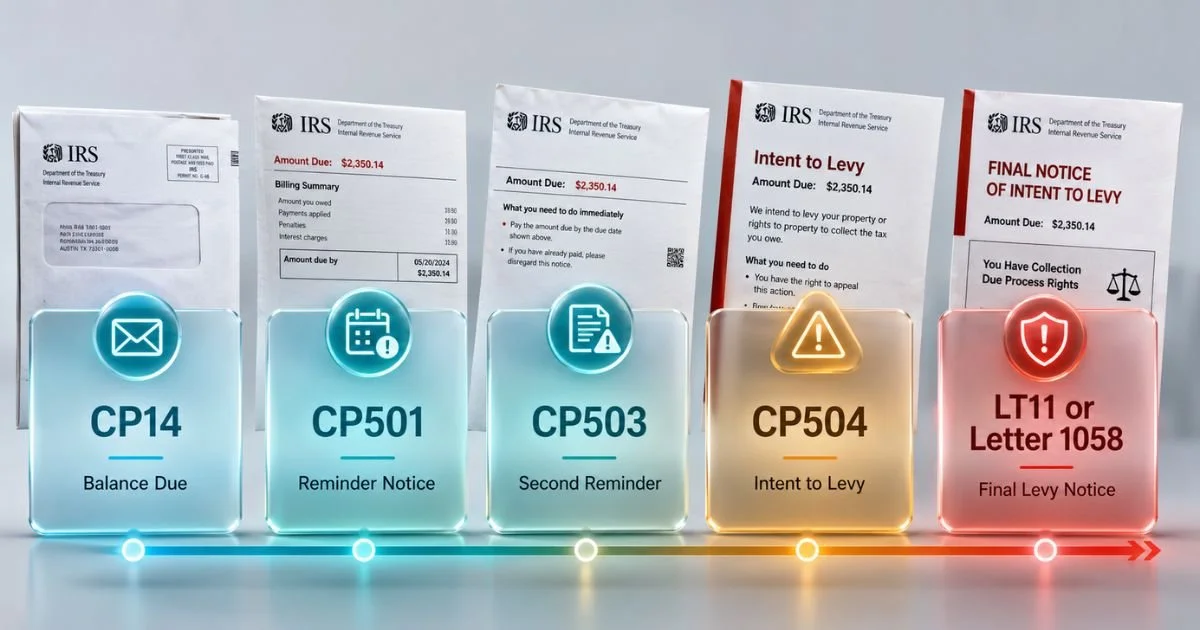
IRS collection notices usually mean the IRS believes a balance is due and wants payment or a response. The notice sequence can become more serious over time, especially if the IRS does not receive payment, a payment plan request, hardship request, appeal request, or other resolution.
Semper Tax Relief provides IRS collection notice help for taxpayers who need to understand the notice, review the balance, and decide what collection resolution option may apply.
CP14, Balance Due Notice
A CP14 notice is often the first notice taxpayers receive when the IRS shows a balance due.
The CP14 usually lists the tax year, amount owed, penalties, interest, and payment deadline. If you received a CP14, the first step is to confirm the tax year, review the balance, and determine whether the IRS amount is correct.
IRS CP14 help may involve checking whether the tax return was processed correctly, whether payments were applied properly, whether penalties can be reviewed, and whether a payment plan or other tax relief option should be considered.
CP501, First Reminder Notice
A CP501 notice usually means the IRS still shows an unpaid balance and is reminding you to respond.
This notice should not be ignored. It is an opportunity to review the balance, correct possible issues, or request a payment arrangement before the matter escalates.
IRS CP501 help may involve reviewing the account, checking payment history, and deciding whether a payment plan, penalty relief request, or other resolution option fits your situation.
CP503, Second Reminder Notice
A CP503 notice commonly appears in the IRS collection notice sequence. It usually means the IRS has not received payment or a proper response.
At this stage, taxpayers should review the notice carefully and start looking at resolution options. Waiting too long can increase the chance of receiving stronger collection letters.
CP504, Notice of Intent to Levy
A CP504 notice is more serious because it warns that the IRS intends to levy certain property or rights to property.
If you received a CP504, you should review the notice quickly. IRS CP504 help may involve checking payment options, payment plan eligibility, hardship options, penalty relief, appeal options, and whether a stronger IRS collection notice may follow.
This is not the time to guess. A CP504 can be a warning sign that the case is moving deeper into collections.
LT11 or Letter 1058, Final Notice of Intent to Levy
LT11 or Letter 1058 is one of the most important IRS collection notices. These letters may include Collection Due Process rights.
If you received LT11 or Letter 1058, the deadline matters. Missing the deadline may reduce your appeal options and make the case harder to control.
IRS LT11 help and IRS Letter 1058 help may involve reviewing the deadline, checking whether a Collection Due Process hearing request is available, reviewing tax resolution options, and identifying the best response before levy action becomes a greater risk.
IRS CP2000 Help
An IRS CP2000 notice can be stressful because it may show a proposed tax increase, penalties, and interest. Many taxpayers think it is a final bill, but that is not always correct.
A CP2000 notice should be reviewed carefully before you agree, disagree, or partially agree.
What a CP2000 notice means
A CP2000 notice is a proposed change notice based on information the IRS received from third parties that does not match the tax return that was filed.
This can happen when the IRS receives information from employers, banks, brokers, payment processors, retirement accounts, cryptocurrency platforms, or other reporting sources.
IRS CP2000 help starts with comparing the IRS proposal to the original tax return and the documents behind it.
Why CP2000 is not the same as a regular tax bill
A CP2000 is not the same as a regular tax bill. The IRS is proposing a change.
You may agree with the proposed change. You may disagree. You may also partially agree if part of the notice is correct and part of it is not.
The response should be based on records, not pressure.
Common CP2000 issues
Common CP2000 issues include missing 1099 income, W2 income, stock sales, retirement distributions, cancellation of debt, self employment income, cryptocurrency reporting, and incorrect cost basis.
One of the most common problems is that the IRS may show gross proceeds from stock sales without the correct basis. That can make the proposed tax look much higher than it should be.
Why taxpayers should review the numbers before signing
Signing too quickly may cause you to agree to tax, penalties, or interest that may not be correct.
Before signing a CP2000 response, you should review the income items, deductions, basis, withholding, credits, and tax calculation. A CP2000 proposed tax change help review can identify whether the IRS proposal is accurate, incomplete, or partly wrong.
How Semper Tax Relief helps with CP2000 notices
At Semper Tax Relief, I review the CP2000 notice, compare it to the filed tax return, review IRS transcripts when appropriate, review supporting documents, and prepare a response strategy.
The response may involve agreeing, disagreeing, partially agreeing, submitting documents, correcting basis information, explaining income reporting, or preparing a written response to the IRS.
IRS Notice CP508C Help
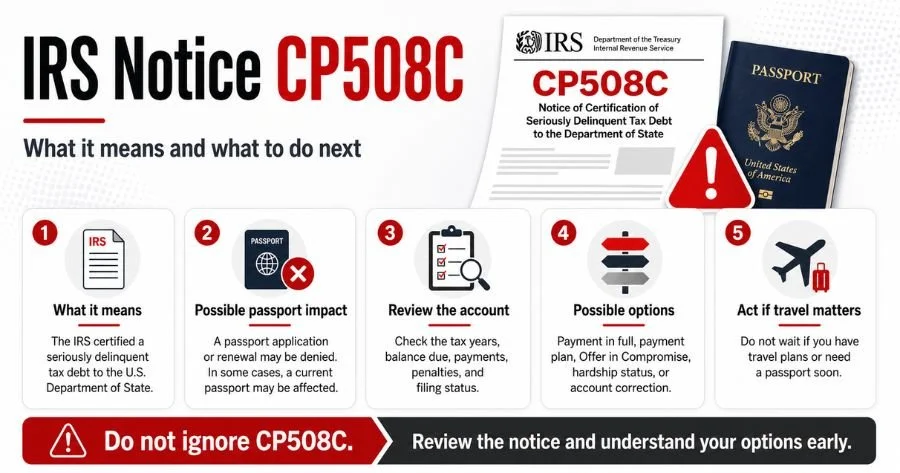
An IRS Notice CP508C means the IRS has certified your seriously delinquent federal tax debt to the U.S. Department of State.
This notice is serious because it can affect your passport. If you are applying for a passport, renewing a passport, or planning international travel, CP508C should be reviewed quickly.
A CP508C notice does not always mean your passport has already been revoked. It means the IRS has sent certification of the tax debt to the State Department. The State Department may deny a passport application, deny a passport renewal, or revoke a current passport in certain cases.
At Semper Tax Relief, I can review the notice, confirm what tax years are involved, check the IRS account history, and help you understand what resolution options may be available.
What IRS Notice CP508C means
IRS Notice CP508C means the IRS believes your federal tax debt meets the rules for seriously delinquent tax debt. The notice may list the tax periods involved, the amount due, and what the IRS says you need to do next.
Why CP508C can affect your passport
When the IRS certifies a seriously delinquent tax debt to the State Department, the State Department generally will not issue a new passport or renew a passport until the tax issue is resolved.
In some cases, the State Department may also revoke or limit a current passport. If you are outside the United States, you may be issued a limited passport that allows you to return directly to the United States.
This is why CP508C should not be ignored, especially if you travel internationally for work, family, business, or personal reasons.
Why you should review the tax debt before responding
Before taking action, the tax debt should be reviewed carefully.
The IRS balance may include tax, penalties, and interest. The issue may involve more than one tax year. It may also involve old balances, missing payments, unfiled returns, Trust Fund Recovery Penalties, or business taxes for which the IRS says you are personally responsible.
A review may help confirm whether the balance is correct, whether all payments were applied, whether returns are filed, and whether the certification may be disputed.
Tax relief options that may help with CP508C
Depending on your facts, possible options may include paying the balance in full, setting up an IRS payment plan, submitting an Offer in Compromise, requesting Currently Non Collectible status due to hardship, requesting innocent spouse relief, or addressing a pending Collection Due Process issue.
Not every option applies to every taxpayer. The right approach depends on the tax years, the balance, your income, expenses, assets, filing compliance, travel needs, and IRS account status.
What to do if you have travel plans
If you have international travel plans, a pending passport application, or an urgent passport renewal issue, CP508C should be reviewed as soon as possible.
The IRS may need time to reverse the certification after the tax issue is resolved. The State Department may also have its own processing time. Waiting until the last minute can create travel problems that are harder to fix.
How Semper Tax Relief helps with IRS Notice CP508C
At Semper Tax Relief, I can help review the CP508C notice, check the IRS account history, identify the tax years involved, confirm whether missing returns are part of the problem, and explain possible resolution options.
If a payment plan, hardship request, Offer in Compromise, penalty review, or account correction is appropriate, I can help prepare the next step.
The goal is to understand the notice, protect your rights, and work toward resolving the tax issue before it creates a larger passport or collection problem.
IRS CP05 Help
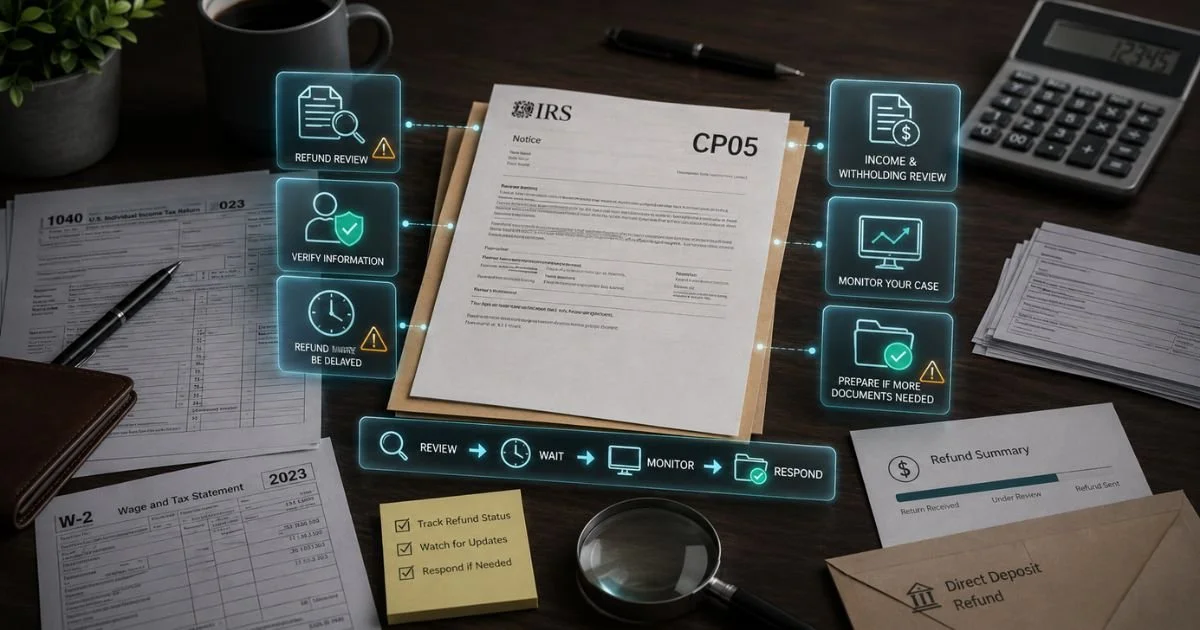
A CP05 notice usually means the IRS is holding or reviewing a refund while it verifies items on the return.
This can be frustrating because the taxpayer may be expecting a refund and instead receives a notice saying the IRS needs more time.
What a CP05 notice means
A CP05 notice usually means the IRS is reviewing information on the tax return before releasing the refund.
The notice may involve income, withholding, credits, or other return items. IRS CP05 help can help you understand what the IRS is reviewing and whether action is needed now.
Why a refund may be delayed
A refund may be delayed because the IRS is reviewing wages, withholding, credits, business income, or other items reported on the return.
Sometimes the IRS is comparing the tax return to information reported by employers, banks, or other third parties. Sometimes the IRS needs more time to confirm whether the return is accurate.
Why CP05 does not always mean an audit
A CP05 notice does not always mean you are being audited. It may be a review or verification notice.
However, it should still be monitored. If the IRS later requests documents or sends an examination letter, the issue may require a more detailed response.
When CP05 becomes more serious
A CP05 notice becomes more serious if the IRS requests documents, delays the refund for a long time, freezes the refund, sends an examination letter, or questions specific income, credits, or deductions.
At that point, the response should be organized and focused on what the IRS is asking for.
How Semper Tax Relief helps with CP05 notices
Semper Tax Relief can review the CP05 notice, compare the return to available documents, check IRS transcripts when appropriate, and prepare for the next step if the IRS requests more information.
The goal is to understand the issue early and avoid sending the wrong information to the IRS.
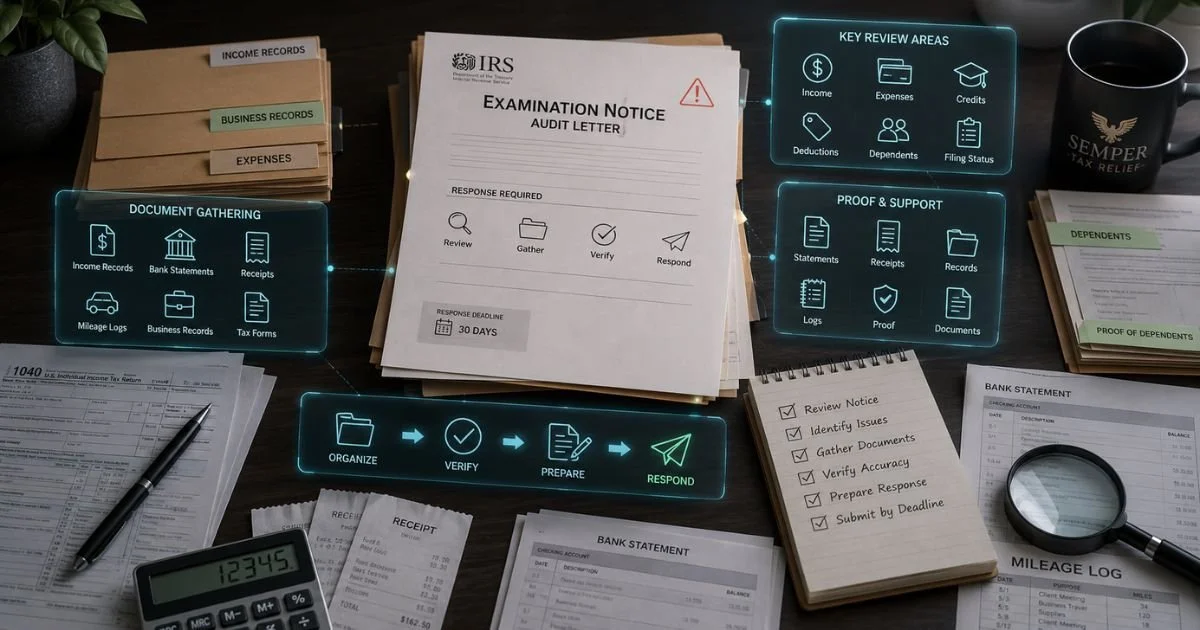
IRS Examination and Audit Letter Help
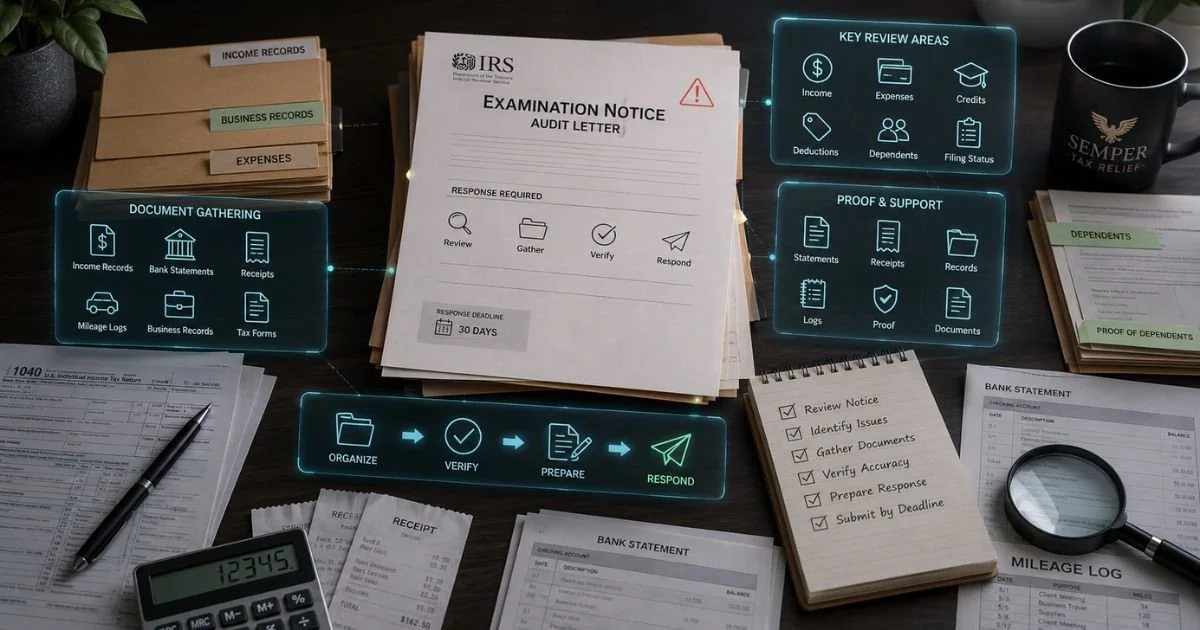
An IRS examination letter or audit letter means the IRS is reviewing part or all of a tax return. The review may be limited to one issue, or it may involve multiple items.
IRS examination notice help should be handled with care because the response can affect the final tax, penalties, interest, and future collection activity.
What an IRS examination letter means
An IRS examination letter means the IRS is reviewing information reported on a tax return.
The IRS may ask for documents, explanations, proof of eligibility, income records, expense records, or other support. The letter should be read carefully so the response matches what the IRS requested.
Common items the IRS may examine
Common items the IRS may examine include business expenses, Schedule C income, dependents, filing status, Earned Income Credit, Child Tax Credit, education credits, charitable deductions, rental losses, stock basis, and unreported income.
IRS audit letter help may involve identifying the exact issue, gathering records, and preparing a clear response.
Why audit letters should be handled carefully
Audit letters should be handled carefully because the IRS is asking for proof.
The response should be organized, accurate, and focused on the items under review. Sending too much information, too little information, or unrelated documents can create confusion.
Documents the IRS may request
The IRS may request income records, receipts, bank records, mileage logs, proof of dependents, business records, basis documents, and tax forms.
The right documents depend on the issue. A business expense audit is different from a dependent audit. A stock basis issue is different from an Earned Income Credit review.
How Semper Tax Relief helps with IRS examination notices
At Semper Tax Relief, I review the examination letter, identify what the IRS is asking for, organize the documents, prepare the response, and help protect the taxpayer from unnecessary confusion.
The goal is to respond clearly and accurately based on the issue under review.
How Semper Tax Relief Reviews an IRS Notice
A good IRS notice review starts with the facts. Before deciding what to do, I look at the full notice, the tax year, the issue, the deadline, and the taxpayer’s overall IRS account situation.
Step 1: Review the full notice
The full notice should be reviewed, including all pages, deadlines, response instructions, payment information, and appeal information.
Many taxpayers only look at the first page. Important details may be on later pages.
Step 2: Identify the tax year and issue
The tax year matters because one taxpayer may have multiple years with different issues.
For example, one year may involve a balance due, another year may involve a CP2000 proposed change, and another year may involve a refund hold. Each year may require a different response.
Step 3: Review IRS transcripts when needed
IRS transcripts can help confirm balances, payments, penalties, return filing status, assessment dates, and collection history.
Transcript review can also help identify whether the notice matches the IRS account history.
Step 4: Check filing compliance
Missing tax returns can affect payment plans, relief options, and collection risk.
Before requesting certain tax relief options, it may be necessary to review whether all required returns are filed or whether a missing return is blocking resolution.
Step 5: Build the response strategy
The right response may be payment, a payment plan, hardship request, penalty relief, CP2000 dispute, audit response, appeal request, or tax resolution submission.
The strategy depends on the notice, the deadline, the taxpayer’s financial position, and the IRS account history.

IRS Notices Semper Tax Relief Can Help Review
Semper Tax Relief can help review many types of IRS notices and letters, including

What to Do If You Received an IRS Notice
If you received an IRS notice, the best first step is to understand what the notice means before taking action.
Do not panic
Many IRS notices can be reviewed and addressed. The notice may be serious, but panic usually leads to poor decisions.
The better approach is to identify the notice number, the tax year, the deadline, and the issue.
Do not ignore the deadline
Deadlines can affect appeal rights, response rights, and collection risk.
This is especially important with CP504, LT11, Letter 1058, CP2000, and IRS examination letters.
Do not assume the IRS is correct
IRS notices can be wrong or incomplete.
The issue may involve missing payments, incorrect income matching, duplicate income, wrong basis information, return processing issues, or incorrect penalty calculations.
Do not send random documents
The IRS response should match what the IRS is asking for.
Sending random documents can slow the case down or create more confusion. The better approach is to prepare a focused response based on the notice.
Request a free case review
If you received an IRS notice and do not know what to do next, Semper Tax Relief can review the notice and help you understand your options.
Request a free case review today. I will help you identify what the IRS is asking for, what deadline matters, and what response may make sense for your situation.

IRS Notice Help For Tax Debt and Collection Problems
If your IRS notice involves tax debt, the next step may be reviewing collection relief options.
Depending on your facts, possible IRS or state tax relief options may include an IRS payment plan, Offer in Compromise, Currently Non Collectible status, penalty relief, a levy release request, or an appeal.
Not every taxpayer qualifies for every option. The correct option depends on income, expenses, assets, filing compliance, tax year, collection status, and the type of notice received.

Frequently Asked Questions About IRS Notices
-
If you received an IRS notice, read every page, identify the notice number, check the tax year, review the deadline, and do not assume the IRS is correct without review.
If you are unsure what the notice means, request IRS letter help before sending payment, signing a response, or mailing documents.
-
A CP14 notice is usually the first balance due notice. It may not be the most serious IRS notice, but it should still be reviewed.
The CP14 may show the tax year, balance, penalties, interest, and payment deadline. If the balance is correct, you may need to review payment options. If the balance looks wrong, the account should be checked before you pay.
-
CP501, CP502, and CP503 are generally balance due reminder notices. They usually mean the IRS still shows an unpaid balance and has not received payment or a proper response.
CP504 is more serious because it warns of intent to levy certain property or rights to property. If you received CP504, review the notice quickly and consider payment options, hardship options, and appeal options.
-
LT11 or Letter 1058 may include Collection Due Process rights. This deadline is important because it may affect your ability to request a hearing and protect certain appeal options.
If you received LT11 or Letter 1058, do not wait until the deadline is close. The notice should be reviewed as soon as possible.
-
A CP2000 is not the same as a regular audit. It is a proposed change notice based on information the IRS received from third parties that does not match the filed tax return.
You may agree, disagree, or partially agree. Before responding, review the proposed change, the tax return, and the supporting documents.
-
A CP05 notice does not always mean you are being audited. It often means the IRS is holding or reviewing a refund while it verifies return information.
However, it should still be monitored. If the IRS later asks for documents or sends an examination letter, the issue may become more serious.
-
Yes. Semper Tax Relief can review the IRS examination letter, identify what the IRS is asking for, help organize documents, and prepare a focused response.
The response should be accurate, complete, and limited to the issue under review.
-
Yes. An IRS notice can be wrong or incomplete.
Common issues include missing payments, duplicate income, incorrect income matching, wrong cost basis, incorrect withholding, processing errors, and penalty issues. That is why the notice should be reviewed before you agree or pay.
-
In many cases, a payment plan may be an option after receiving an IRS notice. Eligibility depends on the balance, filing compliance, financial situation, and collection status.
For some taxpayers, other options may also need to be reviewed, such as Currently Non Collectible status, Offer in Compromise, penalty relief, or levy release.
-
You should consider getting tax professional help with IRS notices if you do not understand the notice, disagree with the IRS, received CP504, LT11, Letter 1058, CP2000, CP05, an examination letter, an audit letter, or any notice with a deadline.
You should also get help if the notice involves a large balance, levy risk, wage garnishment, bank levy, tax lien, refund hold, proposed tax change, or missing tax return.