

IRS Business Audit Reconsideration Help
Our IRS Tax Power of Attorney Representatives in Orange County eliminate tax problems so that you can live your best life!
Specializing in Stopping & Settling Tax Problems
Do I Qualify for the Best Tax Relief? Find out with a Free Case Review
Call or Book Online (24 Hours /7 Days a week)
✔ 100% Confidential ✔No Sales Pressure ✔Personalized Strategy
If you are self employed and owe the IRS, resolving the problem usually requires more than choosing a monthly payment.
You may need to address unfiled tax returns, reconstruct business income and expenses, correct estimated tax payments, respond to collection notices, and document both your household finances and business activity.
Semper Tax Relief helps independent contractors, sole proprietors, consultants, gig workers, real estate professionals, service providers, and other self employed taxpayers understand their IRS accounts and evaluate the resolution options supported by their circumstances.
I am Sergio Melendez, JD EA. I have worked in the tax profession since 2005 and regularly represent self employed taxpayers dealing with unfiled returns, Schedule C tax debt, estimated tax problems, IRS liens, bank levies, Revenue Officers, and collection financial reviews.
The first step is to determine what you owe, why you owe it, which returns remain unfiled, whether the IRS filed a Substitute for Return, and what you can realistically afford after necessary personal and business expenses.
Tax relief does not mean that every self employed taxpayer qualifies for a settlement or reduction. The available options depend on your filing compliance, current estimated payments, income, expenses, assets, equity, collection status, and ability to pay.
If the IRS audited your business, assessed additional tax, and did not consider important records, you may be able to request audit reconsideration.
Audit reconsideration is an administrative process through which the IRS reevaluates the results of a prior examination. It may be available when the assessed liability remains unpaid, a credit was reversed, the IRS made a processing or computational error, or the taxpayer presents relevant information the IRS did not previously consider.
Business audit reconsideration may involve:
• A Schedule C sole proprietorship
• A corporation
• An S corporation
• An LLC
• Certain employment tax assessments
• Certain business credits
• A business related assessment reported on an individual return
• An IRS prepared return involving business income
The correct procedure depends on the entity, tax form, tax period, type of assessment, prior agreements, payment history, and whether a court has already entered a final decision.
I am Sergio Melendez, JD EA. I have worked in the tax profession since 2005 and represent individuals and businesses before the IRS in audit, reconsideration, collection, unfiled return, and tax debt matters.
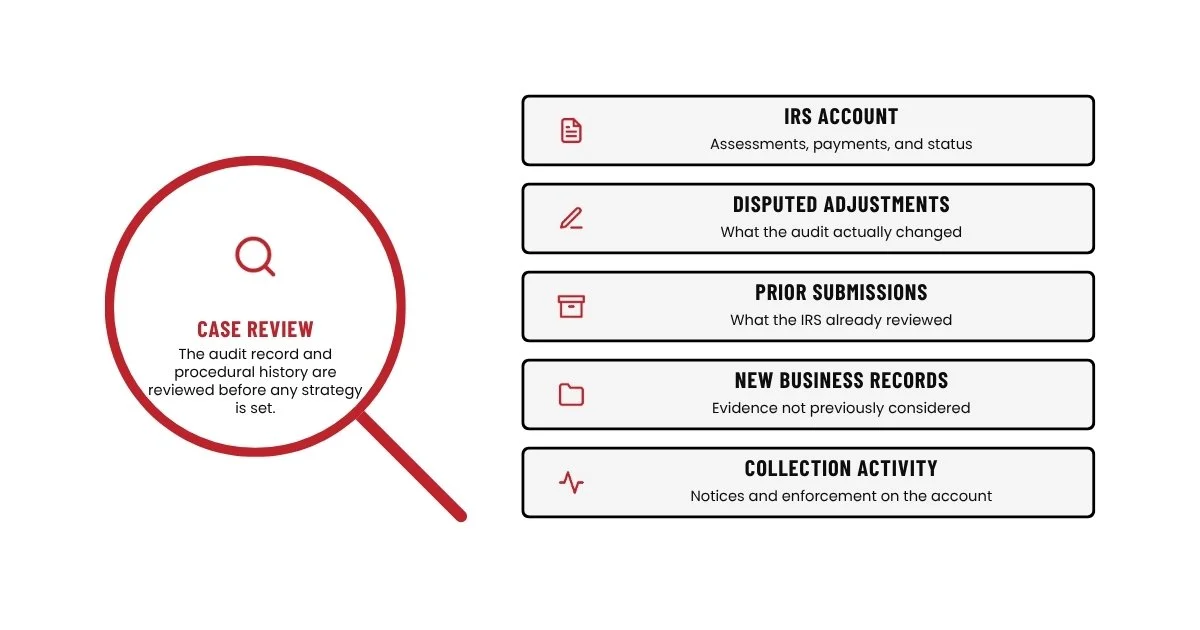
Semper Tax Relief can review the audit report, IRS account, disputed adjustments, previously submitted records, and new supporting information to help determine whether reconsideration or another procedure may be available.
Audit reconsideration does not guarantee that the IRS will reopen the examination, reduce the assessment, remove penalties, or suspend collection.
What Is IRS Business Audit Reconsideration?
IRS audit reconsideration allows a taxpayer to ask the IRS to reevaluate an audit assessment after the original examination has closed.
It is not a new audit requested simply because the taxpayer disagrees with the result.
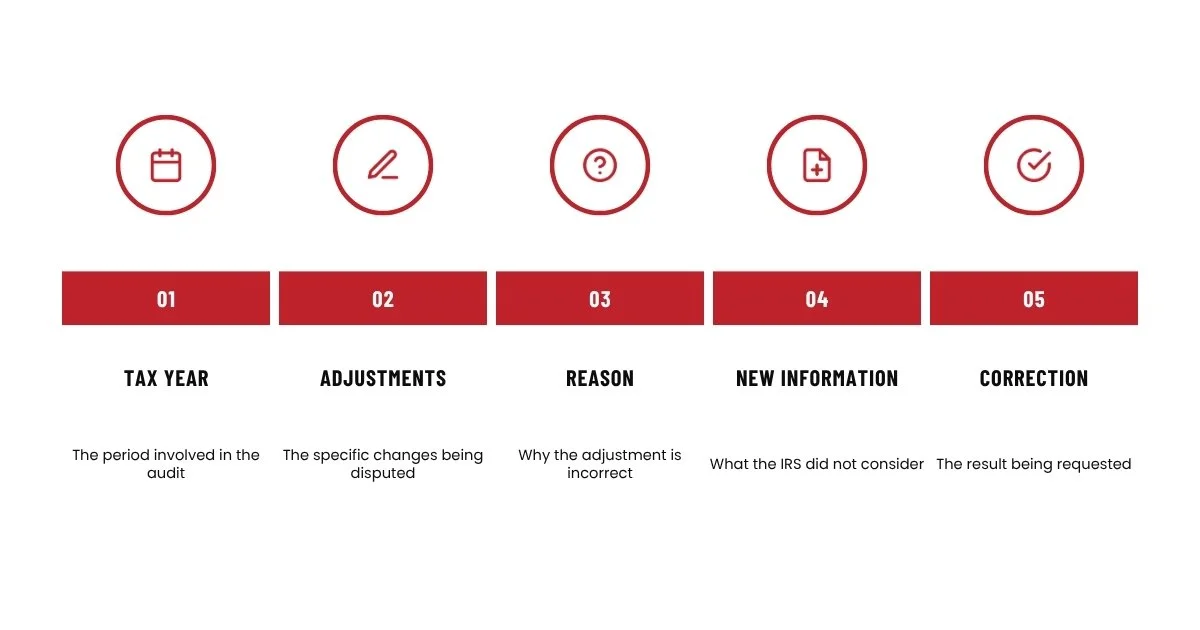
The request should identify:
• The tax year or period involved
• The specific audit adjustments being disputed
• Why the adjustment is believed to be incorrect
• What information the IRS did not previously consider
• Which documents support the taxpayer’s position
• What correction the taxpayer is requesting
The IRS generally focuses on new or previously unconsidered information. Sending the same documents and explanation reviewed during the original examination may not provide a basis for reconsideration.
When Business Audit Reconsideration May Be Available
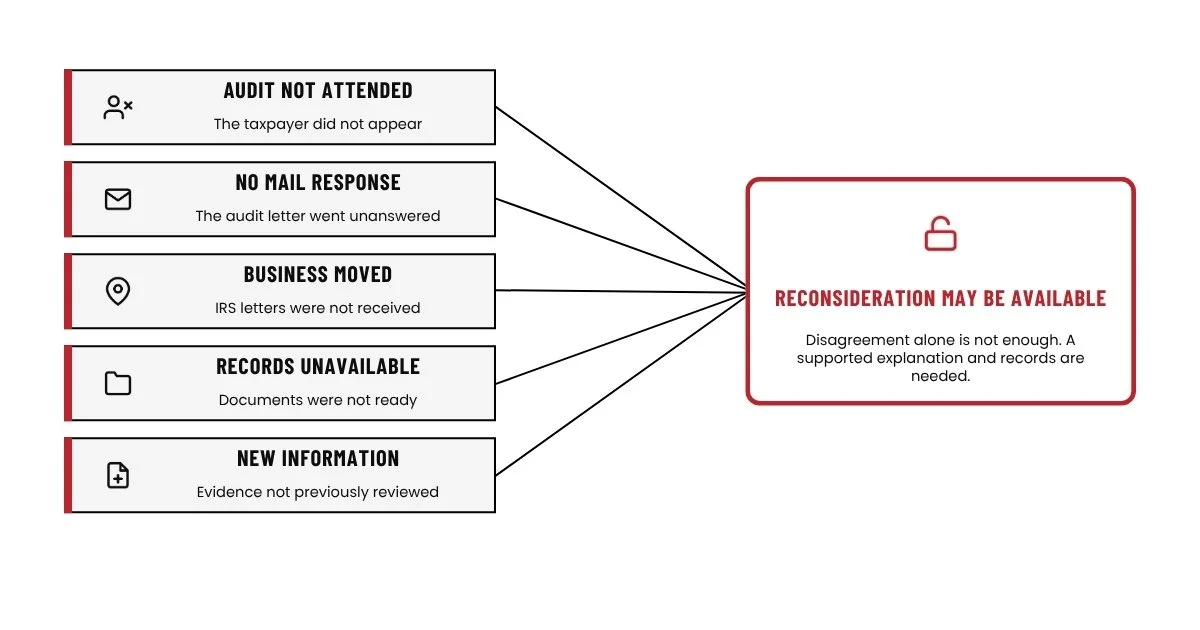
A business or business owner may consider audit reconsideration when:
• The taxpayer did not attend the original audit
• The taxpayer did not respond to an audit by mail
• The business moved and did not receive IRS correspondence
• Records were unavailable during the original examination
• The taxpayer now has information the examiner did not consider
• Business deductions were disallowed because documents were not submitted
• The IRS made a computational or processing error
• The IRS prepared a return because a required return was not filed
• A credit was reversed during examination
• The taxpayer disagrees with an unpaid audit assessment
Disagreement alone may not be enough. The reconsideration request should be supported by a legal and factual explanation and relevant documentation.
Business Assessments That May Require Reconsideration
Different entities and tax types require different procedures.
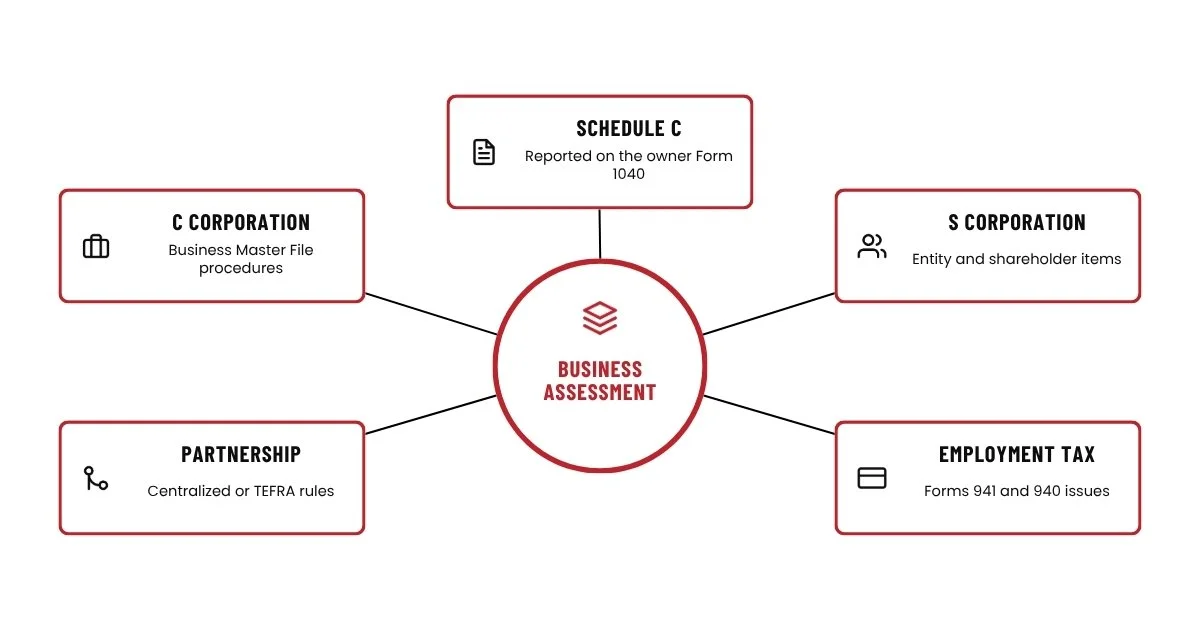
Schedule C Audit Assessments
A Schedule C business is generally reported on the owner’s individual Form 1040.
An audit may adjust:
• Gross receipts
• Cost of goods sold
• Contract labor
• Vehicle expenses
• Travel expenses
• Advertising
• Insurance
• Rent
• Equipment
• Depreciation
• Home office expenses
• Other business deductions
If expenses were disallowed because records were not provided or considered, audit reconsideration may allow the taxpayer to submit additional documentation.
The taxpayer must establish that the expense qualifies under the tax law and that the amount is adequately substantiated.
Corporate Audit Assessments
A C corporation may receive an audit assessment involving income, deductions, losses, credits, compensation, shareholder transactions, depreciation, or other corporate tax issues.
A business audit reconsideration request may be reviewed through Business Master File procedures.
The correct filing and adjustment process depends on the tax form, assessment, audit history, and whether the liability remains unpaid.
S Corporation Audit Issues
An S corporation audit can affect both the entity and its shareholders.
The IRS may adjust:
• Business income
• Shareholder compensation
• Distributions
• Basis
• Loss limitations
• Deductions
• Credits
• Items passed through to shareholders
Correcting an S corporation assessment may also require review of affected shareholder returns. An entity level change does not always adjust every shareholder account automatically.
Partnership Audit Assessments
Partnership audit and adjustment procedures can be especially technical.
Some partnership assessments are governed by centralized partnership audit rules or older TEFRA procedures. These rules can determine who may challenge the adjustment, when it may be challenged, and whether audit reconsideration is available.
A partnership should not assume that the ordinary reconsideration process applies. The partnership agreement, audit year, notices, designated representative, and assessment procedure should be reviewed.
Employment Tax Audit Assessments
An employment tax examination may involve:
• Worker classification
• Wages
• Fringe benefits
• Officer compensation
• Employment tax deposits
• Forms 941 or 940
• Backup withholding
• Employee Retention Credit adjustments
• Other payroll reporting issues
The IRS has procedures for certain Business Master File and Employment Tax Non Filer reconsideration cases.
The correct response depends on whether the assessment resulted from an examination, nonfiler process, mathematical adjustment, credit disallowance, or another procedure.
Common Reasons Business Expenses Are Disallowed
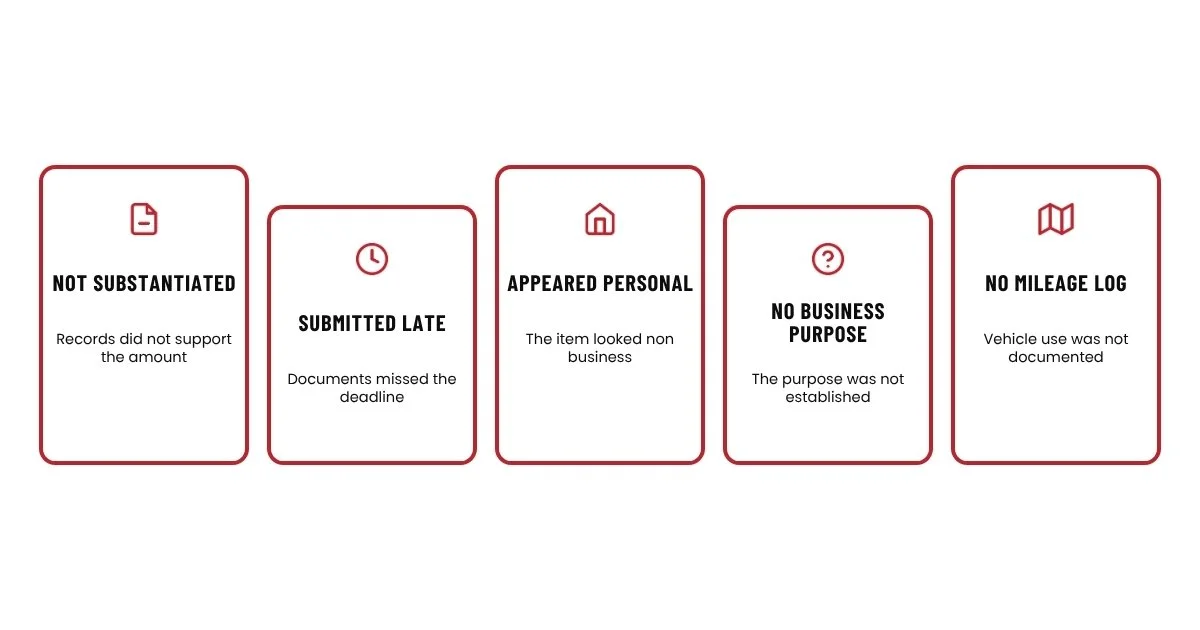
A business expense may be disallowed when the IRS concludes that:
• The expense was not substantiated
• The documents were not provided by the deadline
• The expense appeared personal
• The business purpose was not established
• The amount did not match the return
• The receipt did not identify the expense
• A mileage log was missing
• The taxpayer did not prove payment
• Depreciation records were incomplete
• The deduction belonged to another year
• The entity did not incur the expense
• The taxpayer did not participate in the audit
Audit reconsideration may provide another opportunity to present records, but it does not change the taxpayer’s burden to support the claimed treatment.
Documents That May Support Business Audit Reconsideration
The records needed depend on the disputed audit adjustment.
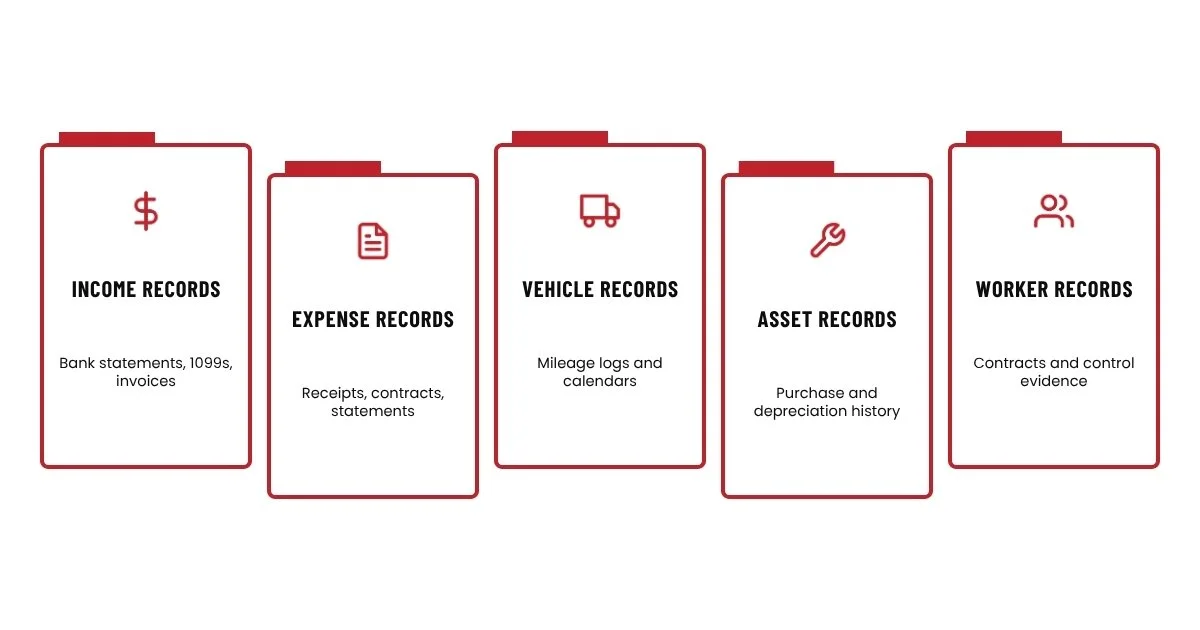
Income Records
Income documentation may include:
• Bank statements
• Payment processor reports
• Forms 1099
• Customer invoices
• Sales reports
• Deposit records
• Loan documents
• Records of owner contributions
• Proof of transfers between accounts
The taxpayer may need to explain why certain deposits were not taxable business receipts.
Business Expense Records
Expense documentation may include:
• Receipts
• Invoices
• Canceled checks
• Bank statements
• Credit card statements
• Vendor statements
• Contracts
• Insurance records
• Payroll reports
• Lease agreements
• Business licenses
A bank or credit card statement can show that a payment occurred, but additional evidence may be required to establish the business purpose.
Vehicle and Mileage Records
Records may include:
• Contemporaneous mileage logs
• Appointment calendars
• Service records
• Vehicle purchase documents
• Business destination information
• Proof of total annual mileage
Reconstructed mileage records may be considered when supported by reliable underlying information, but acceptance is not guaranteed.
Asset and Depreciation Records
Documentation may include:
• Purchase contracts
• Closing statements
• Equipment invoices
• Prior depreciation schedules
• Proof of placed in service dates
• Improvement records
• Disposition records
• Business use information
Worker Classification Records
A worker classification dispute may require:
• Written contracts
• Payment records
• Work instructions
• Evidence of financial control
• Evidence of behavioral control
• Information about the relationship between the parties
• Prior federal reporting
• Facts supporting possible Section 530 relief
A written independent contractor agreement is relevant but does not determine worker status by itself.
When Audit Reconsideration May Not Be Available
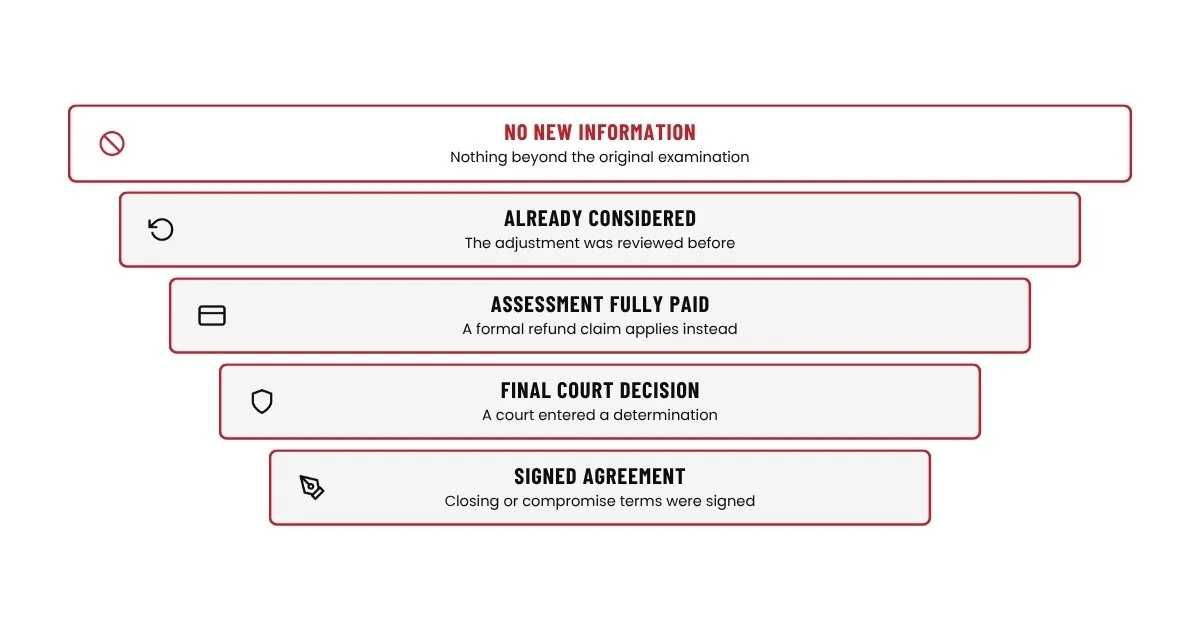
The IRS may decline audit reconsideration when:
• The taxpayer provides no new information
• The disputed adjustment was previously considered
• The taxpayer fully paid the assessment and must use a formal refund claim procedure
• A court entered a final determination
• The taxpayer signed certain closing agreements
• The taxpayer entered into certain compromise agreements
• The taxpayer signed Form 870 AD with IRS Appeals
• Special partnership audit rules control the assessment
• The issue is outside the reconsideration process
This does not always mean the assessment can never be challenged. Another procedure may be available, but its requirements and deadlines must be reviewed separately.
Audit Reconsideration Versus an Amended Return
Audit reconsideration and an amended return are not the same procedure.

Audit Reconsideration
Audit reconsideration is generally used to request reevaluation of an unpaid assessment resulting from a completed audit or an IRS prepared return.
The taxpayer identifies disputed audit changes and submits new or previously unconsidered information.
Amended Business Return
An amended return generally corrects information reported on a taxpayer filed return.
The applicable form depends on the entity and tax involved. For example, an individual may use Form 1040 X, while corporations, partnerships, and employment tax filers use the applicable amended return or adjustment procedure.
Filing an amended return does not guarantee that the IRS will accept the changes. The IRS may examine the amended return or request documentation.
Formal Refund Claim
When the disputed assessment has been fully paid, the taxpayer may need to file a formal claim for credit or refund using the form applicable to the entity and tax.
Refund claims are subject to strict filing periods and amount limitations.
If the IRS disallows a refund claim, separate administrative appeal or court procedures may be available.
The correct procedure should be determined before filing because using the wrong form can delay review and may not preserve a deadline.
Does Audit Reconsideration Stop IRS Collection?
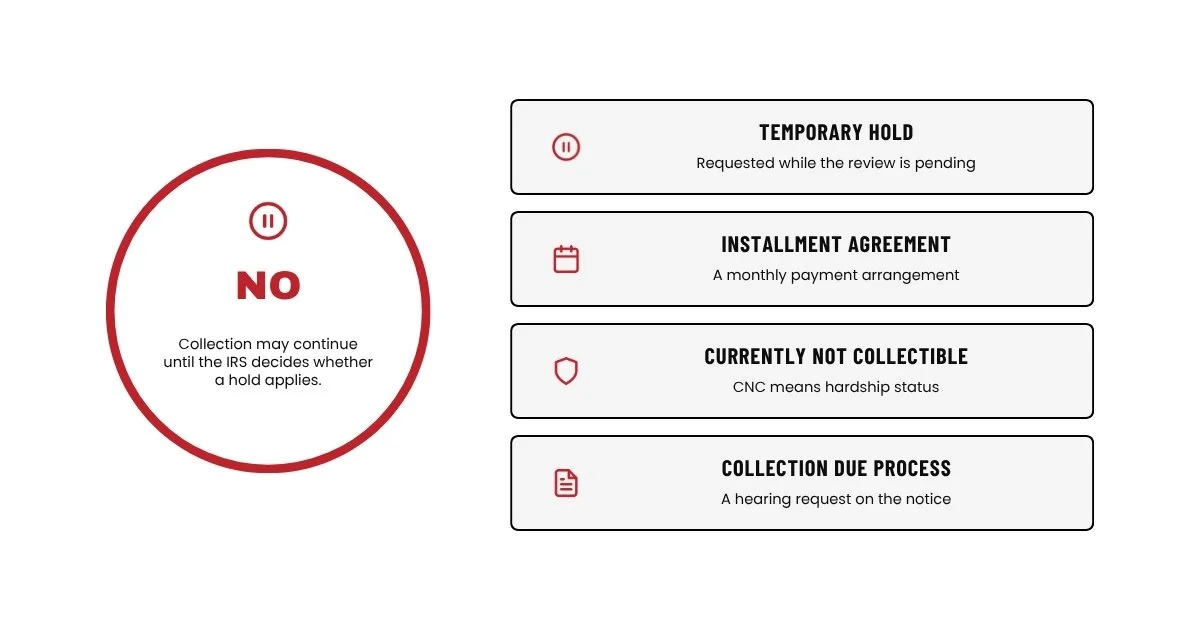
No. Preparing or sending an audit reconsideration request does not automatically suspend IRS collection.
IRS procedures indicate that collection may continue until the IRS receives sufficient documentation and determines whether a collection hold is appropriate.
If the business or owner has received collection notices, a separate response may be necessary.
Depending on the case, that response could involve:
• Requesting a temporary collection hold
• Proposing an installment agreement
• Requesting Currently Not Collectible status
• Filing a Collection Due Process hearing request
• Requesting a Collection Appeals Program review
• Addressing a lien or levy
• Requesting another collection alternative
A collection arrangement does not correct an inaccurate assessment. Audit reconsideration does not automatically provide a payment solution for any balance that remains.
The liability dispute and collection problem may need to be addressed at the same time.
What Happens After the IRS Receives the Request?
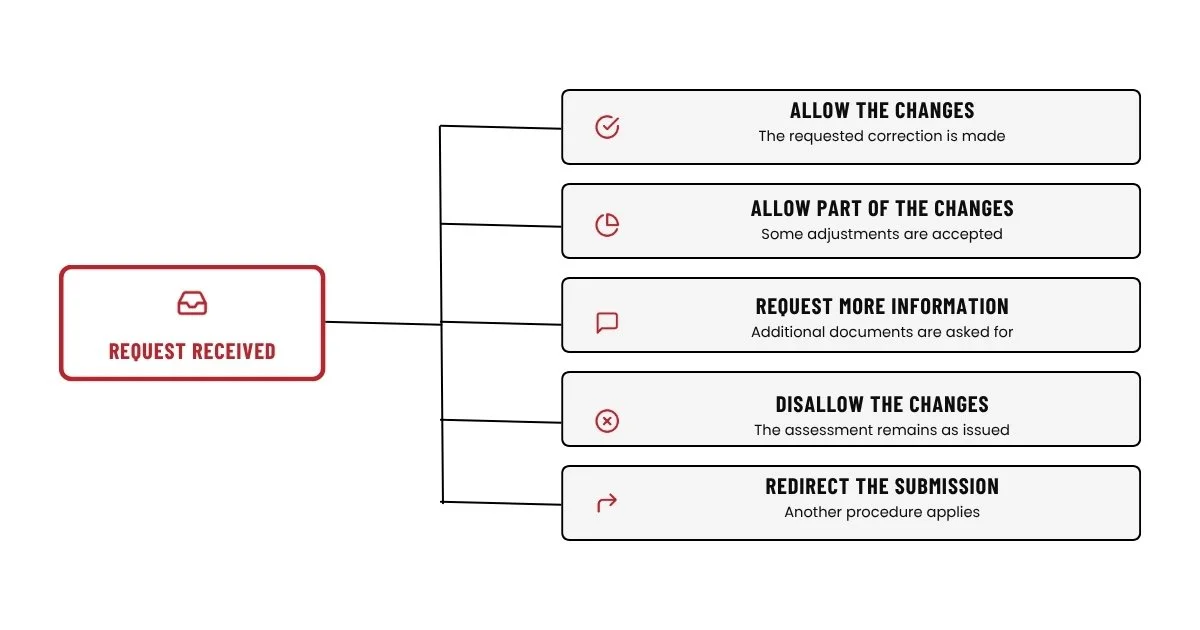
The IRS may:
• Accept the request for reconsideration
• Ask for additional information
• Allow the requested changes
• Allow part of the requested changes
• Disallow the requested changes
• Determine that another procedure applies
• Return or redirect the submission
The time required depends on the type of tax, business entity, original examination function, amount of documentation, IRS workload, and whether the case requires classification or assignment to an examiner.
The IRS may send a revised examination report or another letter explaining its conclusion.
If the taxpayer agrees with the result, any remaining balance must still be paid or addressed through a collection alternative.
If the taxpayer disagrees, the next step may involve an IRS Appeals conference, payment followed by a refund claim, or another available procedure.
IRS Appeals After Audit Reconsideration

A taxpayer who disagrees with the reconsideration result may be able to request review by the IRS Independent Office of Appeals.
Appeal availability depends on:
• The type of tax
• Entity involved
• Assessment procedure
• Amount disputed
• Remaining assessment period
• Prior agreements
• Court history
• Whether the IRS considered the merits of the request
The appeal should explain the disputed issues, facts, legal position, and supporting evidence.
An Appeals conference does not guarantee that the assessment will be reduced.
If court review is being considered, the applicable jurisdiction and deadline should be reviewed by a practitioner admitted to practice before that court.
Semper Tax Relief provides administrative representation before the IRS. Court representation may require separate counsel or another qualified practitioner.
Resolution Options for a Remaining Business Tax Balance
Audit reconsideration may reduce an assessment, leave it unchanged, or change only part of the balance.
If tax remains due, the business or owner may need a separate resolution.
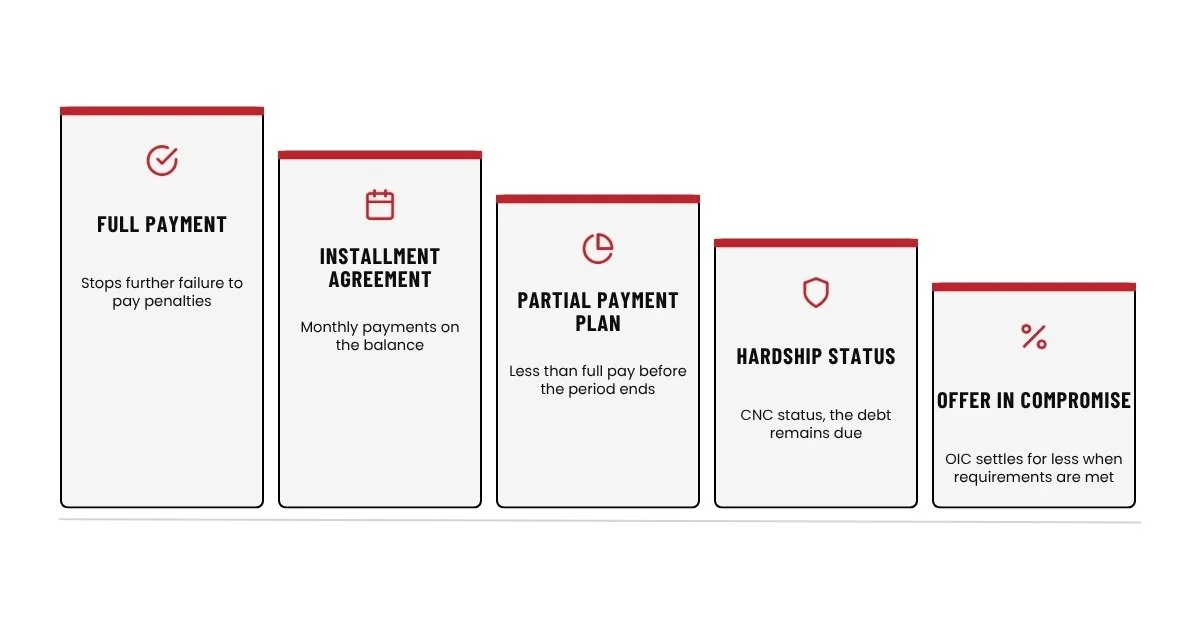
Full Payment
Paying the verified balance generally prevents additional failure to pay penalties and interest from continuing to accrue.
IRS Payment Plan
A qualifying business or individual may request an installment agreement.
The available plan depends on the entity, type of tax, balance, filing compliance, current payments, financial condition, and collection period.
An installment agreement does not reduce the underlying assessment.
Partial Payment Installment Agreement
A Partial Payment Installment Agreement may be considered when the taxpayer cannot fully pay before the collection period expires.
The IRS may review the agreement periodically and increase payments if the taxpayer’s financial circumstances improve.
Currently Not Collectible Status
An individual may qualify for Currently Not Collectible status when payment would prevent the taxpayer from meeting necessary living expenses.
The debt remains due, penalties and interest generally continue, and the IRS may review the account later.
Application of hardship procedures to an operating business depends on the entity, tax, continued operations, and compliance facts.
Offer in Compromise
An Offer in Compromise may be available when the taxpayer meets the applicable requirements and the financial or liability facts support the offer.
The IRS reviews income, expenses, assets, equity, filing compliance, current payments, and collection potential.
Filing an offer does not guarantee acceptance.
Penalty Relief
Penalty relief may be available based on reasonable cause, First Time Abatement when applicable, a statutory exception, or an IRS error.
Penalty relief does not generally remove the underlying audit assessment.
How Semper Tax Relief Can Help
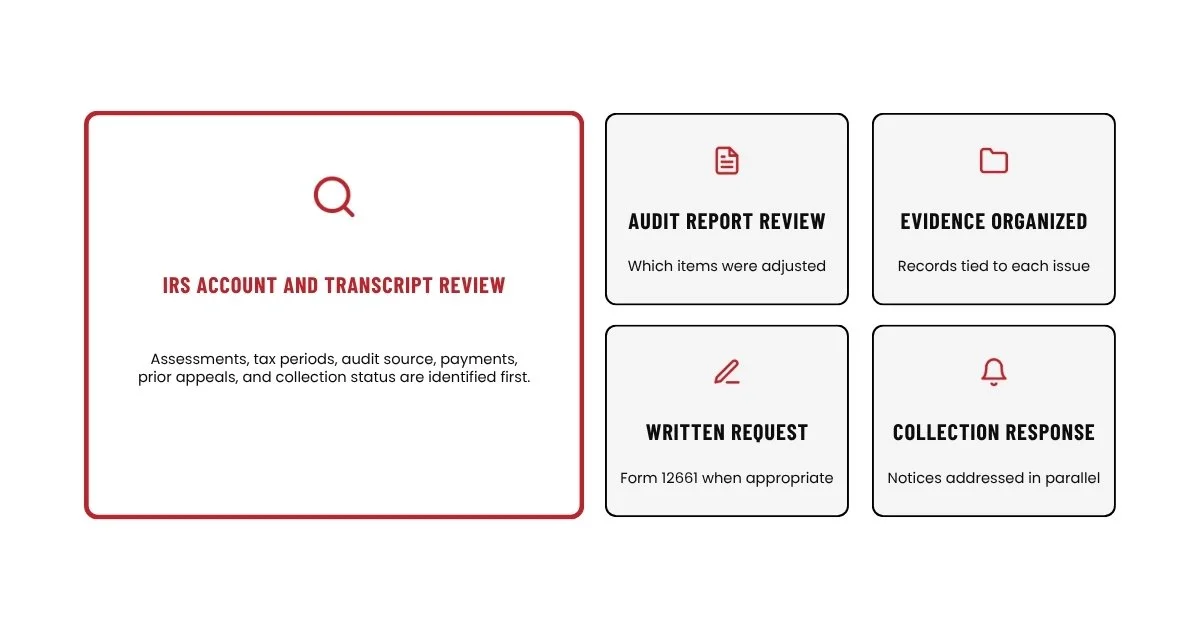
Semper Tax Relief can review the audit assessment and determine which administrative procedure may be appropriate.
Our services may include:
• Obtaining and reviewing IRS account transcripts
• Reviewing the audit report and adjustment explanations
• Identifying the disputed audit issues
• Reviewing what information the IRS previously considered
• Identifying new supporting records
• Reviewing audit reconsideration eligibility
• Organizing documents by disputed issue
• Preparing a written reconsideration request
• Preparing Form 12661 when appropriate
• Communicating with the IRS under a valid power of attorney
• Responding to requests for additional information
• Reviewing the reconsideration result
• Evaluating IRS Appeals rights
• Addressing related collection notices
• Evaluating resolution options for a remaining balance
The scope depends on the business entity, tax type, records, deadlines, procedural history, and engagement.
Semper Tax Relief cannot guarantee that the IRS will reopen the examination, accept the documents, reduce the assessment, remove penalties, stop collection, or approve a payment arrangement.
Our Business Audit Reconsideration Process
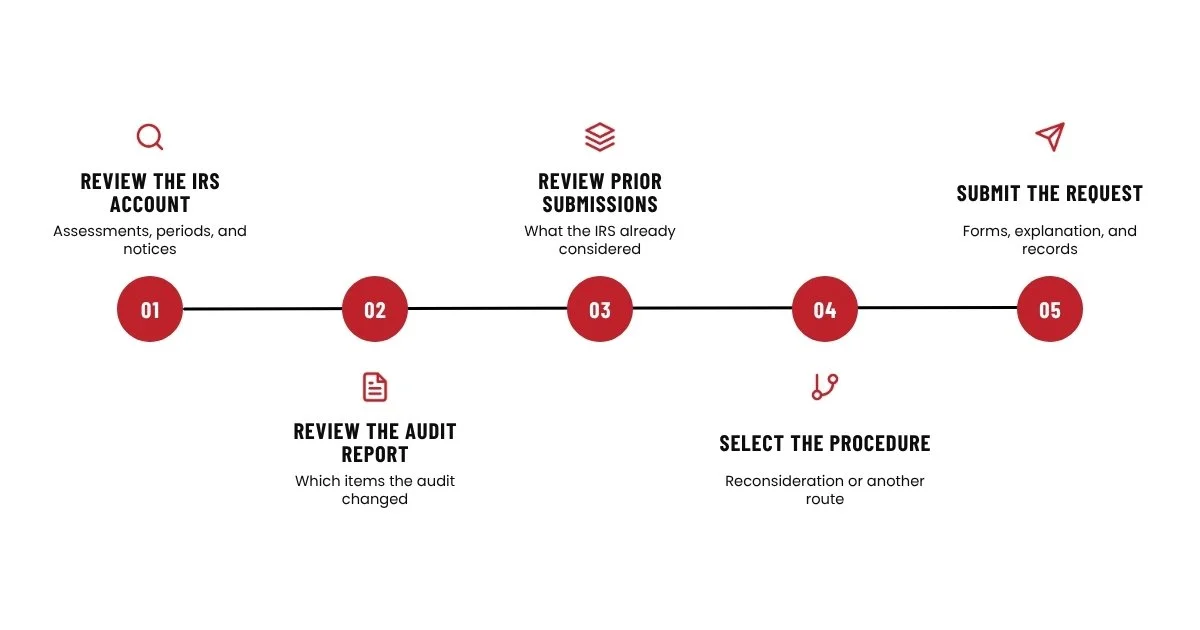
Step 1: Review the IRS Account
We identify the assessment, tax periods, audit source, collection status, payments, prior appeals, and applicable notices.
Step 2: Review the Audit Report
We examine the audit changes and determine which income, expenses, credits, or other items were adjusted.
Step 3: Review Prior Submissions
We identify which documents and arguments the IRS previously considered.
This step helps distinguish genuinely new information from material already reviewed.
Step 4: Organize New Evidence
We organize the supporting records by tax period and disputed adjustment.
The documents should connect directly to the change being requested.
Step 5: Select the Correct Procedure
We determine whether the matter calls for audit reconsideration, an amended return, refund claim, IRS appeal, collection appeal, or another procedure.
Step 6: Submit the Request
When retained, we prepare the written request, applicable forms, explanation, and supporting documents and submit them to the appropriate IRS function.
Step 7: Address Collection and the Final Result
We monitor the reconsideration within the engagement, respond to additional IRS requests, and review options for collection activity or any remaining balance.
Why Work With Semper Tax Relief?
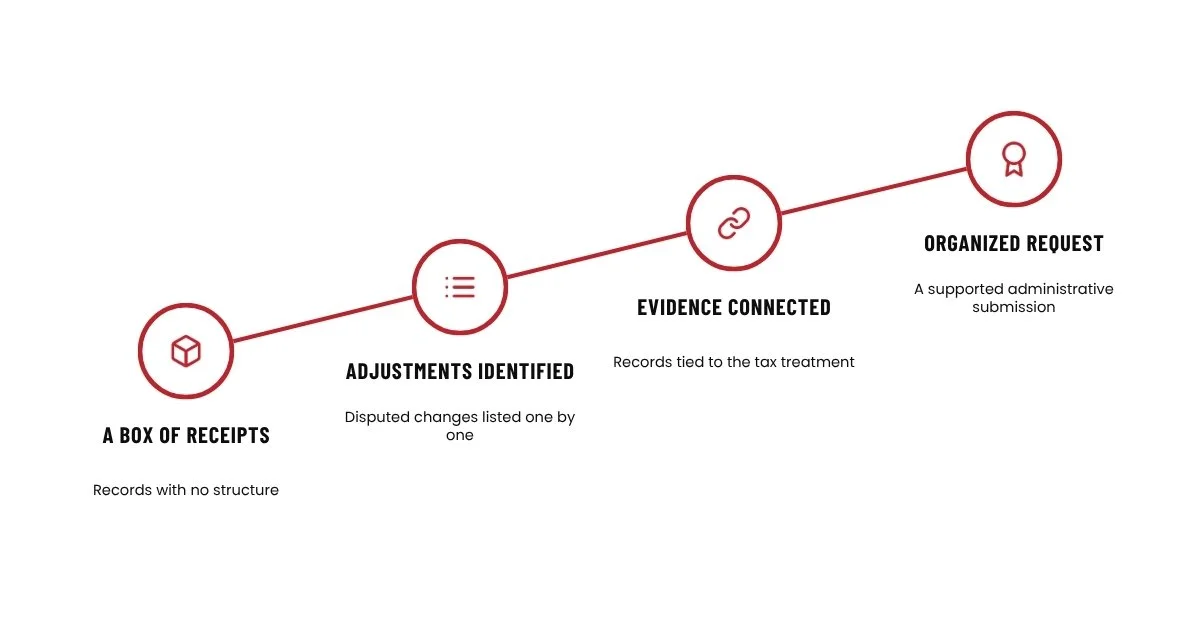
A business audit reconsideration requires more than sending a box of receipts to the IRS.
The request should identify each disputed adjustment, explain the requested correction, and connect the evidence to the tax treatment.
A business may also need to address collection while reconsideration is pending.
I review the audit, IRS account, supporting records, procedural history, and collection status before recommending a strategy.
Semper Tax Relief assists sole proprietors, self employed taxpayers, corporations, S corporations, LLCs, and other qualifying businesses throughout the United States.
Representation may be handled through secure document exchange, telephone appointments, electronic signatures, and IRS power of attorney procedures.
Our goal is to present an organized and supported administrative request without promising a result before the audit record and new evidence are reviewed.
Frequently Asked Questions About Business Audit Reconsideration
-
Answer
-
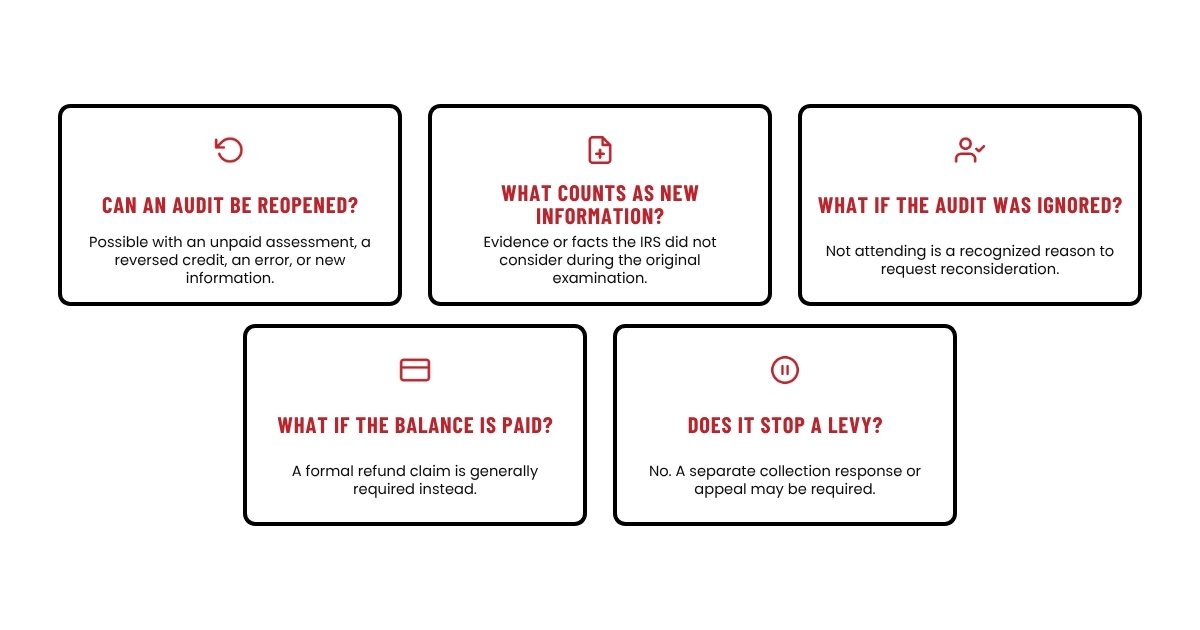
New information generally means relevant evidence or facts the IRS did not consider during the original examination. It may include receipts, bank records, contracts, mileage records, basis documents, payroll information, or another explanation supported by evidence.
-
Possibly. Failure to attend the audit or provide requested information is a recognized reason for requesting reconsideration. The taxpayer must still provide the records needed to support the disputed items.
-
Business Master File audit reconsideration procedures exist for qualifying corporate and other business assessments. The correct submission depends on the entity, return, audit source, payment status, and issue.
-
Possibly, but partnership audits may be controlled by specialized centralized partnership or older TEFRA procedures. Those rules can limit who may challenge an adjustment and which procedure applies. The specific audit year and notices must be reviewed.
-
When the assessment has been fully paid, a formal refund claim is generally required instead of ordinary audit reconsideration. The correct form depends on the entity and type of tax. Strict refund claim deadlines apply.
-
No. Filing a reconsideration request does not automatically stop collection or release a levy. A separate collection response or appeal may be required.
-
Depending on the case, the taxpayer may be able to request an IRS Appeals conference, pay the liability and file a formal refund claim, or use another available procedure. The appropriate response depends on why the request was denied and which rights remain.
Request a Business Audit Reconsideration Review
If the IRS assessed additional business tax without considering important records, the first step is to review the audit report and procedural history.
I can review the IRS account, disputed adjustments, prior submissions, new business records, payment status, and collection activity to help determine whether audit reconsideration or another response may be available.
A case review does not guarantee that the IRS will reopen the audit, reduce the assessment, accept every deduction, remove penalties, stop collection, or approve a payment option.
It provides an opportunity to determine what happened during the audit and prepare a response based on the available records and applicable procedures.
Contact Semper Tax Relief to request a confidential Free Case Review.