

Unfiled Partnership Tax Returns
If your partnership has not filed Form 1065 for one or more years, the problem can affect more than the partnership itself.
Form 1065 is generally an information return.
The partnership reports its income, deductions, gains, losses, credits, distributions, liabilities, and other tax information. Those items are then allocated among the partners through Schedule K 1.
The partners generally use those Schedule K 1 amounts to complete their own individual, corporate, partnership, trust, or estate tax returns.
That means one missing Form 1065 can create filing problems for several taxpayers.
Do I qualify for tax relief? Find out with a free case review.
Call today: 24 Hours / 7 Days a Week or book online.
✔ Confidential ✔ No Pressure ✔ Personalized
I help partnerships identify missing filing years, reconstruct the business records, confirm who the partners were during each year, prepare delinquent Forms 1065 and Schedule K 1 statements, review late filing penalties, respond to IRS nonfiler activity, and determine whether related partner returns also need to be corrected.
I am Sergio Melendez, JD, EA. I have worked in the tax profession since 2005 and represent individuals and businesses before the IRS as an Enrolled Agent.
The first objective is getting the partnership reporting correct.
The partners' individual tax consequences are then reviewed separately.
Who We Help With Unfiled Partnership Tax Returns

This service is for partnerships and partnership taxed LLCs that have one or more missing Form 1065 returns.
That can include:
General partnerships
Limited partnerships
Limited liability partnerships
Multiple member LLCs taxed as partnerships
Real estate partnerships
Professional partnerships
Family partnerships
Investment partnerships
Construction and service businesses
Partnerships that changed accountants
Partnerships with several years of unfinished bookkeeping
Partnerships with missing Schedule K 1 statements
Partnerships that stopped operating without filing a final return
Partnerships receiving IRS nonfiler notices
Partnerships already under IRS Examination
Before preparing several years of returns, I confirm that the entity was actually classified as a partnership for federal tax purposes during each year.
What Is Form 1065?
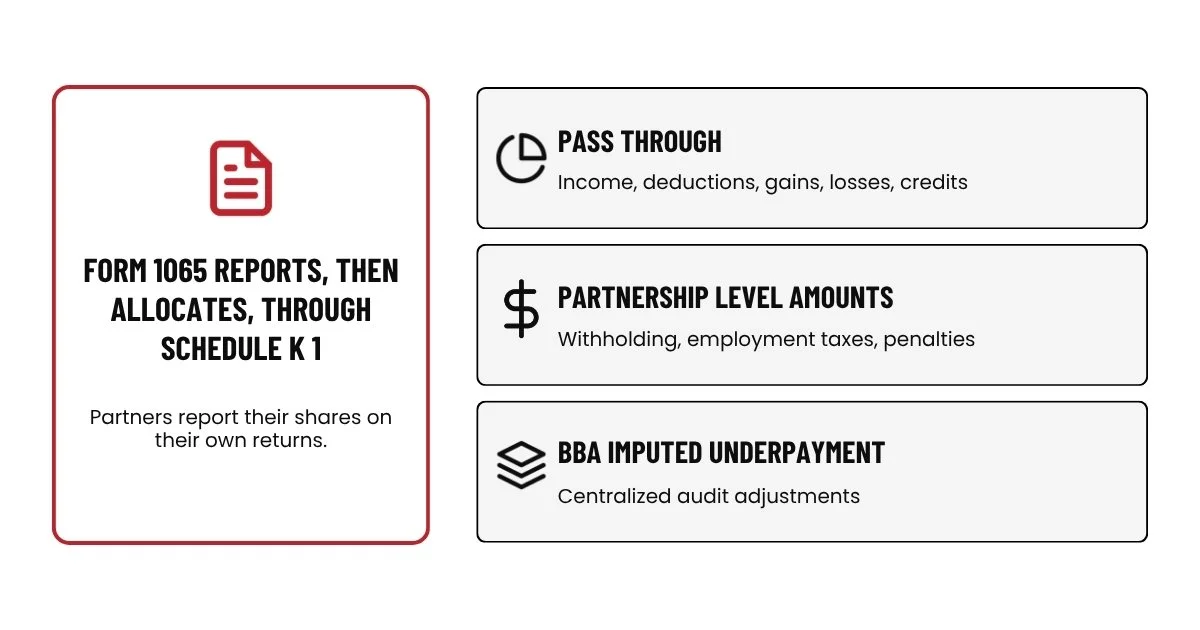
Form 1065, U.S. Return of Partnership Income, is generally the federal information return used by a domestic partnership.
The return reports items including:
Business income
Cost of goods sold
Ordinary business expenses
Rental income
Interest and dividends
Capital gains and losses
Guaranteed payments
• Contributions
Distributions
Partnership liabilities
Partner ownership percentages
Capital account information
Separately stated deductions and credits
Other partnership tax items
The partnership generally files Form 1065 with the IRS and provides each partner with Schedule K 1.
A Partnership Generally Does Not Pay Federal Income Tax on Its Ordinary Business Income
Partnerships generally pass income, deductions, gains, losses, and credits through to the partners.
The partners then report their respective shares on their own tax or information returns.
This means the partnership can report taxable income even though the Form 1065 itself does not calculate ordinary federal income tax in the same manner as a C corporation.
Partnerships Can Still Owe Certain Federal Amounts
It would be incorrect to say a partnership can never owe the IRS directly.
Partnership level liabilities can arise in specific situations.
Examples can include:
Certain withholding taxes
Employment taxes
Penalties
Interest
Certain centralized partnership audit adjustments
An imputed underpayment under the BBA partnership audit regime
Those liabilities should be separated from the income tax normally passed through to the partners.
Who Must File Form 1065?
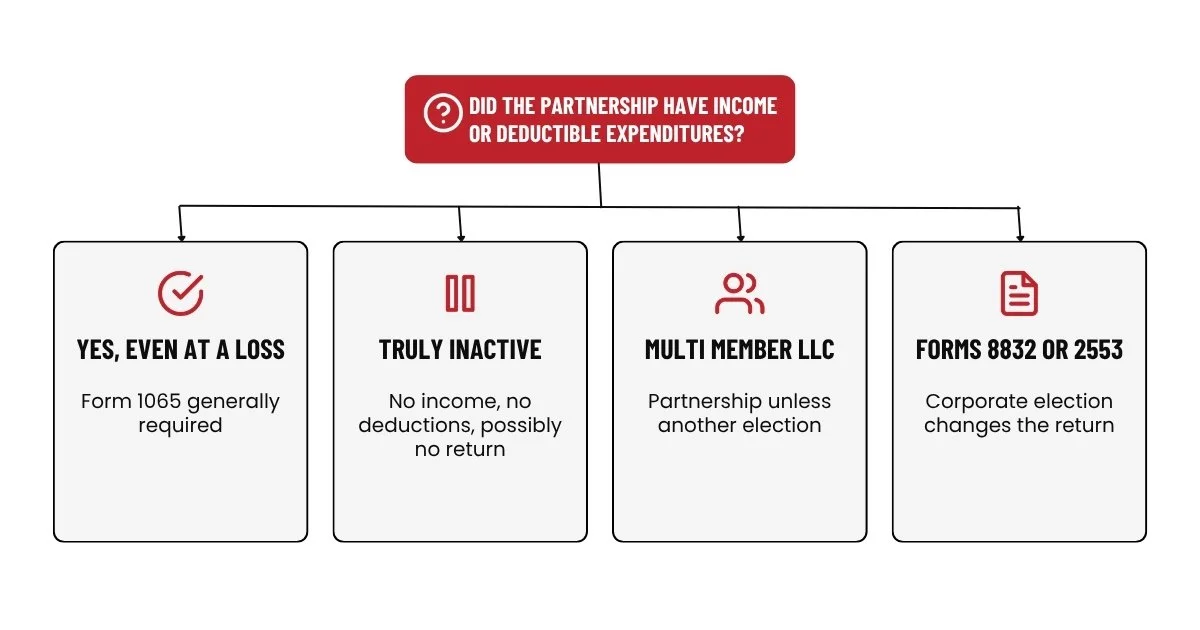
Current IRS instructions generally require every domestic partnership to file Form 1065 unless the partnership neither receives income nor incurs expenditures treated as deductions or credits for federal income tax purposes.
LLCs classified as partnerships for federal tax purposes generally follow the same Form 1065 filing rules.
A Completely Inactive Partnership Can Be Different
A partnership that truly received no income and incurred no deductible or creditable expenditures may not have a Form 1065 filing requirement for that period.
That is narrower than simply saying:
"The business did not make money."
A partnership that operated at a loss can still have a filing requirement because it had income or deductible expenses.
The actual books and activity should be reviewed before deciding that no return was required.
Partnership Classification Should Be Confirmed First
An LLC with two or more members is generally classified as a partnership for federal tax purposes unless it elected another classification.
A business may instead have elected corporate treatment.
Before preparing several delinquent Forms 1065, I confirm:
Federal entity classification
EIN
Ownership
Prior tax filings
Any Form 8832 election
Any Form 2553 election
The return type should be established before the filing project begins.
Schedule K 1 Connects the Partnership Return to the Partners

Schedule K 1 reports each partner's share of the partnership's tax items.
Depending on the partnership, that can include:
Ordinary business income or loss
Rental income or loss
Interest
Dividends
Capital gains and losses
Section 1231 gains and losses
Charitable contributions
Credits
Guaranteed payments
Distributions
Partner liabilities
Foreign tax information
Other separately stated tax items
The partnership files a copy of Schedule K 1 with the IRS and provides the applicable Schedule K 1 to each partner.
Partners Can Owe Tax Even When No Cash Was Distributed
A partner may have to report the partner's share of partnership income even when the partnership did not distribute that amount in cash.
Taxable partnership income and cash distributions are not necessarily the same number.
This is one reason missing Form 1065 returns can create problems on partner tax returns.
A Partner May Be an Individual or Another Entity
A partner does not have to be a person filing Form 1040.
A partner can potentially be:
An individual
Corporation
Partnership
Trust
Estate
Certain other qualifying entities
A missing Schedule K 1 can therefore affect another business or fiduciary return, not just an individual's personal income tax return.
Missing Partnership Returns Can Affect the Partners' Tax Returns

When Form 1065 is missing, the partners may not have the information necessary to complete their own tax filings accurately.
Possible problems include:
Missing Schedule K 1 income
Missing losses
Incorrect Schedule E reporting
Incorrect guaranteed payments
Missing capital gains
Incorrect distributions
Missing deductions or credits
Basis problems
Passive activity issues
At risk limitations
Self employment tax issues
Once the partnership returns are completed, the partner returns may need to be reviewed separately.
Form 8082 May Be Relevant When the Partnership Has Not Filed
Current IRS Schedule K 1 guidance provides that a partner may need Form 8082 when the partner's treatment of a partnership item is inconsistent with the partnership return or when a required partnership return has not been filed.
Whether Form 8082 is appropriate depends on the partner's filing circumstances.
It should not be used as a substitute for getting the missing partnership return completed when the partnership can file accurately.
Partnership Capital Accounts Need to Be Reconstructed
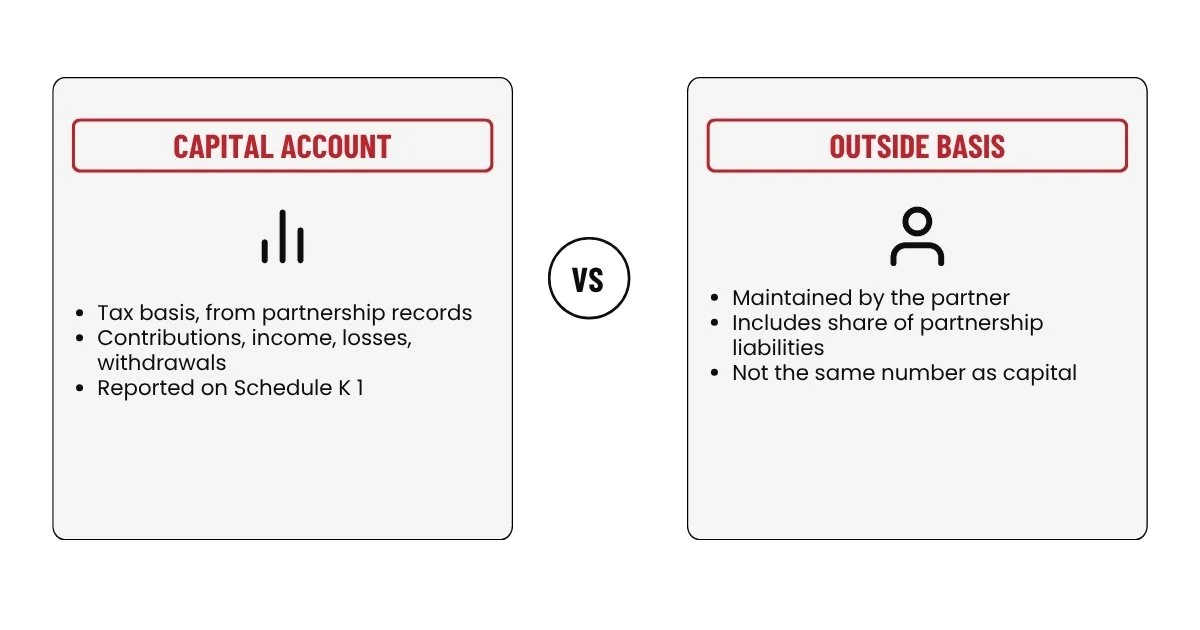
A multi year partnership return project usually requires more than a profit and loss statement.
Partner capital accounts can change every year based on partnership activity.
Current Schedule K 1 reporting generally uses tax basis capital account information.
Capital Accounts Can Change Because of Several Transactions
The partnership books may need to track:
Beginning partner capital
Cash contributions
Property contributions
Partnership income
Partnership losses
Separately stated items
Withdrawals
Distributions
Other applicable adjustments
Ownership changes can also affect how the year's activity is allocated.
Capital Account Is Not the Same as a Partner's Outside Tax Basis
This distinction is important.
The Schedule K 1 capital account is based on the partnership's records.
A partner's adjusted basis in the partnership interest can include additional items, including the partner's share of partnership liabilities.
The partner is generally responsible for maintaining outside tax basis.
I therefore do not treat the Schedule K 1 capital account as automatically equal to the partner's personal tax basis.
Partner Ownership Percentages Can Change From Year to Year
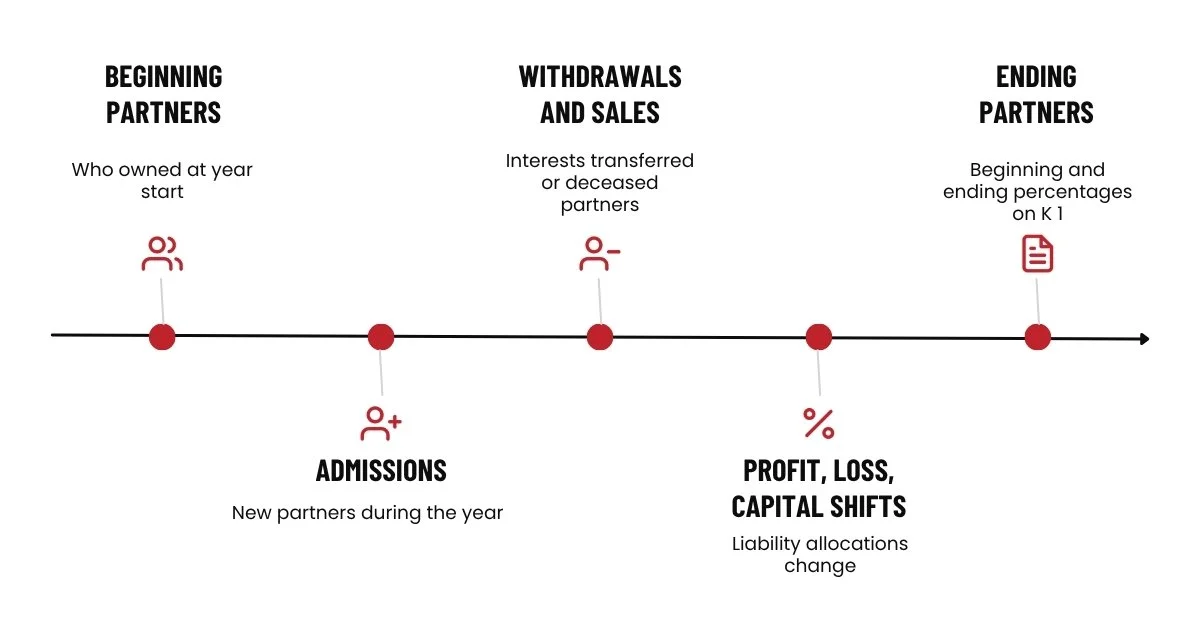
Several missing Form 1065 returns can become difficult when the partnership changed owners during the filing gap.
I review:
Who owned an interest at the beginning of each year
New partners admitted during the year
Partners who withdrew
Interests sold
Interests transferred
Partners who died
Changes in profit percentages
Changes in loss percentages
Changes in capital percentages
Changes in liability allocations
Those changes affect Schedule K 1 reporting.
Beginning and Ending Ownership Can Be Different
Current Schedule K 1 requires beginning and ending partner percentage information.
If a partner entered or left during the year, the allocation of income, loss, deductions, and other items should reflect the applicable partnership agreement and federal tax rules.
Simply dividing everything equally among whoever owns the business today can produce an incorrect historical return.
When Is Form 1065 Due?
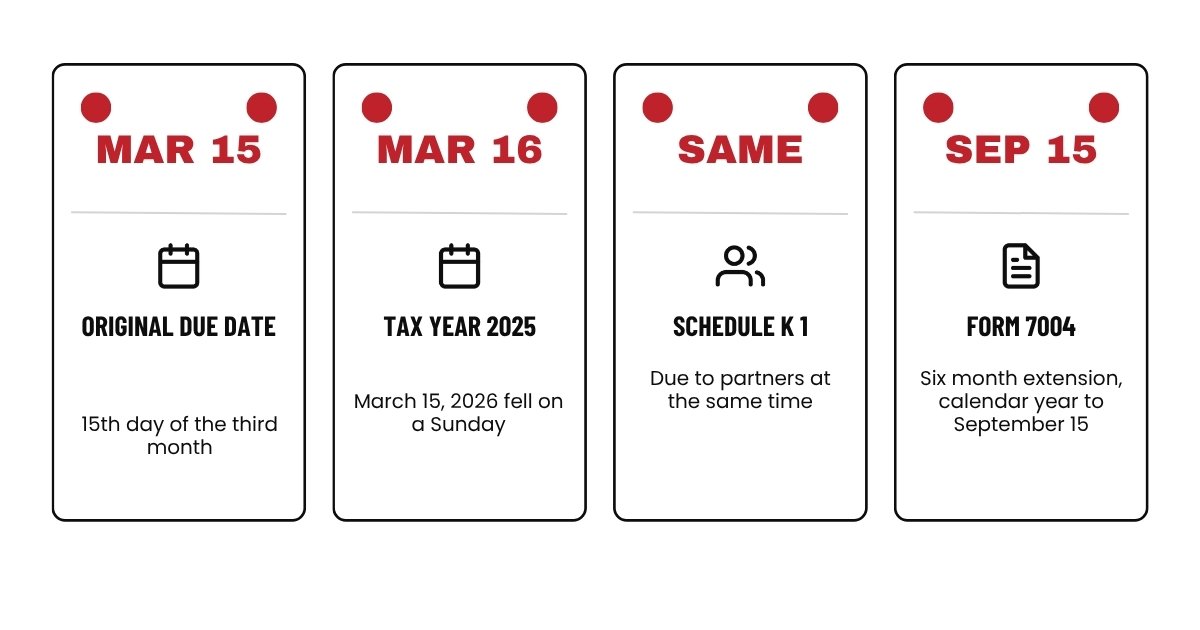
A domestic partnership generally files Form 1065 by the 15th day of the third month after the end of its tax year.
For a calendar year partnership, the regular deadline is March 15.
Because March 15, 2026 fell on a Sunday, the 2025 calendar year Form 1065 was generally due March 16, 2026.
Schedule K 1 Is Generally Due at the Same Time
Partners generally need to receive their Schedule K 1 by the Form 1065 due date, including an applicable extension.
Delaying the partnership return therefore also delays the information partners need for their own tax filings.
Form 7004 Provides an Automatic Extension
A partnership can generally use Form 7004 to request an automatic six month extension of time to file Form 1065.
For a calendar year partnership with a valid extension, the normal extended filing deadline is September 15.
The extension should generally be requested by the original filing deadline.
Late Form 1065 Penalties Can Become Expensive Quickly
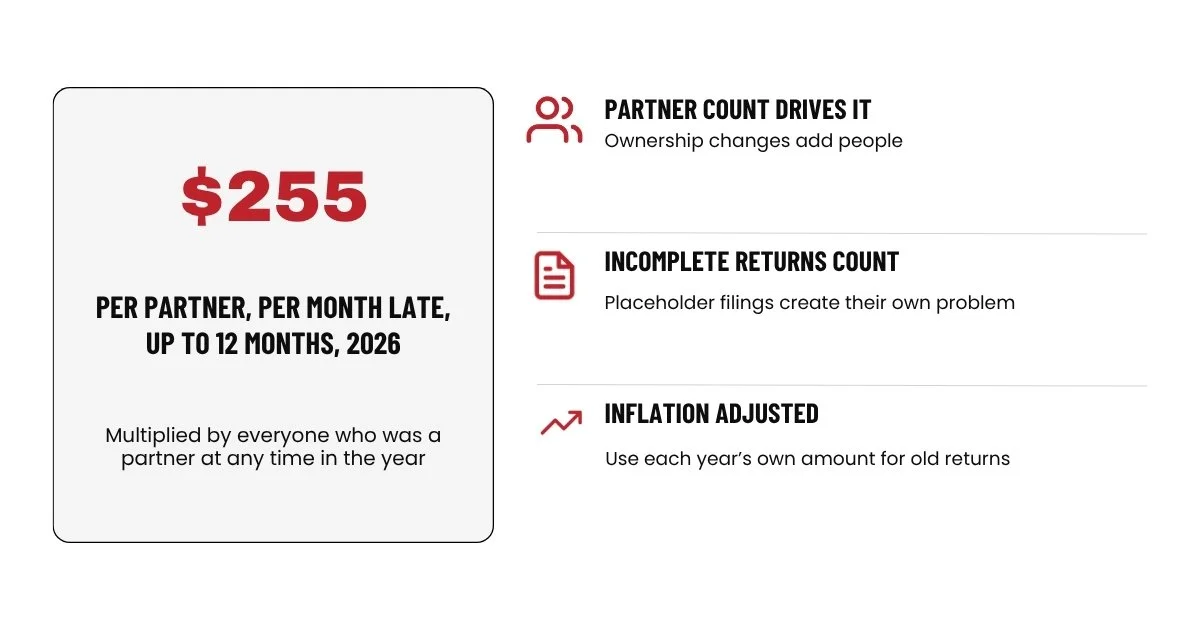
The partnership late filing penalty is unusual because it is calculated using both:
The number of months late
The number of partners
For a Form 1065 required to be filed in 2026, the current penalty is generally:
$255 per partner
for each month or part of a month the return remains late
for a maximum of 12 months
Every Person Who Was a Partner During the Year Can Affect the Penalty
The penalty calculation generally uses the total number of persons who were partners at any time during the partnership's tax year.
For example, the calculation can become substantial when:
Several partners were involved
Ownership changed during the year
The return remained unfiled for many months
The actual partner history needs to be confirmed before evaluating the penalty.
An Incomplete Form 1065 Can Also Trigger the Penalty
The penalty can apply when the partnership files late or fails to include all information required on the return.
Filing a placeholder return without the required partner and tax information can therefore create another compliance problem.
The Penalty Amount Is Adjusted for Inflation
The per partner amount changes periodically.
For returns required to be filed in 2026, the applicable base amount is generally $255.
Historical returns should be reviewed using the penalty amount applicable to their own filing year rather than applying the 2026 figure to every old return.
Late Schedule K 1 Statements Can Carry Separate Penalties
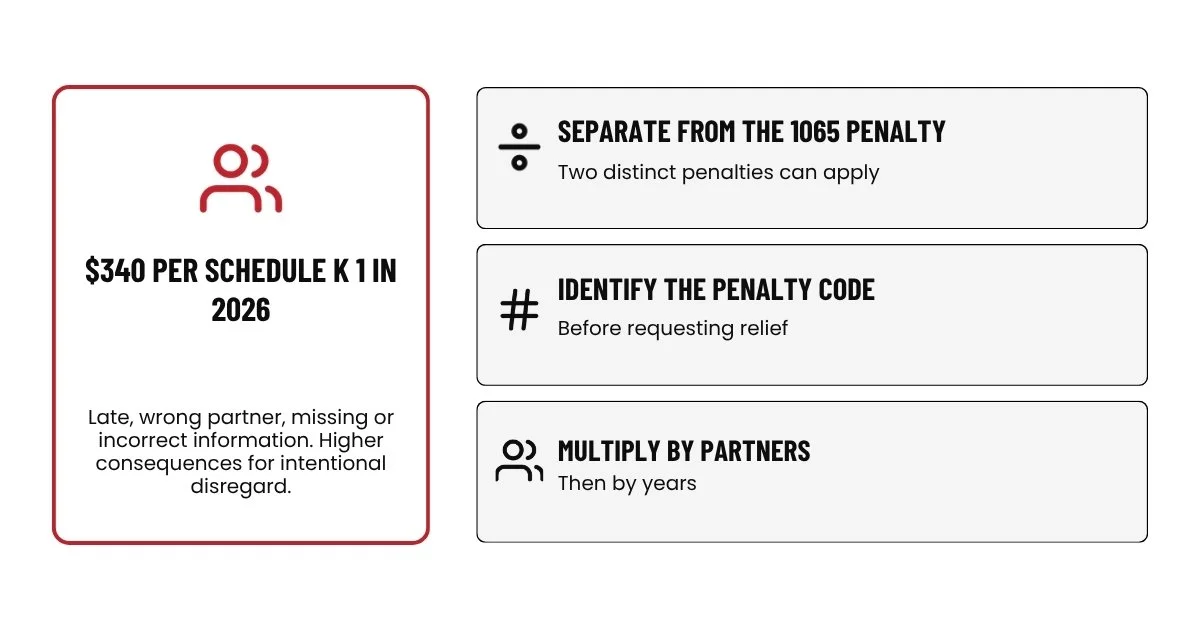
The Form 1065 late filing penalty is not necessarily the only partnership penalty.
For Schedule K 1 statements required during 2026, the current information reporting penalty can generally be $340 for each Schedule K 1 that:
Was not provided timely
Was not provided to the correct partner
Did not contain required information
Contained incorrect required information
Higher consequences can apply in cases involving intentional disregard.
Schedule K 1 Penalties Are Separate From the Form 1065 Penalty
A partnership can potentially have:
A Form 1065 late filing penalty and
Separate Schedule K 1 reporting penalties
The specific penalty code on the IRS account or notice should therefore be identified before requesting relief.
Partnership Penalty Relief May Be Available
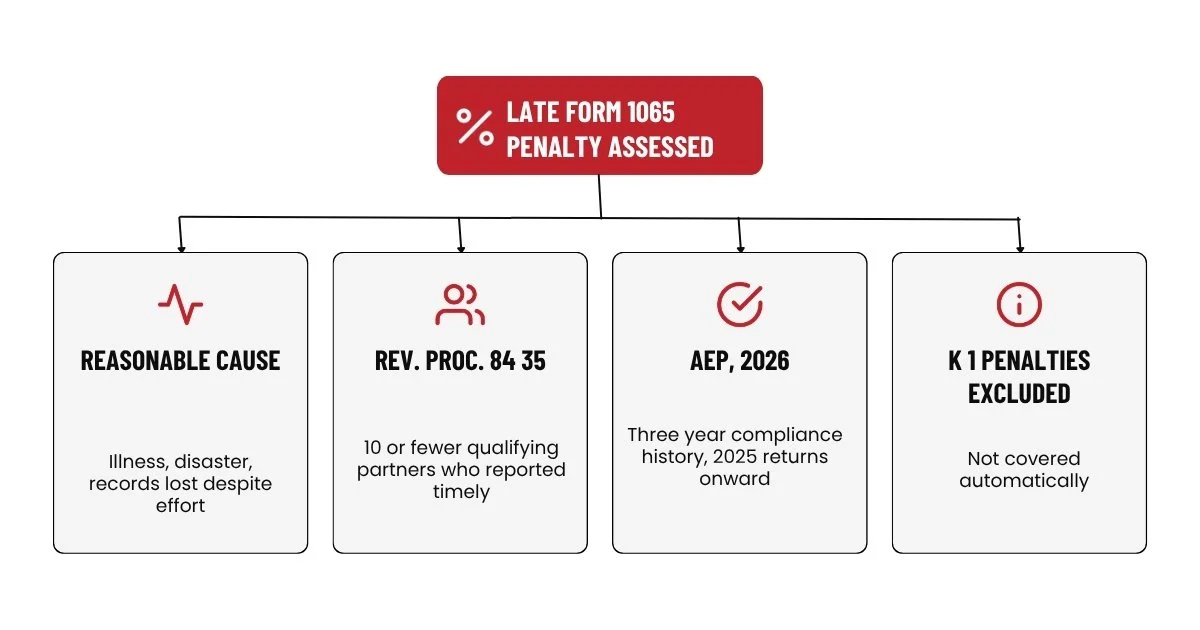
A late filing penalty should not automatically be treated as permanent.
Several penalty relief procedures can potentially apply depending on the tax year and facts.
Reasonable Cause
The Form 1065 instructions provide that the late filing penalty does not apply when the partnership establishes reasonable cause.
The explanation should address what prevented timely filing and what the partnership did to restore compliance.
Possible facts can include:
Serious illness
Death or incapacity
Destruction of records
Natural disaster
Inability to obtain essential records despite reasonable efforts
Certain professional reliance circumstances
Other facts demonstrating reasonable business care and prudence
The strength of the request depends on the actual circumstances.
Revenue Procedure 84 35 Can Help Certain Small Partnerships
The IRS continues to recognize a specific reasonable cause procedure for certain partnerships with 10 or fewer partners.
Current IRS guidance generally requires conditions including:
No more than 10 partners
Qualifying individual or estate partners
Partnership items allocated proportionately as required by the procedure
Partners having timely reported their distributive shares
The procedure does not eliminate the requirement to file Form 1065.
It provides a possible basis for reasonable cause relief from the partnership late filing penalty when all requirements are met.
Automatic Exemption from Penalty Began in 2026
The IRS introduced Automatic Exemption from Penalty, or AEP, during summer 2026.
Form 1065 is included among the return series eligible for AEP consideration beginning with qualifying 2025 original returns.
Generally, the taxpayer must have the required prior three year compliance history and satisfy the other AEP requirements.
AEP applies only to covered penalties.
Separate Schedule K 1 information reporting penalties and other penalties should not be assumed to receive automatic relief.
What IRS Notices Can a Partnership Receive for a Missing Form 1065?
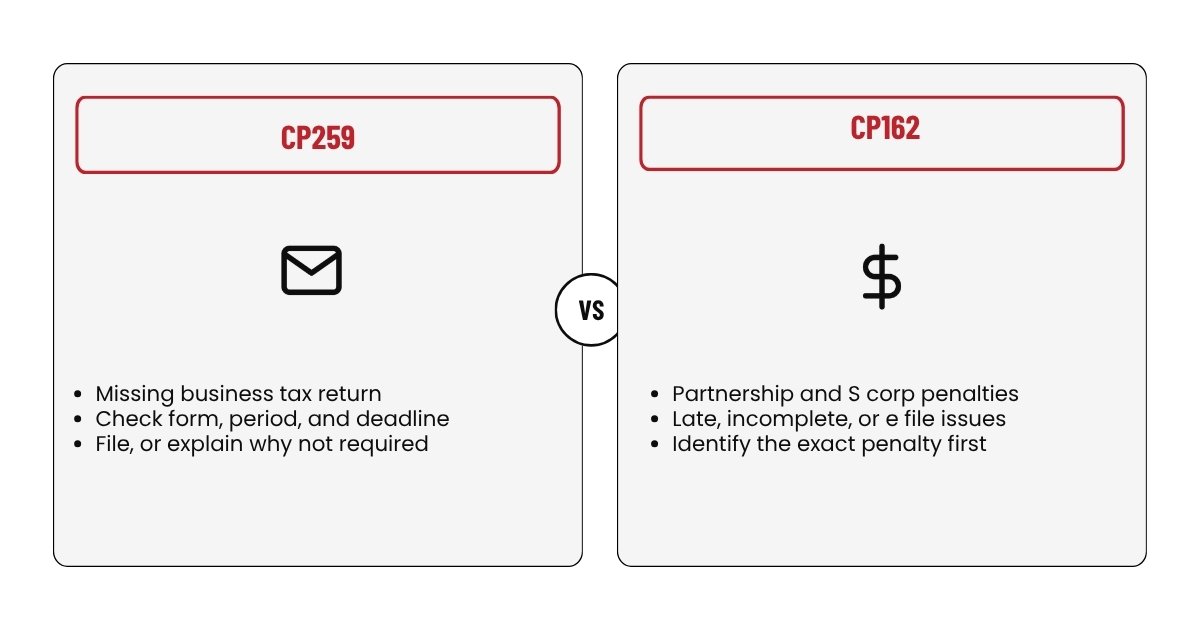
The IRS can identify a missing partnership return through its Business Master File records.
One common notice is CP259.
CP259, Missing Business Tax Return
CP259 states that IRS records show a required business tax return was not filed.
The partnership should review:
Tax form
Tax period
Filing requirement
IRS response deadline
If the return was required, it should generally be prepared and filed.
If the IRS filing requirement is incorrect, the partnership should respond with the applicable information rather than filing a return that was not required.
CP162 Can Involve Partnership Penalties
The IRS uses CP162 series notices for certain partnership and S corporation penalties.
Current IRS guidance explains that CP162 can involve:
Late partnership filing
Incomplete partnership returns
Electronic filing issues
A partnership receiving this notice should identify exactly which penalty was assessed before preparing a relief request.
Can the IRS Establish a Substitute Return for a Partnership?

Yes.
Current IRS partnership examination procedures provide for Substitute for Return processing when a partnership fails to file a required Form 1065.
The IRS may establish an SFR after the filing deadline and extension period have passed and efforts to secure the partnership return have been exhausted.
Current Partnership Nonfiler Cases Fall Under BBA Procedures
For current partnership tax years subject to the centralized partnership audit regime, IRS procedures provide that delinquent partnership returns and partnership Substitute for Return cases are generally subject to BBA procedures.
A late filed return cannot retroactively make a timely election out of the BBA regime.
The IRS May Contact a Nonfiler Partnership Through Examination
Current IRS procedures include partnership nonfiler correspondence such as:
Letter 3798, Nonfiler Appointment
Letter 2205 D, Initial Contact to Schedule Appointment for Partnership Returns
The exact procedure depends on how the IRS case was opened.
Filing the Partnership's Actual Return Still Matters
An IRS established SFR does not mean the partnership's filing work is complete.
The partnership should generally prepare the accurate delinquent return from its own books and records.
The IRS can then determine how that return affects the partnership account and partner level reporting.
The correct submission process depends on which IRS function controls the case.
IRS Business Transcripts Can Help Reconstruct the Partnership Filing History

IRS account research can help identify which Forms 1065 were filed and which remain missing.
Business transcript tools can provide information including:
Partnership return transcripts
Account transcripts
Record of account transcripts
Business entity information
Payments
IRS account activity
Form 1065 Transcripts Are Available
A partnership tax return transcript can show many line items from an original Form 1065 that was filed.
An account transcript can help identify processing, penalties, adjustments, and account transactions.
Business Tax Account Now Supports Partnerships
The current IRS Business Tax Account supports qualifying partnerships filing Form 1065.
Authorized users may be able to review:
Business profile information
Account balances
Payments
Tax transcripts
Compliance reports
IRS notices and letters
Access depends on the user's role and current IRS authorization requirements.
Transcripts Do Not Replace Partnership Books
A transcript may show what was reported to the IRS.
It generally does not recreate:
Detailed bookkeeping
Bank reconciliations
Partner contributions
Partner distributions
Capital accounts
Partnership agreements
Complete allocation records
Those items usually need to come fro
What Records Are Needed to File Old Partnership Returns?

The records depend on the business and the number of missing years.
Useful documents can include:
Prior Forms 1065
Prior Schedules K 1
EIN records
Partnership agreement
LLC operating agreement
Ownership records
Business bank statements
Business credit card statements
Merchant processor reports
Sales records
Customer invoices
Forms 1099
General ledger
Profit and loss statements
Balance sheets
Accounts receivable
Accounts payable
Inventory records
Asset schedules
Depreciation records
Loan statements
Payroll records
Guaranteed payment records
Partner contribution records
Partner distribution records
Partner loan records
Ownership transfer documents
IRS notices
IRS business transcripts
The objective is to rebuild a partnership record that explains both the business activity and the amounts allocated to each partner.
Catch Up Bookkeeping May Be Required Before Filing Form 1065
When the books stopped several years ago, partnership tax preparation often begins with accounting reconstruction.
That can include:
Reconstructing income
Categorizing business expenses
Reconciling bank accounts
Reconstructing assets and depreciation
Identifying liabilities
Rebuilding capital accounts
Separating partner transactions
Identifying guaranteed payments
Reconciling payroll
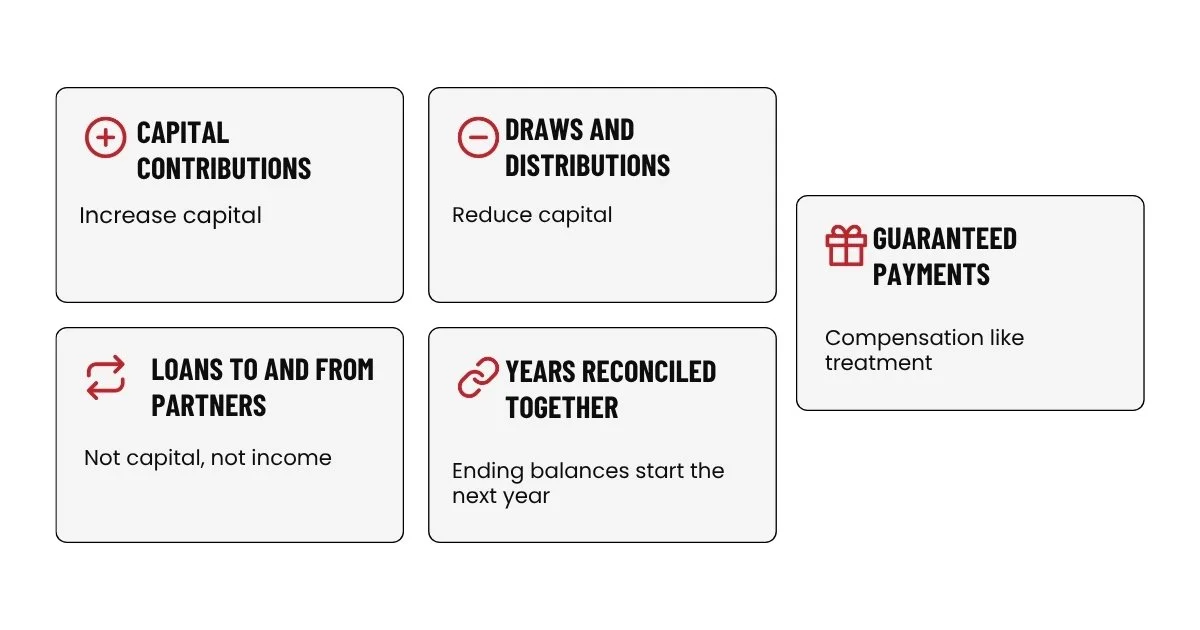
Partner Transactions Require Special Attention
Payments involving partners should be reviewed separately.
They can include:
Capital contributions
Draws
Distributions
Guaranteed payments
Loans from partners
Loans to partners
Expense reimbursements
Those items do not all receive the same tax treatment.
Several Years Should Be Reconciled Together
The ending balance sheet and partner capital accounts from one year generally become part of the starting point for the next year.
That makes several missing Form 1065 returns a coordinated project rather than a series of unrelated returns.
What If Partners Changed During the Missing Years?
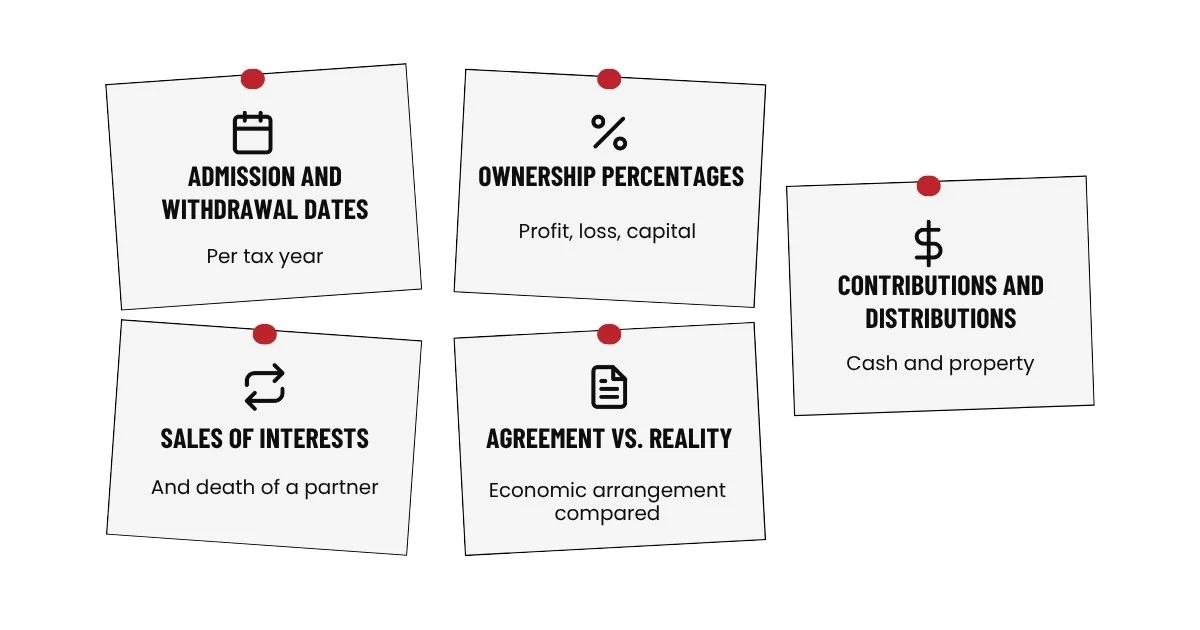
Ownership changes can materially affect delinquent partnership filings.
For each tax year, I review:
Beginning partners
Ending partners
Admission dates
Withdrawal dates
Ownership percentages
Capital contributions
Property contributions
Distributions
Partner liabilities
Sales of partnership interests
Death of a partner
The partnership agreement and actual economic arrangement should be compared with the tax reporting.
Do Not Use Today's Ownership Percentages for Prior Years
A partnership that is 50 percent owned by Partner A and 50 percent by Partner B today may have had a different ownership structure five years ago.
Historical Schedule K 1 statements should reflect the correct historical facts.
That can require reconstructing old ownership records before the returns are prepared.
What If the Partnership Stopped Operating Years Ago?
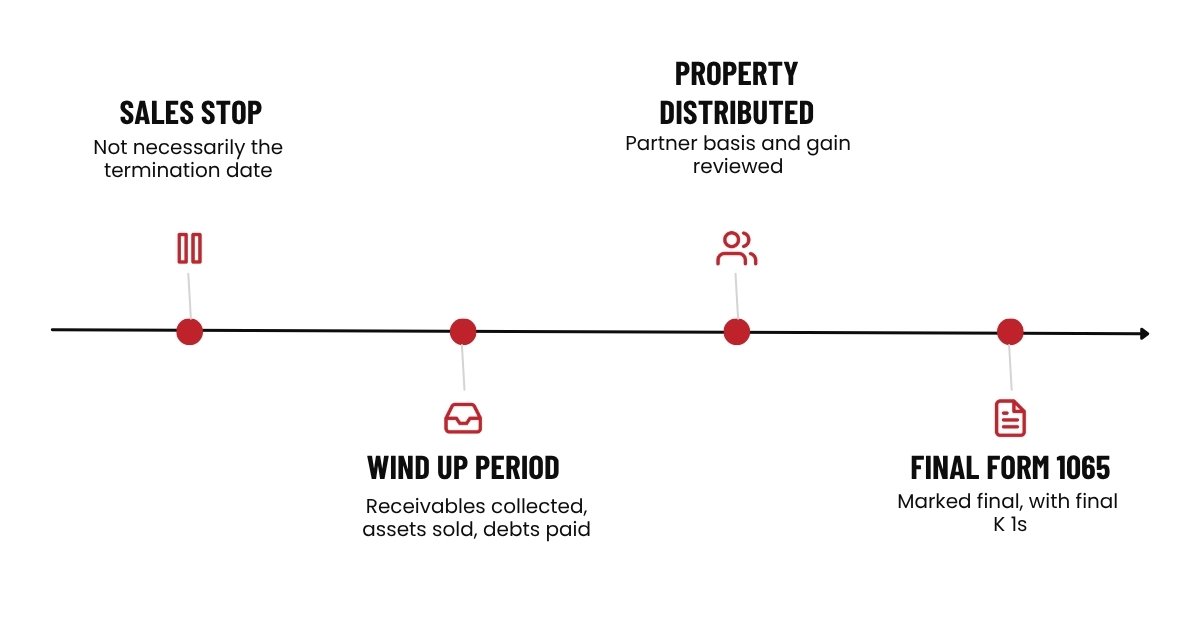
A partnership that discontinued business may still need to complete its final federal tax filings.
Current IRS instructions state that a partnership generally terminates when all operations are discontinued and no part of the business, financial operation, or venture is continued by any partners in a partnership.
The tax year generally ends when the partnership winds up its affairs.
A Final Form 1065 Should Be Identified Properly
The final Form 1065 should indicate that it is the partnership's final return.
Final Schedules K 1 are generally prepared for the partners.
Stopping Deposits Into the Bank Account Is Not Necessarily the Termination Date
Closing the storefront or stopping sales does not always determine the federal termination date.
The partnership may still have been:
Collecting receivables
Selling assets
Paying liabilities
Distributing property
Winding up operations
The actual wind up period should be reviewed.
The Partners May Have Tax Consequences From the Final Year
Final distributions, debt changes, asset sales, and liquidation can affect partner basis and taxable gain or loss.
Those partner consequences should be reviewed separately from the Form 1065 filing itself.
Electronic Filing Rules Can Apply to Delinquent Forms 1065
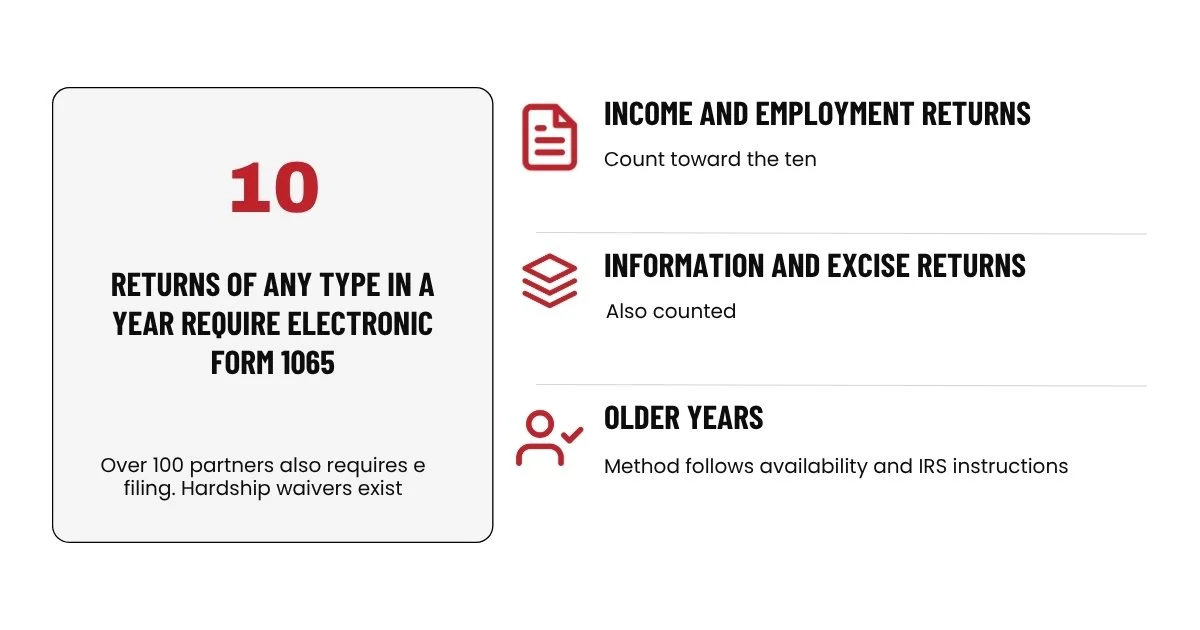
Current IRS rules generally require a partnership to electronically file Form 1065 when it files 10 or more returns of any type during the year.
The count can include:
Income tax returns
Employment tax returns
Information returns
Excise tax returns
Partnerships with more than 100 partners are also required to electronically file Form 1065 and related Schedules K 1.
Hardship waiver procedures are available in qualifying situations.
The filing method for an older return should be reviewed based on the tax year, IRS electronic filing availability, mandatory filing requirements, and any instructions from the IRS employee controlling the case.
Our Process for Filing Unfiled Partnership Tax Returns

Step 1, Confirm the Partnership Classification
I review:
Legal entity
EIN
Federal tax classification
Prior returns
Entity elections
Partnership agreement
Step 2, Identify the Missing Form 1065 Years
I review the IRS business account and available transcripts to determine:
Which returns were filed
Which periods remain missing
Whether IRS nonfiler activity exists
Whether the IRS established an SFR
What penalties have been assessed
Step 3, Identify the Partners for Each Year
I document:
Partner names
Partner tax identification information
Admission and withdrawal dates
Profit percentages
Loss percentages
Capital percentages
Partner type
Step 4, Reconstruct the Partnership Books
We organize or reconstruct:
Income
Expenses
Assets
Liabilities
Payroll
Guaranteed payments
Loans
Capital contributions
Distributions
Step 5, Reconstruct Capital Accounts
Beginning and ending tax basis capital accounts are reviewed for each partner using the partnership's books and applicable tax reporting rules.
Step 6, Prepare Form 1065
Each delinquent partnership return is prepared using the forms and rules applicable to that tax year.
Step 7, Prepare Schedule K 1 Statements
The partnership items are allocated among the appropriate partners.
Each required Schedule K 1 is prepared based on the partnership records and applicable allocation rules.
Step 8, Review Related Partner Returns
Once the partnership filings are established, I identify whether any partners previously filed returns without the correct Schedule K 1 information.
Those partner filings may require a separate review.
Step 9, File Through the Correct IRS Procedure
If Examination, Collection, or another IRS function controls the missing partnership year, the filing method should follow the applicable IRS instructions.
Step 10, Confirm Processing and Penalties
After filing, I review:
Return posting
Partner reporting
Late filing penalties
Schedule K 1 penalties
Other IRS account issues
Available penalty relief
The partnership and partner problems are then addressed separately.
Partnership Filing Compliance Is Different From a Partner's Personal Tax Debt
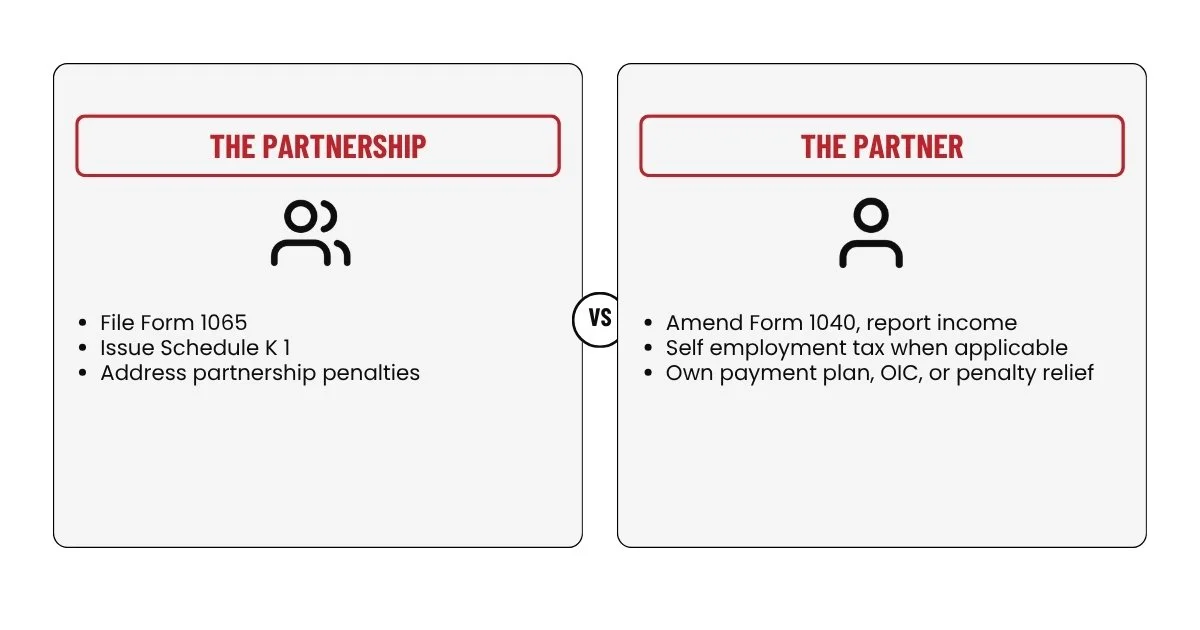
This distinction is important.
Filing Form 1065 does not automatically resolve a partner's personal IRS balance.
For example:
The partnership may need to:
File Form 1065
Issue Schedule K 1
Address partnership penalties
The individual partner may separately need to:
Amend Form 1040
Report partnership income
Address self employment tax when applicable
Pay individual income tax
Request an individual IRS payment plan
Evaluate an Offer in Compromise
Request penalty relief
Those are separate taxpayer accounts.
Partnership Level Tax Debt Can Exist in Specific Cases
Although partnerships generally pass ordinary income tax items to partners, certain partnership level liabilities can still arise.
Under the BBA centralized partnership audit regime, for example, the IRS can assess an imputed underpayment at the partnership level unless another applicable procedure changes how the adjustment is handled.
Employment taxes, withholding obligations, penalties, and other business liabilities can also exist at the partnership level.
The type of liability should therefore be identified before discussing a payment or collection resolution.
What Happens After the Missing Partnership Returns Are Filed?
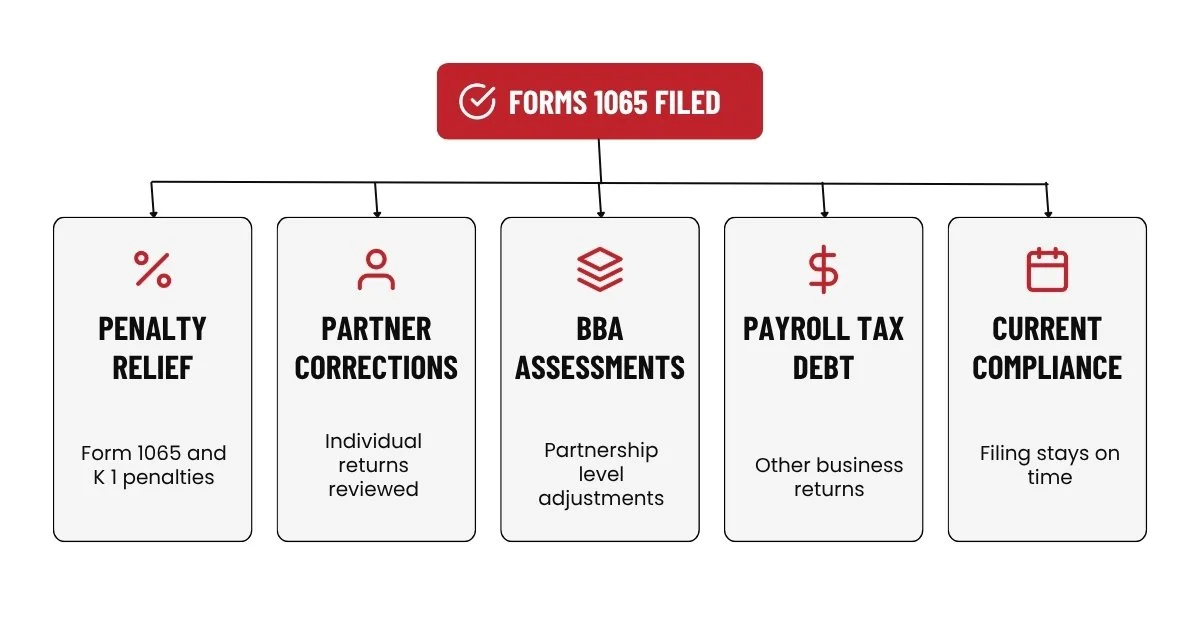
For many Form 1065 nonfiler cases, the next major issue is penalty relief rather than an income tax payment plan.
That is because Form 1065 is generally an information return.
However, the full account should still be reviewed.
Possible next steps can include:
Requesting partnership penalty relief
Addressing Schedule K 1 penalties
Correcting partner returns
Addressing an IRS Examination adjustment
Resolving a BBA partnership level assessment
Addressing payroll tax debt
Correcting other business returns
Establishing current filing compliance
The right next step depends on what the filed returns and IRS account actually show.
Common Mistakes With Unfiled Partnership Tax Returns

Treating Form 1065 Like a C Corporation Income Tax Return
A partnership generally reports information that passes through to partners rather than paying ordinary federal income tax on all partnership profit itself.
Ignoring Schedule K 1
The partner reporting is one of the primary purposes of Form 1065.
Using Current Ownership for Old Tax Years
Historical returns should reflect who actually owned partnership interests during those years.
Treating Capital Account as the Partner's Outside Basis
They are related but are not the same calculation.
Ignoring Guaranteed Payments
Guaranteed payments can affect both the partnership return and partner reporting.
Filing Without Reconstructing the Books
Several years of partnership returns should reconcile from one year to the next.
Filing the Partnership Return but Ignoring Partner Returns
A late Schedule K 1 can create a separate problem on a partner's Form 1040 or entity return.
Assuming Every Late Filing Penalty Must Be Paid
Reasonable cause, Revenue Procedure 84 35, AEP, or another applicable procedure may provide relief depending on the facts.
Why Work With Semper Tax Relief for Unfiled Partnership Returns?
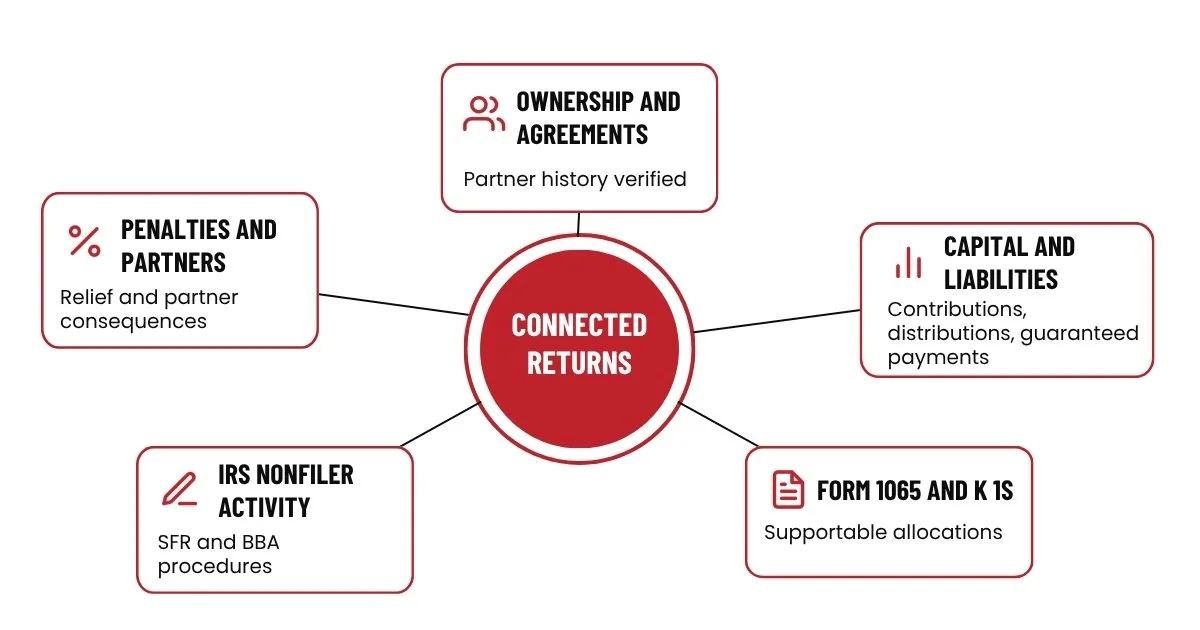
Partnership nonfiler cases can involve several taxpayers and several years of interconnected accounting records.
I review:
Form 1065 filing history
IRS business transcripts
Partnership classification
Partner ownership
Partnership agreements
Income and expenses
Balance sheets
Capital accounts
Partner liabilities
Contributions
Distributions
Guaranteed payments
Schedule K 1 reporting
IRS nonfiler activity
Substitute for Return procedures
Partnership penalties
Partner return consequences
I am Sergio Melendez, JD, EA.
I have worked in the tax profession since 2005 and represent individuals and businesses before the IRS as an Enrolled Agent.
My Juris Doctor degree is an educational credential.
My authority to represent taxpayers before the IRS comes from my Enrolled Agent credential.
The objective is to reconstruct accurate partnership reporting, provide the partners with supportable Schedule K 1 information, restore IRS filing compliance, and address penalties or other IRS issues that remain.
Results depend on the partnership's tax classification, accounting records, ownership history, partner information, filing years, IRS account history, and applicable federal tax rules.
Frequently Asked Questions About Unfiled Partnership Tax Returns
-
Possibly, and often yes.
A domestic partnership generally files Form 1065 unless it received no income and incurred no expenditures treated as deductions or credits for federal income tax purposes.
A partnership that operated at a loss can still have a filing requirement.
-
Generally, partnership income and deductions pass through to the partners, who report their respective shares on their own returns.
However, partnerships can still owe certain federal liabilities, including penalties, withholding obligations, employment taxes, and certain partnership level adjustments under the BBA audit regime.
-
For partnership returns required to be filed in 2026, the general penalty is $255 per person who was a partner at any time during the tax year, for each month or part of a month the return remains late, for up to 12 months.
Reasonable cause and other penalty relief may apply when the requirements are met.
-
The partnership may have a separate information reporting problem.
For statements required in 2026, a $340 penalty can generally apply for each Schedule K 1 that was not furnished timely or contained incorrect required information.
The partner may also need to review a previously filed tax return once the correct Schedule K 1 becomes available.
-
Possibly.
Revenue Procedure 84 35 provides a reasonable cause procedure for certain partnerships with 10 or fewer qualifying partners when all applicable requirements are satisfied.
General reasonable cause and current administrative penalty relief rules may also need to be reviewed.
-
Yes.
Current IRS examination procedures provide for Substitute for Return processing in partnership nonfiler cases.
The partnership should still prepare its own accurate Form 1065 using the actual books and ownership information.
-
The partnership's termination date should be established.
Current IRS rules generally treat a partnership as terminated when operations have stopped and no part of the business, financial operation, or venture continues in a partnership.
A final Form 1065 and final Schedule K 1 statements may still be required.
-
Yes.
I can review the partnership classification, identify the missing years, reconstruct or coordinate the bookkeeping, rebuild partner capital accounts, prepare Forms 1065 and Schedule K 1 statements, review IRS penalties, and identify related partner filing issues.
The amount of reconstruction required depends on the condition of the records and the number of ownership changes involved.
Get a Free Partnership Tax Filing Case Review
If your partnership has several missing tax returns, start by identifying the missing years, ownership history, and business records currently available.
I can review:
Missing Form 1065 years
IRS filing requirements
IRS business transcripts
CP259 notices
CP162 penalties
Partnership nonfiler examinations
Partnership classification
Business bookkeeping
Profit and loss statements
Balance sheets
Partner capital accounts
Partner ownership changes
Guaranteed payments
Partner distributions
Partner loans
Schedule K 1 reporting
Late filing penalties
Schedule K 1 penalties
Revenue Procedure 84 35
Automatic Exemption from Penalty
Reasonable cause
Final return requirements
Related partner tax return problems
You do not need to finish several years of bookkeeping before requesting the review.
Bring the IRS notices, partnership agreement, prior returns, bank statements, accounting records, ownership information, and prior Schedule K 1 statements currently available.
I can help determine what needs to be filed and what should happen next.