

IRS Revenue Officer Help
When an IRS Revenue Officer contacts you, your tax case has usually moved beyond normal notices and routine billing letters. This does not mean your case cannot be resolved, but it does mean the IRS is paying closer attention.
A Revenue Officer case can involve tax debt, unfiled tax returns, payroll tax problems, missed payment agreements, business tax issues, bank levies, wage garnishments, and tax liens. The IRS may ask for detailed financial records, business documents, payroll information, bank statements, and completed collection forms.
If an IRS officer contacted you, I can help you understand what is happening, what the IRS may be looking for, and what steps may help move your case toward a resolution.
Do I qualify for tax relief? Find out with a free case review.
Call today: 24 Hours / 7 Days a Week or book online.
✔ Confidential ✔ No Pressure ✔ Personalized
IRS Revenue Officer Help When Your Case Has Escalated to Field Collections
An IRS Revenue Officer is not the same as receiving a standard IRS notice in the mail. Revenue Officers usually handle more serious collection cases, especially when the IRS needs direct contact with the taxpayer or business.
What an IRS Revenue Officer does
A Revenue Officer works in IRS collection. Their job is to investigate unpaid tax accounts, review filing compliance, collect financial information, and determine how the IRS should proceed.
This may include reviewing whether you can pay in full, qualify for an IRS payment plan, submit an Offer in Compromise, request Currently Not Collectible status, or need another collection resolution.
A Revenue Officer may also review whether enforced collection action is appropriate. That can include a bank levy, wage garnishment, accounts receivable levy, or tax lien.
Why a Revenue Officer may be assigned
The IRS may assign a Revenue Officer when the case needs more attention than automated notices or phone collection can provide.
Common reasons include large unpaid tax balances, payroll tax debt, years of unfiled tax returns, repeated missed deadlines, defaulted payment agreements, or a business that is still operating while tax debt continues to grow.
For business owners, a Revenue Officer may also review payroll tax deposits, employment tax returns, business bank accounts, income sources, and whether responsible individuals may be at risk for personal assessment.
Why this is different from a normal IRS notice
A normal IRS notice usually gives you information, a deadline, and instructions to respond. A Revenue Officer case can be more direct.
You may receive requests for documents, financial forms, business records, and proof of current compliance. You may also face shorter response windows and closer review of your finances.
This is why guessing, delaying, or sending incomplete information can make the case harder. A Revenue Officer is not just asking whether you owe the tax. They are trying to determine what the IRS can collect and how they should collect it.
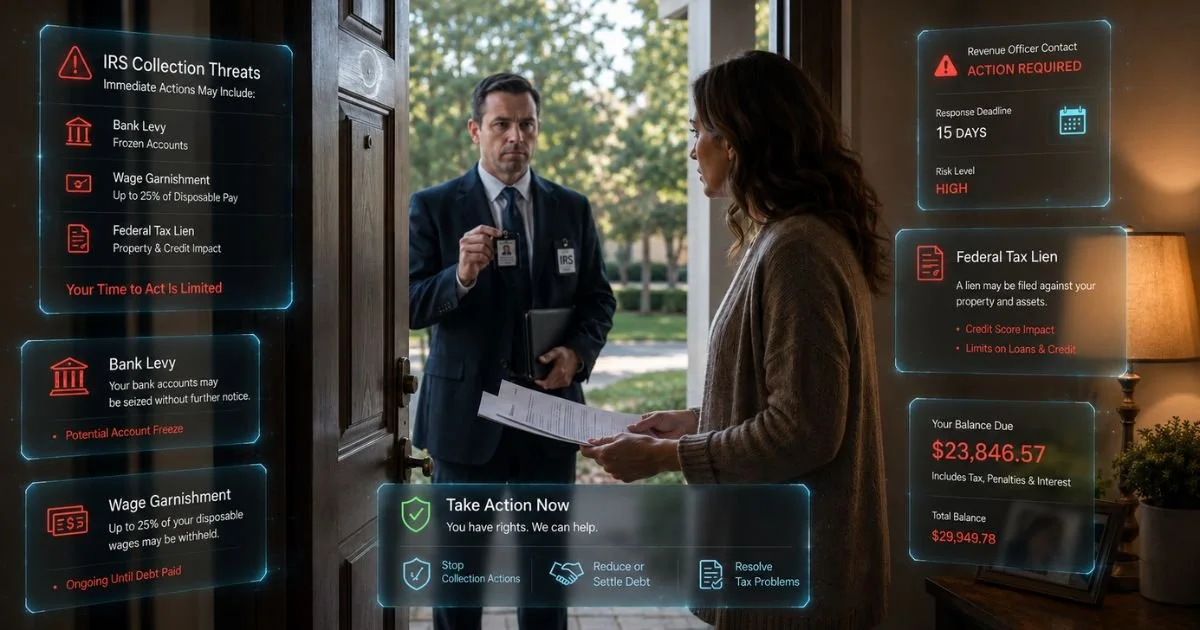
Common Reasons a Revenue Officer Contacts You
A Revenue Officer may contact you for several reasons. The reason matters because the right response depends on the type of tax problem involved.
Large unpaid tax balances
Large IRS balances often receive more attention. If the IRS believes there is a meaningful balance due and no active resolution in place, a Revenue Officer may be assigned to investigate your ability to pay.
The IRS may review your income, assets, bank accounts, property, expenses, and overall financial condition. The goal is to decide whether you can pay in full, make monthly payments, or qualify for another form of tax relief.
Payroll tax debt
Payroll tax debt is one of the most serious reasons a business may hear from a Revenue Officer. These cases often involve employment taxes that were withheld from employees but not paid to the IRS.
If your business owes payroll taxes, the Revenue Officer may review current deposits, past due returns, bank activity, payroll reports, and whether the business is staying current.
In some cases, the IRS may also investigate the Trust Fund Recovery Penalty. This can create personal exposure for owners, officers, or other responsible people involved in payroll tax decisions.
Unfiled tax returns
If you have years of unfiled tax returns, the IRS may assign a Revenue Officer to bring you back into filing compliance.
Before many relief options can be considered, the IRS usually wants required tax returns filed. This may include individual income tax returns, business tax returns, payroll tax returns, or other missing filings.
Filing compliance is often one of the first steps in a Revenue Officer case.
Missed payment agreements
If you had an IRS payment plan and stopped making payments, failed to file a required return, failed to stay current, or did not respond to IRS requests, the agreement may default.
A Revenue Officer may become involved if the IRS believes the account needs more direct collection review.
The key is to find out why the agreement failed and whether it can be reinstated, replaced, or resolved through another option.
Business tax collection issues
Business tax debt can move quickly because the IRS may be concerned about ongoing tax deposits, payroll compliance, business assets, and continued operations.
A Revenue Officer may ask for business bank statements, profit and loss statements, payroll records, accounts receivable information, equipment lists, loan statements, and proof of current deposits.
If your business is under IRS field collection, you should take the case seriously and respond with accurate information.

What a Revenue Officer May Request
A Revenue Officer may request documents that show your income, expenses, assets, debts, and compliance history. These requests should be handled carefully because the information may shape the resolution options available to you.
Financial statements
The IRS may request a Collection Information Statement. This form gives the IRS a detailed picture of your financial condition.
For individuals, this may include income, household expenses, bank accounts, vehicles, real estate, retirement accounts, investments, and debts.
For businesses, this may include revenue, expenses, assets, accounts receivable, equipment, loans, and business bank accounts.
Bank records
A Revenue Officer may ask for bank statements to verify income, cash flow, transfers, deposits, business activity, and available funds.
For business owners, bank records can be especially important because the IRS may compare deposits against reported income and payroll tax compliance.
Payroll records
If payroll taxes are involved, the Revenue Officer may request payroll reports, employment tax returns, deposit history, employee withholding records, and proof that current payroll taxes are being handled correctly.
The IRS may also review who had authority over payroll decisions, who signed checks, who controlled business funds, and who decided which bills were paid.
Tax returns and filing compliance
The IRS may ask for missing returns or proof that returns were filed. This can include individual returns, business returns, payroll tax returns, partnership returns, corporate returns, or other required filings.
If returns are missing, resolving the Revenue Officer case may require preparing and filing those returns first.
Collection information forms
The IRS may ask for forms such as Form 433 A, Form 433 B, or Form 433 F, depending on whether the case involves an individual, a self-employed taxpayer, or a business.
These forms should not be rushed. The numbers need to be accurate, supported, and consistent with the documents provided.

How to Respond to an IRS Revenue Officer
Your response should be organized, timely, and based on a clear strategy. The goal is not just to answer the Revenue Officer. The goal is to protect your position and move the case toward a practical resolution.
Do not ignore deadlines
Ignoring a Revenue Officer can increase the risk of enforced collection. If the IRS has requested documents or a response by a certain date, take that deadline seriously.
If more time is needed, it may be possible to request additional time, but that request should be made before the deadline passes.
Do not guess through financial forms
Financial forms are often the foundation of the collection decision. If the numbers are wrong, incomplete, or unsupported, the IRS may reject the proposal or ask for more information.
Guessing on income, expenses, assets, or business cash flow can create problems. It is better to slow down, gather records, and prepare the information carefully.
Get organized before submitting documents
Before sending documents to the IRS, review what is being requested, what has already been filed, what years are involved, and what collection action may be pending.
A strong response usually starts with organization. That includes notices, deadlines, tax years, balances, missing returns, bank records, payroll records, income details, and expenses.
Consider Power of Attorney representation
With Power of Attorney representation, a qualified tax professional can communicate with the IRS on your behalf.
This can help reduce confusion, protect against incomplete responses, and make sure the Revenue Officer receives the right information in the right format.
Representation does not guarantee a result. It can, however, help you avoid common mistakes and present your case in a more organized way.

How I Help With Revenue Officer Cases
When I help with an IRS Revenue Officer case, I focus on understanding the full picture first. The IRS may be looking at tax balances, filing compliance, current income, business activity, assets, payroll deposits, and collection risk.
Reviewing the case history
I begin by reviewing the case history. This may include IRS notices, account transcripts, missing returns, balances due, prior payment agreements, collection deadlines, liens, levies, and any prior contact with the IRS.
The goal is to understand why the case was assigned to a Revenue Officer and what needs to be addressed first.
Communicating with the Revenue Officer
I can communicate with the Revenue Officer on your behalf after proper authorization is in place.
This can include requesting time, clarifying document requests, discussing compliance issues, responding to collection concerns, and working toward a resolution path.
Preparing financial information
Revenue Officer cases often depend on financial information. I help review the required forms, supporting records, income, expenses, assets, debts, and business documents before they are submitted.
The goal is to provide accurate information that supports the best available resolution option.
Negotiating a resolution path
Depending on the facts, possible resolution options may include an IRS payment plan, a Partial Payment Installment Agreement, Currently Not Collectible status, an Offer in Compromise, penalty relief, filing compliance work, or other collection alternatives.
For business cases, the strategy may also include payroll tax compliance, trust fund review, business financial analysis, and steps to prevent the tax problem from continuing.

Get Help With an IRS Revenue Officer Case
If an IRS Revenue Officer contacted you, do not wait until the next deadline passes. The sooner the case is reviewed, the easier it may be to understand your options and avoid unnecessary mistakes.
Gather notices and deadlines
Start by gathering every IRS notice, letter, deadline, and document request you have received. If the Revenue Officer left a letter, business card, appointment notice, or request for records, keep those together.
Also gather recent tax returns, bank statements, payroll records, business records, and any prior IRS payment plan information.
Review your risk
The risk level depends on the facts. A Revenue Officer case may involve possible levies, liens, wage garnishment, business asset review, accounts receivable collection, payroll tax enforcement, or trust fund exposure.
A case review can help identify what the IRS is asking for, what deadlines matter, and what options may be available.
Request a free case review
If you need IRS Revenue Officer Help, I invite you to request a free case review with Semper Tax Relief.
I will review the situation, explain what the Revenue Officer may be looking for, and help you understand possible next steps. There are no guarantees, and every case depends on the facts, but you do not have to face the IRS alone.

Request Your Free Revenue Officer Case Review
If an IRS Revenue Officer contacted you, now is the time to get organized and respond carefully. Contact Semper Tax Relief to request a free case review. I will help you understand what is happening, what the IRS may request, and what resolution options may fit your situation.
Questions About IRS Revenue Officer Help Frequently Asked Questions
-
The IRS may assign a Revenue Officer when your case needs direct collection attention. This can happen because of a large unpaid tax balance, payroll tax debt, unfiled tax returns, a defaulted payment plan, or business tax collection issues.
A Revenue Officer case usually means the IRS wants more information and may be reviewing whether collection action is appropriate.
-
Yes, a Revenue Officer may be involved in enforced collection action, including a bank levy, if the IRS has followed the required process and the case is not resolved. Whether a levy can happen depends on the facts, notices issued, deadlines, appeal rights, and current status of the case.
If you are concerned about a levy, it is important to review the case quickly.
-
You can speak to a Revenue Officer on your own, but you should be careful. What you say and submit may affect the direction of the case.
If the case involves large balances, payroll taxes, missing returns, business records, liens, levies, or trust fund issues, representation may help you respond in a more organized and informed way.
-
A Revenue Officer may request tax returns, bank statements, financial statements, payroll records, profit and loss statements, business records, loan statements, asset information, expense records, and Collection Information Statements.
The exact request depends on whether the case involves an individual, a self employed taxpayer, or a business.
-
Yes, some Revenue Officer cases can be resolved with an IRS payment plan. The IRS will usually review filing compliance, current tax compliance, financial information, and ability to pay before accepting a plan.
Other options may also be available depending on the facts, including Currently Not Collectible status, a Partial Payment Installment Agreement, or an Offer in Compromise.