
How Long Does IRS Tax Resolution Typically Take, Notice to Resolution
This is one of the first questions almost every client asks me, and I understand why. When you are staring at a notice, "how long" is not just curiosity, it is about knowing how long you have to live with the uncertainty.
The honest answer is that it depends heavily on which resolution path applies to your situation, and I want to walk through realistic ranges for each rather than give you a single number that will not actually match your case.

TLDR
- Timelines vary significantly by resolution type, from weeks for a simple payment plan to many months for an Offer in Compromise.
- IRS processing times generally depend on current staffing, case complexity, and how complete your submission is the first time.
- Missing documentation or an incomplete submission is the most common cause of delay across every resolution path.
- Cases that are already in enforced collection, meaning an active levy or an assigned Revenue Officer, generally move on a different and often faster timeline than cases that are not yet escalated.
- This article gives general ranges based on typical IRS processing patterns, not a guarantee for any specific case.
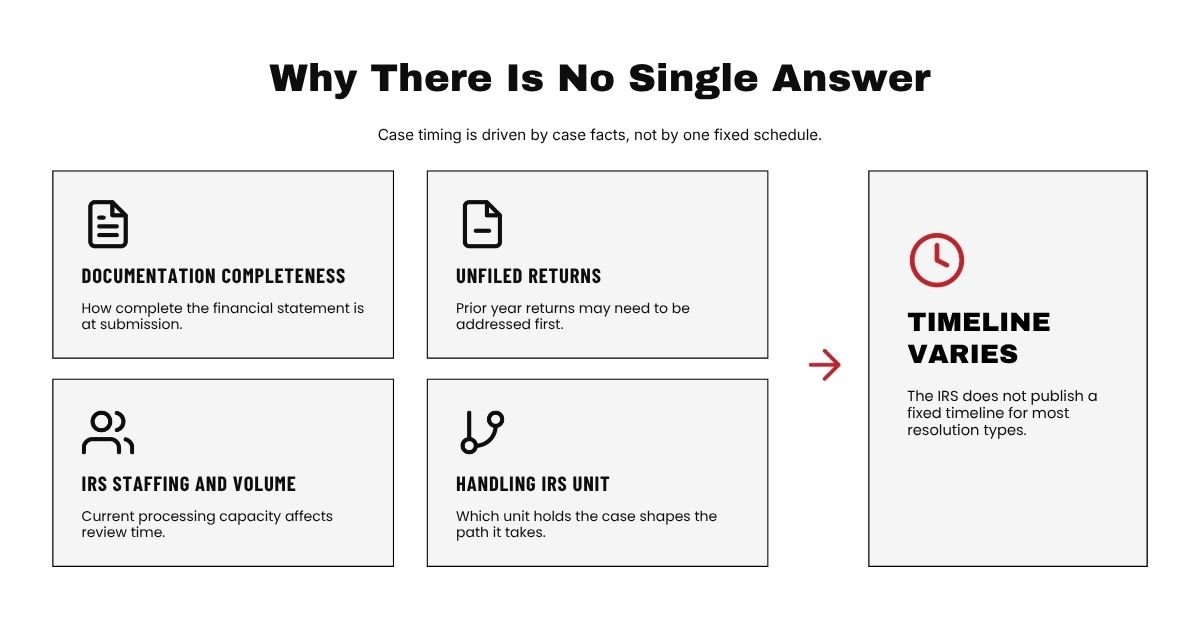
Why There Is No Single Answer
I want to be upfront about something before giving you any numbers. The IRS does not publish a fixed timeline for most resolution types, and the actual time a case takes depends on factors that are specific to your
situation: how complete your financial documentation is, whether you have unfiled returns that need to be addressed first, current IRS staffing and processing volume, and which IRS unit is handling your case.

Typical Timeframes by Resolution Type
Installment Agreements
A simplified installment agreement for a qualifying balance can often be set up quickly, in some cases within the same session online, since it generally does not require a full financial disclosure.
A non-streamlined agreement requiring a full financial statement generally takes longer, since it requires IRS review of Form 433-A or 433-B before approval.
Currently Not Collectible Status
CNC status generally requires submitting financial documentation showing that paying would create a hardship, and IRS review time varies depending on current caseload and whether a Revenue Officer is already assigned to the case.
Offer in Compromise
An Offer in Compromise generally takes the longest of the common resolution paths. The IRS reviews the offer amount, the supporting financial documentation, and confirms filing and payment compliance before making a determination.
Penalty Abatement
First-Time Abatement requests, when the case qualifies, can sometimes be resolved relatively quickly since eligibility is largely based on a compliance history check. Reasonable cause abatement requests generally take longer, since they require IRS review of the specific facts and supporting documentation submitted.
What Actually Slows a Case Down
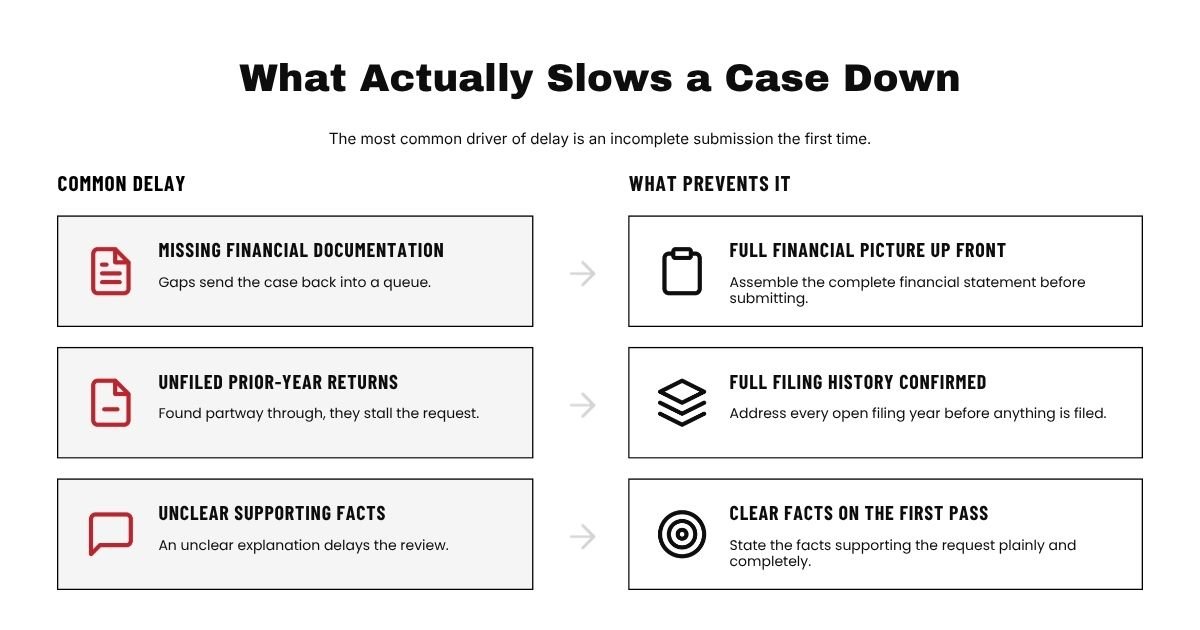
In my experience, the single biggest driver of delay across every resolution type is not the IRS's internal processing speed. It is an incomplete submission the first time around.
Missing financial documentation, unfiled prior-year returns discovered partway through the process, or an unclear explanation of the facts supporting a request all generally result in the case going back into a queue rather than moving forward. This is why I always want the full financial picture and full filing history up front, before submitting anything, rather than filling gaps in after the IRS responds.
Cases Already in Active Collection Move Differently
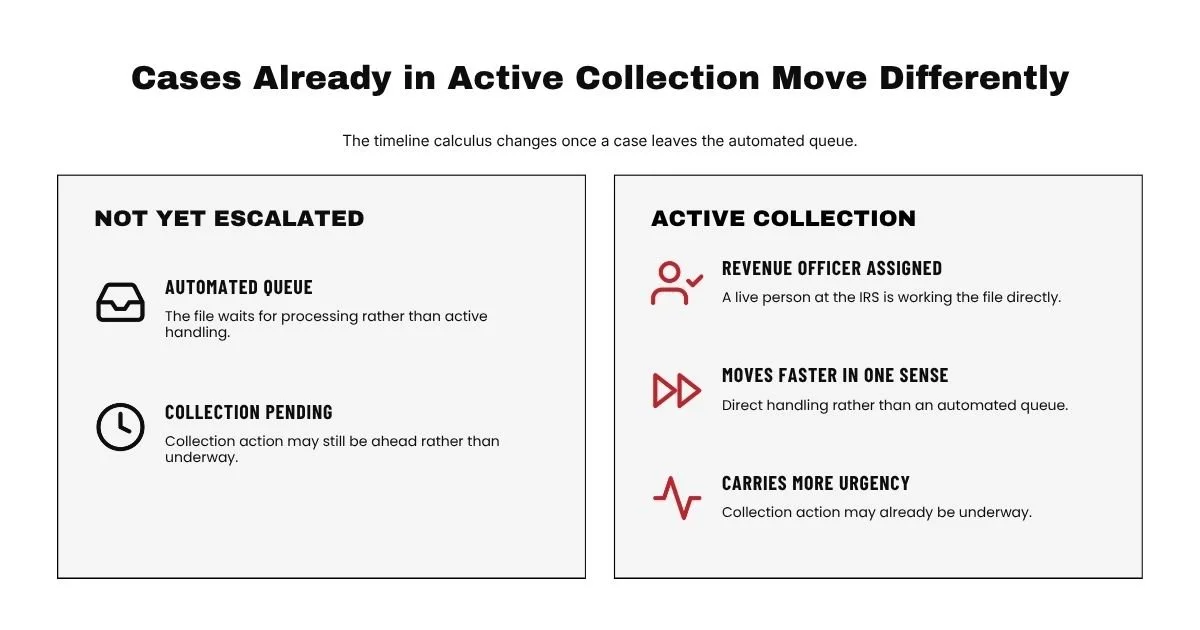
If your case already involves an active levy or an assigned Revenue Officer, the timeline calculus changes. These cases generally move faster in one sense, because there is a live person at the IRS actively working the file rather than an automated queue, but they also generally carry more urgency, since collection action may already be underway rather than pending.
How I Set Expectations With Clients
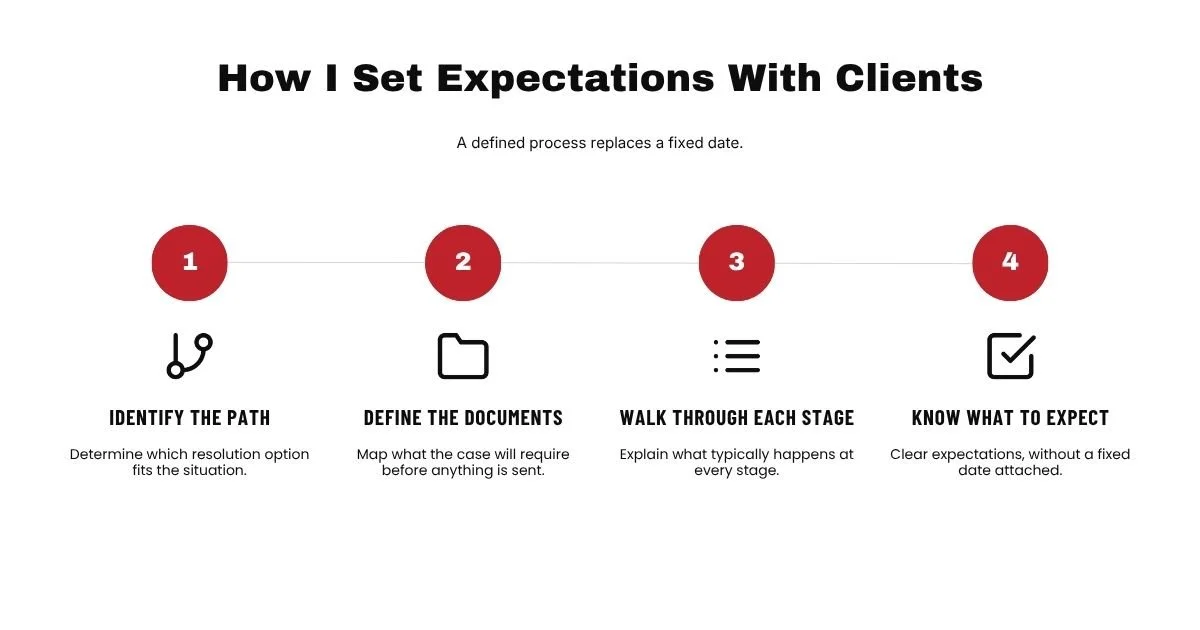
I do not like giving a client a specific date, because I have seen too many cases move faster or slower than expected based on factors outside anyone's control.
What I do instead is walk through which resolution path fits, what documentation the case will require, and what typically happens at each stage, so you know what to expect even without a fixed date attached to it.
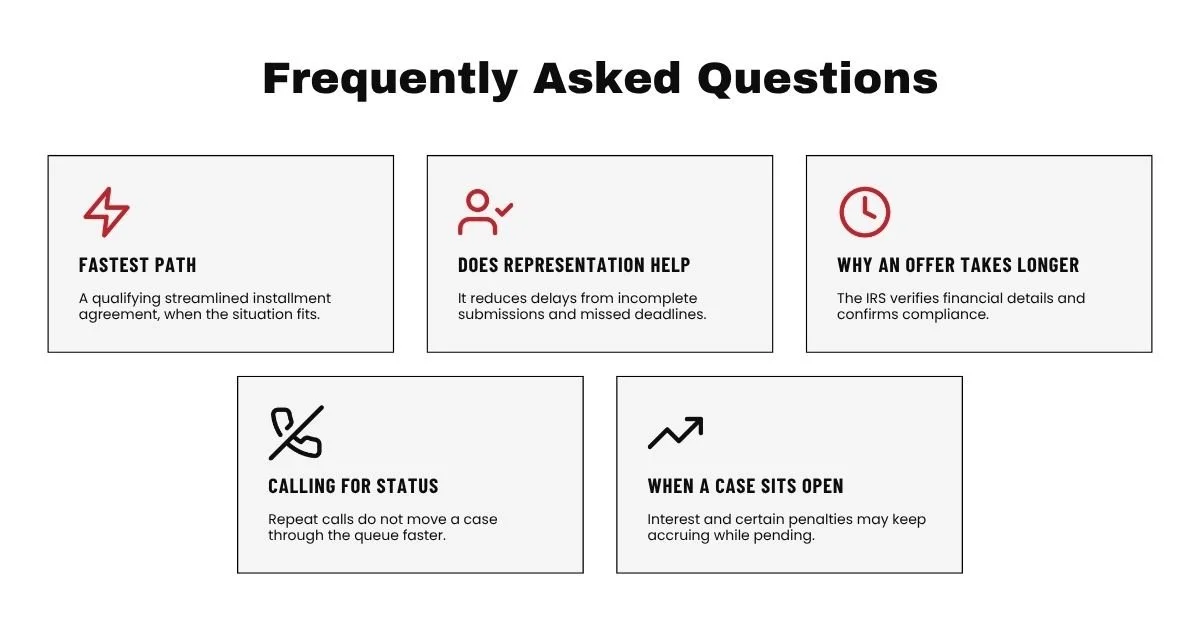
Frequently Asked Questions
-
Generally, a qualifying streamlined installment agreement is the fastest path when the balance and situation qualify, since it typically does not require a full financial disclosure.
Faster is not always the right fit, since a payment plan may not be the best option for every situation. -
Not necessarily in terms of IRS internal processing time, but representation can reduce delays caused by incomplete submissions, missed deadlines, or miscommunication, which are common causes of a case taking longer than it needed to.
-
OIC review generally takes longer than other resolution types because the IRS is verifying financial details, confirming compliance, and in some cases requesting additional documentation. Complex cases or high current IRS caseloads can extend this further.
-
Generally no. Calling for status updates does not typically move a case through the queue faster, and in most cases the person answering the phone cannot see anything beyond the same status information available through other channels.
-
Interest and, depending on the resolution type, certain penalties may continue to accrue while a case is pending, so a longer timeline is not automatically neutral. This is part of why getting the submission right the first time matters.
What Matters More Than the Exact Timeline
The honest truth is that most people asking "how long will this take" really want to know "when will this stop feeling out of control." Once you know which resolution path fits and what the case actually requires, the waiting becomes a defined process rather than an open-ended worry.
I offer a free case review where I can look at your specific situation and give you a realistic sense of what to expect, rather than a generic number that may not apply to your case.