
What an Enrolled Agent Can and Cannot Do for Your IRS Case
I hold the Enrolled Agent credential myself, so I want to answer this one directly and precisely, because I regularly see the credential misunderstood, sometimes underestimated, sometimes overstated.
An Enrolled Agent, or EA, is a federally licensed tax practitioner with unlimited rights to represent taxpayers before the IRS. That license comes directly from the Treasury Department, not from a state, and it is governed by a specific set of federal regulations known as Circular 230.
Here is exactly what that means, what it does not mean, and how it compares to a CPA, a tax attorney, and an unenrolled preparer.

TLDR
- Enrolled Agents have unlimited representation rights before the IRS, the same practice authority as attorneys and CPAs for IRS matters.
- Unlimited means an EA can represent any taxpayer, on any tax matter, before any IRS office, including audits, collections, and appeals.
- Unlike a CPA or attorney, whose licenses cover much broader professional scopes, the EA credential is tax-specific by design.
- EAs earn the credential either by passing a three-part IRS exam or through qualifying prior IRS employment, and must complete ongoing continuing education to keep the license active.
- An EA generally cannot represent a client in U.S. Tax Court or file a civil lawsuit, a distinction from an attorney.
- An unenrolled tax preparer has far more limited representation rights, generally restricted to returns they personally prepared and signed.
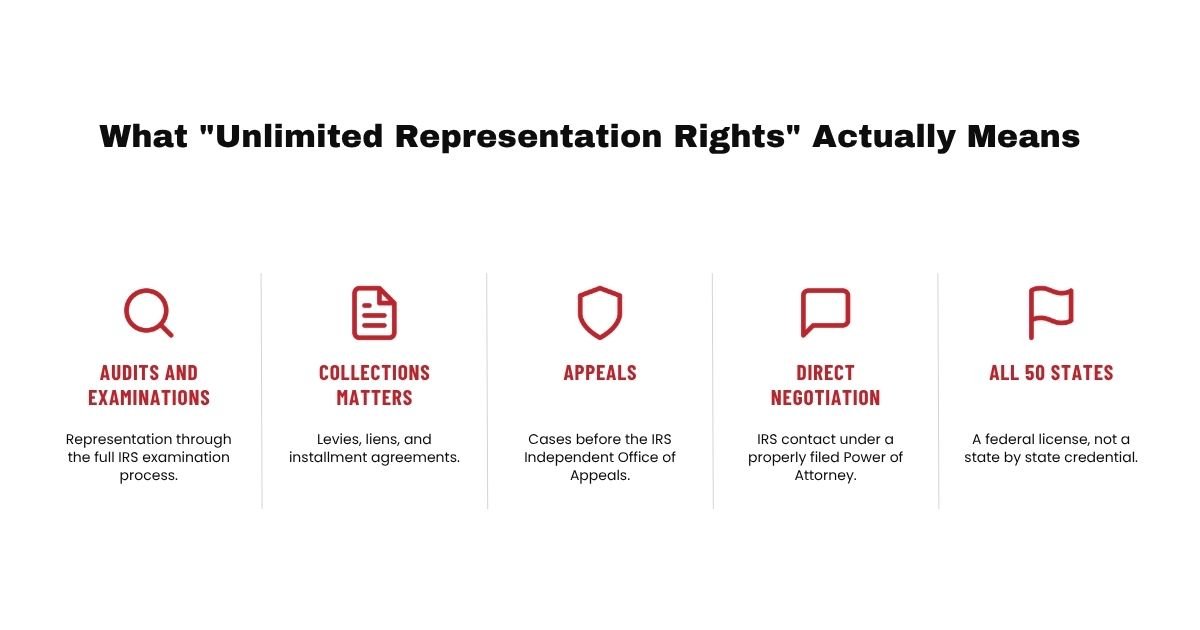
What "Unlimited Representation Rights" Actually Means
This phrase gets used loosely, so I want to define it precisely, straight from the source. The IRS states that Enrolled Agents, like attorneys and CPAs, have unlimited practice rights, meaning they are unrestricted as to which taxpayers they can represent, what types of tax matters they can handle, and which IRS offices they can represent clients before.
In practice, that generally covers:
- Audits and examinations
- Collections matters, including levies, liens, and installment agreements
- Appeals before the IRS Independent Office of Appeals
- Correspondence and negotiation directly with IRS personnel on a client's behalf under a properly filed Power of Attorney
This authority is not tied to which state you live in. It is a federal license that applies the same way in all 50 states, without the state by state licensing considerations that apply to some other credentials.
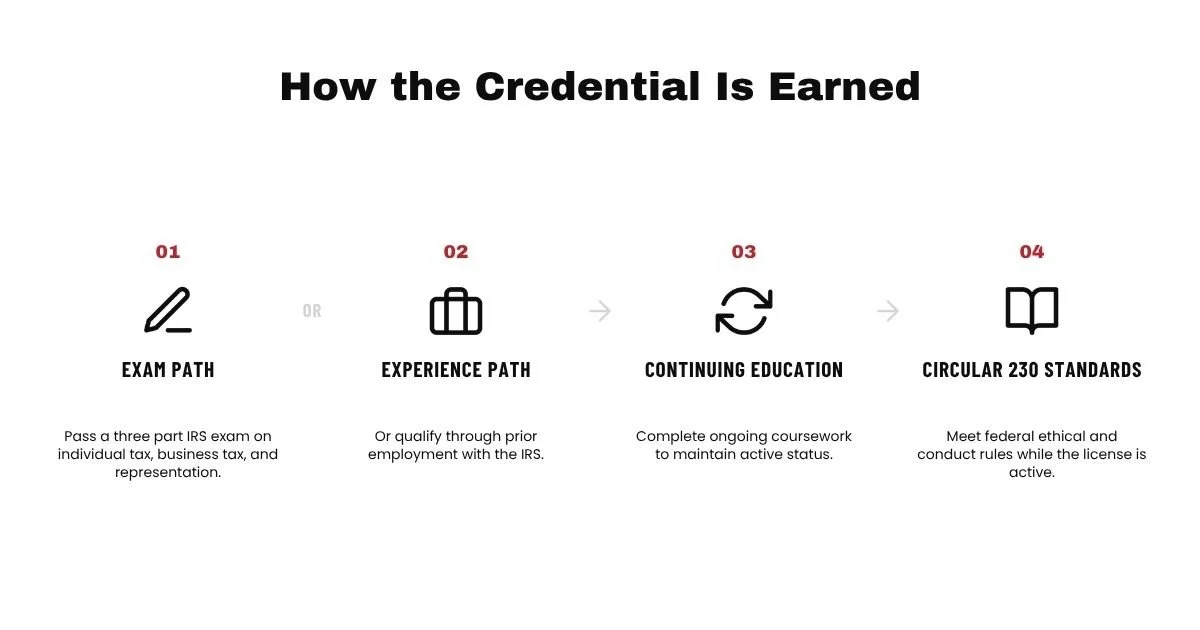
How the Credential Is Earned
An Enrolled Agent earns the credential one of two ways: by passing a three part IRS exam covering individual taxation, business taxation, and representation, practice, and procedures, or through qualifying prior employment with the IRS.
Once licensed, an EA is required to complete ongoing continuing education to maintain active status, and remains subject to Circular 230's ethical and conduct standards for as long as the license is active.
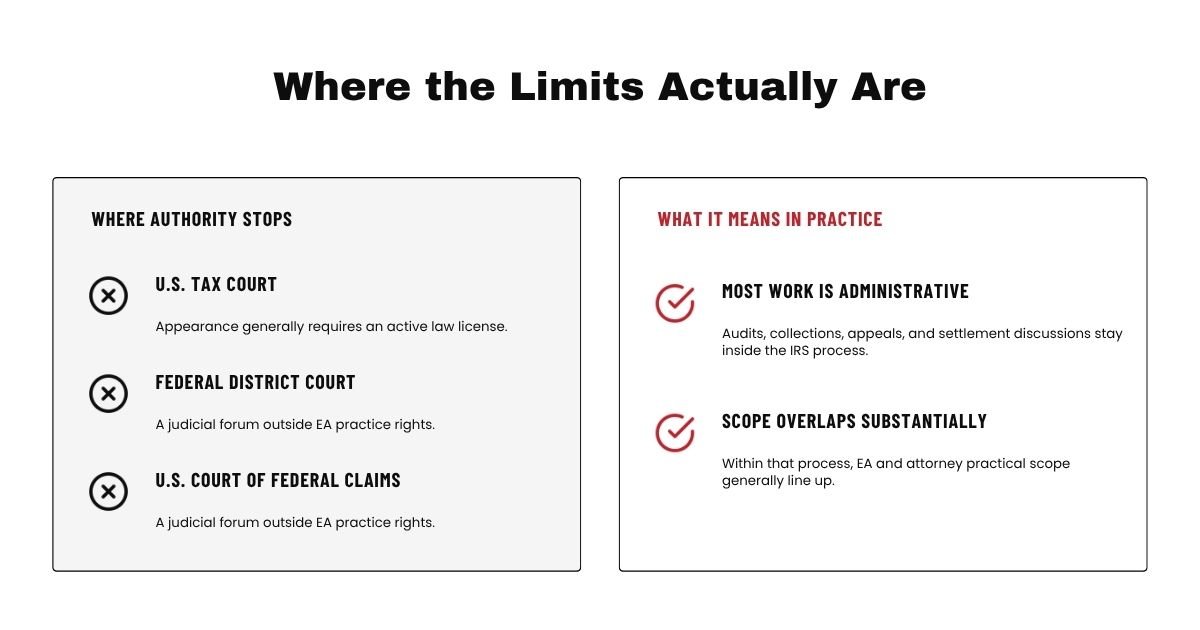
Where the Limits Actually Are
Unlimited does not mean unlimited in every possible legal setting, and I think this is the part that gets glossed over most often.
An Enrolled Agent generally cannot represent a client in U.S. Tax Court, federal district court, or the U.S. Court of Federal Claims. Appearing in those judicial forums generally requires an active law license.
What this generally means in practice is straightforward. The large majority of tax resolution work, audits, collections negotiations, appeals, and settlement discussions, happens entirely within the IRS's administrative process and never requires a court appearance at all. For matters confined to that administrative process, an EA's practical scope and a tax attorney's practical scope generally overlap substantially.
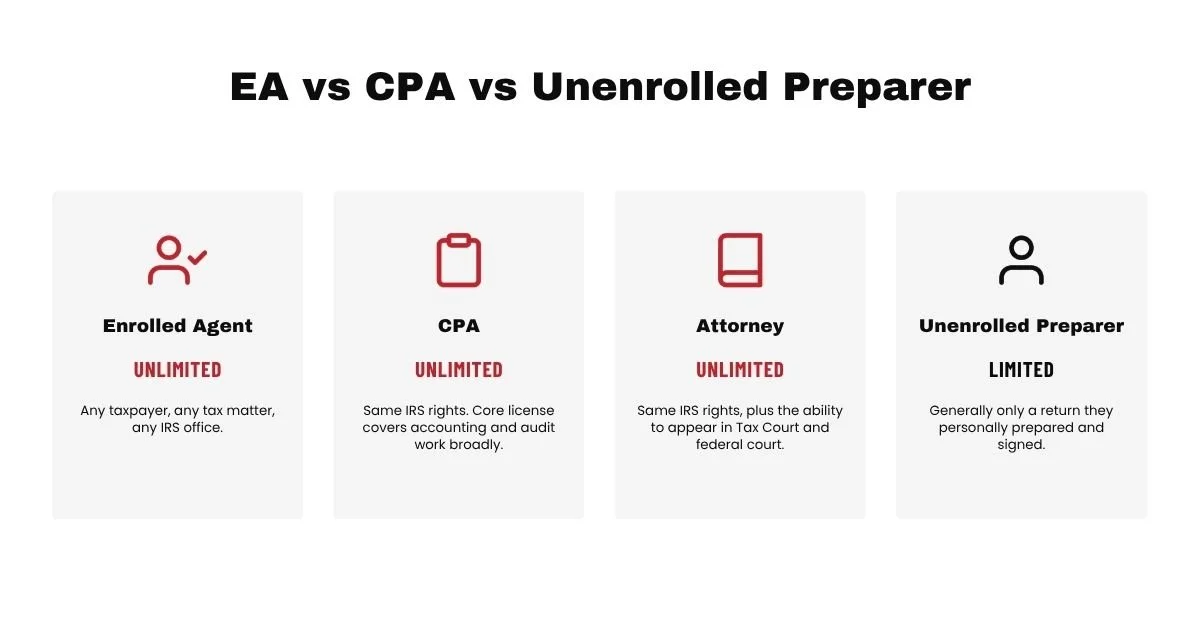
EA vs CPA vs Unenrolled Preparer
REPRESENTATION RIGHTS BEFORE THE IRS
Enrolled Agent: Unlimited - any taxpayer, any matter, any IRS office
CPA: Unlimited, same as EA, but core licensure covers accounting and audit functions broadly rather than tax specifically.
Attorney: Unlimited, plus the ability to appear in Tax Court and federal court.
Unenrolled Preparer (no credential): Generally limited to representing a client only for a return they personally prepared and signed, and only before certain IRS personnel like revenue agents and customer service representatives.
Why This Distinction Matters to a Taxpayer
If your tax problem involves more than the single return an unenrolled preparer signed, for example a multi-year collections case, a payroll tax issue, or an appeal, an unenrolled preparer generally cannot represent you on that broader matter at all. This is not a quality judgment about any individual preparer. It is a hard boundary set by federal regulation.
What This Means for How I Work With Clients
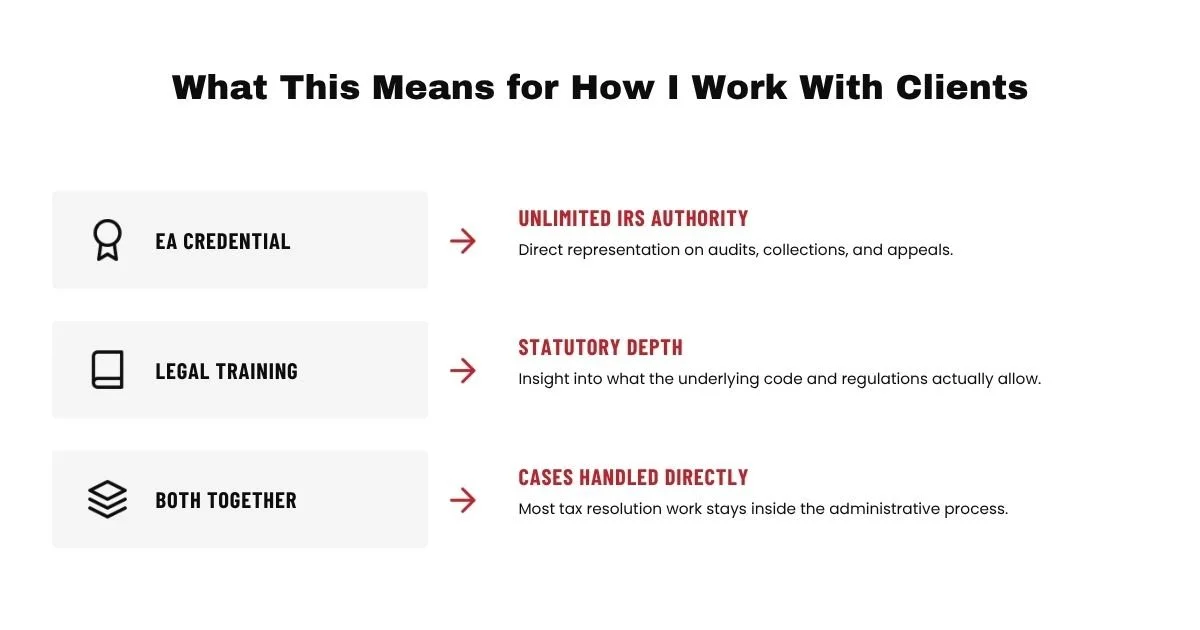
Because I hold both the EA credential and a Juris Doctor, I want to be precise about what each one actually adds, rather than blending them together the way marketing sometimes does. My EA status is what gives me unlimited authority to represent clients directly before the IRS on audits, collections, and appeals. My legal training adds depth on the statutory and procedural side of a case, understanding not just what the IRS is doing, but why, and what the underlying code and regulations actually allow.
For the vast majority of tax resolution cases, the work happens entirely within the administrative process I am licensed to handle directly as an EA.
Frequently Asked Questions
-
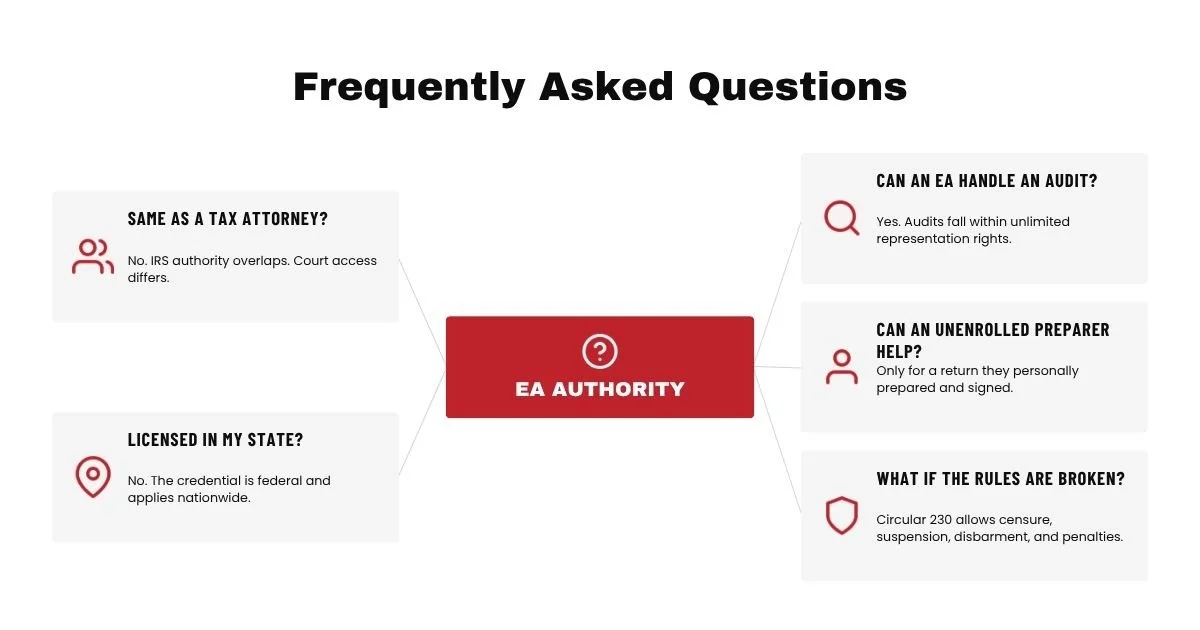
No, though the practical representation authority overlaps substantially for most IRS matters. Both hold unlimited representation rights under Circular 230, but an attorney additionally holds a state law license and can appear in Tax Court and federal court, which an EA generally cannot.
-
Yes. Audits fall squarely within the unlimited representation rights an EA holds, which cover any tax matter before any IRS office.
-
Generally only in a limited way, and only for a return they personally prepared and signed, before certain IRS personnel. For broader collections or appeals matters, an unenrolled preparer generally cannot represent you at all.
-
No. The EA credential is a federal license issued by the Treasury Department and applies the same way nationwide, without state-by-state licensing requirements.
-
Circular 230 allows for censure, suspension, disbarment from practice before the IRS, and monetary penalties for violations.
Choosing the Right Representation for Your Situation
The credential someone holds should tell you exactly what they are legally allowed to do for you, not just how experienced they sound.
If your situation involves an audit, a collections matter, unfiled returns, or an appeal, you want someone with unlimited representation rights, which means an EA, a CPA, or an attorney, not an unenrolled preparer whose authority is limited to the return they signed.
I offer a free case review where I can walk through exactly what your situation involves and what representation it actually requires.