
IRS Form 433 A: Step by Step Guide to the Collection Information Statement
Meta Description: Complete guide to IRS Form 433 A for wage earners and self employed taxpayers, with step by step instructions, real examples, and a documentation checklist.
IRS Form 433 A gives the IRS a detailed picture of your income, monthly expenses, assets, debts, household, employment, and business finances.
The IRS may use this financial information to evaluate how much you can pay toward an outstanding tax balance and which collection resolution may fit your current circumstances.
Form 433 A may support an installment agreement, a partial payment installment agreement, or Currently Not Collectible status. A separate version, Form 433 A (OIC), is used when an individual applies for an Offer in Compromise.
The current regular Form 433 A was revised in June 2026. Wage earners generally complete Sections 1 through 5. Self employed individuals generally complete Sections 1, 3, 4, 5, 6, and 7. Someone with wages and self employment income may need to complete every section.
I am Sergio Melendez, JD, EA. I have spent nearly 20 years helping taxpayers address IRS tax debt, unfiled returns, collection notices, liens, levies, payment plan problems, and financial hardship.
My approach begins with the complete IRS account. I review filing compliance, account transcripts, collection status, income, expenses, assets, available equity, and the resolution the taxpayer is requesting.
Direct Answer
IRS Form 433 A is an IRS financial disclosure form.
Completing it does not guarantee that the IRS will approve a payment plan, hardship status, or another tax relief option. It gives the IRS the information needed to analyze your financial condition and ability to pay.
Your form should be complete, consistent with your financial records, and supported by recent documents.
The numbers you report may affect the monthly payment the IRS requests, the assets it expects you to address, and whether the IRS agrees that collection would create financial hardship.

What Is IRS Form 433 A and Why Does It Matter?
IRS Form 433 A is officially called the Collection Information Statement for Wage Earners and Self Employed Individuals.
The form is used to obtain current financial information from an individual who has an outstanding federal tax liability.
People sometimes call it the IRS hardship Form 433 A. That is not its official name.
Form 433 A may be used to support a hardship request, but it is also used for payment plans, collection investigations, levy release requests, and other financial decisions.
H3 | What Information Does Form 433 A Report?
Form 433 A asks for information about:
• Your household
• Your employment
• Your spouse and dependents
• Expected income changes
• Lawsuits and bankruptcy history
• Trusts and estates
• Certain asset transfers
• Cash and financial accounts
• Investments
• Digital assets
• Available credit
• Life insurance cash value
• Real estate
• Vehicles
• Personal property
• Monthly household income
• Monthly living expenses
• Business income, expenses, accounts, and assets when you are self employed
The current form also asks about foreign assets and financial interests.
It contains questions about digital assets, online financial accounts, mobile payment accounts, business payment processors, and financial interests in business entities.
Form 433 A Is Evidence, Not an Agreement
Submitting Form 433 A does not automatically create a payment plan.
It does not automatically place your account into Currently Not Collectible status.
It also does not automatically release a levy or prevent the IRS from filing a Notice of Federal Tax Lien.
The form provides financial evidence.
The IRS reviews that evidence and applies its collection rules before deciding whether to approve the requested resolution.
This distinction is important.
A taxpayer can prepare an accurate Form 433 A and still request a resolution that does not fit the financial facts.
The financial statement and the requested collection outcome must work together.

Where Form 433 A Fits in the IRS Collection Process
The IRS normally begins collection after a tax has been assessed and a balance due notice has been issued.
If the balance is not resolved, the account may remain in the Automated Collection System, be assigned to a Revenue Officer, or be routed through another IRS collection process.
A detailed Collection Information Statement becomes more likely when:
• You cannot pay the balance in full
• You request a payment below what the IRS expects
• You claim that collection would create financial hardship
• You have substantial assets
• You operate a business
• You have a Revenue Officer assigned
• Your case requires individual financial review
Who May Be Asked to Complete Form 433 A?
Form 433 A may be used for an individual who:
• Owes individual income taxes reported on Form 1040
• May be responsible for a Trust Fund Recovery Penalty
• May be personally responsible for a partnership liability
• Owns a disregarded limited liability company
• Is self employed
• Receives both wages and self employment income
The IRS may request a different Collection Information Statement based on the taxpayer, the type of liability, the collection department, and the resolution being considered.
Revenue Officer Cases
A Revenue Officer may use Form 433 A to investigate income, expenses, assets, financial accounts, business activity, and the taxpayer’s ability to pay.
The Revenue Officer may compare reported income with allowable expenses, review available equity, consider expected income changes, and request documents to verify the information.
A Collection Information Statement should contain recent information.
The IRS may request an updated form when the financial information becomes outdated or the taxpayer’s circumstances change.
Private Collection Agency Cases
The IRS private debt collection program is part of the broader federal tax collection system.
Private collection agencies handle certain inactive tax receivables assigned by the IRS.
The IRS retains responsibility for tax administration and for collection decisions that private collectors are not authorized to make.
A private collection agency generally cannot approve every IRS collection resolution.
A taxpayer may need the account returned to the IRS when requesting a financial hardship determination, an Offer in Compromise, or another resolution that requires an IRS decision.

IRS Form 433 A vs Form 433 F and Other Financial Forms
The correct financial statement depends on the taxpayer, the tax liability, and the collection option being considered.
Do not substitute one form for another merely because one appears shorter.
Form 433 A
Primary Use:
Individual collection cases involving wage earners, self employed individuals, or detailed financial review.
Level of Detail:
Detailed personal, household, asset, income, expense, and business information.
Form 433 F
Primary Use:
Individual collection cases and payment requests that may require a shorter financial statement.
Level of Detail:
Condensed financial information covering employment, accounts, assets, income, and expenses.
Form 433 B
Primary Use:
Business entities, including corporations, partnerships, and certain limited liability companies.
Level of Detail:
Business accounts, assets, income, expenses, employees, and accounts receivable.
Form 433 A (OIC)
Primary Use:
Individual Offer in Compromise applications.
Level of Detail:
Offer specific asset, equity, income, expense, and settlement calculations.
IRS Form 433 A vs 433 F Difference
Form 433 F also collects current financial information from wage earners and self employed individuals.
It is shorter and presents income, employment, assets, and expenses in a more condensed format.
Form 433 A requests broader details about:
• The taxpayer’s household
• Financial history
• Asset transfers
• Foreign financial interests
• Trusts and estates
• Digital assets
• Available credit
• Business operations
Use the form requested by the IRS.
Do not submit Form 433 F when an IRS notice or Revenue Officer specifically requests Form 433 A.
Form 433 A and Form 433 B
A sole proprietor filing Schedule C generally completes the self employment sections of Form 433 A.
Other business entities may need to complete Form 433 B.
A business owner may need to provide both forms when the IRS is reviewing the business liability and the owner’s ability to contribute funds.
IRS Form 433 A OIC
Regular Form 433 A and Form 433 A (OIC) are not interchangeable.
Form 433 A (OIC) is used with Form 656 when an individual submits an Offer in Compromise.
It contains calculations and documentation requirements that apply specifically to an offer.
A taxpayer requesting an installment agreement or Currently Not Collectible status should not automatically use the OIC version.
A taxpayer submitting an Offer in Compromise should follow the current Form 656 package and use the required OIC financial statement.
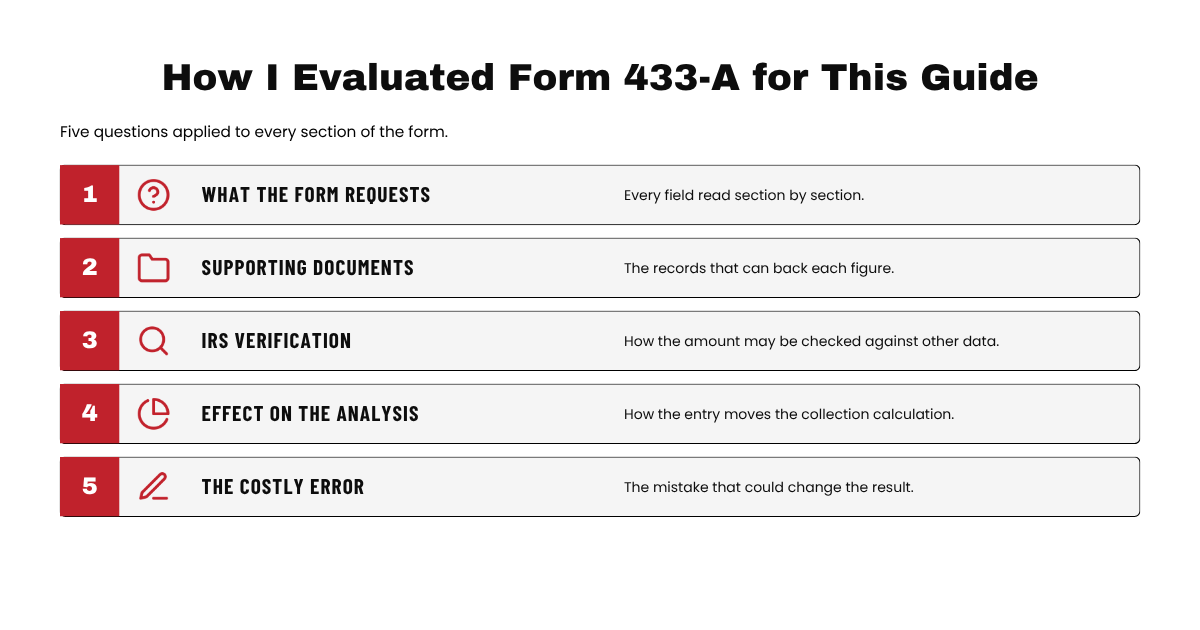
How I Evaluated Form 433 A for This Guide
This guide follows an evidence based method.
I reviewed the current form, the supporting IRS publication, current collection financial standards, the Internal Revenue Manual, and Taxpayer Advocate Service guidance.
Primary Research Sources
The analysis is based on:
Form 433 A, revised June 2026
Publication 1854, How to Prepare a Collection Information Statement
Form 433 A (OIC)
IRS Collection Financial Standards
Internal Revenue Manual Section 5.15.1
Taxpayer Advocate Service guidance for installment agreements and Currently Not Collectible status
Official IRS sources should control when they differ from older articles, online examples, or marketing descriptions.
Evaluation Criteria
I reviewed each part of Form 433 A based on five questions:
What information does the form request?
What documents can support that information?
How may the IRS verify the amount?
How could the information affect the collection analysis?
What mistake could change the result?
This is the same general case method I use when reviewing IRS tax debt.
I first confirm filing compliance and collection status.
I then review income, living expenses, asset equity, collection deadlines, and the requested resolution.
Limits of Financial Examples
The examples in this guide are illustrations.
They are not promises, guarantees, or predictions.
Two taxpayers with the same income can receive different results because of:
• Household size
• County of residence
• Medical costs
• Secured debts
• Business expenses
• Asset equity
• Tax periods
• Filing compliance
• Remaining IRS collection time
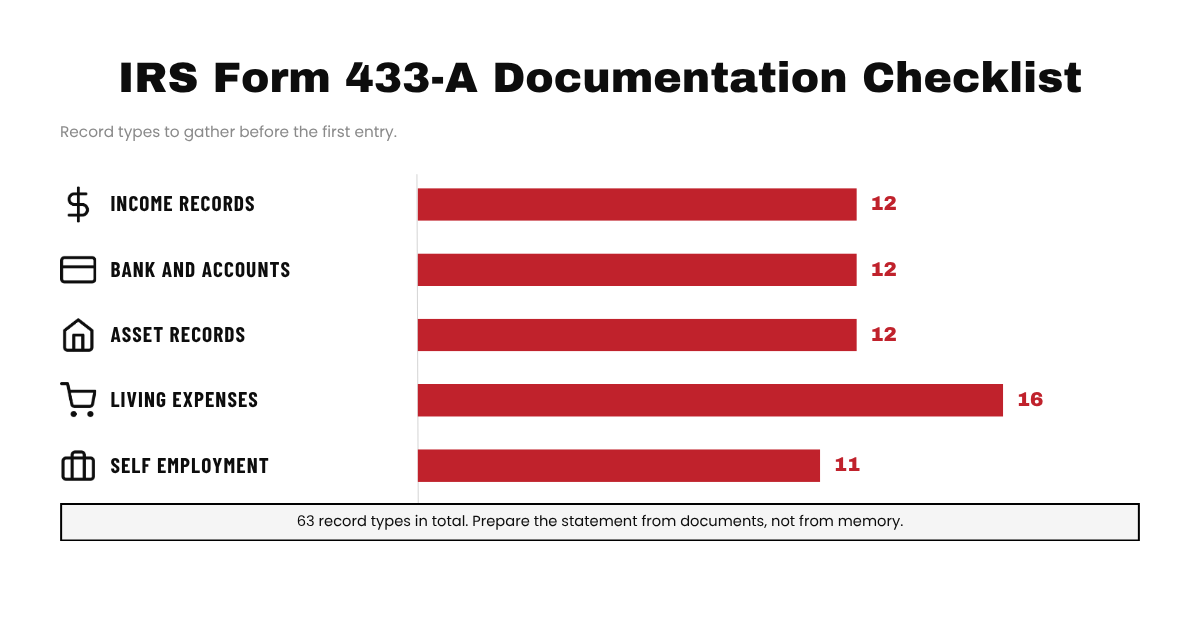
IRS Form 433 A Documentation Checklist
The strongest place to begin is with financial records.
Do not prepare Form 433 A from memory when supporting documents are available.
The IRS may request verification after reviewing the completed statement.
Income Documents
Gather recent records for every source of household income that must be reported, including:
• Pay statements
• Pension statements
• Social Security benefit records
• Unemployment records
• Rental income records
• Partnership distributions
• S corporation distributions
• Court ordered support received
• Investment income
• Gig income
• Platform income
• Recurring gains from asset sales
Do not treat every bank deposit as income.
Deposits may include transfers, loans, refunds, reimbursements, gifts, or actual income.
Each deposit should be identified correctly.
Bank and Financial Account Records
Gather recent statements for:
• Checking accounts
• Savings accounts
• Credit union accounts
• Online financial accounts
• Mobile payment accounts
• Stored value cards
• Brokerage accounts
• Retirement accounts
• Digital asset exchanges
• Digital wallets
• Lines of credit
• Cash value life insurance
Include accounts requested by the form even when the current balance is low or zero.
Asset Records
Gather records showing the current value, ownership, and debt for:
• Real estate
• Vehicles
• Boats
• Recreational vehicles
• Investments
• Retirement accounts
• Digital assets
• Valuable personal property
• Business equipment
• Inventory
• Accounts receivable
• Intangible business assets when applicable
For real estate and vehicles, use a supportable current value rather than the original purchase price.
Current fair market value generally means the amount the asset could reasonably sell for today.
Living Expense Records
Gather proof of:
• Rent or mortgage
• Property taxes
• Homeowner insurance
• Utilities
• Vehicle loan payments
• Vehicle operating costs
• Public transportation
• Health insurance
• Medical expenses not covered by insurance
• Childcare
• Dependent care
• Court ordered payments
• Current federal tax payments
• Current state tax payments
• Delinquent state tax payments
• Other necessary expenses
Separate recurring expenses from one time purchases.
When an expense changes throughout the year, calculate a reasonable monthly average and keep the calculation.
Self Employment Records
A self employed taxpayer should also gather:
• A current profit and loss statement
• Business bank statements
• Payment processor reports
• Accounts receivable
• Accounts payable
• Payroll reports
• Proof of business tax payments
• Vehicle and equipment records
• Business loan statements
• Inventory information
• Records of cash receipts
Business income and expenses should reconcile with the profit and loss statement and bank records.
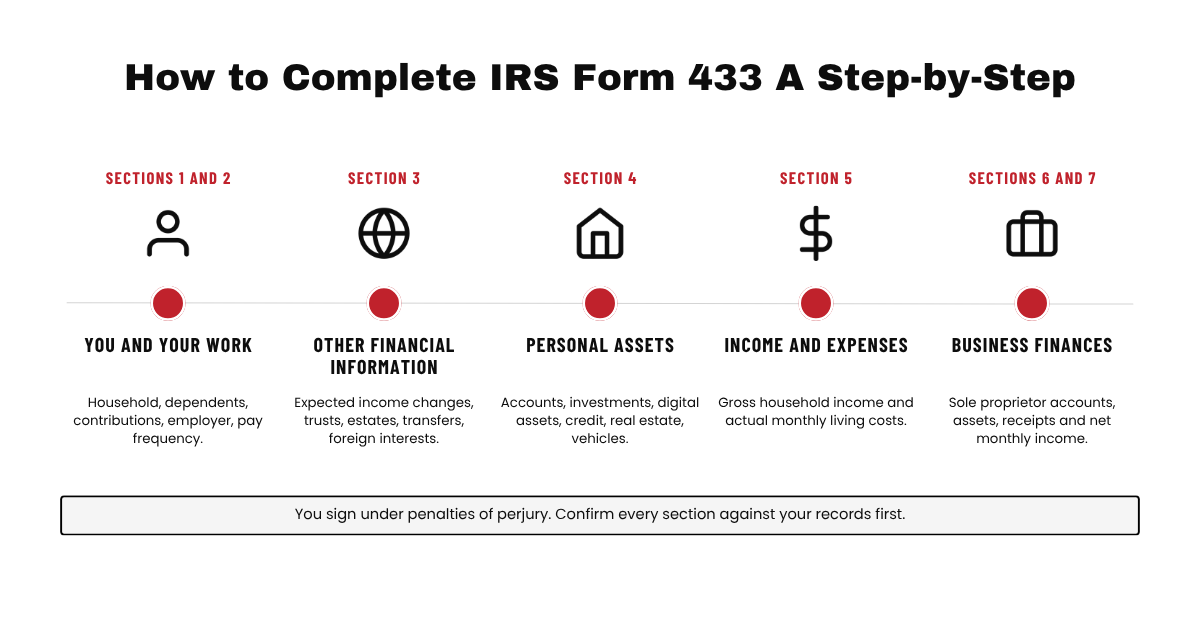
How to Complete IRS Form 433 A Step by Step
The following walkthrough follows the current June 2026 version of Form 433 A.
Read the complete IRS request before beginning because the IRS may ask for specific attachments or set a response deadline.
H3 | Section 1, Personal Information
Section 1 asks for:
• Your name
• Your address
• Your county of residence
• Telephone numbers
• Marital status
• Identifying information
• Household members
• Dependents
• Household contributions
• Outside business interests
Household information matters because family size and shared finances can affect the expense analysis.
List household members accurately.
A person living in the home is not automatically treated as a dependent for every IRS calculation.
The form separately asks whether the person is claimed as a dependent and whether that person contributes income to the household.
Report outside business interests even when the business does not currently generate a profit.
Section 2, Employment Information for Wage Earners
This section asks for:
• Employer information
• Occupation
• Length of employment
• Pay frequency
• Workplace contact information
Use current employment information.
When you or your spouse has more than one employer, attach an additional schedule when the form does not provide enough space.
If income varies because of overtime, commissions, bonuses, or changing hours, explain the pattern and use records that show a fair monthly amount.
The form separately asks whether income is expected to increase or decrease.
Use gross wages in the income section.
Payroll deductions are addressed through the applicable expense and tax categories.
Section 3, Other Financial Information
Section 3 asks about circumstances that may reveal future income, financial claims, or assets.
The questions include:
• Expected increases or decreases in income
• Pending lawsuits
• Bankruptcy history
• Passports
• Extended periods outside the United States
• Dual citizenship
• Incarceration
• Interests in trusts
• Interests in estates
• Life insurance benefits
• Safe deposit boxes
• Certain asset transfers during the previous ten years
The current form asks whether assets with a fair market value greater than $10,000 were transferred for less than full value during the prior ten years.
Answer this question carefully and provide the requested details when it applies.
Section 4, Personal Asset Information
Section 4 requests domestic and foreign assets.
Cash and Financial Accounts
Report cash held outside financial institutions.
List checking, savings, online, mobile, money market, and stored value accounts.
Use the balance as of a specific date.
Do not use a typical balance when the form requests the current balance.
Investments and Business Interests
Report:
• Stocks
• Bonds
• Mutual funds
• Certificates of deposit
• Retirement accounts
• Commodities
• Interests in business entities
List the current value, loan balance, and resulting equity.
Digital Assets
The current form contains a separate digital asset section.
It asks about:
• Virtual currency
• Nonfungible tokens
• Smart contracts
• Wallets
• Exchanges
• Storage locations
• Current United States dollar value
Report direct ownership and other financial interests.
Keep valuation records showing the date and source used.
Available Credit
List bank issued credit cards and lines of credit as requested.
Available credit does not mean that the IRS will always require you to borrow.
The IRS may consider access to credit as part of the broader financial analysis.
Life Insurance
Report policies with cash value.
Include:
• Current cash value
• Policy loans
• Available cash
Term life insurance normally does not have cash value, but the premium may still be relevant in the monthly expense analysis.
Real Estate
List:
• Houses
• Condominiums
• Land
• Rental property
• Time shares
• Other property interests
Provide:
• Current fair market value
• Loan balance
• Monthly payment
• Ownership information
• Equity
Vehicles
Report owned and leased vehicles, including:
• Cars
• Trucks
• Motorcycles
• Boats
• Recreational vehicles
Include:
• Mileage
• Current value
• Loan balance
• Monthly payment
• Equity
Personal Assets
The form asks about:
• Furniture
• Artwork
• Jewelry
• Collections
• Antiques
• Licenses
• Patents
• Copyrights
• Domain names
• Mining claims
Ordinary household property may have limited resale value.
Do not report replacement cost as fair market value.
Use a supportable amount the property could reasonably bring if sold.
Section 5, Monthly Income and Expenses
Section 5 brings together household income and monthly living expenses.
Income may include:
• Gross wages
• Social Security
• Pensions
• Net rental income
• Business distributions
• Net business income
• Child support received
• Alimony received when applicable
• Other recurring income
Rental income should be reported after ordinary and necessary rental expenses.
Do not use depreciation as a monthly cash expense.
If net rental income is a loss, the form may require zero rather than a negative amount.
Expense categories include:
• Food
• Clothing
• Housekeeping supplies
• Personal care
• Miscellaneous household costs
• Housing
• Utilities
• Vehicle ownership
• Vehicle operating expenses
• Public transportation
• Health insurance
• Medical costs not covered by insurance
• Court ordered payments
• Childcare
• Dependent care
• Term life insurance
• Current taxes
• Secured debts
• Delinquent state or local taxes
• Other necessary expenses
Report actual monthly expenses on the form.
The IRS will decide which amounts are allowable after applying its collection standards and reviewing the facts of the case.
Section 6, Business Information
Section 6 is completed by self employed individuals operating a sole proprietorship.
It requests:
• Business identification
• The type of business
• Employees
• Payment processors
• Accounts receivable
• Business accounts
• Business credit
• Business assets
A taxpayer operating through another business entity may need Form 433 B instead.
List each payment processor and each business bank account.
Do not omit online accounts, mobile accounts, or digital payment platforms.
Section 7, Business Income and Expenses
Section 7 calculates monthly net business income.
Business income may include:
• Gross receipts
• Rental income
• Interest
• Dividends
• Cash receipts
• Other business income
Business expenses may include:
• Materials
• Inventory
• Wages
• Rent
• Supplies
• Utilities
• Vehicle costs
• Repairs
• Insurance
• Current business taxes
• Other ordinary business expenses
Do not deduct personal expenses as business expenses.
Do not deduct depreciation as though it were a monthly cash payment.
The business calculation should match the records and current profit and loss statement.
Signature and Certification
You sign Form 433 A under penalties of perjury.
You certify that the financial statement is true, correct, and complete to the best of your knowledge.
For a joint liability, both spouses may need to sign.
Review every section before signing.
Confirm that the form matches:
• Bank statements
• Pay records
• Tax returns
• Loan statements
• Business records
• Asset records
• Supporting expense documents

How the IRS Uses Form 433 A to Decide Payment Plans
The IRS financial analysis generally focuses on four areas:
Monthly income
Allowable living expenses
Asset equity and access to funds
Future ability to pay
The result is not based only on what remains in your bank account today.
Monthly Disposable Income
The IRS compares income with allowable expenses.
The amount remaining may be treated as available to pay the tax debt.
Example:
A taxpayer reports $6,500 in monthly income and $6,300 in actual expenses.
The IRS reviews the expenses and allows only $5,700.
The IRS may calculate monthly disposable income of $800.
The disagreement often concerns allowable expenses rather than reported income.
Asset Equity
The IRS may identify liquid assets and available equity.
When you have cash or liquid assets sufficient to pay the liability, the IRS may request immediate payment.
When you have substantial equity that could be borrowed against or sold without creating financial hardship, the IRS may request payment from that equity.
The IRS should consider the facts surrounding the asset, including:
• Ownership
• Secured debt
• Access to the asset
• Sale expenses
• Tax consequences
• Whether liquidation would create hardship
Future Income Changes
Form 433 A asks whether income is expected to increase or decrease.
Examples include:
• A known job loss
• Retirement
• A new employment contract
• A scheduled bonus
• Seasonal business changes
• The end of temporary disability income
• A return to work
• A reduction in overtime
Document a foreseeable change.
Do not assume the IRS will accept a financial prediction without supporting evidence.
Filing and Payment Compliance
A collection resolution generally requires you to file required tax returns and remain current with future tax obligations.
For a wage earner, this may require correcting federal income tax withholding.
For a self employed taxpayer, this may require current estimated tax payments.
For a business, this may require current payroll tax deposits and timely tax filings.
A future unpaid balance can place an installment agreement or other resolution at risk.
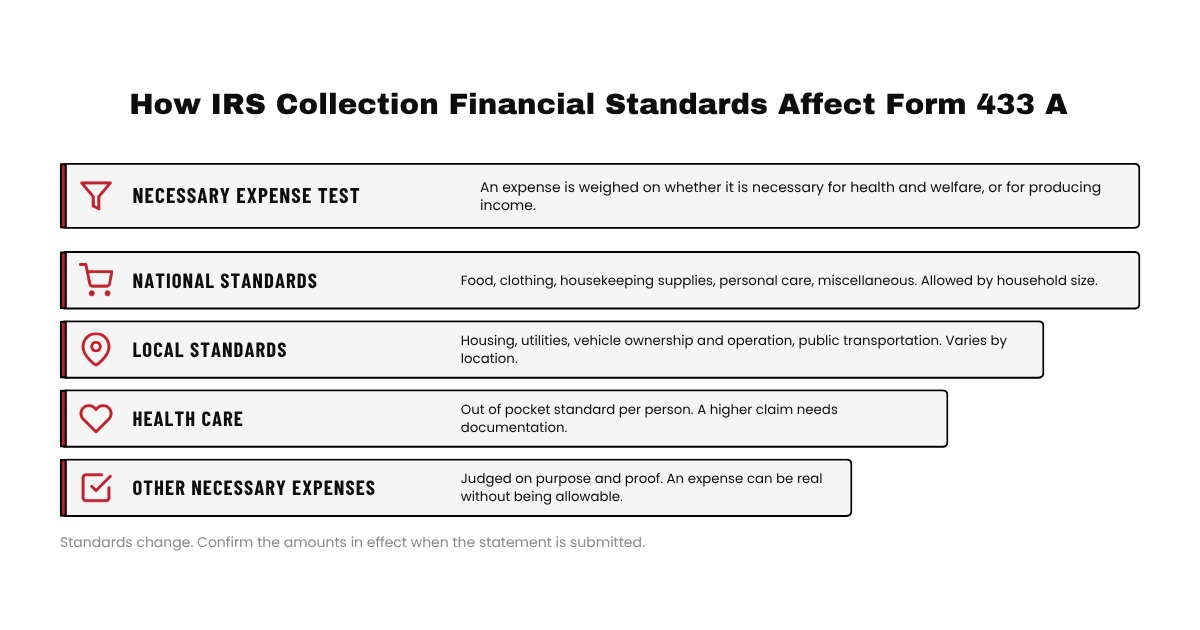
How IRS Collection Financial Standards Affect Form 433 A
The IRS Collection Financial Standards help determine a taxpayer’s ability to pay delinquent federal taxes.
The standards can change.
Confirm the amounts that apply when the financial statement is submitted.
H3 | The Necessary Expense Test
The IRS generally considers whether an expense is necessary for:
• The health and welfare of the taxpayer and family
• The production of income
This does not mean that every expense above a published standard is automatically rejected.
The IRS may allow a higher amount when the taxpayer’s facts support it and the lower allowance would leave the taxpayer without adequate funds for basic living costs.
National Standards
National Standards cover categories such as:
• Food
• Housekeeping supplies
• Clothing
• Personal care products
• Personal care services
• Miscellaneous expenses
The IRS generally allows the total National Standards amount for the applicable household size without requiring proof of the amount actually spent.
Claims above the standard may require evidence showing that the added expense is necessary.
Local Standards
Local Standards address:
• Housing and utilities
• Vehicle ownership
• Vehicle operating expenses
• Public transportation
Housing amounts vary by location and household size.
Transportation amounts may vary by region and the number of vehicles allowed.
A published allowance is not automatically added to the taxpayer’s budget when the taxpayer does not incur the expense.
The IRS considers the applicable collection rule and the taxpayer’s actual facts.
Health Care Expenses
Health insurance is generally listed separately from medical expenses paid directly by the taxpayer.
The IRS publishes an out of pocket health care standard.
A taxpayer claiming a higher amount should be prepared to verify the expense and explain why it is necessary.
Recurring prescriptions, treatment, therapy, medical equipment, and required care can materially affect a hardship analysis when properly documented.
Other Necessary Expenses
Certain expenses are evaluated based on their purpose and documentation.
Examples may include:
• Court ordered support
• Childcare needed for employment
• Current taxes
• Secured debt payments
• Delinquent state tax payments
• Required employment expenses
• Certain education costs
• Certain dependent care costs
An expense can be real without being allowable for IRS collection purposes.
The analysis is based on whether the IRS treats the expense as necessary under its collection rules.
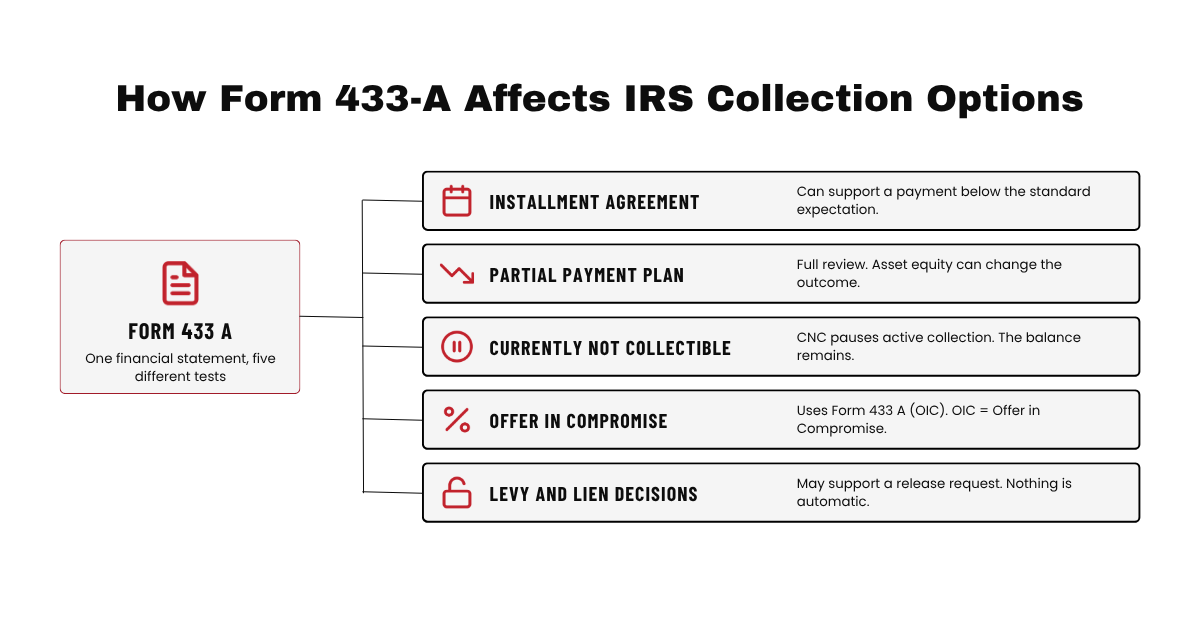
How Form 433 A Affects IRS Collection Options
A completed financial statement can affect several collection resolutions.
The same financial facts can lead to different results depending on the program being requested.
IRS Form 433 A for an Installment Agreement
Form 433 A may be requested when:
• You do not qualify for a simpler payment arrangement
• You request a payment below what the IRS expects
• You have complex finances
• You have a Revenue Officer assigned
The IRS reviews disposable income, assets, the total balance, and the remaining collection period.
A financial statement can support a lower payment, but you must show why a higher payment is not affordable under IRS standards.
An installment agreement does not erase interest or penalties.
The IRS may apply future refunds to the balance.
A Notice of Federal Tax Lien may still be filed in some cases.
Partial Payment Installment Agreement
A partial payment installment agreement may allow monthly payments that are not expected to pay the full balance before the IRS collection period expires.
The IRS performs a full financial review.
The IRS may review the taxpayer’s finances again later.
Available asset equity can affect whether the IRS approves the proposal or requires payment from an asset.
Currently Not Collectible Status
The IRS may place an account into Currently Not Collectible status when the taxpayer cannot pay the tax and also meet necessary living expenses.
Currently Not Collectible status generally pauses active collection.
It does not eliminate the debt.
Interest and penalties may continue.
Tax refunds may be applied to the balance.
A federal tax lien may still affect the taxpayer.
The IRS may later request updated financial information if the taxpayer’s ability to pay appears to have improved.
Offer in Compromise
An Offer in Compromise based on inability to pay generally uses Form 433 A (OIC), not the regular Form 433 A.
The OIC financial statement calculates:
• Equity in assets
• Future income
• Allowable expenses
• Reasonable collection potential
A low monthly budget alone does not establish OIC eligibility.
Home equity, retirement funds, investments, business assets, and expected future income can increase the required offer amount.
Levies and Liens
How Form 433 A affects IRS collection actions depends on what the financial statement proves and what resolution is requested.
The form may support a request to avoid or release a levy when collection would create financial hardship.
The form can also reveal income or assets that the IRS may consider available for payment.
Submitting Form 433 A is not the same as obtaining a levy release.
You should make the request directly and confirm the IRS decision.
A financial resolution also does not automatically remove a filed federal tax lien.
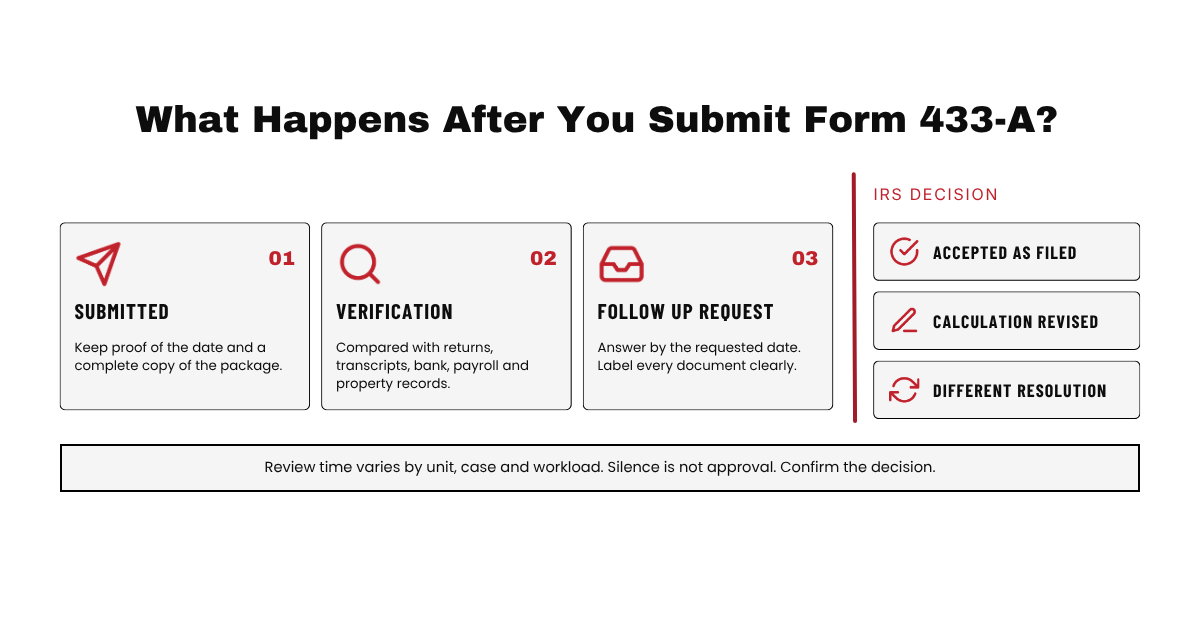
What Happens After You Submit Form 433 A?
After submission, the IRS may:
• Accept the financial information
• Request clarification
• Ask for additional documents
• Revise the expense calculation
• Question asset values
• Propose a different payment amount
• Request liquidation or borrowing against an asset
• Approve or deny the requested resolution
Financial Verification
The IRS may compare Form 433 A with:
• Filed tax returns
• Wage and income information
• Bank statements
• Credit information when permitted by procedure
• Property records
• Vehicle information
• Business records
• Payroll filings
• IRS account transcripts
• Third party information obtained under applicable procedures
Differences do not always mean the form is incorrect.
A bank deposit may be a transfer rather than income.
A tax return may reflect an older period.
Explain the difference and provide supporting records.
Follow Up Requests
A follow up request often means the IRS needs more information before making a decision.
Respond by the requested date.
Identify each document clearly.
Keep the documents organized in the same order as the IRS request.
Do not send original records unless the IRS specifically requires them.
Keep a complete copy of everything submitted.
How Long Does Review Take?
There is no single review period for every Form 433 A.
Timing depends on:
• The IRS collection unit
• Whether a Revenue Officer is assigned
• The completeness of the submission
• The requested resolution
• The number of tax periods
• Business involvement
• Asset valuation issues
• Follow up documents
• IRS workload
Do not assume silence means approval.
Monitor the account and request confirmation of the IRS decision.
Where Do You Send Form 433 A?
There is no universal mailing address for every Form 433 A submission.
Send the form to the:
• IRS office listed in the request
• Assigned Revenue Officer
• Fax number provided by the IRS
• Document Upload Tool location provided in the notice
• Address listed in the applicable correspondence
When responding to an IRS notice, follow the instructions for that notice and department.
Keep proof of submission and a complete copy of the package.

IRS Form 433 A Examples for Tax Debt Cases
These examples show how different facts may affect the analysis.
They are illustrations and do not guarantee a specific IRS result.
Example 1, Wage Earner Requesting a Payment Plan
A married taxpayer owes $58,000 and receives regular wages.
The household includes two children, one vehicle loan, rent, health insurance, and childcare required for both spouses to work.
The taxpayer prepares Form 433 A using:
• Pay statements
• Bank records
• The rental agreement
• Childcare invoices
• Health insurance records
The actual budget shows $500 remaining each month.
The IRS reduces one unsupported expense and calculates $650 of monthly disposable income.
The form may support an installment agreement near the amount accepted by the IRS, subject to collection time, available assets, and other requirements.
Example 2, Self Employed Taxpayer With Seasonal Income
A contractor owes taxes from four years.
Revenue is strong during eight months of the year and significantly lower during the remaining months.
Using only the most recent profitable month would overstate the ability to pay.
Using only a slow month would understate it.
The taxpayer prepares:
• A twelve month income analysis
• A current profit and loss statement
• Business bank records
• Supporting invoices
• Current estimated tax payment records
The IRS can review the seasonal pattern, necessary business expenses, current tax compliance, and average net monthly income before proposing a payment.
Example 3, Family With High Medical Costs
A taxpayer has income above the published standards but also has recurring treatment costs, prescriptions, and medical travel expenses for a dependent.
The taxpayer reports the actual expense and provides:
• Medical bills
• Payment records
• Insurance explanations
• Prescription records
• Proof that treatment is continuing
The IRS may consider an amount above the general health care standard when the additional cost is necessary and supported.
Depending on the complete financial analysis, the evidence could support a reduced payment or Currently Not Collectible status.
Example 4, Taxpayer With Home Equity
A taxpayer has limited monthly disposable income but substantial equity in a second property.
The monthly budget may support a low payment.
However, the IRS may also review whether the property could be sold or borrowed against without causing financial hardship.
The asset may prevent hardship status or affect the amount required under another resolution.
This example shows why the IRS result cannot be predicted from monthly income alone.
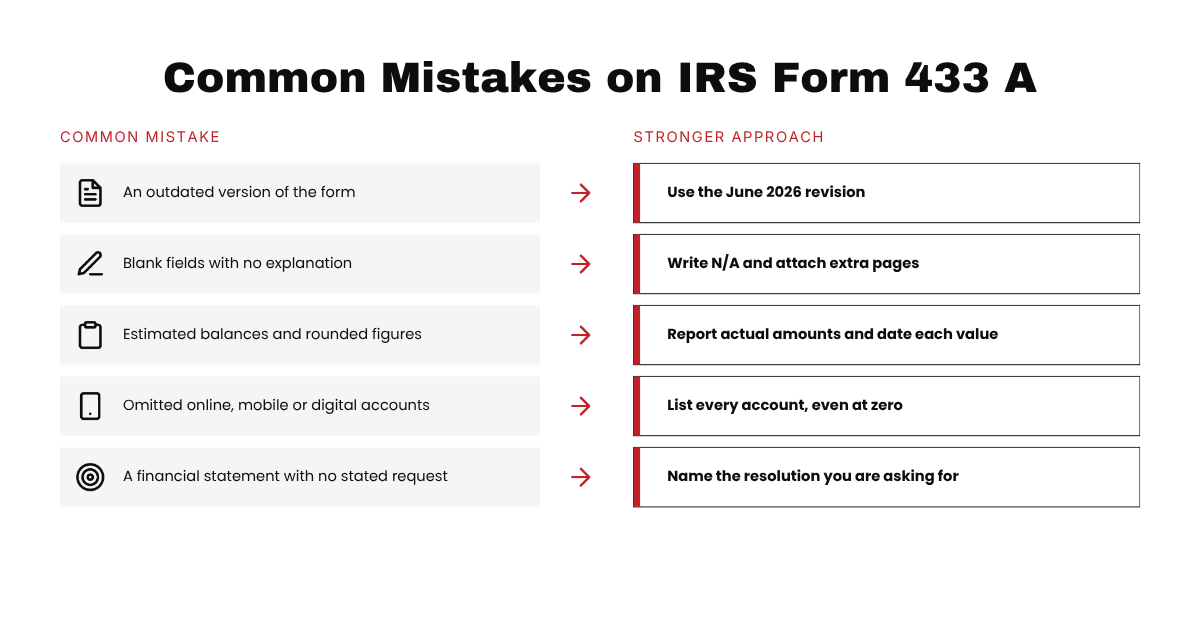
Common Mistakes on IRS Form 433 A
A financial statement can be complete and still present the case poorly.
The following mistakes commonly create questions or change the IRS calculation.
Using an Outdated Form
IRS forms change.
The regular Form 433 A was revised in June 2026.
Check the revision date before preparing the financial statement.
An older form may omit questions or categories included on the current version.
Leaving Unexplained Blank Fields
The form instructs taxpayers to answer all applicable questions and write N/A when a question does not apply.
An unexplained blank can appear incomplete.
Use N/A when appropriate and attach additional pages when more space is needed.
Estimating Without Records
Rounded income, estimated account balances, and unsupported expenses can conflict with statements the IRS later reviews.
Use actual records and identify the date of each value.
Omitting Accounts or Digital Assets
Do not omit an account because it has a zero balance or because it is held through an application instead of a traditional bank.
The current form includes:
• Online accounts
• Mobile accounts
• Stored value cards
• Digital assets
• Wallets
• Exchanges
• Other financial interests in digital assets
Mixing Business and Personal Expenses
A personal mortgage payment is not a business rent expense.
A business vehicle expense should not also be claimed in full as a personal vehicle expense.
Separate the records and avoid counting the same cost twice.
Reporting Tax Return Deductions as Cash Expenses
Depreciation may reduce taxable business income.
It is not a monthly cash payment.
The Form 433 A cash flow calculation is not the same as an income tax return calculation.
Ignoring Spouse or Household Contributions
A spouse may not be liable for the tax but may contribute to shared household expenses.
Household income and expenses may need to be reported when spouses share expenses or live in a community property state.
The correct treatment depends on:
• Who owes the tax
• Household arrangements
• Shared expenses
• Applicable property rules
Reporting Inflated Asset Values
Do not use the cost of replacing furniture, tools, or personal property.
The form requests current fair market value.
Use an amount that reflects what the property could reasonably sell for today.
Submitting the Form Without a Clear Request
The IRS needs to know what collection resolution you are requesting.
State whether the proposal is for:
• An installment agreement
• A partial payment installment agreement
• Currently Not Collectible status
• A levy release
• Another collection decision
Form 433 A supports the request.
It does not replace the request.

When to Prepare Form 433 A Yourself and When to Seek Help
A taxpayer with wages, limited assets, organized records, and a straightforward payment request may be able to complete Form 433 A without representation.
The risk increases when the form involves:
• A business
• Substantial asset equity
• Shared household finances
• Payroll liabilities
• Digital assets
• A Revenue Officer
• Immediate enforcement
• Financial hardship
Situations That May Be Suitable for Self Preparation
Self preparation may be reasonable when:
• The IRS request is clear
• All required tax returns are filed
• Income is stable
• The taxpayer has few assets
• Financial records are complete
• There is no pending levy
• The requested payment is affordable
• There are no unusual transfers
• There are no complex business interests
Even in a simple case, review every section carefully before signing.
Situations That May Require Professional Review
Consider review by a tax attorney, CPA, or enrolled agent experienced with IRS collection when:
• A Revenue Officer is assigned
• The balance covers several tax years
• You own a business
• Payroll taxes are involved
• You have real estate equity
• You own digital assets
• You are requesting hardship status
• A levy has been issued or threatened
• An Offer in Compromise is being considered
• Prior payment plans have defaulted
• The household includes a nonliable spouse
• Income is seasonal or difficult to document
Choosing Someone to Review Form 433 A
People searching for help with IRS Form 433 A near me should look beyond physical location.
Ask whether the person reviewing the form is licensed and regularly handles IRS collection financial statements.
Attorneys, CPAs, and enrolled agents may represent taxpayers before the IRS when properly authorized.
Confirm:
• Who will analyze the finances
• Who will communicate with the IRS
• Whether representation is included
• Whether the service covers only form preparation
• Whether asset and expense analysis is included
A proper review should identify the requested resolution, compare the form with supporting records, calculate likely IRS allowances, identify asset concerns, and explain possible results before submission.
Frequently Asked Questions About IRS Form 433 A
-
Form 433 A is a detailed financial statement for wage earners and self employed individuals with federal tax collection matters.
It reports household information, income, expenses, assets, debts, employment, and business finances.
The IRS uses the information to evaluate how the taxpayer may satisfy an outstanding liability.
It is not an income tax return.
It does not calculate the underlying tax.
It addresses collection of a tax balance that has already been assessed or is being handled through the IRS collection process.
-
A taxpayer completes Form 433 A when the IRS requests it or when it is required to support a collection proposal.
The form may be requested from:
• An individual who owes Form 1040 taxes
• A self employed taxpayer
• A person potentially responsible for a Trust Fund Recovery Penalty
• An owner of a disregarded entity
• A person who may be personally responsible for a partnership liability
Not every taxpayer who owes the IRS must complete Form 433 A.
Some taxpayers qualify for payment arrangements without providing a full financial statement.
-
Yes, but the form is evidence supporting the negotiation rather than the negotiation itself.
You may use the financial statement to support:
• A proposed monthly payment
• A hardship request
• A partial payment installment agreement
• A levy release request
• Another collection resolution
The IRS can accept the proposal, revise the calculation, request more documents, or require a different resolution.
A strong proposal should identify the requested outcome and explain how the financial facts satisfy the applicable IRS rules.
-
Not automatically.
Submitting a financial statement does not, by itself, release a bank levy or wage levy.
You must request the appropriate collection action and obtain an IRS decision.
When a levy creates immediate economic hardship, a complete financial statement and supporting documents may help the IRS evaluate a levy release request.
Do not wait for the entire financial review to finish before communicating an urgent hardship.
-
Regular Form 433 A is used in IRS collection financial investigations, including payment plan and hardship requests.
Form 433 A (OIC) is used with Form 656 for an individual Offer in Compromise.
The OIC version contains:
• Offer specific asset calculations
• Future income calculations
• Equity calculations
• Required supporting documents
Using the wrong form can delay the case.
Follow the IRS request or the current Offer in Compromise package.
-
Use current financial information and the period requested by the IRS.
The IRS may request recent statements, pay records, business reports, and expense documents.
If the financial statement becomes outdated during the investigation, the IRS may request an updated Form 433 A.
Certain programs may request specific statement periods.
An Offer in Compromise may have different document requirements than a regular collection statement.
-
Yes.
Confirm that:
• Every applicable question is answered
• All totals are correct
• Account balances include dates
• Asset values are supportable
• Business income matches the records
• Expenses match supporting documents
• The requested resolution is clearly stated
Compare the form with:
• Bank statements
• Pay records
• Tax returns
• Loan statements
• Asset records
• Business records
• The profit and loss statement
Also review the likely IRS allowance for each expense.
A form can accurately report actual spending while still producing a different IRS payment calculation.
-
Yes.
The IRS may request updated financial information when:
• The existing statement becomes outdated
• Your circumstances change
• A collection resolution is reviewed
• A new collection decision is required
• The IRS believes your ability to pay has improved
Currently Not Collectible status and partial payment arrangements may be reviewed later.
Continue keeping organized financial records after the original form is submitted.

Brief Summary of IRS Form 433 A
IRS Form 433 A is a detailed financial disclosure used in individual IRS collection cases.
The form reports:
• Income
• Living expenses
• Assets
• Debts
• Household information
• Employment
• Self employment finances
The IRS may use the information to evaluate:
• An installment agreement
• A partial payment installment agreement
• Currently Not Collectible status
• A levy release request
• Payment from an asset
• Another collection resolution
The regular Form 433 A is different from Form 433 A (OIC), which is used with an Offer in Compromise.
The IRS may compare actual expenses with current Collection Financial Standards.
Necessary expenses above a published standard may require explanation and documentation.
A complete Form 433 A should be based on current records rather than estimates.
Before submitting the form:
Confirm which financial statement the IRS requested.
Identify the collection resolution you are asking the IRS to approve.
Gather current income, bank, asset, loan, expense, and business records.
Compare the form with every supporting document.
Review how the IRS may calculate allowable expenses and asset equity.
Keep a complete copy of the form and attachments.
Keep proof showing when and how the form was submitted.
When the case involves a Revenue Officer, a levy, substantial assets, business income, payroll taxes, or financial hardship, professional review may help identify issues before the form becomes part of the IRS collection file.