
Tax Relief Company vs. Enrolled Agent: Which Is Better for IRS Tax Debt Help?
You opened an IRS notice, saw a balance you were not ready for, and started searching for help. Now you are trying to figure out whether you need a tax relief company, an Enrolled Agent, a CPA, or a tax attorney. That confusion is common, especially because many tax relief companies advertise big promises without clearly explaining who will actually work on your case.
The real question is not just “tax relief company vs. Enrolled Agent.” The better question is: who is qualified to represent you before the IRS, review your transcripts, explain your options, and negotiate the right tax debt resolution based on your financial situation?
Choosing the wrong help can cost you time, money, and leverage with the IRS. If your case involves unfiled tax returns, wage garnishment, bank levies, tax liens, an Offer in Compromise, or a large IRS balance, you need more than a sales call. You need someone who understands IRS collection rules, compliance requirements, financial disclosures, and resolution strategy.
This guide explains the difference between a tax relief company and an Enrolled Agent, what each can and cannot do, when a CPA or tax attorney may be needed, and how to decide who is best for your IRS tax debt help. Before you hire anyone, you should know who will handle your case, what credentials they hold, and what the next step should look like.

TLDR;
An Enrolled Agent is a licensed tax professional with IRS authority to represent taxpayers.
A tax relief company is a business model, not a credential.
The right choice depends on the complexity of the IRS problem.
Enrolled Agents are a strong fit for audits, penalty abatement, unfiled returns, and payment plans.
Full-service tax relief firms can help with complex cases like levies, garnishments, and Offer in Compromise filings.
A tax attorney is needed when Tax Court, criminal exposure, or attorney-client privilege is involved.
Should I hire a tax relief company or an enrolled agent? Start here
Before comparing costs and credentials, it helps to understand what you're actually choosing between.
An enrolled agent (EA) is a federally licensed individual practitioner. A tax relief company is a business
model, one that may employ EAs, attorneys, CPAs, or, in problematic cases, unlicensed "consultants." The right answer to the question of whether you should hire a tax relief company or an enrolled agent often depends on case complexity, not just credential type. Keep that distinction in mind as you read through the sections below.
What an enrolled agent can legally do for you
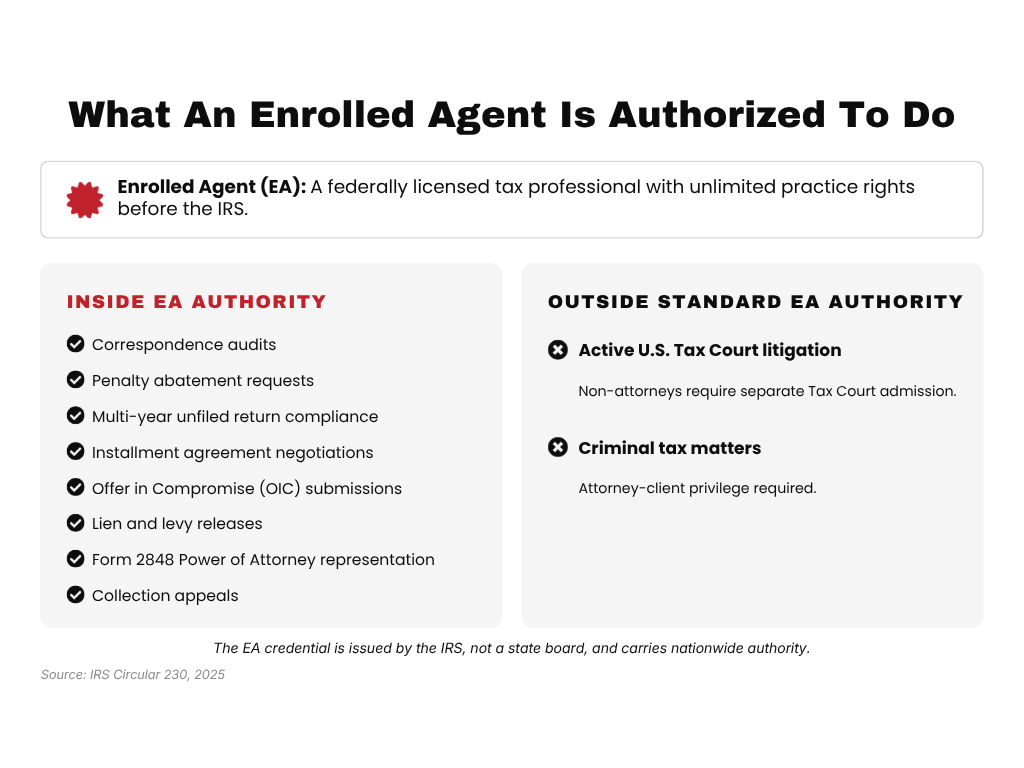
An enrolled agent is a federally licensed tax professional who has either passed all three parts of the IRS Special Enrollment Examination or completed five years of qualifying IRS employment. The credential is
issued by the IRS itself, not a state board, which means it carries nationwide authority. The defining feature of the EA designation is what the IRS calls unlimited practice rights: an EA can represent any taxpayer, in any tax matter, before any IRS office, regardless of who originally prepared the return. For a practical overview of the EA credential and what enrolled agents do, see Enrolled agents: everything you need to know.
In practice, that authority covers a substantial range of IRS work. An EA can file a Form 2848 Power of Attorney to speak directly with IRS agents on your behalf, removing you from direct contact with the agency entirely. That power of attorney covers audits, appeals, collection disputes, lien releases, levy releases, installment agreement negotiations, and Offer in Compromise submissions. For most common IRS problems, an EA has the full legal authority to resolve your case from start to finish. You can check Form 2848 vs Form 8821 to know more about representation versus information authorization.
What case types fall squarely within EA authority
Correspondence audits, penalty abatement requests, multi-year unfiled return compliance, and standard installment agreement negotiations are all squarely within EA territory. These are administrative matters that require IRS knowledge, accurate documentation, and proper communication. A licensed EA handles all of it without needing to escalate. The work is direct, the process is defined, and the EA's credentials give them the same IRS access an attorney would have for these types of cases.
Where the boundary becomes relevant is in situations involving active litigation in U.S. Tax Court or potential criminal tax exposure. EAs can be admitted to practice before the Tax Court under non-attorney rules, but that requires a separate admission process. Criminal matters require full attorney-client privilege, which applies only when working with a licensed attorney, though it's worth noting that communications made under the direction of a supervising attorney may also carry privilege in some contexts. For everything short of those two scenarios, a credentialed EA is fully authorized to represent you.
If penalties are making your IRS balance harder to manage, review whether you may qualify for IRS penalty forgiveness through first-time abatement or reasonable cause relief.
If you have several years of unfiled returns, the first step is to file your missing tax returns so the IRS can replace estimated balances with accurate filings.
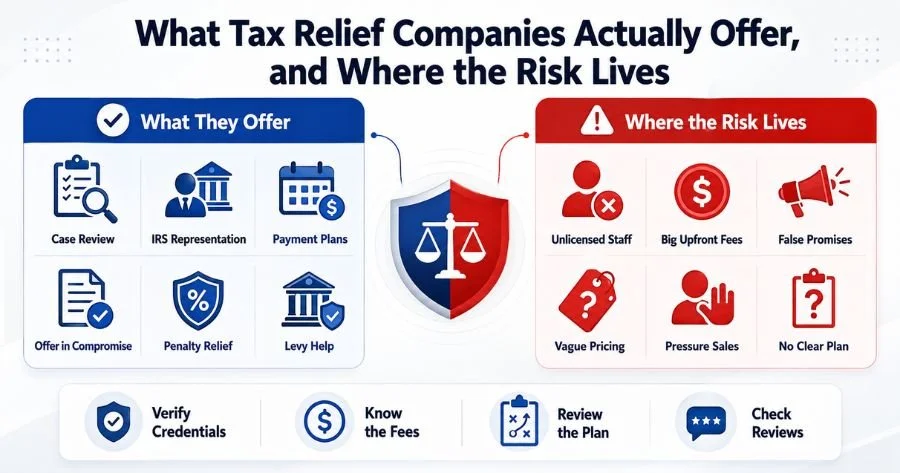
What tax relief companies actually offer, and where the risk lives
"Tax relief company" is a broad category that describes a business model, not a credential. The best tax relief firms are staffed by licensed EAs, attorneys, and CPAs who manage the entire IRS resolution process on a client's behalf.
The problematic ones are built around sales volume rather than credentials, with unlicensed "tax consultants" doing most of the work while a licensed professional's name sits on a wall somewhere. The difference between those two types of firms comes down almost entirely to who holds the licenses and who is actually assigned to your case.
How legitimate firms structure fees and services
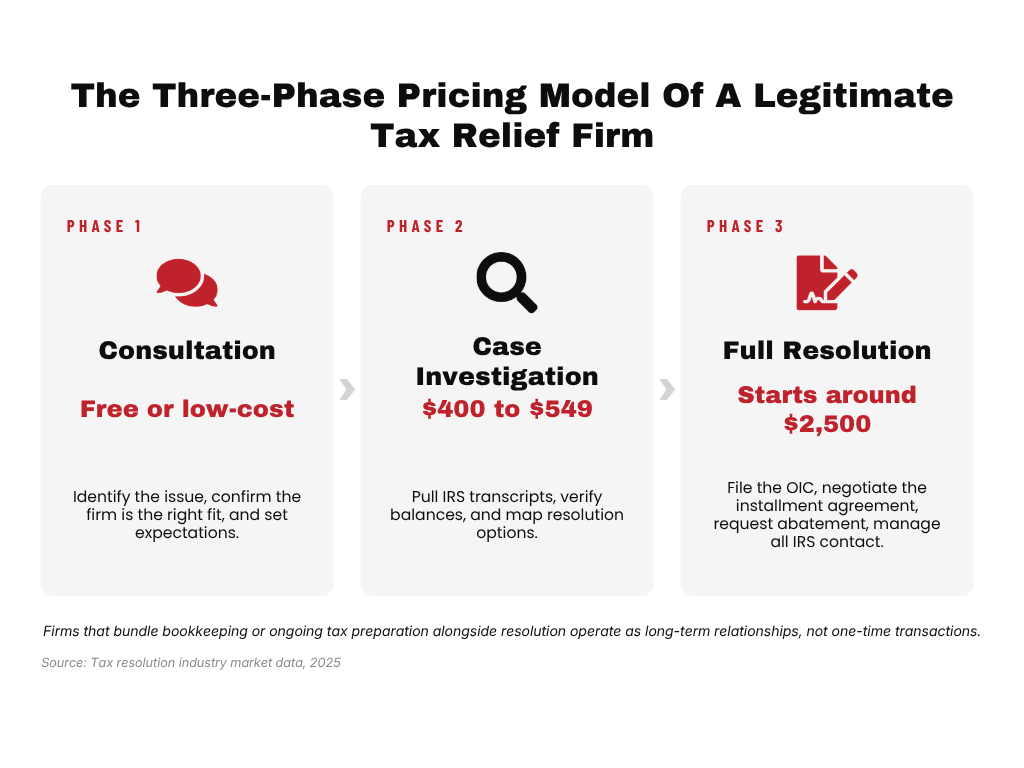
A professional tax debt relief firm typically follows a three-phase model: a free or low-cost initial consultation, a paid case investigation phase (commonly in the $400, $549 range), and a full resolution package priced based on case complexity, often starting around $2,500 and going higher for involved OIC filings or multi-year matters.
Firms that bundle ongoing services like bookkeeping and Efficient Tax Preparation Process with Semper Tax Relief alongside IRS resolution tend to operate as long-term professional relationships rather than one-time transaction businesses.
A firm designed to take one payment and disappear has no reason to offer services that require continued contact, so bundled service offerings are one indicator worth noting when evaluating a provider.
Red flags that separate a real firm from a scam
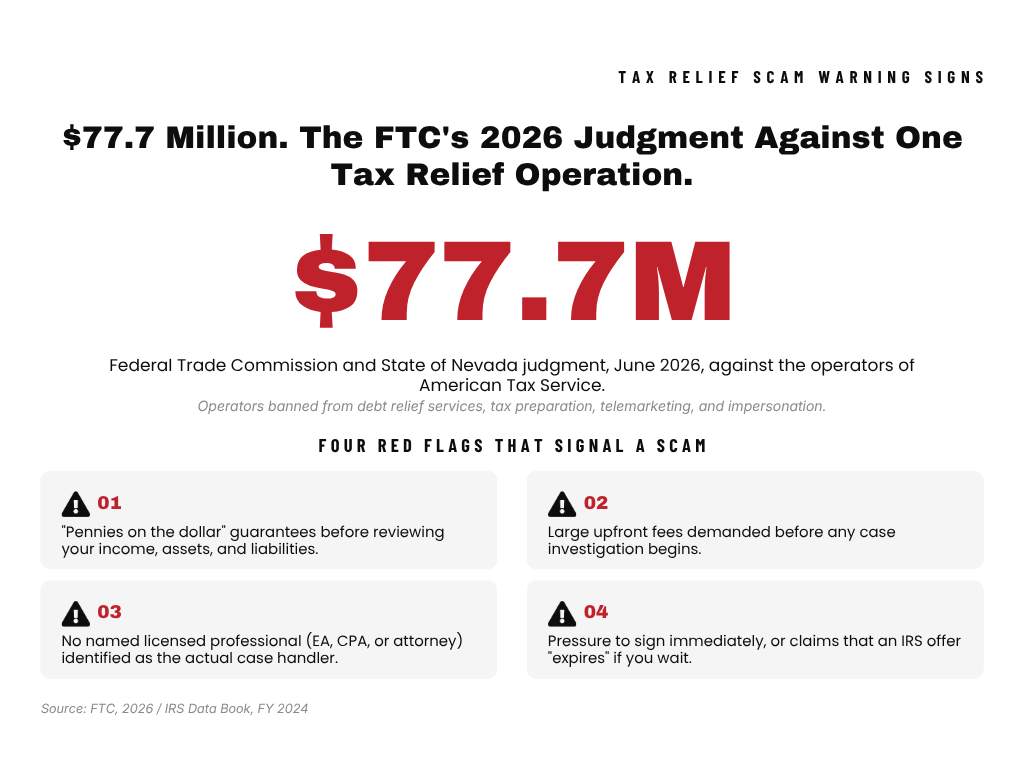
The FTC settled a case in June 2026 against American Tax Service operators for a total judgment of $77.7 million, banning them from debt relief services entirely. The scheme involved impersonating tax authorities and promising to reduce tax debts before reviewing anyone's financials. That case illustrates every red flag worth knowing. Watch for these warning signs before signing anything: See the FTC press release on tax relief scammers for details.
"Pennies on the dollar" guarantees before reviewing your income, assets, and liabilities. The IRS OIC acceptance rate was approximately 21% in FY 2024. No legitimate firm promises approval before seeing your financials.
Large upfront fees demanded before any investigation or case work is completed.
No named licensed professional (EA, CPA, or attorney) identified as your actual case handler.
Pressure to sign immediately, or claims that an IRS offer "expires" if you wait, a sales tactic with no basis in IRS procedure.
If the conversation sounds more like a sales call than a professional consultation, treat that as meaningful data.
What this actually costs: an honest fee comparison
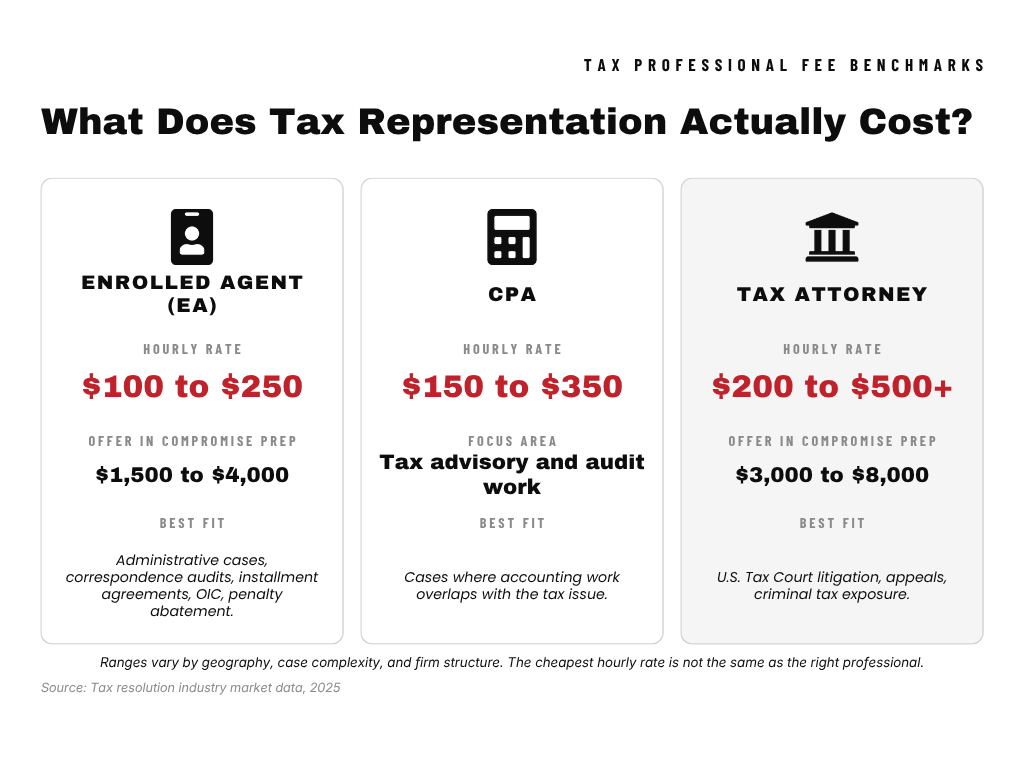
Most articles on this topic stay vague about money. Here are actual fee ranges based on current market data, though costs vary by geography, case complexity, and firm structure. Enrolled agents typically bill $100, $250 per hour for tax representation work and are generally the most affordable credentialed option.
CPAs run $150, $350 per hour for tax-related advisory and audit work. Tax attorneys command $200, $500 or more per hour, particularly for appeals and litigation. For Offer in Compromise preparation specifically, enrolled agents typically charge $1,500, $4,000, while tax attorneys run $3,000, $8,000, with complex matters pushing attorney fees higher.
When the cheapest option becomes the most expensive mistake
The hiring decision should track case complexity, not just hourly rate. An EA handling a straightforward penalty abatement or installment agreement is cost-effective and fully qualified. But an EA at a firm without legal oversight managing a complex OIC involving disputed asset valuations, or a tax relief company without a licensed attorney on staff handling a case headed toward appeals, can produce errors that cost far more to fix than hiring the right professional from the start. The question isn't which type of professional charges less. It's which type of professional is actually equipped to resolve your specific problem.
Matching the right professional to your actual IRS problem
This is where the article becomes a practical tool rather than a general overview. Most IRS problems fall into one of three broad categories. Knowing which applies to your situation goes a long way toward answering the question of whether you should hire a tax relief company or an enrolled agent, or both.
Audits, unfiled returns, and standard payment plans
If your issue involves a correspondence audit, a penalty abatement request, bringing multiple years of unfiled returns into compliance, or setting up a standard installment agreement, a licensed EA is the right call. The work is administrative, the EA has full IRS authority over it, and there's no need to pay attorney rates for work that doesn't require litigation skills. The process is direct, the costs are reasonable, and the EA's credentials give them everything they need to resolve the matter.
Wage garnishments, bank levies, and Offer in Compromise cases
These situations benefit from a full-service approach. Levy releases require fast, direct IRS communication and a firm understanding of the client's complete financial picture. Offer in Compromise applications require accurate documentation of income, expenses, and assets, and the IRS rejects applications that are incomplete or financially implausible. A tax relief firm staffed by licensed EAs, ideally with legal oversight, can handle emergency releases, prepare a defensible OIC submission, and manage all IRS communication through a single case file. This is where a credentialed team adds real value over a solo practitioner working without support staff.
Tax Court litigation and criminal exposure
If your dispute is headed toward U.S. Tax Court, or if criminal tax charges are a possibility, you need a tax attorney. EAs can be admitted to Tax Court practice under non-attorney rules, but criminal matters require
attorney-client privilege, a protection that exists only in the context of a licensed attorney-client relationship. This is the clearest escalation trigger, and any professional worth hiring will tell you the same thing plainly. For official Tax Court guidance, see the U.S. Tax Court information for petitioners.
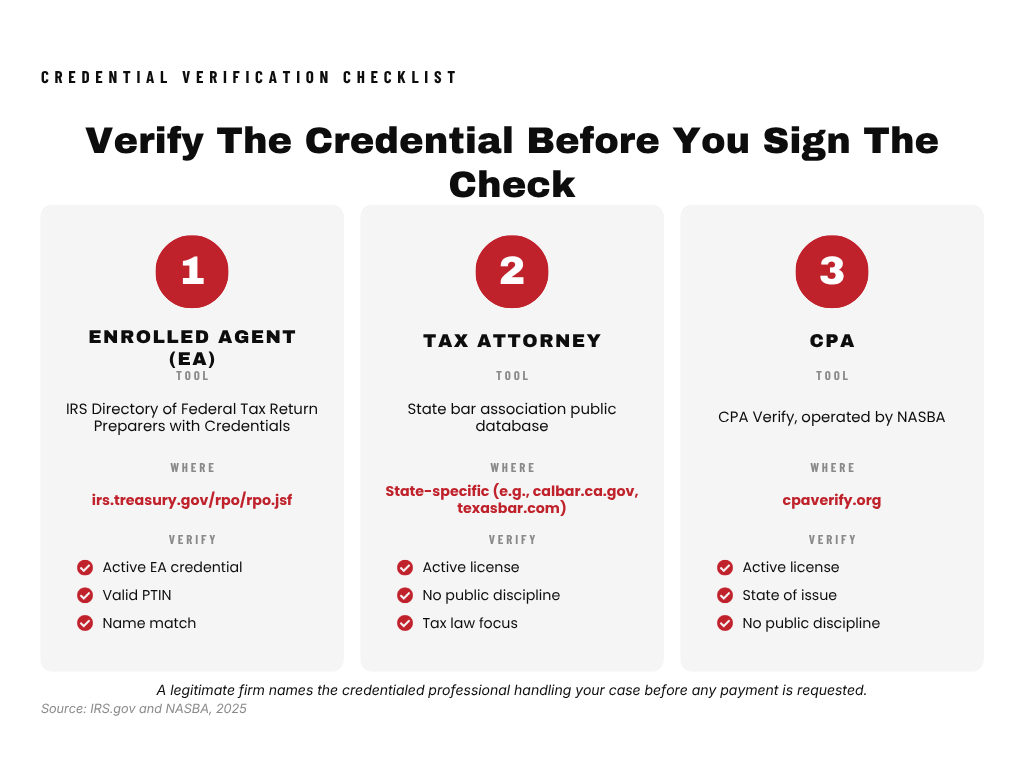
How to verify credentials before you write a check
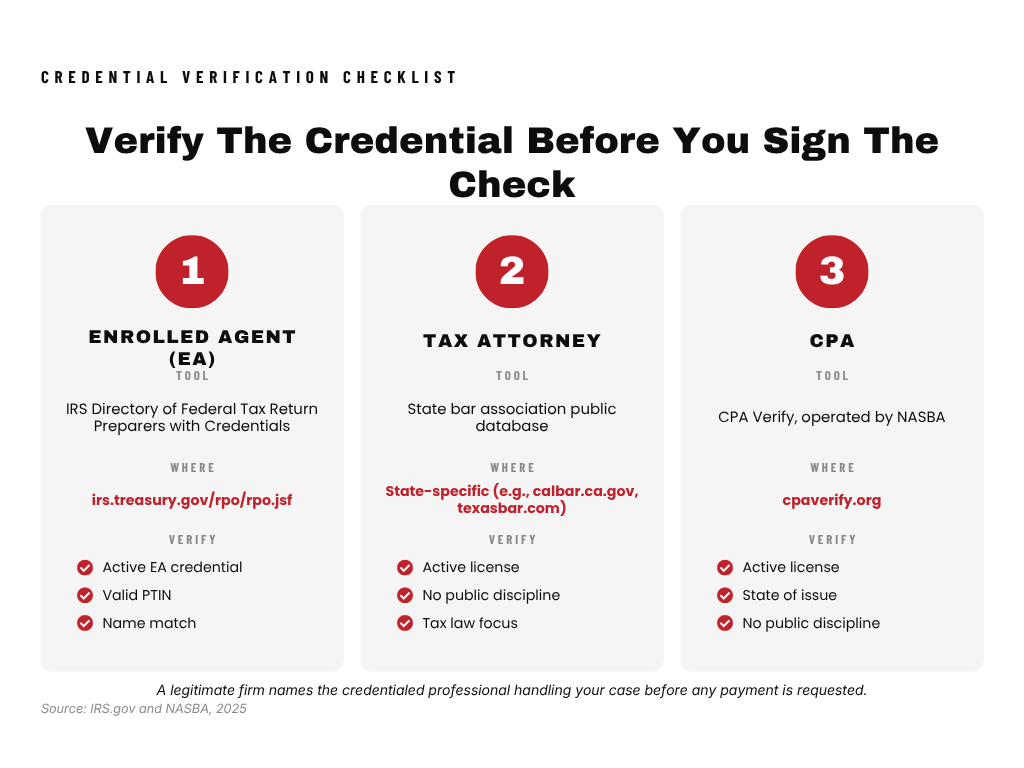
A credential check should happen before any conversation about fees, and the tools to do it are free and publicly available. To confirm EA status and PTIN, use the IRS Directory of Federal Tax Return Preparers
with Credentials and Select Qualifications. Search by the professional's last name and filter by Enrolled Agent credential. For attorneys, check the relevant state bar association's public database. For CPAs, the National Association of State Boards of Accountancy (NASBA) maintains a CPA Verify tool. A legitimate firm will name the credentialed professional handling your case, not route you to a sales representative with a vague "tax consultant" title.
Contract terms that should stop you cold
Before paying anything, read the written agreement. Look specifically for a defined scope of work, itemized fees, clear refund and cancellation terms, and a timeline or milestone structure. Any firm that won't put those elements in writing before being paid is not operating as a professional services firm. No written agreement means no clear accountability, and that asymmetry always works in the firm's favor, not yours. Vague contract language and verbal-only fee quotes are not negotiating tactics. They're structural problems with how the firm does business.
When one firm covers the full picture: EA credentials plus legal oversight
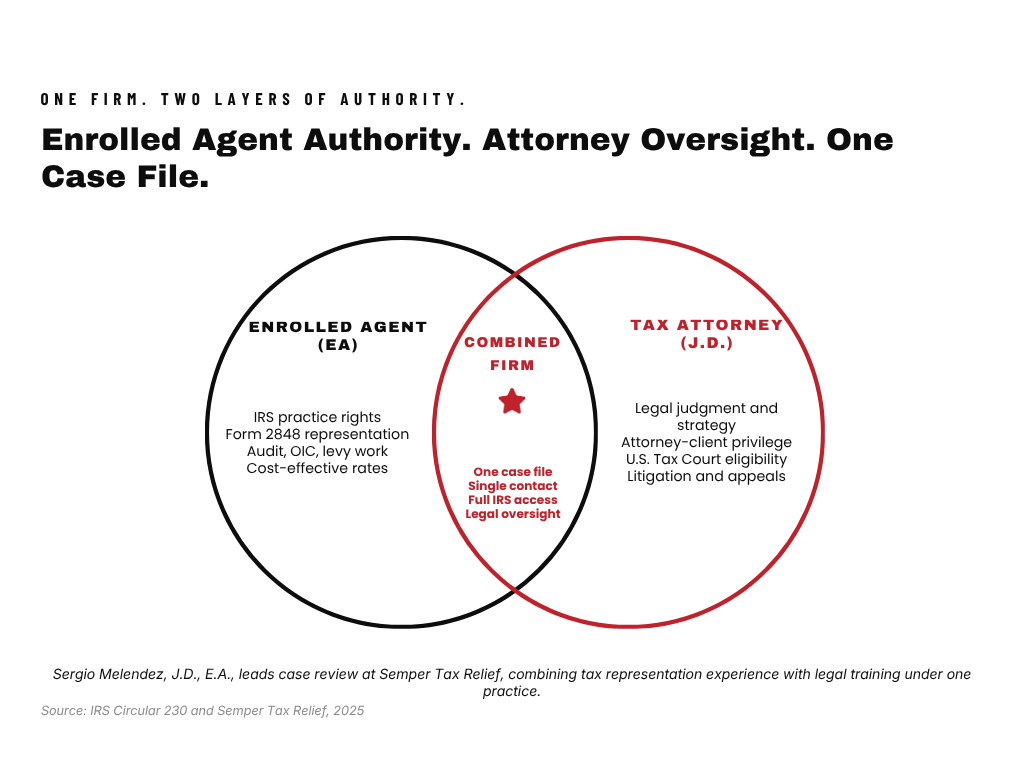
The question of whether to hire a tax relief company or an enrolled agent assumes the two are separate options. The most efficient outcome is a firm where they're the same thing. A licensed team where enrolled agents hold IRS practice authority and a J.D. attorney provides legal oversight resolves the core dilemma. You get the IRS representation rights of an EA combined with the legal judgment and privilege of an attorney, managed under a single case file with one point of contact.
That's the model Semper Tax Relief is built on, a firm that pairs enrolled agent credentials with attorney oversight so clients don't have to choose between affordability and legal depth. Rather than picking between a solo EA and a full-service firm of uncertain credential quality, a team structured this way gives you both. If you're unsure where your situation falls, a free case review is the right starting point. You'll know exactly what you're dealing with and what resolution will realistically require, before committing to anything. Learn more about the team on our Experienced IRS Tax Problem Resolution Specialist and Business Bookkeeping page.
Tax Relief Company vs. Enrolled Agent: Which Is Better for IRS Tax Debt Help? FAQs
-
No. An Enrolled Agent is a federally licensed tax professional who can represent taxpayers before the IRS. A tax relief company is a business that may employ Enrolled Agents, CPAs, attorneys, or unlicensed consultants. The important question is not just the company name, but who is actually handling your case.
-
An Enrolled Agent is often a strong choice for IRS notices, correspondence audits, penalty abatement requests, unfiled returns, installment agreements, and many collection issues. These are administrative IRS matters where an EA has the authority to communicate with the IRS and work toward a resolution.
-
A full-service tax relief firm may be helpful when the case involves multiple tax years, wage garnishments, bank levies, large balances, complex financial review, or an Offer in Compromise. These cases often require documentation, strategy, IRS communication, and ongoing case management.
-
If you don't pay the full amount owed by the due date, the IRS may take further action to collect the debt, including Levying or garnishing your income sources & placing a lien on your property or seizing your assets. In addition, the IRS may issue a passport revocation.
-
Be careful if a company promises “pennies on the dollar” before reviewing your finances, pressures you to sign immediately, charges large upfront fees without explaining the work, or refuses to name the licensed professional assigned to your case. A legitimate provider should explain credentials, scope, fees, and next steps in writing.
-
If you can't pay the full amount on the CP504, review your original tax filings to see if an amended tax return is possible or if one of the following tax relief programs may apply:
1) Temporary time to pay ( & Penalty Forgiveness)
2) Payment Plans ( & Penalty Forgiveness)
3) Penalty Forgiveness
4) Offer In Compromise
5) Non-Collectible Status - Financial Hardship Status
-
The IRS CP504 is the final warning of a balance due on a tax year. This is an important step the IRS needs to issue out levies, garnishments & liens in the future.
The CP504 notice is threatening you with levy action & other collection actions if you do not pay or resolve the tax debt se and get more aggressive.
The collections department of the IRS needs to send out certain letters to you as a legal warning. These legal warnings are mandatory and required before the IRS is able to take any action against you.
From the time the IRS sends you to collections to the time they have the authority to take action is approximately 4 months. The last notice will be sent through certified mail, and the letter will state the final warning.
The best way to deal with this problem is head-on, and for you to take action before the IRS takes action
-
There are different gorunds to appealing the IRS actions. When the IRS issues a CP504 notice, the appeal available is the Collectiona Appeals Program or CAP Request.
A CAP request is a fast track appeals program that is different from a CDP or Collections Due Process Hearing. .A CAP request is designed to have an IRS Collections Manager review for the legality of the notice & to resolve the account with you. If the account is not resolved with IRS Management, the IRS office of appeals will review the account.

Putting the decision together
The framework is straightforward once you separate the layers. The answer to "should I hire a tax relief company or an enrolled agent" isn't always either/or. Enrolled agents carry legitimate, federally granted authority to represent you in the vast majority of IRS matters, at a lower cost than attorneys, and with the same IRS access for administrative cases. A full-service tax relief firm staffed by licensed professionals adds the organizational capacity to manage complex negotiations, emergency levy situations, and OIC filings that benefit from a coordinated team. Attorneys are non-negotiable when litigation or criminal exposure enters the picture.
If you are still comparing payment plans, penalty relief, CNC status, PPIA, or an Offer in Compromise, start with our Ultimate IRS Tax Debt Resolution Guide to understand how each option works before choosing a strategy.
Credentials are the single most reliable filter for separating legitimate help from a costly mistake. If a firm won't name the licensed professional handling your case, won't put fees and scope in writing, or makes guarantees before reviewing your financial situation, walk away. The IRS problem you have today is solvable, but only with someone who has the authority, the credentials, and the transparency to actually solve it.
Before any serious IRS resolution strategy can be reviewed, gather your tax relief supporting documents so your income, expenses, assets, and hardship position can be evaluated correctly.
At Semper Tax Relief, cases are reviewed with the experience of Sergio Melendez, JD EA, combining tax representation knowledge with legal training so taxpayers can better understand their IRS options before making a decision.
Semper Tax Relief offers a free case review for taxpayers who want to understand their options before committing to anything. If you have an IRS notice, a balance due, unfiled returns, or an active levy, the conversation costs nothing and gives you a clear picture of where you stand. Visit SemperTaxRelief.com to schedule your review or call to speak with the team directly. To see what documents we'll request and how the onboarding works, review our New Client Onboarding Documents — Semper Tax Relief | IRS Tax Problems | Business Bookkeeping.