
IRS Offer in Compromise Accepted: How to Verify and Prove Your Tax Settlement
You submitted an IRS Offer in Compromise months ago, and now you are waiting for an answer. No approval letter. No rejection letter. No clear update. That silence can leave you wondering whether your offer is still under review, sitting in a backlog, missing information, or heading toward a decision you have not seen yet.
This is where many taxpayers get tripped up. They assume no news means the case is fine, but an Offer in Compromise is not truly accepted until the IRS issues formal written approval. A real OIC acceptance comes with specific settlement terms, payment deadlines, and future compliance rules. If you miss those requirements, the IRS can default the agreement and bring the full tax debt back.
Verifying an accepted Offer in Compromise is not about taking someone’s word for it. You need the acceptance letter, proof of payment, transcript confirmation, and a clear understanding of what must happen next. The paper trail matters because it proves the IRS approved the tax settlement and shows whether the agreement is still in good standing.
This article explains what the IRS sends when an Offer in Compromise is accepted, how to check the status while you wait, how to prove your tax settlement was approved, what payment deadlines apply, and what to do if your offer was rejected, returned, delayed, or stalled.

TLDR;
An accepted Offer in Compromise must be verified through official IRS written documentation.
A verbal IRS update, payment receipt, or submitted Form 656 is not proof of acceptance.
The IRS acceptance letter confirms the offer amount, covered tax years, payment terms, and compliance obligations.
Form 7249 is the official Offer Acceptance Report and may be requested if proof is needed.
Taxpayers should save multiple copies of the acceptance letter for lenders, creditors, or future tax reviews. A federal OIC only resolves federal tax debt. State tax debt requires a separate state process.
Payment deadlines begin when the acceptance notice is received.
After acceptance, taxpayers must stay compliant with tax filings and payments for five years.
Missing a payment or falling out of compliance can default the OIC and bring back the original tax debt.
If an OIC is rejected, taxpayers usually have 30 days to appeal with Form 13711.
A returned OIC is different from a rejected OIC because the IRS did not review the offer on the merits.
The safest next step is to verify the status, preserve the paper trail, and protect the settlement after approval.
What the IRS Actually Sends When Your OIC Is Accepted
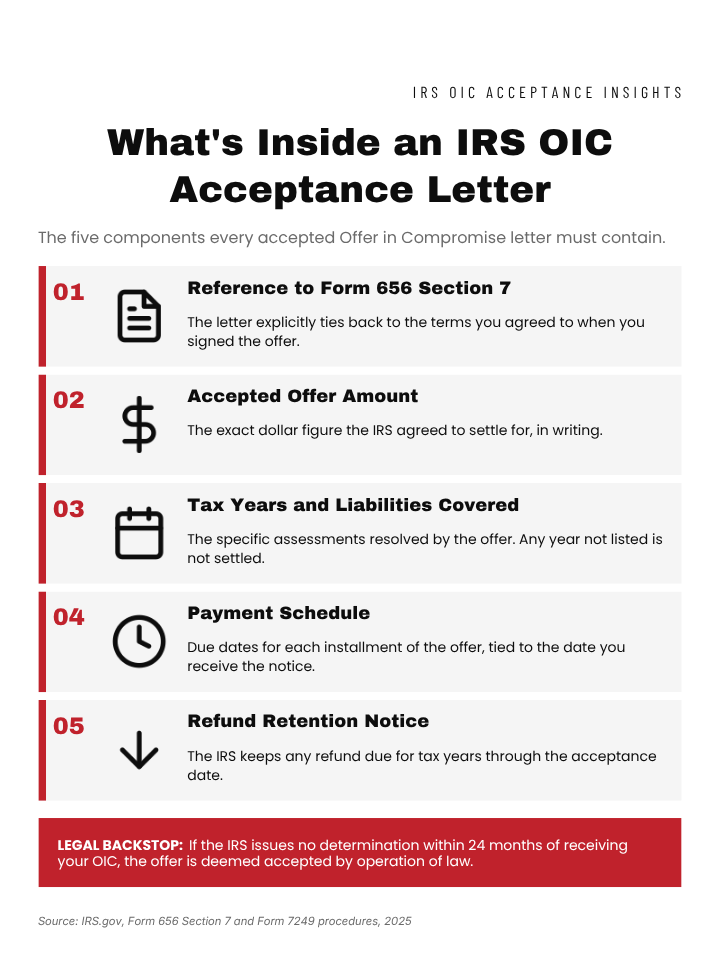
When the IRS accepts your Offer in Compromise, it sends a formal written letter confirming the decision. That letter references the terms outlined in Section 7 of Form 656 and includes the accepted offer amount, the specific tax liabilities covered, and your payment schedule. It also states that the IRS will retain any tax refund due for years covered through the acceptance date, so don't expect a refund check while your OIC terms are still outstanding.
The formal record of acceptance is Form 7249, the Offer Acceptance Report. This document is available for public inspection for one year after acceptance. It lists your name, location, the offer amount, payment structure, and the specific tax liabilities resolved. If you need a copy, submit Form 15086 to the IRS by fax at 855-286-3809 or by mail to the Memphis address listed on the form. The IRS typically responds within about 15 business days, though response times can vary.
There is also a lesser-known protection built into the law: if the IRS does not issue a determination within 24 months of receiving your OIC application, the offer is deemed accepted by operation of law, with no letter required. A deemed acceptance doesn't mean you're off the hook for documentation, though. Contact the IRS to confirm the status and get written acknowledgment, because you'll still need to meet the original offer terms and the five-year compliance window still applies. For more on IRS internal processing procedures related to offers, the IRS's internal guidance explains many of the timelines and recordkeeping details.
How to Check Your OIC Status Before the Notice Arrives
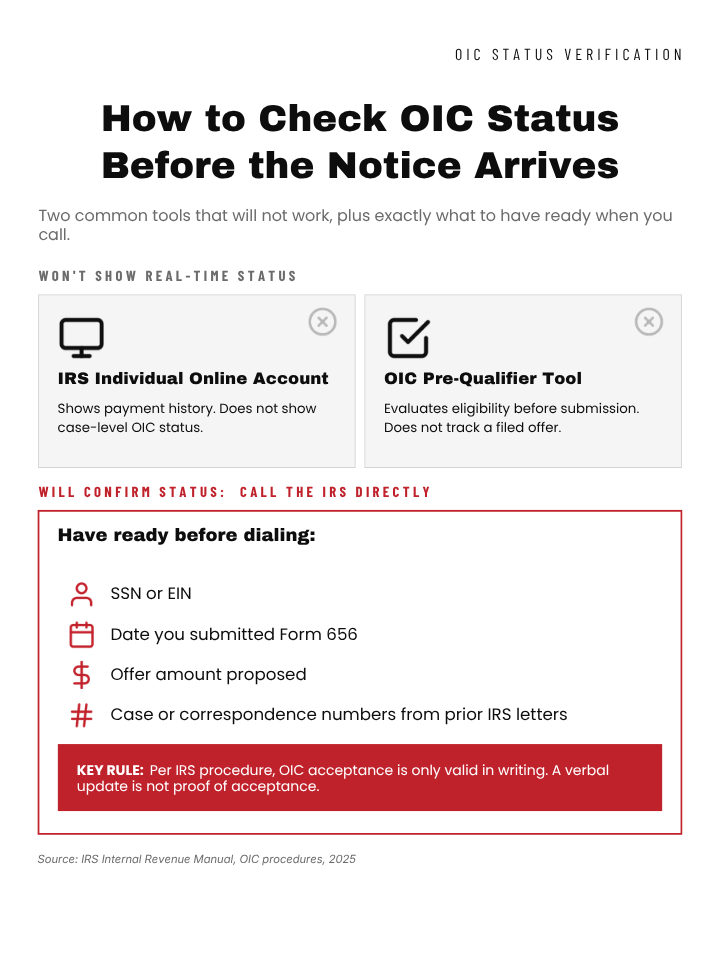
The IRS Individual Online Account gives you access to payment history, case-related balances, and some correspondence. It's a useful starting point, but it won't show you real-time OIC processing status. The IRS Offer in Compromise Pre-Qualifier tool is designed to evaluate eligibility before you submit, not to track a case after submission. Once your offer is pending, the most reliable way to conduct an OIC status check is to call the IRS directly using the phone number listed on the most recent letter you received related to the offer.
When you call, have the following ready: your Social Security Number or Employer Identification Number, the date you submitted Form 656, the offer amount you proposed, and any case or correspondence number from prior IRS letters. Be aware that IRS representatives will require identity verification before discussing your account, and they can generally confirm whether your case is active or has been returned or closed. Per IRS procedure, official OIC acceptance is provided only in writing, do not rely on a verbal acceptance as confirmation. That distinction alone is worth the hold time, especially if months have passed without any written communication. If you're still preparing an offer or want help structuring the submission itself, see our step-by-step guide on How to make the offer for the IRS Offer in Compromise.
Verified Offer in Compromise Acceptance: What Real Settlement Outcomes Look Like
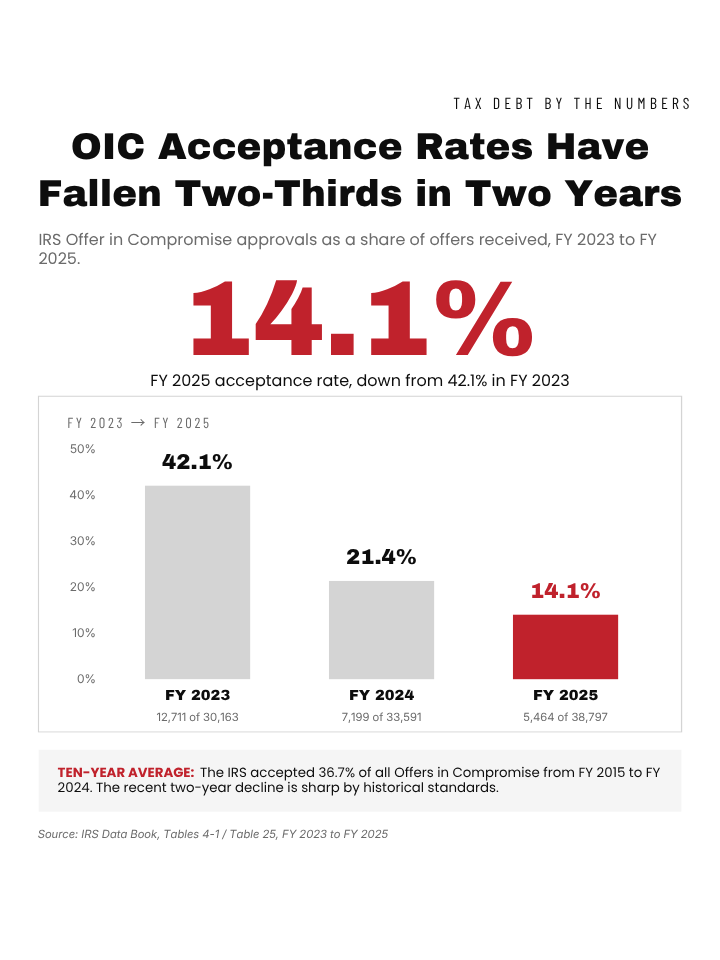
One reason taxpayers struggle to evaluate tax relief firms is that most advertise vague settlement figures with no verifiable context. Knowing what realistic outcomes look like, with actual numbers attached, is the only way to assess whether an OIC makes sense for your situation. The IRS accepts roughly 21% to 42% of offers depending on the fiscal year, with the FY 2024 rate at 21%, down from 42% in FY 2023. Professional representation is consistently associated with higher success rates compared to self prepared submissions, according to IRS and Taxpayer Advocate reporting; the Taxpayer Advocate Office provides notices and analysis that explain some of the program's trends and limitations.
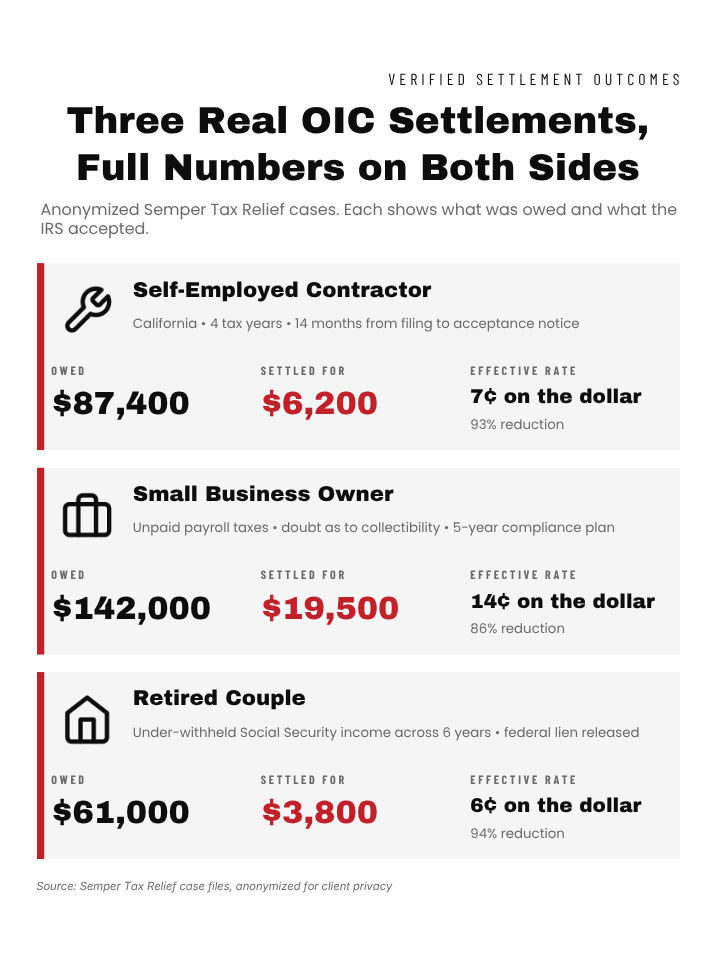
Here are three anonymized case studies that reflect the kind of documented outcomes Semper Tax Relief builds its practice around: A self-employed contractor in California owed $87,400 in federal tax debt across four years. After a full financial analysis using Form 433-A, the accepted offer settled the balance for $6,200, roughly seven cents on the dollar. The IRS OIC acceptance notice arrived within 14 months of submission. A small business owner owed $142,000 in unpaid payroll taxes. After filing several years of delinquent returns and submitting an OIC based on doubt as to collectibility, the accepted offer came in at $19,500. A structured five-year compliance plan was put in place immediately after acceptance. A retired couple carried $61,000 in IRS debt, primarily from under-withheld Social Security income over six years. Their accepted offer amount: $3,800. The federal tax lien was released after all payment terms were completed.
Before comparing your result to another taxpayer’s settlement, use the IRS Offer in Compromise Calculator to understand how income, expenses, and assets drive the offer amount.
Many tax relief firms advertise settlement results without disclosing what was owed, what was paid, or how long the process took. Semper Tax Relief documents case outcomes with specifics, not just the final number. Before hiring any firm for OIC representation, ask them to show you comparable case results with real dollar figures on both sides of the settlement. If they can't produce that, keep looking. For additional tips on improving acceptance odds, outside resources discuss practical acceptance strategies and client ready tips on offer in compromise acceptance tips and a broader guide to getting an OIC accepted.
Proving Verified Offer in Compromise Acceptance to Banks, State Agencies, and Creditors
The only valid proof of acceptance is the official written letter from the IRS. No payment receipt, no application form, and no third-party statement substitutes for the official IRS OIC acceptance notice. Form 7249 from the public inspection file also serves this purpose and can be requested via Form 15086 if the original is lost or unavailable. Many taxpayers attempt to use other documents as substitutes simply because they haven't kept proper records, don't let that be your situation.
If a mortgage lender or creditor is requesting OIC documentation during a financial review, provide the acceptance letter and walk them through what it means. Many lenders are unfamiliar with the OIC process, so a brief explanation of what the document confirms, specifically that a federal tax debt was settled and closed, is often necessary. Make multiple certified copies of the acceptance letter as soon as it arrives. Replacing it later requires submitting a formal request to the IRS, a process that takes time you may not have when a lender is waiting on a response.
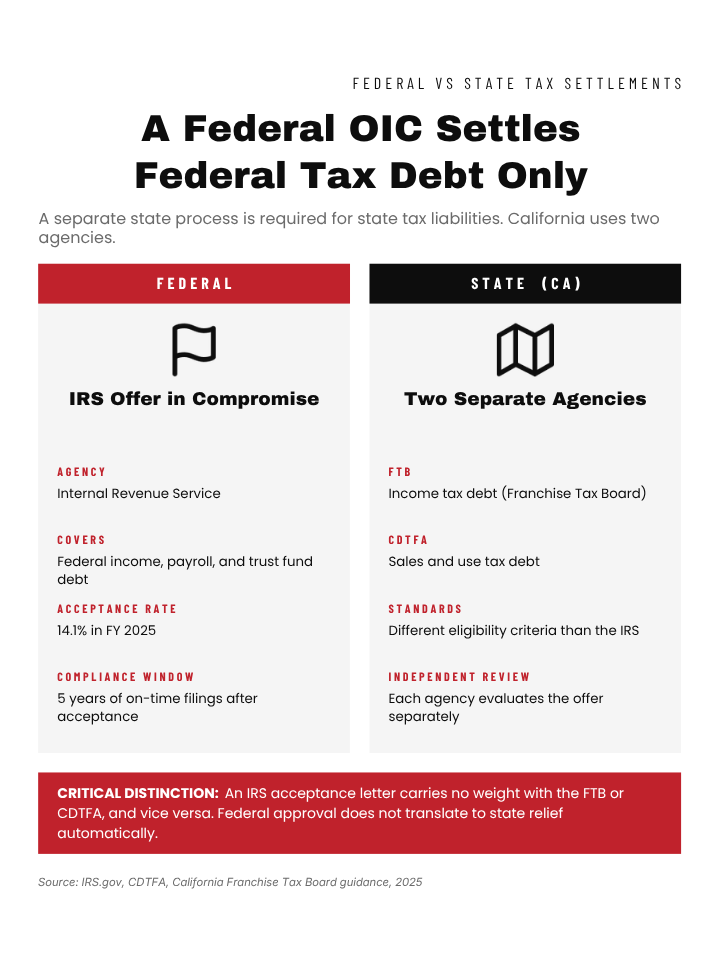
One critical point that surprises many taxpayers: a federal OIC resolves federal tax liability only. If you owe state taxes in California, a separate application is required through either the California Department of Tax and Fee Administration (CDTFA) or the Franchise Tax Board (FTB), depending on the type of liability. Each agency evaluates offers independently. An IRS acceptance letter carries no weight with CDTFA or FTB, and vice versa. California's state programs also have different eligibility standards, so don't assume that approval at the federal level translates to state relief automatically. For how California handles state offers and required forms, review the California state offer-in-compromise process summary and the CDTFA guidance and form for taxpayers.
Payment Deadlines and Compliance Obligations After Acceptance
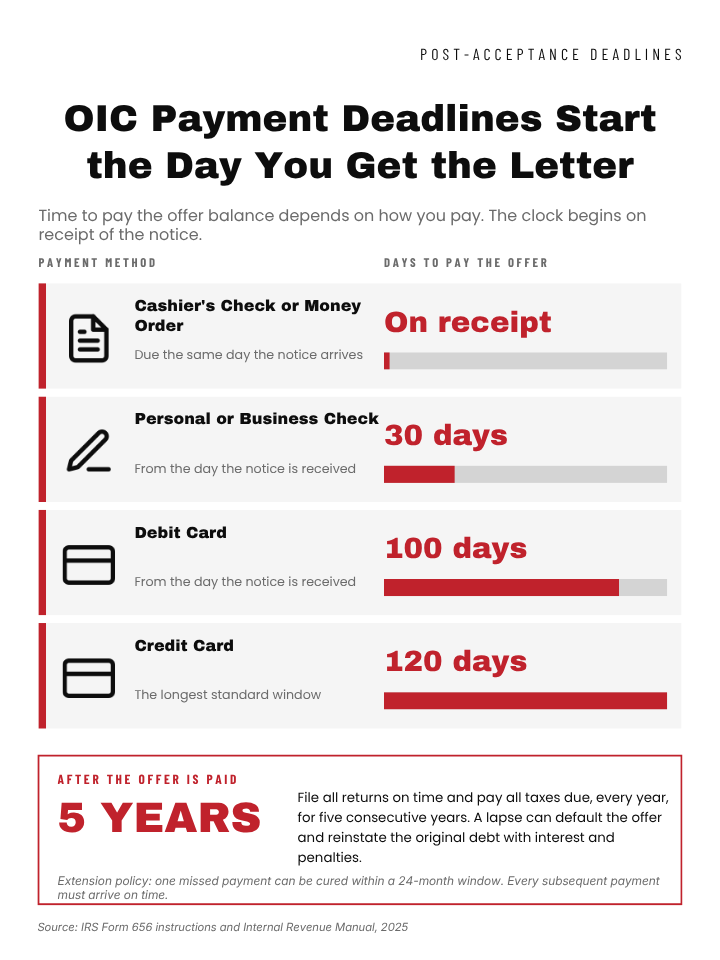
Payment timing after acceptance depends on the payment method used. These deadlines begin from the date you receive the acceptance notice, not the date the IRS approved the offer internally. Cashier's check or money order: due immediately upon receipt Personal or business check: due within 30 days of receipt Debit card: due within 100 days of receipt Credit card: due within 120 days of receipt
The IRS may grant a one-time extension on a payment within a 24-month period, but every subsequent payment must arrive on time without exception. Missing a payment after that extension is gone puts your entire settlement at risk. Treat these Offer in Compromise payment deadlines with the same urgency as the original submission. For a plain-language overview of the program and payment options, TurboTax provides a useful summary of the Offer in Compromise program.
Beyond the payment itself, you are required to file all tax returns on time and pay all taxes due for five consecutive years after acceptance. This is the compliance window, and it is non-negotiable. If you fall behind on filing or fail to pay taxes during those five years, the IRS can default your agreement and reinstate the full original tax debt, including all interest and penalties that have accrued since the original assessment date. That is not a hypothetical risk. It happens.
Post-acceptance monitoring is a core part of what Semper Tax Relief builds into its client process specifically to prevent that outcome. Offer in compromise verification doesn't stop the day the letter arrives, it's an ongoing obligation until the compliance window closes.
Keep copies of your tax relief supporting documents after acceptance because the paper trail protects the settlement if questions come up later.
What to Do If Your OIC Was Rejected, Returned, or Stalled
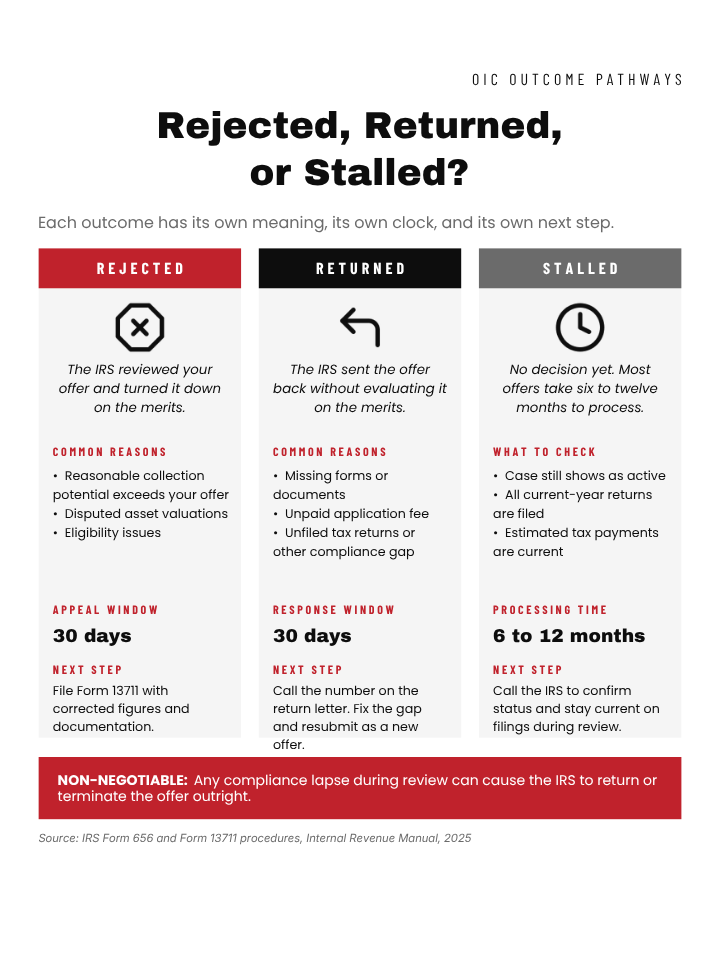
A rejected OIC comes with a written explanation identifying why the IRS turned it down. Common reasons include income calculations that produce a higher reasonable collection potential than your offer amount, disputed asset valuations, or eligibility issues. Read that letter carefully before reacting. You have a 30 day window to file Form 13711, the Request for Appeal of Offer in Compromise, to contest the decision. Include documentation that directly disputes the IRS's figures, corrected income calculations, updated asset appraisals, or both. If you want a practitioner's view on recovering from a rejected OIC, several law firms outline options for clients on what to do when an OIC is rejected and the practical steps after denial.
If the 30-day appeal window closes without action, a new OIC can be submitted with corrected financial information. Alternatively, explore an installment agreement or Currently Not Collectible status as a bridge while you prepare a stronger offer. Neither option is permanent, but both stop enforcement while you regroup. For step-by-step guidance after a denial, see a practical checklist on steps after a denied Offer in Compromise and a law firm overview of rejected OIC practice considerations.
A returned offer is a different situation entirely. The IRS returned it without evaluation, typically because of missing forms, an unpaid application fee, or a compliance problem such as an unfiled return. Call the number on the return letter within 30 days and request reconsideration. If the return was legitimate, fix the documentation gap and resubmit as a new offer. Don't try to argue the return at that stage, just correct it and move forward. You can find practical examples of returned-offer reasons and how practitioners handle them in published practice notes.
If your offer appears stalled, know that OICs typically take six to twelve months to process. A long wait is not automatically a warning sign. What you should confirm is that your case is still active, that all current year filings are complete, and that estimated tax payments are current. Any compliance lapse during the review period can cause the IRS to return or terminate the offer outright. Staying current on your obligations while the OIC is pending is not optional. Community-sourced timelines and practitioner discussions can help set realistic expectations, but official IRS guidance and IRM rules are the final word on processing and deemed-acceptance timelines. For a deeper timeline and preparation checklist, see an outline on how long the IRS Offer in Compromise takes and a community timeline discussion among tax professionals.
If the IRS rejects or returns your offer, the Ultimate IRS Tax Debt Resolution Guide can help you compare payment plans, CNC status, penalty relief, PPIA, and other options.
The Paper Trail Protects the Outcome
A successful Offer in Compromise doesn't end at acceptance. Verified offer in compromise acceptance triggers deadlines, starts a five-year compliance clock, and becomes the document you'll need anytime your tax history is reviewed by a lender, agency, or creditor. Know what that letter contains, keep copies, meet your payment deadline, and stay current on your filings every year until the compliance window closes.
The case studies in this article reflect what realistic OIC outcomes look like when the process is handled with proper documentation and financial analysis from the start. Settlement results aren't accidental. They come from accurate financial disclosure and working with a firm that understands how the IRS evaluates an OIC and reasonable collection potential. For the IRS's own operational procedures related to offers and processing, refer to the applicable sections of the IRS IRM.
If you have a pending offer, an accepted offer you need to document, or you're wondering whether you qualify for an OIC in the first place, start with a free case review at Semper Tax Relief. The review carries a $595 value, there's no cost to you, and you'll leave with a clear picture of your options. Call us or book online, we're available 24/7 because IRS problems don't follow business hours. For broader context on program basics, you can also review the TurboTax overview of the Offer in Compromise program, and for independent taxpayer rights and notices, see the Taxpayer Advocate's information on offer in compromise notices.

IRS Offer in Compromise Accepted: How to Verify and Prove Your Tax Settlement FAQs
-
You know your Offer in Compromise was accepted when the IRS sends a formal written acceptance letter. A phone call, payment receipt, or online account update is not enough by itself. The acceptance letter should confirm the accepted offer amount, the tax periods covered, and the payment terms you must follow.
-
The strongest proof is the official IRS acceptance letter. Form 7249, the Offer Acceptance Report, can also serve as a formal record of the accepted offer. If you lost your acceptance letter or need additional proof, you may be able to request Form 7249 from the IRS using Form 15086.
-
Yes. If a lender, creditor, or financial reviewer asks for proof that your IRS tax debt was settled, the IRS acceptance letter is the document you should provide. It helps show that the federal tax debt was resolved under an accepted Offer in Compromise. Keep multiple copies because replacing the letter later can take time.
-
After acceptance, you must follow the payment terms listed in the IRS acceptance letter. You must also stay compliant for five years by filing required tax returns on time and paying taxes when due. If you miss payments or fall out of tax compliance, the IRS can default the agreement and reinstate the original tax debt.
-
A rejected OIC means the IRS reviewed your offer and decided not to accept it, often because it believes you can pay more based on your financial information. A returned OIC means the IRS did not fully review the offer, usually because something was missing, the fee was not paid, or you were not in filing or payment compliance.
Additional resources referenced in this article:
IRS IRM guidance on offer processing
Timeline: How long an OIC takes
Community timeline questions on OIC approval
Tax professional timeline reports
Discussion on grant rates in the IRS subreddit
Practical OIC explanation video
IRS hiring process (staffing context)
What to do when an OIC is rejected
Guide to getting an OIC accepted
Acceptance tips from a tax practice
Practical notes on rejected offers
California state offer-in-compromise process
CDTFA form and guidance (California)
New York State OIC information
Georgia Department of Revenue Offer in Compromise
For other detailed background reading in our library, see our articles The Ultimate IRS Offer In Compromise Guide and 5 Reasons the IRS Offer In Compromise Program is not for you.