IRS Payment Plan or Offer in Compromise: Which Option Works Best for You?
Which is better, an IRS payment plan or an Offer in Compromise?
The answer depends on your numbers.
If you owe the IRS and cannot pay the full balance, both options may sound helpful. A payment plan gives you time to pay. An Offer in Compromise (OIC) may allow you to settle for less than the full amount owed if you qualify.
But choosing the wrong option can be expensive.
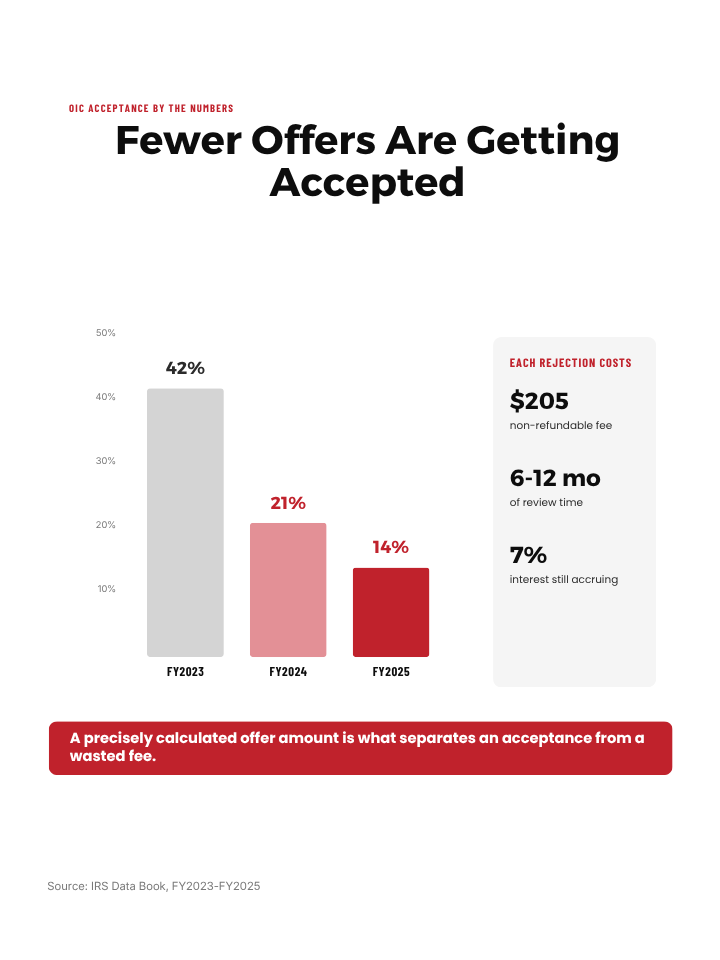
A payment plan usually means paying the full tax debt, plus penalties and interest that may continue to grow over time. An Offer in Compromise may reduce the balance, but the IRS does not accept every offer. In fiscal year 2024, the IRS accepted only about 21 percent of Offer in Compromise applications, down from about 42 percent the year before.
That is why this decision should not be based on hope, ads, or guesswork.
At Semper Tax Relief, we often see taxpayers apply for an Offer in Compromise when a payment plan would have resolved the case faster. We also see taxpayers enter payment plans when their financial situation may have supported a settlement review.
The right option depends on your income, expenses, assets, filing compliance, type of tax debt, and what the IRS believes it can realistically collect.
This article gives you a side-by-side comparison of IRS payment plans and Offers in Compromise, so you can understand how each option works, who may qualify, and what to review before choosing a path.

TLDR;
An IRS payment plan and an Offer in Compromise solve different tax debt problems.
A payment plan is usually better when you can afford to repay the full IRS balance over time.
An Offer in Compromise may be better when your financial records show the IRS cannot realistically collect the full balance.
The IRS uses Reasonable Collection Potential, or RCP, to decide whether an OIC amount is acceptable.
Payment plans are generally faster and easier to approve than OIC applications.
OIC applications require stronger financial documentation and have a higher rejection risk.
All required tax returns must be filed before either option can move forward.
Business owners must also stay current on payroll tax deposits before applying for an OIC.
CNC status may help if you cannot afford payments right now and do not qualify for an OIC yet.
An accepted OIC comes with a five-year compliance requirement.
Choosing the wrong option can cost money, time, fees, and collection leverage.
The best option depends on income, expenses, assets, tax compliance, and ability to pay.
Which Is Better, IRS Payment Plan or Offer in Compromise?
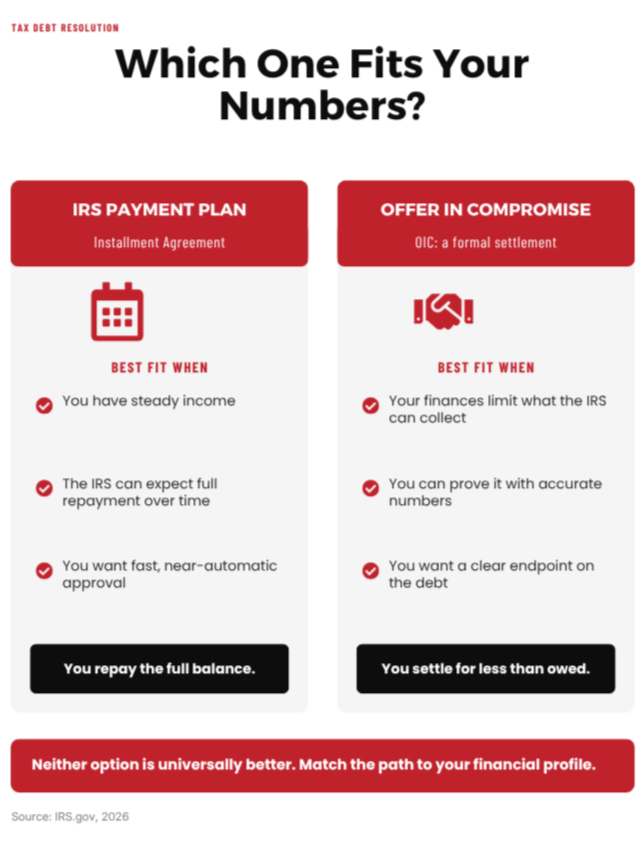
The honest answer is that it depends entirely on your financial profile. Neither option is universally superior. An IRS payment plan is the right fit when you have steady income, and the IRS can reasonably expect full repayment over time. An Offer in Compromise is the better path when your financial picture genuinely limits what the IRS can collect, and you can prove it with accurate numbers. The sections below break down exactly how each option works so you can see which one matches your situation.
What an IRS installment agreement gives you
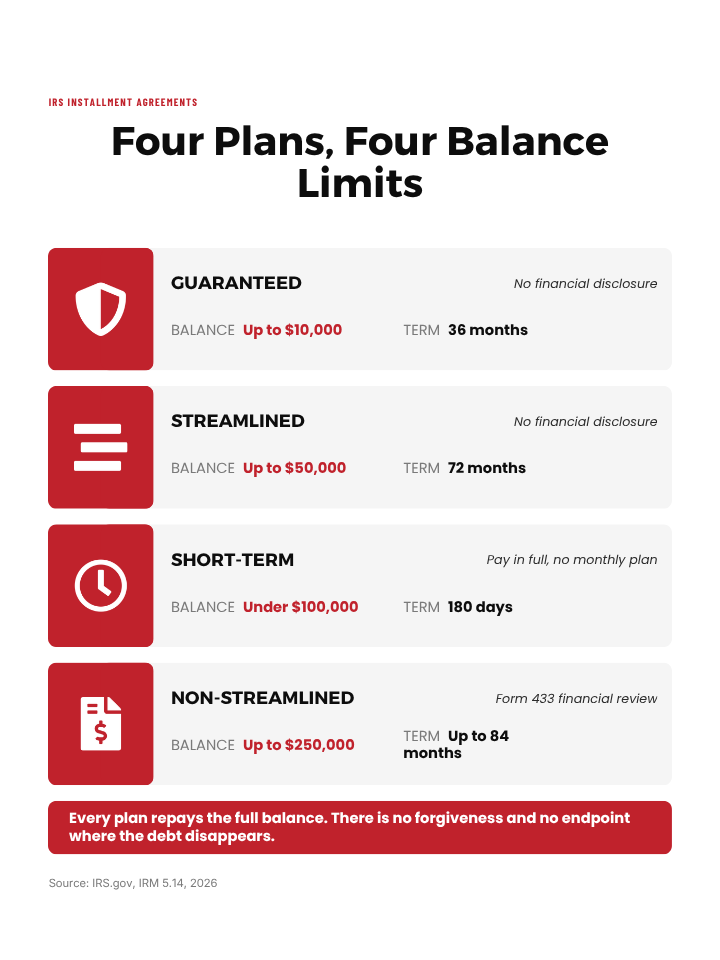
An IRS installment agreement is an arrangement where you repay your full tax debt in monthly installments over time. There are four main types:
Guaranteed plan: balances up to $10,000, paid over 36 months
Streamlined plan: balances up to $50,000, paid over 72 months
Short-term plan: balances under $100,000, paid within 180 days
Non-streamlined plan: balances up to $250,000, paid over up to 84 months
What you are agreeing to in every case is full repayment. There is no forgiveness, no reduction in what you owe, and no endpoint where the remaining debt disappears.
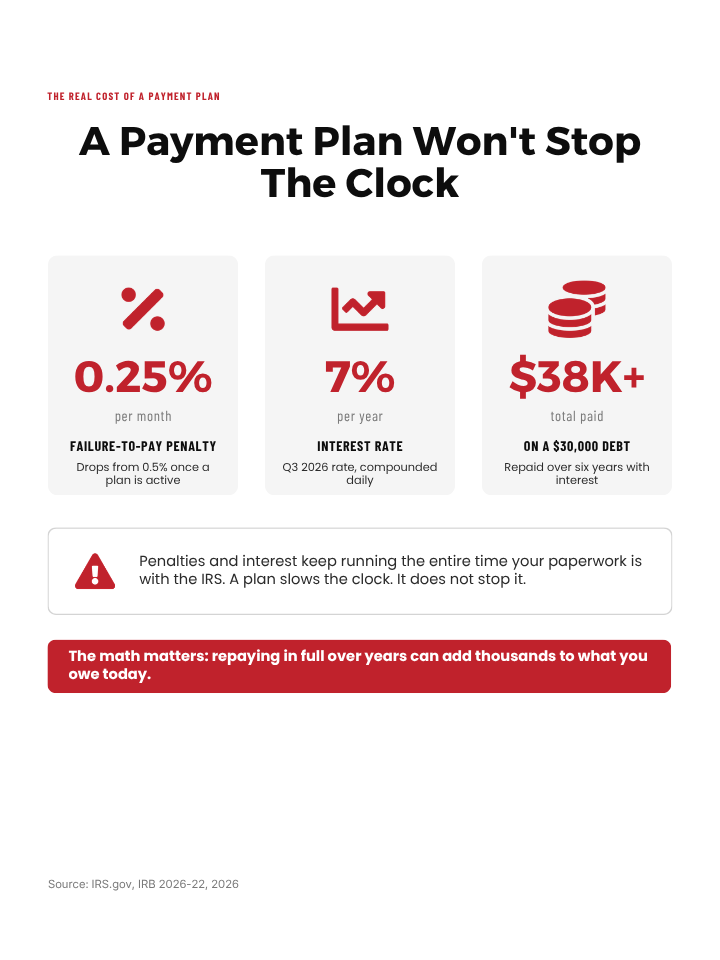
Penalties and interest do not stop while you are in a payment plan. The failure-to-pay penalty drops from 0.5% to 0.25% per month once an agreement is in place, and interest runs at 7% annually as of the third quarter of 2026, compounded daily. The math matters: a $30,000 debt paid over six years can easily cost $38,000 or more by the time you make that final payment.
What an Offer in Compromise actually does
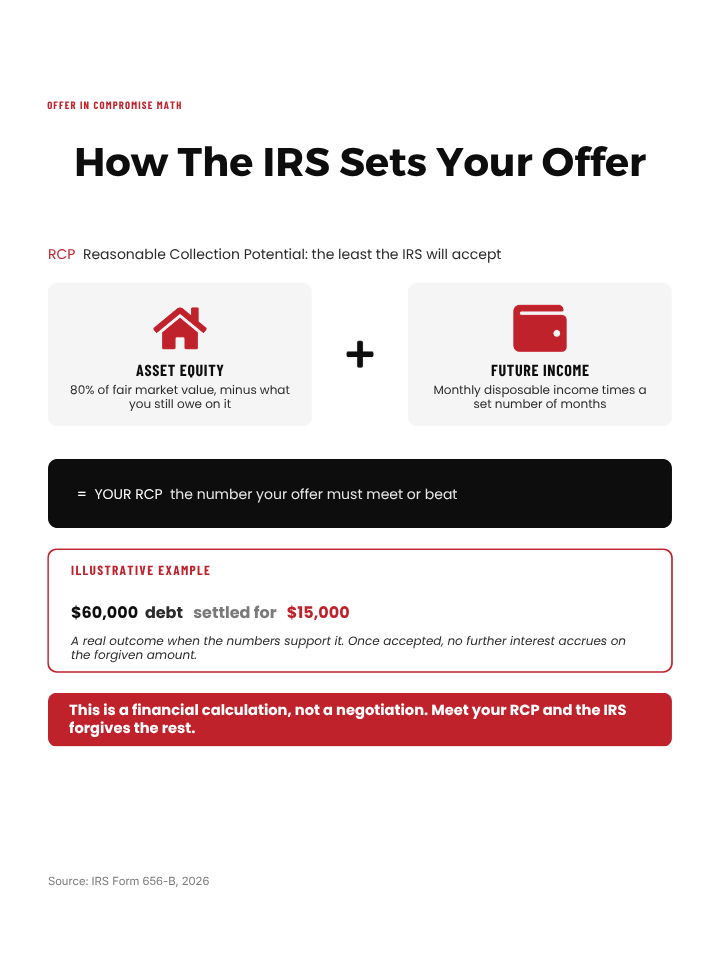
AnOffer in Compromise is a formal tax debt settlement where the IRS agrees to accept less than the full amount owed. The IRS doesn't pick a number arbitrarily, it calculates your Reasonable Collection Potential (RCP), which combines your asset equity (at 80% of fair market value, minus encumbrances) with a multiplier of your monthly disposable income after allowed living expenses. If your offer meets or exceeds that RCP figure, the IRS accepts it and forgives the remaining balance.
This is a financial calculation, not a negotiation. A $60,000 debt settled for $15,000 is a real outcome when the numbers support it, and once accepted, no further interest accrues on the forgiven amount. The key phrase is "when the numbers support it." The IRS won't accept an offer from someone who can clearly afford to pay in full.
If the IRS cannot reasonably collect the full balance, an IRS Offer in Compromise may allow you to settle for less than the amount owed.
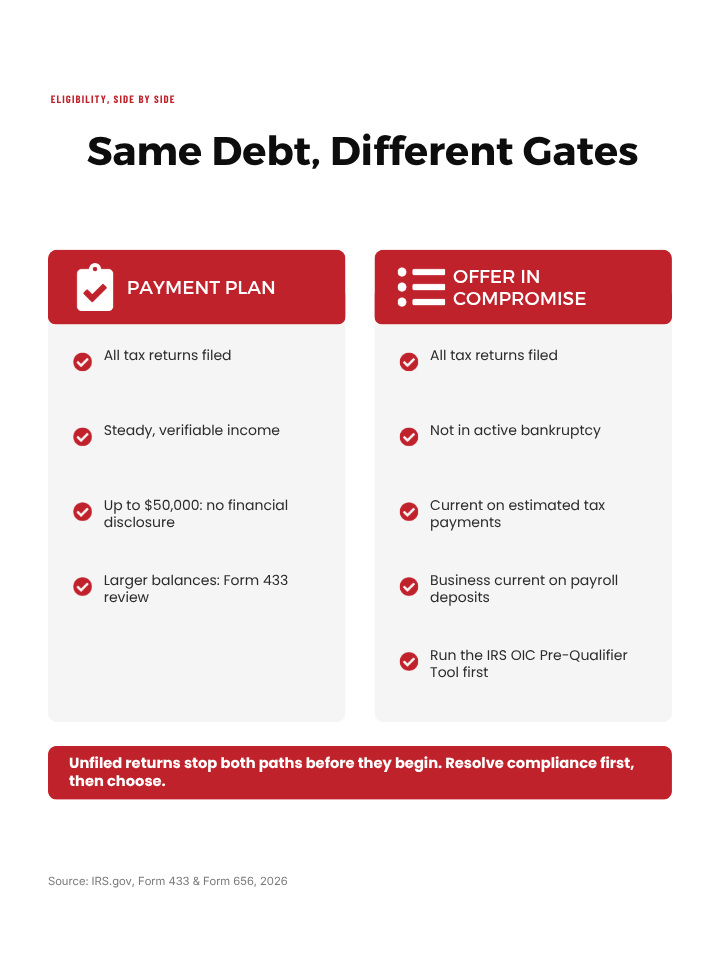
Who Qualifies: Eligibility Rules Side by Side
Gather your tax relief supporting documents before choosing a strategy because both OIC and financial hardship reviews depend on proof.
Payment plan: who gets approved and how fast
Most taxpayers with a filing history and steady income qualify for some form of installment agreement. Streamlined plans for balances up to $50,000 require no financial disclosure and are approved quickly online. Non-streamlined plans for larger balances requireForm 433-A and an IRS financial review. The universal requirement across all plan types is that all tax returns must be filed before the IRS will approve any payment arrangement.
OIC eligibility: the IRS checklist you must pass
Qualifying for an Offer in Compromise means clearing several hard gates before the IRS will even look at your offer amount. All tax returns must be filed. You cannot be in an active bankruptcy. You must be current on estimated tax payments for the current year. Business owners must be current on federal payroll tax deposits for the current quarter and the two prior quarters. Before submitting a formal application, theIRS OIC Pre-Qualifier Tool is the first step every applicant should take to estimate eligibility and a preliminary offer amount.
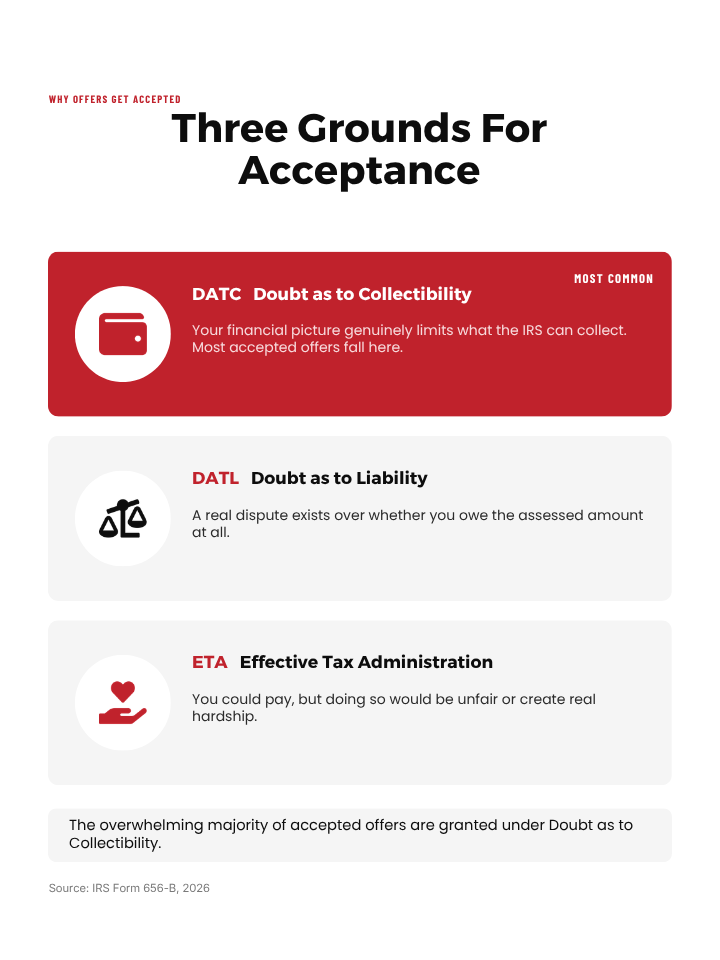
The three grounds for acceptance are Doubt as to Liability, Doubt as to Collectibility, and Effective Tax Administration. The overwhelming majority of accepted offers fall under Doubt as to Collectibility, meaning the taxpayer's financial picture genuinely limits what the IRS can expect to collect over the remaining collection period.
Why the 21% acceptance rate deserves your attention before you apply
The OIC acceptance rate fell from roughly 42% in fiscal year 2023 to approximately 21% in fiscal year 2024. That doesn't mean the program is broken, but it does mean submitting an application without a precisely calculated offer amount is far more likely to fail than succeed. The IRS rejects offers that fall below the RCP calculation, contain incomplete documentation, or are submitted while the taxpayer is out of compliance. Each rejection costs you $205 in non-refundable fees, months of review time, and a debt that kept accruing the entire time.
Before choosing an OIC, use the IRS Offer in Compromise Calculator to estimate whether your income, expenses, and assets may support a settlement.
What about Currently Not Collectible status?
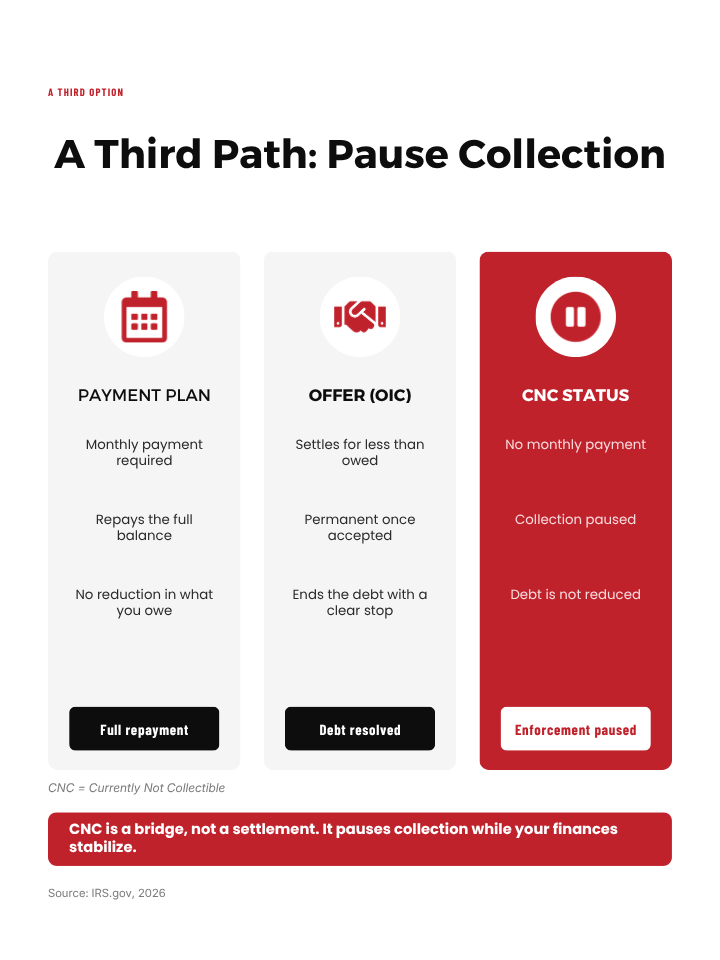
There is a third option worth knowing: Currently Not Collectible (CNC) status. The IRS can temporarily suspend collection activity when a taxpayer demonstrates they have no ability to pay living expenses and their tax debt at the same time. CNC is not a settlement and it doesn't reduce what you owe, but it pauses enforcement while your financial situation stabilizes. Unlike a payment plan, no monthly payment is required during CNC status. Unlike an OIC, it doesn't permanently resolve the debt. For taxpayers who can't qualify for an OIC yet but also can't sustain installment payments, CNC can serve as a bridge while the underlying financial picture improves.
Real-World Scenarios That Show When Each Option Wins
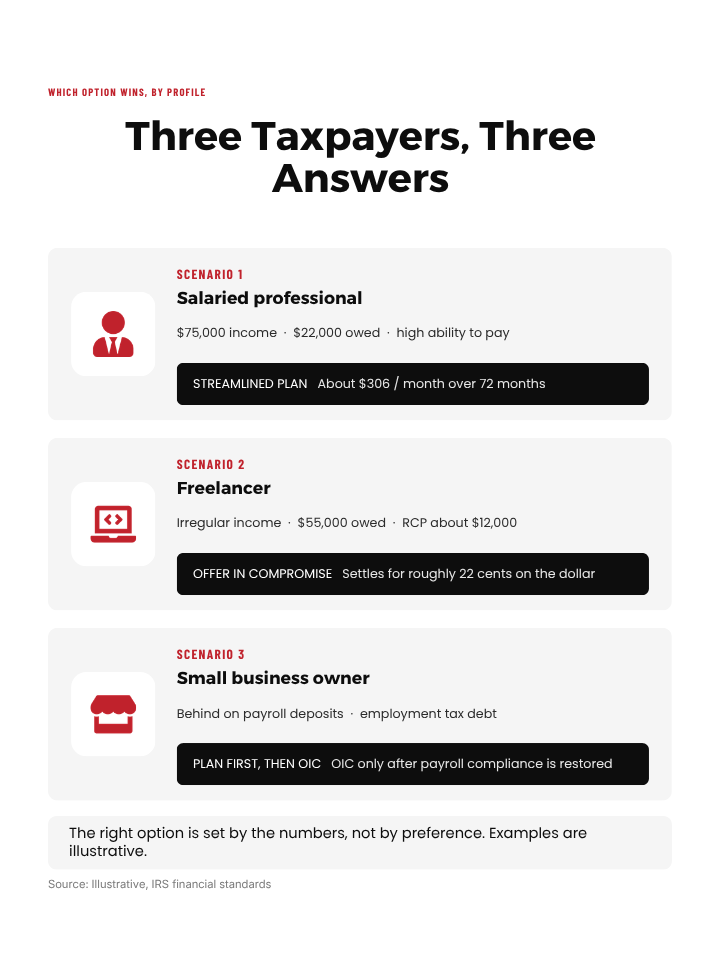
Scenario 1: Steady income, no major financial hardship
A salaried professional earning $75,000 per year owes $22,000 in back taxes. Their income and assets produce a high RCP, meaning the IRS calculates they have the ability to pay most or all of the debt. An OIC application would almost certainly be rejected. A Streamlined Installment Agreement at roughly $306 per month over 72 months is the cleaner, faster path here. The total paid will exceed $22,000 due to interest and penalties, but the timeline is manageable and approval is near-automatic.
Scenario 2: Limited income, few assets, genuine hardship
A freelancer with irregular income owes $55,000 in back taxes. After calculating allowable living expenses against their income usingIRS national standard expense tables, their RCP comes out to $12,000. An offer that matches or exceeds that figure has a realistic chance of acceptance, resolving a $55,000 problem for roughly 22 cents on the dollar. A payment plan at this balance would require a non-streamlined agreement with full financial disclosure and repayment of the entire $55,000 plus years of compounding interest.
Scenario 3: Small business owner with payroll tax debt
Business owners with employment tax debt face an added layer of complexity. To be OIC-eligible, the business must be current on payroll tax deposits for the current quarter and the two prior quarters. An owner who is behind on those deposits cannot submit an OIC until compliance is fully restored.
If your OIC is accepted, review Offer in Compromise Accepted to understand payment deadlines and the five-year compliance rule.
A non-streamlined installment agreement may be the necessary bridge while the business stabilizes, with the OIC as a longer-term goal once compliance is back on track. This is the scenario where professional guidance changes the outcome most dramatically, because the sequencing of steps matters as much as the choice between options.
IRS Form 2848 Power of Attorney allows a qualified representative to speak directly with the IRS about payment plans, OICs, CNC, appeals, and collections.
The Long-Term Consequences Most Taxpayers Overlook
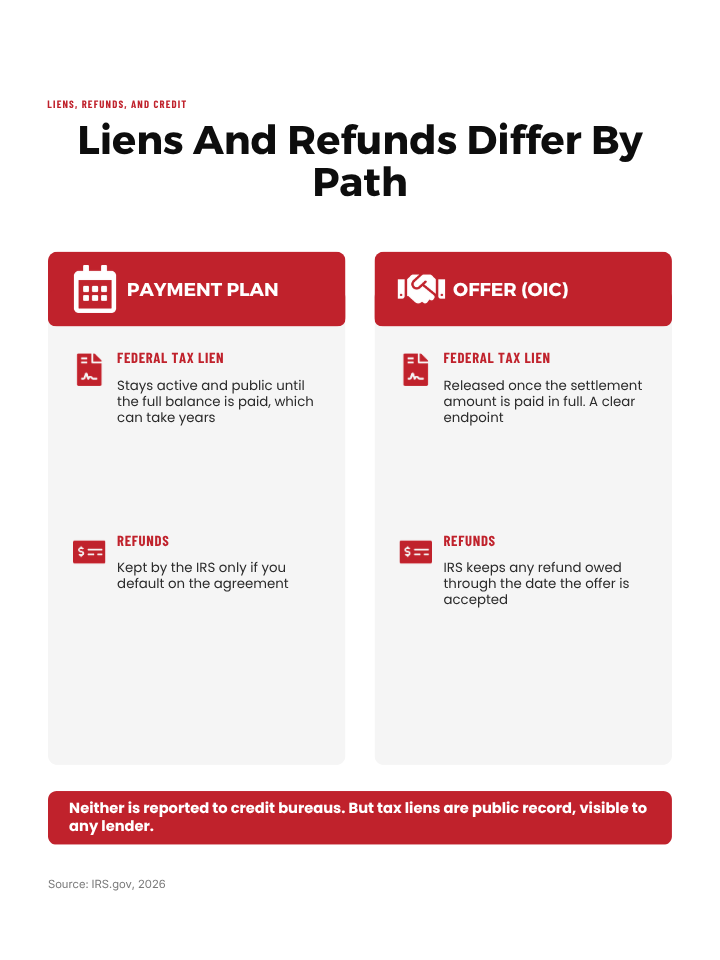
How liens, refund seizures, and credit play out differently
The IRS can file a federal tax lien under either option. Under a payment plan, that lien stays active and public until the full balance is paid, which can take years under a non-streamlined agreement. Under an accepted OIC, the lien is released once the settlement amount is paid in full, offering a clear endpoint rather than years of open exposure to lenders and creditors.
Refund seizure works differently between the two options. During an active OIC review, the IRS keeps any refund owed to the taxpayer through the date the offer is accepted. Under a standard installment agreement, refunds are not automatically seized unless the taxpayer defaults. Neither option is reported directly to credit bureaus, but tax liens are public record and visible to any lender who pulls a title or public records search.
The 5-year compliance requirement that can undo an accepted OIC
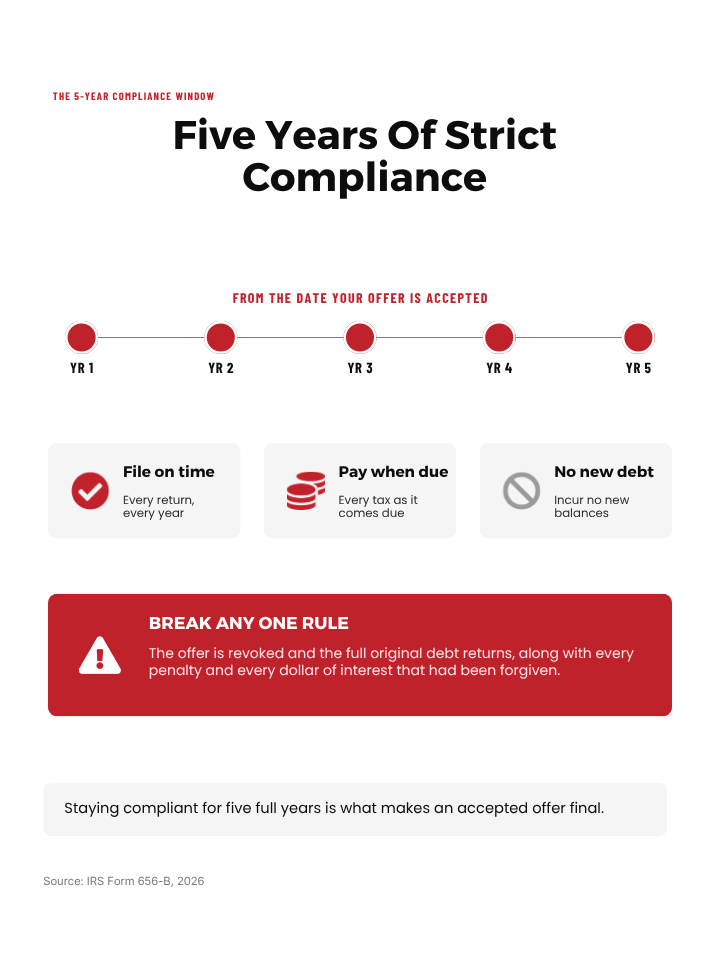
An accepted Offer in Compromise is not unconditional. For five full years after acceptance, the taxpayer must file all returns on time, pay all taxes when due, and not incur new tax debt. Violating any of those conditions revokes the offer entirely and reinstates the full original debt along with all penalties and interest that had been forgiven. This is not a minor footnote buried in the agreement. It is the most common reason accepted OICs are later unwound, and it means the work of staying compliant doesn't end on the day you get the acceptance letter. If penalties are making the balance harder to manage, IRS penalty forgiveness may be reviewed before locking into a long-term payment plan.
For more on when an offer may not be the right choice, see Semper Tax Relief's5 Reasons the IRS Offer In Compromise Program is not for you.
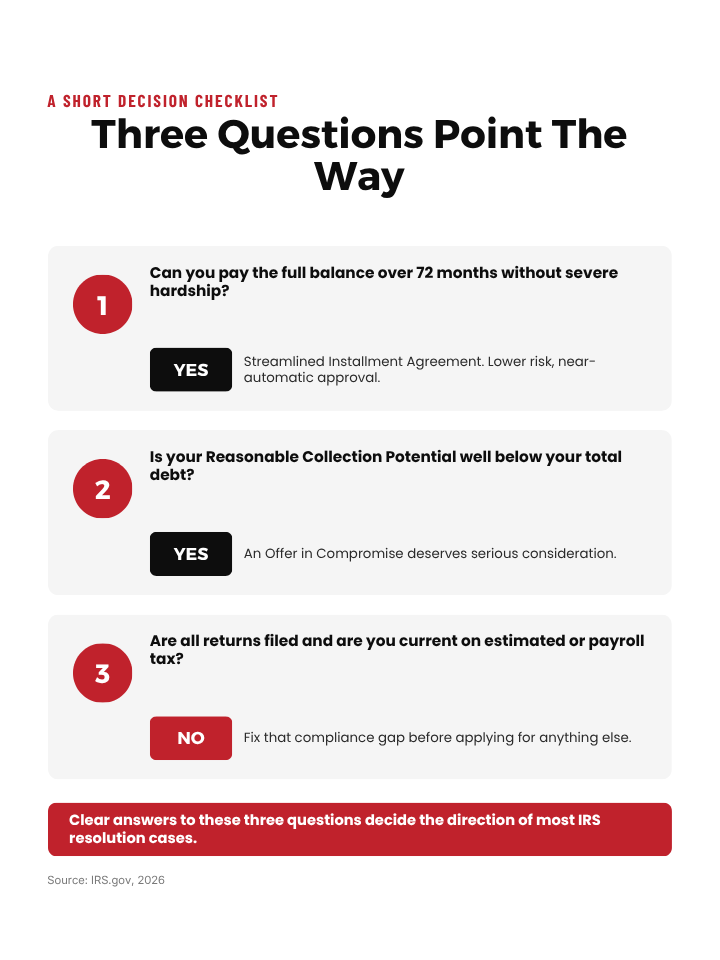
A Short Decision Checklist Before You Commit
Questions that point you toward the right option
Before committing to either path, answer these questions honestly:
Can you pay your full balance over 72 months without severe financial hardship?
If yes, a Streamlined Installment Agreement is the lower-risk path with near-automatic approval.
Is your Reasonable Collection Potential significantly lower than your total debt?
If your asset equity plus future income potential falls well short of what you owe, an OIC deserves serious consideration.
Are all your tax returns filed and are you current on estimated or payroll tax obligations?
If the answer to either part is no, resolve that compliance gap before applying for anything else.
These questions determine the direction of the vast majority of IRS resolution cases. Getting clear answers before taking any action saves time, money, and the risk of triggering enforcement while you're in the middle of a review process.
When professional guidance changes which option you actually qualify for
TheRCP calculation is where most self-prepared OIC applications go wrong. Taxpayers routinely undercount allowable expenses or miscalculate asset equity using the full fair market value instead of the IRS's required 80% quick-sale discount. Those errors either inflate the offer amount unnecessarily or produce a number the IRS won't accept. At Semper Tax Relief, theRCP calculation is completed before any application is submitted, which is exactly why a free case review is the logical first step before choosing between these options. Getting the wrong answer doesn't just mean a rejection letter; it can restart the IRS collection clock on a debt you thought was close to resolved.
IRS Payment Plan or Offer in Compromise: Which Option Works Best for You? FAQs
-
An IRS payment plan is better when you can realistically pay the full tax balance over time. It is usually faster to set up, has a lower rejection risk, and may not require a full financial review if you qualify for a streamlined agreement. However, it does not reduce the tax debt, and penalties and interest may continue until the balance is paid.
-
An Offer in Compromise may make more sense when your income, expenses, assets, and financial situation show that the IRS cannot realistically collect the full balance. The key number is your Reasonable Collection Potential, or RCP. If your RCP is significantly lower than what you owe, an OIC may be worth reviewing before agreeing to years of monthly payments.
-
Yes, you may be able to submit an Offer in Compromise later, even if you are already in a payment plan. This may happen if your financial situation changes or if a deeper review shows that your ability to pay is lower than expected. You still need to meet OIC eligibility rules, including filing compliance, current tax payments, and complete financial documentation.
-
If the IRS rejects your Offer in Compromise, it should send a written explanation. You generally have 30 days to appeal using Form 13711. A rejection may happen because the IRS believes your offer is too low, your financial documents are incomplete, your asset values are higher than reported, or your compliance is not current. If the OIC does not work, a payment plan, CNC status, or another resolution option may still be available.
-
If you cannot afford a payment plan and do not qualify for an Offer in Compromise, Currently Not Collectible status may be an option. CNC does not erase the debt, but it can pause IRS collection if paying would prevent you from covering necessary living expenses. Penalty relief or a partial payment installment agreement may also be worth reviewing depending on your income, assets, expenses, and collection statute.
Choose the Right Path, Not Just Any Path
When deciding which is better, an IRS payment plan or an Offer in Compromise, the answer comes down to your numbers, not a general preference. A payment plan is the right move when you have steady income and a balance the IRS reasonably expects you to repay over time. An Offer in Compromise is the better path when your financial picture genuinely limits what the IRS can collect, and you can document that clearly with accurate numbers. Both options work, but only when they're matched to the right financial profile.
With OIC acceptance rates sitting at 21%, an incorrectly prepared application isn't just a setback. It's a wasted $205 non-refundable fee, six to twelve months of review time, and a debt that kept accruing interest at 7% annually the entire time the IRS had your paperwork. For a plain-language overview of how the Offer in Compromise program works, see this TurboTax guide to Offers in Compromise.
If neither option is clearly right yet, the Ultimate IRS Tax Debt Resolution Guide can help compare payment plans, OIC, CNC, penalty relief, and other IRS options.
Before you choose between a payment plan and an Offer in Compromise, get the numbers in front of a credentialed professional who can run the actual RCP calculation for your situation. Semper Tax Relief offers a free case review (a $595 value) to help taxpayers understand exactly which option they qualify for and what a realistic resolution looks like. Call or book online 24/7 at sempertaxrelief.com. Don't guess on a decision with this much at stake.