
If your spouse passed away and left behind a joint tax debt, I want to start with the part people usually need to hear first: this debt did not appear because of anything you did, and there are real options for addressing it, even if paying it right now is simply not possible.
Currently Not Collectible status is one of those options, and I want to walk through how it works specifically in this situation.
TLDR:
- If you filed a joint return, you are generally jointly and severally liable for the full balance, even after your spouse's death, and even if the debt was based mostly or entirely on your spouse's income.
- Currently Not Collectible status can pause active IRS collection if your income and necessary living expenses show you cannot pay anything without hardship.
- CNC does not erase the debt, and interest generally continues to accrue while it is in place.
- If the tax debt was really your spouse's, not yours, Innocent Spouse Relief may be worth exploring separately from or alongside CNC, and an executor can pursue this on a decedent's behalf under certain conditions.
- If you live in California, community property rules add another layer worth understanding - see the companion post on California community property and tax debt.
- This is a genuinely difficult situation to navigate alone while grieving, and it is worth getting direct guidance rather than guessing at which option fits.
Why the Debt Does Not Simply Disappear
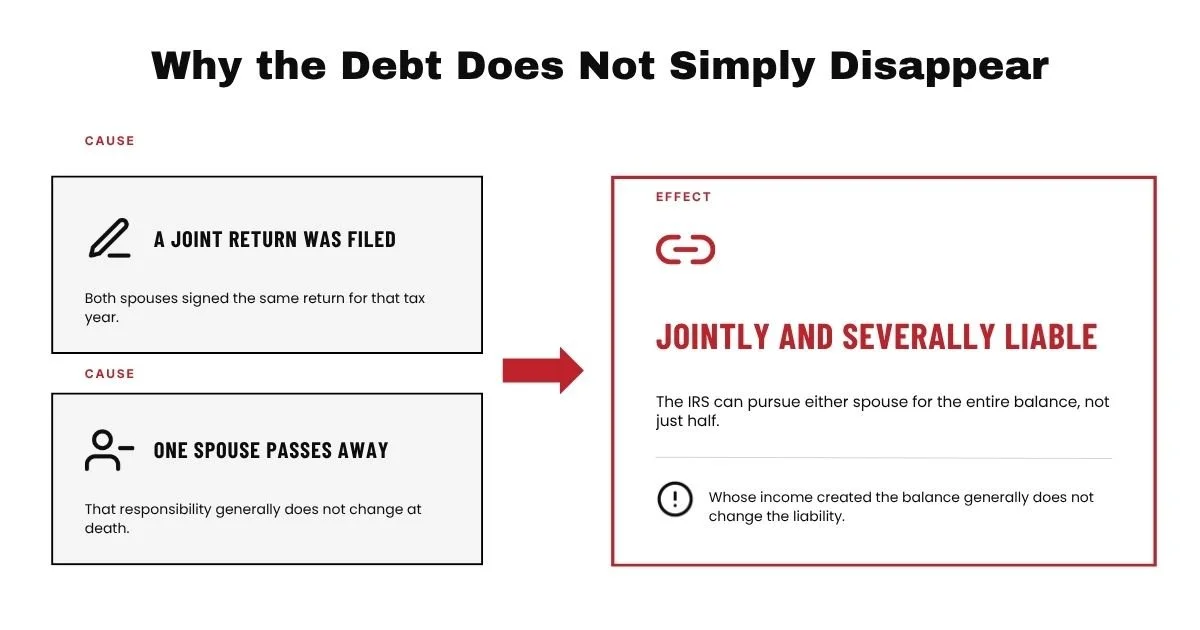
I want to address this directly and gently. If you filed a joint tax return with your spouse, both of you were generally jointly and severally liable for the full balance, meaning the IRS can pursue either spouse for the entire amount, not just half.
That responsibility generally does not change when one spouse passes away. This can feel deeply unfair, especially if the debt stemmed largely from your spouse's income or a business decision you were not closely involved in.
There are paths that address that unfairness directly, covered further below, but the starting legal reality is that joint liability generally survives.
How Currently Not Collectible Status Works Here
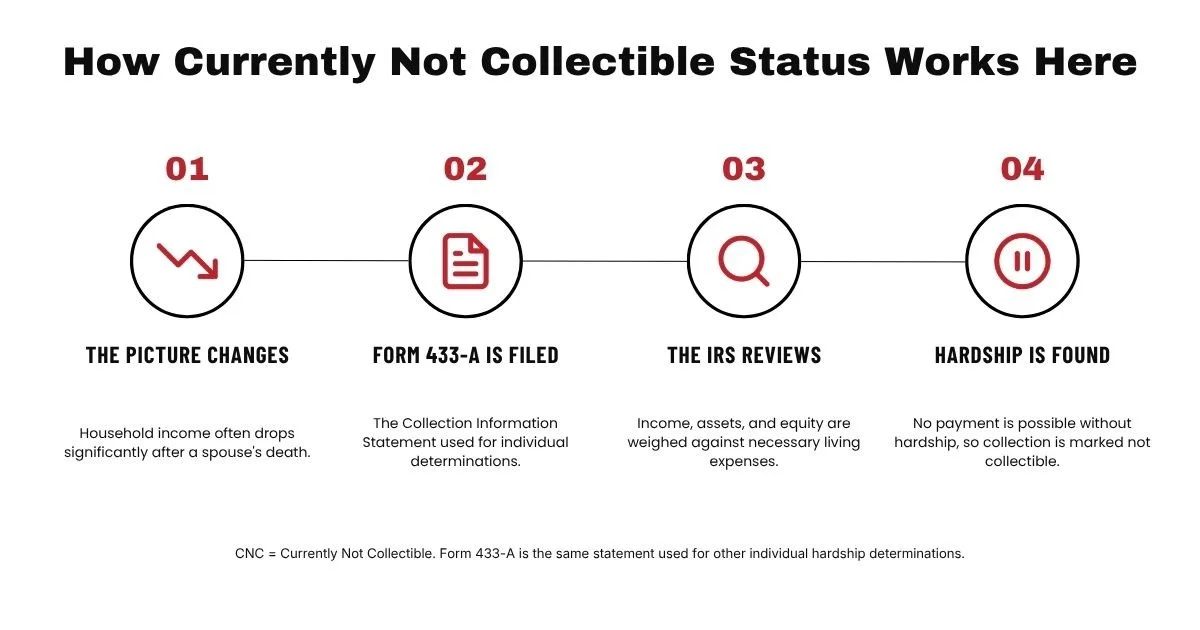
Currently Not Collectible status is not unique to surviving spouses. It is available whenever a taxpayer's financial condition shows no income or assets, no meaningful equity in assets, or insufficient income to make any payment without creating hardship.
The determination is based on financial information you provide on Form 433-A, the same Collection Information Statement used for other individual hardship and resolution determinations.
For a surviving spouse, this often means a genuinely different financial picture than existed when the joint return was filed, particularly if household income dropped significantly after your spouse's death. That changed picture is exactly what a CNC determination is designed to account for.
What CNC Does and Does Not Do
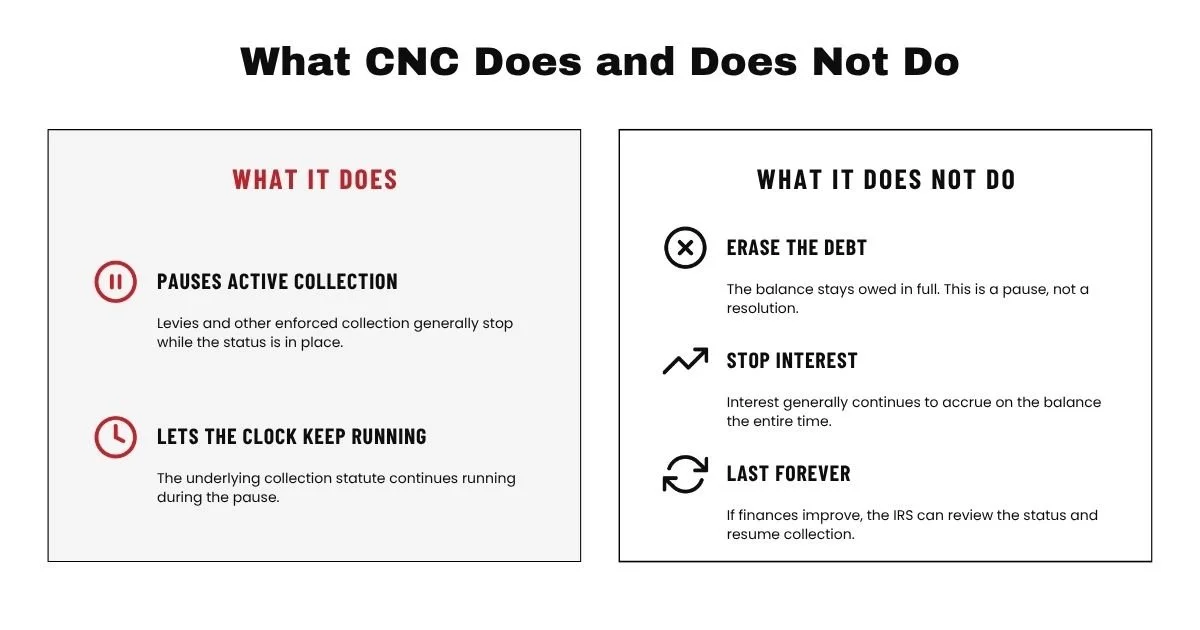
I think it is important to be precise here, because I do not want this to read as more of a solution than it actually is. CNC generally pauses active collection, meaning the IRS generally stops pursuing levies or other enforced collection while the status is in place.
It does not erase the debt, and interest generally continues to accrue on the balance the entire time. If your financial situation improves later, the IRS can review and potentially remove CNC status, resuming collection.
CNC is a pause, not a resolution, though for some surviving spouses, particularly those on a fixed or reduced income, that pause can last a meaningful amount of time, and the underlying collection statute continues running during it as well.
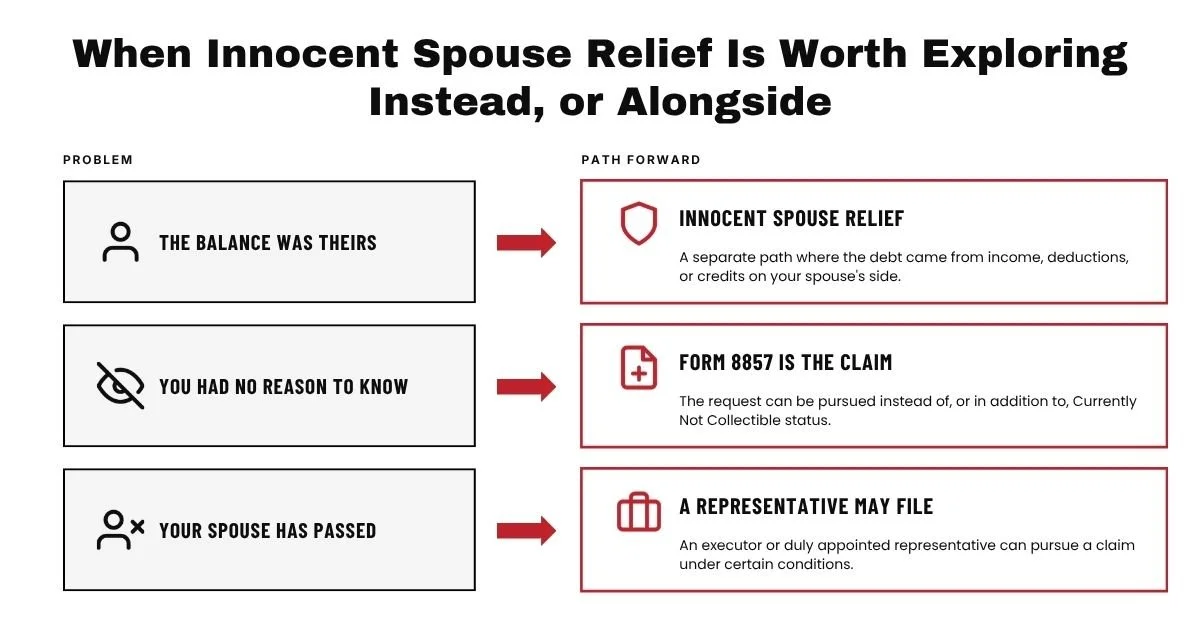
When Innocent Spouse Relief Is Worth Exploring Instead, or Alongside
If the tax debt genuinely was your spouse's, based on income, deductions, or credits related to their side of things that you did not know about and had no reason to know about, Innocent Spouse Relief is a separate path worth exploring, potentially instead of or in addition to CNC.
Notably, this is not necessarily foreclosed by your spouse's death. An executor or other duly appointed representative can pursue a Form 8857 innocent spouse claim that was filed during the decedent's lifetime, and in some circumstances can file Form 8857 after death as long as the decedent met the eligibility requirements while alive.
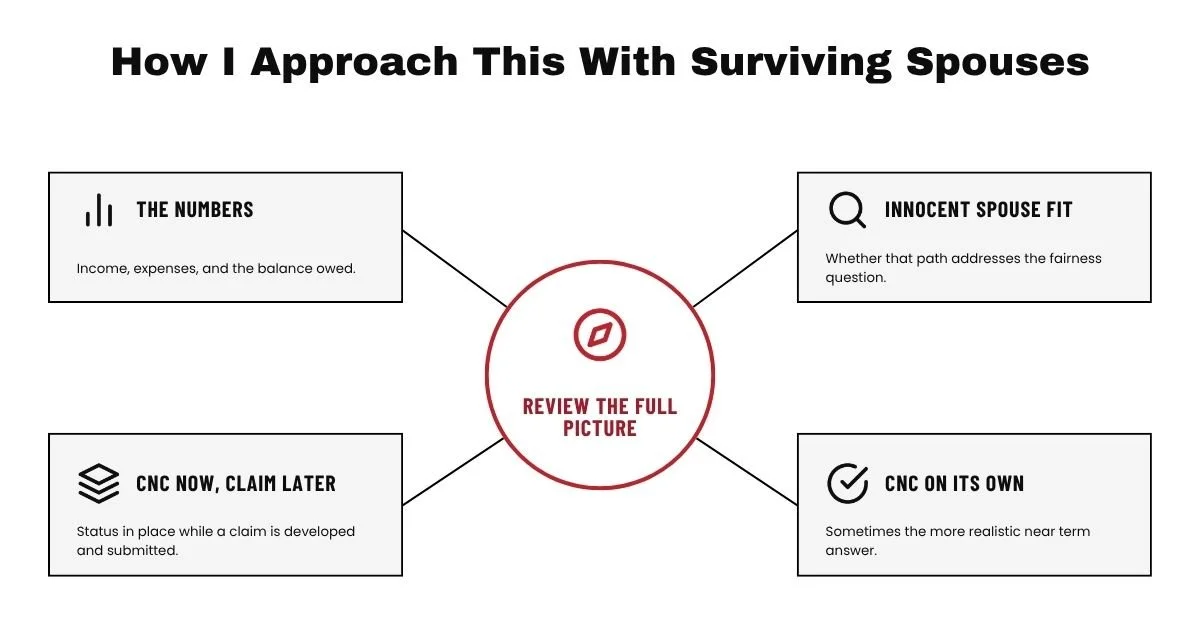
How I Approach This With Surviving Spouses
This is one of the situations where I try hardest to slow down before recommending anything. I want to understand not just the numbers, income, expenses, the balance owed, but also whether Innocent Spouse Relief might genuinely apply, since that path can address the underlying fairness question in a way that CNC alone does not.
Sometimes the right approach is CNC now while an innocent spouse claim is developed and submitted separately. Sometimes CNC is the more realistic near-term answer on its own. That determination depends entirely on your specific facts.
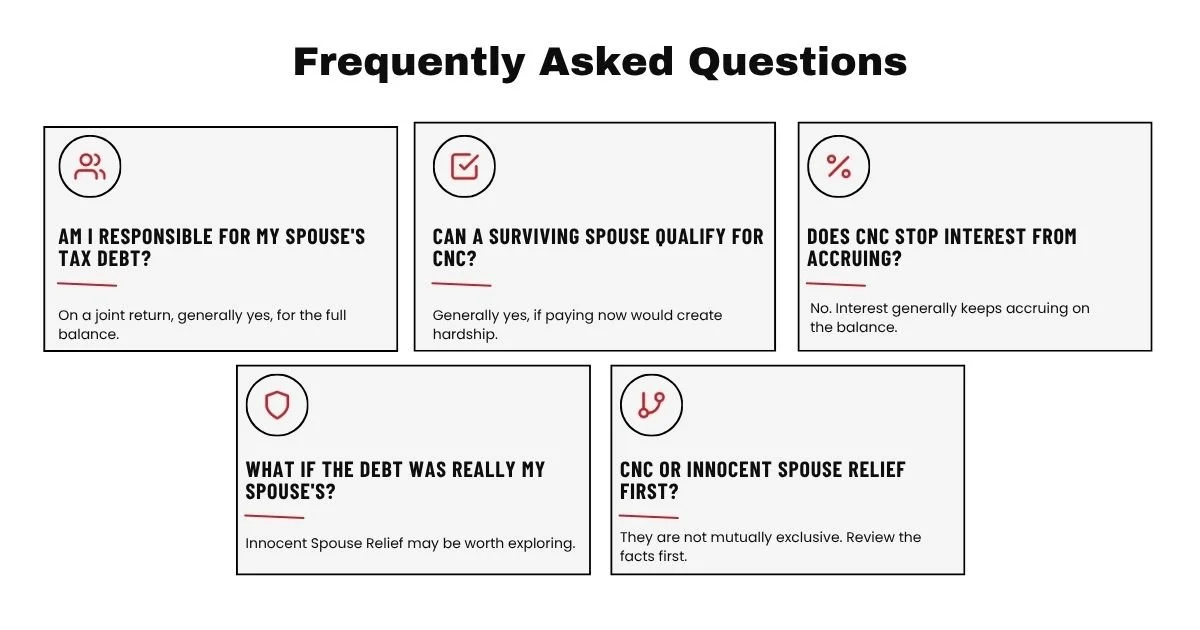
Frequently Asked Questions
-
If you filed a joint return, generally yes, you remain jointly and severally liable for the full balance even after your spouse's death.
If you filed separately, the answer depends on other factors, including whether you live in a community property state. -
Generally yes, if your income and necessary living expenses show that paying anything right now would create hardship, based on the same standards used for any taxpayer.
-
No. Interest generally continues to accrue on the balance while CNC status is in place. CNC pauses active collection, not the growth of the debt itself.
-
Innocent Spouse Relief may be worth exploring, and it is not necessarily off the table just because your spouse has passed away.
-
This depends heavily on your specific situation, and the two are not mutually exclusive.
A careful review of your facts is generally the right starting point rather than assuming one path over the other.
You Do Not Have to Sort This Out Alone
Dealing with a joint tax debt while grieving your spouse is an enormous amount to carry at once. I want you to know there are real options here, and figuring out which one fits does not require you to become an expert in IRS procedure yourself.
I offer a free case review to help you understand your options, including whether CNC, Innocent Spouse Relief, or some combination makes sense for your situation.