
Yes, generally, an estate can pursue an Offer in Compromise to settle a decedent's tax debt for less than the full amount owed.
What I want to walk through is how this actually works in practice, because an estate OIC has a few wrinkles that an individual, living taxpayer's offer does not.

TLDR:
- An executor or personal representative can generally submit an Offer in Compromise on behalf of a decedent's estate, using the same Form 656 process used by living taxpayers.
- The IRS generally evaluates the offer based on the estate's reasonable collection potential, its available assets and any collectible income, the same basic framework used for any OIC.
- A notable Tax Court case, Estate of Kwang Lee v. Commissioner, confirmed the IRS can factor in amounts it could potentially recover from the executor or heirs personally, not just the estate's own remaining assets, when calculating that reasonable collection potential.
- This means an estate OIC is not evaluated in a vacuum. What was distributed to heirs before the offer, and what the executor could potentially be required to return, can factor into what the IRS considers collectible.
- If the decedent had an accepted OIC in place before death, its terms generally continue to apply to the estate, though the executor may need to coordinate directly with the IRS on remaining obligations.
- This is a narrower, more procedurally complex path than an individual's OIC, and getting the reasonable collection potential calculation right matters even more given the case law above.

The Short Answer, and Why It Is More Complicated Than It Sounds
Technically, yes, an executor can file for an Offer in Compromise on behalf of a decedent's estate, using the same basic mechanism a living taxpayer would use.
But an estate OIC is not just an individual OIC with a different name on the form. The IRS's evaluation of what the estate could realistically pay does not stop at the estate's own remaining bank account balance.
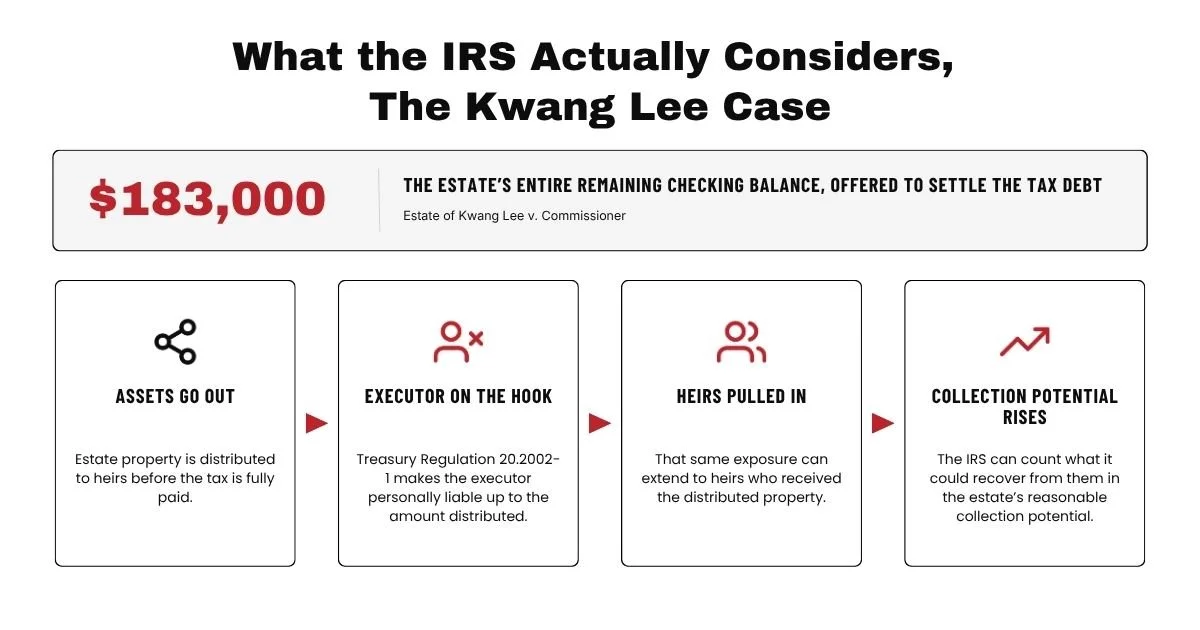
What the IRS Actually Considers, The Kwang Lee Case
This is the part of this topic that most content online glosses over entirely, and I think it is the most important thing an executor considering this path needs to understand.
In Estate of Kwang Lee v. Commissioner, the estate offered its entire remaining checking account balance, $183,000, to settle its tax debt through an Offer in Compromise. The key legal question was whether the IRS could also factor in amounts it might be able to recover separately from the executor or heirs, under provisions addressing executor personal liability for distributions made before estate tax was fully paid, when calculating the estate's reasonable collection potential.
The relevant regulation, Treasury Regulation Section 20.2002-1, generally provides that if an executor pays another debt or distributes part of the estate before all estate tax is paid, the executor is personally liable, to the extent of that payment or distribution, for the unpaid estate tax.
That same potential liability can extend to heirs who received the distributed property.
What this means practically: if assets were already distributed to heirs before the estate pursues an OIC, the IRS is not necessarily limited to what remains in the estate's own accounts when deciding whether to accept the offer. It can potentially factor in what it could recover from the executor or heirs directly.

Why Timing and Sequencing Matter More for an Estate OIC
This connects directly to the broader theme running through this cluster: distributing estate assets before resolving known tax liabilities creates risk, and an estate OIC is a clear, concrete example of exactly how that risk plays out.
An offer calculated on a picked-over estate, after distributions already went out, may not be evaluated the way the executor expects, precisely because of the authority described above.
This is one more reason why the sequencing discussed in our companion posts on executor personal liability matters here specifically: an estate that pursues an OIC before distributing assets is generally in a cleaner, more straightforward position than one that tries to settle after the fact.
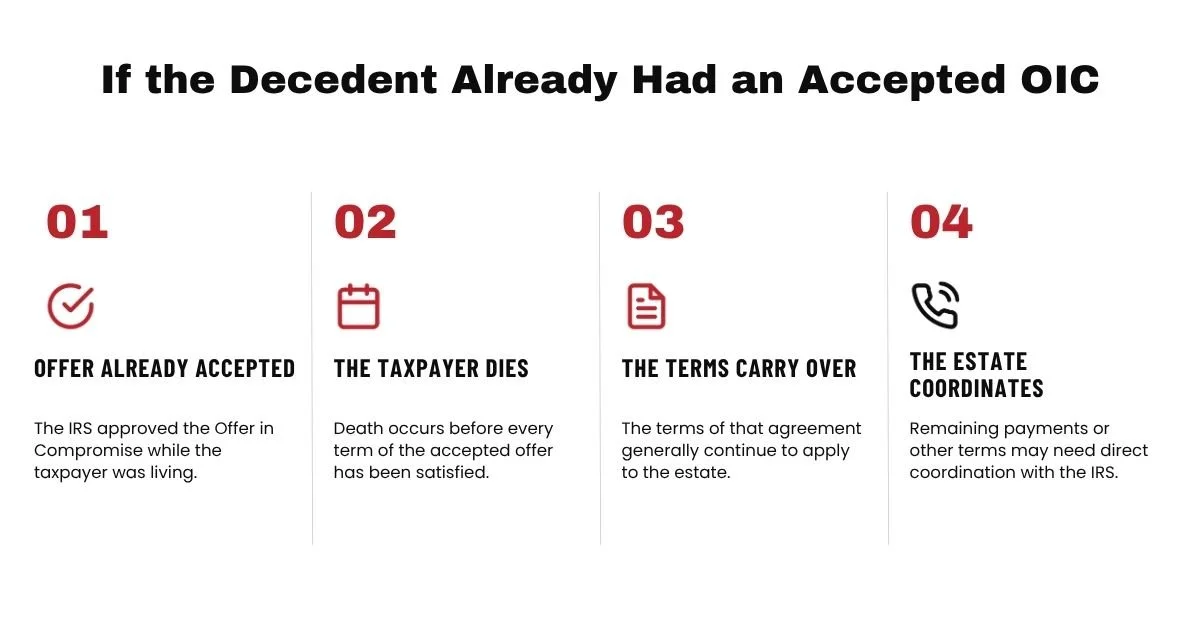
If the Decedent Already Had an Accepted OIC
A separate scenario worth addressing: if the decedent had an Offer in Compromise already accepted by the IRS before they passed away, the terms of that agreement generally continue to apply.
The estate may still need to fulfill remaining payment obligations or comply with other terms of the accepted offer.
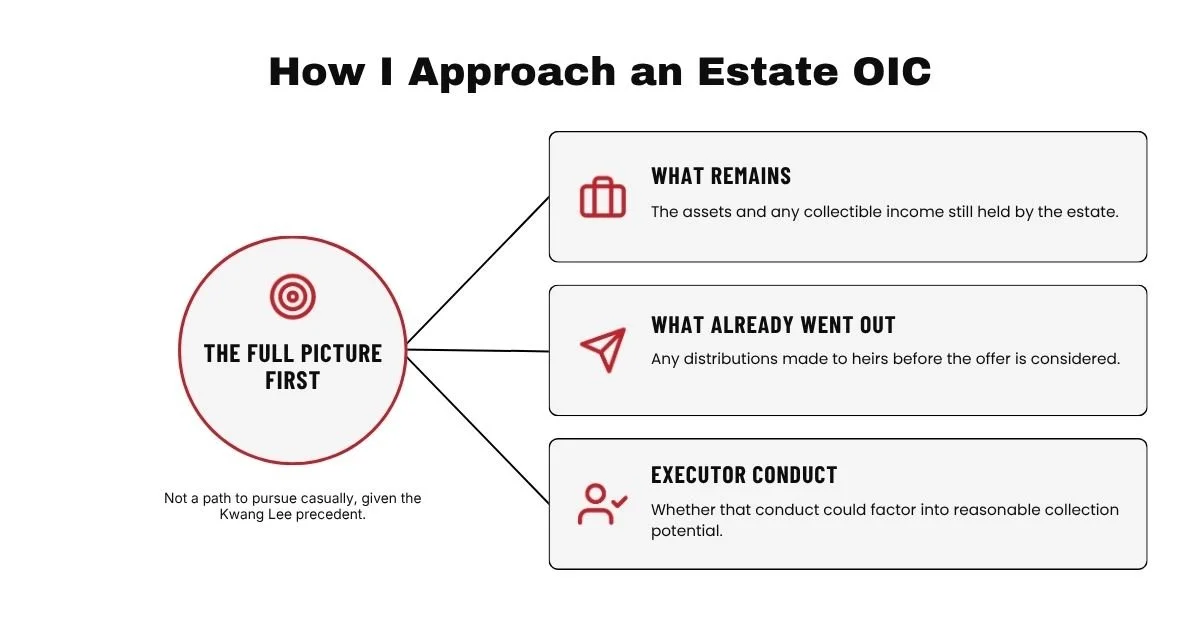
How I Approach an Estate OIC
When I am evaluating whether an OIC makes sense for an estate, I want to understand the full picture before recommending it: what remains in the estate, what if anything has already been distributed, and whether the executor's own conduct up to that point could factor into how the IRS views the estate's reasonable collection potential.
Given the Kwang Lee precedent, this is not a path I would recommend pursuing casually without that fuller picture in hand first.
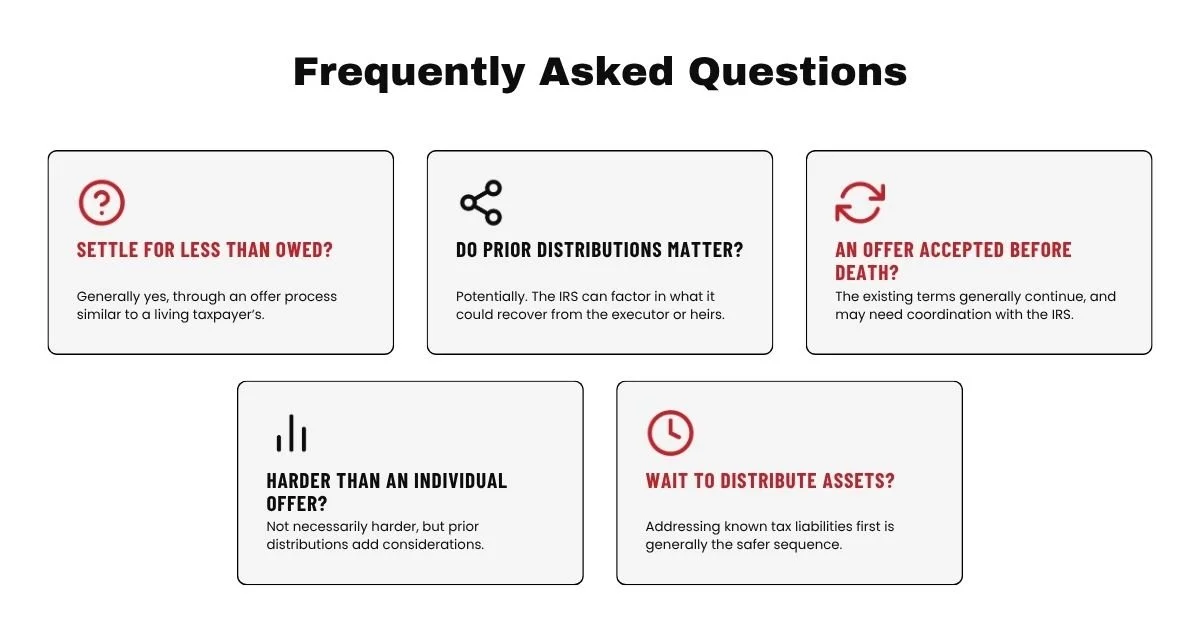
Frequently Asked Questions
-
Generally yes, through an Offer in Compromise process similar to what a living taxpayer would use, though the IRS's evaluation can extend beyond just the estate's remaining assets.
-
Potentially, yes. Case law indicates the IRS can factor in amounts potentially recoverable from the executor or heirs when calculating what the estate could realistically pay.
-
The existing terms generally continue to apply to the estate, though this may require direct coordination with the IRS.
-
Not necessarily harder in every case, but it involves additional considerations, particularly around prior distributions and executor liability exposure, that an individual, living taxpayer's offer does not carry.
-
Generally, resolving or at least clearly addressing known tax liabilities before distributing assets is the safer sequence, both for OIC purposes and for the executor's own personal liability exposure covered in our companion posts.
Considering an Offer in Compromise for an Estate
If you are administering an estate with tax debt that exceeds what the estate can realistically pay, an Offer in Compromise may be worth exploring, but the sequencing and structure of that offer matter more than they would for an individual taxpayer.
I offer a free case review to help you understand whether this path makes sense for your specific situation and how to approach it correctly.