California is a community property state, and that status affects more than how assets get divided in a divorce. It can also affect how the IRS approaches collecting a deceased spouse's tax debt, even in situations where you might assume you are protected because you filed separately.
I want to walk through what that actually means, since this is one of the more misunderstood corners of this entire topic.
TLDR:
- In a community property state like California, income and assets earned during the marriage are generally treated as jointly owned, regardless of whose name is on the account or paycheck.
- This means the IRS may be able to reach community property to collect a deceased spouse's separately incurred tax debt in some circumstances, even if you filed a separate return.
- Filing jointly creates joint and several liability regardless of community property status, and that generally survives a spouse's death.
- Innocent Spouse Relief and California's separate Innocent Joint Filer program exist specifically to address unfair outcomes from this framework, at both the federal and state level.
- Even after innocent spouse relief is granted, the IRS may still be able to collect from the non-liable spouse's interest in community property under certain circumstances, since relief changes who is liable but not necessarily what property remains reachable.
- This is a genuinely complex intersection of state property law and federal tax collection, and it deserves individualized review rather than general assumptions.
What Community Property Status Actually Changes
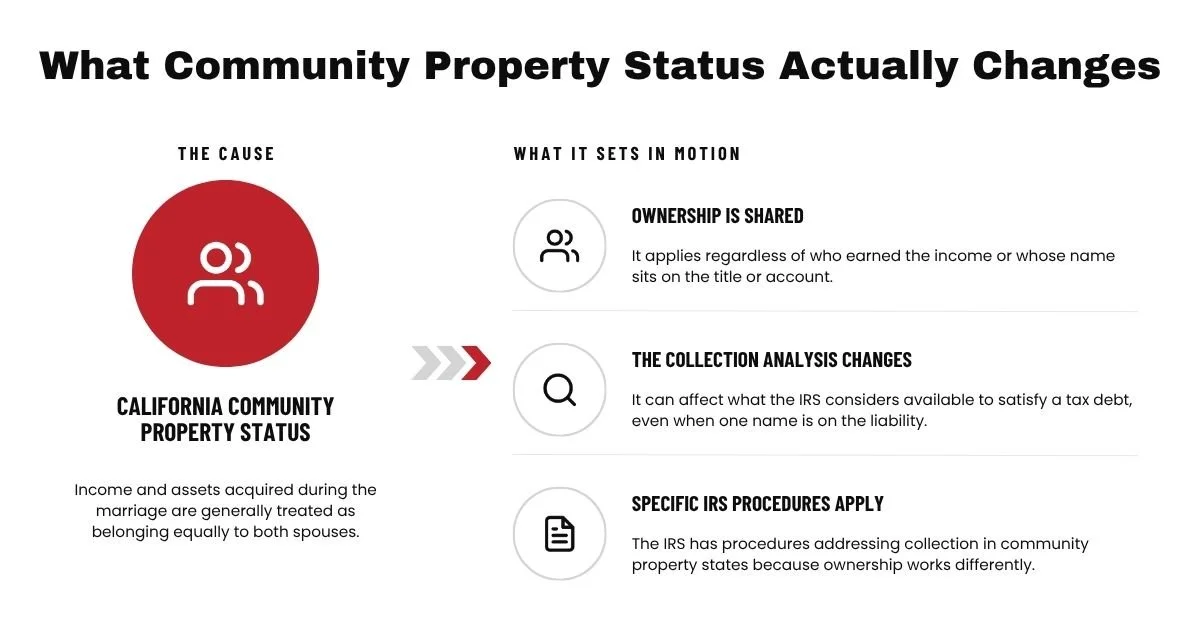
In a community property state, income and assets acquired during the marriage are generally treated as belonging equally to both spouses, regardless of which spouse earned the income or whose name is on the title or account.
This matters for IRS collection because it can affect what the IRS considers available to satisfy a tax debt, even when only one spouse's name is on the liability. The IRS has specific procedures addressing how it approaches collection in community property states precisely because this ownership structure changes the usual analysis.
Joint Returns vs Separate Returns, and Why It Still Gets Complicated
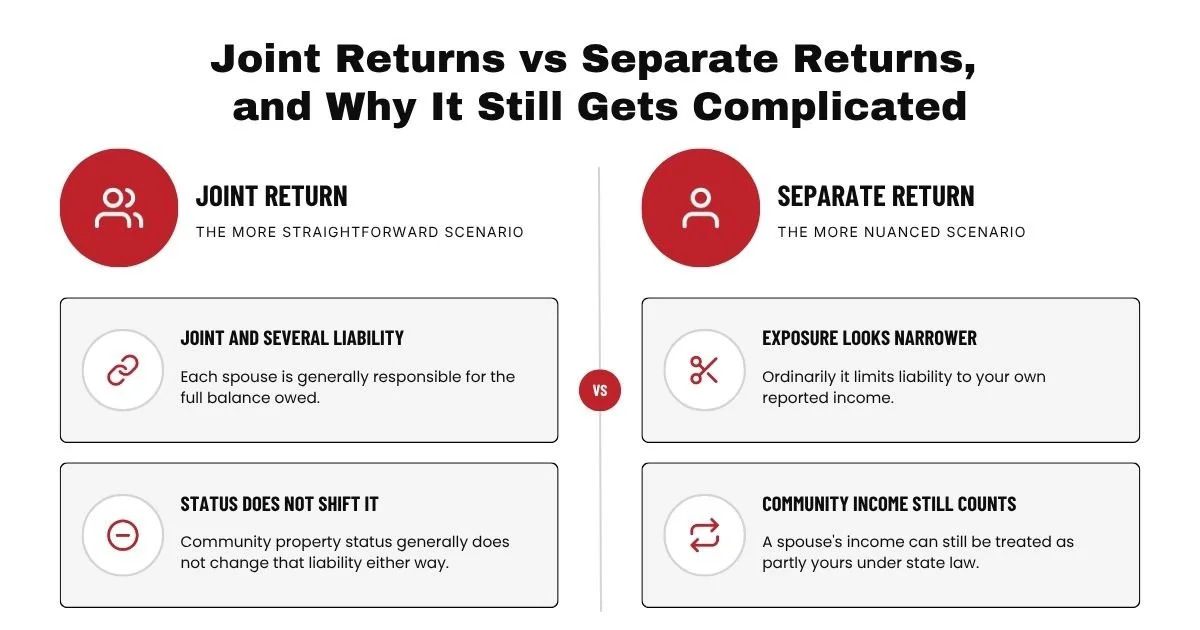
If you filed a joint return with your spouse, you are generally jointly and severally liable for the full balance, and that liability generally does not change based on community property status one way or the other. This is the more straightforward scenario, covered more broadly in our companion post on Currently Not Collectible status for a surviving spouse.
If you filed separately, the analysis is more nuanced. Ordinarily, filing separately limits your exposure to your own reported income and liability.
But in a community property state, income that would otherwise be considered your spouse's separate income can, in some circumstances, still be considered partly yours for tax purposes, because it is treated as community income under state law.
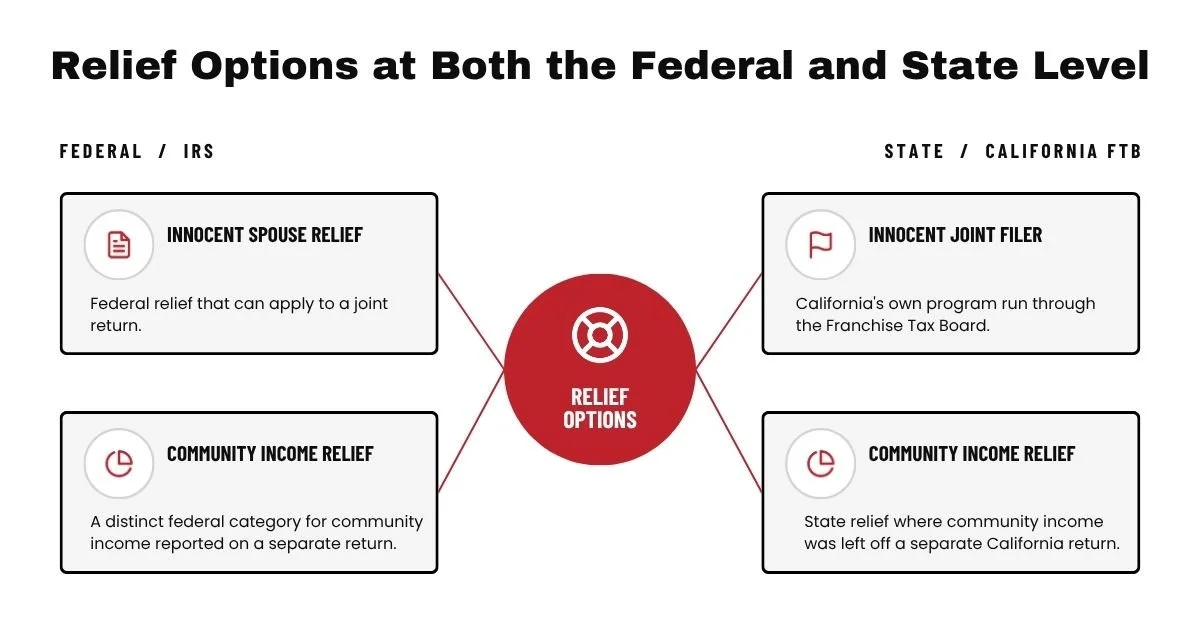
Relief Options at Both the Federal and State Level
Because this framework can produce results that feel deeply unfair, particularly for a surviving spouse who had no knowledge of or control over the liability, both the IRS and California offer relief mechanisms specifically addressing this.
At the federal level, Innocent Spouse Relief can apply not only to joint returns but specifically to situations involving community income on a separate return, through a distinct category sometimes referred to as relief from liability for tax attributable to an item of community Income.
At the state level, California's Franchise Tax Board offers its own Innocent Joint Filer program, along with a separate community income relief category addressing situations where community income was not included on a separate California return.
Both programs exist because the underlying community property framework can otherwise produce outcomes that do not match anyone's intuitive sense of fairness, and both are worth exploring directly rather than assuming neither applies.
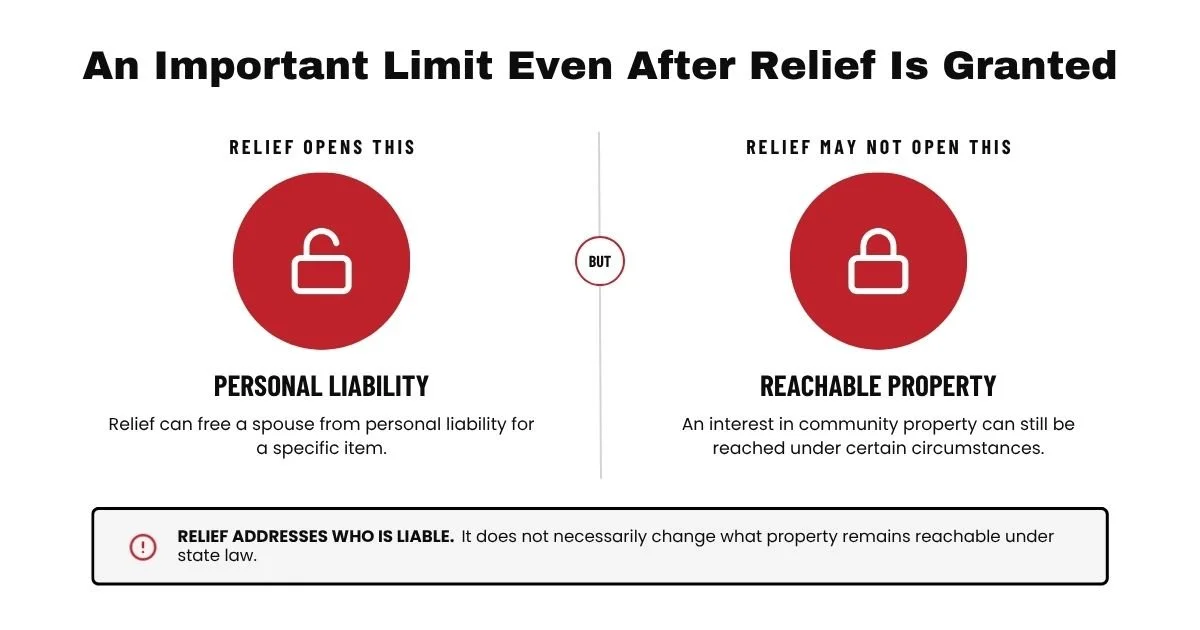
An Important Limit Even After Relief Is Granted
I want to flag something that surprises people. Even after innocent spouse relief is granted, freeing a spouse from personal liability for a specific item, the IRS may still be able to collect from that spouse's interest in community property under certain circumstances, since relief addresses who is liable, not necessarily what property remains
reachable under state law.
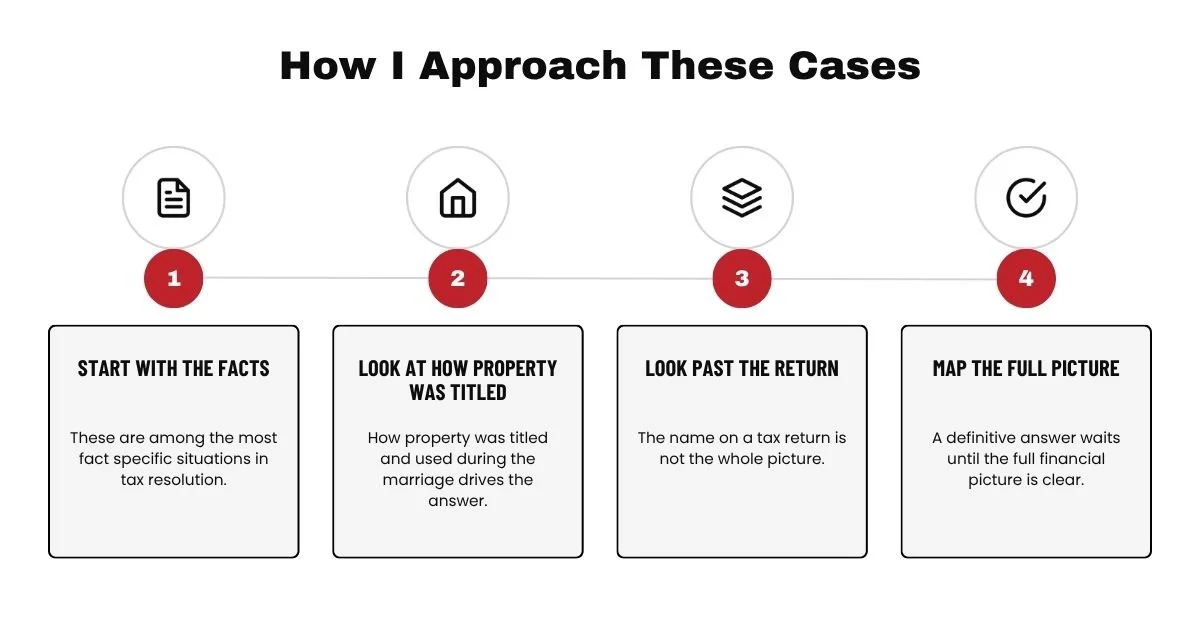
How I Approach These Cases
Community property collection questions are some of the most fact-specific situations I encounter, since the answer depends on how property was actually titled and used during the marriage, not just which spouse's name appears on a tax return. When someone comes to me with this question, I want to understand the full financial picture
before saying definitively what is and is not reachable, because generalizing here tends to create more confusion than clarity.
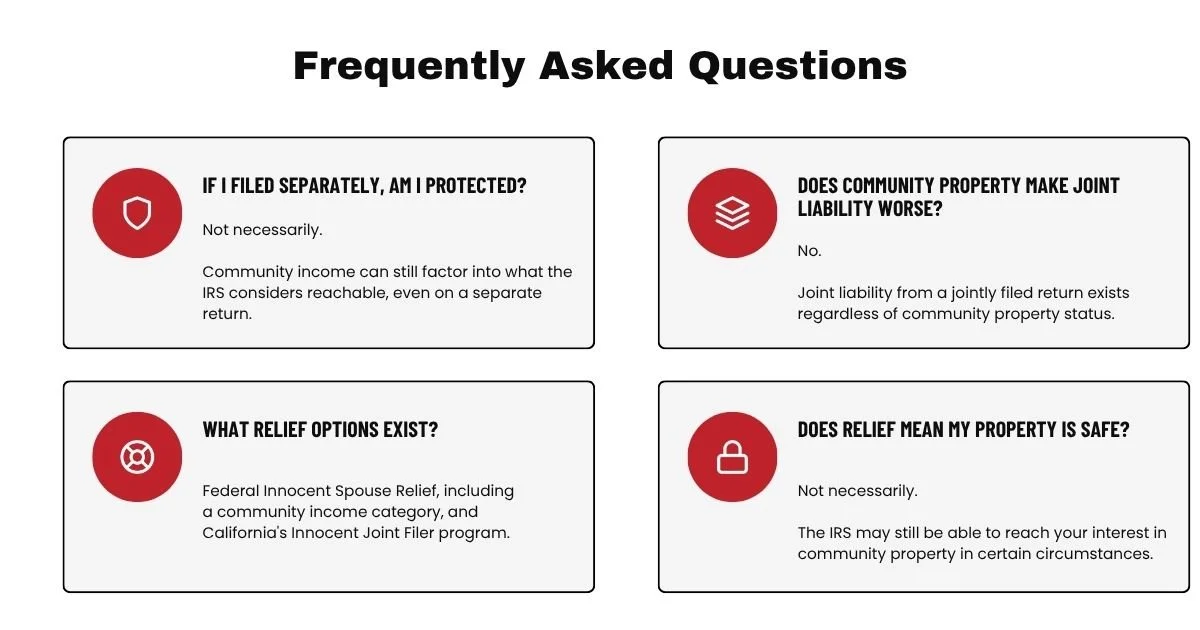
Frequently Asked Questions
-
Not necessarily, and this is one of the more misunderstood parts of
community property tax law. Community income can still factor into what the IRS considers reachable, even on a separate return.
-
Joint liability from a jointly filed return exists regardless of community property status. Community property status separately affects what happens with separate returns and community income allocation.
-
Both federal Innocent Spouse Relief, including a category specific to community income, and California's Innocent Joint Filer program exist to address exactly this kind of situation.
-
Not necessarily. Relief addresses your personal liability, but the IRS may still be able to reach your interest in community property under certain circumstances.
-
The concepts are related but run through separate programs and processes. California has its own Innocent Joint Filer and community
income relief provisions distinct from the federal programs.
Sorting Out Community Property and Tax Debt
If you are trying to understand whether you are exposed to a deceased spouse's tax debt because of California's community property rules, this is genuinely one of the more fact-specific questions in tax resolution, and it deserves a careful look at your actual situation rather than a general answer.
I offer a free case review to help you understand how community property rules apply to your specific circumstances and what relief options might fit.