
I want to correct a common assumption right away, because it is the opposite of what most people expect. Unlike many other protected assets, a 401(k) or traditional IRA is not automatically exempt from an
IRS levy. The law gives the IRS broad authority here. What actually protects most retirement accounts in practice is IRS policy, not a guaranteed legal exemption.
I want to walk through exactly how this works, because the distinction between "cannot legally levy" and "generally chooses not to levy" matters enormously.

TLDR:
- Under IRC Section 6331, the IRS generally has authority to levy all property and rights to property, and general retirement benefits and pensions are not on the specific list of exempt property in IRC Section 6334.
- 401(k)s, traditional and SEP IRAs, and similar employer-sponsored or individual retirement plans are generally not legally exempt from levy, though some specific federal, military, and Railroad Retirement benefits are.
- As a matter of internal policy, not law, the IRS has stated it will not levy retirement savings unless it determines the taxpayer engaged in "flagrant conduct."
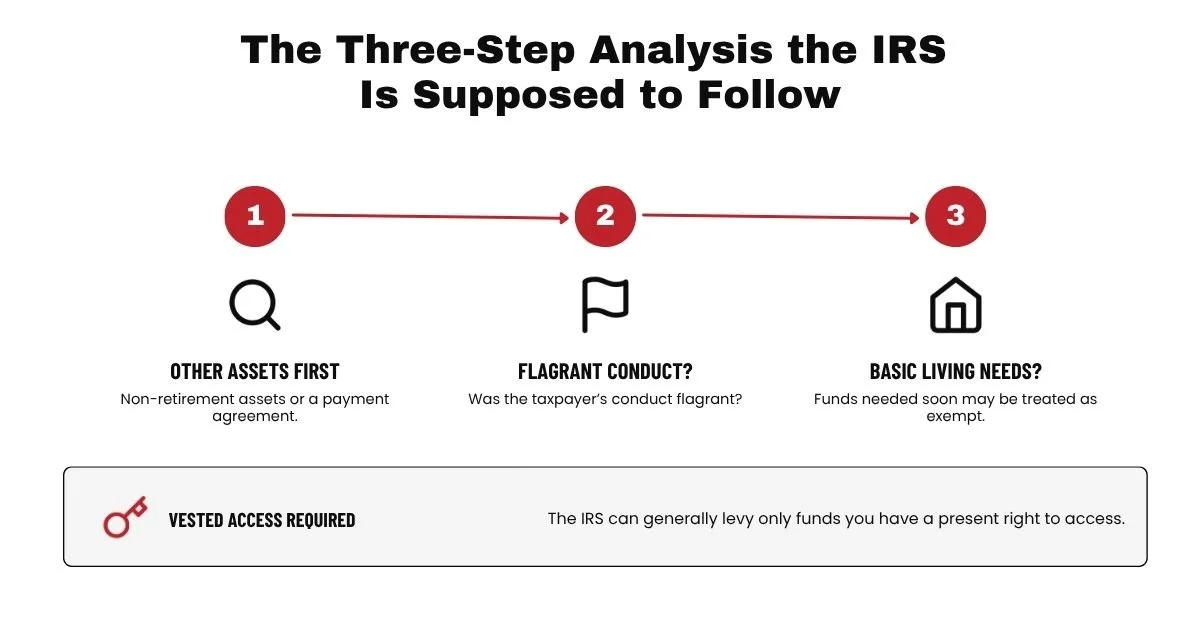
- The IRS generally can only levy a retirement account if the taxpayer has a present right to access the funds. Accounts without vested access rights are generally not reachable.
- The IRS generally must exhaust other, easier collection targets first and complete the standard notice sequence, including the 30-day Final Notice of Intent to Levy, before a retirement account levy is even considered.
- This distinction between legal exemption and IRS policy is important precisely because policy can change, and it is not a guarantee written into the statute itself.
The Legal Reality: No Automatic Exemption
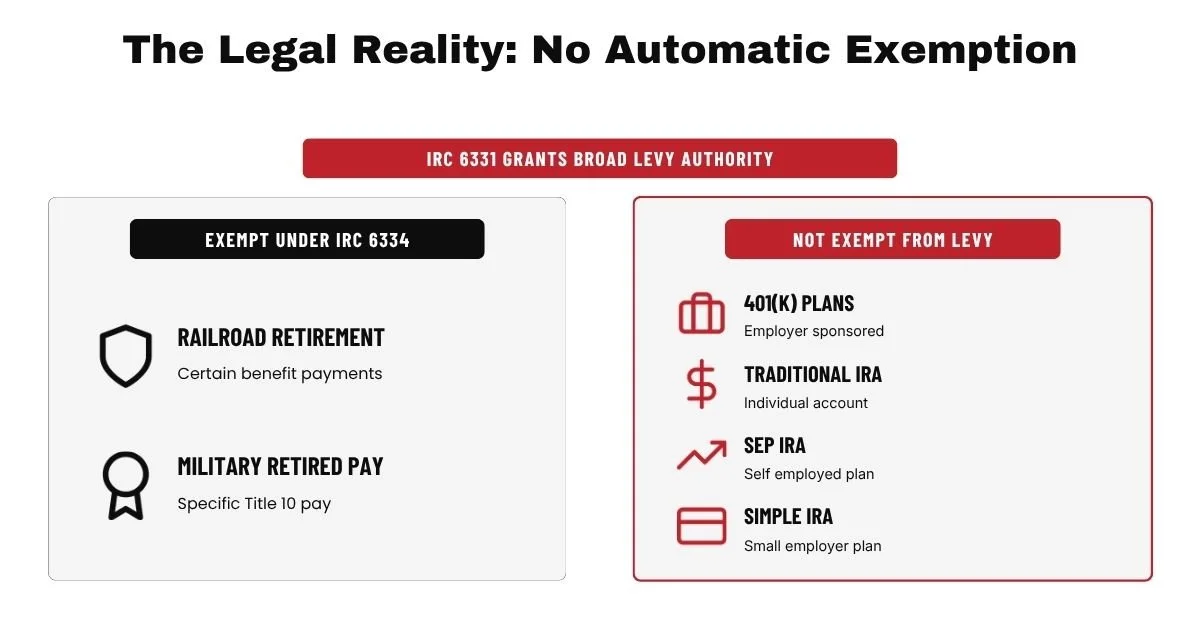
I want to be precise here because this genuinely surprises people. IRC Section 6331 gives the IRS authority to levy upon all property and rights to property. IRC Section 6334 then lists specific categories of property exempt from that authority, and general retirement benefits and pensions are not on that list.
Some narrower categories of retirement-adjacent income are exempt, specifically certain payments under the Railroad Retirement Act, and annuities based on retired or retainer pay under a specific section of Title 10 covering the armed forces.
But for most people's actual retirement savings, employer-sponsored 401(k) plans, traditional IRAs, SEP IRAs, and SIMPLE IRAs, there is generally no statutory exemption protecting the account from levy.
What Actually Protects Most Retirement Accounts, IRS Policy
This is the part I want to emphasize, because it is genuinely more protective than the bare statute suggests, but it is a different kind of protection than most people assume they have.
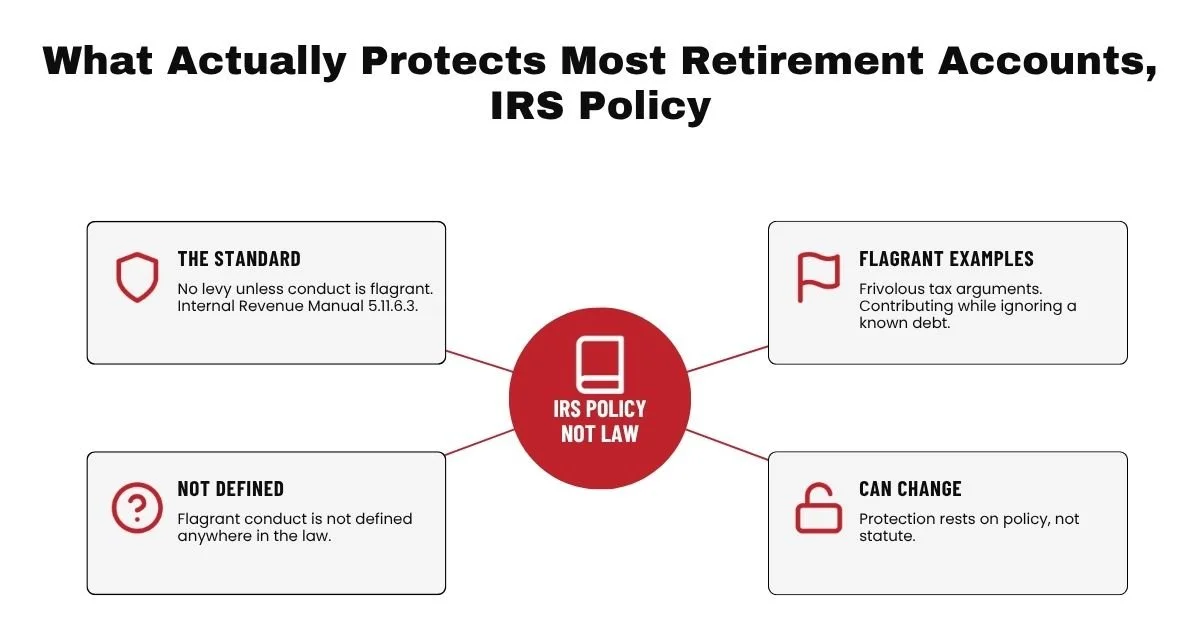
As a matter of internal policy, the IRS has stated it will not levy a taxpayer's retirement savings unless it determines the taxpayer engaged in what the agency calls "flagrant conduct." This standard comes from Internal Revenue Manual section 5.11.6.3, not from the statute itself.
Examples of what can constitute flagrant conduct generally include things like making frivolous legal arguments to avoid paying tax, continuing to contribute to retirement accounts while a known tax debt goes unaddressed, or other evasion-related behavior.
Notably, the National Taxpayer Advocate has specifically criticized the fact that "flagrant conduct" is not defined in the Internal Revenue Code, the regulations, or internal IRS guidance, and has recommended Congress codify retirement account protection into law rather than leaving it as internal policy that could change.
I think this is worth understanding clearly: the practical protection most people have is real, but it rests on IRS policy discretion, not a legal guarantee written into the statute the way the exemption for, say, unemployment benefits or child support is.
The Three-Step Analysis the IRS Is Supposed to Follow
According to IRM guidance, IRS collection officers are generally expected to work through a specific analysis before levying a retirement account:
1. Are there non-retirement assets available, or a feasible payment agreement possible? If so, those are generally pursued first.
2. Was the taxpayer's conduct flagrant?
3. Is the retirement fund necessary now, or soon, to meet the taxpayer's basic living expenses? If so, it may be treated as exempt from levy on that basis.
If You Do Withdraw Funds to Pay the IRS
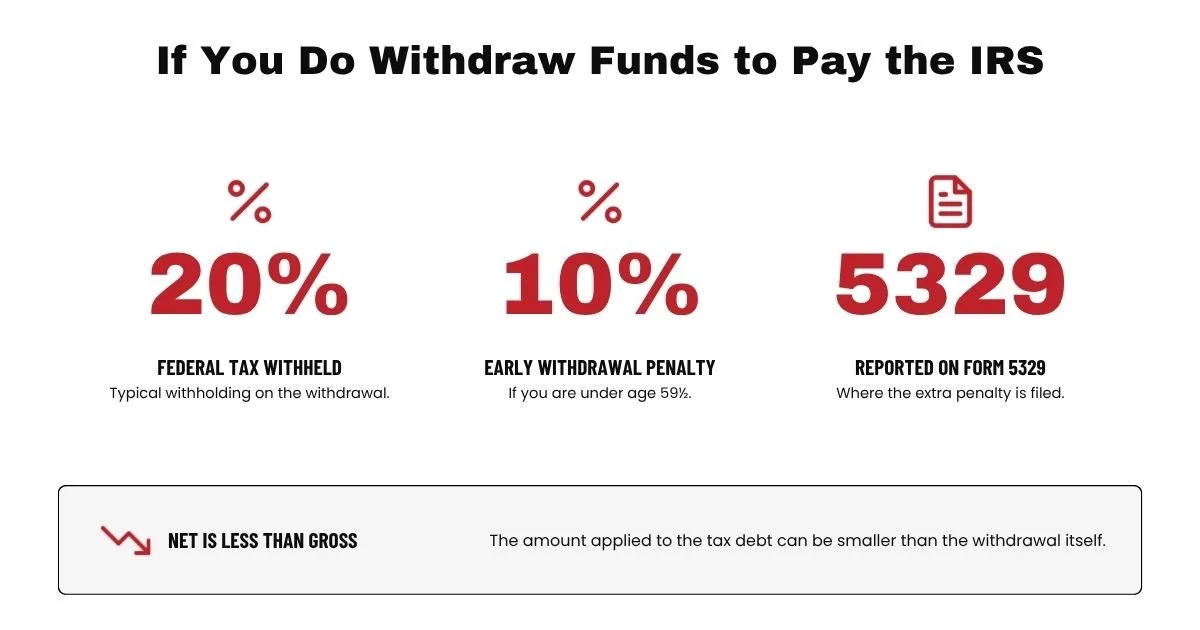
A separate, practical point worth flagging: if you voluntarily withdraw retirement funds to pay a tax debt, or the IRS does levy an account you have access to, an early withdrawal generally triggers its own tax consequences, typically 20 percent withheld for federal tax and, if you are under 59 and a half, an additional 10 percent early withdrawal penalty, reported on Form 5329.
This is worth knowing before agreeing to a "voluntary" levy or withdrawal under pressure, since it can mean a smaller net benefit toward the tax debt than the gross withdrawal amount suggests.
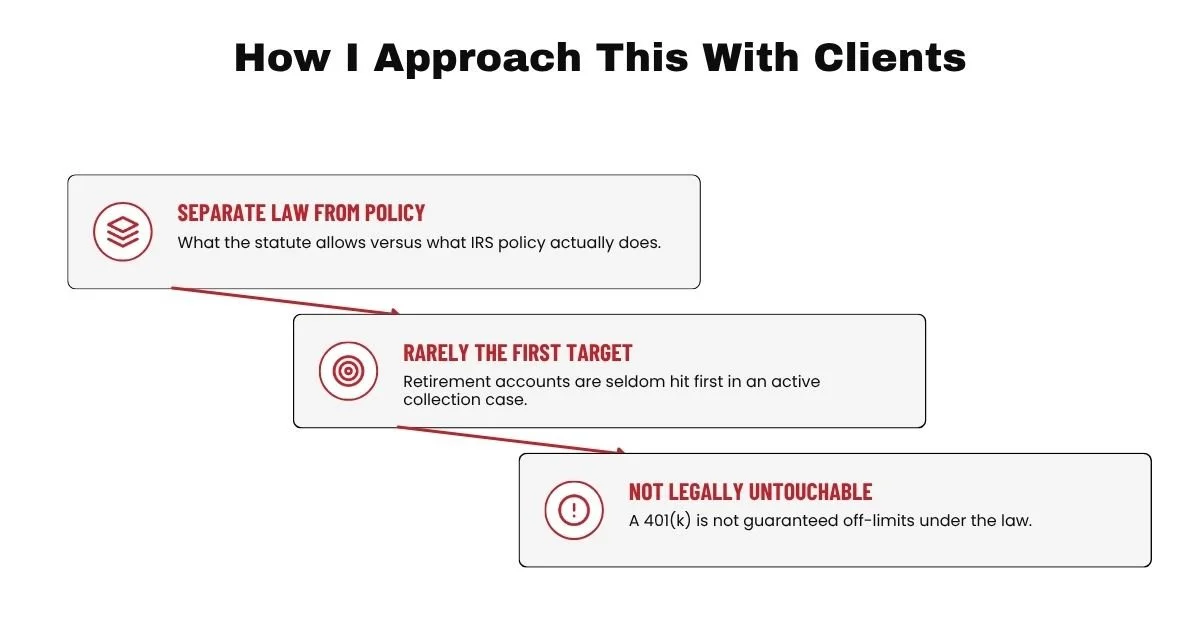
How I Approach This With Clients
When someone comes to me worried specifically about their retirement account, I want to walk through this exact distinction: what the law technically allows versus what the IRS's own policy generally does in practice. In my experience, retirement accounts are rarely the first target in an active collection case, precisely because the IRS
generally has to work through easier options and the flagrant conduct analysis first. That said, I do not want anyone to operate under the false assumption that a 401(k) is legally untouchable, because it is not.
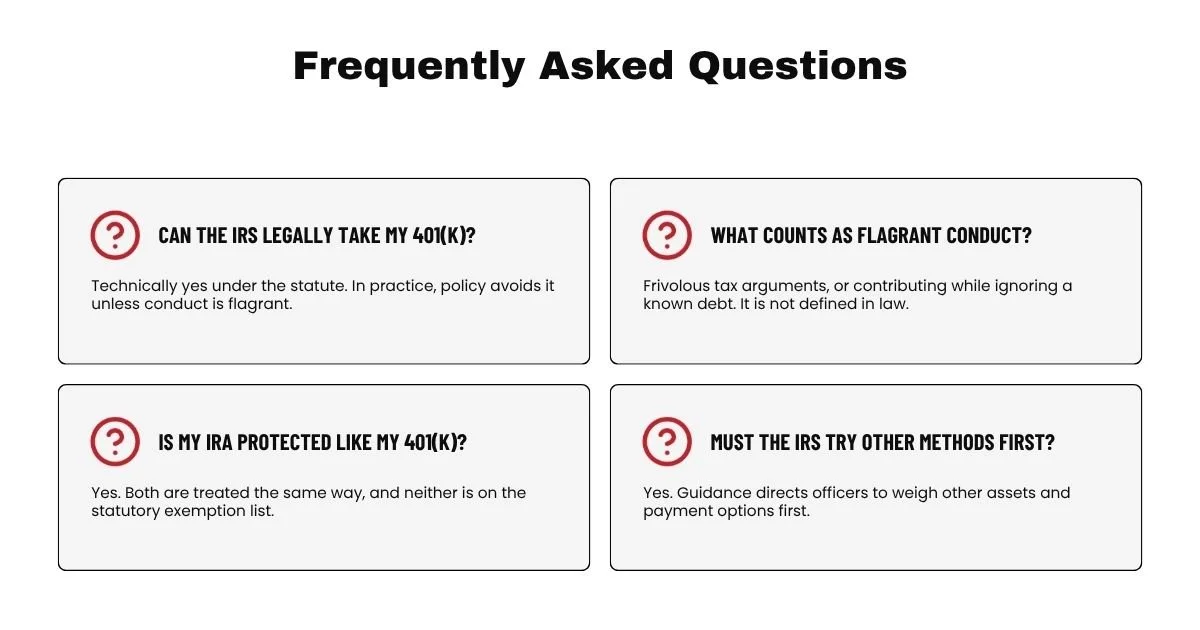
Frequently Asked Questions
-
Technically yes, under the statute, since general retirement accounts are not on the specific list of exempt property. In practice, IRS policy generally avoids this unless the taxpayer's conduct is considered flagrant.
-
Examples generally include frivolous legal arguments to avoid tax, continuing retirement contributions while ignoring a known tax debt, or other evasion-related behavior. The term is not precisely defined in law, which the National Taxpayer Advocate has specifically flagged as a gap.
-
Generally yes, both are treated similarly under this framework, neither is on the statutory exemption list, and both are generally subject to the same IRS policy approach.
-
Generally yes, IRS guidance directs collection officers to consider non-retirement assets and payment agreement options first.
-
An early withdrawal generally triggers its own withholding and potential penalty, separate from the tax debt itself.
Understanding Your Actual Risk
If you are worried about your retirement savings because of a tax debt, understanding the real distinction between legal exemption and IRS policy is the first step toward an accurate picture of your actual risk, rather than either false alarm or false comfort.
I offer a free case review to help you understand where your specific situation stands and what proactive steps make sense.