Trust Fund Recovery Penalty (TFRP): Am I Personally Liable for Payroll Taxes?
The IRS Trust Fund Recovery Penalty can make a business owner, corporate officer, employee, partner, or other financial decision maker personally responsible for certain unpaid payroll taxes. The penalty applies when the IRS concludes that the person was responsible for collecting, accounting for, or paying trust fund taxes and willfully failed to do so.
The amount generally equals the unpaid federal income tax withheld from employees, plus the employee portion of Social Security and Medicare taxes. The employer portion of payroll taxes and the business level penalties are generally not included in the TFRP calculation. Interest may be added after the penalty is assessed.
This means the IRS can create personal liability even when the payroll tax debt originally belonged to a corporation, partnership, or limited liability company. The business does not have to close before the IRS begins or completes a TFRP investigation.
I have worked in tax since 2005, founded Semper Tax Relief in 2016, and represent taxpayers before the IRS as an Enrolled Agent. I also earned my Juris Doctor in 2019. My approach to TFRP cases begins with the records, the authority each person actually held, the dates they learned about the unpaid taxes, and the IRS procedures used to propose the assessment.
Direct Answer
The IRS Trust Fund Recovery Penalty is a personal assessment under Internal Revenue Code Section 6672. The IRS must establish two main elements. First, the person had sufficient responsibility or control over the company’s financial affairs. Second, the person acted willfully by knowingly failing to pay the trust fund taxes or by showing plain indifference after learning they were unpaid.
The strongest time to challenge the penalty is usually before assessment, particularly during the Form 4180 investigation and after receiving Letter 1153. A person generally has 60 days from the date of the proposed assessment letter to appeal, or 75 days when the letter is addressed outside the United States.

What Is the IRS Trust Fund Recovery Penalty?
The trust fund recovery penalty is sometimes called the responsible person penalty, trust fund penalty, payroll tax penalty, one hundred percent penalty, or Section 6672 penalty.
Although the IRS calls it a penalty, it functions as an additional collection method. It permits the government to collect unpaid trust fund taxes from one or more individuals or entities that had responsibility for the taxes and acted willfully.
How the IRS Trust Fund Recovery Penalty Works
A business with employees generally withholds federal income tax and the employee portion of Social Security and Medicare taxes from wages. The business must report and deposit those amounts as required.
When the business fails to deposit them, the IRS may continue collecting from the business. It may also investigate the people who controlled the business finances. When the IRS finds responsibility and willfulness, it can assess the unpaid trust fund portion against those people personally.
The result is that the business payroll tax debt and the individual TFRP accounts may exist at the same time. The IRS can pursue several responsible people, but its policy is to collect the underlying trust fund tax only once.
Why the IRS Treats Trust Fund Taxes Differently
Trust fund taxes come from amounts withheld from employees or collected from other people. Federal law treats those amounts as being held for the United States until they are deposited.
The IRS therefore treats the use of those funds for rent, vendors, loan payments, owner draws, or other expenses as more serious than an ordinary unpaid business expense. Paying other creditors while employment taxes remain unpaid can be evidence of willfulness.
What Payroll Taxes Are Included in the TFRP?
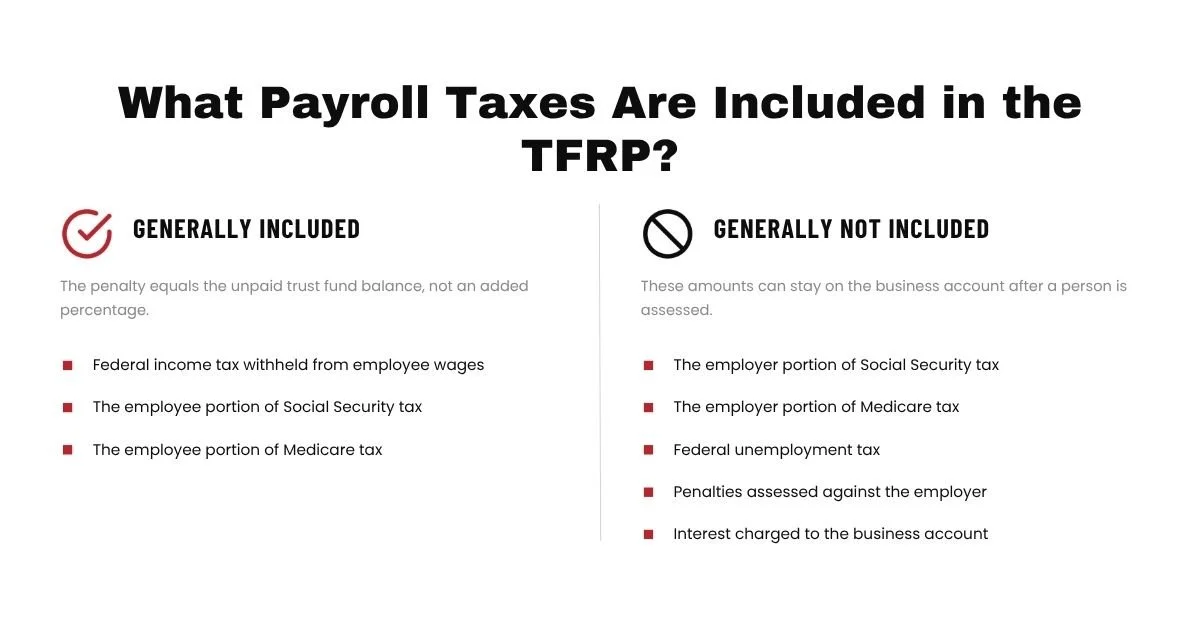
The trust fund recovery penalty is generally based on the trust fund portion of the unpaid employment tax liability.
Amounts Generally Included
The calculation normally includes:
Federal income tax withheld from employee wages
The employee portion of Social Security tax
The employee portion of Medicare tax
The TFRP amount is equal to the unpaid trust fund balance. It is not calculated as an additional percentage placed on top of the trust fund amount.
Amounts Generally Not Included
The TFRP generally does not include:
The employer portion of Social Security tax
The employer portion of Medicare tax
Federal unemployment tax
Penalties assessed against the employer
Interest charged to the business account
Those amounts may remain owed by the business even when a responsible person is assessed separately for the trust fund portion.
Why the TFRP Amount May Differ From the Business Balance
A business payroll tax account can include tax, penalties, interest, and several payroll tax components. The TFRP calculation isolates the trust fund portion.
Payments and credits posted to the business can also change the amount available for assessment. For that reason, I review the payroll tax periods, tax modules, payment dates, payment designations, and TFRP calculation instead of assuming the proposed amount is correct.
Trust Fund Recovery Penalty Versus Payroll Tax Debt
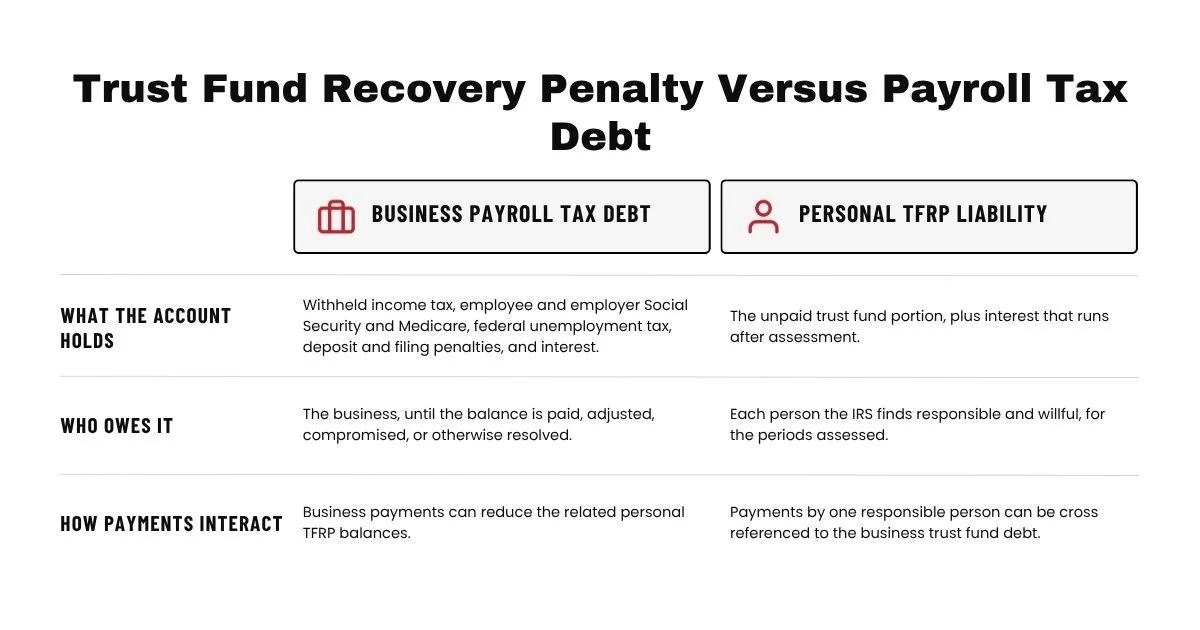
The trust fund recovery penalty and the business payroll tax debt are connected, but they are not the same liability.
Business Payroll Tax Debt
The business account may include:
Withheld federal income tax
Employee Social Security and Medicare tax
Employer Social Security and Medicare tax
Federal unemployment tax when applicable
Deposit penalties
Filing penalties
Interest
The business remains responsible for its employment tax account unless the liability is fully paid, adjusted, compromised, or otherwise resolved.
Personal TFRP Liability
The individual TFRP account generally includes the unpaid trust fund portion and interest following assessment.
The IRS may assess more than one responsible person for the same tax periods. Each assessed person may be held responsible for the unpaid trust fund amount, but the IRS should not collect more than the total trust fund liability.
Why Resolving the Business Account Still Matters
Payments made by the business can reduce the related TFRP balances. Payments from responsible people can also be cross referenced to the business trust fund liability.
A complete strategy should therefore evaluate both sides of the case. Resolving only the business account may leave personal exposure unaddressed. Resolving only one person’s account may fail to account for payments made by the business or other responsible people.
Who Is Responsible for the Trust Fund Recovery Penalty?
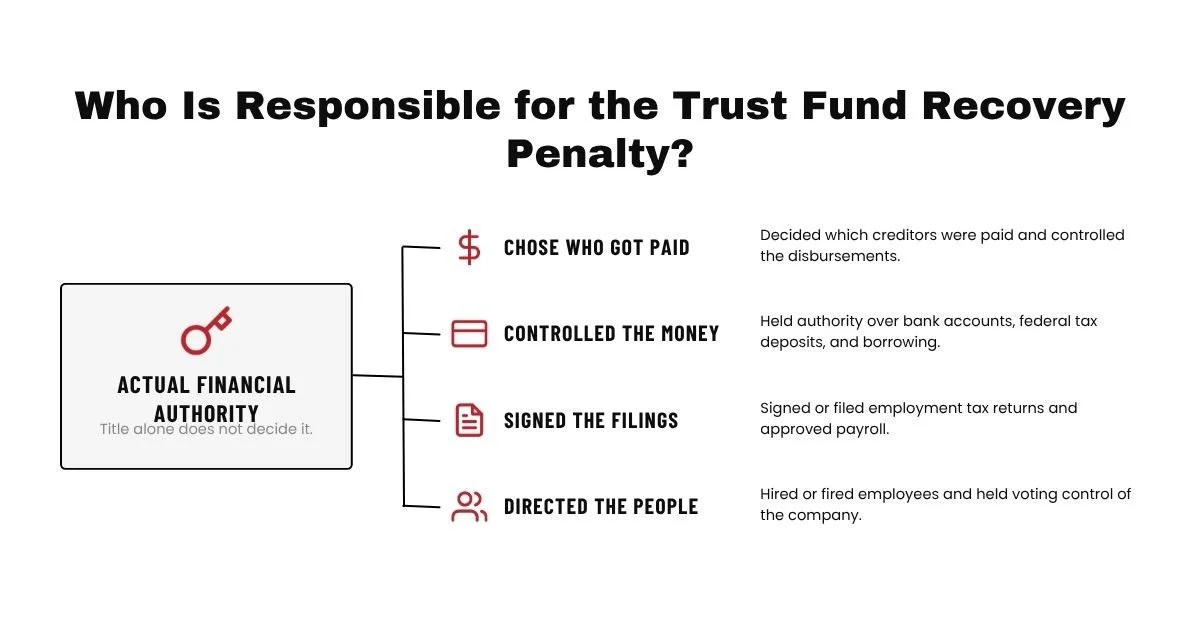
The IRS does not decide responsibility based on job title alone. It examines whether the person had meaningful authority over the business finances and the payment of creditors.
A president, treasurer, shareholder, or manager is not automatically liable because of the title. At the same time, a person without an ownership interest can still be responsible when that person exercised significant financial control.
People the IRS May Investigate
Potential responsible people may include:
Business owners
Corporate officers
Corporate directors
Shareholders
Partners
Members or employees of a limited liability company
Controllers
Financial managers
Bookkeepers with independent payment authority
Payroll managers
Trustees
Third party payroll providers and responsible people within those companies
The IRS may also examine the common law employer even when payroll functions were outsourced. Using a payroll service does not automatically transfer every employment tax responsibility away from the employer.
Factors That Indicate Responsibility
The IRS may consider whether a person:
Decided which creditors were paid
Controlled payroll or other disbursements
Signed or filed employment tax returns
Made federal tax deposits
Had authority over company bank accounts
Hired or fired employees
Controlled voting stock
Borrowed money for the company
Exercised independent judgment over financial matters
No single factor always controls the outcome. Check signing authority alone does not automatically establish responsibility, particularly when the person signed checks only as directed and had no independent decision making power.
Trust Fund Recovery Penalty for Small Business Owners
A small business owner commonly has authority over bank accounts, payroll, vendor payments, financing, and tax deposits. Those facts may support responsibility.
However, ownership by itself is not enough. The IRS should still examine what the owner actually did, when the owner exercised control, and whether someone else had independent control over the financial decisions.
IRS Trust Fund Recovery Penalty for Corporate Officers
Corporate officers face greater scrutiny when they had access to financial information and authority to direct payments.
An officer who held the title in name only, had no substantive duties, and exercised no control over finances may have a valid responsibility defense. The records must support that position.
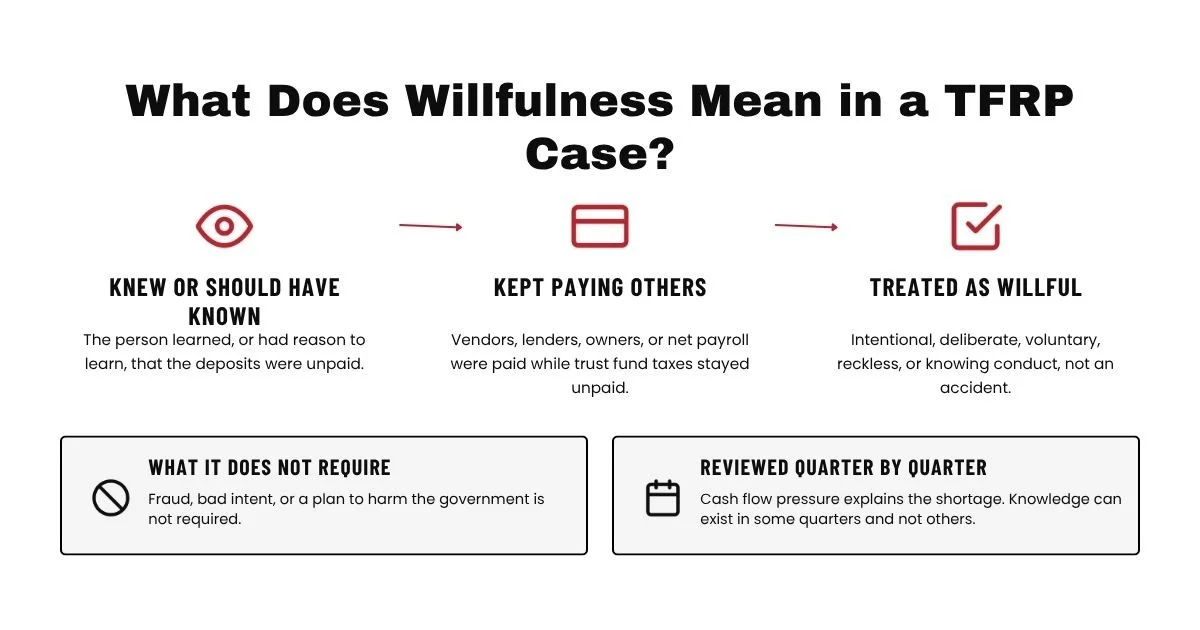
What Does Willfulness Mean in a TFRP Case?
Willfulness does not require fraud, bad intent, or a plan to harm the government.
The Internal Revenue Manual describes willful conduct as intentional, deliberate, voluntary, reckless, or knowing conduct rather than an accidental failure. The government generally looks for evidence that the person knew or should have known the taxes were unpaid and intentionally disregarded the requirement or showed plain indifference.
Conduct That May Support Willfulness
Examples may include:
Paying vendors after learning payroll taxes were unpaid
Continuing to issue net payroll without making federal tax deposits
Paying owners or related businesses while trust fund taxes remained unpaid
Ignoring IRS notices about missing deposits
Failing to investigate after receiving information that payroll taxes were not paid
Continuing the same payment pattern for several quarters
Allowing a payroll provider to continue handling deposits after discovering a pattern of nonpayment
The facts must still be evaluated for each tax period. A person may have knowledge during some quarters but not others.
Cash Flow Problems Do Not Automatically Defeat Willfulness
Many payroll tax cases begin with a genuine cash shortage. The business may be trying to pay employees, preserve contracts, purchase materials, or avoid closing.
Financial pressure explains why the problem occurred, but it does not automatically prevent a finding of willfulness. When a responsible person knows the deposits are unpaid and continues paying other creditors, the IRS may treat those payment decisions as willful.
When Lack of Knowledge May Matter
A person who did not know about the unpaid taxes may have a defense, especially when the person reasonably relied on accurate reports or had no access to the payroll tax information.
The defense becomes weaker after the person receives notices, learns deposits were missed, or discovers financial mismanagement and fails to investigate or correct it.
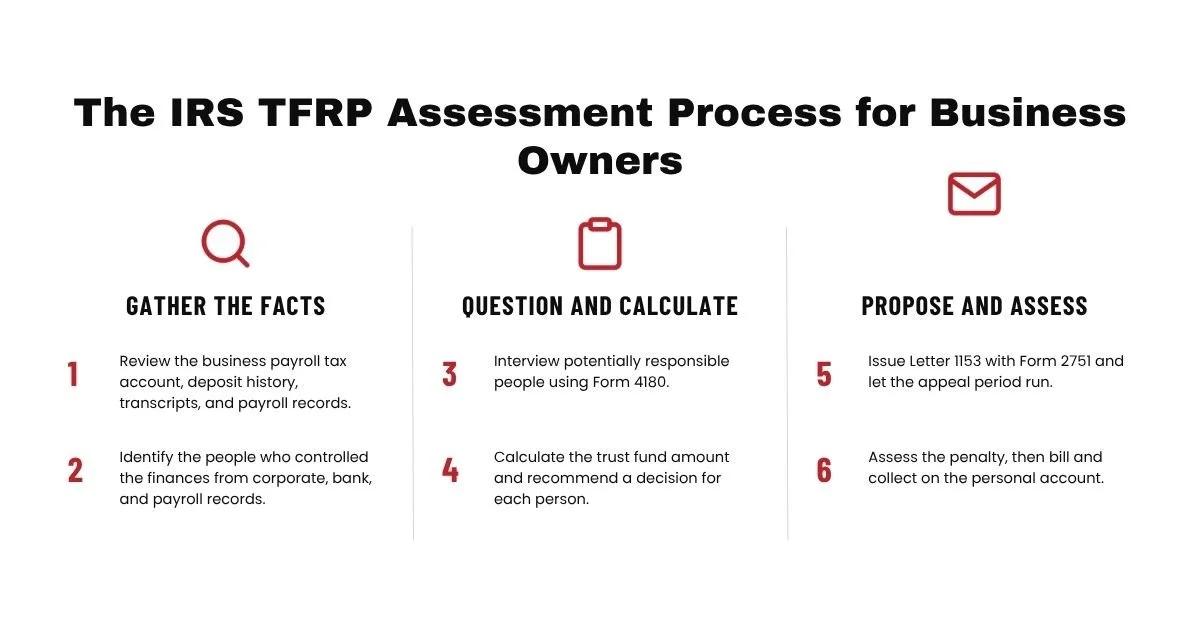
The IRS TFRP Assessment Process for Business Owners
The IRS TFRP assessment process often begins while the IRS is collecting payroll taxes from the business.
A revenue officer may examine both the company’s ability to pay and the responsibility of the people connected to the company. The business does not have to stop operating before the investigation begins.
H3 Step 1 Review of the Business Payroll Tax Account
The revenue officer may review:
Forms 941 or other employment tax returns
Federal tax deposit history
Account transcripts
Business bank records
Payroll records
Prior collection activity
The amount of the remaining trust fund liability
Step 2 Identification of Potentially Responsible People
The IRS may use corporate records, partnership records, bank signature cards, payroll records, tax returns, loan documents, emails, and interviews to identify people with control over the business finances.
Step 3 Form 4180 Interviews
Potentially responsible people may be interviewed using Form 4180. The interview focuses on financial authority, knowledge of the unpaid taxes, creditor payments, payroll duties, and the roles of other people.
Step 4 TFRP Calculation and Recommendation
The revenue officer calculates the trust fund amount and prepares a recommendation concerning each potentially responsible person.
Responsibility and willfulness must be evaluated separately. One person may be recommended for all periods, another for only certain periods, and another may not be recommended at all.
Step 5 Letter 1153 and Form 2751
The IRS normally provides Letter 1153 when it proposes the assessment. Form 2751 may also be included for the person to agree to the proposed amount.
A person generally has 60 days from the letter date to appeal, or 75 days when the letter is addressed outside the United States. Failing to respond can result in assessment and a demand for payment.
Step 6 Assessment and Collection
After assessment, the TFRP becomes a personal federal tax liability. The IRS may issue a billing notice, including Notice CP15B, and may consider liens, levies, seizures, payment arrangements, or other collection actions.
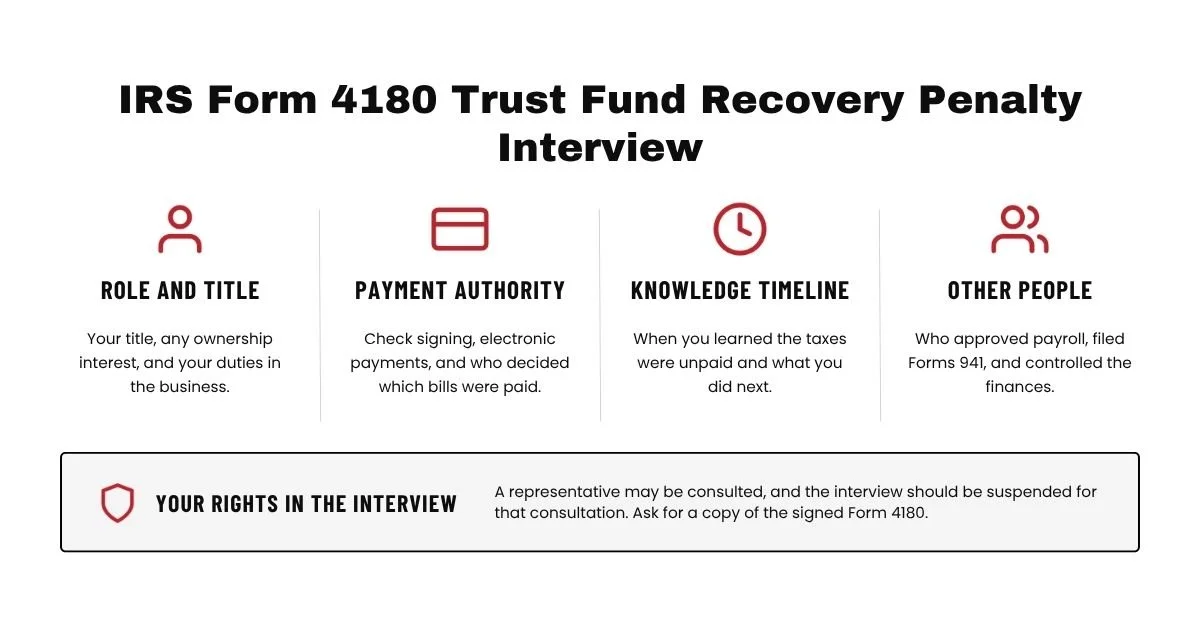
IRS Form 4180 Trust Fund Recovery Penalty Interview
Form 4180 is the IRS interview record used to gather information from a potentially responsible person.
The interview is intended to obtain direct and detailed information about the person’s involvement in the business. The questions focus on responsibility and willfulness, but the revenue officer may ask additional questions based on the facts.
Common IRS Form 4180 Interview Questions
The revenue officer may ask:
What was your title?
Did you own part of the business?
Could you sign checks?
Could you authorize electronic payments?
Who decided which bills were paid?
Who prepared and filed Forms 941?
Who approved payroll?
Who made federal tax deposits?
When did you learn the taxes were unpaid?
What did you do after learning about the debt?
Were vendors or lenders paid during the same periods?
Did the company use a payroll service provider?
Who else controlled the business finances?
Did you have the power to hire or fire employees?
Could you borrow money or direct company funds?
Your Rights During the Interview
A potentially responsible person may ask to consult with an authorized representative. The Internal Revenue Manual directs the employee to suspend the interview to permit that consultation.
The IRS may ask the person to sign Form 4180 after the interview. When feasible, the revenue officer should provide a copy of the signed form to the person or representative.
What to Do After a Trust Fund Recovery Penalty Interview
After the interview:
Obtain a copy of Form 4180
Review every answer for accuracy
Identify incomplete or misleading statements
Gather supporting records
Prepare a written explanation when context is missing
Track the date of any Letter 1153
Do not miss the appeal deadline
The Form 4180 interview is evidence, but it is not the only evidence. Bank records, corporate documents, payroll records, payment history, emails, and testimony from other people may confirm or contradict the interview statements.
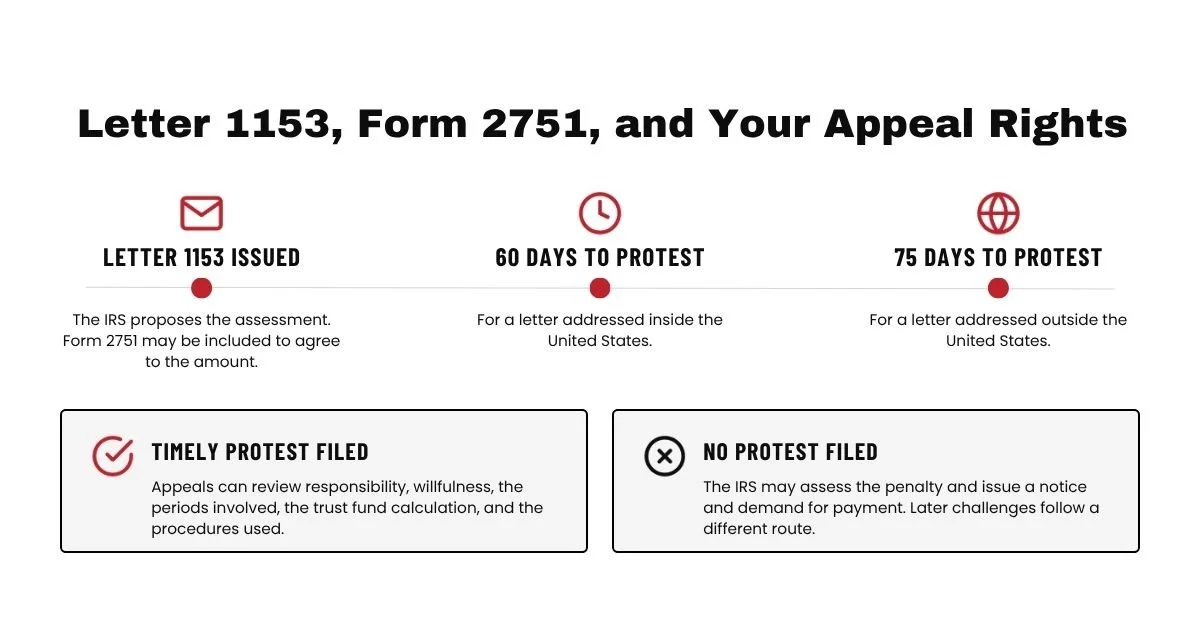
Letter 1153, Form 2751, and Your Appeal Rights
Letter 1153 is the formal notice that the IRS plans to assess the trust fund recovery penalty.
This is one of the most important stages because the penalty has not yet become a final personal assessment.
How Long You Have to Appeal
The appeal period is generally:
60 days from the date of Letter 1153 for a letter addressed within the United States
75 days from the date of Letter 1153 for a letter addressed outside the United States
The protest should identify the disputed tax periods, the issues being contested, the relevant duties and authority, and any disagreement with the calculation.
What Form 2751 Means
Form 2751 is an agreement to the proposed assessment.
Signing it can simplify the IRS assessment process. However, the Internal Revenue Manual states that a signed Form 2751 does not immediately eliminate appeal rights during the statutory restriction period. The exact procedural effect should still be reviewed before signing.
H3 What Happens When You Do Not Respond
When a person does not submit a timely protest, the IRS may assess the TFRP and issue a notice and demand for payment.
After assessment, challenging the liability can require a different procedure, such as paying the required portion, filing a refund claim, and pursuing further review when appropriate.
What Appeals Can Review
An appeal may address:
Whether the person had sufficient responsibility
Whether the conduct was willful
Whether the person was involved during each tax period
Whether the trust fund amount was calculated correctly
Whether payments or credits were overlooked
Whether the IRS followed the required assessment procedures
A Taxpayer Advocate Service case published in 2025 shows why factual and account analysis matters. TAS reported that an officer’s assessment was abated and another proposed assessment was not asserted after arguments concerning payroll deposits, payment application, and deferred employer Social Security taxes were presented in Appeals.
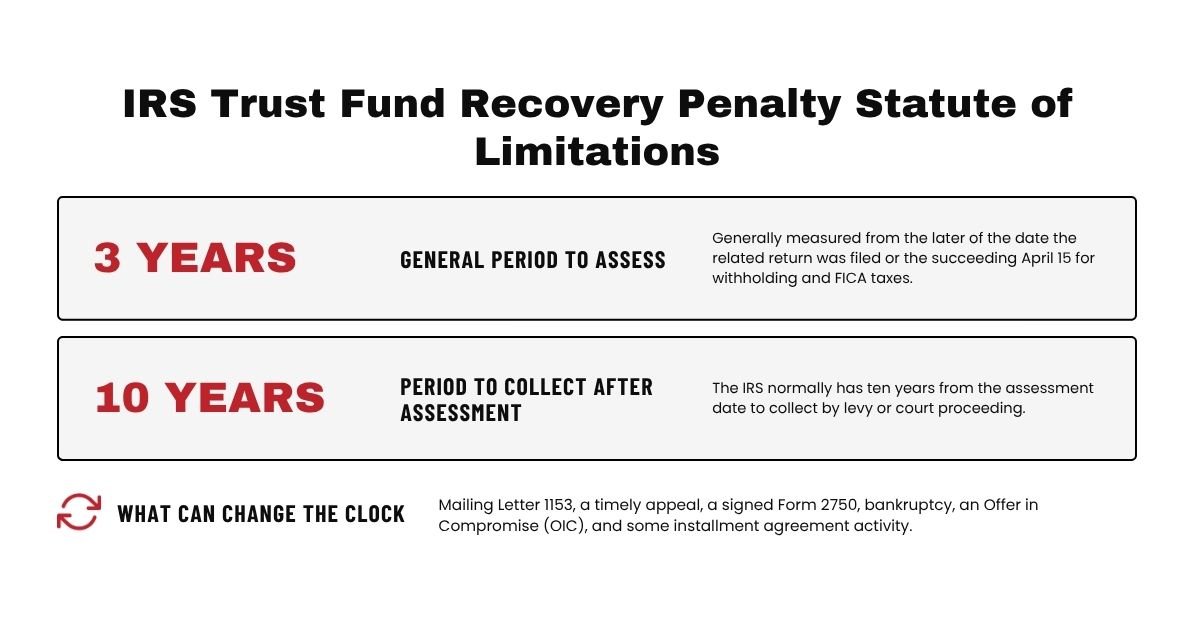
IRS Trust Fund Recovery Penalty Statute of Limitations
There are separate time limits for assessment and collection. They should not be confused.
Assessment Statute
The general assessment rule is three years from the date the related return was filed or the return due date, whichever is later.
For withholding and Federal Insurance Contributions Act taxes, the IRS generally measures the period from the succeeding April 15 or the date the return was filed, whichever is later. Special rules can apply to missing returns, false returns, substitute returns, extensions, and other circumstances.
Mailing or delivering Letter 1153 can extend the assessment period. A timely appeal may extend it further. A person may also be asked to sign Form 2750 to extend the assessment statute.
Collection Statute
The IRS normally has ten years from the TFRP assessment date to collect the liability by levy or court proceeding.
Certain events can suspend or affect the collection period. Examples may include bankruptcy, an Offer in Compromise, some installment agreement activity, and certain court proceedings. The collection statute should be calculated from the account records rather than estimated from the age of the original payroll tax periods.
Why the Statute Dates Matter
Assessment and collection dates can affect:
Whether the IRS may still assess the penalty
Which quarters remain open
Whether a statute extension should be signed
The value of an installment agreement
The value of a Partial Payment Installment Agreement
The timing of an Offer in Compromise
Whether waiting creates more risk than benefit
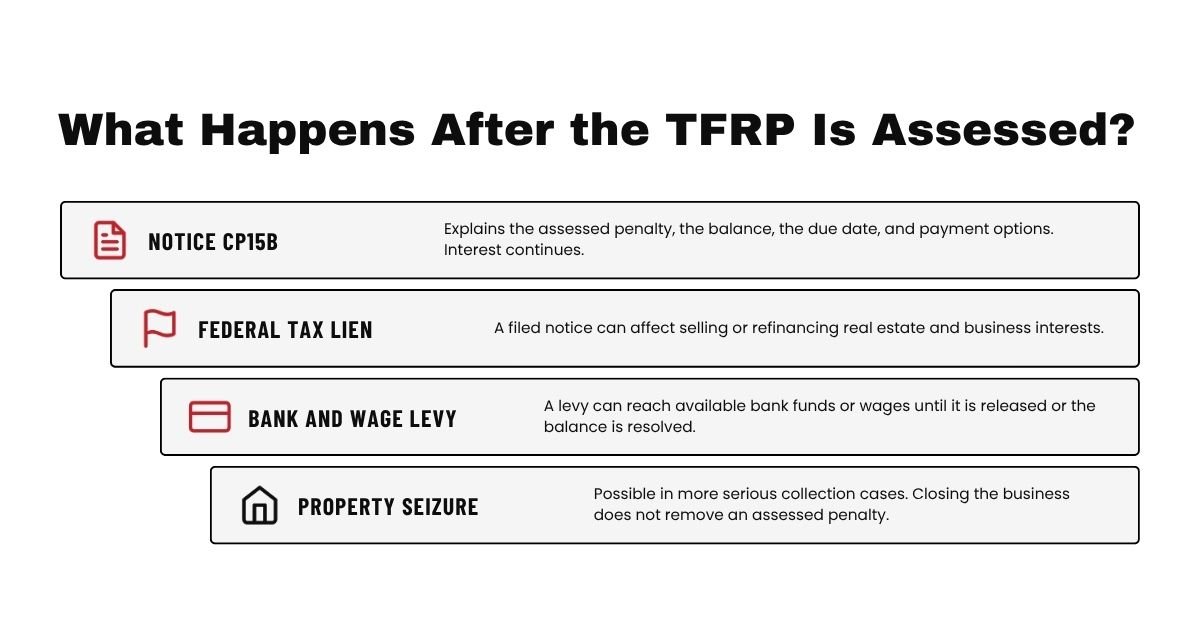
What Happens After the TFRP Is Assessed?
After assessment, the trust fund recovery penalty appears as a personal federal tax liability.
The IRS may send Notice CP15B, which explains the assessed penalty, balance, payment due date, and available payment options. Interest continues until the balance is paid.
Federal Tax Lien
The IRS may file a Notice of Federal Tax Lien to establish its claim against property and property rights.
A lien can affect the sale or refinancing of real estate, business interests, and other assets.
Bank Levy
The IRS may levy personal bank accounts after completing the required collection notice process.
A bank levy generally reaches funds available when the levy is received, subject to applicable legal protections and release procedures.
Wage Levy
The IRS may levy wages or other income. A wage levy may continue until it is released, the liability is paid, or the collection period expires.
Property Seizure
In more serious collection cases, the IRS may seize property. The IRS TFRP page specifically warns that collection may include lien, levy, or seizure action against personal assets.
The Business Closing Does Not End Personal Liability
Closing or dissolving the business does not automatically remove an assessed TFRP.
The personal liability follows the assessed person and is governed by the individual collection account and collection statute.
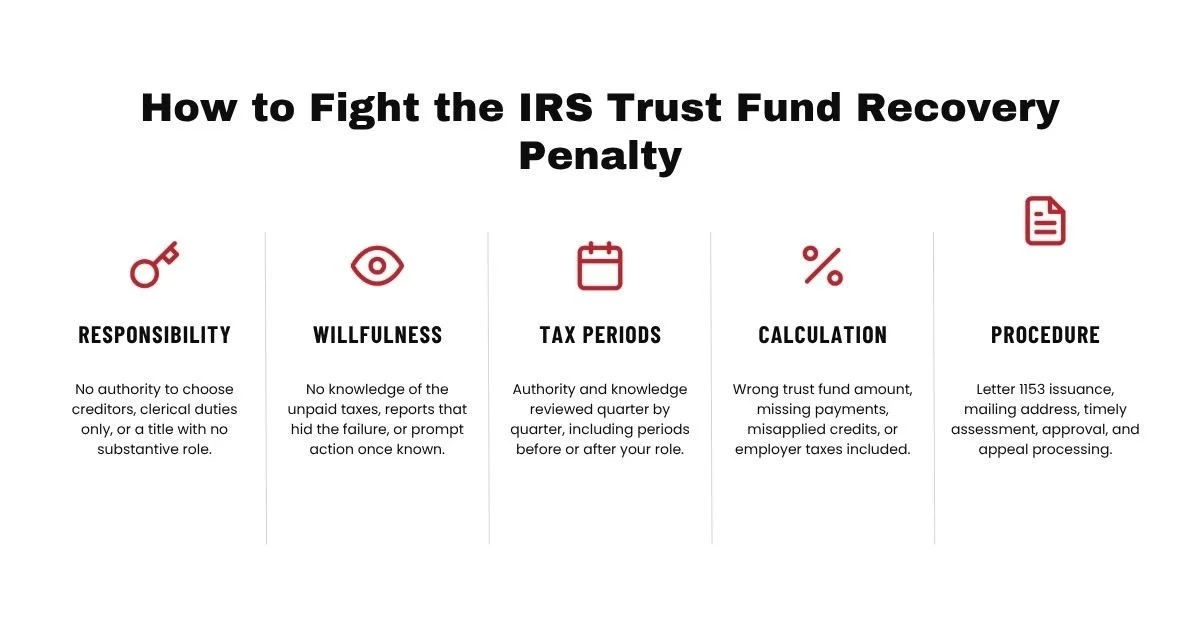
How to Fight the IRS Trust Fund Recovery Penalty
A TFRP defense should be built around the required legal elements, the tax periods, and the documentary record.
The objective is not simply to state that someone else handled payroll. The objective is to show what authority you had, what authority you lacked, when you learned of the unpaid taxes, and what actions you took.
Challenge Responsibility
A responsibility defense may be supported when:
You had no authority to choose creditors
You could not access company funds
You signed checks only as directed
You performed clerical or ministerial duties
You had no authority over payroll deposits
You held a title but had no substantive duties
Another person exercised actual financial control
The Internal Revenue Manual recognizes that non owner employees who perform ministerial acts without independent judgment generally should not be treated as responsible people.
Challenge Willfulness
A willfulness defense may be supported when:
You did not know the taxes were unpaid
Payroll reports falsely showed the deposits were made
A payroll provider concealed the failure
You acted promptly after learning about the problem
You lacked authority to correct the payment failure
The funds used to pay other creditors were not under your control
The IRS will compare that explanation with notices, emails, bank activity, payment decisions, and actions taken after knowledge arose.
Challenge the Tax Periods
Responsibility and willfulness should be reviewed separately for every quarter.
A person may have joined the company after the debt began, left before later quarters accrued, lost financial authority, or gained knowledge only during a limited period.
Challenge the Calculation
The calculation may be challenged when:
Trust fund amounts are incorrect
Business payments are missing
Payments were applied to the wrong period
Credits were not cross referenced
Employer tax amounts were included
The wrong tax periods were used
Another adjustment changed the business liability
Challenge Procedural Errors
The file should also be reviewed for:
Proper issuance of Letter 1153
Correct mailing address
Timely assessment
Managerial approval
Correct appeal processing
Accurate calculation notices
A procedural issue does not automatically cancel the penalty, but it can materially affect the assessment or the available remedy.
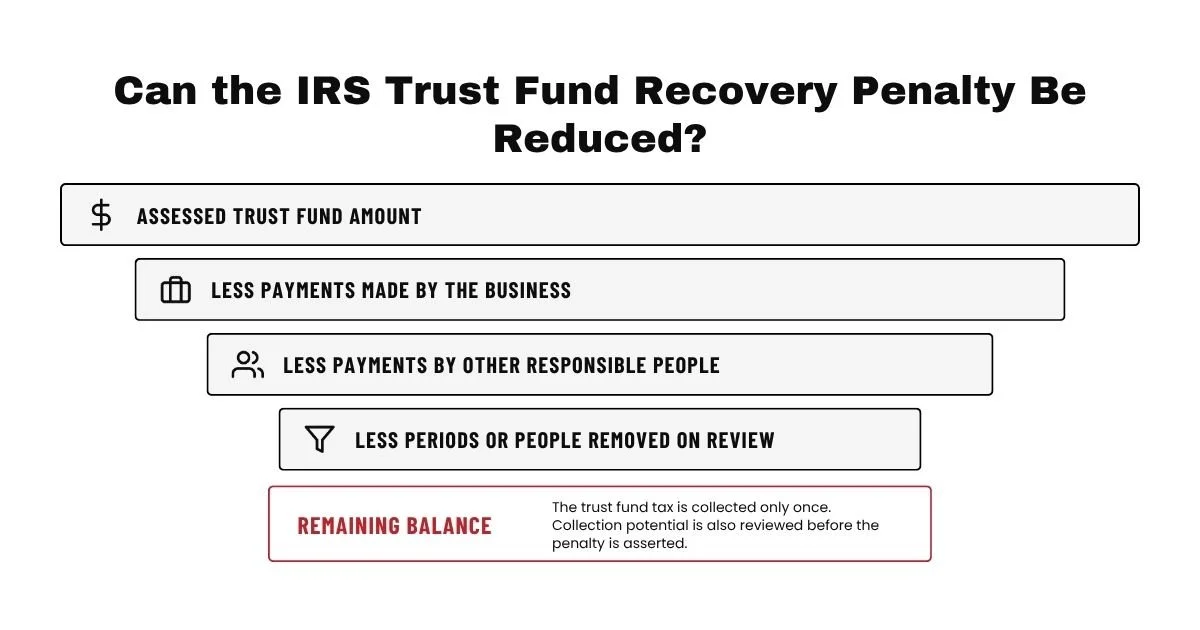
Can the IRS Trust Fund Recovery Penalty Be Reduced?
The TFRP can be reduced when the underlying trust fund liability is reduced, when payments are credited, when tax periods are removed, or when the IRS agrees that the person was not responsible or willful for some or all periods.
Payments by the Business
When the business pays the delinquent trust fund tax after the TFRP has been assessed, the related TFRP assessment should be reduced to prevent duplicate collection.
The Internal Revenue Manual states that the IRS policy is to collect the unpaid trust fund taxes only once.
Payments by Another Responsible Person
Payments made by another responsible person may also reduce the unpaid trust fund balance.
The related accounts should be monitored because payment cross references may not be immediately clear from a basic balance notice.
Successful Appeal or Reconsideration
The revenue officer or Appeals may remove:
Certain responsible people
Certain tax periods
Incorrect amounts
Periods lacking sufficient proof of willfulness
The Internal Revenue Manual permits a revenue officer to concede a proposed assessment in full or in part when information submitted with a protest changes the original determination.
Collectibility Before Assessment
IRS procedures also require a collectibility determination during a TFRP investigation. In some cases, the IRS may decide not to assert the penalty when there is no present or future collection potential, although the standards and facts require careful review.
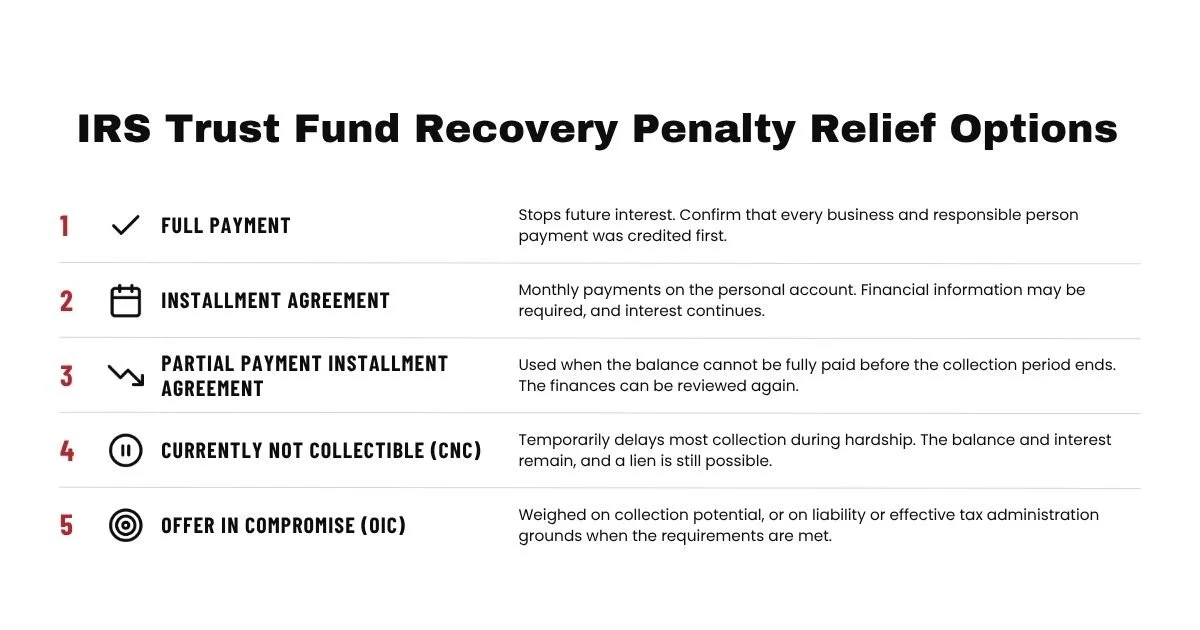
IRS Trust Fund Recovery Penalty Relief Options
Once the TFRP has been assessed, the correct relief option depends on income, expenses, assets, equity, collection statute dates, filing compliance, and the strength of any remaining liability dispute.
Full Payment
Full payment stops future interest from adding to the unpaid balance.
The person should still confirm that all related business and responsible person payments have been properly credited.
Installment Agreement
An assessed TFRP may be included in a personal installment agreement.
The IRS may require financial information, particularly when the balance is high or the proposed payment will not pay the debt within the remaining collection period. Interest continues while the agreement is active.
Partial Payment Installment Agreement
A Partial Payment Installment Agreement may be considered when the taxpayer cannot fully pay before the collection statute expires.
The IRS generally reviews income, allowable living expenses, assets, equity, and future collection potential. The financial condition may be reviewed again while the agreement remains in effect.
Currently Not Collectible Status
The IRS may temporarily delay most collection when paying the tax would create financial hardship.
Currently Not Collectible status does not forgive the TFRP. Interest continues, refunds may be applied to the balance, the IRS may file a tax lien, and the financial condition may be reviewed later.
Offer in Compromise
An individual may be able to include an assessed TFRP in an Offer in Compromise.
For an offer based on doubt as to collectibility, the IRS generally evaluates the person’s reasonable collection potential, including assets and future income after allowed living expenses. An offer may also be considered under doubt as to liability or effective tax administration when the applicable requirements are met.
An accepted offer for one responsible person does not automatically release the business or other responsible people. The IRS may retain collection rights against other people who remain liable.
Which Option Is Best?
The best way to settle a trust fund recovery penalty with the IRS depends on:
Whether the liability can still be challenged
The amount owed
Available assets and equity
Monthly disposable income
Remaining collection time
Business payments
Payments by other responsible people
Current filing and deposit compliance
A collection option should not be selected until the liability and account credits have been checked.
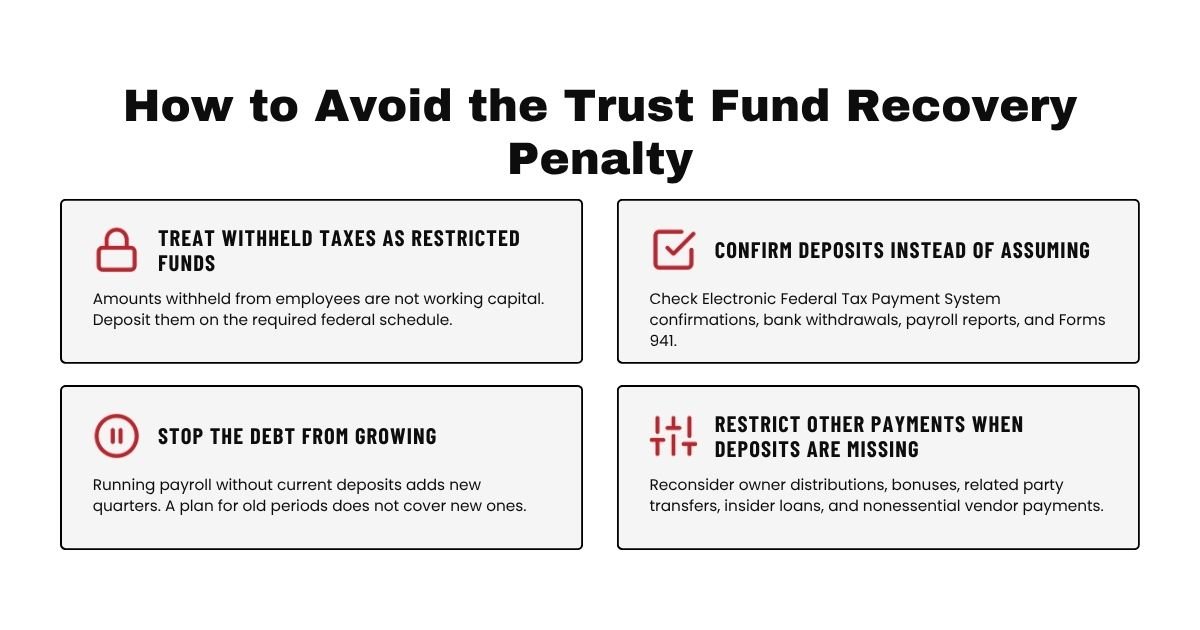
How to Avoid the Trust Fund Recovery Penalty
The most effective way to avoid the TFRP is to prevent new unpaid trust fund taxes from accruing.
Treat Withheld Taxes as Restricted Funds
Amounts withheld from employees should not be treated as working capital.
The funds should be deposited according to the required federal tax deposit schedule rather than held for future operating expenses.
Confirm Deposits Instead of Assuming They Were Made
Review:
Electronic Federal Tax Payment System confirmations
Payroll provider reports
Bank withdrawals
Forms 941
IRS business tax account records
IRS notices
Using a payroll provider does not eliminate the employer’s need to confirm that returns and deposits were completed.
Stop the Debt From Growing
When the business cannot make current deposits, continuing to run payroll can add new quarters to the case.
The business should determine whether it can operate while meeting current payroll tax duties. A payment plan for old periods does not excuse new deposit failures.
Restrict Other Payments When Deposits Are Missing
Owners should reconsider:
Owner distributions
Bonuses
Related business transfers
Insider loan payments
Nonessential vendor payments
New borrowing that will not address current taxes
Paying other creditors after learning that trust fund taxes are unpaid may support a finding of willfulness.
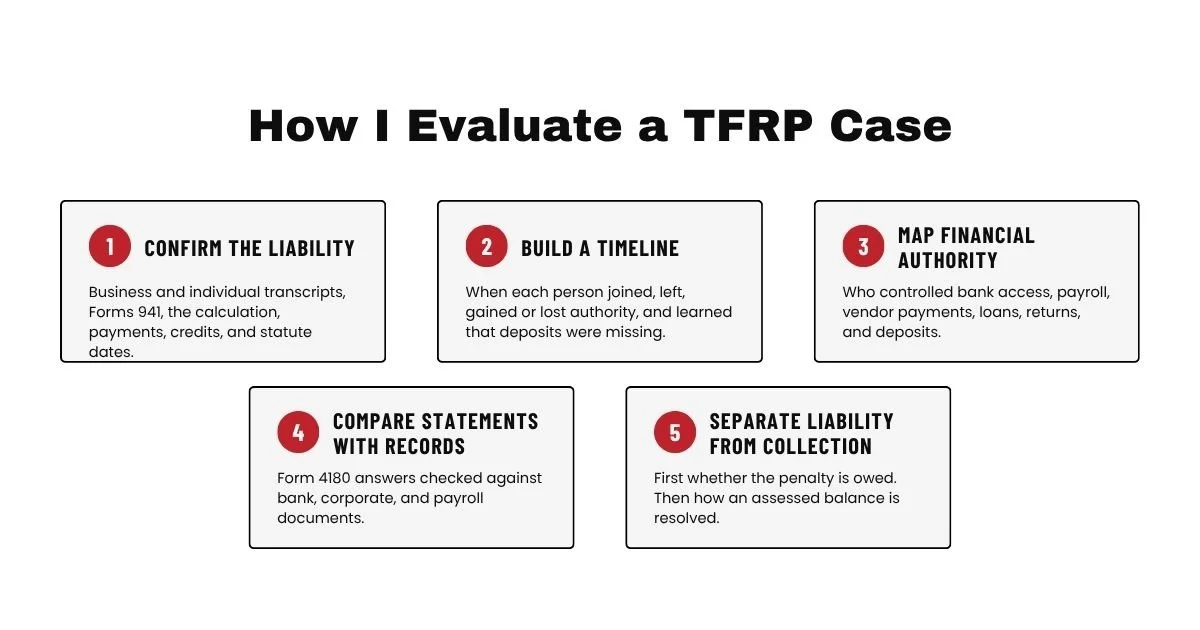
How I Evaluate a TFRP Case
I treat a TFRP matter as a fact and evidence review, not as a general request for a payment plan.
Step 1 Confirm the Liability
I review:
Business account transcripts
Individual TFRP transcripts
Forms 941
TFRP calculations
Payment history
Credits and adjustments
Assessment and collection dates
Step 2 Build a Timeline
The timeline should identify:
When each person joined the company
When each person left
When financial authority began or ended
When each payroll tax period accrued
When each person learned deposits were missing
What payments were made afterward
When Form 4180 interviews occurred
When Letter 1153 was issued
Step 3 Map Financial Authority
I compare titles with actual authority.
The important questions are who controlled bank access, payroll, vendor payments, loans, tax returns, deposits, and financial reporting.
Step 4 Compare Statements With Records
The IRS commonly relies on Form 4180 interviews, corporate records, bank signature information, cancelled checks, bank statements, payroll records, and other evidence concerning each person’s role.
I compare the interview statements with those records. A title may appear important but carry little authority. A person with a modest title may have exercised substantial control.
Step 5 Separate Liability From Collection
The first question is whether the person legally owes the TFRP.
The second question is how an assessed balance can be paid or resolved.
Mixing those questions too early can cause a person to accept a liability that should have been challenged.
Research Sources Used
This guide was prepared using current IRS guidance reviewed in July 2026, including the IRS TFRP pages, Internal Revenue Manual Sections 5.7.3, 5.7.4, 5.7.5, 5.7.6, 5.17.7, and 5.19.14, IRS payment and collection guidance, and Taxpayer Advocate Service materials.
Frequently Asked Questions About the Trust Fund Recovery Penalty
-
Yes. The IRS may assess more than one person when each person independently meets the responsibility and willfulness requirements.
For example, an owner and controller may both have authority over company funds and may both know the employment taxes are unpaid. Each can be assessed for the full unpaid trust fund amount. However, the IRS policy is to collect the trust fund tax only once across the business and all responsible people.
This makes payment tracking important. A payment by the business or another responsible person should reduce the remaining trust fund amount, even though each account may initially display a larger assessed balance.
-
No. Check signing authority is relevant, but it does not automatically establish responsibility.
The IRS should determine whether you exercised independent judgment and had authority to choose which creditors were paid. Someone who signed checks only as directed may be performing a ministerial duty. Someone who decided which bills were paid may have significant financial control.
The actual use of the authority matters more than the existence of a name on a bank signature card.
-
Yes, but employment in bookkeeping or payroll does not automatically create liability.
A non owner employee who entered payroll data or paid bills only under direct instructions may have a responsibility defense. A controller, payroll manager, or bookkeeper who independently selected creditors, controlled bank accounts, or directed payroll tax deposits may face greater exposure.
The analysis should focus on independent authority, not the department name or job title.
-
No. Outsourcing payroll does not automatically remove the employer’s employment tax responsibility.
The IRS may investigate the payroll provider, responsible people within the provider, and people within the employer. The owner’s willfulness may depend partly on what the owner knew, whether the provider concealed the failure, what notices were received, and what the owner did after discovering the problem.
Business owners should confirm that deposits cleared and returns were filed instead of relying only on payroll reports.
-
Form 2751 generally indicates agreement with the proposed assessment, so it should be reviewed carefully before signing.
Signing may be appropriate when the person agrees with responsibility, willfulness, the tax periods, and the amount. It may be inappropriate when important facts, payments, or defenses have not been considered.
The Internal Revenue Manual states that signing Form 2751 does not immediately extinguish appeal rights during the applicable restriction period. Even so, a person should understand the legal and procedural effects before signing.
-
Yes. Once assessed, the TFRP may be included in an individual installment agreement.
The payment amount may depend on the balance, income, expenses, assets, equity, and remaining collection period. A payment arrangement does not erase the liability, and interest generally continues until the balance is paid.
Before entering an agreement, confirm that all business payments and payments by other responsible people have been credited.
-
Potentially. An assessed TFRP may be considered through an Offer in Compromise when the person meets the applicable requirements.
For doubt as to collectibility, the IRS evaluates assets and expected future income after allowable expenses. A doubt as to liability offer may be considered when there is a genuine dispute concerning the existence or amount of the debt.
An accepted offer for one person generally does not release other responsible people from their separate liabilities.
-
TFRP liabilities generally receive special treatment under bankruptcy law and are ordinarily not discharged.
The Internal Revenue Manual states that trust fund recovery penalties are treated as taxes required to be collected or withheld and generally remain collectible after the bankruptcy stay ends. Bankruptcy results depend on the chapter filed, assessment history, procedural facts, and applicable law, so the issue requires individual legal review.
A bankruptcy filed by the business also does not automatically stop the IRS from assessing or collecting the TFRP from responsible people who are not personally in bankruptcy.
Brief Summary
The IRS Trust Fund Recovery Penalty can convert unpaid business payroll taxes into personal liability.
The IRS must establish that the person had meaningful responsibility for collecting, accounting for, or paying trust fund taxes and acted willfully.
The penalty generally equals the unpaid employee income tax withholding and employee Social Security and Medicare tax. It does not generally include the employer portion or business level penalties.
Responsibility depends on actual financial authority, not title alone.
Willfulness may exist when a person knows the taxes are unpaid and continues paying other creditors.
Form 4180 is used to document the person’s duties, authority, knowledge, and actions.
Letter 1153 generally provides 60 days to appeal, or 75 days when addressed outside the United States.
The IRS generally has three years to assess the penalty under the applicable rules and normally ten years after assessment to collect it, subject to extensions and suspensions.
Potential defenses include lack of responsibility, lack of willfulness, incorrect tax periods, missing payments, calculation errors, and procedural defects.
After assessment, possible collection options may include an installment agreement, Partial Payment Installment Agreement, Currently Not Collectible status, or Offer in Compromise.
The strongest response begins with the records. Confirm the tax periods, calculation, authority, knowledge timeline, payments, appeal deadline, and collection statute before selecting a resolution.