CP504B Notice: Is the IRS About to Levy Your Business Bank Account?
A CP504B notice is a serious IRS intent-to-levy warning for a business tax account. It means the IRS shows an unpaid business tax balance and may move forward with collection action if the business does not pay, make arrangements, dispute the balance, or take another appropriate step.
The notice generally gives the business 30 days from the notice date to pay or contact the IRS. A CP504B notice does not prove that the IRS has already sent a levy to your bank.
It does mean the account has reached a stage where a business bank levy, a levy on accounts receivable, a levy on other property, or the filing of a Notice of Federal Tax Lien may become possible.
When I review a CP504B notice, I do not begin by assuming that the balance is correct or that a bank levy will happen immediately.
I first verify the business, tax form, tax period, assessment, payment history, filing status, and current collection stage.
The correct response depends on what the IRS account actually shows.
A business that already paid may need to locate a missing or misapplied payment. A business that cannot pay in full may need an installment agreement, an Offer in Compromise, or a temporary collection delay.
A business that disputes the liability may need to provide records or use the correct appeal process.

Brief Summary
A CP504B notice means the IRS has issued a formal notice of intent to levy for an unpaid business tax liability.
It does not necessarily mean your business bank account has already been levied. It does mean that the IRS collection process has reached a serious stage.
The business generally has 30 days from the notice date to pay, request an arrangement, dispute the balance, provide proof of payment, or take another appropriate action.
The correct response depends on the tax form, tax period, amount owed, filing history, payment history, current compliance, and financial condition of the business.
How I Evaluated the CP504B Notice
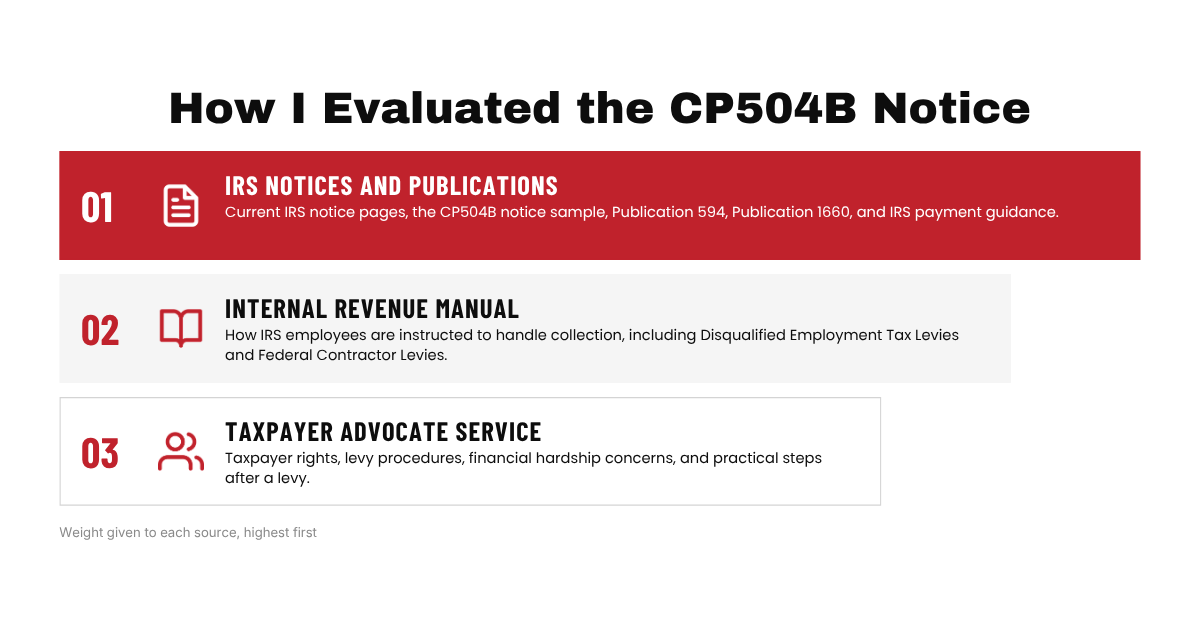
I based this guide primarily on current IRS notice pages, the official CP504B notice sample, IRS Publication 594, IRS Publication 1660, IRS payment guidance, the Internal Revenue Manual, and Taxpayer Advocate Service collection materials.
Questions Used in My Review
I evaluated the CP504B notice by asking six questions.
What does CP504B authorize the IRS to do?
What generally must happen before a business bank levy?
Which levy exceptions can shorten the normal process?
Which payment or collection alternatives may be available?
Which appeal rights arise from CP504B, and which require a later notice?
What records should a business review before agreeing with the balance?
This method matters because the notice title alone does not reveal the full status of the IRS account.
The tax form, tax period, prior notices, appeal history, filing compliance, payment history, and type of liability can change the correct response.
Why the Source of the Information Matters
I give the most weight to current IRS notice pages and publications because they explain what the IRS states it may do.
I use the Internal Revenue Manual to understand how IRS employees are instructed to handle collection actions, including Disqualified Employment Tax Levies and Federal Contractor Levies.
I use Taxpayer Advocate Service materials to clarify taxpayer rights, levy procedures, financial hardship concerns, and practical steps after a levy.
What Is a CP504B Notice?
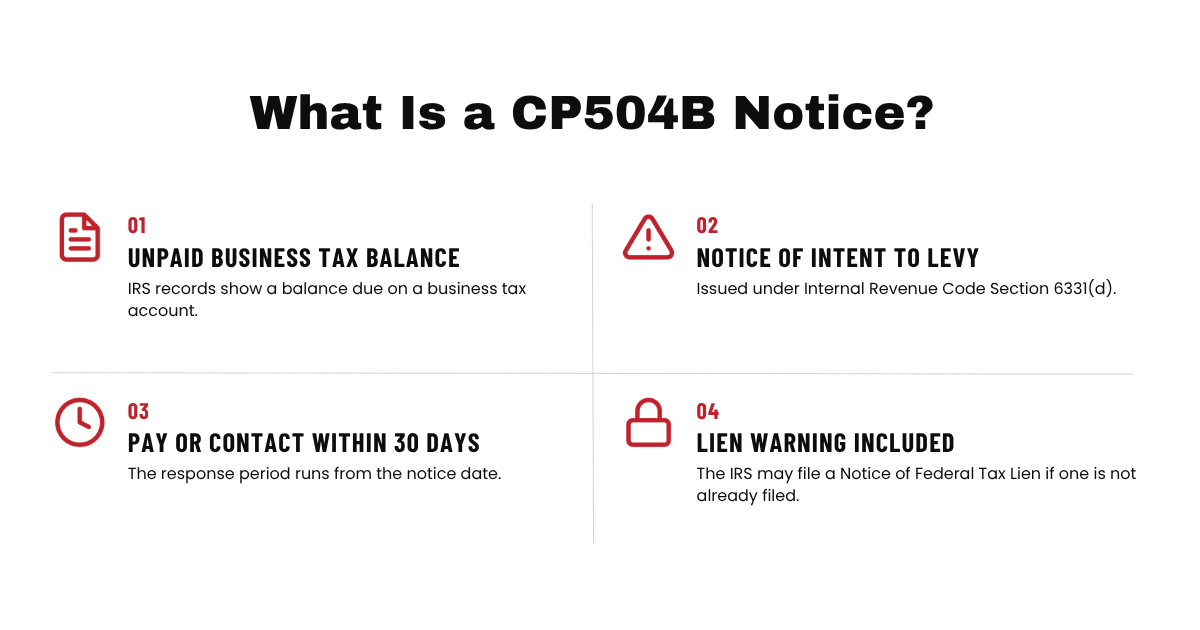
A CP504B notice is an IRS collection notice issued because IRS records show an unpaid business tax balance.
It serves as a notice of intent to levy under Internal Revenue Code Section 6331(d).
The notice tells the business to pay the balance or contact the IRS within 30 days of the notice date.
It also warns that the IRS may file a Notice of Federal Tax Lien if one has not already been filed.
CP504B Notice Meaning for Businesses
For a business, the CP504B notice means the account has moved beyond an ordinary initial balance due notice.
The IRS is no longer simply reporting that money is owed. It is warning that enforced collection may follow if the account remains unresolved.
That does not mean every business receiving a CP504B notice will experience a business bank levy.
It means the IRS believes the balance remains unpaid and the business should review the notice before the response period expires.
Why the IRS Sent the Notice
The notice should identify the following information:
Business name
Employer Identification Number
Tax period
Tax form
Original tax amount
Penalties
Interest
Current amount due
The liability may involve corporate income tax, employment tax, unemployment tax, excise tax, or another tax reported under a business Employer Identification Number.
The CP504B notice usually appears after previous IRS billing activity. However, the notice history should still be confirmed through IRS account transcripts.
Is CP504B a Final Notice Before Levy?
CP504B is a notice of intent to levy, but the phrase \"final notice\" should be used carefully.
For a Disqualified Employment Tax Levy or Federal Contractor Levy, the IRS may be able to issue a levy after the 30 day period without providing the usual Collection Due Process hearing before the levy.
The IRS generally provides appeal rights after the levy in those situations.
In many other cases, the IRS sends another notice providing an opportunity to request a Collection Due Process hearing before levying property, unless that hearing opportunity was previously provided.
The practical answer is that CP504B is serious, but it is not always the same notice as an LT11 or Letter 1058 that expressly provides Collection Due Process hearing rights.

CP504B Versus CP504 and an LT11 or Letter 1058
Business owners often confuse CP504B with CP504 and later levy notices.
The notices are related, but they do not always provide the same rights or apply to the same type of tax account.
CP504B Notice
CP504B is generally connected to a business tax account.
It is a notice of intent to levy under Internal Revenue Code Section 6331(d).
The business is generally told to pay or contact the IRS within 30 days.
The notice may warn about a Disqualified Employment Tax Levy or Federal Contractor Levy.
It also identifies rights under the Collection Appeals Program.
In many other cases, a separate Collection Due Process notice may follow before a levy.
CP504 Notice
CP504 is commonly used for individual tax accounts, although the exact taxpayer and liability should always be checked.
It is also an IRS intent to levy notice.
The IRS describes CP504 as a final reminder concerning unpaid tax.
The notice may warn about levies on income, bank accounts, property, and state tax refunds.
It may also provide information about the Collection Appeals Program.
LT11 or Letter 1058
An LT11 or Letter 1058 is generally titled Final Notice of Intent to Levy and Notice of Your Right to a Hearing.
It usually gives the taxpayer a specific deadline to request a Collection Due Process hearing.
A timely hearing request may suspend levy action for the tax periods covered by the notice while the hearing remains pending, subject to applicable statutory exceptions.
A timely Collection Due Process request may also preserve the opportunity for judicial review of the IRS Appeals determination.
Why the Difference Matters
A business should not assume that a CP504B notice automatically provides the same rights as an LT11 or Letter 1058.
The notice number, notice date, tax periods, and wording concerning appeal rights should be reviewed carefully.
Missing a Collection Due Process deadline may affect whether collection activity is suspended and whether a later Appeals decision can be reviewed by the United States Tax Court.
Can the IRS Levy a Business Checking Account?
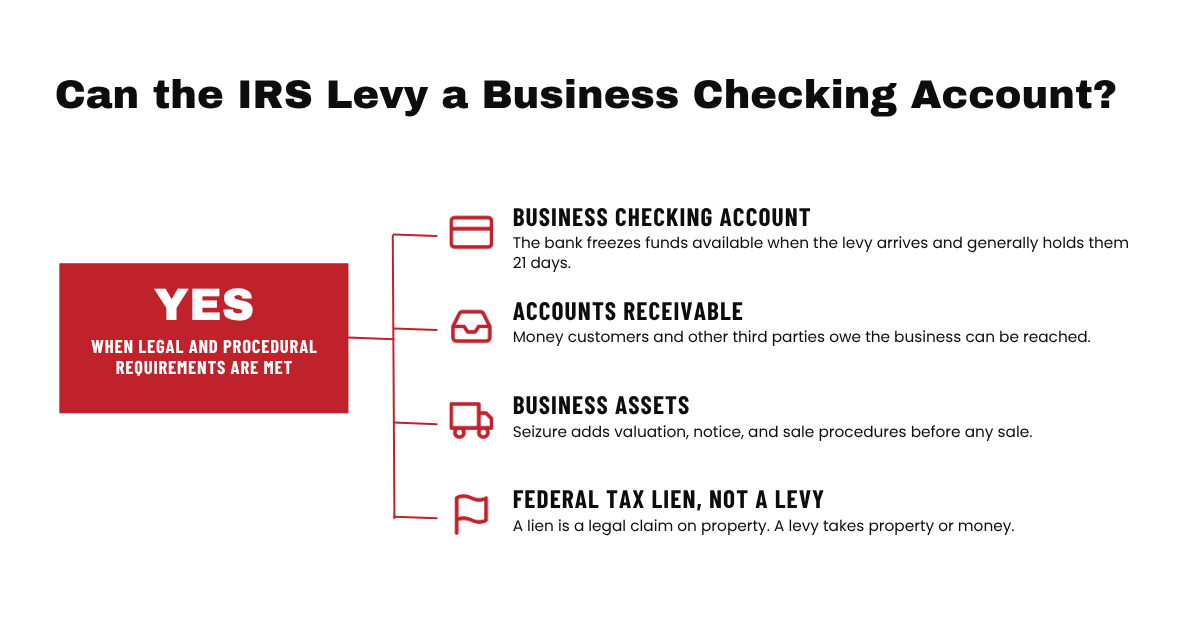
Yes. The IRS can levy a business checking account when the legal and procedural requirements for levy action have been met.
The IRS can also reach other property or rights to property, including accounts receivable, commissions, payments owed to the business, and certain business assets.
What Happens During an IRS Bank Levy?
A CP504B notice is not the same as an actual IRS bank levy.
An actual bank levy generally occurs when the IRS sends a levy to the financial institution.
The bank freezes funds available in the account when it receives the levy, up to the amount stated in the levy.
The bank generally holds those funds for 21 days before sending them to the IRS.
The holding period gives the business time to address ownership disputes, payment errors, financial hardship, or a possible levy release.
Funds deposited after the bank receives the levy are not normally captured by that same one-time bank levy.
The 21-day holding period begins after the bank receives the actual levy. It does not begin when the business receives the CP504B notice.
Accounts Receivable and Customer Payments
The IRS may levy money owed to the business by customers or other third parties.
For a business that depends on accounts receivable to fund payroll and operating expenses, a levy on customer payments can be as disruptive as a levy on the operating bank account.
A levy generally reaches the property or payment right that exists when the levy is served.
Certain continuing payment streams may be treated differently depending on the type of levy issued.
Business Assets
The CP504B guidance lists business assets as property that may be subject to levy.
The IRS does not seize and sell business property in every collection case.
Asset seizure involves additional procedures, valuation requirements, notices, and sale rules.
The IRS may also consider whether the expected sale proceeds justify the seizure and sale process.
IRS Levy Versus Federal Tax Lien
A levy takes property or money.
A federal tax lien is the government’s legal claim against property after a tax assessment, demand for payment, and failure to pay.
Filing a Notice of Federal Tax Lien places the public on notice of the government’s claim.
CP504B warns that the IRS may file a Notice of Federal Tax Lien if one has not already been filed.
A federal tax lien may affect financing, property transactions, and relationships with lenders or other creditors.
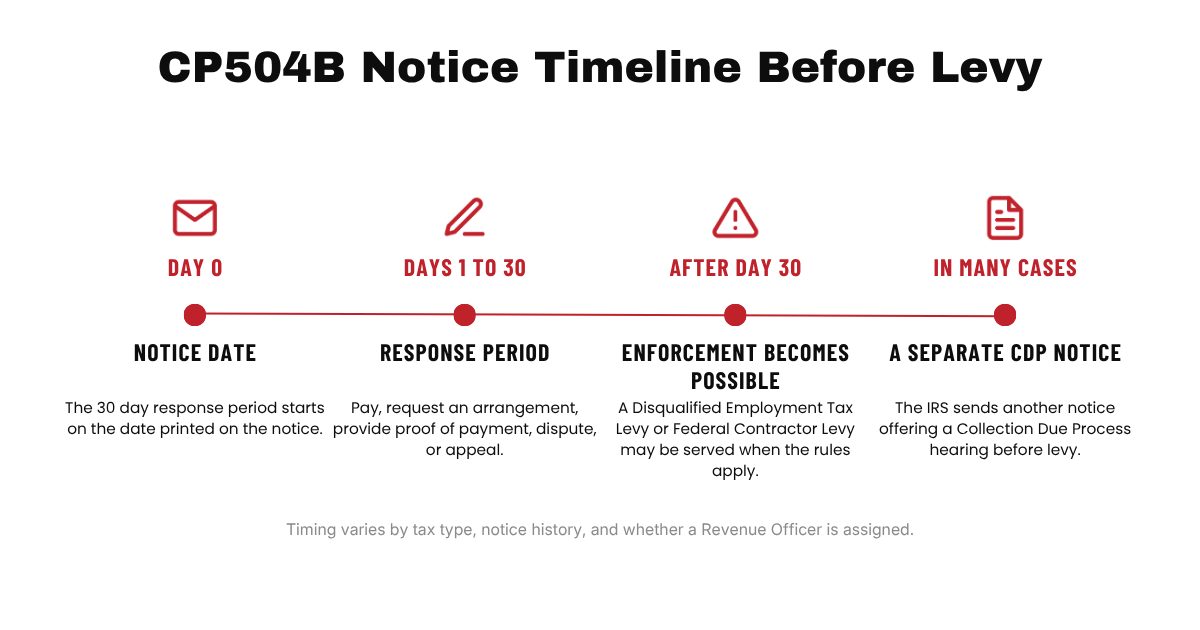
CP504B Notice Timeline Before Levy
The CP504B notice generally tells the business to pay or contact the IRS within 30 days of the notice date.
That does not create one universal levy date for every business.
It creates a response period after which additional IRS collection action may become possible.
Days 1 Through 30
During the 30 day period, the business should determine whether the balance is correct and decide which response is supported by the facts.
The appropriate response may include:
Paying the balance in full
Making a partial payment while requesting an arrangement
Requesting an installment agreement
Providing proof that the balance was already paid
Correcting a misapplied payment
Disputing an assessment or account error
Requesting a temporary collection delay
Evaluating an Offer in Compromise
Exercising applicable appeal rights
Simply calling the IRS without completing the requested action may not resolve the account.
The business should retain proof of every payment, submission, fax, upload, mailed response, and telephone conversation.
What May Happen After 30 Days?
The IRS may serve a Disqualified Employment Tax Levy or Federal Contractor Levy if the balance remains unresolved after the response period and the legal requirements apply.
In many other situations, the IRS generally sends another notice providing an opportunity to request a Collection Due Process hearing before issuing a levy, unless that right was already provided.
Disqualified Employment Tax Levy
A Disqualified Employment Tax Levy applies only when statutory requirements are met.
It is not available for every unpaid payroll tax account.
Certain employment tax liabilities may qualify when the taxpayer previously requested a Collection Due Process hearing concerning employment taxes arising within the applicable lookback period.
When the IRS issues this type of levy, it generally provides the Collection Due Process hearing opportunity after the levy.
Federal Contractor Levy
Special levy rules may apply when the taxpayer is a federal contractor.
A Federal Contractor Levy is another exception to the usual requirement that a Collection Due Process hearing opportunity be provided before levy action.
Appeal rights are generally provided after the levy.
How Long After CP504B Does the IRS Levy?
There is no single answer.
The timing depends on the following factors:
Type of tax
Prior notice history
Whether Collection Due Process rights were previously issued
Whether the account is assigned to an IRS Revenue Officer
Whether the business is a federal contractor
Whether the liability qualifies for a Disqualified Employment Tax Levy
Whether the business has contacted the IRS
Whether a payment or collection arrangement is pending
The safest approach is to work from the notice date and complete the appropriate response before the 30 day period expires.
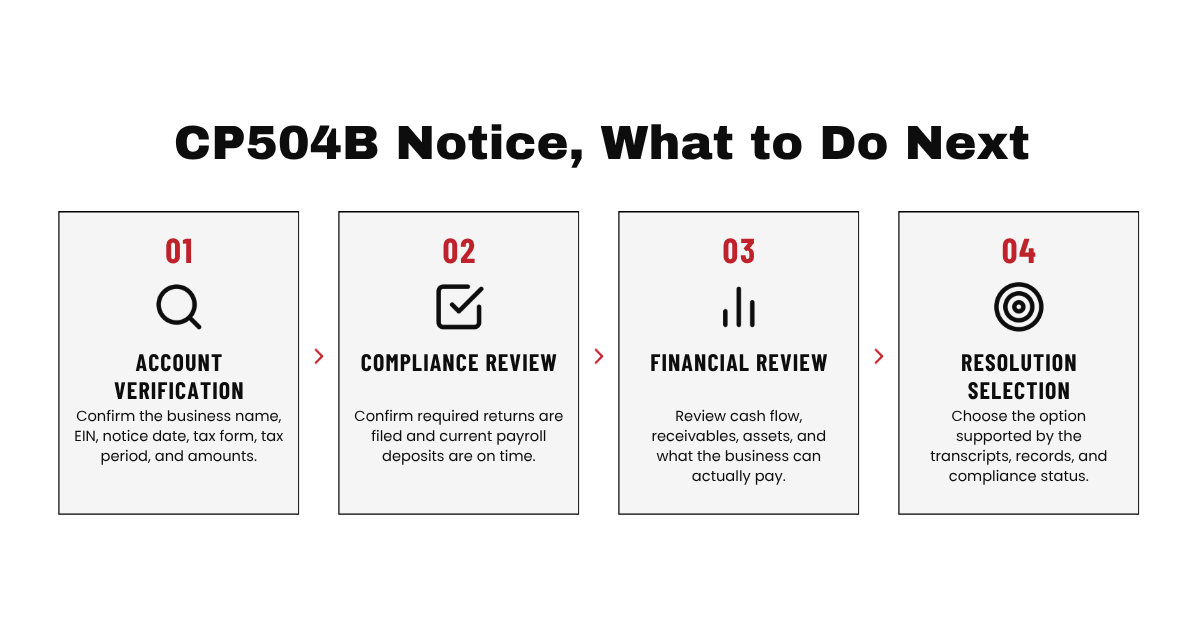
CP504B Notice: What to Do Next
When I review a CP504B notice, I separate the work into account verification, compliance review, financial review, and resolution selection.
This prevents the business from choosing a payment option before confirming whether the IRS balance is accurate.
Review Every Page of the Notice
Confirm the following information:
Business legal name
Employer Identification Number
Notice number
Notice date
Tax form
Tax period
Tax amount
Penalty amount
Interest amount
IRS telephone number
IRS response address
A business may owe for several tax periods, but the notice may apply to only some of them.
The response should address the exact periods shown on the CP504B notice.
CP504B Notice Proof of Payment and Transcript Check
If the business already paid, locate the payment confirmation before contacting the IRS.
Useful records may include:
Electronic Federal Tax Payment System confirmations
IRS Direct Pay confirmations
Bank statements
Cancelled checks
Wire transfer records
Payroll provider deposit reports
Installment agreement records
Prior IRS correspondence
A business tax account transcript can show federal tax deposits, payments, penalties, interest, return processing, assessments, and balance changes.
Eligible business owners may also be able to review balances, payment history, transcripts, and selected notices through an IRS Business Tax Account.
Match each payment to the correct tax form, tax period, date, and amount.
A payment can leave the business bank account and still be applied to the wrong tax period or tax form.
Check Filing Compliance
A collection arrangement may be delayed or denied if required tax returns are missing.
Identify every required business return, including:
Business income tax returns
Payroll tax returns
Federal unemployment tax returns
Excise tax returns
Required information returns
Filing a missing return does not automatically correct the CP504B balance.
The business should confirm that the return was processed and that the IRS account changed as expected.
Check Current Payroll Tax Deposits
A business with employees should determine whether current payroll tax deposits are being made on time.
The IRS generally expects an operating business to remain current with present tax obligations while paying older liabilities.
Falling behind on new payroll tax deposits while trying to resolve older tax debt can create additional liabilities and may affect the available resolution options.
Protect Essential Business Records
Create one file containing:
The CP504B notice
IRS account transcripts
Filed tax returns
Payment confirmations
Prior installment agreements
Bank statements
Financial statements
Proof of every response
The goal is to create a complete timeline showing what was assessed, what was paid, what remains unpaid, and what IRS action is pending.
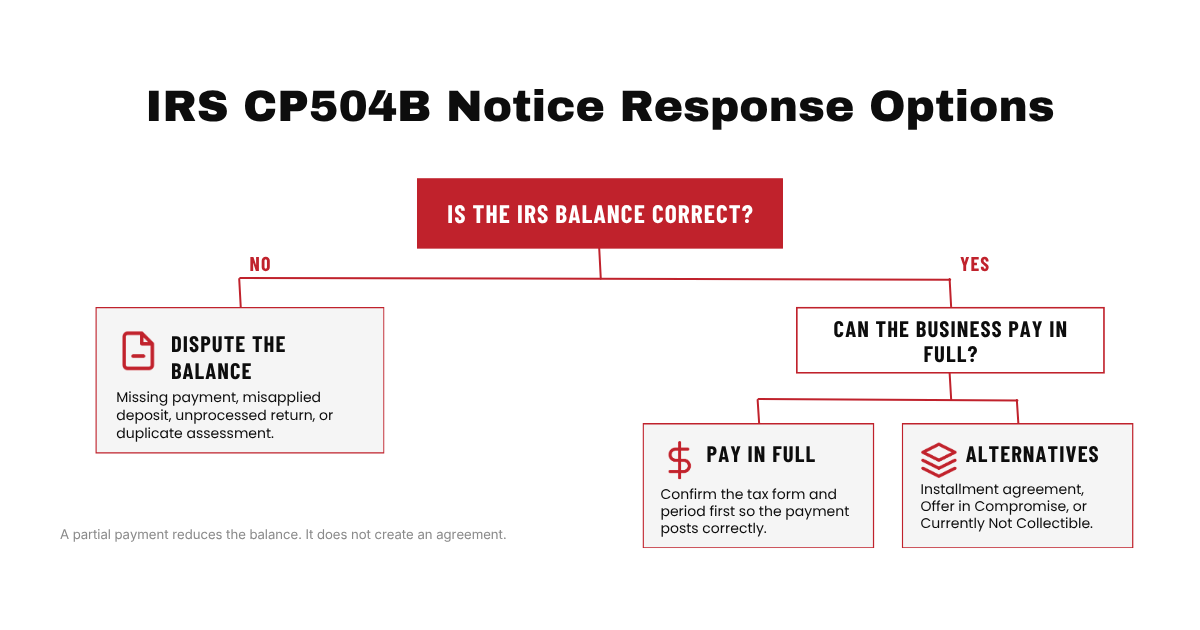
IRS CP504B Notice Response Options
There is no single response that fits every CP504B notice.
The correct option depends on the accuracy of the balance, business cash flow, asset equity, filing compliance, tax type, remaining collection period, and ability to remain current.
Pay the Balance in Full
Paying the correct balance in full generally removes the unpaid liability supporting the levy warning.
Before making a large payment, confirm the tax form and tax period so the payment is directed correctly.
Available business payment methods may include:
IRS Direct Pay for businesses
Electronic Federal Tax Payment System
Card payments through an approved processor
Check or money order
Same-day bank wire
Other payment methods listed by the IRS
Make a Partial Payment
A partial payment reduces the unpaid balance and future interest on the amount paid.
However, a partial payment does not automatically create a payment agreement or guarantee that IRS collection will stop.
If full payment is not possible, the business should combine any partial payment with a documented request for an appropriate collection arrangement.
CP504B Notice Payment Plan Options
An installment agreement allows a business to make payments over time, subject to IRS approval and the terms of the agreement.
Eligibility depends on:
Amount owed
Type of tax
Filing compliance
Federal tax deposit compliance
Proposed monthly payment
Remaining collection period
Financial information requested by the IRS
Certain operating businesses with trust fund taxes and an assessed balance of $25,000 or less may qualify for a streamlined In-Business Trust Fund Express installment agreement if they satisfy the applicable requirements
Business cases above that amount, or cases that do not meet streamlined requirements, may require bank statements, asset information, income verification, expense verification, and a business collection information statement.
A request for an installment agreement is not the same as an approved agreement.
Continue monitoring the IRS account until the IRS confirms acceptance.
Offer in Compromise
An Offer in Compromise may allow qualifying IRS tax debt to be settled for less than the full amount owed.
The IRS generally evaluates:
Ability to pay
Business income
Business expenses
Asset equity
Remaining collection period
Current tax compliance
A business that can fully pay through assets, income, or an installment agreement generally will not qualify merely because the owner prefers a settlement.
The business must generally file all required tax returns.
A business with employees must also make required federal tax deposits for the current quarter and the two preceding quarters before submitting an Offer in Compromise.
A business in an open bankruptcy proceeding is generally not eligible.
Submitting an Offer in Compromise does not automatically release a bank levy that was already issued.
Existing levy activity should be addressed separately.
Currently Not Collectible Status for a Business
The IRS may temporarily delay collection when the business cannot pay because of financial hardship.
The IRS may request Form 433-B and supporting documents concerning:
Bank accounts
Accounts receivable
Property
Vehicles
Equipment
Other assets
Business income
Operating expenses
If approved, Currently Not Collectible status generally suspends most active collection activity.
It does not cancel the tax debt.
Penalties and interest continue, and the IRS may still file a Notice of Federal Tax Lien.
For an operating business, the IRS may closely examine whether the company can continue paying current taxes while meeting necessary operating expenses.
Dispute the Balance
If the business disagrees with the amount, identify the exact reason.
Possible issues include:
A payment applied to the wrong tax period
A tax return that has not been processed
An account adjustment that was not posted
A duplicate assessment
A payroll deposit credited incorrectly
An amended return that is still under review
A penalty that may qualify for relief
An assessment the business had no prior opportunity to dispute
The response should include records directly connected to the tax form and period listed on the CP504B notice.
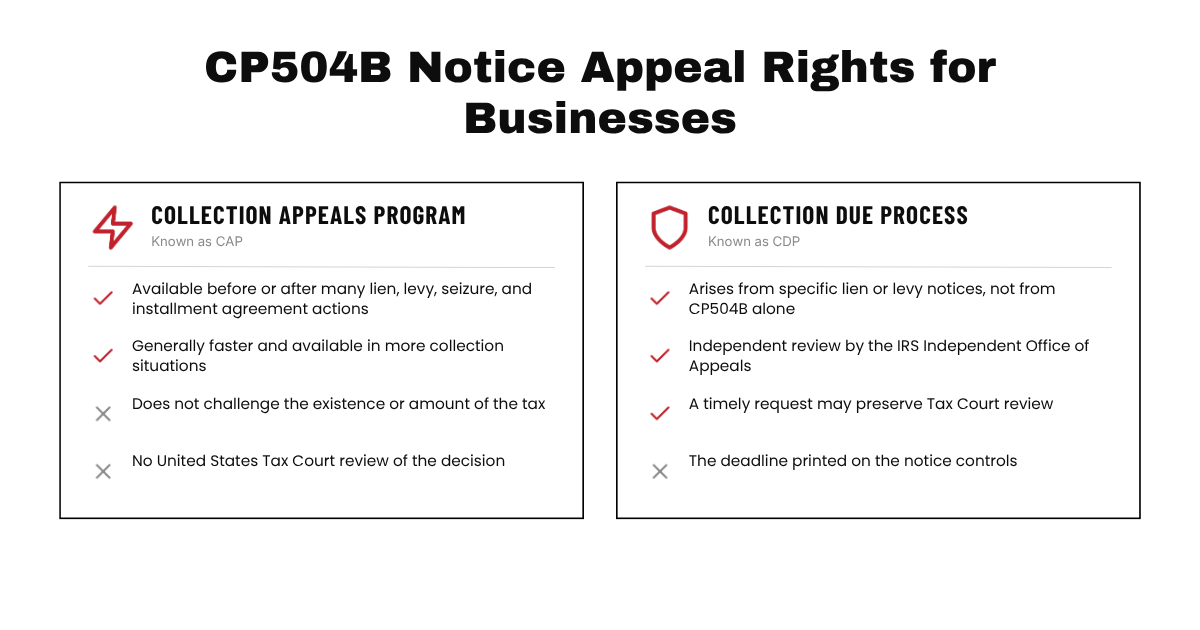
CP504B Notice Appeal Rights for Businesses
CP504B identifies the Collection Appeals Program as a possible way to challenge proposed levy or lien action.
Collection Appeals Program rights and Collection Due Process rights are not interchangeable.
Collection Appeals Program
The Collection Appeals Program, commonly called CAP, may be available before or after certain lien, levy, seizure, or installment agreement actions.
CAP is generally faster and available in more collection situations than Collection Due Process.
However, CAP does not ordinarily allow the taxpayer to challenge the existence or amount of the underlying tax liability.
A taxpayer also cannot obtain United States Tax Court review of a CAP decision.
The CP504B notice may state that the business can call the IRS or submit Form 9423 within the period stated on the notice to request a CAP appeal before collection action.
The business should follow the instructions on its actual notice because procedures may differ depending on whether the case is handled through automated notices, telephone collection, or an IRS Revenue Officer.
Collection Due Process
Collection Due Process rights arise from specific lien or levy notices.
A timely Collection Due Process request can allow the business to:
Propose collection alternatives
Raise certain liability issues when permitted
Address financial hardship
Challenge certain collection procedures
Receive an independent review by the IRS Independent Office of Appeals
A timely request may also preserve the right to ask the United States Tax Court to review the Appeals determination.
Does CP504B Allow a Collection Due Process Hearing?
CP504B itself is generally not the same as an LT11 or Letter 1058.
In many cases, the IRS later issues a notice providing Collection Due Process rights before levy, unless that opportunity was already provided.
Disqualified Employment Tax Levy and Federal Contractor Levy rules can permit levy action before the hearing, with appeal rights provided afterward.
Protect Every Appeal Deadline
The business should use the date printed on the notice, not the date the notice was opened.
Contacting the IRS does not automatically extend a Collection Due Process deadline.
The hearing request must be submitted to the address listed on the applicable notice and filed within the stated period.

What if the Business Already Paid or Has a Payment Agreement?
A CP504B notice can arrive after a payment was made or while another request is being processed.
Do not assume the notice can be ignored without checking the IRS account.
The Business Paid the Balance
Payments may take time to post.
If the balance was recently paid in full, the business should review its current IRS balance and payment history.
Confirm the following:
The payment cleared the bank
The payment was accepted by the IRS payment system
The correct Employer Identification Number was used
The correct tax form was selected
The correct tax period was selected
The payment posted to the intended IRS account
If the payment was misapplied, provide the IRS with the payment date, amount, confirmation number, bank record, and intended tax period.
The Business Has an Approved Installment Agreement
If the CP504B liability is included in an approved installment agreement, continue making every required payment.
Confirm that the agreement remains active and that the tax period shown on CP504B is included.
An installment agreement covering one group of periods may not cover a newly assessed liability or a later payroll tax period.
The Business Requested an Agreement but Has No Approval
A pending request is not the same as an approved agreement.
The business should consider paying as much as possible while the request is pending to reduce additional interest.
Track the request until the IRS:
Accepts the agreement
Rejects the request
Requests more information
Proposes different payment terms
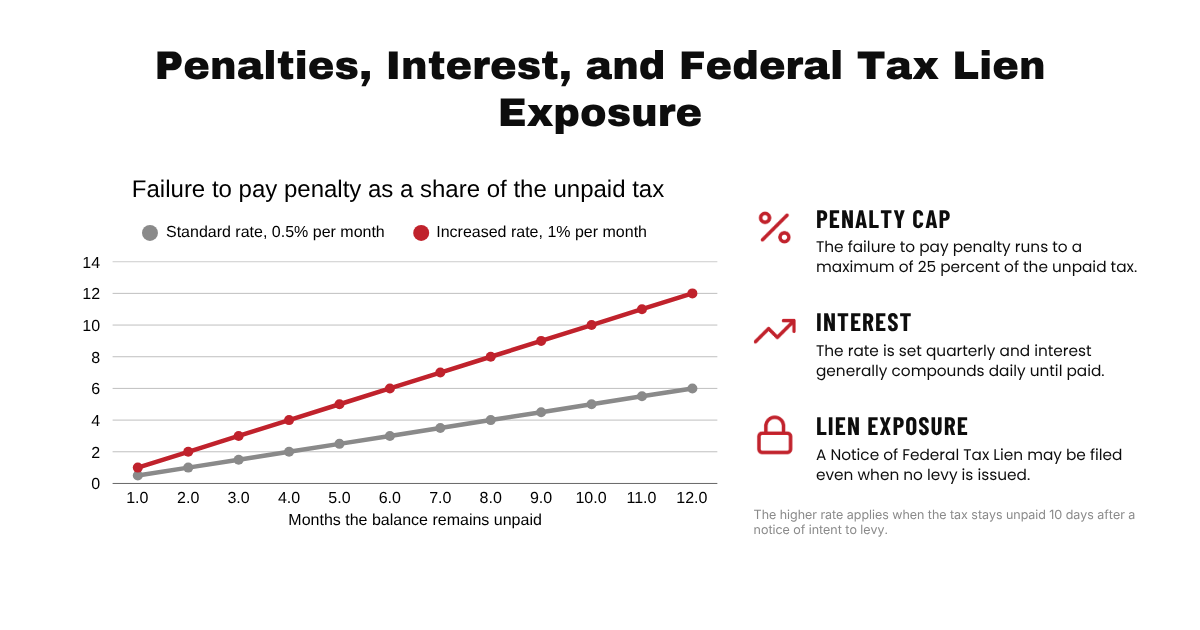
Penalties, Interest, and Federal Tax Lien Exposure
The amount shown on CP504B may continue to increase while the tax remains unpaid.
Failure to Pay Penalty
The general failure to pay penalty is 0.5 percent of the unpaid tax for each month or part of a month the balance remains unpaid, up to 25 percent.
If the tax remains unpaid 10 days after the IRS issues a notice of intent to levy, the failure to pay penalty rate may increase to one percent per month or part of a month.
The calculation depends on the type of liability and the facts of the account.
Interest
Interest generally accrues on unpaid tax from the original payment due date until the balance is paid.
The interest rate is determined quarterly, and interest generally compounds daily.
Penalty Relief
Receiving CP504B does not prevent a business from requesting penalty relief when a valid legal basis exists.
Possible relief may include:
Reasonable cause
First Time Abatement, when applicable
Correction of an IRS error
Relief based on incorrect written advice from the IRS
Eligibility depends on the type of penalty, filing and payment history, facts, documentation, and applicable IRS rules.
Penalty relief should be evaluated separately from the need to address the underlying tax and immediate collection risk.
Notice of Federal Tax Lien
The IRS may file a Notice of Federal Tax Lien even if it does not immediately levy the business bank account.
An installment agreement, Offer in Compromise request, or Currently Not Collectible determination does not automatically prevent lien filing.
The result depends on the type of resolution, amount owed, and collection circumstances.
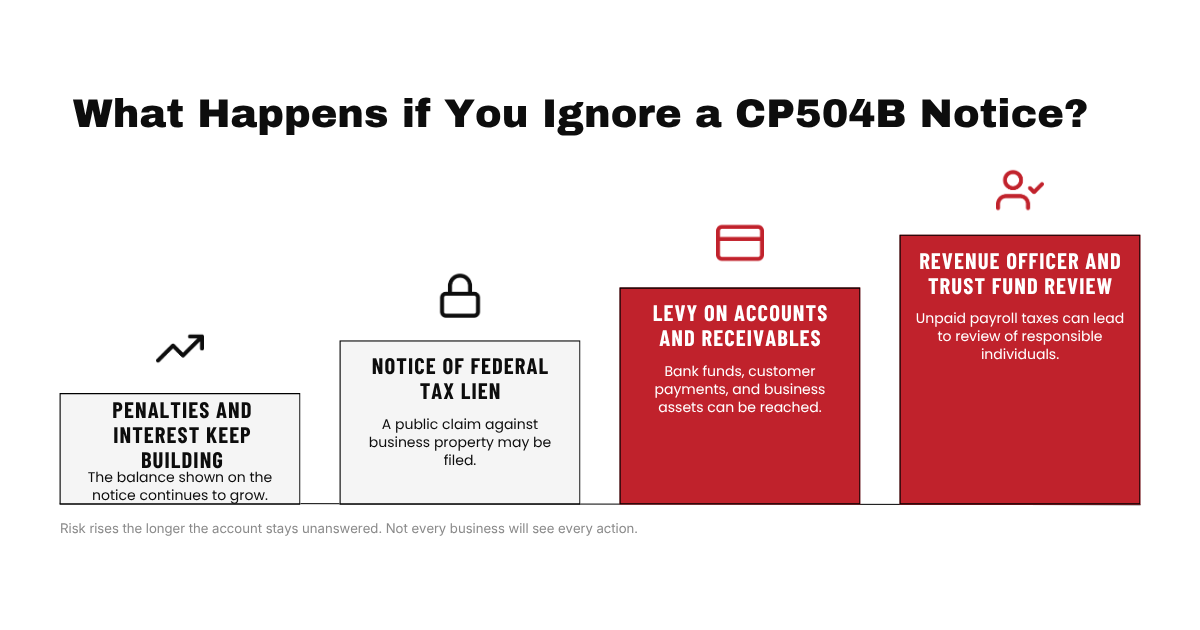
What Happens if You Ignore a CP504B Notice?
Ignoring CP504B leaves the IRS account unresolved and increases the possibility of further collection action.
Possible consequences include:
A levy on a business bank account
A levy on accounts receivable
A levy on payments owed by customers
A levy on qualifying federal contractor payments
A levy on business assets
Filing a Notice of Federal Tax Lien
Additional penalties and interest
Assignment to an IRS Revenue Officer
Additional enforcement involving unpaid payroll taxes
Potential investigation of responsible individuals when trust fund payroll taxes remain unpaid
Not every business will experience all of these actions.
The next step depends on the type of tax, notice history, collection assignment, business conduct, and available assets.
A business does not need to agree with the IRS balance to respond.
The business can pay, request an arrangement, provide proof, dispute the account, or exercise applicable appeal rights.
Silence provides the IRS with no new information and no proposed method for resolving the liability.
Frequently Asked Questions About CP504B
-
No. CP504B is an intent to levy warning, not proof that a levy has already been sent to the bank.
The notice generally gives the business 30 days to pay or contact the IRS.
In many cases, the IRS issues a separate notice providing Collection Due Process rights before levying other property, unless that hearing opportunity was already provided.
Certain employment tax and federal contractor situations are exceptions. Those levies may occur before the normal hearing, with appeal rights provided after the levy.
The business should still treat CP504B as urgent because it confirms that the account has reached the intent to levy stage.
-
Yes. An IRS levy can reach a business bank account even when the company uses that account to pay employees, rent, vendors, and taxes.
The bank generally freezes funds available when it receives the levy.
The business must contact the IRS promptly to request a release and explain how the levy affects operations.
The IRS may release a levy when legal grounds are met, including when a release may help collect the tax, when an installment agreement does not permit the levy to continue, or when another applicable release standard is satisfied.
-
First, obtain the levy information from the bank, including:
Date the levy was received
Amount frozen
IRS contact information
Date the bank expects to send the funds
Contact the IRS immediately.
A bank generally holds levied funds for 21 days before sending them to the IRS.
During that period, the business may request a release, correct an error, address ownership of the funds, or propose a resolution.
Do not wait until the end of the holding period.
The IRS must send a release to the bank before the funds are transferred if the levy is to be stopped.
-
Requesting a payment plan may affect collection activity, but a request is not the same as an approved agreement.
The IRS generally cannot issue a new levy while certain installment agreement requests are pending and during specified appeal periods, subject to legal exceptions.
An existing levy is not automatically released merely because a payment plan was requested.
Once an agreement is approved, the IRS is generally required to release a levy when the agreement terms do not allow the levy to remain in place.
The business should obtain confirmation of the request and continue tracking the account until the IRS makes a decision.
-
Possibly.
The IRS may temporarily delay collection when financial information shows that the business cannot pay.
The business may be required to provide:
Form 433 B
Bank statements
Accounts receivable reports
Asset information
Income records
Expense records
Payroll records
The IRS may also examine whether the business can remain current with payroll deposits and other present tax obligations.
Currently Not Collectible status does not erase the balance.
Penalties and interest continue, the IRS can review the account later, and a federal tax lien may still be filed.
-
CP504B generally identifies CAP rights, but it is not always the notice that creates the usual pre levy Collection Due Process hearing right.
In many cases, the IRS later issues a notice providing Collection Due Process rights before levy, unless that opportunity was already provided.
Review the actual IRS notice history before deciding that Form 12153 is available.
Sending the wrong form to the wrong address does not protect a deadline stated in another notice.
-
Identify the exact source of the disagreement.
If a payment is missing, provide the payment confirmation and bank record.
If a return or amended return was filed, provide proof of filing.
If a payment was credited to the wrong period, identify the correct intended period.
A business tax account transcript can help locate deposits, payments, assessments, penalties, interest, and processing activity.
Do not send original records unless the IRS specifically requires them.
Keep a complete copy of the response and proof of delivery.
-
A business may qualify, but receiving CP504B does not establish Offer in Compromise eligibility.
The IRS considers:
Ability to pay
Business income
Business expenses
Asset equity
Remaining collection period
Current tax compliance
The business must generally file required returns and remain current with applicable tax obligations.
A business with employees must make required federal tax deposits for the current quarter and the two preceding quarters before applying.
An Offer in Compromise should be evaluated using the business financial records, not only the size of the IRS tax debt.
CP504B Notice Action Checklist
A CP504B notice means the business should verify the IRS account and select a response before the notice period expires.
Use this checklist:
Record the CP504B notice date
Review every page of the notice
Confirm the Employer Identification Number
Confirm the tax form and tax period
Obtain business tax account transcripts
Review federal tax deposits and payment history
Locate proof of every payment
Confirm whether all required returns are filed
Confirm whether current payroll deposits are being made
Identify whether an IRS Revenue Officer is assigned
Determine whether the business can pay in full
Evaluate installment agreement eligibility
Review whether financial hardship supports a temporary collection delay
Evaluate Offer in Compromise requirements after reviewing income, expenses, assets, and compliance
Identify CAP or Collection Due Process rights
Protect every appeal deadline
Keep proof of every telephone call, payment, upload, fax, and mailed response
The main point is straightforward.
CP504B does not always mean that a business bank levy will occur immediately.
It does mean the IRS has issued a formal intent to levy warning and the business should not leave the account unanswered.
Verify the balance first.
Then respond with the option supported by the tax account, financial records, and current compliance status.