IRS Payroll Tax Debt: Consequences, Relief Options, and How to Protect Your Business
IRS payroll tax debt develops when a business does not deposit or pay required federal employment taxes. It may include income tax withheld from employee wages, Social Security and Medicare taxes, the employer share of those taxes, federal unemployment tax, penalties, and interest.
The direct answer is that unpaid payroll taxes can place both the business and certain individuals at risk. The IRS may assess penalties, file a federal tax lien, levy business accounts or customer payments, seize property, or investigate whether an owner, officer, employee, or other decision maker should be personally assessed through the Trust Fund Recovery Penalty.
The best way to resolve IRS payroll tax debt is to confirm the amount owed, file every required employment tax return, remain current with new payroll tax deposits, review the financial condition of the business, and select a payment or settlement option supported by the facts.
I have worked in the tax profession since 2005 and focus much of my practice on IRS collection matters, business tax debt, payroll tax problems, unfiled returns, and Trust Fund Recovery Penalty cases. I am an IRS Enrolled Agent and hold a Juris Doctor degree.
This article explains how IRS payroll tax debt works, what can happen when the debt remains unpaid, which IRS payroll tax debt relief options may be available, and how I evaluate the risk to the business and the people involved.

Key Facts About IRS Payroll Tax Debt
IRS payroll tax debt is often more serious than ordinary income tax debt because part of the balance includes money withheld from employee wages.
• Failure to deposit penalties may increase based on how late the deposits are, and interest continues to add to the balance.
• A federal tax lien can attach to business property and accounts receivable.
• An IRS levy can take funds from bank accounts, customer payments, and other property rights.
• The Trust Fund Recovery Penalty may make responsible individuals personally liable for the unpaid trust fund portion.
• IRS payment options may include full payment, a Simple Payment Plan for qualifying business trust fund debt, a regular installment agreement, a partial payment installment agreement, an Offer in Compromise, or temporary collection delay.
• A business generally must file required returns and remain current with new federal tax deposits before the IRS will approve a long term resolution.
• The right resolution depends on the amount owed, collection deadlines, business cash flow, asset equity, future income, and whether the business can remain current.
What IRS Payroll Tax Debt Means
What Payroll Taxes Include
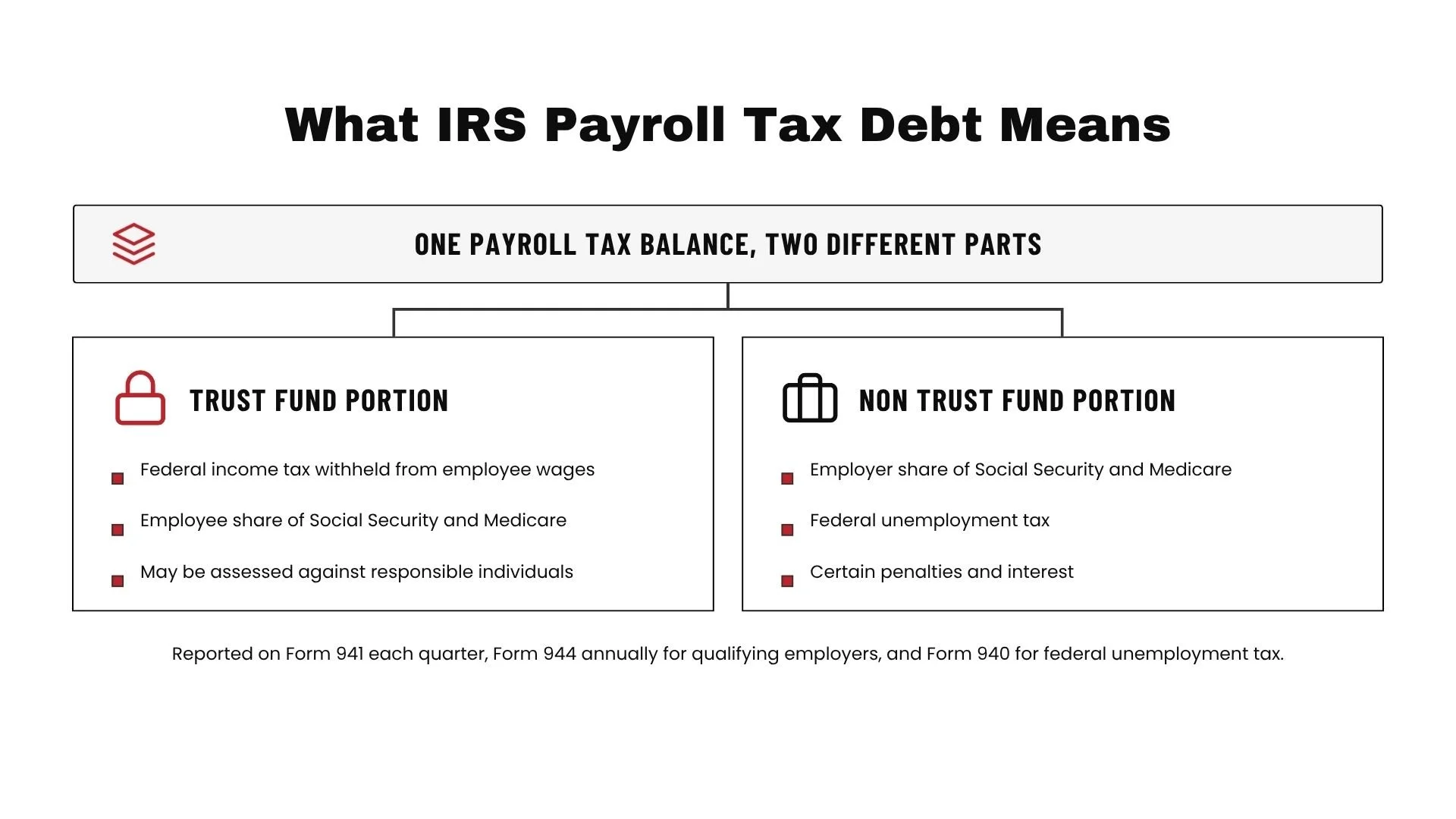
Payroll taxes generally include federal income tax withheld from employee wages, the employee and employer portions of Social Security and Medicare taxes, and federal unemployment tax when applicable.
Most employers report wages, tips, income tax withholding, and Social Security and Medicare taxes on Form 941 each quarter. Certain qualifying employers use Form 944 annually instead. Federal unemployment tax is generally reported on Form 940.
A business can create payroll tax debt by failing to deposit the correct amount, depositing late, using the wrong payment method, filing an employment tax return without full payment when a deposit was required, or failing to file the return.
Trust Fund Taxes Versus Employer Taxes
The trust fund portion generally includes federal income tax withheld from employees and the employee portion of Social Security and Medicare taxes.
The employer holds these amounts until they are deposited with the Treasury. The money does not become available operating cash simply because it remains in the business bank account.
The non trust fund portion generally includes the employer share of Social Security and Medicare taxes, federal unemployment tax, and certain penalties and interest.
This distinction matters because the IRS may assess the unpaid trust fund amount against responsible individuals through the Trust Fund Recovery Penalty. The employer portion generally remains a liability of the business rather than becoming part of the Trust Fund Recovery Penalty assessment.
Why Businesses Fall Behind
Many payroll tax problems begin during a cash flow shortage.
A business may have enough money to issue employee paychecks but not enough to pay rent, suppliers, insurance, loan payments, and payroll tax deposits at the same time. The owner may decide to delay the IRS deposit and plan to replace the money after the next large payment arrives.
That decision often creates a cycle. The next payroll produces another deposit obligation before the prior amount has been replaced. The business may then use new withholding to cover older operating costs.
The IRS refers to the continued creation of new employment tax debt while older payroll tax debt remains unpaid as pyramiding. IRS collection procedures instruct revenue officers to stop continued pyramiding and to verify that current deposits are being made while the older debt is addressed.
Other common causes include bookkeeping errors, missing Forms 941, incorrect deposit schedules, payroll service failures, worker classification disputes, unreported tips, incorrect overtime calculations, or changes in business ownership that were not handled correctly.
Using a payroll company does not automatically transfer all federal employment tax responsibility away from the employer. Depending on the arrangement, the employer may remain liable when a payroll provider fails to file returns or make deposits.
IRS Consequences for Unpaid Payroll Taxes
Failure to Deposit Penalties
The IRS may charge a Failure to Deposit Penalty when an employer does not deposit employment taxes on time, in the correct amount, or through the required deposit method.
The published penalty rates generally increase as follows:
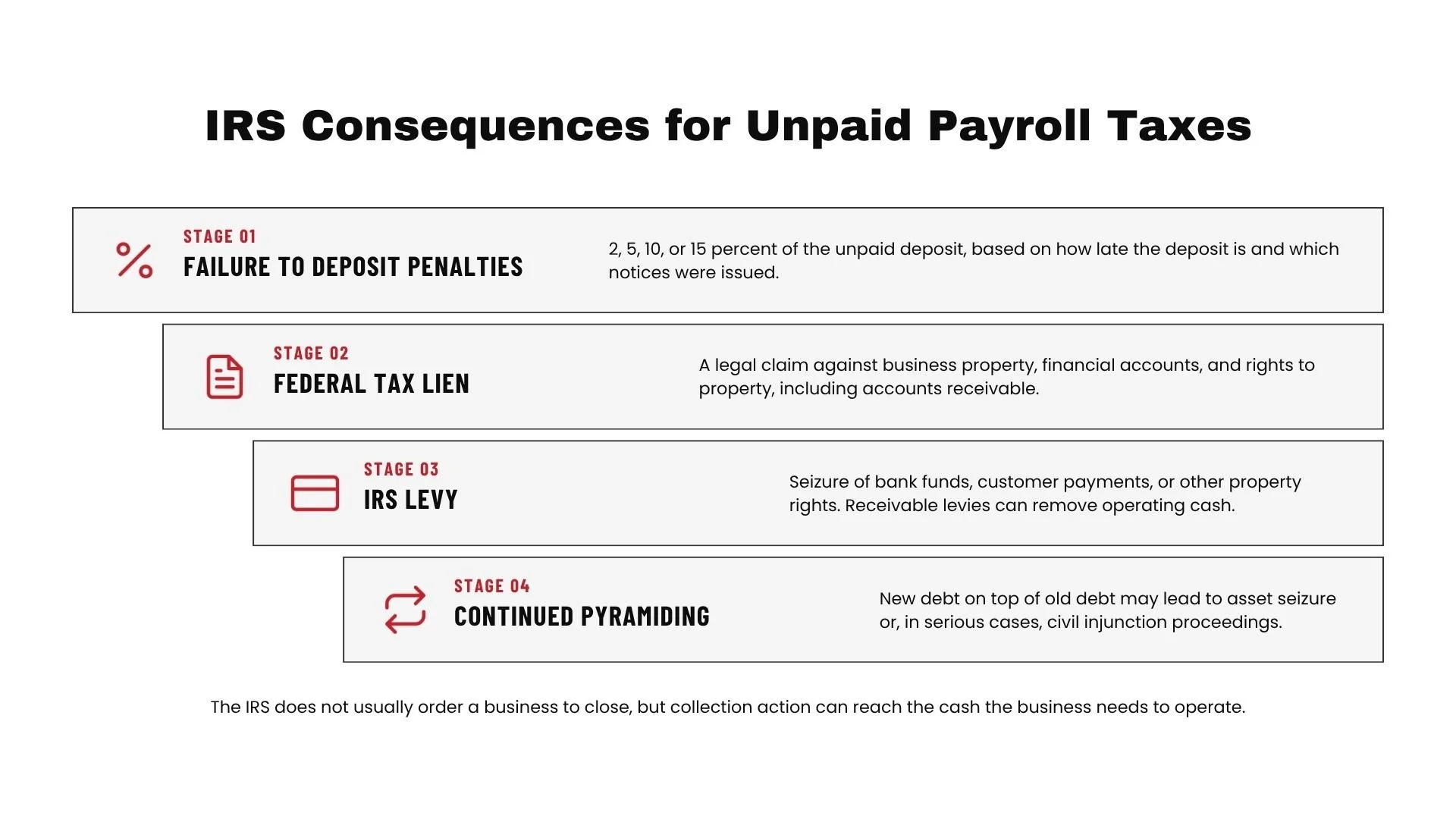
• 2 percent when the deposit is one to five calendar days late
• 5 percent when the deposit is six to fifteen calendar days late
• 10 percent when the deposit is more than fifteen calendar days late
• 15 percent after certain notices or demands for immediate payment
These percentages apply to the unpaid deposit. Interest may also be charged on the penalty and the unpaid tax. The exact result depends on the deposit history, notices issued, payment application, and other account facts.
Penalty relief may be available when the business can establish reasonable cause or another recognized basis for relief. A lack of funds by itself generally does not resolve the issue. The supporting facts, timing, records, and actions taken after the problem was discovered matter.
Federal Tax Liens
A federal tax lien is the government’s legal claim against property when a tax has been assessed, the IRS has issued a demand for payment, and the balance remains unpaid.
The lien may attach to business property, equipment, financial accounts, and rights to property, including accounts receivable. The IRS may also file a Notice of Federal Tax Lien in the public record to alert creditors of its claim.
A tax lien does not directly take money from the business. It secures the government’s interest in property.
The lien can still create serious operating problems. It may interfere with financing, the sale of business assets, business acquisitions, real estate transactions, or the ability to obtain a line of credit.
IRS Levies
A levy is different from a lien. A levy is a legal seizure of property or rights to property to collect a tax debt.
The IRS may levy a business bank account, accounts receivable, customer payments, investment accounts, or other property belonging to the liable taxpayer. The IRS may also seize and sell certain business assets when legal and administrative requirements are met.
A levy on accounts receivable can be especially damaging. Customers who receive the levy may be required to send payments to the IRS rather than to the business. That can remove the cash needed for payroll, rent, supplies, and current tax deposits.
A levy may be released when the legal requirements for release are met. Possible grounds may include full payment, an approved payment arrangement, an improperly issued levy, or a determination that the release will help collect the liability. Immediate economic hardship is primarily evaluated in relation to an individual’s ability to pay necessary living expenses, although separate business considerations may apply when a levy prevents the taxpayer from carrying on a trade or business. A levy release does not erase the tax debt.
Can the IRS Shut Down a Business for Payroll Tax Debt
The IRS does not usually issue a notice that simply orders a business to close because payroll taxes are owed.
However, collection action can make continued operation difficult or impossible. The IRS may levy operating accounts, take accounts receivable, seize business property, investigate responsible individuals, or seek stronger legal remedies when a business repeatedly creates new payroll tax debt.
IRS procedures for businesses that continue pyramiding allow revenue officers to consider enforcement measures, including seizure of physical assets and, in serious cases, civil injunction proceedings intended to stop continued employment tax violations.
The practical answer is that unresolved payroll tax debt can threaten the survival of a business even when the IRS does not directly order the business to close.
The Trust Fund Recovery Penalty and Personal Liability
What the Trust Fund Recovery Penalty Does
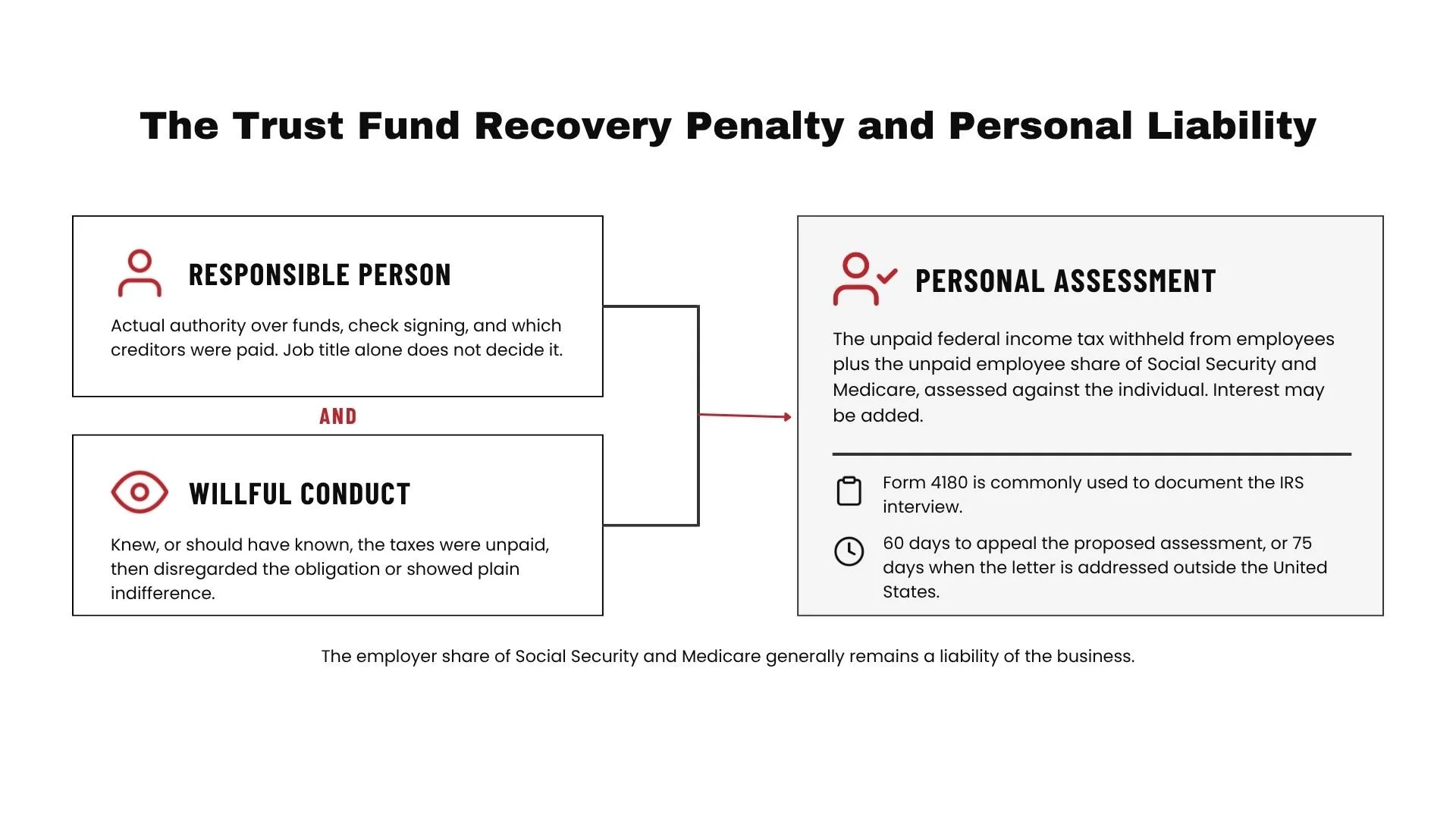
The Trust Fund Recovery Penalty allows the IRS to assess the unpaid trust fund portion of employment taxes against one or more responsible individuals who acted willfully.
The penalty is generally equal to the unpaid federal income tax withheld from employees plus the unpaid employee portion of Social Security and Medicare taxes. Interest may be added to the personal assessment.
The IRS does not have to wait until the business permanently closes before beginning or completing the Trust Fund Recovery Penalty process.
Who May Be a Responsible Person
Responsibility depends on actual authority and control rather than job title alone.
The IRS may review whether a person had the duty and authority to collect taxes, control business funds, decide which creditors were paid, sign checks, authorize electronic payments, hire or fire employees, sign employment tax returns, or direct financial affairs.
Possible responsible persons may include:
• Business owners
• Corporate officers
• Directors or shareholders
• Partners or members
• Financial officers
• Controllers
• Payroll managers
• Bookkeepers with independent payment authority
• Third party payroll providers or responsible employees within those companies
• Other people who controlled the use of business funds
An employee whose role was limited to paying bills exactly as directed by a superior may have a different responsibility analysis from a person who independently decided which creditors would be paid. Each person must be evaluated based on the specific facts.
What Willful Means
Willful does not necessarily mean that a person acted with criminal intent or intended to defraud the government.
For Trust Fund Recovery Penalty purposes, the IRS generally looks at whether the person knew, or should have known, that employment taxes were unpaid and then intentionally disregarded the obligation or showed plain indifference.
Using available funds to pay other creditors after learning that trust fund taxes are unpaid may support a willfulness finding. Paying net wages while withholding taxes remain unpaid may also be considered.
This is why a person should not casually answer questions about financial control, check signing authority, or payment decisions without reviewing the relevant records.
The IRS Interview and Appeal Process
The IRS may conduct an interview to determine who was responsible and whether the conduct was willful. Form 4180 is commonly used to document the interview.
The IRS may review bank signature cards, cancelled checks, electronic payment authority, corporate records, employment agreements, payroll records, tax returns, emails, bookkeeping access, and testimony from other people involved in the business.
When the IRS proposes the Trust Fund Recovery Penalty, it generally issues a letter explaining the proposed assessment and appeal rights. A person generally has 60 days from the date of the letter to appeal, or 75 days when the letter is addressed outside the United States.
Missing the appeal deadline can limit the opportunity to challenge the proposed assessment before it becomes final. The tax periods, assessment calculations, responsibility factors, and willfulness evidence should be reviewed promptly.
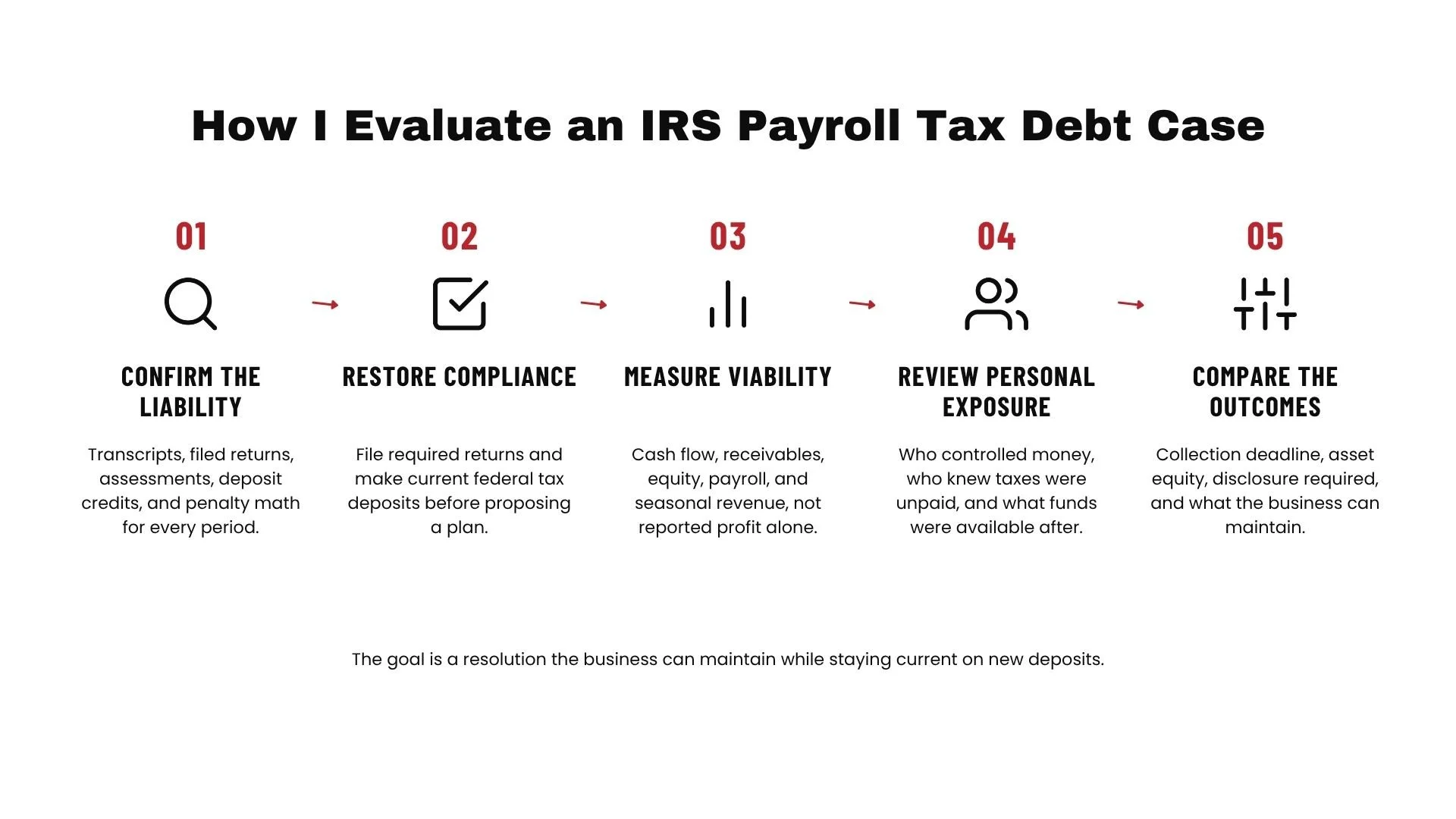
How I Evaluate an IRS Payroll Tax Debt Case H2
Step One, Confirm the Liability
I begin by identifying every tax period involved.
That normally includes reviewing IRS account transcripts, filed Forms 941, Forms 940, assessment records, deposit history, payments, penalty calculations, notices, and any returns prepared by the IRS.
I compare the IRS records against payroll reports, general ledger accounts, bank statements, payroll service reports, and filed returns.
The purpose is to answer several basic questions:
• Which returns are missing
• Which returns were filed but not fully paid
• Whether all deposits were correctly credited
• Whether payments were applied to the intended tax periods
• Whether amended returns are needed
• Whether penalties appear correctly calculated
• Whether the collection period is different for each quarter
I do not select a resolution program until I understand what the IRS has assessed and why.
Step Two, Restore Filing and Deposit Compliance
A business seeking an installment agreement generally must file required returns and remain current with applicable federal tax deposit requirements.
Current IRS procedures direct revenue officers to confirm filing and payment compliance before granting business payment plans.
An employer applying for an Offer in Compromise must generally have filed required returns and made required federal tax deposits for the current quarter and the two preceding quarters.
This means the business must address two problems at the same time:
• The older payroll tax debt
• The current payroll tax obligation
A payment agreement for old debt will normally fail if the business continues creating new liabilities.
Step Three, Measure Business Viability
I review whether the business can continue operating while paying current taxes and contributing something to the older debt.
The review may include:
• Current profit and loss statements
• Balance sheets
• Bank statements
• Accounts receivable
• Loans and credit obligations
• Payroll expenses
• Rent and occupancy costs
• Inventory
• Equipment and vehicle equity
• Owner compensation
• Related business transactions
• Cash flow projections
• Seasonal revenue changes
A business may appear profitable on an income statement but still lack enough cash to cover current deposits and an IRS payment. The opposite can also occur when depreciation or other accounting expenses reduce reported income but cash remains available.
The analysis should reflect actual cash flow, reasonable operating needs, and the IRS collection rules that apply to the requested resolution.
Step Four, Review Personal Exposure
I separately review the risk to each person who may face a Trust Fund Recovery Penalty assessment.
I look at who controlled money, who knew the taxes were unpaid, when that knowledge arose, whether the person could direct payments, and whether funds were available after the person learned of the tax problem.
A business payment plan does not automatically prevent a Trust Fund Recovery Penalty investigation. Current IRS procedures may allow some qualifying business trust fund payment plans without a completed Trust Fund Recovery Penalty determination, but the exact treatment depends on timing, assignment status, compliance, and the type of agreement.
Step Five, Compare the Available Outcomes
I then compare the realistic alternatives.
The goal is not to select the program with the most attractive name. The goal is to choose a resolution the business can maintain while protecting current compliance and addressing personal exposure.
I consider:
• How quickly the balance can be paid
• Whether the collection period may expire before full payment
• Whether the business has equity that the IRS expects it to use
• Whether a full financial disclosure is required
• Whether the business can remain open
• Whether an owner or officer may owe a separate Trust Fund Recovery Penalty
• Whether a penalty abatement request has a factual basis
• Whether immediate collection action must be addressed first
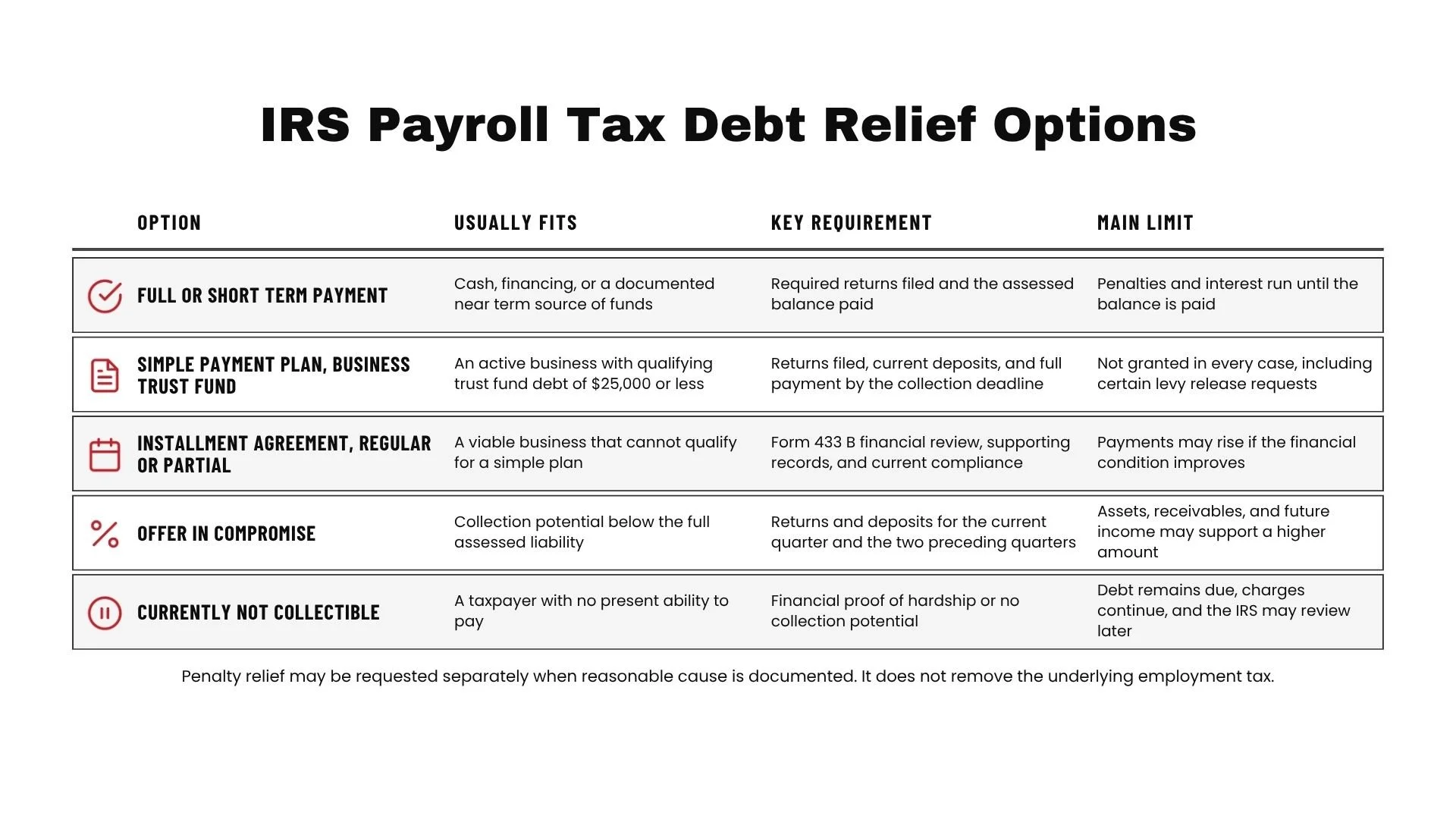
IRS Payroll Tax Debt Relief Options
Comparison of the Main Resolution Options
OPTION | USUALLY FITS | MAIN REQUIREMENTS | IMPORTANT LIMITS
Full Payment | A business with available cash, financing, or assets | File required returns and pay the assessed balance | Financing costs and asset consequences should be reviewed
Short Term Payment Arrangement | A business expecting near term funds | Ability to pay within the allowed period and remain current | Penalties and interest may continue until paid
Simple Payment Plan, Business Trust Fund | An active business with qualifying trust fund debt of $25,000 or less | Required returns filed, current deposits made, and payment sufficient to full pay by the collection deadline | Does not apply in every case, including certain levy release or delay situations
Regular Business Installment Agreement | A viable business that cannot qualify for a simple plan | Full financial review may be required, along with current compliance | The IRS may require higher payments, asset use, or a lien determination
Partial Payment Installment Agreement | A business that can pay something but may not full pay before collection expires | Detailed financial analysis and periodic review | Payments may increase if the financial condition improves
Offer in Compromise | A business or responsible individual whose collection potential is less than the full liability | Filing compliance, current deposits, financial disclosure, asset and income review | Not everyone qualifies, and current compliance must continue
Currently Not Collectible Status | A taxpayer with no present ability to pay | Financial proof of hardship or lack of collection potential | Debt remains due, penalties and interest continue, and the IRS may review the account later
Penalty Relief | A business with reasonable cause or another recognized basis | Detailed explanation and supporting records | Relief is not automatic and does not remove the underlying tax
Full Payment or Short Term Payment
Full payment generally stops future interest and penalty growth on the amount paid and removes the need for a long term collection agreement.
A business may use available cash, a loan, a line of credit, asset proceeds, owner contributions, or another funding source. The cost and risk of outside financing should be compared with the continuing IRS charges and collection risk.
A short term arrangement may fit when the business expects a documented source of funds, such as the sale of an asset, a loan closing, or collection of a large receivable.
The business should not promise a full payment date based only on hopeful revenue projections. Failure to complete the arrangement may place the account back into active collection.
Simple Payment Plan for Business Trust Fund Debt
The IRS changed its terminology and procedures in July 2026.
The arrangement formerly called the In Business Trust Fund Express Installment Agreement is now called the Simple Payment Plan, Business Trust Fund.
Under the current Internal Revenue Manual, qualifying business trust fund liabilities with an unpaid assessment balance of $25,000 or less may be resolved without a full Collection Information Statement when the proposed payment will full pay the liability, including accruals, by the Collection Statute Expiration Date.
The current procedure removed the former 24 month payment requirement and does not require direct debit in every qualifying case. The business must still file required returns, remain current with federal tax deposits, and meet the other procedural conditions.
A Simple Payment Plan may not be granted merely because the balance falls below the limit. The IRS may reject or require a different analysis when the request accompanies a levy release, appears intended only to delay collection, or the business continues creating new debt.
Regular Business Installment Agreement
A business that does not qualify for the Simple Payment Plan may request another type of installment agreement.
The IRS may require Form 433 B or another financial statement, supporting bank records, current financial statements, asset information, proof of expenses, and a proposed monthly payment.
The IRS may evaluate whether the business can borrow, sell assets, reduce expenses, increase payments, or change owner compensation.
Penalties and interest generally continue while the installment agreement is active. A Notice of Federal Tax Lien may also be filed depending on the facts and the type of agreement.
Partial Payment Installment Agreement
A Partial Payment Installment Agreement may be considered when the taxpayer can make monthly payments but cannot fully pay before the collection period expires.
The IRS generally requires a financial analysis. The proposed payment is based on the amount the IRS determines is available after allowable or necessary expenses.
A Partial Payment Installment Agreement is not a permanent guarantee that the payment will remain unchanged. The IRS may review the taxpayer’s financial condition and increase the payment when income, expenses, or equity changes.
For an active employer, current payroll tax deposits remain essential. New employment tax debt may default the agreement and return the account to collection.
Offer in Compromise for Payroll Tax Debt
An Offer in Compromise may settle qualifying IRS tax debt for less than the full assessed amount.
The IRS considers ability to pay, income, expenses, asset equity, and other facts. In most collection cases, the offer must generally equal or exceed the reasonable collection potential calculated under IRS rules.
An employer seeking an Offer in Compromise must generally file required returns and make required federal tax deposits for the current quarter and the two preceding quarters before applying.
An Offer in Compromise for payroll tax debt is not automatically available simply because the business is struggling. The IRS may conclude that business assets, accounts receivable, future income, owner contributions, or other collection sources are sufficient to pay more.
A separate analysis may be required when the business owes employment taxes and an owner or officer also has a personal Trust Fund Recovery Penalty assessment.
Currently Not Collectible Status
Currently Not Collectible status temporarily suspends most active collection when the IRS determines that the taxpayer cannot pay.
The debt is not forgiven. Penalties and interest may continue, the IRS may file a Notice of Federal Tax Lien, refunds may be applied to the debt, and the financial condition may be reviewed later.
For active businesses with employees, the IRS will closely examine whether current federal tax deposits are being made and whether continued operation is creating new payroll tax debt.
Currently Not Collectible treatment may be more realistic for an inactive or defunct entity with no assets, or for an individual Trust Fund Recovery Penalty account where collection would create qualifying hardship. The correct treatment depends on the liable taxpayer and the account facts.
Payroll Tax Penalty Relief
Penalty relief may reduce part of the total balance when the business has a valid legal or administrative basis.
Possible supporting facts may include serious illness, casualty, records destroyed by events outside the taxpayer’s control, incorrect written advice from the IRS, or a payroll provider failure combined with meaningful employer oversight and prompt corrective action.
The request should identify the specific tax period, penalty, cause of the failure, dates involved, steps taken to comply, and records supporting the explanation.
Removing a penalty does not remove the original payroll tax. Interest related to an abated penalty may be adjusted, but interest on the underlying tax generally remains.
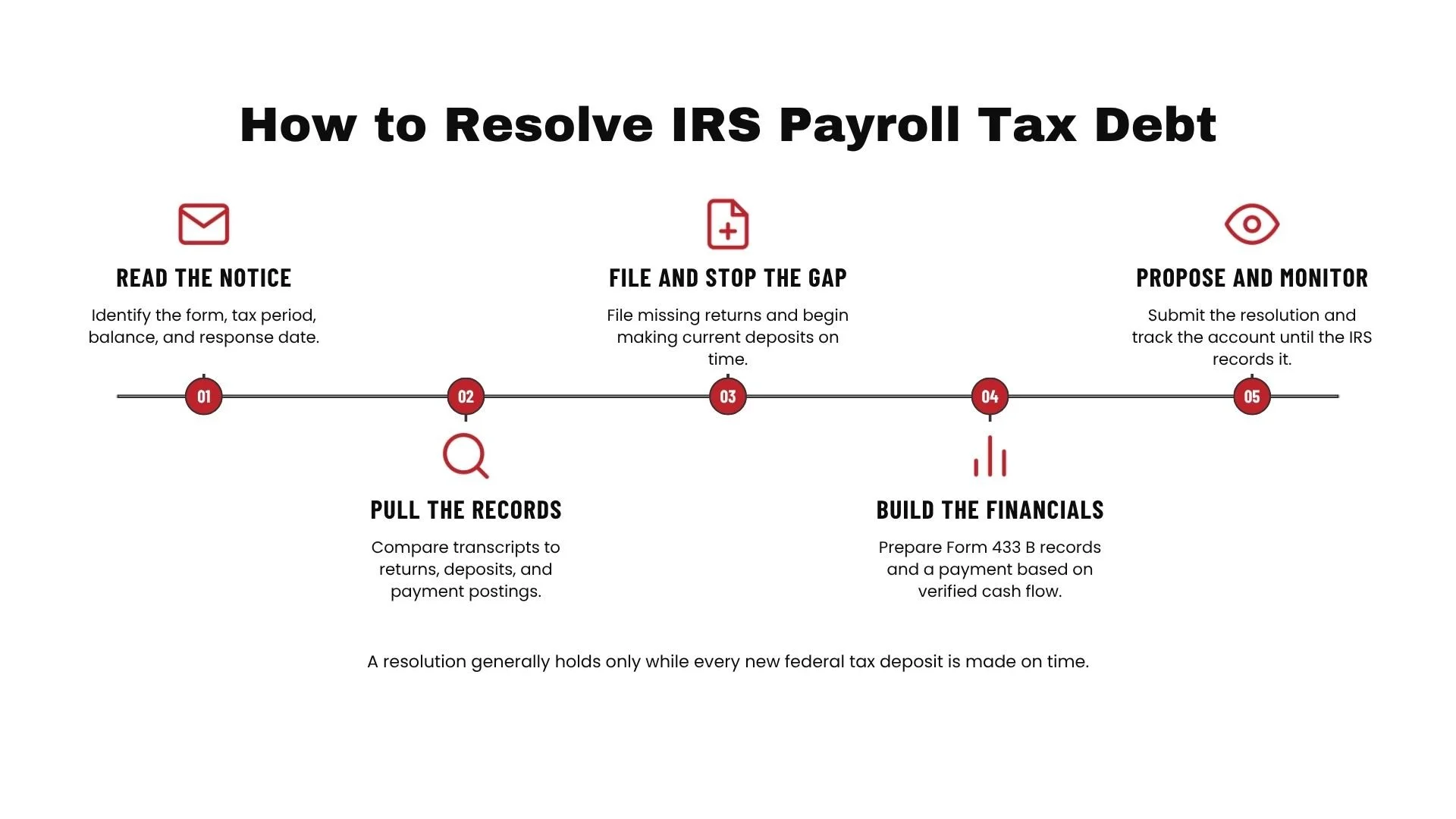
How to Resolve IRS Payroll Tax Debt
Step One, Read the Notice and Protect the Deadline
Identify the notice number, tax form, tax period, assessed amount, response date, and IRS department handling the account.
Do not assume every notice provides the same appeal rights.
A balance notice, penalty notice, lien notice, proposed Trust Fund Recovery Penalty letter, and final levy notice each involve different procedures.
Step Two, Obtain IRS Account Records
Request account transcripts and review them against filed employment tax returns and payment records.
Confirm:
• Return filing dates
• Assessment dates
• Deposit credits
• Payment application
• Penalty transactions
• Interest accruals
• Collection notices
• Existing liens or levies
• Collection statute dates
The notice balance alone may not explain every quarter or show whether payments were applied correctly.
Step Three, File Missing Employment Tax Returns
File every required Form 941, Form 944, Form 940, or corrected return.
A missing return prevents a complete evaluation and may cause the IRS to estimate or pursue the liability through other procedures.
Filing a return does not require the business to pay the full amount at the same time. Filing accurately allows the liability to be established and permits the resolution process to move forward.
Step Four, Stop New Payroll Tax Debt
The business must begin making current federal tax deposits on time.
This may require:
• Correcting the deposit schedule
• Using EFTPS or a Business Tax Account
• Separating payroll tax funds from operating funds
• Changing payroll providers
• Confirming deposits after every payroll
• Reducing payroll or other expenses
• Increasing working capital
• Changing owner draws or compensation
• Considering whether the business can continue operating at its current size
The IRS is unlikely to approve a lasting resolution while the business continues creating new debt.
Step Five, Prepare Accurate Financial Information
Prepare current financial records before proposing a payment.
The IRS may request Form 433 B, bank statements, receivables, loan records, asset values, business expenses, payroll reports, and proof of current deposits.
The proposed payment should be based on verified cash flow rather than a number selected only because it feels affordable.
Step Six, Address the Trust Fund Recovery Penalty
Determine whether the IRS has started or may start a responsible person investigation.
Collect records showing:
• Each person’s job duties
• Dates of involvement
• Check signing authority
• Online banking authority
• Payroll access
• Knowledge of the unpaid taxes
• Ability to direct payments
• Communications with owners or managers
• Resignation or termination dates
• Restrictions imposed by lenders or other parties
The business collection strategy and the personal Trust Fund Recovery Penalty strategy should be coordinated.
Step Seven, Propose the Appropriate Resolution
Select the option that fits the verified facts.
A business that can full pay should not submit an Offer in Compromise merely because a settlement sounds preferable.
A business that cannot meet a regular installment agreement should not agree to a payment that will immediately cause missed deposits, unpaid rent, or another default.
The strongest proposal is one that follows IRS rules, is supported by records, and leaves the business able to remain current.
Step Eight, Monitor the Account
Continue reviewing deposits, payments, transcripts, notices, and agreement status after submitting the request.
IRS processing can take time. Waiting for a response does not mean the case should be ignored.
Keep proof of every submission, including fax confirmations, upload receipts, certified mail records, payment confirmations, and copies of documents sent.

What to Do After an IRS Payroll Tax Notice or Levy
When You Receive a Payroll Tax Notice
Read the notice before making a payment or calling the IRS.
Confirm whether the notice concerns:
• A missing return
• A balance due
• A deposit penalty
• A payment applied to the wrong period
• A proposed adjustment
• A federal tax lien
• A proposed levy
• A Trust Fund Recovery Penalty investigation
• A proposed personal assessment
Respond to the department and address shown on the notice unless current IRS instructions direct otherwise.
When You Receive CP504B
CP504B is a notice of intent to levy that may be issued for a business balance.
The notice warns that the IRS may levy property or rights to property and may file a Notice of Federal Tax Lien. The notice generally instructs the taxpayer to act within 30 days.
Depending on the account history, the IRS may use a Disqualified Employment Tax Levy or another collection procedure. Review the notice carefully and consider available payment and appeal options before the deadline.
When a Bank or Receivable Levy Has Been Issued
Obtain a copy of the levy and identify:
• The tax periods included
• The amount demanded
• The date served
• The bank, customer, or third party involved
• Whether funds have already been sent
• Whether the levy affects current payroll or essential operations
Contact the assigned revenue officer or IRS unit and present a specific proposal.
A levy release request should explain the legal and financial grounds for release and provide supporting records. A verbal statement that the business needs the money may not be enough.
Even when a levy is released, the underlying payroll tax debt remains and must be resolved.
When a Revenue Officer Is Assigned
A revenue officer may request financial information, missing returns, proof of deposits, Form 433 B, records concerning responsible individuals, or a deadline for a payment proposal.
Respond by the stated deadline or request a reasonable extension before it expires.
Provide complete and accurate records, but first understand what is being requested and how the information relates to the collection case or Trust Fund Recovery Penalty investigation.
Do not provide guesses when exact records can be obtained.
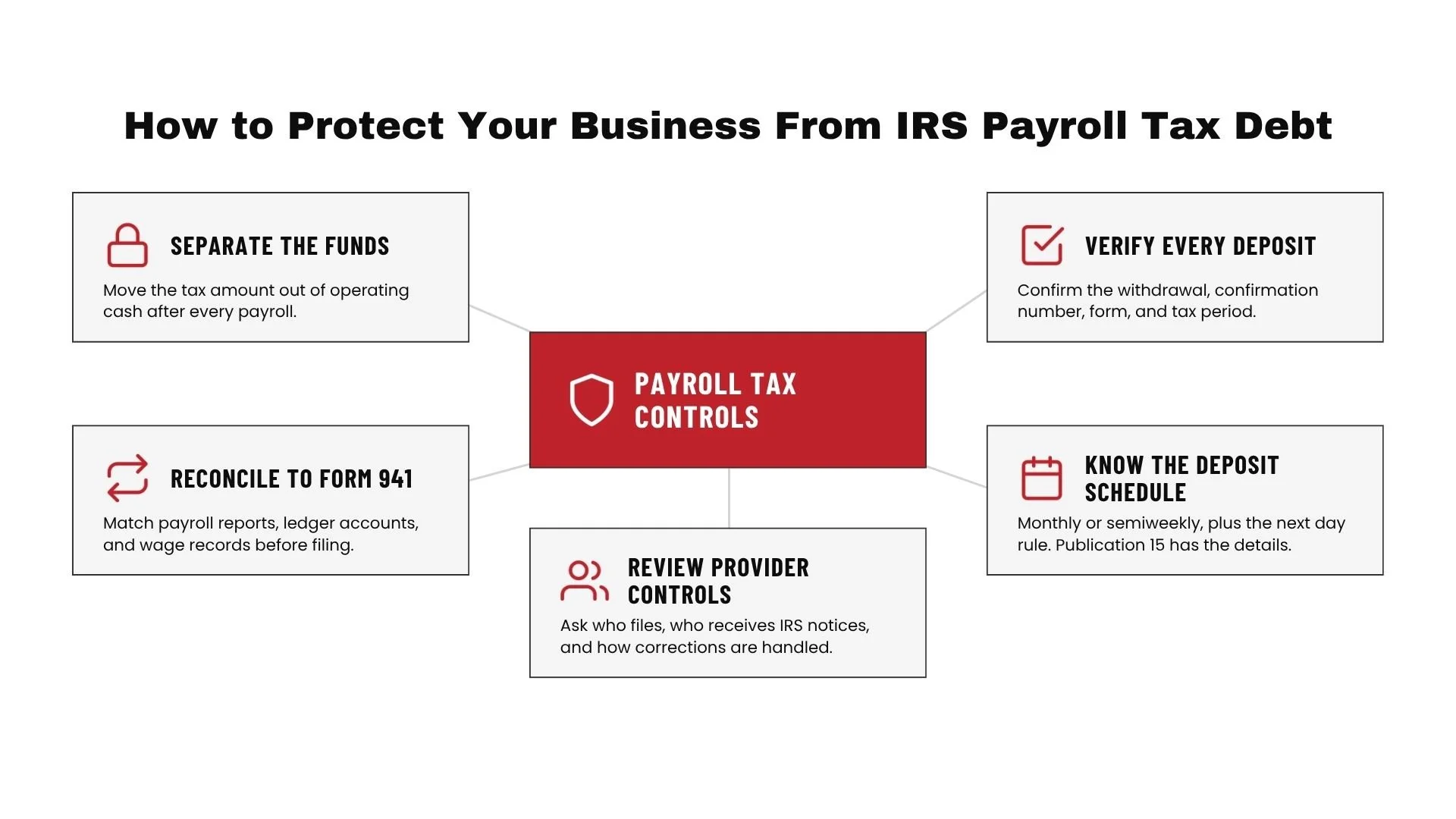
How to Protect Your Business From IRS Payroll Tax Debt
Separate Payroll Tax Funds
Use a dedicated account or internal process for employment tax deposits.
After each payroll, transfer the tax amount away from ordinary operating cash. This reduces the risk that withheld taxes will be used for rent, vendors, inventory, or owner distributions.
Verify Every Federal Tax Deposit
Do not rely only on a payroll summary stating that taxes were calculated.
Confirm that the funds were actually withdrawn and credited through EFTPS or the business tax account.
Review the confirmation number, deposit date, tax form, and tax period.
Reconcile Payroll Reports to Forms 941
Compare payroll reports, general ledger payroll accounts, wage records, deposits, and Form 941 before each return is filed.
Differences should be researched before they carry into Forms W 2 or later quarters.
The IRS generally expects employers to report wages, reported tips, withholding, and Social Security and Medicare taxes on Form 941 or Form 944.
Monitor the Deposit Schedule
An employer’s deposit schedule can change based on prior tax liability.
The business should know whether it is a monthly or semiweekly depositor and whether the next day deposit rule applies after a large payroll tax liability.
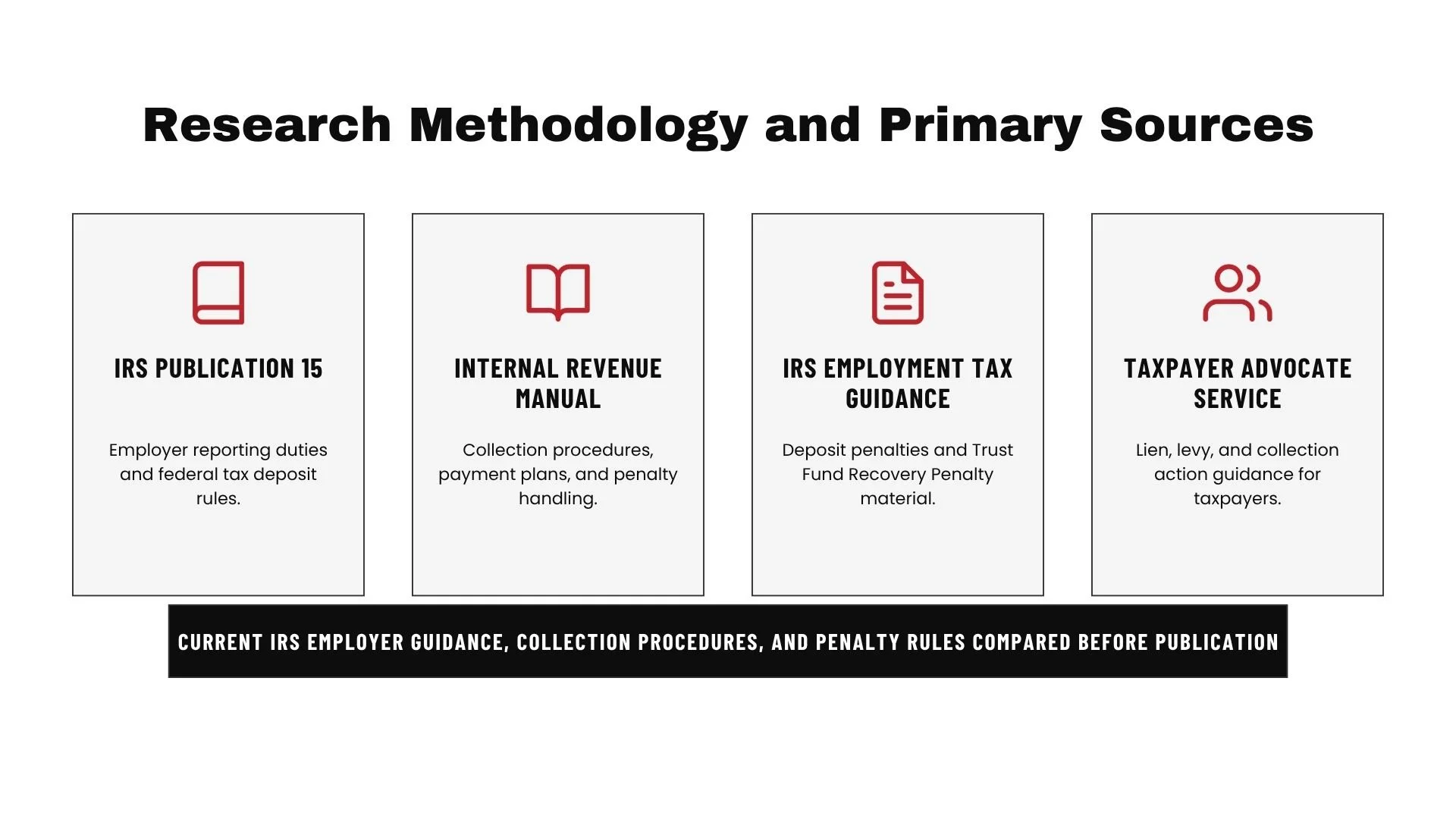
Publication 15 provides the current federal deposit rules and employer responsibilities.
Review Payroll Provider Controls
Ask the payroll provider:
• When funds are withdrawn
• When deposits are transmitted
• How confirmation is provided
• Who receives IRS notices
• Who files Forms 941 and 940
• How corrections are handled
• What happens when the account lacks funds
The employer should retain access to payroll reports and federal deposit confirmations even when the provider handles the filings.
Do Not Use Current Withholding to Fund Old Debt
Current payroll tax deposits should be paid before making voluntary payments on older quarters unless a specific IRS agreement or legal strategy provides otherwise.
Paying old debt while creating new payroll tax debt usually worsens the case and may support stronger collection action.
Review Business Viability Early
A business that cannot pay current payroll taxes may need immediate changes to staffing, pricing, expenses, financing, owner compensation, or operations.
Continuing the same structure while hoping future revenue will solve the problem may increase both the business debt and personal Trust Fund Recovery Penalty exposure.
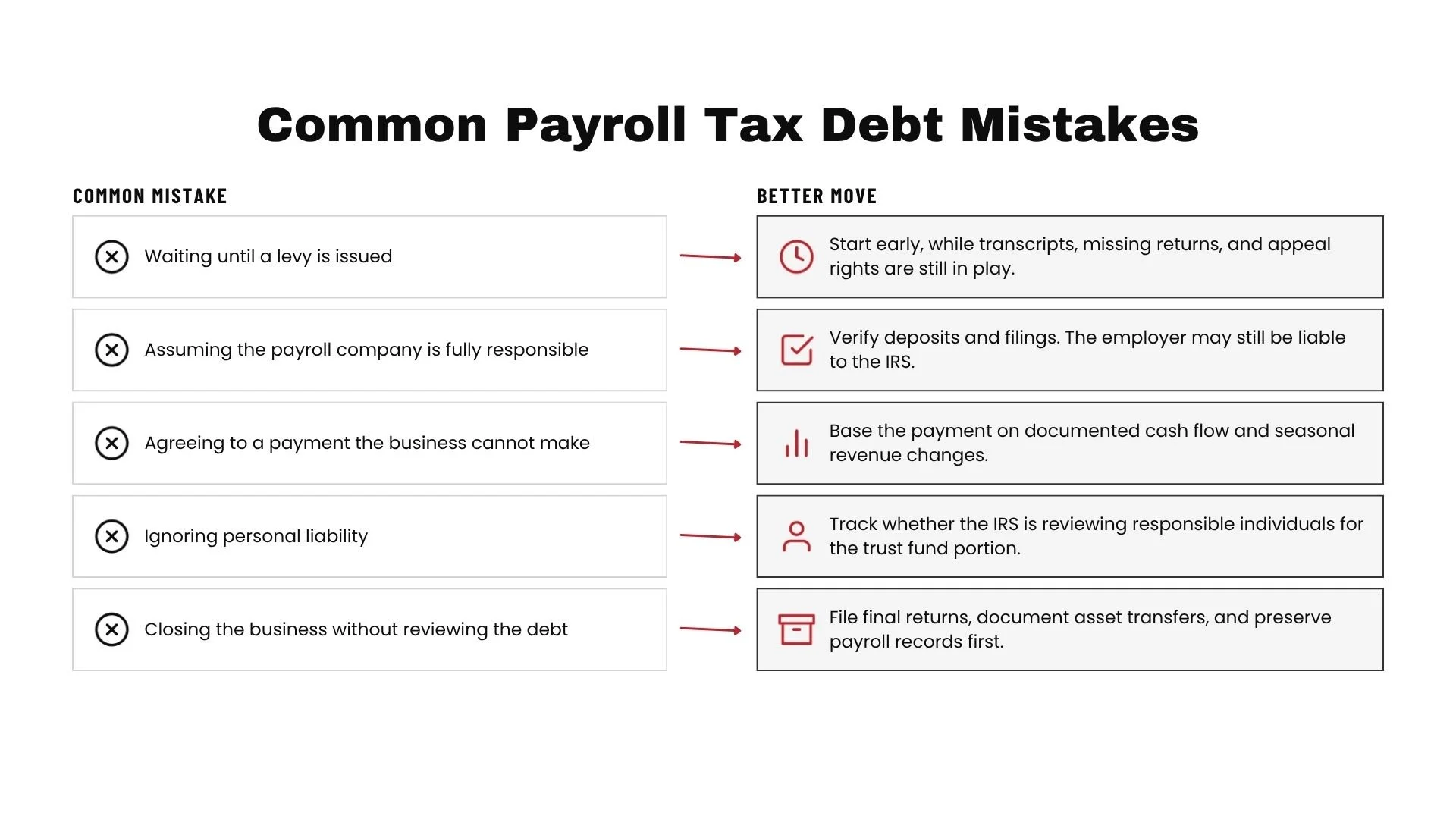
Common Payroll Tax Debt Mistakes
Waiting Until a Levy Is Issued
More resolution options are usually available before the IRS levies bank accounts or customer payments.
Early review provides time to obtain transcripts, file missing returns, prepare financial records, and protect appeal rights.
Assuming the Payroll Company Is Fully Responsible
A payroll company may have contractual or legal responsibility depending on the arrangement, but the employer may still remain liable to the IRS.
The employer should verify deposits and filings rather than assuming that an automatic withdrawal proves the tax was paid.
Making an Unaffordable Payment Agreement
A payment agreement that causes the business to miss current deposits is not a workable resolution.
The payment should be supported by documented cash flow and should account for seasonal changes and necessary operating costs.
Ignoring Personal Liability
Resolving the business account does not always resolve a Trust Fund Recovery Penalty investigation.
Owners and officers should understand whether the IRS is reviewing their individual responsibility and whether a separate appeal or payment strategy is needed.
Closing the Business Without Reviewing the Tax Debt
Closing an entity does not automatically cancel payroll tax debt or personal Trust Fund Recovery Penalty exposure.
Before closing, review final employment tax returns, asset transfers, accounts receivable, payroll records, responsible person issues, and the effect of any successor business.
Promising the IRS Money That Is Not Available
Do not base a resolution on a hoped for loan, sale, investment, or customer payment unless the source is reasonably certain.
An unsupported promise may delay the case without producing a lasting solution.
Frequently Asked Questions About IRS Payroll Tax Debt
-
Yes, personal liability may apply to the trust fund portion when the IRS determines that you were a responsible person and acted willfully.
Responsibility depends on actual authority over business finances, not title alone. The IRS may review whether you signed checks, controlled bank accounts, decided which creditors were paid, signed tax returns, supervised payroll, or had the ability to direct payments.
Willfulness generally requires knowledge, or reason to know, that the taxes were unpaid, followed by an intentional disregard or plain indifference. Paying other creditors after learning of the unpaid trust fund taxes may support the IRS position.
A minority owner, bookkeeper, officer, manager, or employee is not automatically liable. The facts for each person must be reviewed separately.
-
The IRS does not usually close a business merely by issuing a balance due notice.
However, the IRS may levy business bank accounts, take accounts receivable, file tax liens, seize property, or pursue court action in serious cases involving continued payroll tax violations.
Those actions may leave the business without enough cash or assets to operate.
The risk increases when the business continues paying wages while failing to make current federal tax deposits. IRS procedures direct revenue officers to stop continued pyramiding and consider stronger enforcement when normal collection measures do not produce compliance.
The practical goal is to restore current compliance before collection action removes the funds the business needs to survive.
-
Payroll tax debt may be included in an Offer in Compromise when the taxpayer meets the eligibility and financial requirements.
The IRS reviews income, expenses, asset equity, and future collection potential. A business that can pay through assets, financing, or future cash flow may not qualify for a settlement.
An active employer generally must file required returns and make all required federal tax deposits for the current quarter and the two preceding quarters before applying.
The business must continue making current deposits while the offer is reviewed. A new liability may cause the offer to be returned or rejected.
Separate offers or financial reviews may be required when the business owes payroll taxes and an individual also owes a Trust Fund Recovery Penalty assessment.
-
The best plan depends on the balance, collection deadline, financial condition, compliance history, and whether the business remains active.
A qualifying active business with trust fund debt of $25,000 or less may be eligible for the current Simple Payment Plan, Business Trust Fund. The payment must generally full pay the covered liability by the collection deadline, and current filing and deposit requirements must be met.
A business that does not qualify may need a regular installment agreement supported by Form 433 B and financial records.
A Partial Payment Installment Agreement may apply when the business can make monthly payments but cannot fully pay before the collection period expires.
The best plan is one the IRS can approve and the business can maintain without creating new payroll tax debt.
-
Some payroll tax penalties may be reduced or removed when the employer qualifies for penalty relief.
The IRS may consider reasonable cause when the failure resulted from circumstances outside the taxpayer’s control and the taxpayer acted with ordinary business care and prudence.
A successful request usually requires more than stating that the business lacked money. It should explain what happened, when it happened, how the event prevented compliance, what funds were available, which creditors were paid, and what corrective steps were taken.
Payroll service errors, illness, casualty, destroyed records, incorrect IRS advice, and other events may be relevant, but no single fact guarantees relief.
Penalty relief does not remove the underlying employment tax.
-
First, identify the notice number, tax period, form, balance, deadline, and IRS contact information.
Second, compare the notice with the filed return, deposit confirmations, bank records, and IRS transcript.
Third, determine whether the notice is correct. A balance may result from an unpaid return, a missing deposit, an incorrectly applied payment, a penalty, or an IRS adjustment.
Fourth, file any missing returns and begin making current deposits.
Finally, decide whether the balance can be paid, requires an installment agreement, supports another collection alternative, or should be disputed.
Do not send a general response to an unrelated IRS address. Follow the instructions on the notice and retain proof of the submission.
-
Currently Not Collectible status may temporarily suspend most collection when the IRS determines that the taxpayer cannot pay.
The balance remains due. Penalties and interest may continue, a federal tax lien may be filed, and the IRS may review the taxpayer’s finances later.
For an active employer, the IRS will also consider whether the business is making current payroll tax deposits. A business that continues creating new debt may face enforcement rather than temporary collection delay.
Currently Not Collectible status may be more appropriate for an inactive business with no assets or for an individual Trust Fund Recovery Penalty account where collection would create qualifying financial hardship.
The specific taxpayer, business status, assets, and current compliance must be reviewed before relying on this option.
-
No. Closing the company does not automatically eliminate the employment tax liability.
The IRS may continue collecting from remaining business assets, accounts receivable, refunds, or other property belonging to the entity.
The IRS may also investigate whether responsible individuals should be assessed for the trust fund portion.
Before closing, the business should file final employment tax returns, make required deposits when possible, preserve payroll records, document ownership and authority, identify remaining assets, and review whether another business will continue similar operations.
Transfers of assets to owners, related companies, or successor businesses should be reviewed carefully. Closing without documenting what happened may create additional collection and personal liability questions.
Final Takeaway
IRS payroll tax debt requires a different response from ordinary business debt.
The business must address old tax periods while paying every current federal tax deposit. The people involved must also consider whether the IRS may pursue the trust fund portion personally.
The correct process is:
• Confirm the assessed debt
• File every required return
• Correct current payroll deposits
• Review business cash flow and assets
• Evaluate Trust Fund Recovery Penalty exposure
• Compare payment and settlement options
• Respond before collection deadlines expire
• Monitor the account until the IRS records the resolution
The objective is not simply to obtain the lowest possible payment. The objective is to establish a resolution that follows IRS rules, protects current compliance, and gives the business a realistic chance to continue operating.