IRS Private Collection Agencies: What to Do When You Owe the IRS
Direct answer: If the IRS assigns your tax debt to a private collection agency, you still owe the debt to the IRS. The private agency may contact you, explain payment methods, and arrange payments intended to pay the balance in full within seven years or before the applicable collection expiration date, whichever comes first. It cannot levy your bank account, garnish your wages, file a Notice of Federal Tax Lien, collect a financial statement, approve an Offer in Compromise, or place your account in Currently Not Collectible status. You may ask in writing for the account to be returned to the IRS, but that request does not cancel the debt or guarantee approval of a tax relief option.
Receiving a CP40 or CP140 notice can feel confusing. You may have spent months or years receiving IRS letters, then suddenly hear from a company that is not the IRS. That does not automatically mean the contact is fraudulent. The IRS is required by law to assign certain inactive tax debts to authorized private collection agencies. The important first step is to verify the assignment before discussing your account or making a payment.
I am Sergio Melendez, an Enrolled Agent and Juris Doctor with over 20 years of tax experience. When I review an IRS private collection case, I do not begin by choosing a monthly payment. I first confirm the assignment, review the tax periods, check the balance and filing history, identify the collection expiration dates, and determine whether full payment is realistic. The payment amount should fit the complete tax resolution strategy, not simply end a collection call.
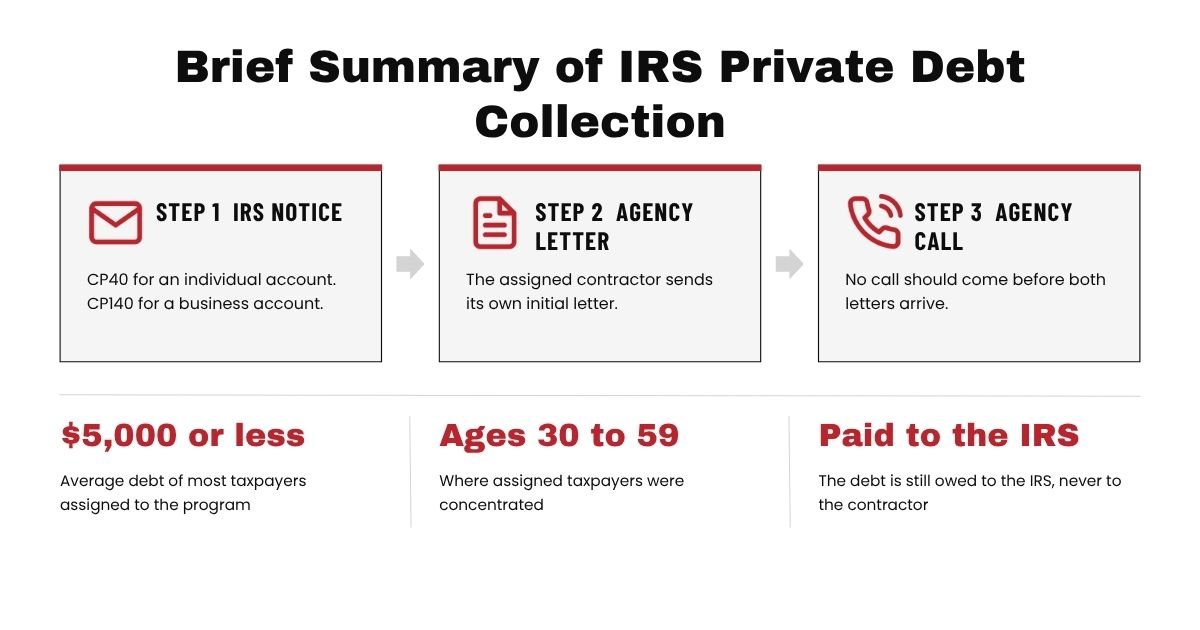
Brief Summary of IRS Private Debt Collection
An IRS private collection agency is a contractor that contacts taxpayers about certain inactive federal tax debts. The agency works for the federal government, but its employees are not IRS Revenue Officers and do not have the same collection authority.
The IRS currently identifies CBE Group Inc., Coast Professional, Inc., and ConServe as its authorized private collection agencies. Because government contracts can change, verify the agency against the current IRS list and the information printed on your notice before sharing personal information.
The IRS sends a notice before the private agency contacts you. For an individual account, this is generally Notice CP40. A business account may receive Notice CP140. The private agency then sends its own initial letter. The letters contain information used for two party identity verification. The agency should not call before sending its letter.
Key Takeaways
Your tax debt is still owed to the IRS, not to the private company.
Payments must be made to the IRS or the United States Treasury through an approved payment method.
The private agency may arrange and monitor payments that are expected to pay the debt in full within the permitted period.
The private agency cannot file a tax lien, issue a levy, garnish wages, issue a summons, report the IRS debt to credit bureaus, or collect a financial statement.
The private agency cannot approve an Offer in Compromise or Currently Not Collectible status.
You may request in writing that the private agency return the account to the IRS.
Returning the account to the IRS does not remove the balance. It may allow the IRS to consider options that require a financial review or an IRS decision.
Interest and applicable penalties may continue until the balance is paid or otherwise resolved under the law.
The Government Accountability Office reviewed IRS program data through 2023 and found that most individual and business taxpayers assigned to private collection had an average debt of $5,000 or less. The report also found that taxpayers in the program were concentrated between ages 30 and 59. This matters because private collection is not limited to people with extremely large balances. It often affects working adults, families, self employed taxpayers, and small business owners with older unresolved accounts.

What It Means When the IRS Assigns Your Debt to a Private Collection Agency
Assignment to a private collection agency means the IRS has transferred contact and payment monitoring for certain unpaid tax periods to an authorized contractor. It does not transfer ownership of the tax debt. The liability remains a federal tax obligation, and payments continue to be processed by the IRS.
The IRS generally assigns accounts that it is not actively working. An account may be older, the IRS may have lacked resources to pursue it, the IRS may have been unable to locate the taxpayer, or enough time may have passed without active contact or assignment.
Why the IRS Uses Private Collection Agencies
Congress requires the IRS to use private contractors for certain inactive tax receivables. The assignment is generally based on the status of the account, not on a finding that you committed fraud or intentionally refused to pay.
A private collection notice should still be taken seriously. The underlying balance remains open. Applicable interest and penalties may continue, refunds may be applied to the debt when allowed, and the account may later return to active IRS collection.
What an Inactive Tax Account Means
Inactive does not mean forgiven, settled, closed, or beyond the collection period. It generally means the IRS is not actively assigning its own collection personnel to work the account at that time.
I recommend treating the assignment as an opportunity to review the complete account. An older balance may involve several assessments, payments that were not applied correctly, prior installment agreements, missing returns, or different collection expiration dates. The amount printed on the most recent letter is important, but it is not the only information needed to select a resolution.
Notice CP40 for Individual Tax Accounts
Notice CP40 tells an individual taxpayer that the IRS assigned an unpaid account balance to a private collection agency. It includes the assigned agency and information needed for the verification process. The agency should also send a separate letter confirming the assignment before calling.
Keep the CP40 notice. Do not throw it away after the first call. The authentication information may be needed again, and the notice can help identify the agency that the IRS selected.
Notice CP140 for Business Tax Accounts
Notice CP140 tells a business taxpayer that an overdue tax account was assigned to a private collection agency. The notice explains the assigned agency and the verification process. It also explains that payments are made to the IRS or the United States Treasury, not to the contractor.
A business should identify the tax form and period involved before agreeing to a payment. A balance involving income tax, an employment tax return, or another business filing may require different compliance work. A private agency can discuss payment, but it cannot complete a financial resolution analysis for the business.
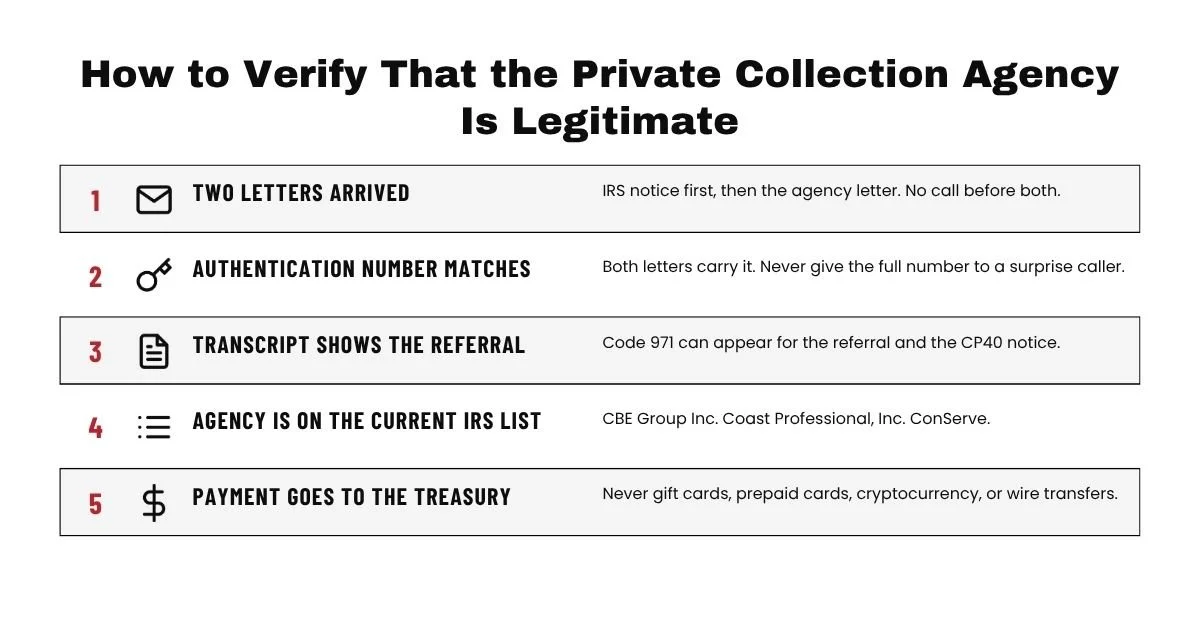
How to Verify That the Private Collection Agency Is Legitimate
Tax scams often rely on fear and urgency. A caller may claim that immediate payment is required or threaten arrest, a bank seizure, or another action. A legitimate IRS contractor must follow a defined contact process, so you have ways to verify the assignment before discussing your account.
Confirm That You Received Two Letters
The IRS should send its notice first. The private collection agency should then send a separate initial contact letter. The agency should not begin with an unexpected phone call before sending its letter.
For an individual account, look for CP40. For a business account, look for CP140. Compare the agency named in the IRS notice with the company that contacted you.
Use the Taxpayer Authentication Number
The IRS notice and the agency letter include authentication information. During the call, the information is used so that both sides can verify identity. Do not provide the entire number to an unexpected caller before following the process described in your letters.
If the caller cannot complete the required verification, end the call and independently review the notice. Use the contact information printed on the IRS notice or the current IRS private debt collection page, rather than a number provided through an unsolicited text or email.
Review Your IRS Account Transcript
An IRS account transcript can provide another verification method. The IRS explains that a transcript may show transaction code 971 for referral to a private debt collection agency and for issuance of the CP40 notice.
A transcript review can also show assessments, payments, penalty activity, and other account events. It may not answer every resolution question, but it can help confirm whether the private agency assignment is recorded on the IRS account.
Confirm the Agency Against the Current IRS List
As of July 23, 2026, the IRS lists CBE Group Inc., Coast Professional, Inc., and ConServe as authorized contractors. The agency name, mailing address, and phone number should match current IRS information.
Do not rely on an old article or an old letter from a prior contractor. Contracts can change. Current IRS information controls.
Watch for Payment Scam Warning Signs
A legitimate private agency should not demand that you pay the company directly. It should not require gift cards, prepaid cards, cryptocurrency, wire transfers, or another unusual payment method. Payments are made to the IRS, and a check or money order should be payable to the United States Treasury.
A contractor also should not threaten to arrest you or claim it can immediately seize your bank account. Private collection agencies do not have levy authority. Threats that conflict with these limits are a reason to stop the conversation and verify the contact.
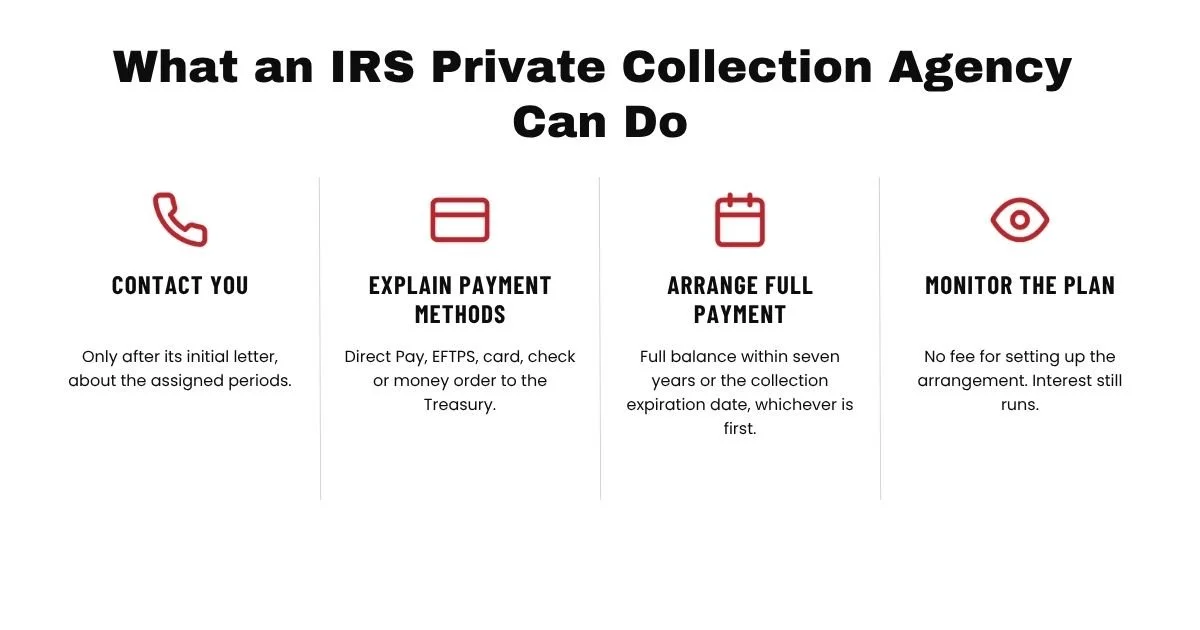
What an IRS Private Collection Agency Can Do
A private agency has a limited role. It can contact you, discuss the unpaid account, explain payment methods, and arrange payments within the program rules. Understanding that role helps you separate a legitimate request from a false threat.
Contact You About the IRS Balance
After sending its initial letter, the agency may call you about the assigned tax debt. Its employees must identify the company as an IRS contractor, follow applicable collection rules, and respect taxpayer rights.
You may ask questions about the tax periods, the amount assigned, and how payments will be credited. Do not assume that every figure is correct merely because it appears in the agency system. Compare it with IRS records and your payment history.
Explain Approved IRS Payment Methods
The agency may explain IRS Direct Pay, the Electronic Federal Tax Payment System, card payment services, checks, money orders, and authorized direct debit options. The funds are paid to the IRS or the United States Treasury.
Keep proof of every payment. Save confirmation numbers, bank records, cancelled checks, and correspondence. If a payment posts to the wrong tax period, proof of the payment may be needed to request a correction.
Arrange and Monitor Full Payment
The agency may set up and monitor a payment arrangement that is expected to pay the assigned debt in full within seven years or before the applicable collection expiration date, whichever comes first. The IRS receives and processes the payments while the agency monitors whether required payments are made.
This arrangement may work when the required payment is affordable and full payment is the correct strategy. It may be a poor fit when the payment would prevent you from covering necessary living expenses, staying current on new taxes, or operating a viable business.
Discuss a Payment Without Charging an Arrangement Fee
The IRS states that a private collection agency cannot charge a fee for setting up its payment arrangement.
That does not mean the underlying balance stops growing. Interest and applicable penalties may continue while the debt remains unpaid. You should review the projected total cost and the time remaining for collection before committing to a long repayment period.
A PCA Payment Arrangement Is Not the Same as Every IRS Installment Agreement
The Internal Revenue Manual explains that a payment arrangement granted by a private agency remains assigned to private debt collection and is monitored by the agency. It is not recorded in the same account status used for a regular IRS installment agreement.
This distinction matters when comparing protections, terms, fees, financial review requirements, and available alternatives. Before accepting a private collection payment amount, determine whether the arrangement addresses the whole case or only the immediate request for payment.
What an IRS Private Collection Agency Cannot Do
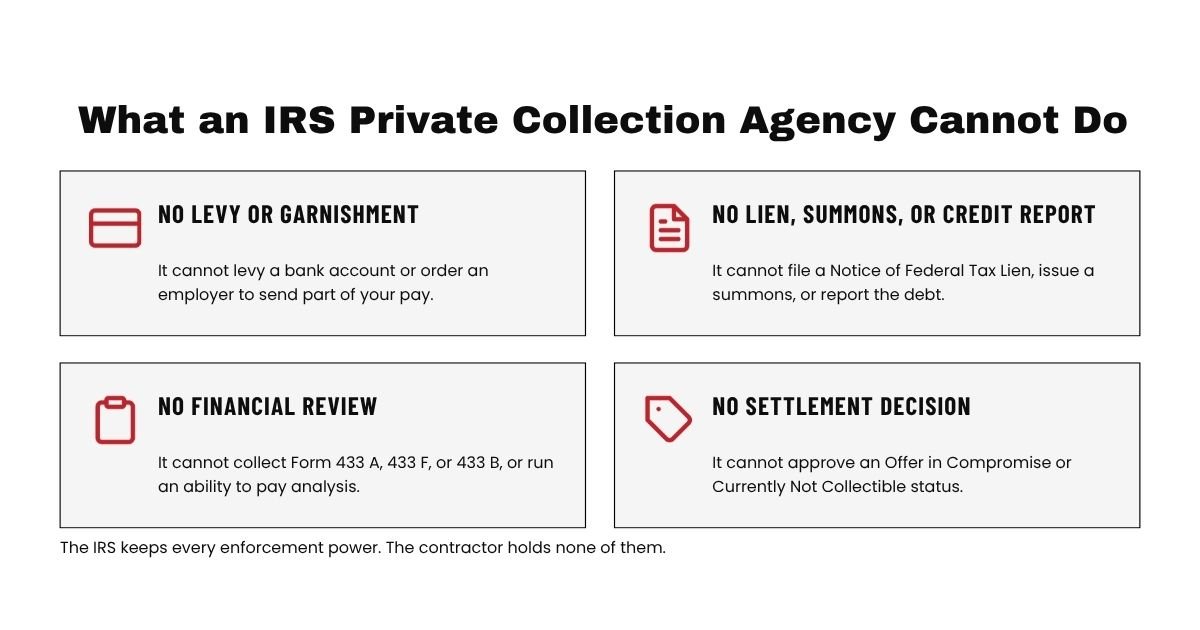
The limits on private agency authority are central to this topic. A contractor can request payment, but it cannot exercise the enforcement powers assigned to the IRS.
It Cannot Levy Your Bank Account
A private collection agency cannot issue an IRS levy against your bank account. It also cannot direct your bank to freeze or send funds based on its own authority.
The IRS retains legal levy authority when statutory and procedural requirements are met. Therefore, a private agency lacking levy power does not mean the account can be ignored forever. If the account returns to active IRS collection, the IRS may consider enforcement under the applicable rules.
It Cannot Garnish Your Wages
The contractor cannot issue a wage levy or order your employer to send part of your pay to the government. A threat by the contractor to garnish wages directly would conflict with the limits stated by the IRS.
The IRS may have wage levy authority after required notices and procedures. That is separate from the contractor’s authority. The proper strategy is to verify which department currently controls the account and whether any final collection notice was previously issued.
It Cannot File a Notice of Federal Tax Lien
The private agency cannot file a Notice of Federal Tax Lien. A federal tax lien filing is an IRS action, not a contractor action.
A lien may already exist from an earlier period, or the IRS may consider one later. Review the account and public record rather than assuming there is no lien because the private agency did not file one.
It Cannot Collect a Financial Statement
The private agency cannot collect financial information for an IRS ability to pay decision. It should not demand a Form 433 A, Form 433 F, Form 433 B, bank statements, property valuations, or a full monthly expense analysis to decide whether you qualify for hardship relief.
The IRS may request financial information when evaluating Currently Not Collectible status, a Partial Payment Installment Agreement, an Offer in Compromise, or another option. That review should occur through the proper IRS process.
It Cannot Approve an Offer in Compromise
Only the IRS can evaluate and decide an Offer in Compromise. The IRS generally reviews ability to pay, income, expenses, asset equity, filing compliance, current payment compliance, and other facts. An offer is not available merely because the account was assigned to private collection.
The private agency also cannot promise that the IRS will accept a particular settlement amount. Any projection should be based on current financial information and the applicable offer rules.
It Cannot Approve Currently Not Collectible Status
A contractor cannot place the account in Currently Not Collectible status. The IRS may approve temporary collection delay when financial hardship prevents payment, usually after reviewing financial information and supporting documents. The debt is not forgiven, penalties and interest generally continue, refunds may be applied, and the IRS may review the taxpayer’s finances later.
It Cannot Issue a Summons or Report the Debt to Credit Bureaus
The Taxpayer Advocate Service states that a private agency cannot issue a summons, report the IRS tax debt to credit rating agencies, or collect financial information.
This does not remove other effects of unresolved federal tax debt. For example, an existing federal tax lien may affect property and financing even though the private agency did not report the debt to a credit bureau.
What to Do After Receiving a CP40 or CP140 Notice
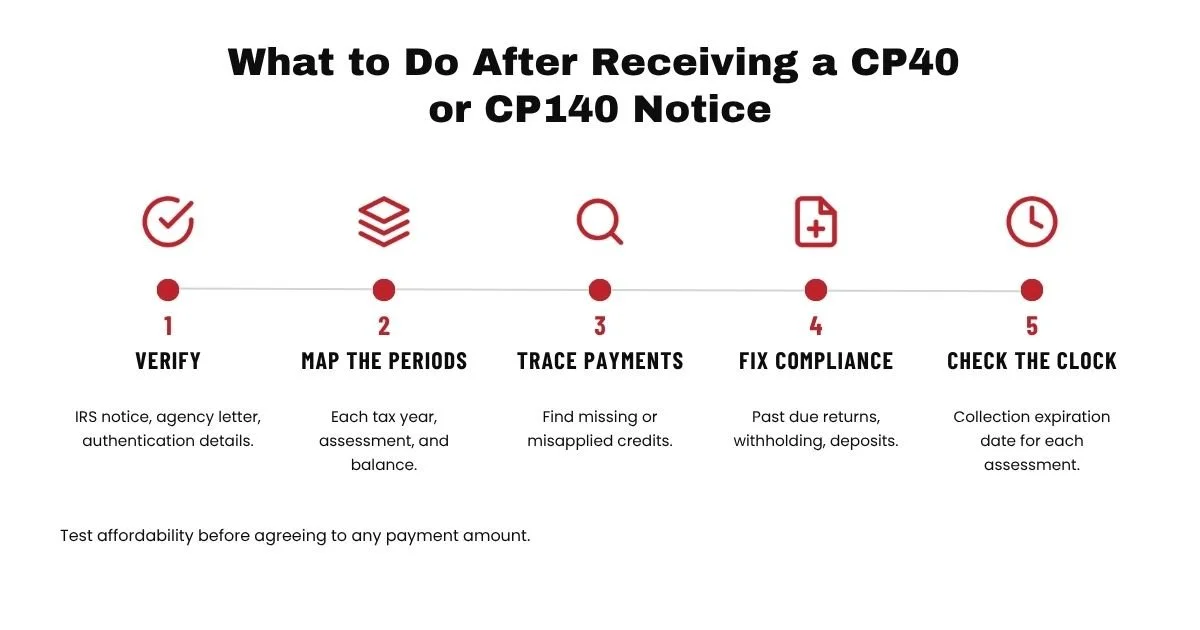
The best response is organized and deliberate. You do not need to agree to the first payment amount discussed. You also should not ignore the notice simply because the caller works for a contractor.
Verify the Assignment Before Discussing the Account
Confirm the IRS notice, the separate agency letter, the taxpayer authentication information, and the current agency list. Review your IRS Online Account or account transcript when available.
If the information does not match, stop and investigate. Do not send money while the identity of the caller remains uncertain.
Identify Every Tax Period and Assessment
Write down each tax year or business tax period assigned to the agency. Confirm the original tax, penalties, interest, payments, credits, and current balance.
A single total can hide several separate assessments. Each assessment may have its own collection expiration date and history. That can affect whether full payment, a partial payment arrangement, or another option should be considered.
Check Whether Any Payments Are Missing or Misapplied
Compare IRS records with bank statements, cancelled checks, electronic confirmations, refund offsets, and prior agreement records. If you already paid an amount that still appears due, the IRS advises working with the agency and providing payment information so the payment can be researched and properly credited.
Do not pay the same amount twice merely to end the call. Document the issue and request correction through the proper process.
Review Your Filing History
Private collection assignment does not prove that all required returns have been filed. The GAO found that many taxpayers assigned to the program had not filed a current income tax return, although some may not have had a filing requirement.
File all required past due returns even when you cannot pay the resulting balance in full. Filing compliance is commonly required before the IRS will approve a long term payment resolution or consider an Offer in Compromise.
Correct Current Tax Compliance
A resolution can fail when new tax debt continues to arise. Wage earners may need to correct withholding. Self employed taxpayers may need to make current estimated tax payments. Employers may need to file payroll returns and make current federal tax deposits.
The IRS generally requires required returns and current payment compliance before granting many installment agreements or processing an Offer in Compromise. The exact requirements depend on the taxpayer and the resolution requested.
Review the Collection Statute Expiration Dates
The IRS generally has ten years from an assessment to collect, but the calculation can be affected by events that suspend or extend the period. Each assessment has its own Collection Statute Expiration Date.
Do not estimate the date by adding ten years to the tax return year. Review IRS records and account history. Bankruptcy, certain appeals, pending offers, litigation, and other events can change the calculation.
Decide Whether Full Payment Is Realistic
A private agency payment arrangement is built around full payment within the permitted period. Calculate whether the proposed amount can be made while paying rent or mortgage, food, utilities, transportation, insurance, current taxes, and necessary business costs.
Do not agree to a payment you know will fail. A default may delay the real resolution and leave you with less cash to address current compliance.
How Private Collection Relates to IRS Tax Relief
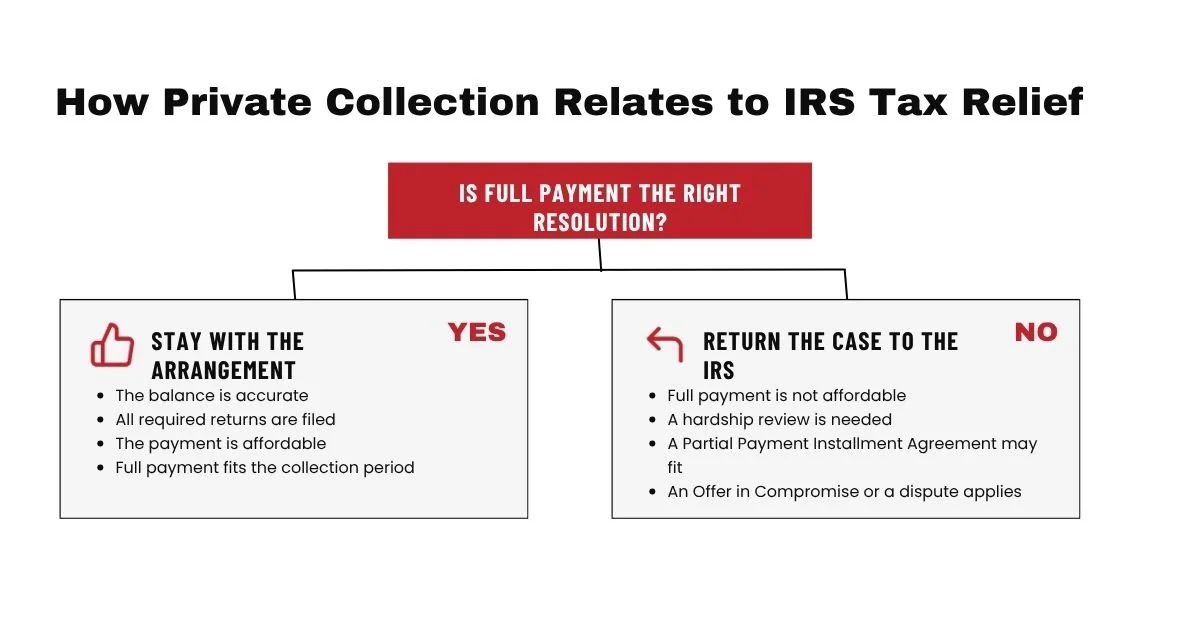
Private collection and tax relief are related, but they are not the same process. The contractor’s main function is to collect full payment. Several tax relief options require the IRS to review finances, legal liability, compliance, and collection potential.
When I review these cases, I ask one central question: Is full payment through the contractor the correct resolution, or does the account need to return to the IRS for a different evaluation?
When a Private Collection Payment Arrangement May Work
A contractor arrangement may be reasonable when the debt is accurate, all required returns are filed, the required payment is affordable, no better IRS alternative applies, and the balance can be paid within the permitted period.
The limitation is important. Interest and applicable penalties may continue, and the arrangement is intended to pay the full assigned balance. It is not a settlement for less than the amount owed.
When the Case May Need to Return to the IRS
Returning the account may make sense when you cannot afford full payment, need a hardship determination, may qualify for a Partial Payment Installment Agreement, want to submit an Offer in Compromise, dispute the liability, have unfiled returns, or believe the assignment should have been excluded.
A written return request does not approve any of those options. It moves the case away from the contractor so the proper IRS function can review the request.
IRS Installment Agreement
An IRS installment agreement permits monthly payment over an approved period. Current IRS procedures include different plan types, and the available terms depend on the balance, tax type, filing compliance, current payment compliance, collection period, and financial information when required.
An installment agreement does not erase the debt. Interest and applicable penalties generally continue until the balance is paid. A federal tax lien may already exist or may be considered under IRS procedures.
Partial Payment Installment Agreement
A Partial Payment Installment Agreement may allow monthly payments based on the amount the taxpayer can afford when full payment before the collection expiration date is not possible. The IRS generally requires a financial analysis and may review the agreement later. Penalties and interest continue while the balance remains unpaid.
This option is not automatically better than a private agency arrangement. The result depends on income, allowable expenses, asset equity, collection time, and future changes in ability to pay.
Currently Not Collectible Status
The IRS may temporarily delay most collection activity when payment would create financial hardship. The IRS may request Forms 433 F, 433 A, or 433 B and documents verifying income, expenses, bank accounts, property, and other assets.
Currently Not Collectible status does not cancel the tax debt. Interest and penalties continue, federal refunds may be applied, the IRS may file a Notice of Federal Tax Lien, and collection may resume if the taxpayer’s ability to pay improves.
Offer in Compromise
An Offer in Compromise may settle eligible tax debt for less than the full balance. The IRS considers ability to pay, income, expenses, asset equity, and the facts of the case. The program is not available to everyone, and the IRS generally expects the offer to reflect what it can reasonably collect.
Applicants generally must file required returns, make required estimated tax payments, and meet current federal tax deposit requirements when applicable. An open bankruptcy case generally prevents eligibility. Acceptance is not guaranteed, and a private collection agency cannot approve or reject the offer.
Penalty Relief
Some taxpayers may qualify for relief from certain penalties through First Time Abate, reasonable cause, a statutory exception, or another administrative provision. Qualification depends on the penalty and the taxpayer’s compliance history or supporting facts.
Penalty relief does not automatically remove the underlying tax. Interest connected to a reduced penalty is generally adjusted when the penalty is reduced, but interest on unpaid tax usually remains. A private agency cannot decide a penalty relief request.
Disputing the Tax Liability
A private collection agency is not the correct forum for deciding that an assessment is wrong. A disputed balance may require an amended return, payment tracing, audit reconsideration, Substitute for Return replacement, identity theft procedures, innocent spouse relief, a Doubt as to Liability Offer in Compromise, or another account correction process.
The correct procedure depends on how the balance arose and which rights remain available. Returning the account to the IRS does not itself correct the assessment. Evidence and a valid procedural request are still required.

How to Request That the Account Be Returned to the IRS
You are not required to continue working with the assigned private collection agency. The IRS and Taxpayer Advocate Service state that a request to return the account must be submitted in writing to the private agency.
Submit a Clear Written Request
Your letter should identify you, identify the account or notice, state that you do not wish to work with the private collection agency, and request that the account be returned to the IRS. Use the mailing address in the agency letter and keep a complete copy.
Send the request through a method that gives you proof of mailing or delivery. The exact method is your choice, but documentation can become important if calls continue or the account status is unclear.
paragraphs here
Dont wait to file on
Do Not Include Unnecessary Financial Information
The purpose of the return request is to end private agency handling and send the account back to the IRS. The private agency cannot conduct the financial analysis needed for hardship status, a Partial Payment Installment Agreement, or an Offer in Compromise.
Prepare financial forms and supporting documents for the IRS process that will evaluate the requested option, not for the private contractor.
Understand the Difference Between an Oral Hold and a Written Return Request
The Taxpayer Advocate Service explains that telling the agency orally that you plan to contact the IRS about collection alternatives may result in a 60 day hold. If no IRS agreement is reached during that period, the agency may resume contact. TAS therefore points to a written request when the taxpayer no longer wants to work with the agency.
An oral hold may give temporary time, but it should not replace a written return request when your decision is to leave private collection.
What Happens After the Account Returns
The debt remains due unless it is paid, adjusted, compromised, discharged, or expires under applicable law. The IRS may route the account to another collection function, review a submitted resolution request, send additional notices, or leave the account inactive for a period.
There is no automatic approval of an installment agreement, Currently Not Collectible status, or Offer in Compromise. Filing compliance, current tax compliance, financial information, asset equity, collection time, and other facts may control the result.
Track the Transfer
After sending the written request, monitor IRS transcripts or account information. Keep a log of calls, letters, mailing dates, delivery proof, and the names of people you speak with.
The Internal Revenue Manual provides procedures for handling written correspondence asking a private agency to cease contact, which supports keeping a clear written record.
Who Should Be Excluded From IRS Private Collection
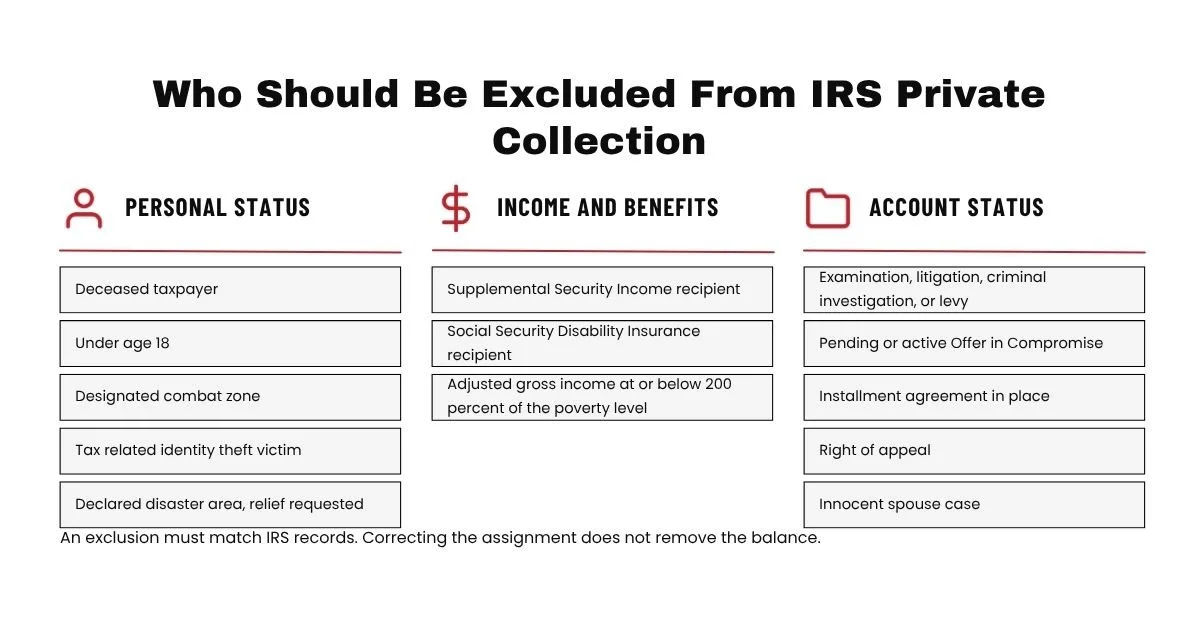
The IRS lists categories of accounts that should not be assigned to private collection. An improper assignment should be raised promptly, but the exclusion must be supported by the actual account facts and IRS records.
Current IRS Exclusion Categories
The IRS currently lists the following exclusions:
A deceased taxpayer.
A taxpayer under age 18.
A taxpayer in a designated combat zone.
A victim of tax related identity theft.
A recipient of Supplemental Security Income.
A recipient of Social Security Disability Insurance.
A taxpayer whose adjusted gross income does not exceed 200 percent of the applicable poverty level.
An account under examination, litigation, criminal investigation, or levy.
An account subject to a pending or active Offer in Compromise.
An account subject to an installment agreement.
An account subject to a right of appeal.
An account classified as an innocent spouse case.
A taxpayer in a presidentially declared disaster area who is requesting collection relief.
Why an Account May Still Be Assigned Incorrectly
The IRS relies on account codes, filed return data, benefit information, and other records. Those records may be incomplete, outdated, or not yet processed. A recent hardship, disability benefit, identity theft determination, appeal, or submitted resolution may not be reflected immediately.
The GAO reported concerns about how the IRS identifies taxpayers with limited financial means and whether people receive enough individualized information about resolution options. That does not prove that every low income assignment is improper, but it supports verifying the data used for the assignment.
What to Do if You Believe You Should Have Been Excluded
Gather evidence showing the applicable exclusion. This may include benefit records, identity theft documentation, an appeal request, an Offer in Compromise receipt, installment agreement records, examination notices, disaster relief information, or proof of current income.
Contact the appropriate IRS function and request correction. You may also submit a written request to the private agency for return of the account. The exclusion issue and the underlying tax resolution are separate. Correcting the assignment does not erase the debt.
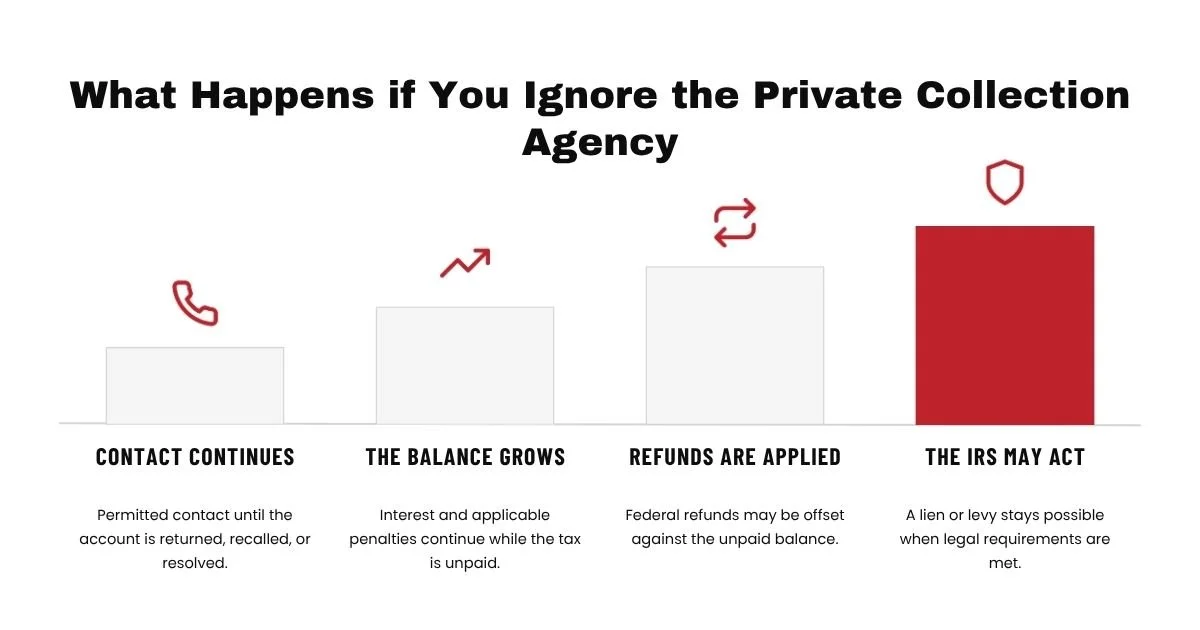
What Happens if You Ignore the Private Collection Agency
Ignoring the contractor does not give the contractor enforcement power, but it also does not resolve the federal tax debt.
The Private Agency Cannot Enforce Collection
The contractor cannot file a lien, issue a levy, garnish wages, or issue a summons. It may continue permitted contact unless the account is returned, recalled, resolved, or contact is otherwise restricted.
Interest and Applicable Penalties May Continue
Unpaid federal tax generally continues to accrue interest and applicable penalties until paid or otherwise adjusted. Delay can therefore increase the balance even when the private agency cannot seize property.
The IRS May Retain or Regain Control of the Account
The IRS remains the creditor and retains lawful collection authority. A private collection assignment does not permanently prevent the IRS from filing a federal tax lien or issuing a levy when legal requirements are met.
The timing and next action depend on the account. Do not assume that silence means the IRS abandoned the debt.
Refunds May Be Applied to the Balance
Federal refunds may be applied to unpaid federal tax debt under applicable offset rules. Making monthly payments does not necessarily prevent a refund from being applied.
A payment strategy should account for expected refunds and should correct withholding or estimated payments so that new compliance problems do not arise.
Collection Time Continues to Matter
Each assessment generally has a ten year collection period, subject to suspension and extension rules. A private collection assignment does not create a new ten year period by itself. Review the actual assessment dates and any events that affected the collection statute.
Waiting may sometimes appear attractive when an expiration date is close, but it can carry collection, financial, and compliance risks. The account history should be reviewed before relying on expiration as a strategy.
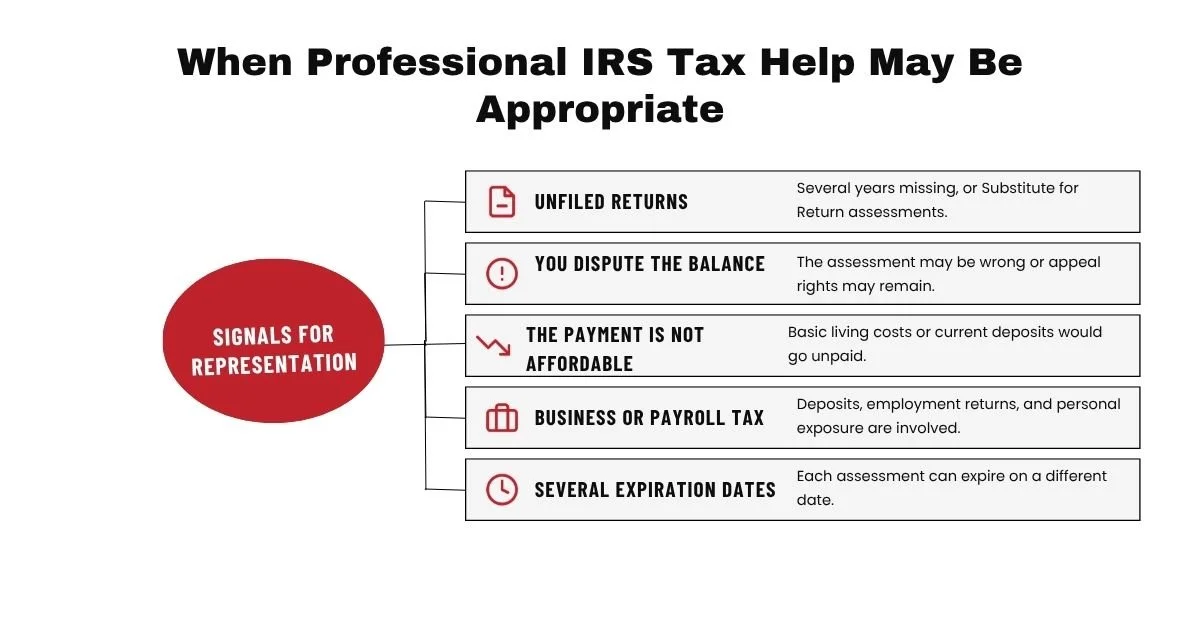
When Professional IRS Tax Help May Be Appropriate
Some private collection accounts are simple. Others are a small part of a larger tax problem. Professional representation may be useful when the correct response requires transcript analysis, financial calculations, liability correction, or direct IRS contact.
You Have Several Years of Unfiled Returns
Missing returns can prevent approval of many collection alternatives. They may also create new balances once filed. A filing plan should identify which returns are required, whether the IRS prepared Substitute for Return assessments, and how the new liabilities affect the resolution.
You Disagree With the Balance
A payment arrangement is not the right first step when the debt may be wrong. Review how the assessment arose, which notices were issued, whether appeal rights remain, and what evidence supports correction.
You Cannot Afford the Proposed Payment
A payment that consumes money needed for basic living expenses or current tax deposits may quickly fail. Financial analysis may show that a lower IRS payment, temporary hardship status, or another option should be evaluated. Approval depends on IRS standards and the supporting records.
You Need an Offer in Compromise or Hardship Review
The private agency cannot decide these requests. A representative can help prepare the financial disclosure, supporting documents, compliance work, and legal basis for an IRS submission. No professional can guarantee acceptance.
The Account Includes Business or Payroll Taxes
Business tax debt may involve federal tax deposits, employment tax returns, personal assessment exposure, business viability, accounts receivable, and current operating expenses. The payment plan should not create new payroll tax debt.
Several Collection Expiration Dates Are Involved
Multiple assessments can expire on different dates, and suspension events may affect each one. A transcript based review can prevent a decision based on an incorrect estimate.
How I Review an IRS Private Collection Case
My review generally includes the IRS account transcripts, current balance, tax periods, assessment dates, collection expiration dates, filing compliance, current withholding or deposits, income, necessary expenses, assets, prior agreements, notices, and available appeal or correction procedures.
I then compare full payment, an IRS installment agreement, a Partial Payment Installment Agreement, Currently Not Collectible status, an Offer in Compromise, penalty relief, and any valid liability dispute. The goal is to identify an option supported by the facts, not to force every taxpayer into the same program.
Frequently Asked Questions About IRS Private Collection Agencies
-
No. A private collection agency cannot issue a wage levy or order your employer to send part of your pay to the IRS. It also cannot file a Notice of Federal Tax Lien or levy your bank account.
The IRS retains enforcement authority when legal and procedural requirements are satisfied. Therefore, the contractor’s limited power does not mean the debt should be ignored. If the account returns to active IRS collection, review prior notices and available resolution or appeal rights promptly.
-
No. You may request that the private agency return your account to the IRS. The request must be submitted in writing to the agency. Keep a copy and proof of delivery.
Returning the case does not remove the tax debt. It may be appropriate when you need an IRS financial decision, want to dispute the balance, believe an exclusion applies, or cannot afford the contractor’s full payment arrangement.
-
No. A private collection agency cannot accept or reject an Offer in Compromise and cannot create a settlement based on your financial hardship. Its payment arrangement is intended to pay the assigned balance in full within the permitted period.
The IRS may accept an Offer in Compromise when the legal and financial requirements are met. It reviews ability to pay, income, expenses, assets, compliance, and the basis for the offer. Acceptance is not automatic.
-
You should receive an IRS notice and then a separate letter from the assigned agency before the agency calls. The letters contain authentication information. Compare the company with the current IRS list, and review your IRS account transcript or Online Account when possible.
A legitimate agency will not demand payment to itself, request gift cards or cryptocurrency, or claim it can arrest you or immediately levy your bank account. Payments should go to the IRS or the United States Treasury through an approved method.
-
No. The contractor cannot make a Currently Not Collectible determination. The IRS may temporarily delay most collection when it determines that payment would create financial hardship, usually after reviewing income, expenses, assets, and supporting documents.
Currently Not Collectible status does not forgive the debt. Interest and penalties continue, refunds may be applied, a federal tax lien may be filed, and the IRS may review the taxpayer’s financial condition later.
-
Private collection assignment does not create a new ten year collection period by itself. The collection period generally begins with assessment, and each assessment has its own expiration date. Certain events can suspend or extend the period.
A contractor payment arrangement must account for the applicable collection expiration date. Before relying on an expiration date, review IRS records for bankruptcy, offers, appeals, litigation, and other events that may have affected the calculation.
-
Gather proof of payment, including the date, amount, payment method, confirmation number, bank record, check image, and tax period you intended to pay. The IRS advises working with the agency to research why the payment was not credited properly.
Do not send a duplicate payment until the posting issue is reviewed. A payment may have been applied to another year, another tax type, a spouse’s account, or an estimated tax period.
-
Yes. Taxpayers have the right to retain representation. An attorney, certified public accountant, or Enrolled Agent with appropriate authorization may review the account and communicate concerning federal tax matters within the scope of that authorization.
Representation does not create special eligibility or guarantee a result. Its value is in identifying the correct procedure, preparing accurate submissions, protecting deadlines, and presenting the facts to the proper IRS function.
Get Help Reviewing an IRS Private Collection Case
A CP40 or CP140 notice does not mean you are out of options. It means an older or inactive IRS balance has reached a different collection channel. The private agency has limited authority, but the tax debt still needs a plan.
I am Sergio Melendez, an Enrolled Agent and Juris Doctor with over 20 years of tax experience. At Semper Tax Relief, I review the IRS account before recommending a payment or relief request. That review may include transcripts, missing returns, collection expiration dates, current compliance, financial ability, asset equity, prior notices, and the available IRS resolution procedures.
The right result depends on the facts. A private agency payment arrangement may work for one taxpayer. Another taxpayer may need the account returned to the IRS for an installment agreement, Partial Payment Installment Agreement, Currently Not Collectible review, Offer in Compromise, penalty request, or liability correction. Each option has requirements and limitations.
Book a 10 minute call with Semper Tax Relief to discuss the notice, the assigned agency, and the next step for your IRS account.
This article provides general educational information. IRS procedures, agency contracts, account status, and eligibility rules can change. Review the current notice and the facts of the individual case before taking action.