

TLDR;
You generally need to issue Form 1099-NEC to an independent contractor you pay $2,000 or more during the calendar year for services.
The $2,000 is a yearly total per contractor, not a per payment limit.
Cash, checks, direct deposit, and Zelle payments generally count toward the $2,000, and you as the payer are responsible for the 1099-NEC.
Credit card, debit card, and payment app business payments are generally reported by the processor on Form 1099-K, so you usually leave them out of your 1099-NEC totals.
Payments to C corporations and S corporations generally do not require a 1099-NEC, with exceptions for attorney fees and medical payments.
The $2,000 Rule for Paying Independent Contractors
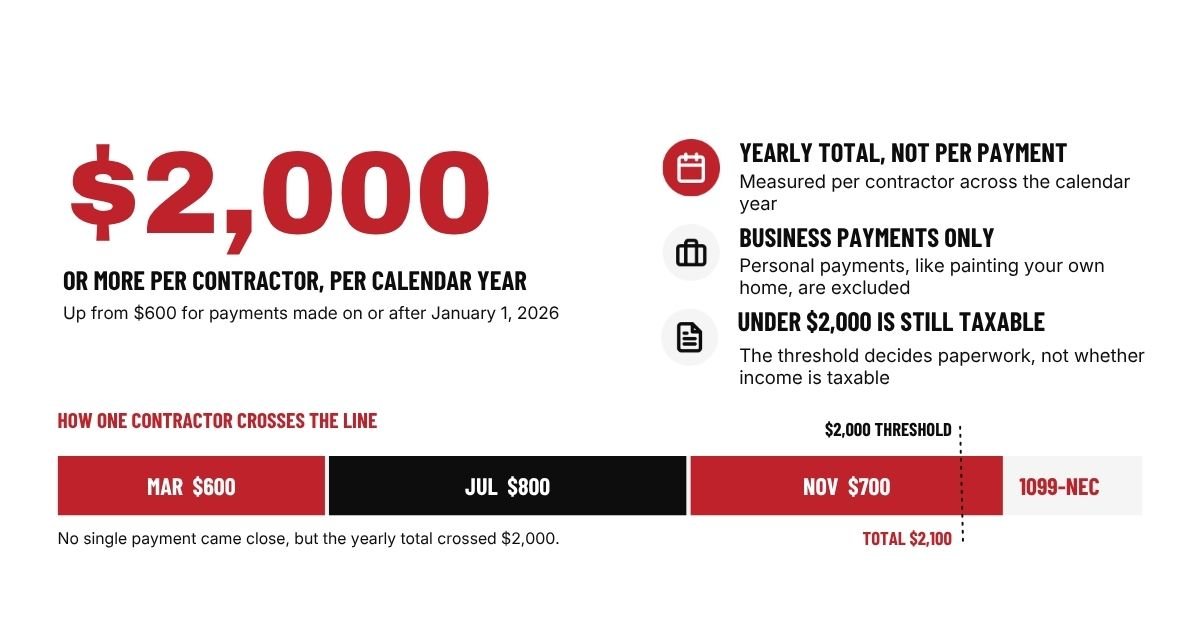
If you run a business and pay someone who is not your employee to perform services, you generally need to send them, and the IRS, a Form 1099-NEC once your payments to that person reach $2,000 or more for the year. The threshold rose from $600 to $2,000 for payments made on or after January 1, 2026.
For a full breakdown of what changed and when 2026 forms are due, see our guide to the new 1099-NEC threshold and February 1, 2027 deadline.
The rule generally applies to payments made in the course of your trade or business. Personal payments, such as hiring someone to paint your own home, generally do not require a 1099-NEC.
Is the $2,000 Threshold Per Payment or Per Year
The $2,000 is generally measured as the total you pay one contractor during the calendar year, not each individual payment. For example, if you pay a web designer $600 in March, $800 in July, and $700 in November, your total is $2,100, and a 1099-NEC is generally required even though no single payment came close to $2,000.
That is why tracking every payment from the start of the year matters. A contractor who looks well under the threshold in spring may cross it by December. Keep in mind that the threshold only decides whether you file paperwork. Income under $2,000 is still generally taxable to the contractor who received it.
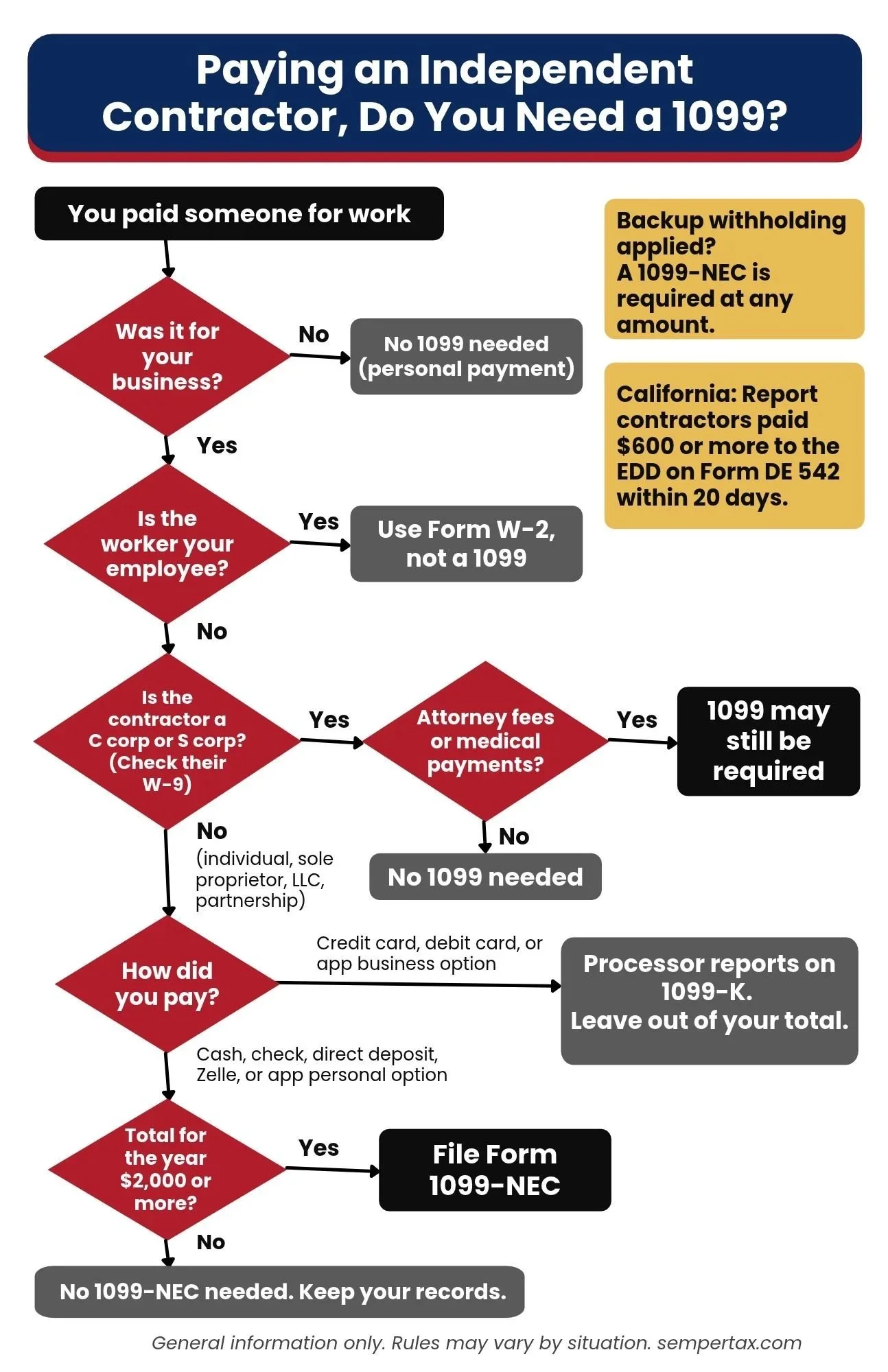
How the Way You Pay Changes Who Files the 1099
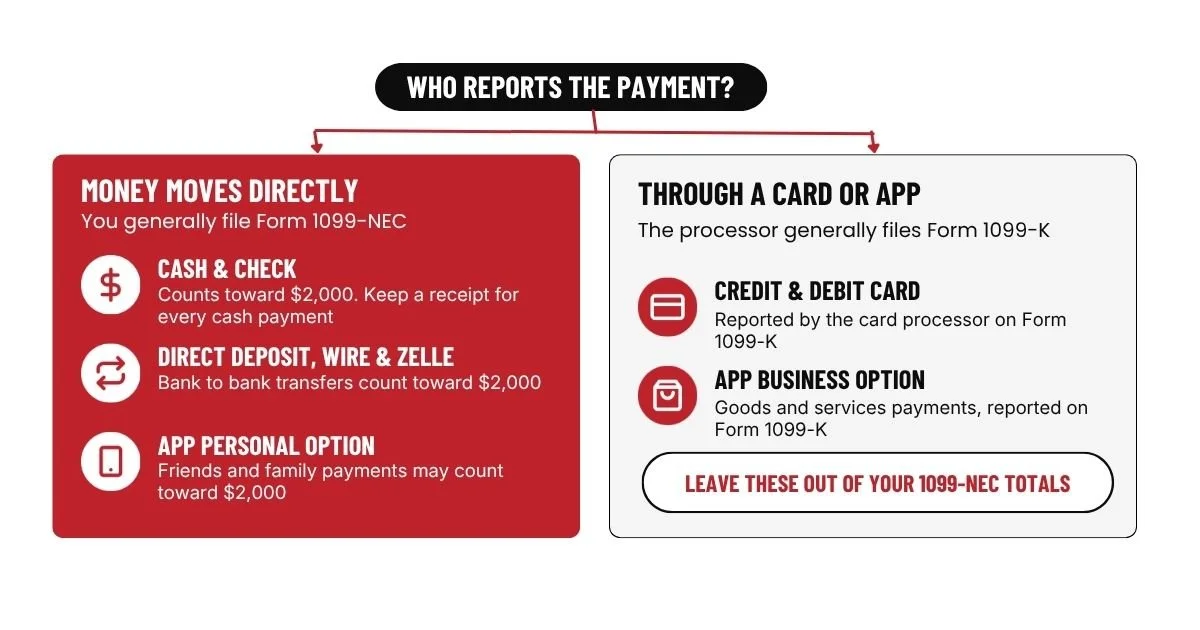
The payment method you use can change who is responsible for reporting the payment to the IRS. In general, if the money moves directly from you to the contractor, the 1099-NEC is your responsibility. If it moves through a card network or a payment app's business service, the processor is generally the one who reports it, on Form 1099-K.
Cash, Check, and Direct Deposit Payments
Paying in cash does not remove the reporting requirement. Cash, checks, direct deposit, and wire transfers all generally count toward the $2,000, and you are generally responsible for issuing the 1099-NEC. Cash payments are often the hardest to document, so keep a written receipt or invoice for each one.
Zelle Payments to Contractors
Zelle generally works like a direct transfer between bank accounts rather than a payment processor, and it does not issue Form 1099-K. For 1099 purposes, a Zelle payment is generally treated much like a check or bank transfer. That means Zelle payments to a contractor generally count toward the $2,000, and the 1099-NEC is generally your responsibility.
Venmo, PayPal, and Cash App, Personal vs. Business Payments
With payment apps, how you send the money may matter.
Business or goods and services payments: when you pay a contractor through an app's business or goods and services option, the app is generally treated as a third party settlement organization and is responsible for any reporting on Form 1099-K. You generally leave these payments out of your 1099-NEC totals.
Personal or friends and family payments: when you use the personal option to pay for business services, the app generally does not treat it as a business transaction, and the 1099-NEC responsibility may fall back on you.
Using the personal option to pay for business services can also cause problems on the contractor's side, so the business payment option is usually the cleaner choice.
Credit Card and Debit Card Payments
Payments you make to a contractor by credit card or debit card are generally reported by the card processor on Form 1099-K, not by you on Form 1099-NEC. Leave card payments out of your 1099-NEC totals so the same income is not reported twice.
Quick Reference, Payment Method and Which Form Applies
Cash: counts toward $2,000. You generally file Form 1099-NEC.
Check: counts toward $2,000. You generally file Form 1099-NEC.
Direct deposit or wire: counts toward $2,000. You generally file Form 1099-NEC.
Zelle: counts toward $2,000. You generally file Form 1099-NEC.
Venmo, PayPal, or Cash App, personal option: may count toward $2,000. You may need to file Form 1099-NEC.
Venmo, PayPal, or Cash App, business option: generally excluded. The processor reports on Form 1099-K if its threshold is met.
Credit or debit card: generally excluded. The processor reports on Form 1099-K.
Do You Send a 1099 to a Corporation or S Corporation

In general, no. Payments for services to a business that is taxed as a corporation are generally exempt from 1099-NEC reporting, with a few important exceptions.
Payments to C Corporations and S Corporations
Payments to C corporations and S corporations generally do not require a 1099-NEC, even if you pay them well over $2,000. This exemption is based on how the business is taxed, so you will need to confirm its tax classification rather than going by its name alone. A business with "Inc." in its name is usually a corporation, but a business with "LLC" in its name may or may not be.
LLCs, It Depends on How the LLC Is Taxed
An LLC can be taxed several different ways, so "LLC" alone does not tell you whether to send a 1099.
Single member LLC taxed as a sole proprietorship: generally receives a 1099-NEC.
LLC taxed as a partnership: generally receives a 1099-NEC.
LLC that elected to be taxed as a C corporation or S corporation: generally does not receive a 1099-NEC, except for the exceptions below.
Exceptions, Attorney Fees and Medical Payments
Some payments are reportable even when the recipient is incorporated.
Attorney fees: fees paid for legal services of $2,000 or more are generally reported on Form 1099-NEC, even if the law practice is incorporated.
Attorney gross proceeds: payments to an attorney that are not for the attorney's own services, such as settlement funds, are generally reported on Form 1099-MISC and still use a $600 threshold.
Medical and health care payments: payments to physicians and other medical or health care providers of $2,000 or more are generally reported on Form 1099-MISC, even if the provider is a corporation.
Use Form W-9 to Confirm the Contractor's Tax Classification
The simplest way to know whether a contractor needs a 1099 is to collect Form W-9 before you pay them. The W-9 shows the contractor's legal name, Taxpayer Identification Number, and federal tax classification, including whether an LLC is taxed as a corporation.
Request it at the start of the relationship, while you still owe the contractor money, since it is usually much harder to get once they are paid in full.
Paid One Contractor Several Ways, How to Count Toward $2,000
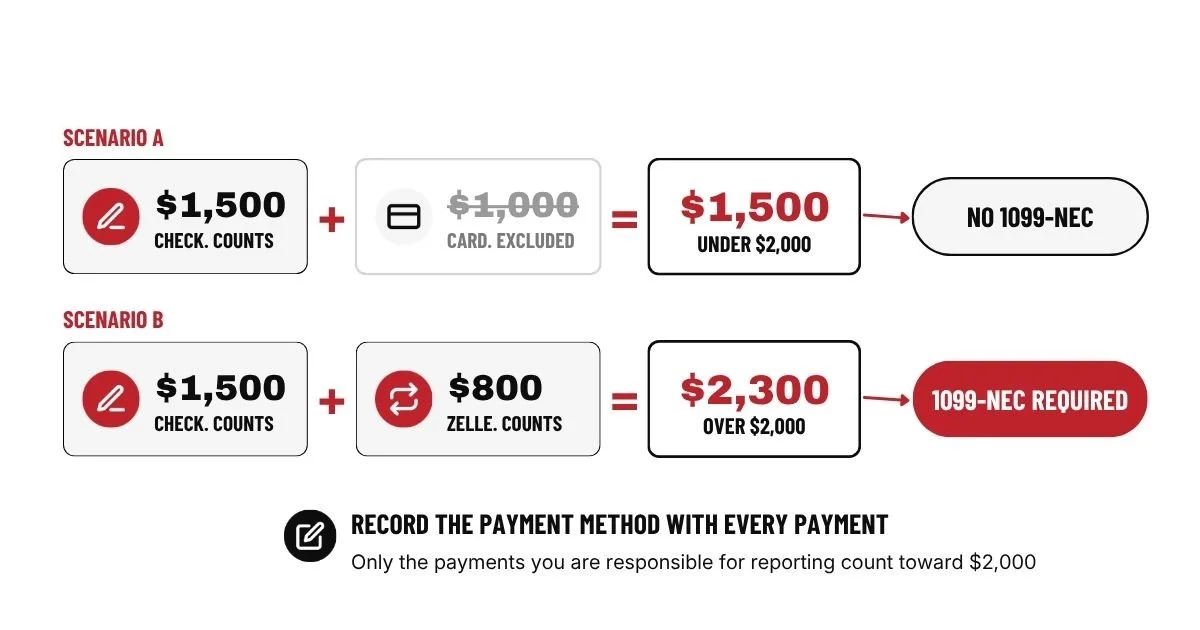
Many businesses pay the same contractor more than one way during the year. In that case, you generally add up only the payments that are your responsibility to report.
For example, say you paid a contractor $1,500 by check and $1,000 by credit card during the year. The $1,000 card payment is generally reported by the card processor on Form 1099-K, so only the $1,500 counts toward your 1099-NEC. Because $1,500 is under $2,000, a 1099-NEC is generally not required.
Now say you paid the same contractor $1,500 by check and $800 by Zelle. Both generally count, your total is $2,300, and a 1099-NEC is generally required.
Recording the payment method alongside each payment makes this sorting much easier at year end.
Your Next Step Once a Contractor Crosses $2,000
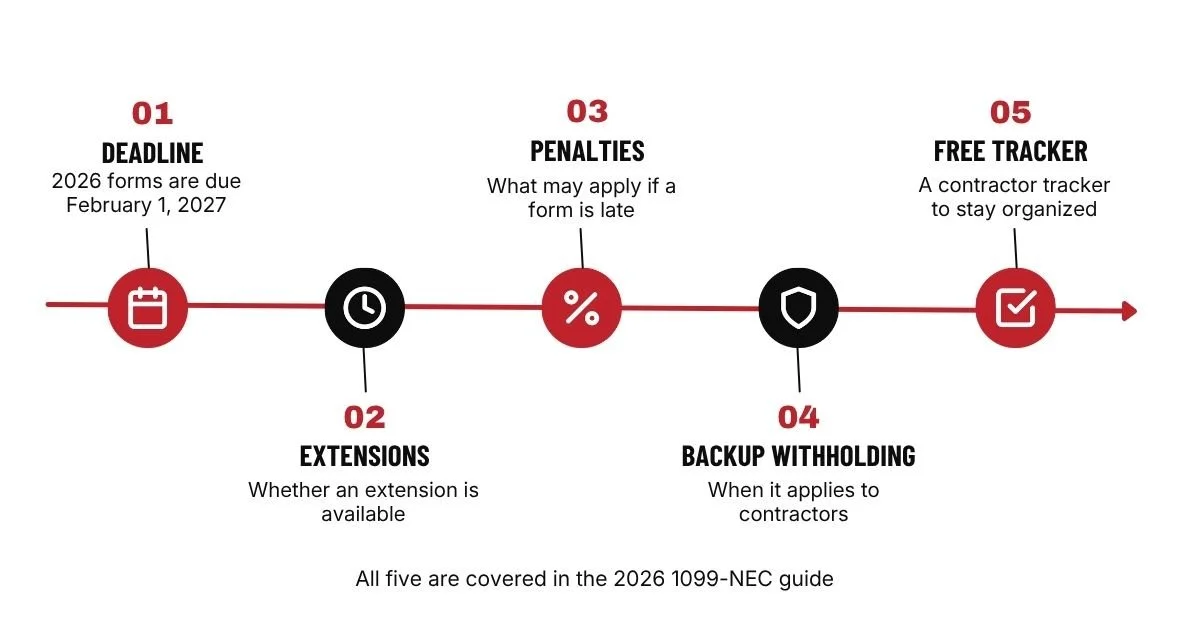
Once you know which contractors need a 1099-NEC, the next questions are when the forms are due, whether an extension is available, and what penalties may apply if a form is late.
Our 2026 1099-NEC guide covers the current deadline, extension rules, penalties, backup withholding, and a free contractor tracker to help you stay organized.
California Callout: Contractor Reporting Still Starts at $600
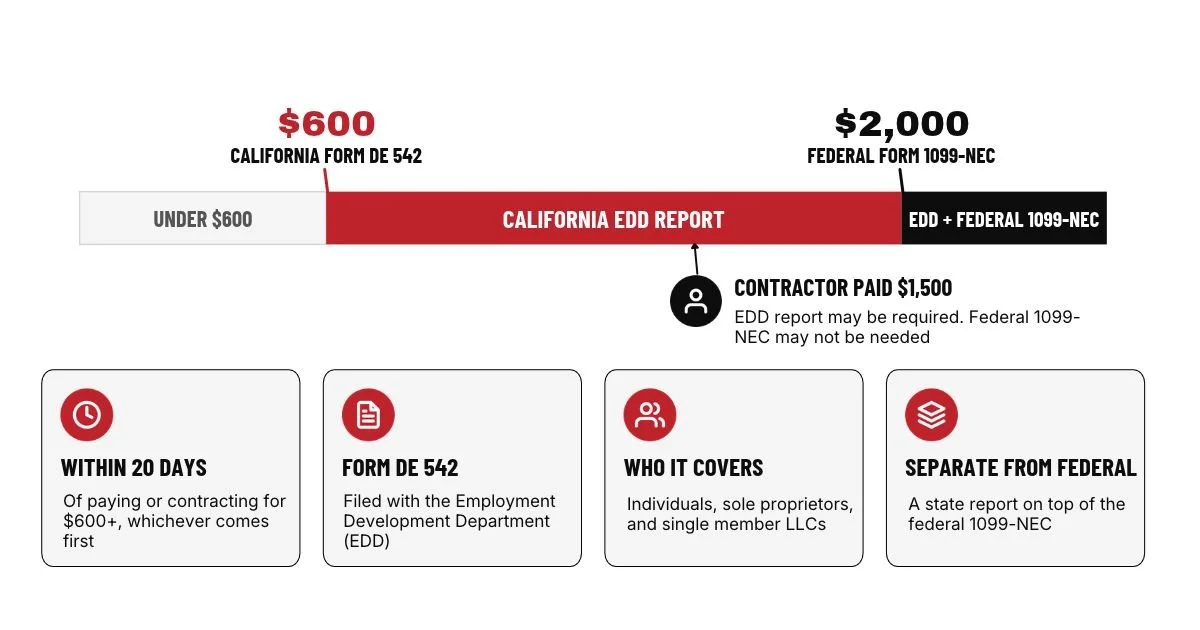
If your business is in California, the federal $2,000 threshold is not the only rule to watch. California generally requires businesses to report independent contractors to the Employment Development Department on Form DE 542 within 20 days of paying them $600 or more, or entering into a contract for $600 or more, whichever comes first.
This applies to contractors who are individuals, sole proprietors, or single member LLCs, and it is separate from the federal 1099-NEC. That means a California contractor you pay $1,500 may not need a federal 1099-NEC but may still need to be reported to the EDD.
Need Help Sorting Out Contractor Payments and 1099s

If you are not sure which contractors need a 1099, or you have missed 1099 filings in prior years, it may be possible to file the missing forms and request penalty relief where you qualify. Semper Tax Relief is led by an Enrolled Agent and Juris Doctor who can represent taxpayers before the IRS. We can review your contractor payments, help you understand your filing obligations, and work with you toward getting current.
Learn more about our 1099-NEC filing service.
Paying Independent Contractors, Frequently Asked Questions
-
For payments made in 2026, you can generally pay a contractor up to $1,999.99 for the year without issuing a 1099-NEC. Once your total payments to that contractor reach $2,000 or more, a 1099-NEC is generally required.
Card payments and payment app business payments are generally not counted toward that total.
-
Generally yes, if your total payments to that contractor reach $2,000 or more. Zelle does not issue Form 1099-K, so Zelle payments are generally treated like checks or bank transfers, and the 1099-NEC is generally your responsibility.
-
It depends on how you paid. Payments sent through the app's business or goods and services option are generally reported by the app on Form 1099-K, so you usually do not include them on a 1099-NEC.
Payments sent through the personal option may need to be counted toward your 1099-NEC total.
-
Generally no. Payments to S corporations and C corporations are generally exempt from 1099-NEC reporting.
The main exceptions are attorney fees and medical or health care payments, which may still be reportable.
-
Generally yes, if your total payments to the sole proprietor for services reach $2,000 or more during the year and were made by cash, check, direct deposit, or Zelle. Sole proprietors are not corporations, so the corporate exemption generally does not apply.
-
It is generally a good idea to collect Form W-9 before you make the first payment.
The W-9 gives you the contractor's legal name, Taxpayer Identification Number, and tax classification, which tells you whether a 1099 may be required. It is usually much harder to get a W-9 after the contractor has been paid in full.
-
Generally yes, if your total payments to that contractor for the year reach $2,000 or more. Paying in cash does not remove the reporting requirement, so keep a receipt or invoice for every cash payment.