
IRS Financial Hardship: How the IRS Reviews Income, Expenses, and Assets
If you cannot afford to pay your IRS tax debt, the IRS may review your complete financial condition before deciding what you are required to pay. This review usually includes your monthly income, necessary living expenses, available cash, property, vehicles, investments, retirement accounts, and equity in other assets.
The direct answer is that the IRS generally calculates your ability to pay by subtracting allowable monthly expenses from your monthly income. The IRS then reviews whether you have cash or equity in assets that could be used to reduce the tax debt without preventing you from paying necessary living expenses.
The result of this financial analysis may affect whether you qualify for Currently Not Collectible status, a Partial Payment Installment Agreement, a financially based payment plan, or an Offer in Compromise.
I have worked with IRS collection cases for nearly 20 years. One of the most important lessons I have learned is that a hardship request is not approved simply because someone says a payment would be difficult. The financial statement and supporting records must show why the proposed payment is not affordable.
At the same time, the IRS financial review is not always as simple as adding income and subtracting bills. The IRS may limit certain expenses, question unusual transactions, allocate household costs between spouses, and consider whether an asset could be sold or borrowed against.
My goal in this guide is to explain how that review works, what financial information the IRS may request, and how your income, expenses, and assets can affect the tax relief options available to you.

BRIEF SUMMARY
The IRS reviews income, allowable expenses, and asset equity.
Your actual expenses are not automatically accepted in full.
The IRS uses national and local financial standards for several expense categories.
Money remaining after allowable expenses is generally treated as monthly disposable income.
Owning a home, vehicle, or retirement account does not automatically disqualify you from hardship relief.
Different resolution programs use financial information in different ways.
The correct financial form and supporting records depend on your type of case.
What Does IRS Financial Hardship Mean?
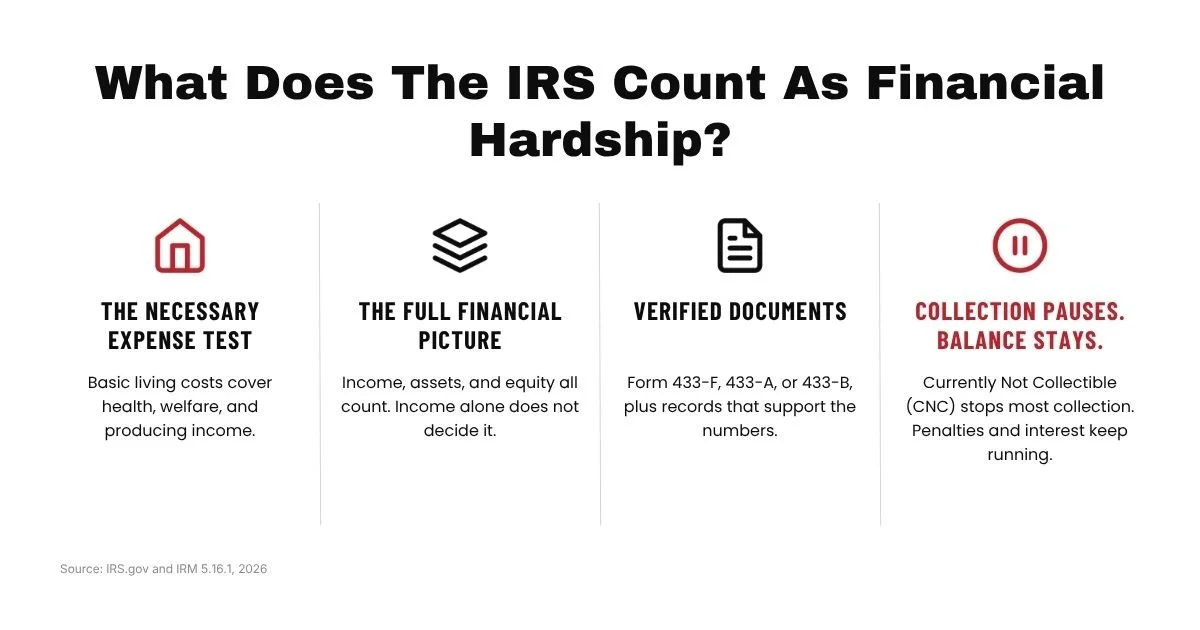
IRS financial hardship generally means that paying the tax debt would leave you unable to cover necessary living expenses for yourself and your family.
This does not mean that every financial inconvenience qualifies as hardship. The IRS looks at whether you can pay for basic health, welfare, and income producing needs after making a tax payment.
A taxpayer may have a high income and still experience hardship because of necessary medical care, childcare, housing costs, or other required expenses. Another taxpayer may have limited income but still have available cash or substantial equity in an asset.
The IRS therefore looks at the full financial picture rather than relying on income alone.
Hardship Is Based on Financial Evidence
When I prepare an IRS financial hardship request, I focus on evidence that can be verified.
That evidence may include pay statements, bank records, mortgage statements, rental agreements, medical bills, vehicle loan records, court orders, insurance statements, and business financial records.
The IRS may ask a taxpayer to complete Form 433 F, Form 433 A, or Form 433 B before approving a temporary delay in collection. It may also request documents that verify income, living expenses, bank accounts, property, and other assets.
Hardship Does Not Automatically Eliminate the Tax Debt
A temporary hardship determination may place an account in Currently Not Collectible status. This generally suspends most active collection while the taxpayer remains unable to pay.
The balance is not automatically forgiven. Penalties and interest may continue to increase, future refunds may be applied to the balance, and the IRS may later review whether the taxpayer’s financial condition has improved.
The IRS may also file a Notice of Federal Tax Lien while the account is in hardship status.
Hardship and Tax Filing Compliance
Before requesting a long term tax resolution, I normally confirm whether all required tax returns have been filed and whether current estimated taxes or payroll tax deposits are being paid.
A taxpayer should not create a new balance while asking the IRS to resolve an older balance.
In an immediate hardship situation, the IRS may sometimes consider temporary collection relief even when filing issues remain. That does not eliminate the obligation to file the missing returns or become current with future tax payments.
How Does the IRS Determine Your Ability to Pay Tax Debt?
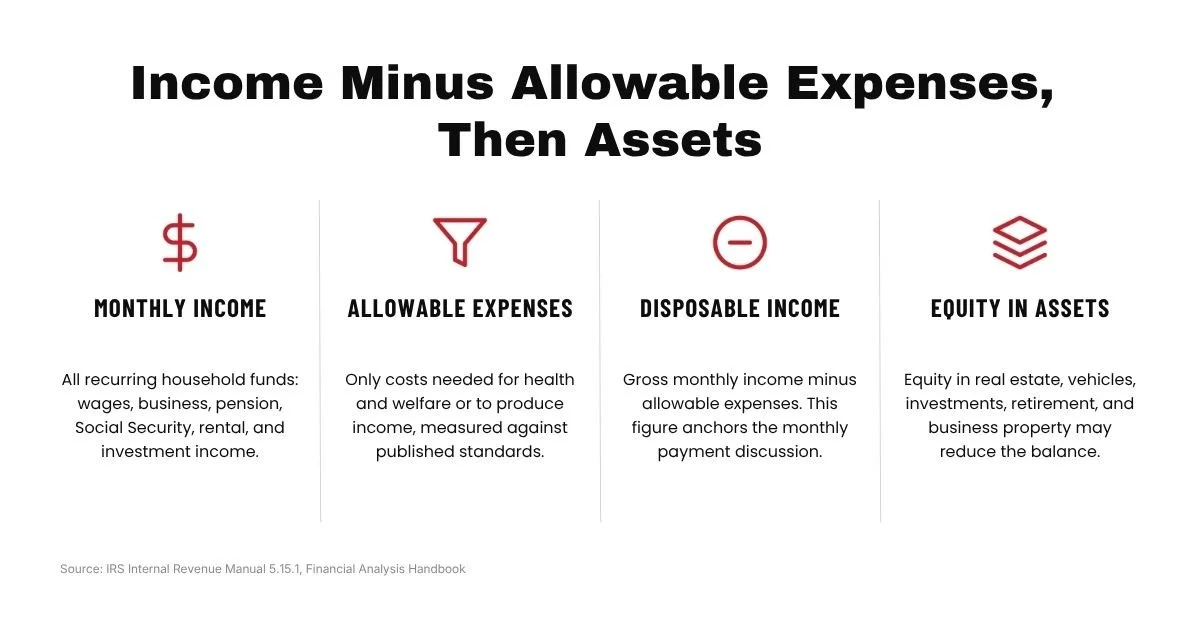
The IRS generally reviews four major financial areas when determining your ability to pay.
These areas are income, allowable expenses, monthly disposable income, and equity in assets.
The financial analysis may lead the IRS to request full payment, partial payment, a monthly installment payment, liquidation of an asset, or a temporary hardship determination.
The IRS Reviews Your Monthly Income
The IRS begins by identifying the income available to your household.
This may include wages, business income, pension income, Social Security income, rental income, interest, dividends, distributions, child support received, and other recurring funds.
The IRS will often compare the financial statement against tax returns, wage information, bank deposits, and other records.
A major difference between reported income and bank deposits may require an explanation.
The IRS Determines Which Expenses Are Allowable
The IRS does not simply subtract every bill that a taxpayer pays.
An expense generally must be necessary for the health and welfare of the taxpayer or family, or necessary for the production of income.
The IRS Financial Analysis Handbook separates expenses into allowable living expenses, other necessary expenses, and certain conditional expenses that may be considered based on the facts of the case.
The IRS Calculates Monthly Disposable Income
Monthly disposable income is generally the amount left after allowable expenses are subtracted from gross monthly income.
If the IRS determines that you have $600 remaining after allowable expenses, that amount may become the starting point for discussing an affordable monthly payment.
The final result can depend on the type of resolution being requested, the time remaining for collection, asset equity, and the facts of the case.
The IRS Reviews Available Assets
The IRS may review whether you have cash, investments, real estate, vehicles, business property, retirement funds, life insurance value, accounts receivable, or other assets that could be used to pay the debt.
The IRS may consider whether assets can be sold or used as collateral without causing hardship.
It may request full or partial payment from available assets before approving a reduced payment arrangement.
What Income Does the IRS Count?
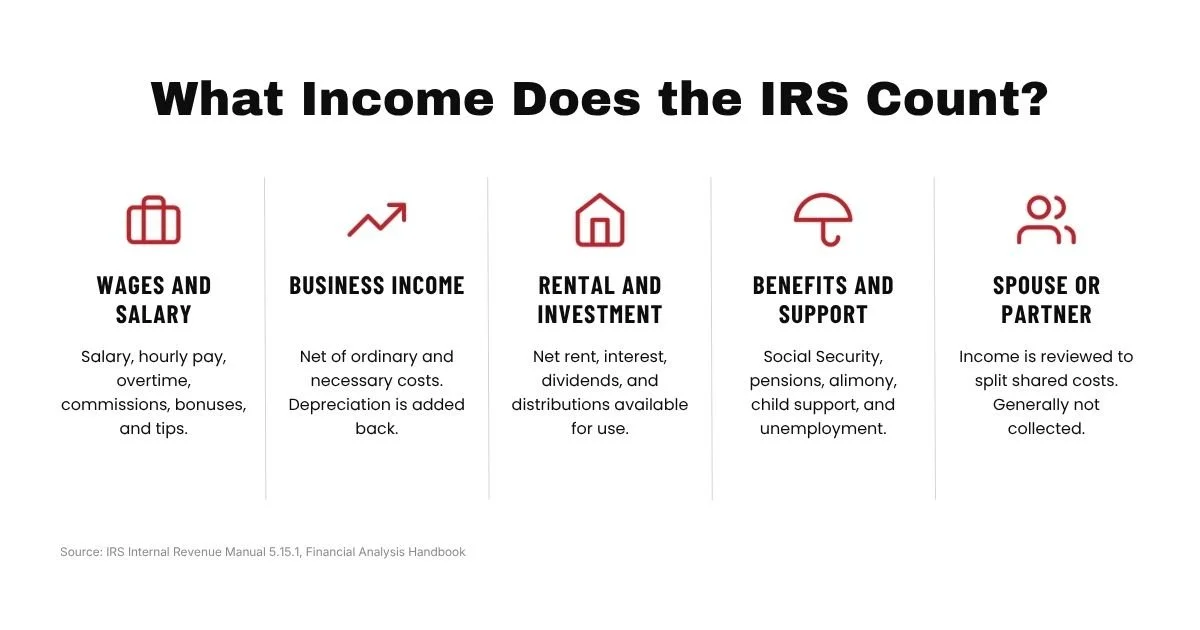
The IRS generally looks at recurring income available to pay household expenses and the tax debt.
Some income may not be taxable on a federal income tax return but may still be relevant to an IRS collection analysis.
Household income, including certain income that may be exempt from tax, can be considered when determining ability to pay.
Wages and Salary
Wages may include regular salary, hourly pay, overtime, commissions, bonuses, tips, and other compensation received from employment.
I normally review several recent pay statements rather than relying on one paycheck. This helps identify overtime, benefit deductions, retirement contributions, and changes in current income.
If income fluctuates, I may use a reasonable monthly average and explain why the selected period reflects the taxpayer’s current financial condition.
H3: Self Employment and Business Income
For a self employed taxpayer, the IRS generally looks at net business income after ordinary and necessary business expenses.
The financial review may include business bank statements, tax returns, a current profit and loss statement, merchant processing records, and accounts receivable.
Depreciation and other noncash tax deductions may reduce taxable income but may not reduce the cash available for an IRS payment calculation.
Allowable business expenses must generally be necessary to produce business income. Noncash expenses such as depreciation are not normally allowed when calculating payment potential.
Rental and Investment Income
Net rental income may be included after necessary rental expenses are considered.
Interest, dividends, partnership distributions, corporate distributions, and investment income may also be included when they are available for household use.
A taxpayer should be prepared to explain any large deposits that do not represent continuing income, such as loan proceeds, transfers between accounts, or the sale of an asset.
Social Security, Pension and Retirement Income
Social Security payments, pension payments, and regular retirement distributions may be included in the household income calculation.
The treatment of a retirement account as an asset is separate from the treatment of monthly retirement income.
A taxpayer may receive monthly retirement income while also owning a retirement account with additional value.
Support and Other Household Income
The IRS may consider alimony received, child support received, unemployment benefits, recurring family support, and other money regularly used for household expenses.
Income from a dependent child is generally treated differently from funds contributed by an independent adult living in the home.
Does the IRS Count My Spouse’s Income?
The answer depends on who owes the tax, how household expenses are shared, and whether community property rules apply.
When a taxpayer lives with a spouse or another person who is not liable for the tax debt, the IRS may review total household income to determine the taxpayer’s proper share of household expenses.
The nonliable person’s income and assets are generally not treated as money available to pay the taxpayer’s separate debt merely because they live together.
However, their contribution may affect how much of the rent, mortgage, utilities, food, and other shared expenses should be allocated to the taxpayer.
Community property law can change this analysis. California and several other states have community property rules that may affect what income or property is subject to collection.
What Living Expenses Does the IRS Allow?
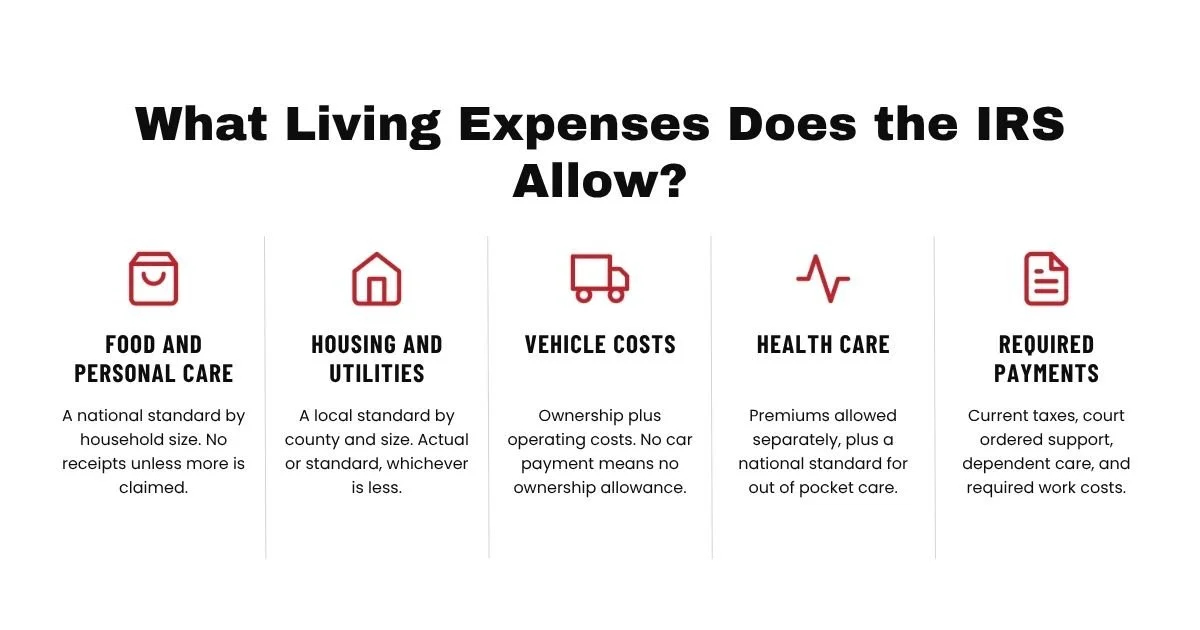
The IRS generally allows expenses that are necessary for health and welfare or for producing income.
The amount allowed may be based on the taxpayer’s actual expense, an IRS financial standard, or a documented amount that exceeds the standard because of special circumstances.
Food, Clothing and Personal Care
The IRS uses a national standard for food, housekeeping supplies, clothing, personal care, and miscellaneous expenses.
The standard is based on household size. A taxpayer generally receives the applicable standard without having to prove every grocery, clothing, or personal care purchase.
If the taxpayer claims more than the standard, the additional amount may need to be documented and shown to be necessary.
Housing and Utilities
Housing and utility expenses may include rent or mortgage payments, property taxes, homeowners insurance, maintenance, electricity, gas, water, telephone service, internet service, and certain other household costs.
The IRS uses local housing standards based on location and household size.
The amount allowed is generally limited to the actual verified expense or the applicable standard, whichever is lower, unless the taxpayer establishes that a higher amount is necessary and reasonable.
A taxpayer with high housing expenses should not assume the IRS will immediately require a move.
The financial review may consider the cost of moving, transportation changes, family needs, medical conditions, and other facts.
Vehicle Ownership and Operating Costs
Vehicle expenses are generally divided into ownership costs and operating costs.
Ownership costs may include a monthly car loan or lease payment.
Operating costs may include fuel, insurance, registration, maintenance, repairs, parking, and tolls.
The IRS generally compares actual vehicle expenses against the applicable transportation standard.
A taxpayer with no car payment normally does not receive a vehicle ownership allowance, although operating costs may still be allowed.
A single taxpayer is normally allowed expenses for one vehicle. Additional vehicles may be considered when they are necessary for another working household member, a dependent, medical care, or the production of income.
Health Insurance and Medical Costs
Health insurance premiums may be allowed as a separate expense.
The IRS also has a national standard for out of pocket health care costs. This may include medical services, prescription medication, eyeglasses, hearing aids, and medical supplies.
A taxpayer with expenses above the standard may be allowed more when the additional cost is necessary, reasonable, and documented.
Childcare and Dependent Care
Reasonable childcare may be allowed when it is needed so the taxpayer or spouse can work.
Care for an elderly or disabled dependent may also be allowed when there is no reasonable alternative.
The amount should be supported by payment records, invoices, provider statements, or other credible documentation.
Current Taxes
Current federal income tax withholding, state income tax withholding, Social Security taxes, Medicare taxes, and required estimated tax payments may be allowed.
The IRS generally expects the taxpayer to remain current with present tax obligations while resolving an older balance.
An excessive withholding amount may be adjusted if it regularly creates a large refund instead of covering the expected current tax.
Court Ordered Payments
Court ordered child support, alimony, and certain other court ordered payments may be allowed when the payments are required and are actually being made.
The court order alone may not be enough. The taxpayer may also need proof of current payment.
Education and Employment Expenses
Education expenses may be allowed when they are required as a condition of employment or are necessary for a child with special educational needs when a comparable public option is not available.
Required union dues, uniforms, professional licensing costs, and other mandatory employment expenses may also be considered.
Expenses the IRS May Question
The IRS may question private school tuition, voluntary retirement contributions, excessive vehicle payments, unsecured debt payments, charitable contributions, recreation costs, payments for property that is not necessary, and expenses paid for another person.
This does not mean every questioned expense will be denied.
It means that the expense may require an explanation, supporting documents, and a clear connection to health, welfare, income production, or the specific facts of the case.
What Are the IRS Collection Financial Standards?
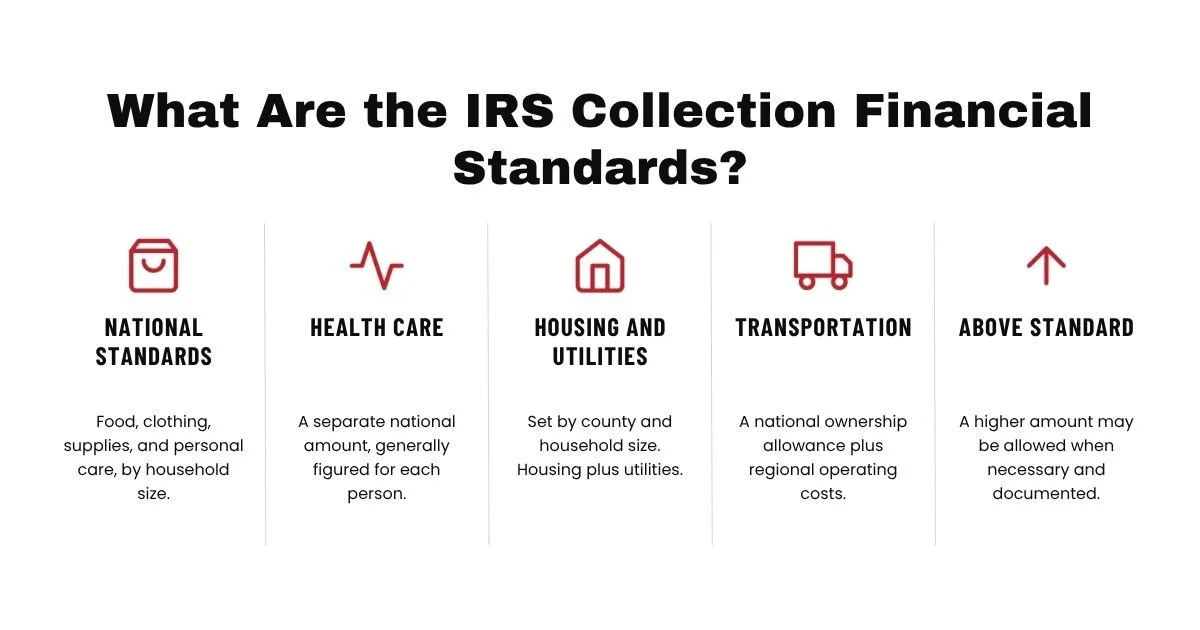
The IRS Collection Financial Standards are guidelines used when calculating a taxpayer’s ability to repay delinquent taxes.
They are not a complete household budget. They are part of a collection formula.
The standards are updated periodically. I use the standards in effect when the IRS is reviewing the case rather than relying on old figures found in a prior financial statement or online article.
National Standards
National standards generally apply to food, clothing, housekeeping supplies, personal care, miscellaneous expenses, and out of pocket health care.
The food, clothing, and personal care standard is based on household size.
The health care standard is generally calculated for each person in the household.
Local Housing and Utility Standards
Housing and utility standards vary by location and household size.
A homeowner in Orange County may have a different applicable standard than a taxpayer living in another California county or another state.
The standard can include mortgage or rent, property taxes, insurance, utilities, telephone service, internet service, and maintenance.
Transportation Standards
Transportation standards include a national ownership allowance and regional or local operating allowances.
The IRS normally uses the lower of the actual amount paid or the applicable standard unless a higher necessary amount is properly supported.
Actual Expenses Above the Standards
An expense above an IRS standard is not automatically rejected.
The taxpayer may be able to request a deviation by showing that the additional expense is necessary, reasonable, and supported by documentation.
Examples may include a medically required diet, unusually high prescription costs, a long employment commute, or housing needs related to a medical condition.
How Does the IRS Calculate Monthly Disposable Income?
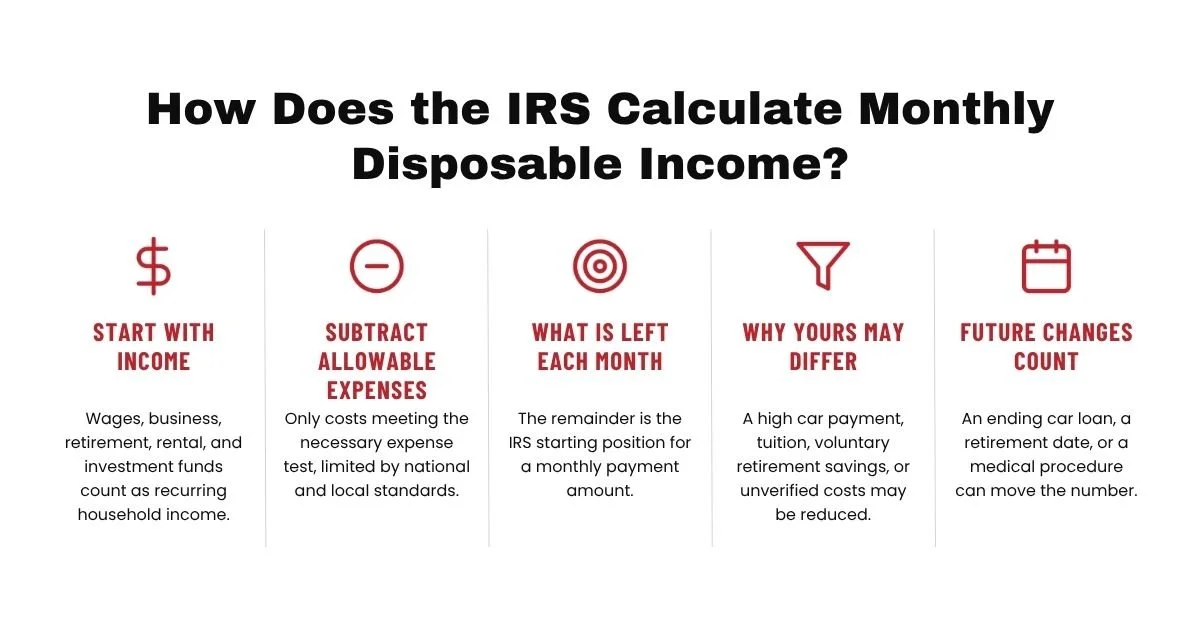
Monthly disposable income is generally calculated by subtracting allowable monthly expenses from monthly income.
This is one of the most important numbers in an IRS financial statement.
A taxpayer’s actual bank balance and monthly cash flow may feel very different from the IRS calculation because some actual expenses may be limited or excluded.
Simple Monthly Disposable Income Example
Monthly wages and other household income: $8,000
Allowable housing and utilities: $3,200
Allowable food and personal expenses: $1,700
Allowable transportation: $1,050
Insurance and medical expenses: $750
Current taxes and other necessary expenses: $900
Total allowable expenses: $7,600
Estimated monthly disposable income: $400
The IRS may begin with the position that $400 is available for a monthly tax payment.
That does not automatically mean the final payment will be exactly $400.
The case may require further analysis of future income changes, medical needs, asset equity, the collection expiration dates, or expenses that were not fully considered in the first calculation.
Why Your Calculation May Differ From the IRS
Your calculation may include every bill you currently pay.
The IRS calculation may exclude part of a high vehicle payment, private school tuition, voluntary retirement contributions, unsecured debt payments, or an expense that cannot be verified.
The IRS may also identify recurring income that was not included in the original financial statement.
H3: Future Changes Can Matter
A financial statement should reflect the taxpayer’s current condition, but known future changes may also matter.
Examples include an expiring vehicle loan, a scheduled retirement, the end of childcare expenses, a pending job loss, a medical procedure, or a temporary increase in business income.
I explain material changes rather than presenting numbers that create a misleading picture of the taxpayer’s actual ability to pay.
How Does Equity in Assets Affect IRS Financial Hardship?
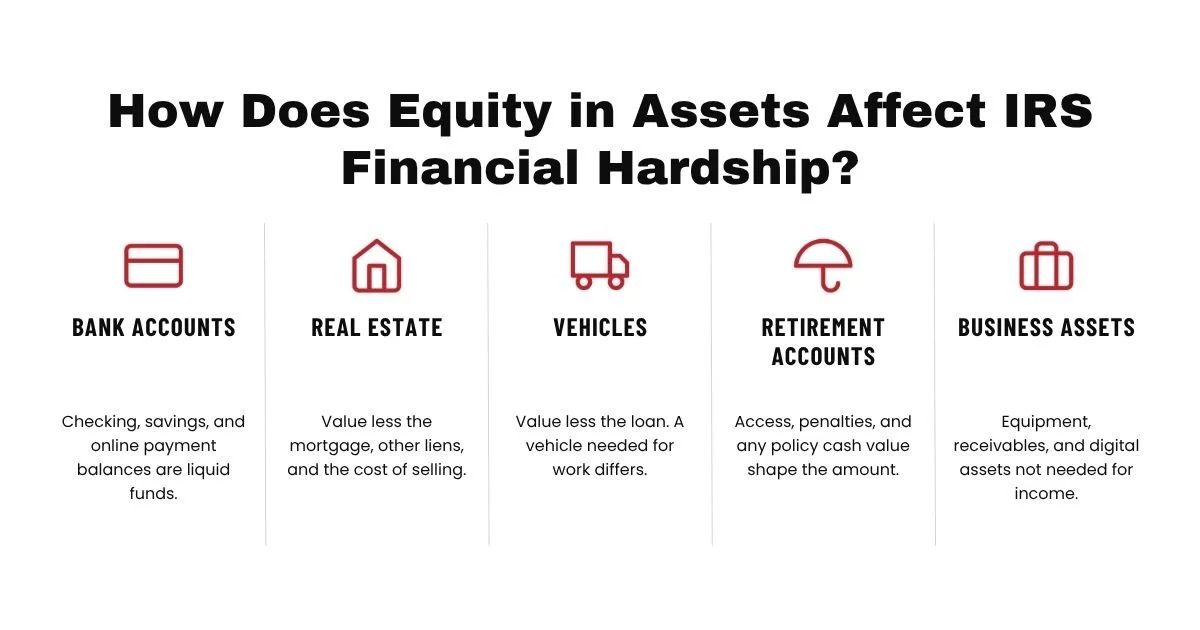
A taxpayer can have little or no monthly disposable income and still have assets that affect the hardship request.
The IRS may ask whether the asset can be sold, borrowed against, or otherwise used to pay part of the tax debt.
The important issue is usually not whether the taxpayer owns an asset. The issue is how much equity is available and whether using that equity would create a financial hardship.
Money in Bank Accounts
Checking accounts, savings accounts, online payment accounts, cash management accounts, and similar funds may be treated as liquid assets.
The IRS may review current balances and recent bank statements.
Large withdrawals, transfers, cash deposits, and payments to family members may require an explanation.
Home Equity and Real Estate
The IRS may review the fair market value of a home or other property, the mortgage balance, other valid liens, ownership percentage, and costs associated with selling or borrowing.
Owning a home does not automatically prevent a hardship determination.
A homeowner may have little usable equity, may be unable to qualify for financing, or may depend on the property for necessary housing.
The taxpayer’s age, health, income, family needs, and access to credit may affect the analysis.
Vehicles
The IRS may review the value of each vehicle and the related loan balance.
A normal vehicle needed for employment and family transportation is different from an additional vehicle with significant equity that is not needed for health, welfare, or income production.
The analysis should consider whether replacing or selling the vehicle would actually produce meaningful funds after paying the loan and replacement costs.
Retirement Accounts
Retirement accounts may be treated as assets.
However, the analysis can depend on the taxpayer’s age, retirement status, withdrawal restrictions, penalties, tax consequences, loan availability, and need for the account to provide future necessary living expenses.
The IRS may consider whether the taxpayer depends on the retirement funds, whether the account can be liquidated or borrowed against, and the cost associated with accessing the funds.
Life Insurance
Term life insurance generally does not have a cash value.
Whole life and other permanent policies may have cash surrender value or borrowing value that the IRS may review as an asset.
Business Assets
Business assets may include equipment, inventory, accounts receivable, cash, investments, vehicles, intellectual property, and ownership interests.
The IRS should consider whether an asset is needed to produce business income.
Selling a necessary piece of equipment may reduce the ability of the business to generate income and make future tax payments.
A nonessential business asset may receive different treatment.
Cryptocurrency and Digital Assets
Digital assets must be disclosed when requested on the applicable financial statement.
The IRS may consider their current value, ownership records, and whether the assets can be liquidated.
Which IRS Financial Form Will You Need?
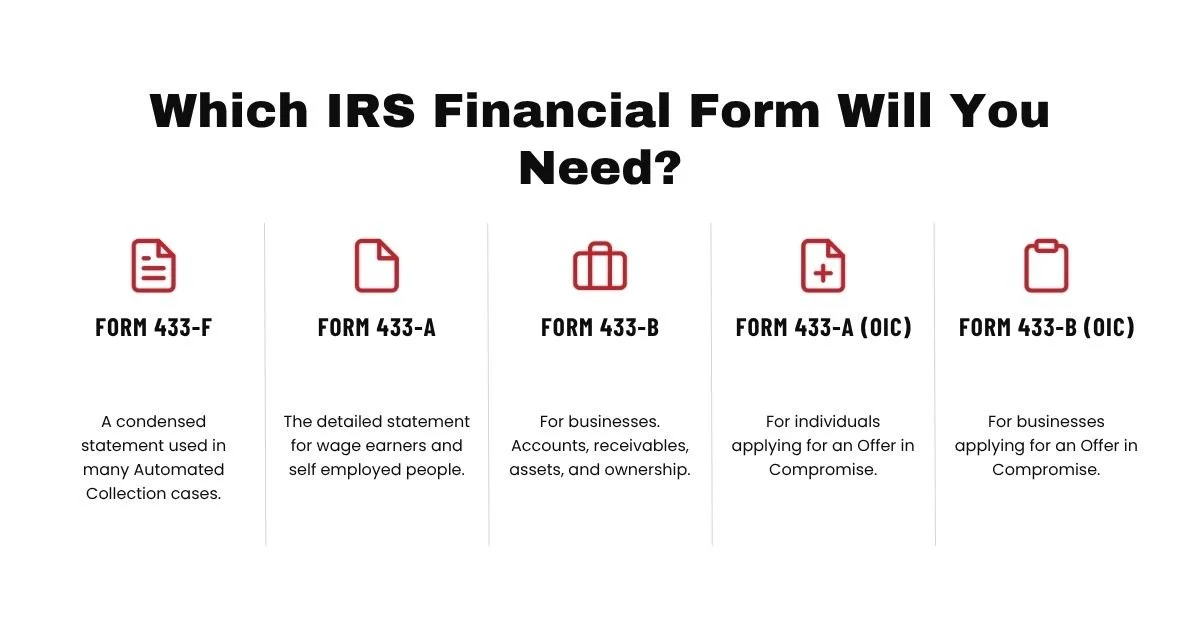
The required Collection Information Statement depends on the taxpayer, the collection department, and the type of resolution being requested.
Submitting the wrong form can delay the case or leave out information needed for the requested program.
IRS Form 433 F
Form 433 F is a condensed Collection Information Statement commonly used in certain IRS collection cases.
It requests information about bank accounts, investments, available credit, real estate, vehicles, income, and monthly living expenses.
It may be used when discussing a financially based installment agreement or hardship request with the Automated Collection System.
IRS Form 433 A
Form 433 A is a detailed Collection Information Statement for wage earners and self employed individuals.
It requests personal information, employment information, assets, income, expenses, and business information when the taxpayer is self employed.
The IRS may request verification such as tax returns, pay statements, bank records, investment statements, loan statements, and recurring bills.
IRS Form 433 B
Form 433 B is used for businesses.
It requests business bank accounts, receivables, assets, credit sources, income, expenses, and ownership information.
A business case may also require separate personal financial statements from responsible individuals.
IRS Form 433 A OIC
Form 433 A OIC is used by individuals applying for an Offer in Compromise based on collectibility or certain hardship grounds.
The Offer in Compromise calculation uses a specific method for determining asset value and future income.
A standard Form 433 A calculation may not produce the same result.
IRS Form 433 B OIC
Form 433 B OIC is used by businesses applying for an Offer in Compromise.
It focuses on business income, expenses, assets, receivables, ownership interests, and available equity.
Why the Correct Form Matters
Each form asks different questions and may be evaluated under different procedures.
Before preparing a financial statement, I identify the tax periods involved, the collection department handling the case, the taxpayer’s filing status, business ownership, and the resolution being requested.
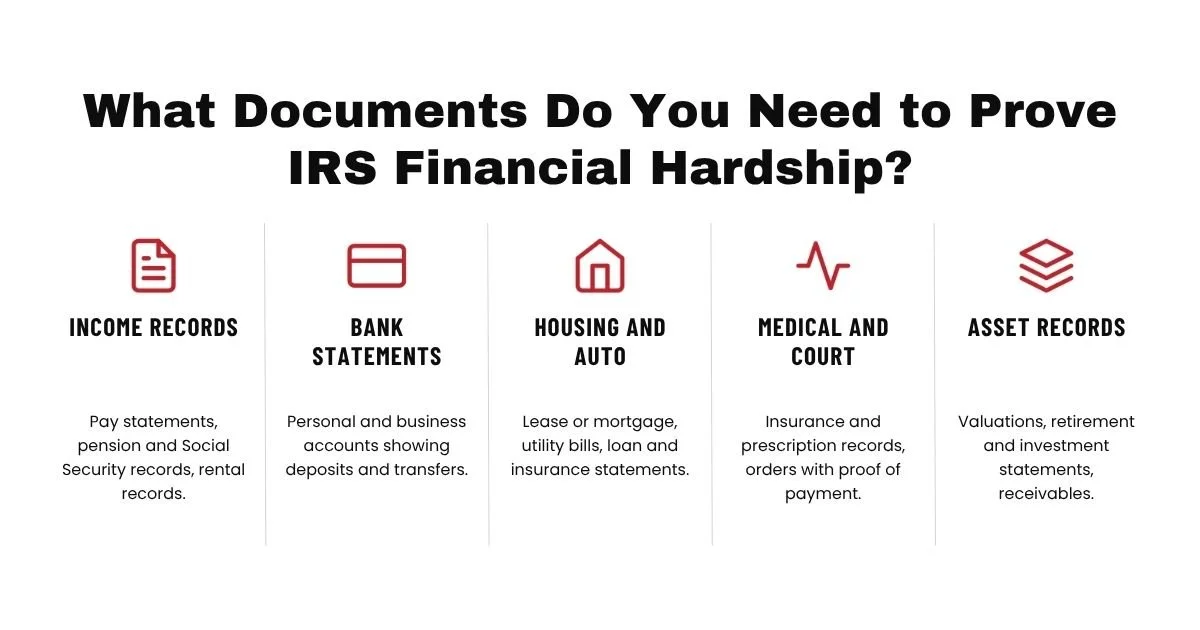
What Documents Do You Need to Prove IRS Financial Hardship?
A complete financial statement should be supported by records that match the numbers being reported.
The exact documents depend on the case.
The IRS may verify some information internally and request additional records when an amount appears inconsistent, unusual, or above an applicable standard.
Income Records
Common income records include recent pay statements, pension statements, Social Security records, unemployment statements, profit and loss statements, rental records, and evidence of support received.
Bank Statements
The IRS may request personal and business bank statements.
The statements should be reviewed for recurring deposits, large transfers, electronic payment accounts, loan proceeds, and transactions that require an explanation.
Housing Records
Housing records may include a lease, mortgage statement, property tax bill, homeowners insurance statement, utility bills, and documents showing homeowner association payments.
Vehicle Records
Vehicle records may include loan statements, lease agreements, insurance statements, registration records, and evidence supporting unusually high operating expenses.
Medical and Insurance Records
These records may include health insurance statements, prescription receipts, medical bills, payment plans, and proof of recurring care.
Only the financial information needed to support the expense should be provided.
Sensitive medical details should be limited when they are not necessary to establish the cost or hardship.
Court Orders and Required Payments
Court ordered payments should be supported by the order and proof that payments are currently being made.
H3: Business Records
Business owners may need current profit and loss statements, bank statements, merchant processor reports, accounts receivable lists, payroll records, loan statements, and documents supporting major business expenses.
Asset Records
Asset records may include property valuations, mortgage balances, retirement statements, investment statements, life insurance cash value statements, digital asset records, and business asset schedules.
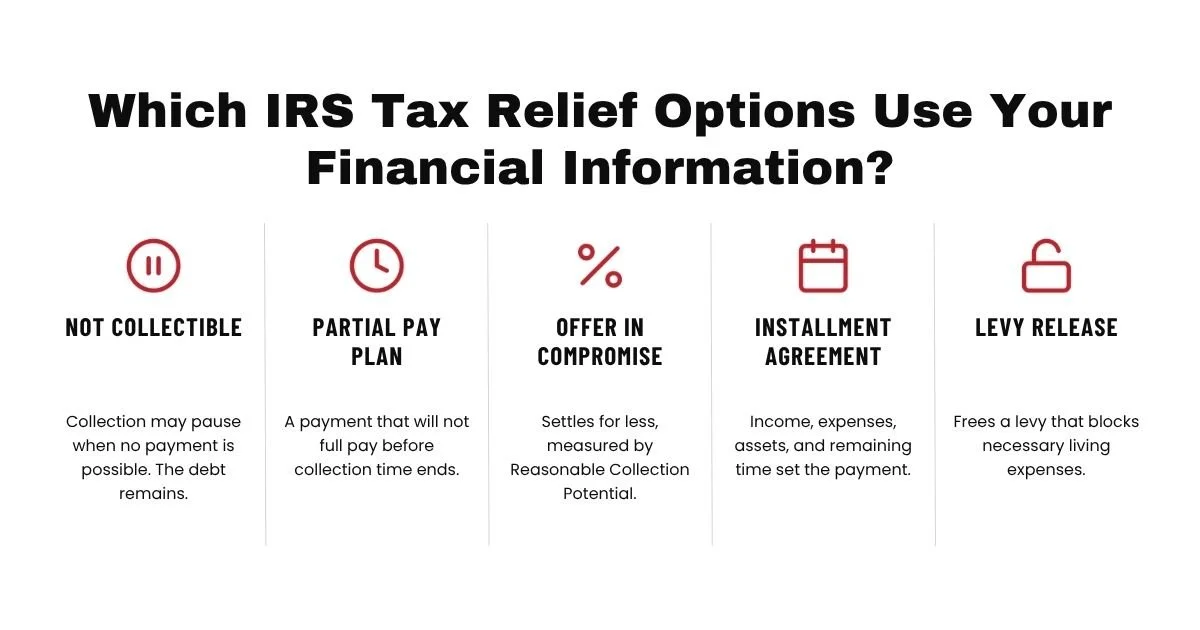
Which IRS Tax Relief Options Use Your Financial Information?
Several IRS tax debt resolution programs rely on financial information.
The same income, expense, and asset facts can produce different results depending on the program being requested.
Currently Not Collectible Status
Currently Not Collectible status may be considered when the taxpayer cannot make a payment after necessary living expenses are covered.
The IRS may temporarily suspend most collection activity, but the tax remains due.
Interest and penalties may continue, refunds may be applied to the debt, and the financial condition may be reviewed later.
Partial Payment Installment Agreement
A Partial Payment Installment Agreement may be considered when the taxpayer can afford a monthly payment but cannot fully pay the tax debt before the collection period expires.
The IRS may periodically review the taxpayer’s financial condition and adjust the payment if the ability to pay changes.
Offer in Compromise
An Offer in Compromise may allow a qualifying taxpayer to settle for less than the full balance.
For an offer based on doubt as to collectibility, the IRS examines available asset value and anticipated future income after allowable living expenses.
The IRS refers to this measurement as Reasonable Collection Potential.
A taxpayer who can fully pay through assets, an installment agreement, or another reasonable method will generally have difficulty qualifying for an offer based solely on inability to pay.
Financially Based Installment Agreement
Some taxpayers qualify for an installment agreement without a complete financial statement.
Other cases require the IRS to review income, expenses, assets, and the time remaining for collection before setting the payment.
The payment may be higher than the taxpayer expects when the IRS limits expenses or identifies available asset equity.
Hardship Levy Release
When an IRS levy prevents a taxpayer from paying necessary living expenses, the taxpayer may request a hardship release.
The IRS may require immediate financial information and supporting records to determine whether the levy is creating economic hardship.
A levy release addresses the immediate collection action.
It does not automatically resolve the underlying tax debt.
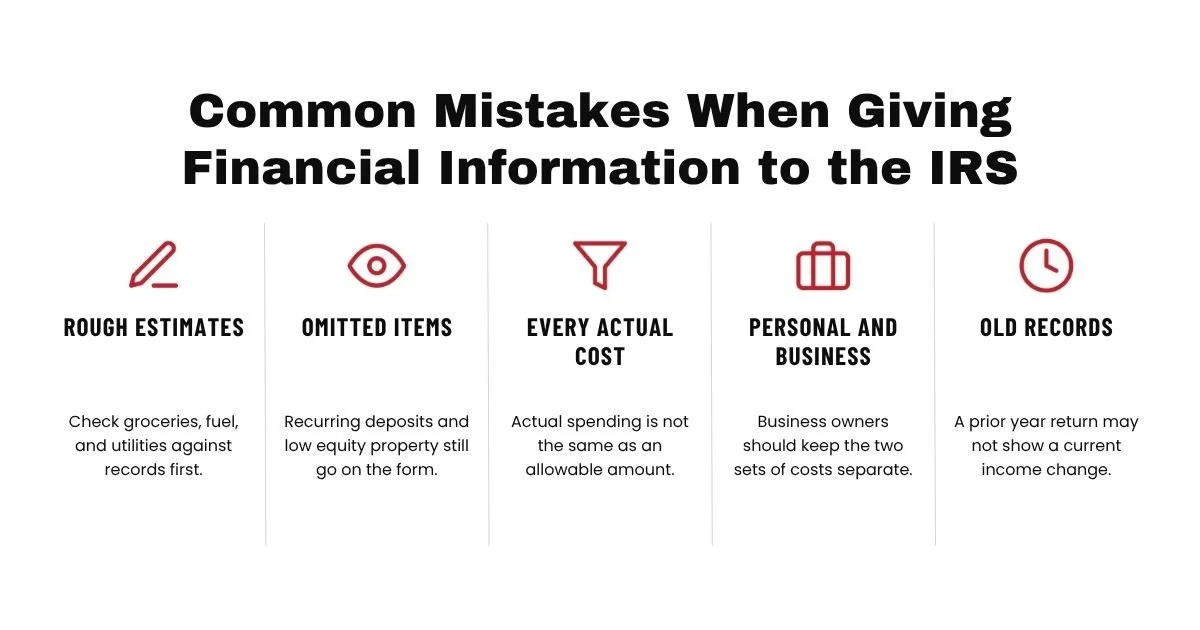
Common Mistakes When Giving Financial Information to the IRS
Financial disclosure should be accurate, complete, and consistent.
A careless statement can result in an unaffordable payment, a denied hardship request, or additional questions from the IRS.
Using Estimates Without Reviewing Records
A taxpayer may estimate groceries, fuel, utilities, or business income from memory.
Those estimates may be materially different from the records.
I compare the financial statement against bank activity, bills, and income records before giving the numbers to the IRS.
Leaving Out Income
Recurring deposits, cash income, rental income, business distributions, or family support may be identified during the review.
Income should not be excluded merely because it is not reported on a wage statement.
Leaving Out Assets
The IRS financial forms ask about bank accounts, real estate, investments, vehicles, digital assets, insurance value, business interests, trusts, and transferred property.
An asset with little value or no available equity may still need to be disclosed.
Claiming Every Actual Expense as Allowable
A taxpayer may actually pay $1,200 each month on credit cards or $1,500 on a vehicle.
That does not automatically mean the entire payment will be allowed in the IRS calculation.
The purpose of the debt and the applicable financial standards matter.
Failing to Explain Expenses Above the Standards
An expense above the standard should be supported with records and an explanation showing why it is necessary.
Submitting the higher amount without support makes it easier for the IRS to limit the expense.
Mixing Personal and Business Expenses
Business owners should separate personal spending from ordinary and necessary business expenses.
Duplicate deductions can occur when the same expense is listed on the business statement and again as a personal living expense.
Using Old Financial Information
A prior year tax return may not reflect a current job loss, business decline, medical condition, new dependent, or increase in income.
The IRS is evaluating the current ability to pay, supported by current records.
Requesting the Wrong Resolution
A taxpayer with no monthly disposable income may focus only on an Offer in Compromise when Currently Not Collectible status may provide more immediate relief.
Another taxpayer may request hardship status even though accessible asset equity supports partial payment.
I compare the available programs before selecting the request.
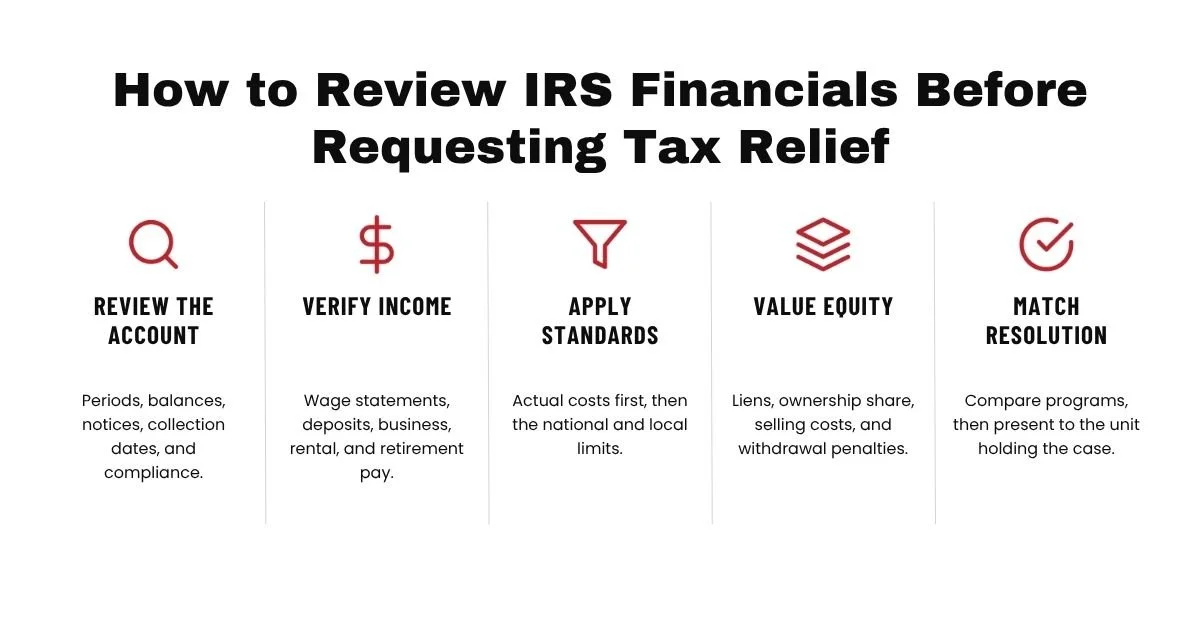
How I Review IRS Financials Before Requesting Tax Relief
I do not begin by forcing a taxpayer into a specific program.
I begin by determining what the IRS can legally collect, what the taxpayer can realistically pay, and what resolution is supported by the records.
Step 1, Review the IRS Account
I review the tax periods, balances, collection status, notices, penalties, assessment dates, and available collection expiration information.
The amount owed is only one part of the analysis.
Step 2, Confirm Filing and Current Payment Compliance
I identify missing returns and determine whether current withholding, estimated payments, or payroll tax deposits need to be corrected.
A resolution is more stable when the taxpayer is not creating a new balance.
Step 3, Verify Monthly Income
I review wage statements, bank deposits, business income, retirement income, rental income, and other household funds.
When income changes from month to month, I determine whether an average or another reasonable method best reflects current income.
Step 4, Review Actual Expenses
I calculate the household’s actual monthly expenses before applying IRS limitations.
This shows where the taxpayer’s cash is going and identifies expenses that may require stronger documentation.
Step 5, Apply IRS Financial Standards
I compare actual expenses against the current national and local standards.
When an expense exceeds the standard, I determine whether there is a factual basis for requesting a higher allowance.
Step 6, Review Asset Equity
I review bank funds, real estate, vehicles, investments, retirement accounts, insurance value, business assets, and other property.
I also consider loans, valid encumbrances, ownership percentage, selling costs, withdrawal penalties, and whether the asset is necessary for income or basic living needs.
Step 7, Calculate Monthly Disposable Income
I calculate the amount remaining after allowable expenses.
I then compare that amount against the tax balance, collection time remaining, and possible resolution programs.
Step 8, Compare the Available Resolutions
I compare Currently Not Collectible status, a Partial Payment Installment Agreement, an Offer in Compromise, a standard installment agreement, and other available strategies.
The lowest payment is not always the best long term result.
Step 9, Prepare the Financial Statement and Supporting Package
The financial statement should tell one consistent story.
Income should match the records. Expenses should be organized. Asset values should be supportable. Special circumstances should be explained clearly.
Step 10, Present the Request to the Correct IRS Department
The approach may differ depending on whether the case is assigned to the Automated Collection System, a Revenue Officer, the Offer in Compromise unit, or IRS Appeals.
Understanding who controls the case helps determine which form, supporting records, and procedure should be used.
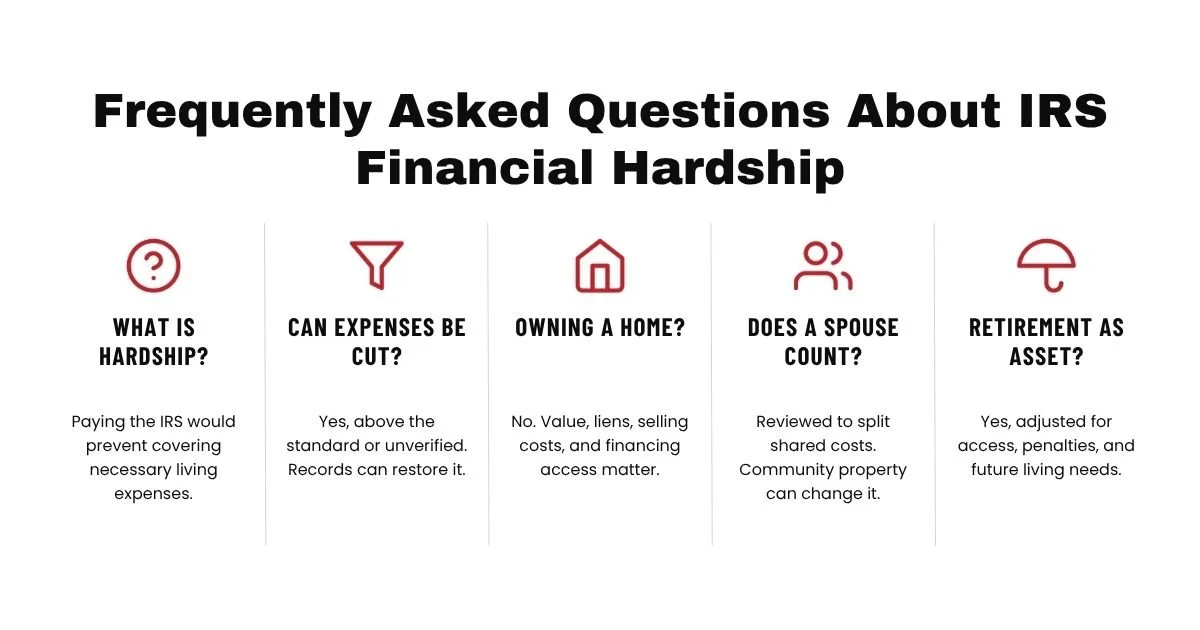
Frequently Asked Questions About IRS Financial Hardship
-
Financial hardship generally exists when paying the IRS would prevent a taxpayer from covering necessary living expenses.
The IRS may compare household income against allowable costs for housing, food, transportation, health care, current taxes, childcare, and other required expenses.
The IRS may also review available cash and asset equity.
A taxpayer may have a monthly shortfall but still have an asset that can be used to pay part of the debt.
The final decision depends on the complete financial condition rather than one income number or one expense.
-
The IRS generally calculates gross monthly income and subtracts allowable monthly expenses.
The amount remaining is monthly disposable income.
The IRS may then review available cash, property equity, retirement funds, investments, business assets, and the amount of time remaining to collect the debt.
The payment amount can also depend on the type of installment agreement or tax relief program being considered.
-
The IRS can limit an expense when it exceeds the applicable standard, is not necessary for health or welfare, is not required to produce income, or is not properly supported.
However, an expense above the standard may still be allowed when the taxpayer provides documentation and establishes that the amount is necessary and reasonable.
A medical condition, special dietary requirement, employment need, or family circumstance may support a higher allowance.
-
Yes, owning a home does not automatically disqualify you.
The IRS may examine the home’s value, mortgage balance, other liens, selling costs, ownership percentage, and access to financing.
The IRS should also consider whether selling or borrowing against the home is realistic and whether doing so would create hardship.
A taxpayer with little usable equity may receive different treatment from a taxpayer who owns substantial accessible equity.
-
The IRS may review your spouse’s income to determine how shared household expenses should be allocated.
A nonliable spouse’s income is generally not automatically treated as money available to pay your separate tax debt.
However, the IRS may determine that the spouse pays part of the rent, mortgage, utilities, food, or other household costs.
Community property laws may also affect the result.
California taxpayers should receive a review that considers applicable community property rules.
-
Retirement accounts may be treated as assets.
The IRS may consider whether the account can be withdrawn, borrowed against, or accessed only after separation from employment.
Age, penalties, income tax consequences, retirement status, and the need for future living expenses may affect the equity calculation.
A retirement account should not be excluded from the financial statement merely because it is intended for retirement.
-
Form 433 F is a shorter Collection Information Statement often used in certain collection cases.
Form 433 A is more detailed and is used for wage earners and self employed individuals when the IRS requires a more complete financial investigation.
Form 433 A includes detailed personal, employment, asset, income, expense, and business sections.
The IRS will normally identify which form is required based on the case and resolution request.
-
There is no single fixed period that applies to every taxpayer.
The IRS may later review whether the taxpayer’s financial condition has improved.
Collection may resume if the taxpayer becomes able to pay.
The debt may continue to increase through interest and applicable penalties, although the IRS collection period continues to run unless an event suspends or extends it.
Get Help Preparing Your IRS Financial Hardship Request
The numbers used in an IRS financial statement can determine whether you receive hardship status, an affordable payment, or a request to liquidate assets.
An incomplete statement may make your financial condition appear stronger than it really is.
An unsupported expense may be removed.
An overlooked asset may cause the IRS to question the accuracy of the entire submission.
I am Sergio Melendez, an IRS Enrolled Agent and Juris Doctor with nearly 20 years of tax experience.
I help taxpayers review their IRS accounts, organize financial records, calculate allowable expenses, evaluate asset equity, and select a resolution supported by the facts.
Semper Tax Relief assists taxpayers throughout the United States with IRS financial hardship requests, Currently Not Collectible cases, Partial Payment Installment Agreements, Offers in Compromise, tax payment plans, liens, levies, and years of unfiled tax returns.
Request a free case review to learn how the IRS may evaluate your income, expenses, assets, and ability to pay.