IRS LT16 Notice: How to Respond and Reduce Collection Risk
Received IRS Letter LT16? Learn what it means, how to respond, address missing returns, and compare options that may reduce collection risk.
An IRS LT16 Notice means the IRS is trying to collect unpaid taxes, believes one or more required tax returns are missing, or both.
The notice is serious because an unresolved account may progress to additional collection activity. Depending on the account and the notices already issued, that activity may include a Notice of Federal Tax Lien, a wage levy, a bank levy, or contact from an IRS Revenue Officer.
LT16 does not automatically mean that a levy has already been issued. It is also not always the final notice legally required before the IRS can levy property.
The best response is to read the notice carefully, follow the response instructions printed on your copy, verify the tax periods and balances, address any required returns, and compare the collection options available under your specific facts. Following the notice instructions may reduce enforcement risk, but it does not guarantee that every collection action will be suspended.
There is no single response period that applies to every LT16 notice. Use the date and instructions printed on the letter you received.
This post explains what an IRS LT16 notice means, how it may fit into the IRS collection process, how to respond, and what limitations apply to the main tax debt resolution options.

Brief Summary of the IRS LT16 Notice
The LT16 notice is an IRS collection notice concerning unpaid taxes, unfiled returns, or both.
It is a request for action. It is not a judgment about why the tax problem happened.
Responding may reduce the chance of additional collection activity. The result depends on the account status, prior notices, filing compliance, payment ability, and whether the IRS accepts the requested arrangement.
LT16 may concern an unpaid balance, missing tax returns, or both.
LT16 is serious, but it is not always the final notice legally required before a broad levy.
The response date printed on your notice controls. Do not assume that every LT16 notice provides the same deadline.
If a required return is missing, file it or explain why no return was required.
If you cannot pay in full, possible options may include a payment plan, a partial payment installment agreement, Currently Not Collectible status, or an Offer in Compromise.
A payment plan does not erase the debt. Interest and applicable penalties generally continue until the balance is paid.
Currently Not Collectible status may temporarily suspend most collection activity. It does not forgive the tax debt, and interest and penalties continue.
An Offer in Compromise may settle qualifying tax debt for less than the full amount. Submitting an offer does not guarantee acceptance.
Payroll tax cases may create added business and personal exposure. Receiving LT16 does not automatically mean that a Trust Fund Recovery Penalty has been assessed.
Keep copies of every notice, payment, return, submission, and IRS communication.
The IRS and the Taxpayer Advocate Service advise taxpayers to read collection notices carefully, respond, and review available payment or hardship options rather than ignore the account.
What Is an IRS LT16 Notice?
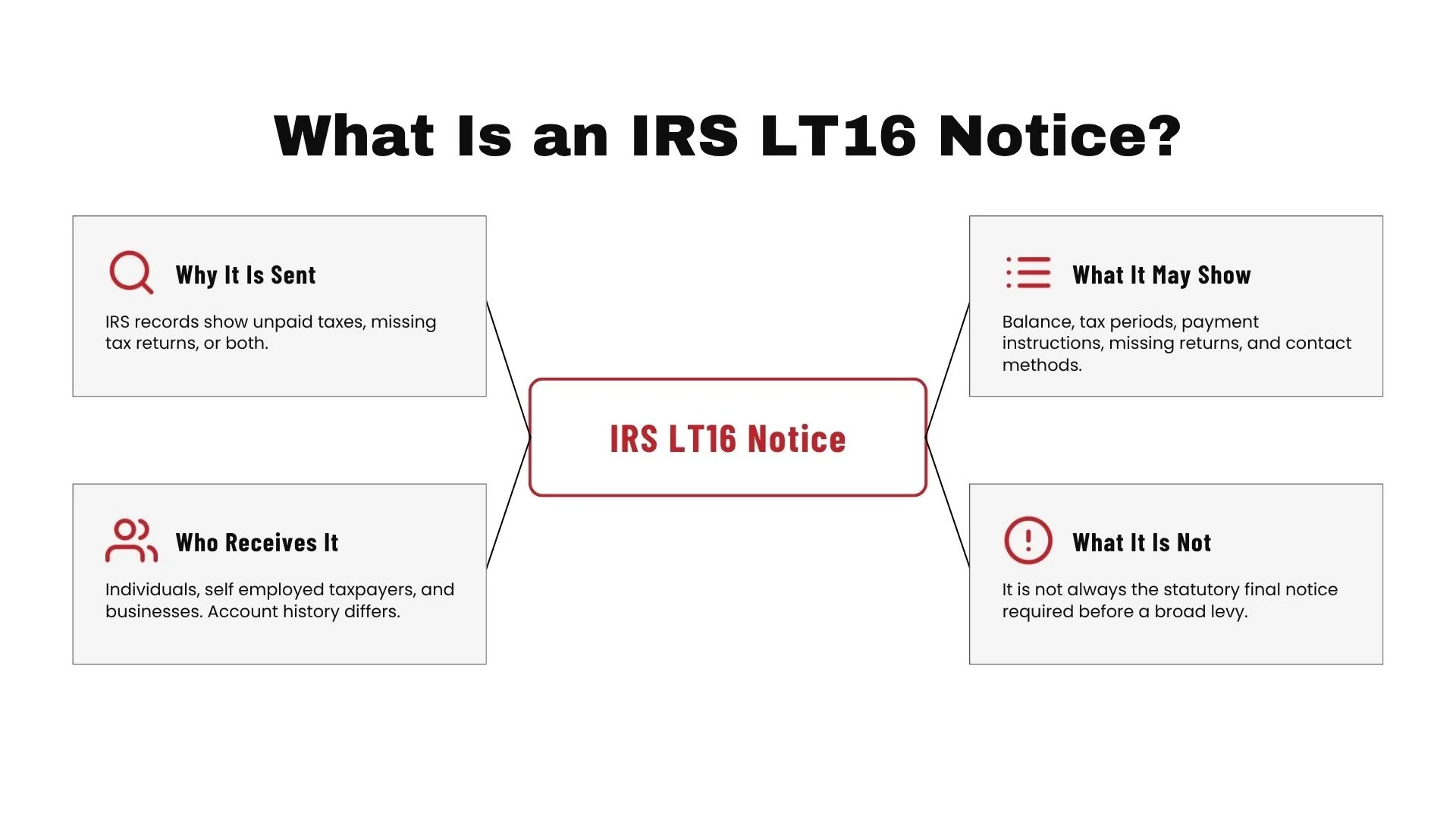
The IRS sends LT16 when its records show unpaid taxes, missing tax returns, or both.
The notice may identify the balance, tax periods, payment instructions, missing returns, and methods for contacting the IRS.
An LT16 notice may be sent to an individual taxpayer, a self employed taxpayer, or a business. The account history and collection stage can differ from one taxpayer to another.
What the LT16 Notice May Ask You to Do
The notice may ask you to take one or more of the following actions:
Pay the balance in full.
Pay what you can and request a payment arrangement for the remaining balance.
File tax returns the IRS shows as missing.
Contact the IRS if you disagree with the balance or believe a return was already filed.
Provide financial information if paying would prevent you from meeting necessary living expenses.
Following these instructions may reduce collection risk. It does not guarantee approval of a payment plan, hardship request, penalty request, or Offer in Compromise.
Is LT16 a Final Warning Before Enforced Collection?
LT16 may be described as a serious warning before additional collection action, but it is not always the statutory final notice before a levy.
In most cases, the IRS must provide a notice of intent to levy and an opportunity for a Collection Due Process hearing before it issues a broad levy.
LT11 and Letter 1058 are common notices that provide those hearing rights. Exceptions may apply in certain situations, including some state refund levies, federal contractor levies, jeopardy situations, and disqualified employment tax levies.
The practical point is that LT16 deserves prompt attention even when another legal notice may still be required.
How LT16 May Fit Into the IRS Collection Process
There is no universal IRS notice sequence that applies to every taxpayer.
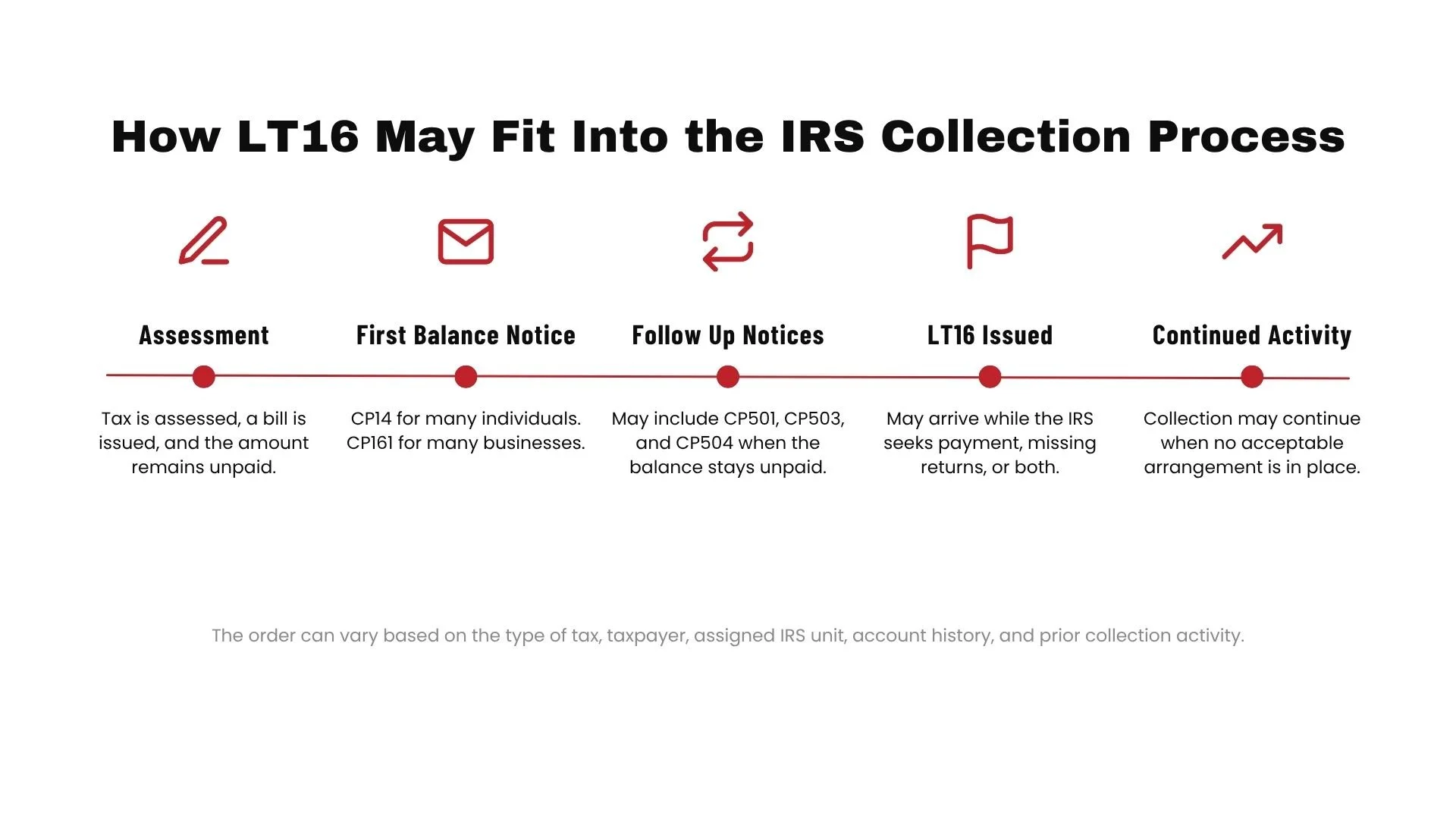
The IRS collection process generally begins after a tax is assessed, a bill is issued, and the amount remains unpaid. If the taxpayer does not pay or establish an acceptable arrangement, the IRS may continue collection activity.
For many individual taxpayers, the first balance due notice is CP14.
For many business taxpayers, the first balance due notice is CP161.
If the account remains unpaid, the IRS may send additional notices, which can include CP501, CP503, and CP504. LT16 may be issued while the IRS is seeking payment, missing returns, or both.
The order can vary based on the type of tax, taxpayer, assigned IRS unit, account history, and prior collection activity.
IRS CP and LT Notices Do Not All Carry the Same Rights
CP and LT are notice identifiers. They do not describe one single legal stage.
A billing notice requests payment.
A final notice of intent to levy may provide a specific Collection Due Process hearing deadline.
A Notice of Federal Tax Lien filing may create a separate hearing right.
Read the exact notice number and appeal language. Do not assume that every IRS collection notice provides the same rights or deadline.
Difference Between IRS LT11 and LT16 Notice
LT16 generally addresses unpaid taxes, missing returns, or both. It warns that additional collection activity may follow when the account remains unresolved.
LT11 is commonly used as a final notice of intent to levy and notice of the right to a hearing.
A timely Collection Due Process request is generally due within thirty days from the date of the final levy notice. The deadline and available rights should be confirmed from the actual notice.
If a taxpayer has both LT16 and LT11, the LT11 hearing deadline generally requires immediate review. Missing the deadline may affect the taxpayer’s right to later seek Tax Court review of the Appeals determination.
Can the IRS Levy After an LT16 Notice?
The IRS may eventually issue a levy after LT16 when all legal notice requirements have been satisfied and no restriction on levy applies.
A levy is a legal seizure of property or rights to property. Depending on the account, it may reach wages, bank funds, accounts receivable, certain federal payments, and other assets.
A federal tax lien is different. A lien is the government claim against property. A levy is the collection action used to take funds or property.
LT16 should be treated as a reason to review the account before it reaches a more advanced enforcement stage. Responding does not guarantee that a lien will not be filed or that all levy action will be suspended.
How to Read Your IRS Letter LT16
Do not focus only on the total balance.
Read the entire notice and identify every tax period, form, instruction, response method, and date.
Information to Locate on the Notice
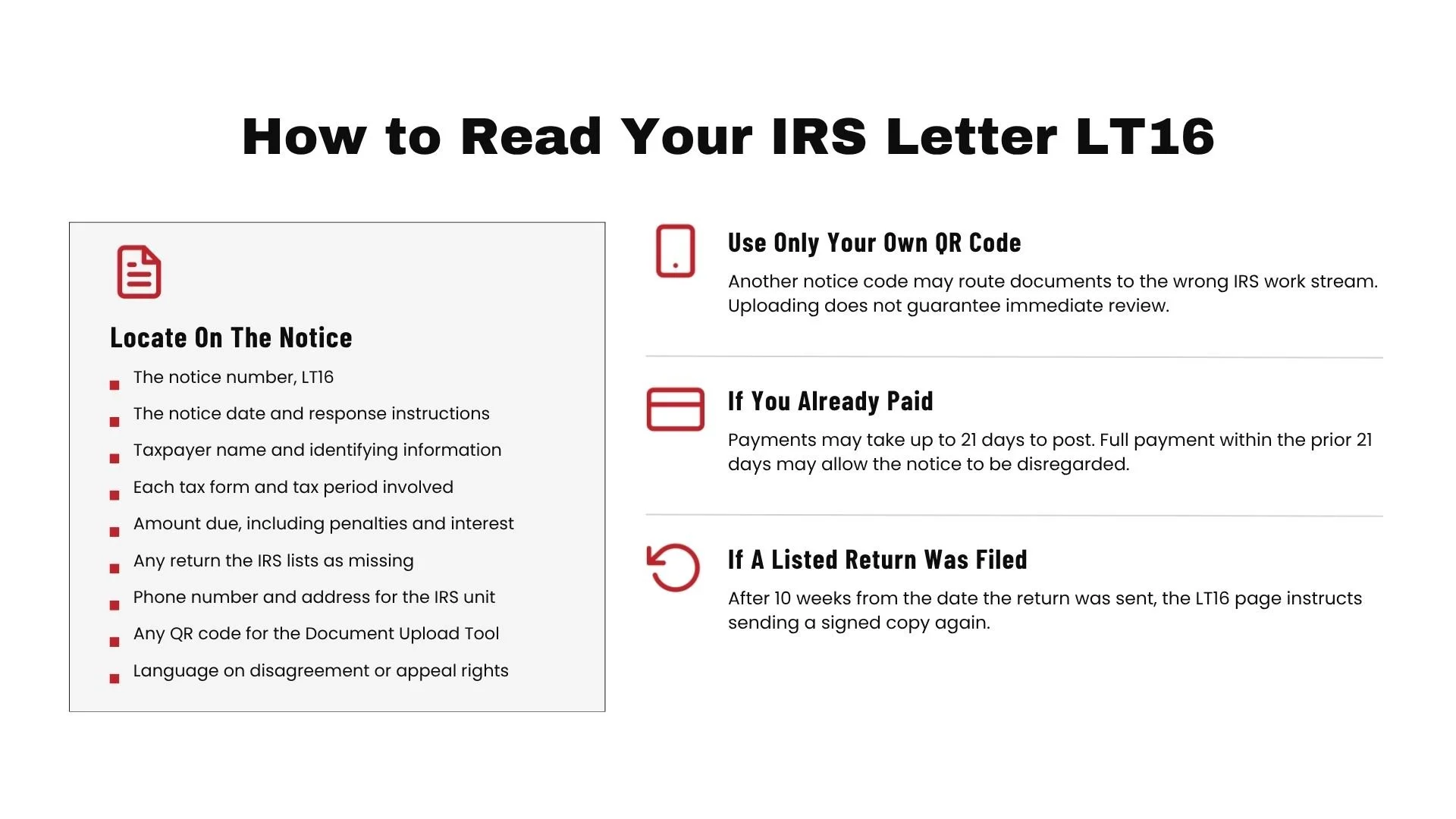
Look for the following information:
The notice number, LT16.
The notice date and response instructions.
The taxpayer name and identifying information.
Each tax form and tax period involved.
The amount due, including tax, penalties, and interest.
Any return the IRS lists as missing.
The phone number and address for the IRS unit handling the notice.
Any QR code or access code for the IRS Document Upload Tool.
Language explaining disagreement procedures or appeal rights.
Some current collection notices contain a QR code that connects to the IRS Document Upload Tool.
Use only the QR code printed on your specific notice. Using another notice’s code may direct the documents to the wrong IRS work stream. Uploading documents may provide a useful submission record, but it does not guarantee immediate review or approval.
If You Already Paid the Balance
Payments may take up to twenty one days to post to an IRS account.
The current IRS LT16 page states that a taxpayer who paid the balance in full within the prior twenty one days may disregard the notice.
Even then, review the IRS Online Account or transcript and keep proof of payment. A payment may have been delayed, rejected, or applied to the wrong tax form or period.
If the payment was applied incorrectly, contact the IRS with the payment date, amount, confirmation number, canceled check, or bank record.
If You Already Filed a Return Listed as Missing
First, confirm whether the return has posted to the IRS account.
The IRS LT16 page states that if more than ten weeks have passed since the return was sent, the taxpayer should send a signed copy again.
Follow the submission instructions on the notice and keep proof of delivery. Resubmitting a return does not guarantee a specific processing date.
If the return was filed recently, confirm its status before sending another copy. Duplicate submissions may create additional processing issues.
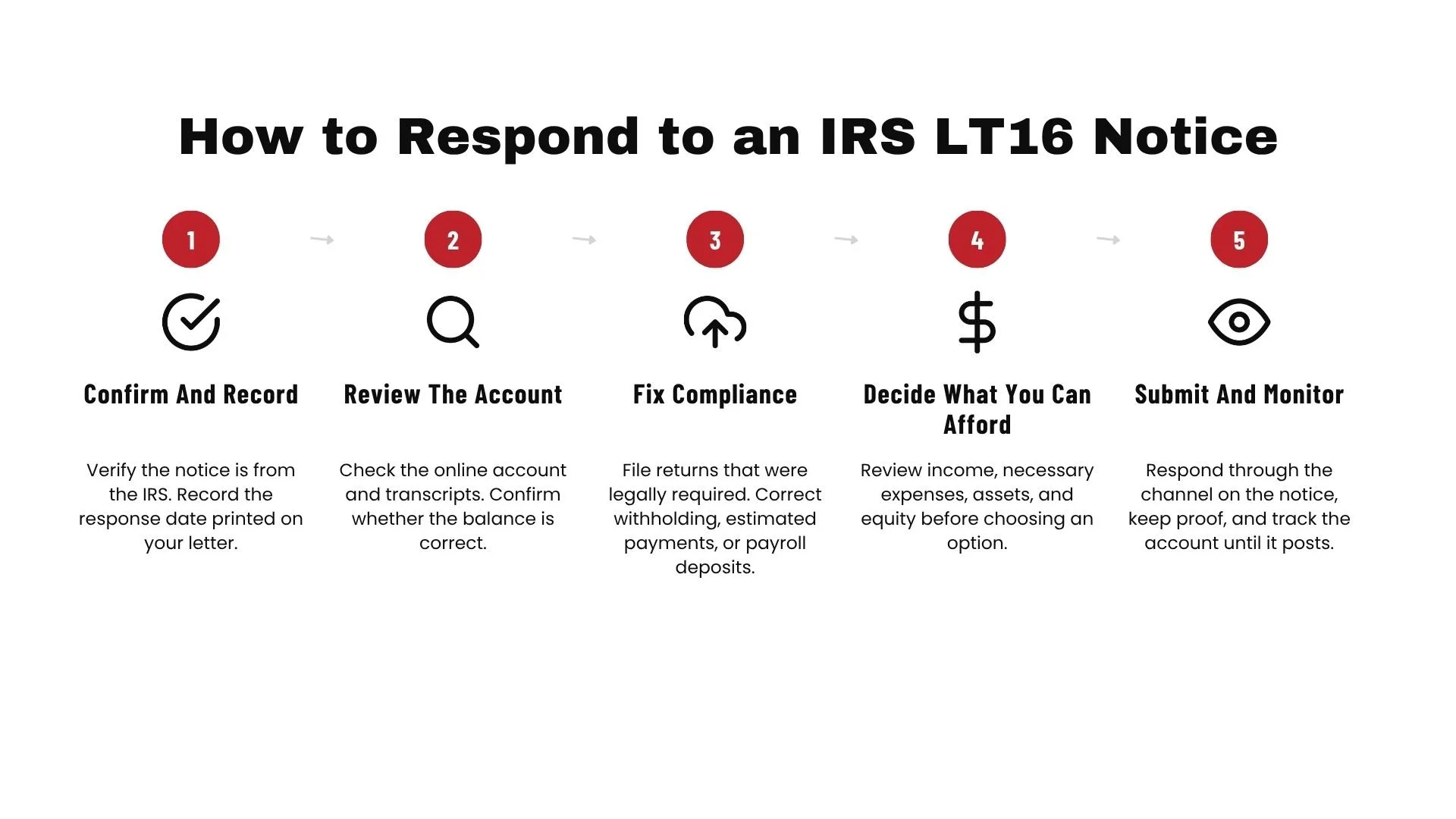
How to Respond to an IRS LT16 Notice
A complete response follows a clear order.
I begin with notice accuracy, then filing compliance, current tax compliance, financial ability, and collection strategy.
Step 1, Confirm the Notice and Record the Response Date
Verify that the notice is from the IRS.
Check the notice number, return address, tax periods, identifying information, and contact instructions.
Record the response date or requested action date shown on your letter.
The official LT16 page does not state one universal response period for every case. Do not substitute a general online timeline for the instructions on the actual notice.
If the date has passed, respond anyway. A missed date does not automatically remove every available option, but additional delay may increase collection risk.
Step 2, Review Your IRS Online Account and Transcripts
An IRS Online Account may show balances, payment history, notices, and other account information.
Account transcripts may help identify assessments, payments, penalties, posted returns, collection codes, and prior agreements.
For a business, review the Business Tax Account when available and compare the IRS information with payroll returns, deposit records, filed income tax returns, and prior correspondence.
A transcript is a record of account activity. It does not replace a review of the filed return, source documents, notice language, or applicable law.
Step 3, Confirm Whether the Balance Is Correct
Compare the LT16 notice with filed returns, amended returns, payment confirmations, prior agreements, and transcripts.
Possible issues may include:
A payment applied to the wrong tax year.
A payment applied to the wrong tax form.
A return that has not posted.
An amended return that remains under review.
An IRS prepared assessment that does not reflect available deductions or credits.
A joint liability that may involve innocent spouse relief.
A penalty that may qualify for administrative or reasonable cause relief.
A penalty relief request does not guarantee approval. The IRS reviews the type of penalty, account history, facts, documentation, and applicable legal standard.
If you disagree with the amount, contact the number on the notice and have supporting records ready. Depending on the issue and collection stage, Appeals review may be available.
Step 4, Address Missing Tax Returns
Read the notice carefully to identify which returns the IRS believes are missing.
Determine whether each return was legally required before filing it.
Filing requirements can depend on income, filing status, age, self employment income, entity type, payroll activity, and other facts.
If a return was required, prepare and file an accurate return.
The IRS states that taxpayers must be current with required filings to apply for the online payment agreement options described on its LT16 and payment plan pages. Offer in Compromise eligibility also generally requires all legally required returns and current required tax payments.
Filing a missing return does not guarantee that the balance will decrease. The result depends on the income, deductions, credits, payments, and law for that year.
Step 5, Correct Current Tax Compliance
Resolving old tax periods usually requires attention to current taxes.
A wage earner may need to adjust federal income tax withholding.
A self employed taxpayer may need to begin or correct estimated tax payments.
A business with employees may need to file current payroll returns and make required federal tax deposits.
Current compliance does not erase the older balance. It may prevent a new balance from interfering with a payment plan, hardship request, or Offer in Compromise.
Step 6, Determine What You Can Afford
Review monthly income, necessary living expenses, available cash, investments, vehicles, real estate, business assets, and other equity.
Ask these questions:
Can I pay the balance in full without creating a greater financial problem?
Can I make monthly payments while remaining current on new taxes?
Would the proposed payment prevent me from paying necessary household or business expenses?
Do my income and assets indicate that the IRS may expect more than I can comfortably pay?
The answers help identify which collection alternatives deserve review.
A personal budget does not automatically control the IRS decision. The IRS may apply financial standards, request documents, or make adjustments based on the account facts.
Step 7, Submit the Response Through the Correct Channel
Use the phone number, mailing address, fax number, online tool, or Document Upload Tool instructions shown on the notice.
Different IRS units handle different types of work. Sending documents to a general address may delay routing.
Keep a complete copy of everything submitted.
Retain fax confirmations, certified mail tracking, upload confirmations, payment records, and notes from each IRS contact.
Proof of submission shows that a response was sent. It does not prove that the IRS accepted the request or completed the requested account adjustment.
Step 8, Monitor the Account
IRS processing is not immediate.
A submitted return, payment, financial statement, payment plan request, hardship request, or Offer in Compromise may require time to post and be reviewed.
Check the online account and transcripts for changes.
Continue making required current tax payments.
Follow up after the processing period given by the IRS employee, notice, or submission instructions.
Waiting for IRS processing is not the same as ignoring the case. Continue monitoring until the requested action posts or the IRS issues a written decision.
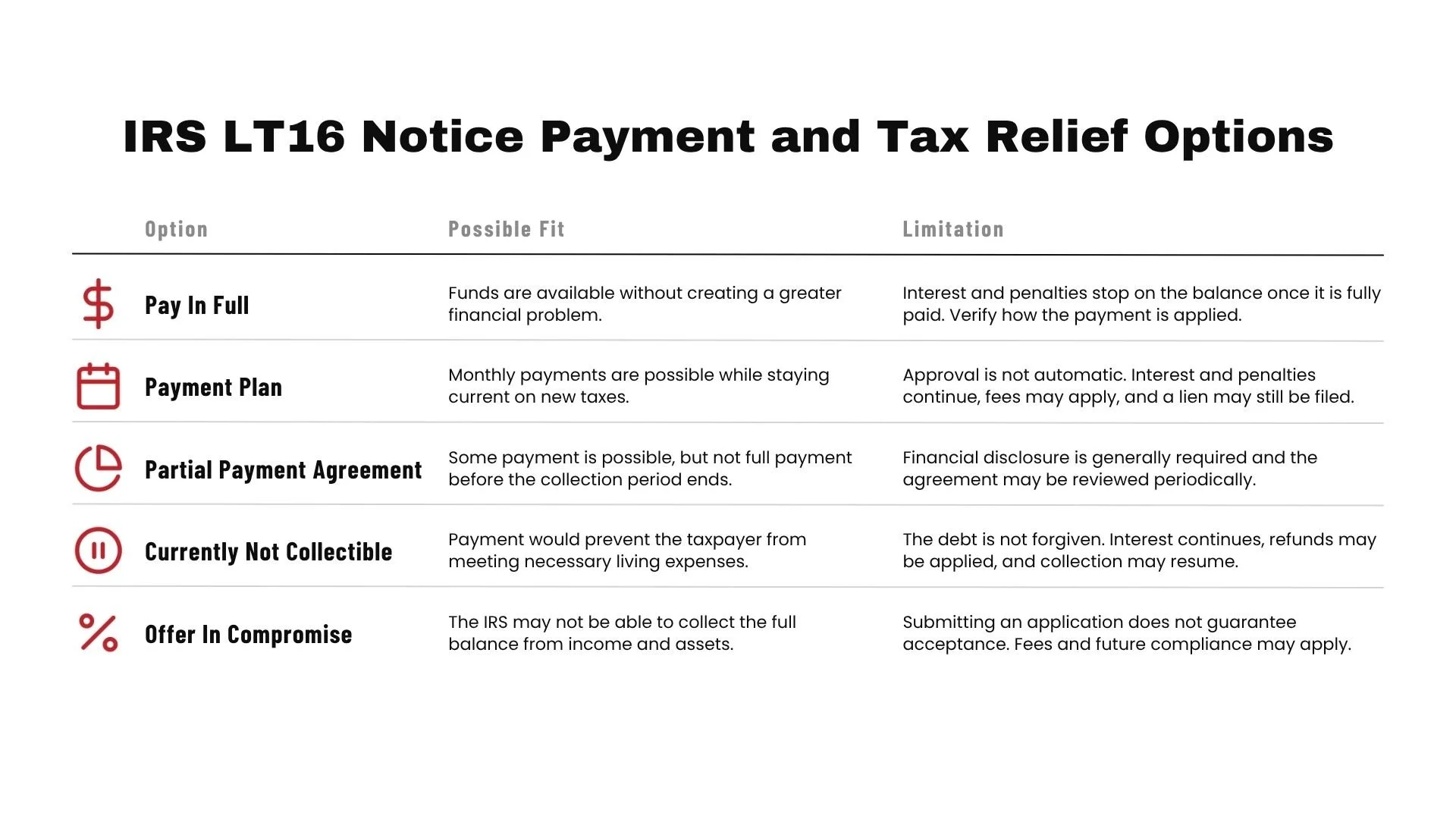
IRS LT16 Notice Payment and Tax Relief Options
The appropriate response depends on the balance, filing status, current compliance, income, expenses, assets, collection period, and type of tax.
No single tax relief option is appropriate for every taxpayer.
Comparison of the Main Options
OPTION
Pay in full
POSSIBLE FIT
Funds are available without creating a greater financial problem.
POSSIBLE EFFECT
Once the payment posts and fully pays the balance, additional interest and applicable penalties do not continue on that paid balance.
LIMITATION
The taxpayer must have enough available funds. Payment processing and application should still be verified.
OPTION
Short term payment plan
POSSIBLE FIT
An individual expects to pay the balance within one hundred eighty days.
POSSIBLE EFFECT
Provides additional time to pay.
LIMITATION
Interest and applicable penalties continue until the balance is fully paid. The taxpayer must be able to complete payment within the approved period.
OPTION
Simple payment plan
POSSIBLE FIT
An individual owes $50,000 or less in combined tax, penalties, and interest and has filed all required returns.
POSSIBLE EFFECT
Allows monthly payments over time when approved.
LIMITATION
Approval is not automatic in every circumstance. Interest and applicable penalties continue, user fees may apply, and the IRS may still file a Notice of Federal Tax Lien.
OPTION
Other installment agreement
POSSIBLE FIT
The taxpayer needs terms outside the online criteria.
POSSIBLE EFFECT
May provide a monthly arrangement after an IRS review.
LIMITATION
The IRS may require Forms 433 F, 433 A, 433 B, or other financial records. The proposed payment may be changed or rejected.
OPTION
Partial payment installment agreement
POSSIBLE FIT
The taxpayer can pay something but may not be able to fully pay before the collection period expires.
POSSIBLE EFFECT
May allow monthly payments that do not fully pay the assessed balance before the collection period ends.
LIMITATION
The IRS generally requires financial disclosure and may review the agreement periodically. Interest and penalties continue, and the payment may later change.
OPTION
Currently Not Collectible status
POSSIBLE FIT
Payment would prevent the taxpayer from meeting necessary living expenses.
POSSIBLE EFFECT
May temporarily suspend most active collection activity.
LIMITATION
It does not forgive or cancel the debt. Interest and penalties continue, refunds may be applied, the IRS may file a federal tax lien, and collection may resume if the financial condition improves.
OPTION
Offer in Compromise
POSSIBLE FIT
The IRS may not be able to collect the full balance from income and assets, or another recognized legal basis applies.
POSSIBLE EFFECT
May settle accepted tax debt for less than the full amount.
LIMITATION
Submitting an application does not guarantee acceptance. The IRS reviews eligibility, financial information, compliance, and ability to pay. Payments, fees, and future compliance requirements may apply.
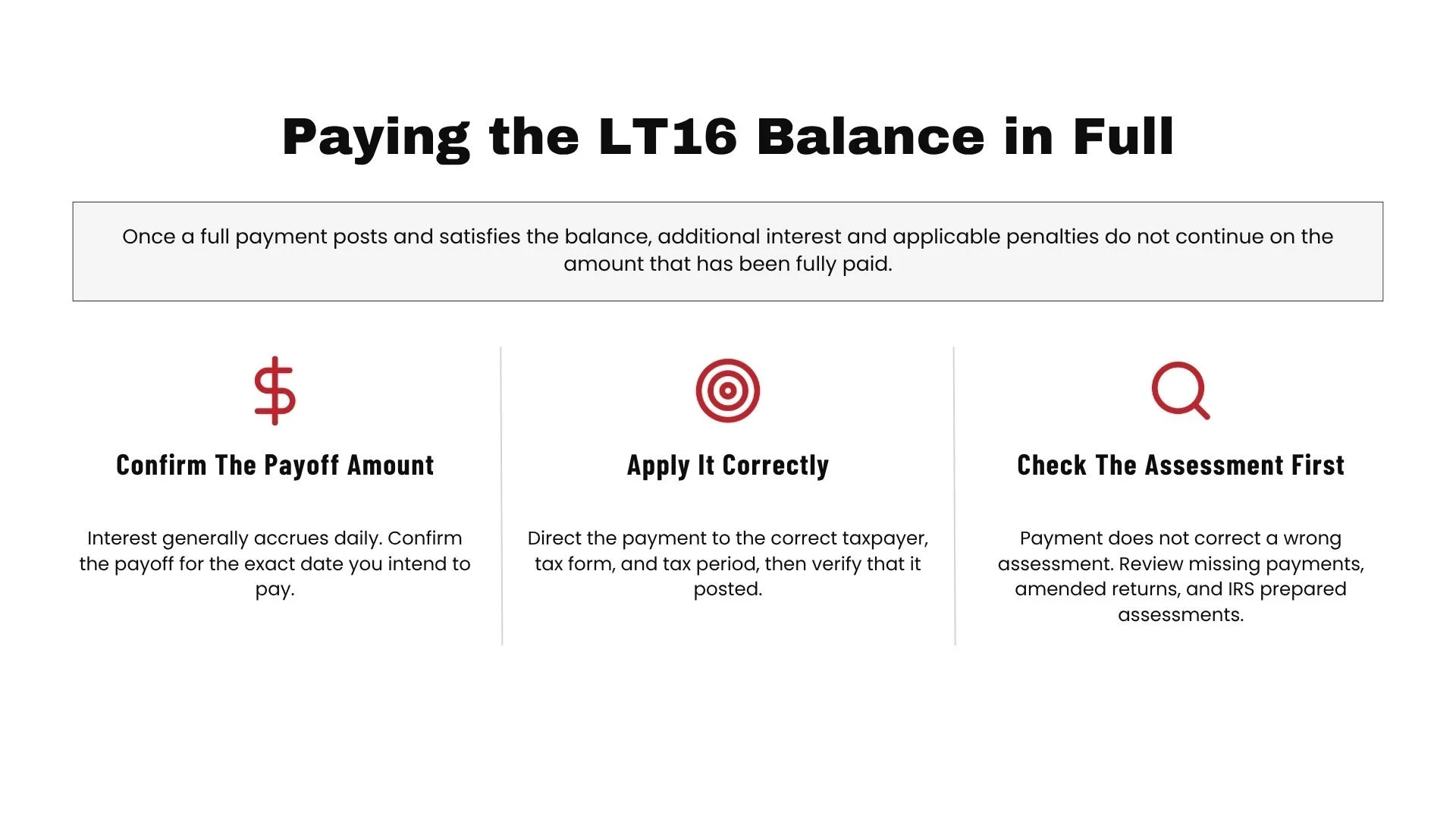
Paying the LT16 Balance in Full
Paying the assessed balance in full is generally the most direct way to conclude collection for that balance.
Once a full payment posts and satisfies the balance, additional interest and applicable penalties do not continue on the amount that has been fully paid.
Confirm the Correct Payoff Amount
Interest generally accrues daily.
Confirm the payoff amount for the date you intend to pay.
Apply the payment to the correct taxpayer, tax form, and tax period.
A submitted payment does not help the intended balance when it is rejected or applied incorrectly. Review the online account or transcript after the expected posting period.
Paying in Full Does Not Correct a Wrong Assessment
Do not assume that payment is the correct response when the liability may be wrong.
Review missing payments, amended returns, IRS prepared assessments, innocent spouse issues, identity theft, and other possible account errors first.
Payment may limit future interest on the amount paid, but it can create a separate refund claim issue when the underlying assessment is disputed.
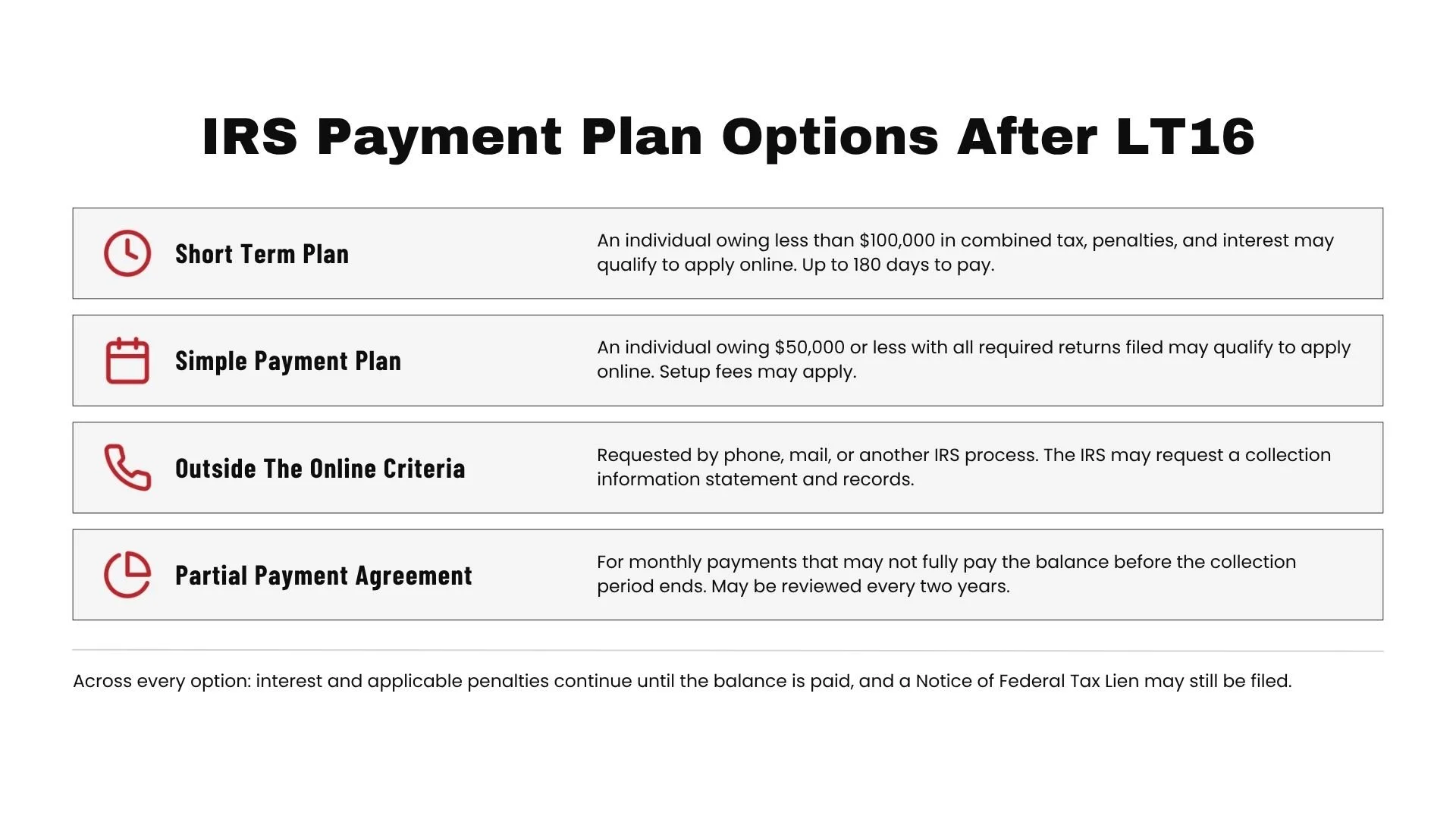
IRS Payment Plan Options After LT16
Many taxpayers who cannot pay in full may request an IRS payment plan.
A payment plan may restrict levy activity while a processable request is pending or while an approved agreement remains in effect. Legal exceptions and account specific issues may apply.
A payment plan does not erase the tax debt. Interest and applicable penalties continue until the balance is paid, and a Notice of Federal Tax Lien may still be filed.
Short Term Payment Plan
An individual who owes less than $100,000 in combined tax, penalties, and interest may qualify to apply online for a short term plan.
The current online option allows up to one hundred eighty days to pay.
This option may fit someone with a reliable source of funds expected within that period.
It is not a suitable solution when full payment within the approved period is unrealistic.
Interest and applicable penalties continue until the balance is fully paid.
Simple Payment Plan
An individual may qualify to apply online for a simple payment plan when the combined tax, penalties, and interest are $50,000 or less and all required returns have been filed.
Meeting the online criteria allows the taxpayer to apply. It does not guarantee that every proposed term or payment amount will be accepted.
Setup fees may apply.
Interest and applicable penalties continue.
A federal tax lien may still be filed depending on the account.
Payment Plans Outside the Online Criteria
Taxpayers who do not meet the online criteria may still request a payment arrangement by phone, mail, or another IRS process.
The IRS may request a collection information statement, bank records, pay records, proof of expenses, property information, and business financial records.
The IRS may approve, modify, or reject the proposed payment based on its review.
A processable pending request may restrict levy action, but merely stating an intention to request a plan does not necessarily create that restriction.
Partial Payment Installment Agreement
A partial payment installment agreement may apply when the taxpayer can make monthly payments but cannot fully pay the liability before the collection period expires.
The IRS generally requires detailed financial information.
The agreement may be reviewed every two years. The IRS may increase, decrease, or leave the payment unchanged based on updated information.
The agreement does not automatically forgive the unpaid balance.
Interest and applicable penalties continue while the liability remains unpaid.
The final amount collected depends on payments, collection period changes, future compliance, offsets, and other account activity.
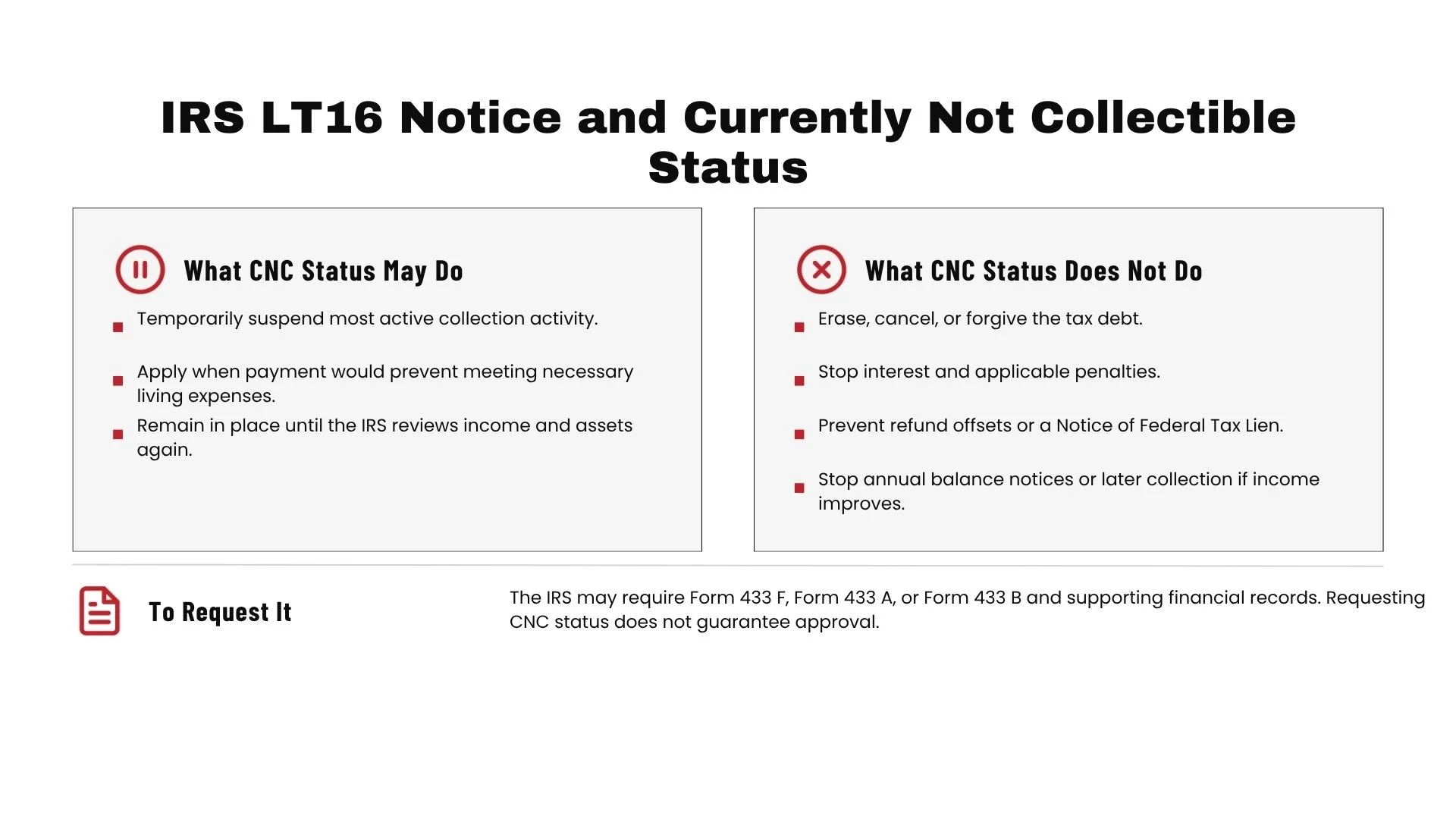
IRS LT16 Notice and Currently Not Collectible Status
Currently Not Collectible status may apply when the IRS determines that the taxpayer cannot pay the tax debt and necessary living expenses at the same time.
The taxpayer may need to provide Form 433 F, Form 433 A, Form 433 B, and supporting financial records.
Approval depends on the financial facts and IRS review. Requesting CNC status does not guarantee approval.
What Currently Not Collectible Status May Do
CNC status generally means the IRS temporarily suspends most collection activity because the taxpayer cannot afford to pay at that time.
The word temporarily matters.
The IRS may later review the taxpayer’s income and assets and may resume collection if the ability to pay improves.
What Currently Not Collectible Status Does Not Do
CNC does not erase, cancel, or forgive the tax debt.
Interest and applicable penalties continue.
The IRS may apply future federal tax refunds to the balance.
The IRS may file a Notice of Federal Tax Lien.
The taxpayer may continue receiving annual balance notices.
Unfiled Returns and Hardship Cases
The IRS may request missing returns before making a collection decision.
In some hardship situations, the IRS may place an account in CNC status even when unfiled returns remain. This is fact specific and should not be treated as a universal rule.
The taxpayer should continue filing current returns and making required current payments to avoid creating additional liabilities.
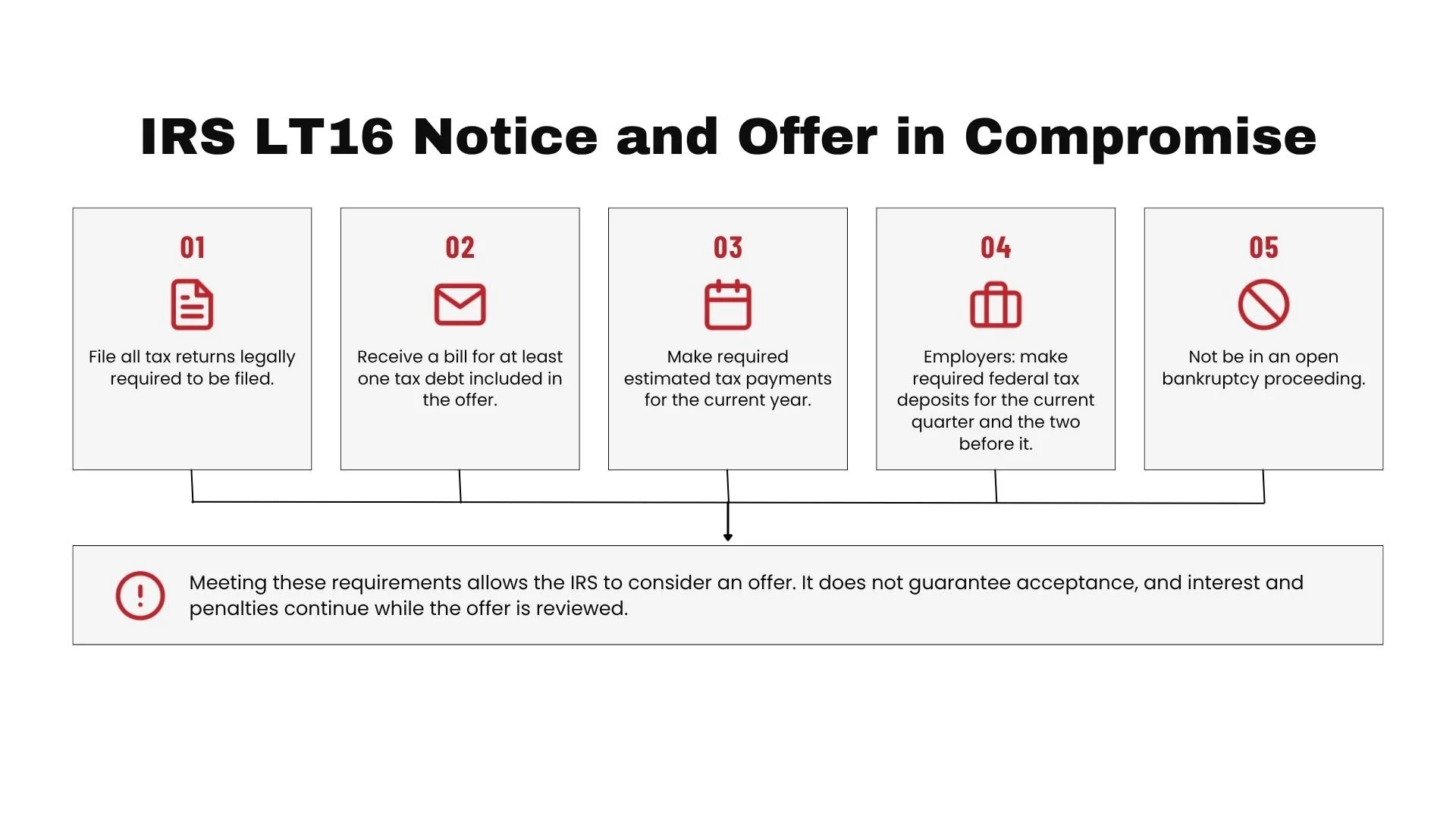
IRS LT16 Notice and Offer in Compromise
An Offer in Compromise is an agreement through which the IRS accepts less than the full tax debt when the taxpayer satisfies a recognized legal basis and the IRS accepts the proposal.
For many offers based on inability to pay, the IRS reviews income, allowed expenses, assets, equity, and future payment ability.
The amount of tax debt alone does not determine eligibility.
Offer in Compromise Eligibility Requirements
Before an offer can generally be considered, the taxpayer must:
File all tax returns legally required to be filed.
Receive a bill for at least one tax debt included in the offer.
Make required estimated tax payments for the current year.
For a business owner with employees, make required federal tax deposits for the current quarter and the two preceding quarters.
Not be in an open bankruptcy proceeding.
Meeting these requirements does not guarantee that the offer will be accepted.
What Happens While an Offer Is Pending
Submitting an offer does not immediately create every collection restriction.
The IRS may levy before an authorized IRS official signs and acknowledges the offer as pending.
Once a processable offer is pending, levy restrictions generally apply under federal law, subject to legal exceptions.
Interest and penalties continue while the IRS evaluates the offer.
The collection period is generally suspended while the offer is pending and for certain additional periods.
What Happens If the Offer Is Accepted
Acceptance may settle the included tax debt for the agreed amount.
The taxpayer must comply with the payment terms and remain current with filing and payment obligations through the fifth year after acceptance.
Failure to meet those obligations may result in default of the offer.
Acceptance does not automatically release another person who is separately liable for the same tax.
It also does not mean that every refund or payment made before acceptance will be returned.

IRS LT16 Notice and Years of Unfiled Returns
An LT16 notice may list one or more tax returns that the IRS believes are missing.
The filing problem and collection problem should be reviewed together.
Begin With a Filing Requirement Review
Determine whether a return was legally required for each year.
Filing requirements depend on income, filing status, age, self employment income, business activity, payroll activity, and other facts.
If the return was required, prepare an accurate taxpayer filed return using the records available.
Possible records include:
Wage and income transcripts.
Bank statements.
Bookkeeping records.
Prior year returns.
Forms W 2 and 1099.
Business expense records.
Basis and investment records.
Payroll reports.
Do Not Assume an IRS Prepared Return Is Correct
When the IRS prepares a return using available third party information, the assessment may not include every deduction, credit, dependent, basis adjustment, business expense, or filing status available to the taxpayer.
A taxpayer filed return may correct the assessment.
It does not guarantee that the tax will decrease. The final result depends on accurate records and the law for that year.
Missing Returns and Collection Alternatives
The IRS generally requires filing compliance for payment plan and Offer in Compromise consideration.
A serious hardship case may be handled differently depending on the facts and assigned IRS unit.
Filing old returns does not automatically place the taxpayer into a payment plan, CNC status, or an Offer in Compromise.
The taxpayer must still request and qualify for the applicable collection alternative.
If the IRS Says a Filed Return Is Missing
Confirm whether the return posted to the account.
If more than ten weeks have passed since the return was sent, the current LT16 page instructs the taxpayer to submit a signed copy again.
Keep proof of the second submission.
Resubmission does not guarantee a particular adjustment or processing date.
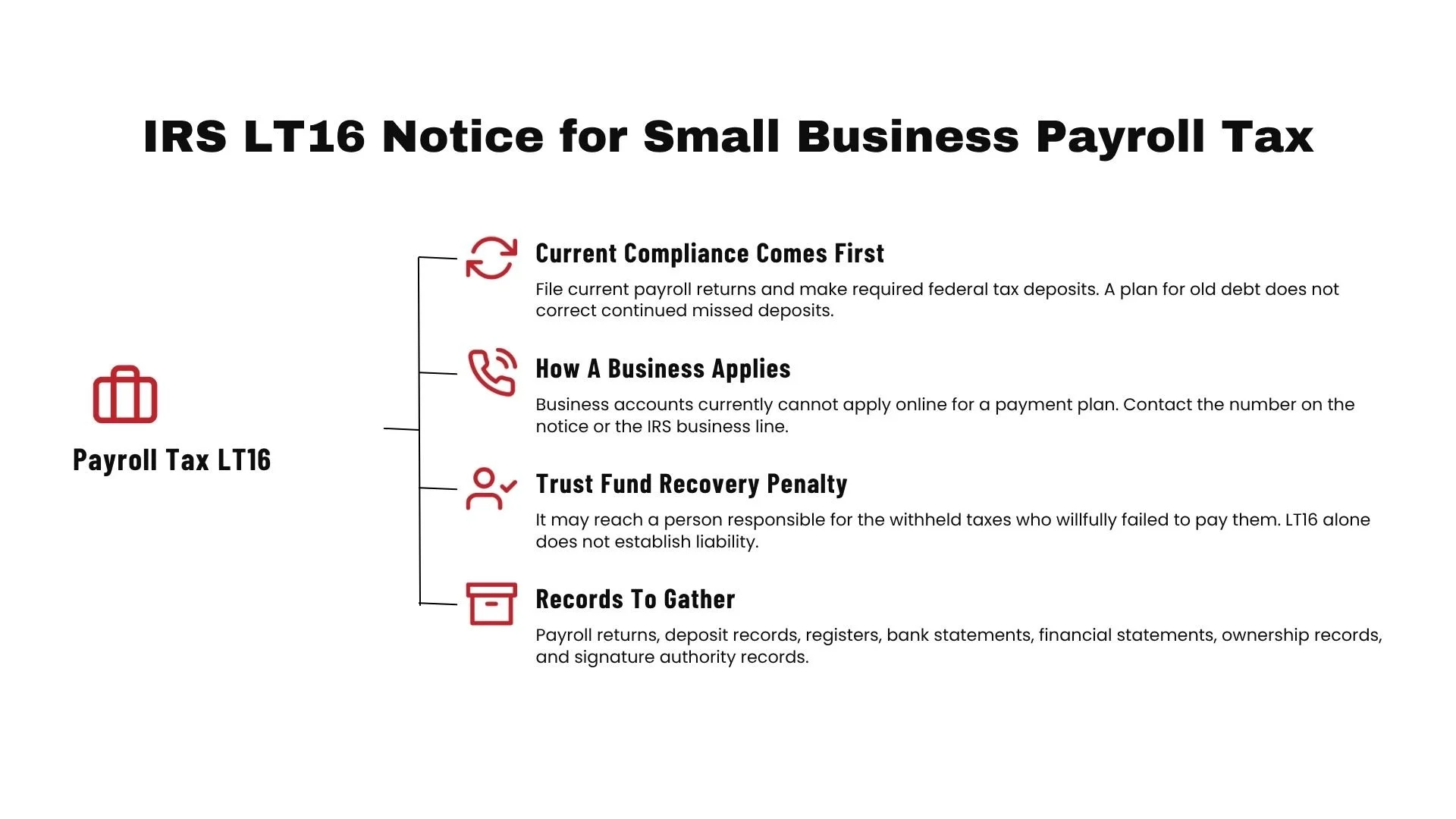
IRS LT16 Notice for Small Business Payroll Tax
An LT16 notice involving Forms 941, 940, 943, 944, or another business tax return requires review of both the old debt and current compliance.
Payroll tax cases can involve the business account and possible personal liability for certain responsible individuals.
Receiving LT16 does not automatically mean that personal liability has been proposed or assessed.
Current Payroll Compliance Comes First
The business should file current payroll returns and make required federal tax deposits.
A payment arrangement for old payroll debt does not correct continued missed deposits.
The IRS currently does not allow business accounts to apply online for a payment plan. A business may contact the number on the notice or the IRS business line to discuss available options.
Contacting the IRS does not guarantee approval of the requested plan.
The business may need to provide financial records and show that current tax obligations are being met.
Possible Trust Fund Recovery Penalty Exposure
Employment taxes withheld from employees are trust fund taxes.
The IRS may assess the Trust Fund Recovery Penalty against a person who was responsible for collecting, accounting for, or paying those taxes and who willfully failed to do so.
Responsibility is based on actual authority and control, not title alone.
Willfulness may include paying other creditors when the responsible person knew the trust fund taxes remained unpaid.
The penalty generally equals the unpaid trust fund portion, plus applicable interest.
LT16 alone does not establish responsibility, willfulness, or personal liability.
The IRS generally conducts a separate investigation before proposing the Trust Fund Recovery Penalty.
Business Records to Gather
Gather the following records:
Payroll returns for every period involved.
Federal tax deposit records.
Payroll registers.
Business bank statements.
Profit and loss statements.
Balance sheets.
Accounts receivable reports.
Officer and ownership records.
Signature authority records.
Records showing who made financial decisions.
These records help evaluate the business balance, current compliance, payment ability, business viability, and possible personal exposure.
Gathering records does not guarantee that a payment arrangement or personal liability defense will be accepted.
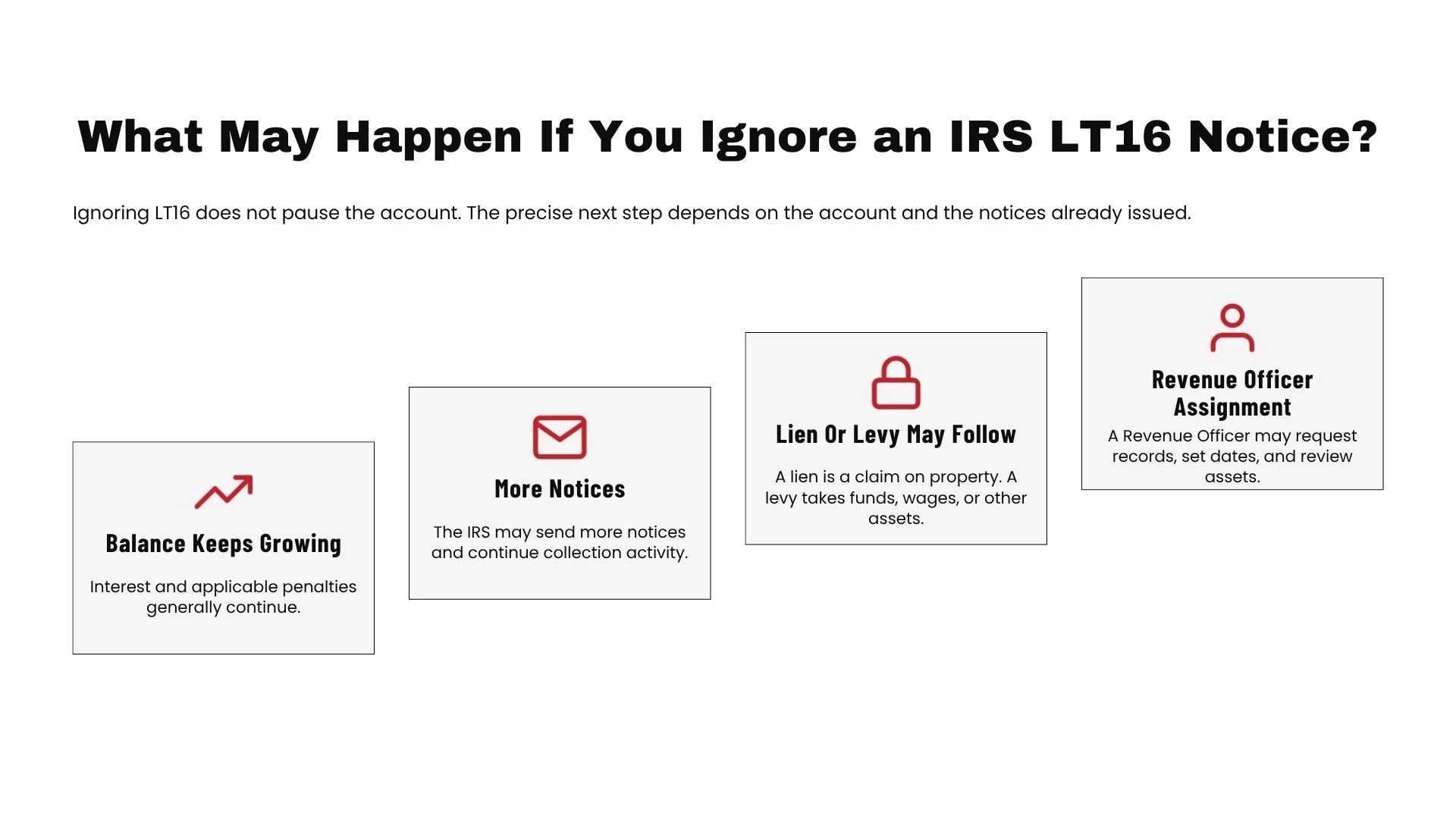
What May Happen If You Ignore an IRS LT16 Notice?
Ignoring LT16 does not pause the account.
Interest and applicable penalties generally continue.
The IRS may send additional notices and may pursue further collection activity after satisfying the required procedures.
The precise next step depends on the account.
Possible Notice of Federal Tax Lien
A federal tax lien arises by law after assessment, notice and demand, and failure to pay.
A Notice of Federal Tax Lien is the public filing used to notify creditors of the government’s claim.
The filing may affect a sale, refinance, loan, business financing, or the priority of other creditors.
A lien is not the same as a levy.
Responding to LT16 does not guarantee that the IRS will refrain from filing a lien. The IRS may file one even when a taxpayer has certain payment arrangements or CNC status.
Possible Bank Levy
A bank levy generally reaches funds held by the financial institution when the levy is received, subject to applicable exemptions and procedures.
The bank generally holds the funds for a statutory period before sending them to the IRS.
A request for levy release may be considered when legal or hardship grounds apply.
Requesting a release does not guarantee approval. The result depends on the account, financial facts, legal requirements, and timing.
Possible Wage Levy
A wage levy may continue against future pay until the levy is released, the liability is paid, the collection period ends, or another legal event applies.
The taxpayer is generally allowed an exempt amount based on filing status, pay frequency, and dependents claimed on the required exemption statement.
Entering a payment plan or obtaining hardship status may support a levy release in some cases. A release is not automatic until the IRS processes and communicates it to the employer.
Possible Revenue Officer Assignment
The IRS collection process may include assignment to a Revenue Officer.
A Revenue Officer may request records, set response dates, review business operations, investigate assets, and discuss collection alternatives.
Assignment does not remove the taxpayer’s rights.
It also does not guarantee that a levy, lien, seizure, or particular resolution will occur. The outcome depends on the facts and the taxpayer’s response.
Appeal and Representation Rights
Taxpayers generally have the right to be informed, challenge the IRS position, appeal many IRS decisions, retain representation, and receive a fair collection process.
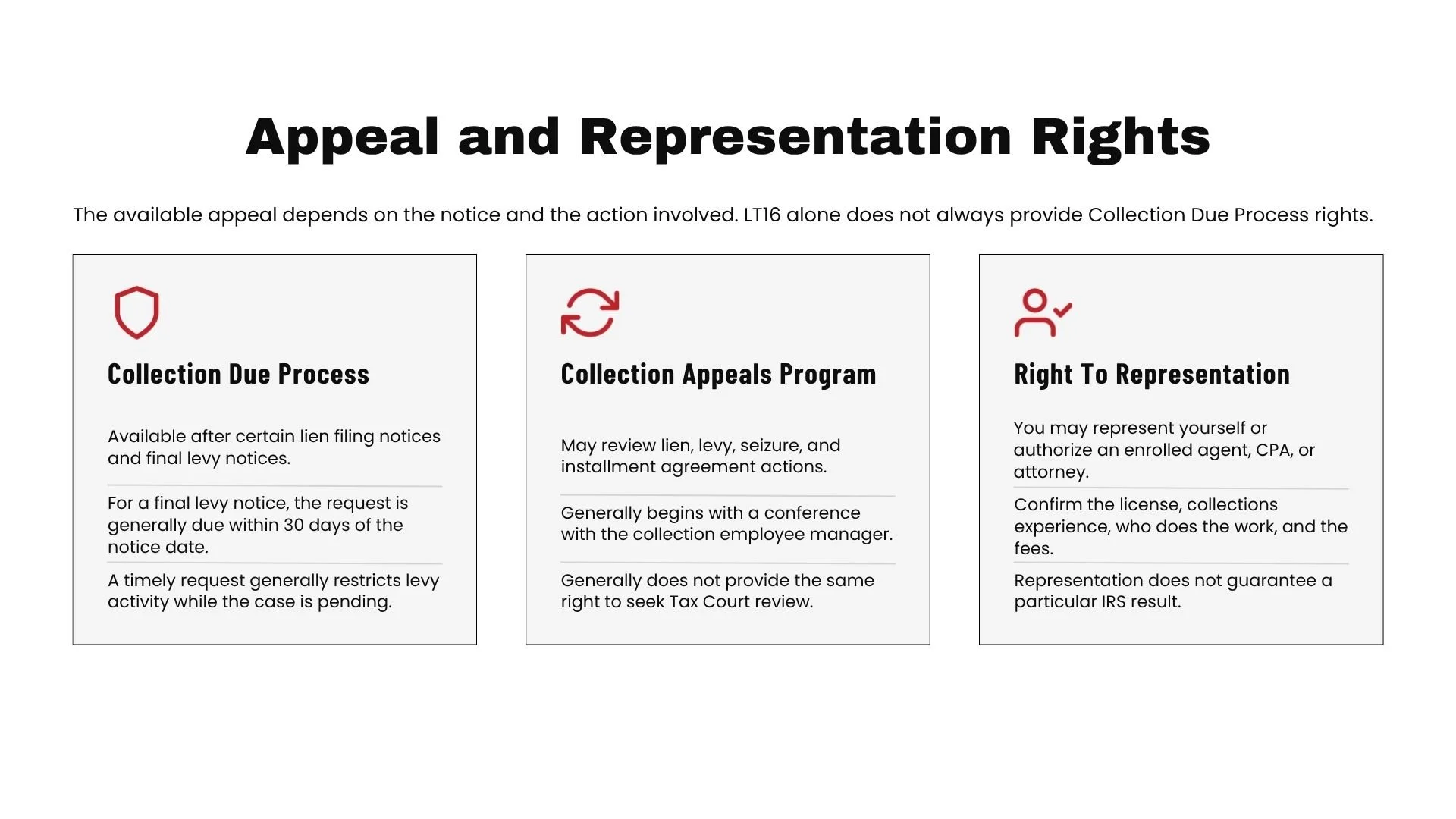
The available appeal depends on the notice and action involved.
Collection Due Process
A Collection Due Process hearing may be available after certain lien filing notices and final levy notices.
A timely request may allow the IRS Independent Office of Appeals to review:
Whether the IRS followed required procedures.
Available collection alternatives.
Certain challenges to the underlying liability when legally permitted.
Whether the proposed action balances efficient collection with the taxpayer’s legitimate concerns.
For a final levy notice, the hearing request is generally due within thirty days from the notice date.
A timely request generally restricts levy activity for the periods involved while the hearing and permitted court review are pending. Exceptions may apply.
LT16 alone does not always provide Collection Due Process rights.
Collection Appeals Program
The Collection Appeals Program may review a range of lien, levy, seizure, and installment agreement actions.
The taxpayer generally begins by requesting a conference with the collection employee’s manager.
The deadline and procedure depend on the action involved.
A CAP decision generally does not provide the same right to seek Tax Court review as a timely Collection Due Process case.
Requesting CAP review does not guarantee that the collection action will be reversed.
Right to Representation
You may represent yourself or authorize an enrolled agent, certified public accountant, or attorney who is eligible to practice before the IRS.
The appropriate representative depends on the work required.
A straightforward payment plan may require less analysis than a payroll tax investigation, disputed assessment, Collection Due Process hearing, innocent spouse request, or bankruptcy related matter.
Search terms such as IRS LT16 notice help near me, IRS LT16 tax relief specialist, tax professional to handle IRS LT16 notice, and IRS LT16 notice tax attorney or enrolled agent should lead to a credentials review.
Confirm:
The professional license.
Experience with IRS collections.
Who will perform the work.
The fee structure.
The scope of representation.
Whether the proposed strategy is supported by the account and financial facts.
Hiring a representative does not guarantee a particular IRS result or provide preferential treatment.
How I Evaluate an IRS LT16 Case
I do not begin by selecting a tax relief program.
I begin by identifying the facts that control the available options.
Evaluation Methodology
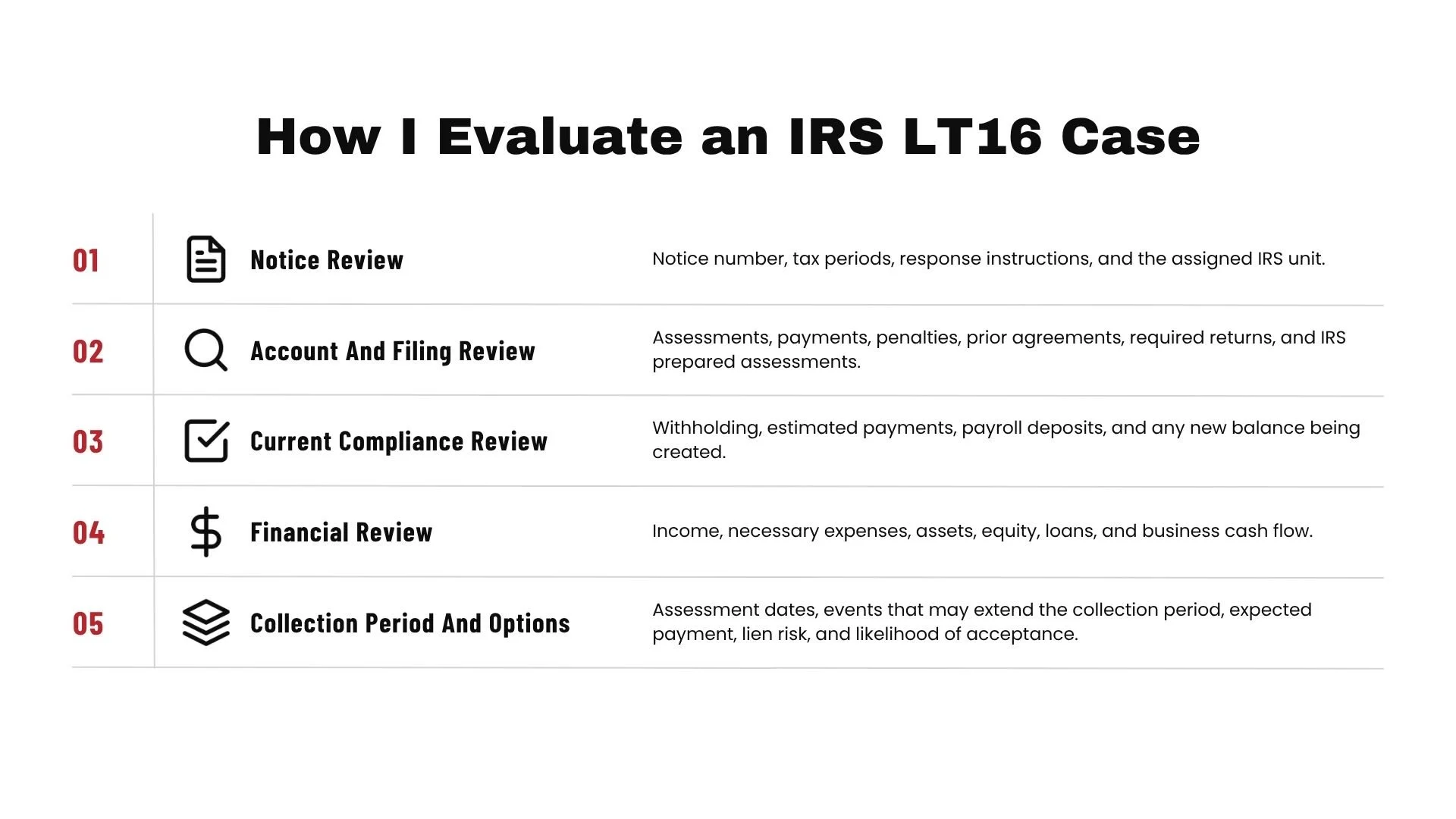
I use seven review categories:
Notice review, including the notice number, tax periods, response instructions, and assigned IRS unit.
Account review, including assessments, payments, penalties, interest, prior agreements, and collection activity.
Filing review, including legally required returns, returns that have not posted, and IRS prepared assessments.
Current compliance review, including withholding, estimated payments, payroll deposits, and new balances.
Financial review, including income, necessary expenses, assets, equity, loans, and business cash flow.
Collection period review, including assessment dates and events that may suspend or extend the collection period.
Resolution comparison, including expected payment, financial disclosure, lien risk, levy restrictions, compliance requirements, and likelihood of acceptance.
The goal is to identify the most supportable option, not to assume that every taxpayer qualifies for the same program.
Example, Wage Earner With One Balance
A taxpayer has all required returns filed, owes $18,000, has stable wages, and can pay $400 per month without missing necessary expenses.
A payment plan may deserve review before CNC status or an Offer in Compromise.
That does not mean the IRS will automatically approve a $400 payment.
The available term depends on the collection period, online criteria, compliance, and whether the proposed amount satisfies IRS requirements.
Example, Self Employed Taxpayer With Missing Returns
A self employed taxpayer has three potentially missing returns and cannot confirm the total balance.
The first task is determining which returns were legally required and preparing accurate filings.
The taxpayer must also address current estimated tax payments.
Filing the returns may change the balance. It does not guarantee a reduction or immediate approval of a collection alternative.
Example, Business With Payroll Tax Debt
A business owes payroll taxes and continues missing deposits.
The immediate concern is stopping the creation of new tax debt through current filing and deposit compliance.
The owner should review cash flow, business viability, payroll returns, deposits, and possible responsible person exposure before proposing a payment plan.
Current compliance improves the ability to request a resolution. It does not guarantee approval or prevent every possible enforcement action.
Frequently Asked Questions About IRS LT16
-
LT16 is a collection notice that warns about possible enforcement, but it is not always the final notice legally required before a broad levy.
In most cases, the IRS must provide a notice of intent to levy and an opportunity for a Collection Due Process hearing before levy action.
LT11 and Letter 1058 are common final levy notices.
Exceptions may apply, so the notice history and transcripts should be reviewed.
Receiving LT16 does not mean that the IRS will levy immediately. Ignoring it may allow the account to progress to a later collection stage.
-
Use the response date and instructions printed on the LT16 notice you received.
The current IRS LT16 page does not provide one universal response deadline for every case.
Respond as soon as reasonably possible, especially when the notice involves missing returns, payroll taxes, a large balance, or prior collection activity.
If the printed date has passed, contact the IRS or your representative.
A late response may still be considered, but it does not guarantee that the IRS will delay additional collection activity.
-
Many taxpayers can request a payment plan after LT16.
An individual may qualify to apply online for a simple payment plan when the combined tax, penalties, and interest are $50,000 or less and all required returns have been filed.
An individual who owes less than $100,000 may qualify to apply for a short term plan of up to one hundred eighty days.
Meeting the application criteria does not guarantee that every proposed monthly amount or term will be approved.
Interest and applicable penalties continue until the balance is fully paid.
A federal tax lien may still be filed.
-
Yes.
A taxpayer who cannot pay the IRS and necessary living expenses at the same time may ask the IRS to review the account for Currently Not Collectible status.
The IRS may request income, expense, bank, property, and other asset information.
Submitting the request does not guarantee approval.
If approved, CNC generally suspends most collection activity temporarily.
It does not erase the debt.
Interest and penalties continue, refunds may be applied, a federal tax lien may be filed, and collection may resume if the taxpayer’s ability to pay improves.
-
LT16 does not prevent an eligible taxpayer from applying for an Offer in Compromise.
The IRS reviews filing compliance, current tax payments, income, allowed expenses, assets, equity, and ability to pay.
The taxpayer must also satisfy the applicable procedural requirements.
Submitting an offer does not guarantee acceptance.
Interest and penalties continue while the offer is reviewed.
The IRS may return or reject an offer when the eligibility, documentation, payments, or financial facts do not support it.
-
Do not agree to a collection arrangement until you understand the account.
Review transcripts, payment confirmations, filed returns, amended returns, identity theft issues, joint liability issues, and IRS prepared assessments.
Contact the number on the notice with supporting records.
The IRS may correct the account when the documentation supports an adjustment.
Providing documents does not guarantee that the IRS will agree with the requested change.
Appeal or refund claim procedures may be available depending on the issue and procedural stage.
-
Check whether the return has posted to the IRS account.
If more than ten weeks have passed since the return was sent, the current LT16 page instructs the taxpayer to send a signed copy again.
Use the submission method stated on the notice and keep proof of delivery.
Sending another copy does not guarantee a specific processing time.
If the original return was filed recently, confirm its status before submitting a duplicate.
-
Not every LT16 case requires professional representation.
A taxpayer may be able to handle the notice when:
The balance is correct.
All required returns are filed.
There is no active enforcement action.
The taxpayer can pay in full or request a straightforward payment plan.
Professional review may be useful when the case involves:
Several tax years.
Unfiled returns.
Disputed assessments.
Payroll taxes.
A federal tax lien.
A wage or bank levy.
A Revenue Officer.
An Offer in Compromise.
Hardship financials.
Innocent spouse issues.
Bankruptcy questions.
An appeal deadline.
Enrolled agents, certified public accountants, and attorneys may represent taxpayers before the IRS when properly authorized.
Representation may improve communication and case preparation. It does not guarantee approval of a particular resolution.
IRS LT16 Action Checklist
What to Do After Receiving LT16
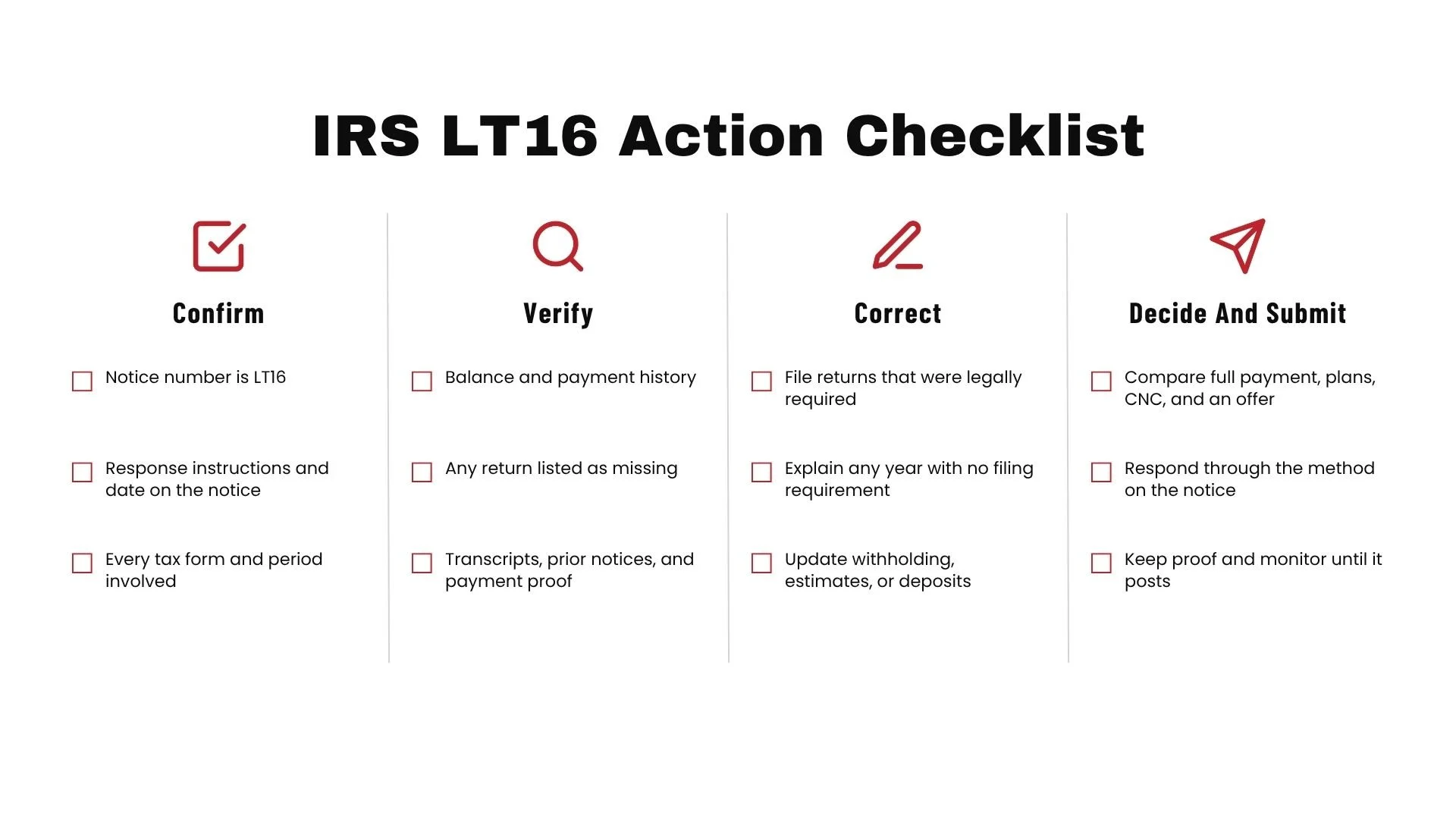
Confirm that the notice number is LT16.
Record the response instructions and date shown on the notice.
Identify every tax form and period involved.
Review the balance and payment history.
Check whether any return is listed as missing.
Gather returns, transcripts, payment proof, and prior notices.
Determine whether each missing return was legally required.
File required returns or explain why no filing requirement existed.
Review current withholding, estimated payments, or payroll deposits.
Determine what you can afford without creating a greater financial hardship.
Compare full payment, a payment plan, a partial payment agreement, CNC status, and an Offer in Compromise.
Review the limitations and compliance requirements of each option.
Respond through the phone number, address, fax number, or upload method shown on the notice.
Keep proof of every submission and payment.
Monitor the account until the IRS posts the requested action or issues a written decision.
The main point is not to panic and not to ignore the notice.
Confirm the facts, follow the notice instructions, correct filing issues, and request the collection option supported by the complete account and financial picture.
Taking these steps may reduce collection risk. They do not guarantee that every enforcement action will be suspended or that the IRS will approve the requested resolution.