
IRS Letter 725-B: What It Means When a Revenue Officer Wants to Meet With You
Received IRS Letter 725 B? Learn why a revenue officer wants to meet, what to bring, your rights, and how to prepare.
IRS Letter 725 B is an appointment letter from an IRS revenue officer. It normally means the IRS has scheduled a meeting to discuss unfiled tax returns, unpaid tax balances, or both.
The letter should identify the assigned revenue officer and provide the proposed date, time, and location of the appointment.
This is more serious than a routine balance reminder because a specific revenue officer is now responsible for working the collection case. However, IRS Letter 725 B does not automatically mean that you are being audited or accused of a crime.
Revenue officers generally handle civil collection matters. These matters may include delinquent returns, unpaid assessments, financial reviews, payment arrangements, and possible collection enforcement.
I recommend responding promptly, even when you cannot pay the full balance or gather every requested document before the appointment.
Contacting the revenue officer gives you an opportunity to confirm the meeting, request a different date when needed, clarify what information is required, and determine whether professional representation should be put in place.

IRS Letter 725 B at a Glance H2Confirm that the letter is authentic.
Review the appointment date, location, tax periods, and requested records.
Call the assigned revenue officer by the date stated in the letter.
Do not provide estimates or incomplete financial statements simply to meet a deadline.
Review your filing history, current tax compliance, income, expenses, and assets before the meeting.
Consider representation when the case involves payroll taxes, several missing returns, a large balance, threatened enforcement, or disputed tax assessments.
I am Sergio Melendez, an Enrolled Agent and Juris Doctor. My tax practice focuses on IRS collection matters, tax debt resolution, unfiled returns, payment arrangements, financial hardship cases, liens, levies, and representation before IRS collection personnel.
My approach begins with reviewing the IRS account, identifying the collection department, restoring filing compliance, understanding the taxpayer’s rights, and evaluating the complete financial situation before selecting a resolution. |
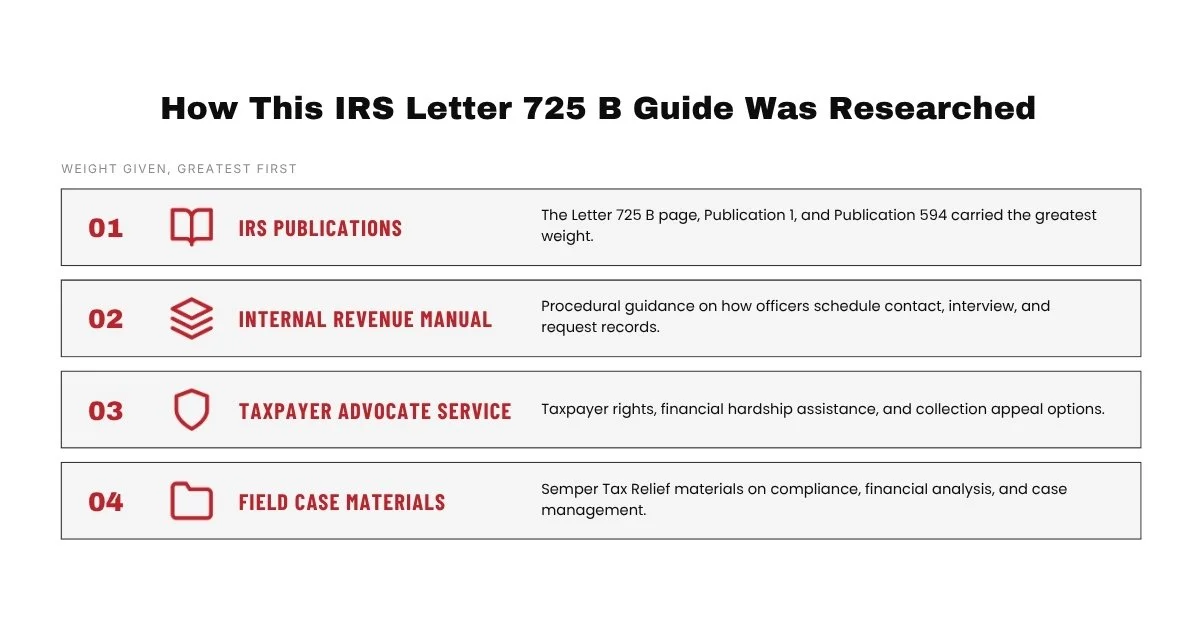
HOW THIS IRS LETTER 725 B GUIDE WAS RESEARCHED
I prepared this article as a practical research guide, not as a summary of marketing claims from tax relief companies.
PRIMARY RESEARCH SOURCES
The primary sources reviewed for this article include the IRS page for Letter 725 B, IRS Publication 594, IRS Publication 1, the Internal Revenue Manual provisions governing revenue officer contact, current IRS collection financial forms, and Taxpayer Advocate Service materials concerning taxpayer rights and collection alternatives.
The Internal Revenue Manual is particularly useful because it explains how revenue officers are instructed to schedule initial contact, conduct an investigative interview, request financial information, recognize representation, establish document deadlines, and communicate possible consequences.
The Internal Revenue Manual provides procedural guidance for IRS employees. It does not replace the Internal Revenue Code, Treasury regulations, court decisions, or the specific instructions printed on your letter.
HOW THE SOURCES WERE EVALUATED
I gave the greatest weight to IRS publications and official procedural guidance.
Taxpayer Advocate Service materials were used to explain taxpayer rights, financial hardship assistance, and collection appeals in a practical form.
I also reviewed Semper Tax Relief materials concerning field collection, filing compliance, taxpayer rights, financial analysis, collection departments, and case management.
The goal was to explain the IRS process accurately while giving taxpayers a clear framework for preparing and responding. |
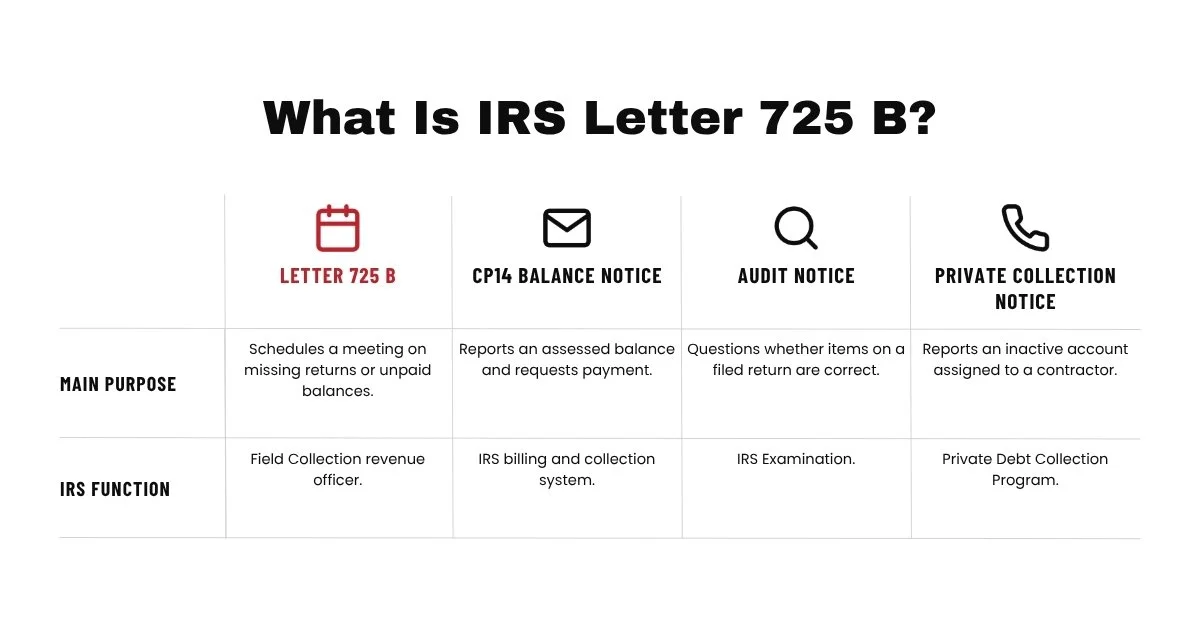
WHAT IS IRS LETTER 725-B
IRS Letter 725 B is commonly called an IRS meeting letter, IRS appointment letter, or revenue officer appointment letter.
The IRS uses it to schedule contact with a taxpayer whose case has been assigned to Field Collection.
The meeting may concern unfiled tax returns, unpaid balances, or both.
The appointment may be scheduled at an IRS office, at a business, at another approved location, or by telephone. The letter should include the revenue officer’s contact information.
WHAT DOES IRS LETTER 725 B MEAN FOR YOUR CASE
The practical meaning is that your account is no longer being handled only through automated billing notices.
A revenue officer has been assigned to investigate the account, secure missing returns, evaluate collection potential, and work toward a case resolution.
The initial investigative interview is an important part of the revenue officer’s work.
The officer may review filing compliance, attempt to obtain financial information, identify assets and income sources, and discuss how the delinquency may be resolved.
IRS LETTER 725 B COMPARED WITH OTHER IRS CONTACTS, H3
IRS Contact
IRS Letter 725 B
Main Purpose
Schedules a meeting concerning missing returns, unpaid balances, or collection information.
Typical IRS Function
Field Collection revenue officer.
IRS Contact
CP14 or another balance notice.
Main Purpose
Reports an assessed balance and requests payment.
Typical IRS Function
IRS billing and collection system.
IRS Contact
Audit notice.
Main Purpose
Questions whether items reported on a filed return are correct.
Typical IRS Function
IRS Examination.
IRS Contact
Private collection notice.
Main Purpose
Reports that an inactive account was assigned to an authorized private collection agency.
Typical IRS Function
IRS Private Debt Collection Program.
Letter 725 B is generally a collection contact, not an IRS audit meeting.
A revenue agent normally examines the accuracy of a filed return.
A revenue officer normally works to collect assessed tax, secure required returns, review financial information, and determine the next collection action.
A taxpayer can have an examination matter and a collection matter at the same time. The complete IRS account should still be reviewed.
A private collection agency is also different from a revenue officer.
Private collectors are contractors and do not have the same enforcement authority as IRS collection employees.
Letter 725 B identifies contact with an IRS revenue officer, not a private collection contractor. |
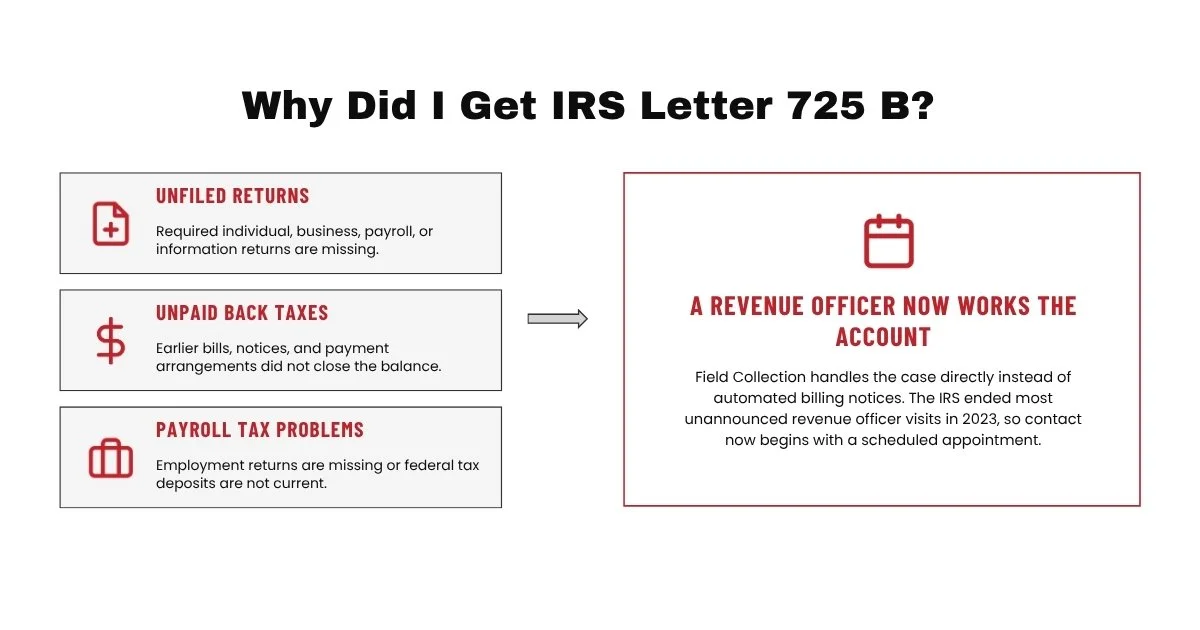
WHY DID I GET IRS LETTER 725-B
The exact reason should be determined from your letter, account transcripts, filing history, and the tax periods assigned to the officer.
In most cases, the IRS wants to address a filing problem, a collection problem, or both.
YEARS OF UNFILED TAX RETURNS, H3
You may receive an IRS 725 B letter for unfiled tax returns when IRS records show that required individual, business, payroll, or information returns are missing.
The revenue officer may ask why the returns were not filed, whether the business was operating, whether income records are available, and when accurate returns can be submitted.
The officer may also investigate whether returns were legally required for each period.
Do not assume that every year listed by the IRS must automatically be filed without reviewing the filing requirements.
At the same time, do not tell the officer that no return was required unless the facts and records support that position.
BACK TAXES THAT REMAIN UNRESOLVED
You may receive an IRS 725 B letter for back taxes owed when prior bills, collection notices, payment requests, or installment arrangements did not resolve the account.
The IRS may want to determine whether the balance can be paid in full, paid over time, resolved through an offer in compromise, or placed in a temporary hardship status.
The officer may request a collection financial statement before making that determination.
BUSINESS AND PAYROLL TAX PROBLEMS
Business cases may receive greater attention when employment tax returns are missing, federal tax deposits are not current, or payroll tax balances continue to increase.
Revenue officers working business cases may review current payroll, the number of employees, deposit history, business bank accounts, receivables, assets, and the ability of the business to remain current while addressing prior liabilities.
The officer may also review who controlled payroll decisions, who signed checks, who had authority over business funds, and whether responsible individuals may have personal exposure for trust fund taxes.
WHY THE IRS USES AN APPOINTMENT LETTER
The IRS ended most unannounced revenue officer visits in 2023.
In most cases, revenue officers now begin contact through an appointment letter or scheduled communication.
Limited exceptions may apply for summonses, subpoenas, and certain sensitive enforcement actions.
The appointment letter gives taxpayers notice of the meeting and an opportunity to gather records, verify the officer, arrange representation, and prepare a response. |
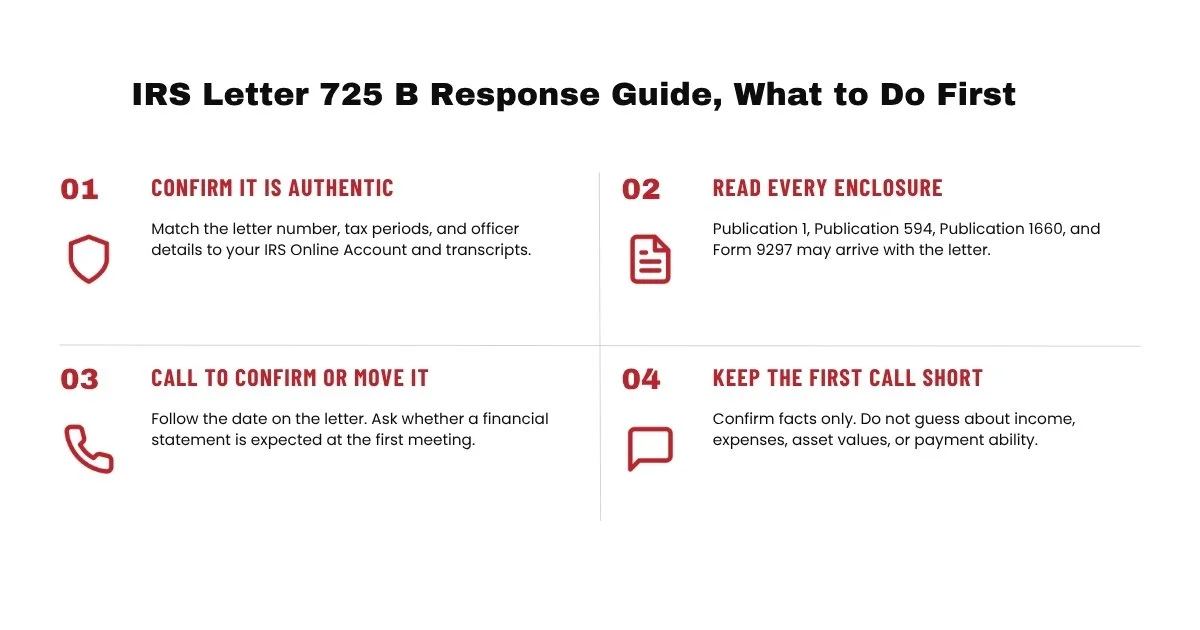
IRS LETTER 725 B RESPONSE GUIDE, WHAT TO DO FIRST
How you respond during the first several days can affect the direction of the case.
The goal is not to rush into a financial proposal.
The goal is to understand the account, protect the appointment deadline, and begin preparing accurate information.
CONFIRM THAT THE LETTER IS AUTHENTIC
Compare the letter number, taxpayer information, assigned tax periods, return address, and revenue officer contact information with your IRS records.
You may also review your IRS Online Account and account transcripts.
If the IRS letter does not appear legitimate or you suspect a scam, contact the IRS through a telephone number published on IRS.gov.
An authentic revenue officer is an IRS employee.
The IRS does not initiate collection contact through social media or text messages asking for personal or financial information.
READ EVERY PAGE AND ENCLOSURE
Review the appointment date, time, location, response date, tax forms, tax periods, balances, and requested records.
Letter 725 B may be issued with Publication 1, Publication 594, Publication 1660, and Form 9297 when the purpose is to conduct an initial investigative interview.
Form 9297 identifies the information the officer expects and may provide separate document deadlines.
CALL TO CONFIRM OR RESCHEDULE THE APPOINTMENT
Follow the exact confirmation instruction and date printed on your letter.
When you call, confirm the officer’s name, the appointment date, the location, the tax periods, and the requested information.
Ask whether the officer expects a completed financial statement at the first meeting.
If you need to reschedule, contact the officer before the appointment.
Internal IRS guidance generally directs revenue officers to select a new date within a limited period after the original appointment unless special circumstances support a longer delay.
This is an internal procedural guideline. It is not a guarantee that every requested delay will be approved.
A PRACTICAL FIRST CALL SCRIPT
You can keep the first contact focused:
“I received IRS Letter 725 B and I am calling to confirm the appointment. I am reviewing the tax periods and the documents listed on Form 9297. Please confirm what you expect to address at the meeting and whether you need a completed collection financial statement. I may also obtain representation. I will contact you promptly if a new appointment date is needed.”
Do not guess about income, expenses, asset values, missing returns, or payment ability during an unplanned call.
Tell the officer when you need to review the records before providing a complete answer. |
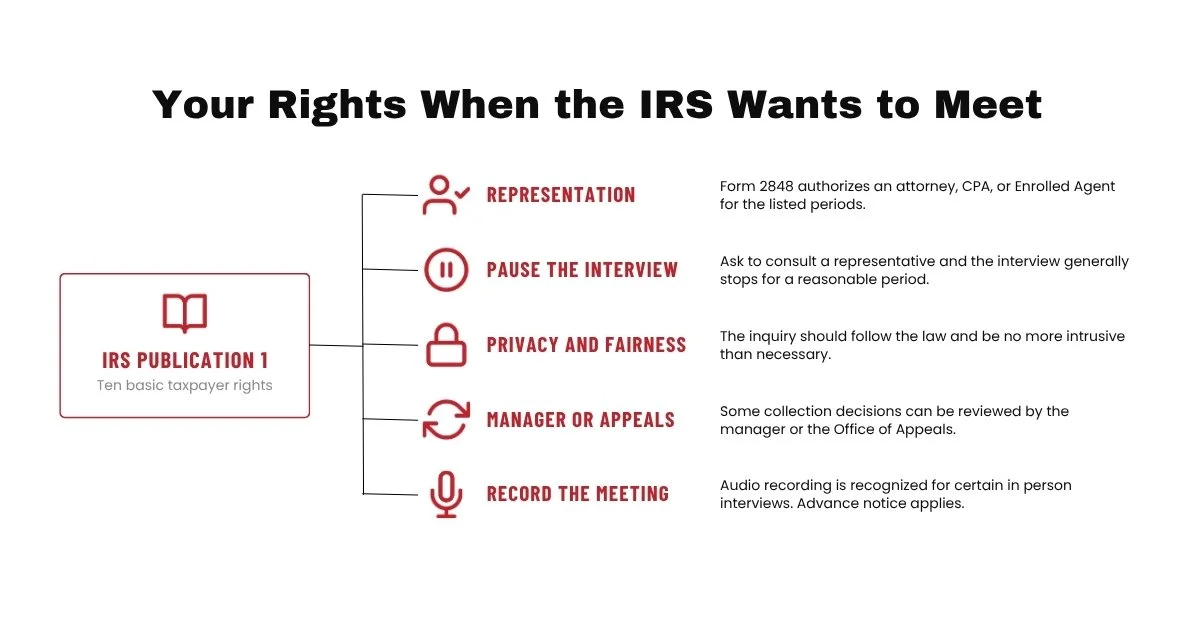
YOUR RIGHTS WHEN THE IRS WANTS TO MEET
Receiving an IRS appointment letter does not remove your taxpayer rights.
IRS Publication 1 identifies ten basic protections.
These include the rights to be informed, receive quality service, challenge the IRS and be heard, retain representation, maintain privacy, and have your financial circumstances considered.
THE RIGHT TO REPRESENTATION
You may authorize an eligible representative through Form 2848.
Depending on the tax matter, the representative may be an attorney, certified public accountant, Enrolled Agent, or another individual permitted to practice before the IRS.
Form 2848 allows an authorized person to represent you and receive confidential tax information for the tax matters and periods listed on the form.
The tax forms and periods must be listed correctly.
A power of attorney that covers only some assigned periods may not prevent the revenue officer from contacting you about periods that are not covered.
When a valid Form 2848 covers all open periods, direct collection contact generally should be made with the representative.
The officer may still need taxpayer participation in certain circumstances.
Representation does not remove the obligation to provide accurate information or comply with lawful requests.
THE RIGHT TO PAUSE AN INTERVIEW TO SEEK REPRESENTATION
If you state during an interview that you want to consult an authorized representative, IRS procedures generally require the employee to suspend the interview and allow a reasonable period for the consultation.
An exception may apply when an interview is being conducted under a summons.
Asking to seek representation does not erase document deadlines or prevent every collection action.
Confirm the next date, the requested records, and any consequences the officer states may follow if no representative contacts the IRS.
THE RIGHT TO PRIVACY AND A FAIR REVIEW
The IRS inquiry should comply with the law and should be no more intrusive than necessary.
You also have the right to present facts and documents that affect the amount owed, your ability to pay, or your ability to provide information by a deadline.
This does not mean you can refuse a proper request merely because the information is private.
It means the request and enforcement process must remain within legal and procedural limits.
THE RIGHT TO REQUEST MANAGERIAL OR APPEALS REVIEW
If you disagree with certain collection decisions, you may be able to request review by the revenue officer’s manager or by the IRS Independent Office of Appeals.
The available procedure depends on the action.
Collection Due Process rights and Collection Appeals Program rights have different deadlines, procedures, and court review consequences.
Publication 1660 and the specific collection notice should be reviewed before selecting an appeal route.
RECORDING AN IN PERSON MEETING
IRS procedures recognize a taxpayer’s right to make an audio recording of certain in person interviews concerning the determination or collection of tax.
The same right does not generally extend to telephone interviews or video recording.
Advance notice and compliance with the applicable recording procedure may be required. |
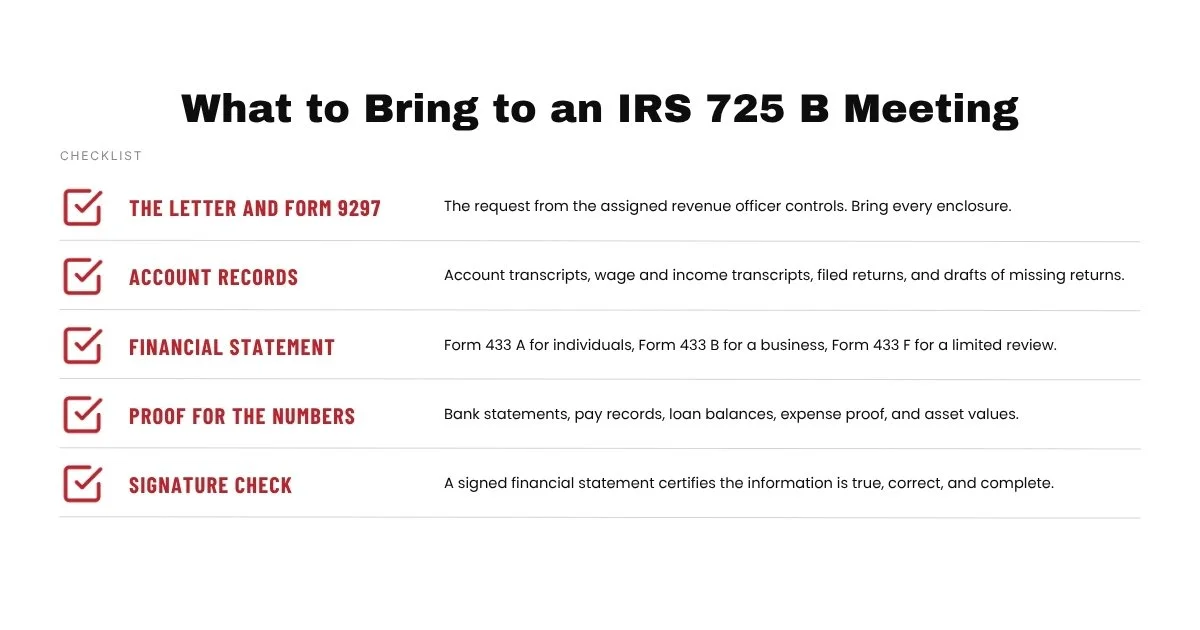
WHAT TO BRING TO AN IRS 725 B MEETING
The controlling document is the request included with your letter, especially Form 9297.
Do not assume that a generic document list replaces the items requested by the assigned revenue officer.
REVIEW THE ACCOUNT BEFORE PREPARING FINANCIAL FORMS
Start by identifying every assigned tax period, assessed balance, missing return, pending payment, prior agreement, collection notice, and collection statute date shown in the available IRS records.
A payment proposal based on the wrong balance or incomplete tax periods may fail to resolve the complete case.
The first objective is to determine what the IRS believes is unresolved and whether the account records are accurate.
ADDRESS MISSING TAX RETURNS
Determine which returns were required, which were filed, which are missing, and whether any recently filed returns are still processing.
Do not prepare missing returns from estimates when accurate records can be obtained.
Income transcripts, payroll reports, bank activity, bookkeeping records, Forms W 2, Forms 1099, prior returns, and business records may be needed before the returns can be completed.
Current filing and payment compliance is often required before the IRS approves a collection alternative.
Revenue officers may address current estimated tax payments and federal tax deposits during the initial investigative interview, including cases handled through a representative.
PREPARE THE REQUESTED FINANCIAL STATEMENT
The revenue officer may request Form 433 A for a wage earner or self employed individual, Form 433 B for a business, or Form 433 F for a more limited financial review.
Form 433 A requests information about household members, employment, income, bank accounts, investments, digital assets, vehicles, real estate, business interests, living expenses, debts, and self employment activity.
The IRS may request records verifying assets, income, expenses, and loan balances.
Form 433 B requests business information, ownership, income, expenses, bank accounts, receivables, digital assets, vehicles, equipment, real estate, debts, and other property.
The IRS may request financial statements, bank records, loan documents, bills, and supporting records after reviewing the form.
COMMON RECORDS TO ORGANIZE
IRS Letter 725 B and every enclosure.
Form 9297 and a response checklist.
Account transcripts and wage and income transcripts.
Filed returns and drafts of missing returns.
Personal and business bank statements.
Pay statements, pension records, Social Security statements, and proof of other income.
Current profit and loss reports and business balance sheets.
Mortgage statements, vehicle loan statements, and other secured debt records.
Proof of housing, utilities, insurance, medical costs, transportation, child care, court ordered payments, and other claimed expenses.
Retirement, brokerage, digital asset, and investment statements.
Vehicle, real estate, equipment, receivable, and business asset information.
Proof of current estimated tax payments or federal tax deposits.
CHECK THE INFORMATION BEFORE SUBMISSION
Compare the forms against the supporting documents before signing.
Confirm that transfers between accounts are not mistakenly counted as new income.
Confirm that loan balances, asset values, household contributions, payroll figures, and business expenses are supported.
A signed collection financial statement may contain a certification that the information is true, correct, and complete.
Review every entry before submitting it. |
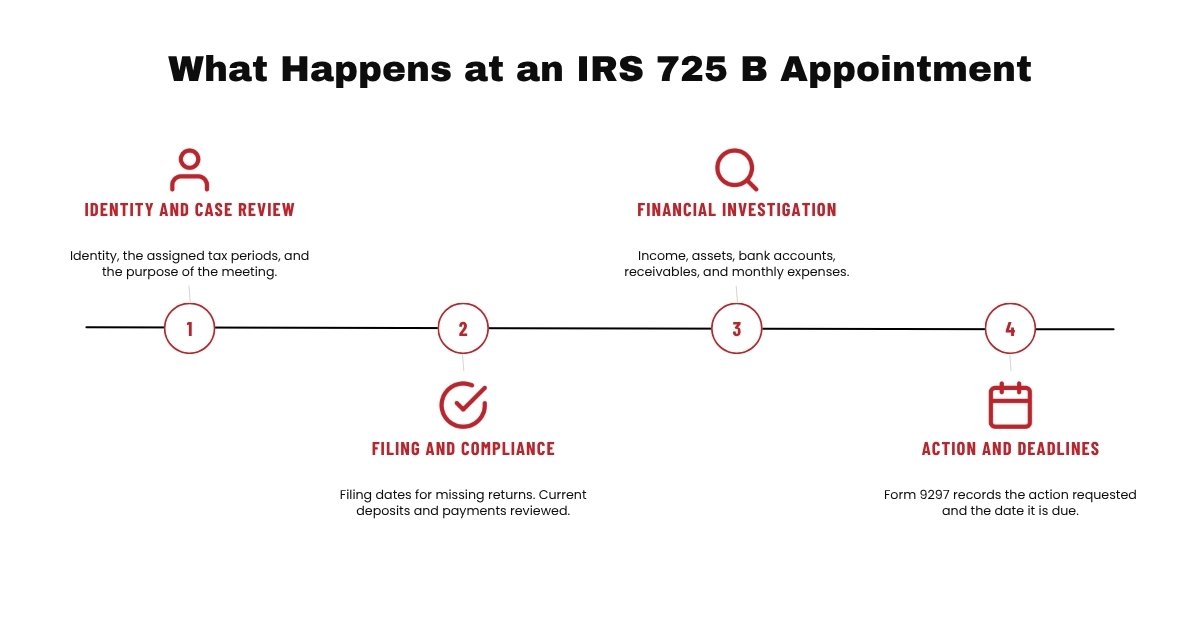
WHAT HAPPENS AT AN IRS 725 B APPOINTMENT
The exact meeting depends on the taxpayer, the tax periods, the type of debt, the available records, and whether a representative attends.
Most initial meetings focus on filing compliance, the assessed balance, current payment compliance, financial information, and the next required action.
STAGE ONE, IDENTITY AND CASE REVIEW
The revenue officer may verify your identity and contact information, identify the assigned tax periods, confirm whether you received Publication 1, and explain the purpose of the appointment.
The officer may also ask about the status of a prior installment agreement, appeal request, offer in compromise, bankruptcy, innocent spouse request, or recently filed return that affects the case.
STAGE TWO, FILING AND CURRENT COMPLIANCE
The officer may identify delinquent returns and establish dates for filing them.
For a business or self employed taxpayer, the officer may also review whether current payroll deposits or estimated tax payments are being made.
A plan for old tax debt may not remain workable if new tax balances continue to arise.
This is why current compliance is often addressed before a long term collection resolution is approved.
STAGE THREE, FINANCIAL INVESTIGATION
Revenue officers generally attempt to secure, review, and discuss a financial statement during the initial investigative interview.
When a complete statement is unavailable, the officer may seek preliminary information about income, assets, payroll, employees, bank accounts, and possible levy sources.
Questions may cover household income, employment, business revenue, accounts receivable, property equity, vehicles, retirement accounts, digital assets, monthly expenses, loans, transfers, and the reason the tax debt was not paid.
Answer accurately.
When you do not know an answer, state that you need to verify the record.
Do not present guesses as facts.
STAGE FOUR, RESOLUTION AND DEADLINES
The officer may request full payment, discuss a payment arrangement, ask for additional documents, consider financial hardship, or explain what must occur before another program can be evaluated.
For an in person meeting, Form 9297 may be used to identify the requested action, the deadline, and the type of enforcement that may follow if the taxpayer does not comply.
EXAMPLE, INDIVIDUAL WITH MISSING RETURNS
Assume an individual received IRS Letter 725 B for three missing returns and an older assessed balance.
The meeting may result in a deadline for preparing the missing returns, a request for Form 433 A, and a follow up date to review the actual liability after the returns are processed.
The officer may not be able to approve a final payment arrangement at the first meeting because the complete amount owed is not yet known.
EXAMPLE, BUSINESS WITH PAYROLL TAX DEBT
Assume a company owes employment taxes and is still operating.
The officer may review current deposits, payroll, bank records, receivables, business assets, responsible individuals, and whether the business can remain current.
The meeting may lead to a short document deadline, a business financial review, a payment demand, or further investigation concerning the trust fund portion of the payroll taxes.
The facts determine the next step. |
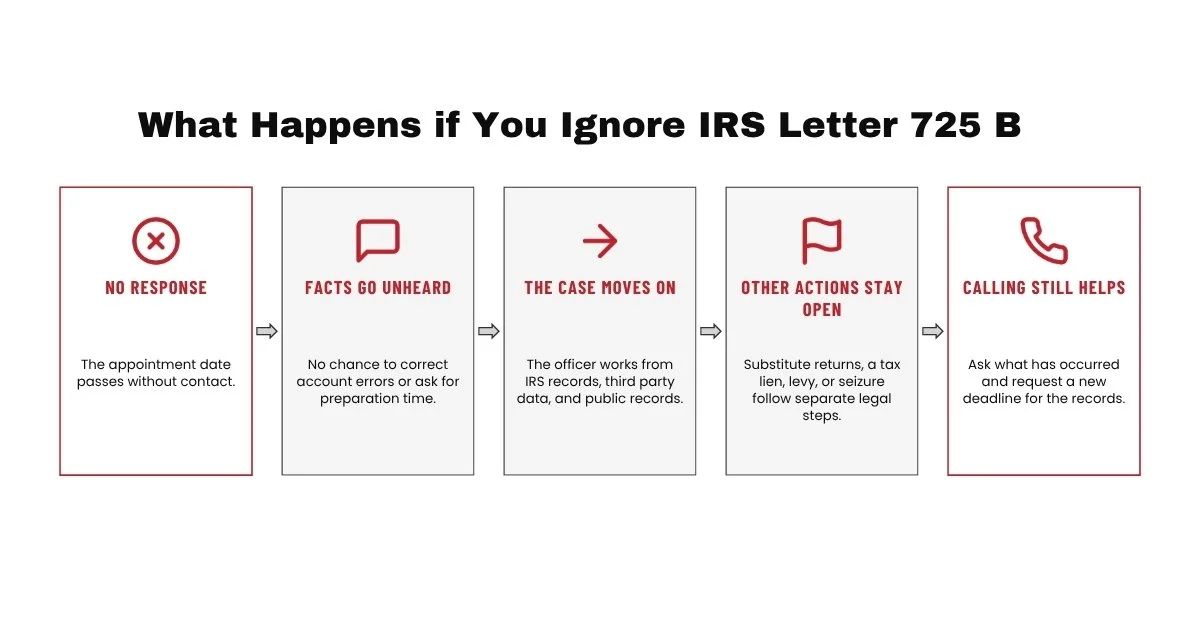
WHAT HAPPENS IF YOU IGNORE IRS LETTER 725 B
Ignoring the letter removes your opportunity to explain the facts, correct account errors, request more preparation time, or propose a collection alternative before the officer takes further action.
A failure to respond may lead to collection of the balance, substitute return preparation, rejection or termination of an installment agreement, a levy, asset seizure, or the filing of a Notice of Federal Tax Lien.
LETTER 725 B DOES NOT AUTOMATICALLY MEAN AN IMMEDIATE LEVY
The letter itself does not mean that every enforcement action will occur immediately.
Levy, lien, seizure, summons, substitute return, and installment agreement actions have separate legal and procedural requirements.
IRS collection may progress from billing to liens, levies, summonses, and other actions when a balance remains unresolved.
Taxpayers may also have collection appeal rights depending on the notice and action involved.
WHY NONRESPONSE INCREASES COLLECTION RISK
A revenue officer must move the assigned case toward resolution.
When the taxpayer does not respond, the officer may rely on IRS records, third party information, known income sources, known bank accounts, public records, prior returns, and other available information.
Nonresponse can also affect whether the officer grants additional time.
A taxpayer who communicates, provides accurate records, and meets agreed deadlines is in a better position to request consideration of a collection alternative than a taxpayer who repeatedly misses appointments.
IF THE APPOINTMENT DATE HAS ALREADY PASSED
Call the revenue officer as soon as possible.
Explain that you received or located the letter, ask what action has occurred, and request a new deadline for the information.
Do not assume that no action occurred simply because you did not receive another letter.
Review account transcripts, recent bank activity, payroll notices, lien records, and any final levy notices that may have been issued.
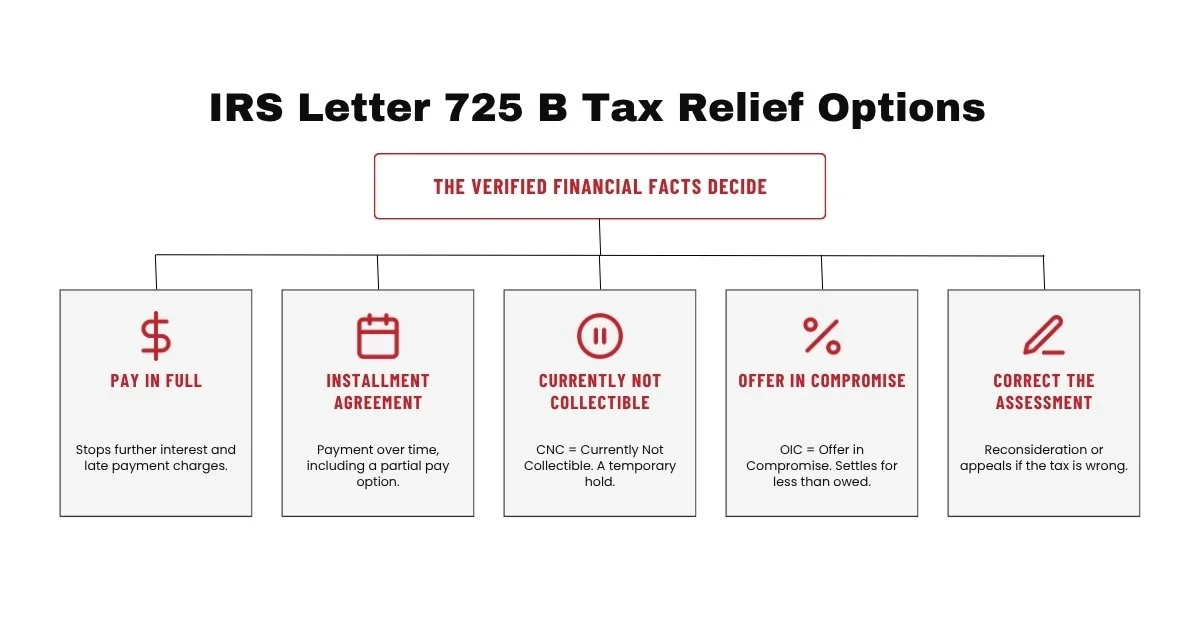
IRS LETTER 725 B TAX RELIEF OPTIONS
The correct resolution depends on the tax amount, filing status, collection statute, household finances, business viability, asset equity, current compliance, and whether the assessed tax is accurate.
The meeting should not begin with an assumption that an offer in compromise is always the best result.
The financial facts should determine the strategy.
FULL PAYMENT OR SHORT TERM PAYMENT
Paying the correct balance in full generally stops future interest and late payment charges from continuing to accrue on that balance.
When full payment is possible within a short period, a short term payment arrangement may be considered.
Before making a large payment, confirm the tax periods, collection status, pending adjustments, and payment application instructions.
INSTALLMENT AGREEMENT
An installment agreement allows payment over an extended period.
Eligibility, financial disclosure, payment amount, term, payment method, and approval requirements depend on the type of tax, balance, filing status, and case assignment.
The IRS offers online payment arrangements for qualifying individual taxpayers.
A case assigned to a revenue officer may still require direct negotiation with that officer, especially when the balance, business debt, missing returns, or financial circumstances fall outside online criteria.
PARTIAL PAYMENT INSTALLMENT AGREEMENT
A partial payment installment agreement may allow monthly payments that are not expected to pay the full balance before the collection period expires.
The IRS generally requires financial disclosure and may review the agreement later.
The payment must reflect the taxpayer’s verified ability to pay under the applicable collection rules.
Asset equity and changes in income may affect approval or future review.
CURRENTLY NOT COLLECTIBLE STATUS
If paying the IRS would prevent you from meeting basic living expenses, the IRS may temporarily place the account in Currently Not Collectible status.
This status does not cancel the debt.
Penalties and interest generally continue, refunds may be applied to the balance, a federal tax lien may be filed, and the IRS may review the financial condition later.
OFFER IN COMPROMISE
An offer in compromise may settle qualifying tax debt for less than the full amount.
The IRS evaluates income, expenses, asset equity, ability to pay, and relevant special circumstances.
Submitting an offer does not mean it will be accepted.
The IRS reviews and verifies the application.
Filing compliance, current tax payments, the offer amount, supporting records, application requirements, and statutory restrictions all affect whether the offer can be processed and approved.
PENALTY RELIEF
Penalty relief may be available through first time abatement, reasonable cause, statutory relief, administrative waiver, or correction of an IRS error, depending on the penalty and facts.
Penalty relief does not automatically resolve the remaining tax and interest.
It should be evaluated as part of the complete account rather than treated as a substitute for a collection plan.
DISPUTING AN INCORRECT TAX BALANCE
If the assessed tax is incorrect, the proper response may involve filing an original return, replacing an IRS substitute return, requesting audit reconsideration, responding to an underreporter adjustment, seeking innocent spouse relief, reporting identity theft, filing an amended return, or pursuing an administrative appeal.
A payment arrangement does not necessarily correct an inaccurate assessment.
The liability issue and the collection issue may require separate procedures. |

DO I NEED A TAX PROFESSIONAL FOR IRS LETTER 725 B
You are not required to hire a professional simply because you received IRS Letter 725 B.
Some taxpayers can gather the records, complete the requested forms, communicate clearly, and resolve the matter directly.
The decision should be based on the risk and scope of the case, not fear created by advertising.
SITUATIONS THAT MAY SUPPORT REPRESENTATION
Consider representation when the case involves one or more of the following:
Several years of unfiled returns.
Business payroll or trust fund taxes.
A large balance that cannot be paid within a standard term.
A pending bank levy, wage levy, lien, seizure, or summons.
Disputed tax assessments or substitute returns.
Significant home equity, retirement funds, digital assets, business assets, or receivables.
A closed or failing business with unresolved payroll taxes.
Prior payment plan defaults or rejected collection proposals.
Financial hardship affecting housing, health care, transportation, or business operations.
Facts that may raise fraud or criminal tax concerns.
A civil tax representative should not attempt to handle possible criminal exposure without the involvement of qualified criminal tax counsel.
WHAT AN AUTHORIZED REPRESENTATIVE CAN DO
A representative can review transcripts, identify open tax periods, confirm filing compliance, organize Form 9297 responses, prepare collection financial statements, communicate with the officer, request reasonable time, present collection alternatives, and challenge procedural errors.
A representative cannot make inaccurate information acceptable, conceal assets, ignore lawful requests, or guarantee that the IRS will approve a particular result.
QUESTIONS TO ASK BEFORE HIRING HELP
Who will personally work the case?
Is that person authorized to practice before the IRS?
Will the representative review account transcripts before recommending a program?
Does the fee include unfiled returns, financial preparation, appeals, payroll tax investigation, and follow up contact?
What information is still needed before any resolution can be evaluated?
Will the representative speak directly with the assigned revenue officer?
Are any results being promised before the financial records are reviewed?
Choose the person who can explain the process, the factual weaknesses, the available options, and the work required.
Do not rely only on a sales presentation. |
FREQUENTLY ASKED QUESTIONS ABOUT IRS LETTER 725-B
-
Usually, no.
Letter 725 B is generally issued by an IRS revenue officer working a civil collection case involving unfiled returns, unpaid balances, or both.
An audit notice normally comes from an IRS examination function and questions the accuracy of a filed return.
A collection case and an audit can exist at the same time.
Review the issuing office, employee title, tax periods, and enclosures before concluding that the matter is limited to collection.
-
Yes, you can ask the assigned revenue officer to reschedule.
Call before the appointment and explain why additional time is needed.
Internal IRS guidance generally directs officers to place the new appointment within a limited period after the original date unless special circumstances support more time.
The officer may also continue working other parts of the collection case while the meeting is pending.
Rescheduling is not the same as placing the account on hold.
-
You may request a different meeting location.
Appointments may occur at an IRS office, a business, or by telephone.
A taxpayer may also request a change involving a residence, business, or representative’s office.
Approval depends on whether the taxpayer is an individual or business, the purpose of the meeting, safety considerations, and the facts of the case.
-
Often, an authorized representative can conduct the initial contact or attend the appointment under a valid Form 2848.
The authorization must cover the correct tax forms, tax periods, and matters.
The revenue officer may still require your participation when personal testimony, verification, business observation, signatures, or facts within your direct knowledge are needed.
Representation changes who communicates with the IRS, but it does not remove your responsibility to provide complete and accurate information.
-
Contact the officer before the deadline.
Identify what is complete, what remains outstanding, why it is unavailable, and when it can reasonably be provided.
Ask whether the meeting should proceed with the available records or whether a short extension will be granted.
Obtain a clear list of the remaining documents and the new deadline.
Form 9297 may be used to record requested actions, deadlines, and possible consequences.
-
Not automatically.
The IRS identifies levy as one possible action when a taxpayer does not respond, but the government must still satisfy the applicable levy notice and due process requirements.
Review whether a final notice of intent to levy has already been issued for the assigned tax periods.
Letter 725 B should not be treated as a substitute for reviewing the complete collection history.
-
Most unannounced revenue officer visits ended in 2023.
The IRS now generally uses Letter 725 B to schedule a meeting in advance.
A scheduled meeting may still occur at a business or residence.
Business cases may require observation of the operation and business assets when the matter cannot be resolved through telephone contact.
Limited unannounced activity may still occur for summonses, subpoenas, and certain sensitive enforcement actions.
-
IRS procedures recognize a right to make an audio recording of certain in person interviews involving the determination or collection of tax.
The same right does not generally apply to telephone interviews, and it does not provide a right to make a video recording.
Contact the revenue officer in advance and follow the applicable IRS procedure before bringing recording equipment.
-
Tell the revenue officer that you dispute the liability and identify the reason.
Gather the return, assessment notice, examination report, income documents, payment records, correspondence, and other proof that supports the dispute.
The correct procedure may involve filing a missing return, replacing a substitute return, requesting reconsideration, filing an amended return, seeking innocent spouse relief, or using an appeal procedure.
Do not assume that the revenue officer can reverse every assessment during the appointment.
-
It is serious because your case has been assigned to an IRS employee who is responsible for obtaining returns, evaluating payment ability, and making collection decisions.
It is also a process that can be managed.
Read the letter, protect the deadline, verify the account, prepare the requested records, and enter the meeting with a realistic resolution plan.
Ignoring the letter presents greater risk than responding with an organized and accurate case. |
RESOLVE IRS LETTER 725 B WITH A CLEAR PROCESS
IRS Letter 725 B means the IRS wants direct contact concerning unresolved tax filings, unpaid balances, or both.
The revenue officer may review compliance, financial information, assets, payment ability, and the steps needed to close the case.
Start with the notice.
Confirm the appointment, identify every tax period, review the account transcripts, and organize the documents listed on Form 9297.
Do not begin by choosing a tax relief program.
First determine whether the tax is correct, whether all required returns are filed, whether current taxes are being paid, how much the IRS can legally collect, and what payment the financial records actually support.
When the case involves several missing tax years, payroll taxes, a large balance, disputed assessments, business assets, financial hardship, liens, levies, or a summons, professional representation may help organize the response and communicate with the revenue officer.
At Semper Tax Relief, I review the IRS account, filing history, collection status, financial records, and taxpayer circumstances before recommending a resolution.
The purpose of that review is to identify the complete problem and the correct procedural response, rather than react to one letter without examining the account behind it. |