IRS Filed a Return for Your Business? What IRC 6020(b) Means and What to Do Next
When the IRS files a return for your business under IRC 6020(b), it means the IRS believes a required return was not filed and is using its legal authority to prepare one. For many business owners, this involves missing employment tax returns such as Form 941 or Form 940. It can also involve certain partnership returns handled by a Revenue Officer.
The return prepared by the IRS is commonly called an IRS substitute for return, an SFR business return, or a default return. It may be based on earlier returns, federal tax deposits, wage information, account credits, or other records available to the IRS.
The IRS is not preparing the return to identify every fact that may reduce the liability. Its purpose is to establish a return, assess tax, and move the account forward when the business has not filed.
I am Sergio Melendez, an IRS Enrolled Agent and Juris Doctor with 20 years of tax experience. I have worked with business owners facing payroll tax problems, missing returns, estimated IRS assessments, Revenue Officer investigations, and collection cases.
My first priority in an IRC 6020(b) case is to identify what the IRS has done, determine whether the proposed numbers are accurate, and file the correct returns when the estimates do not reflect the business records.
Direct Answer
You generally should not ignore an IRC 6020(b) notice or assume that the IRS numbers are correct.
Review every return period listed, compare the proposed amounts with your payroll and accounting records, and respond by the date stated in the letter.
Depending on the facts, you may file your own return, sign an IRS prepared return that is accurate, or provide records showing that no return was required.
IRS Prepared Business Returns: Key Points to Know
Brief Summary
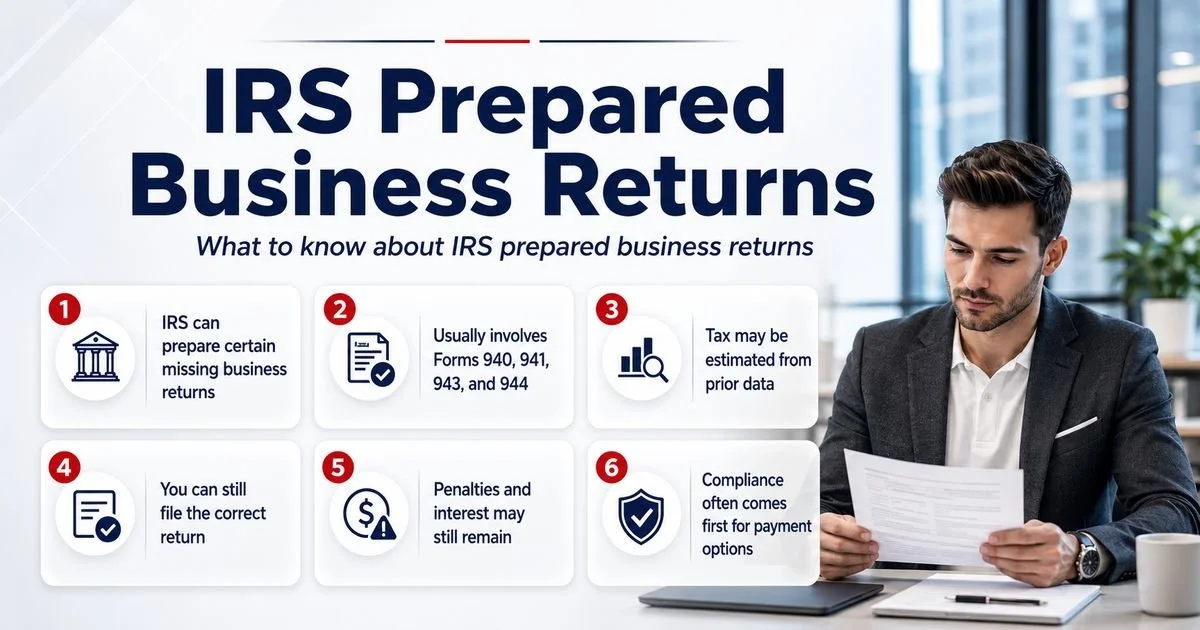
IRC 6020(b) allows the IRS to prepare certain missing business returns.
The automated business program mainly covers Forms 940, 941, 943, and 944.
The proposed tax may be estimated from earlier returns, deposits, credits, or wage information.
You may still file an accurate business return, even after the IRS has started the process.
Filing the missing return does not automatically remove penalties, interest, or an existing assessment.
Filing compliance usually must be addressed before the IRS will approve a payment plan or consider an Offer in Compromise.
What IRC 6020(b) Means for a Business
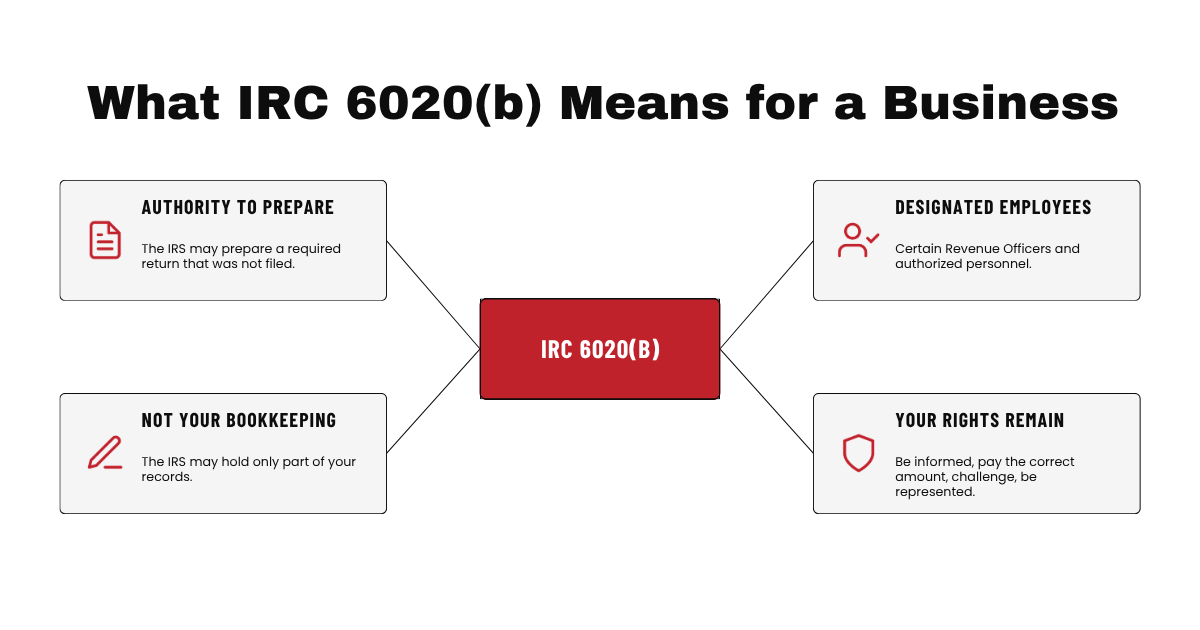
IRC 6020(b) gives the IRS authority to prepare a return when a taxpayer fails to file a required return or submits a return that the IRS determines is false or fraudulent.
The authority can be used by designated IRS employees, including certain Revenue Officers and other authorized personnel.
An IRS Prepared Return Is Not the Same as Voluntary Compliance
When I prepare a delinquent return for a client, I use the business records to report the actual wages, deposits, income, expenses, and other required information.
When the IRS prepares a return, it may have only part of that information.
The IRS is creating a legally processable return so that it can assess tax. It is not acting as the business owner’s accountant, bookkeeper, or tax adviser.
This is why an IRS filed return for business may be very different from a return prepared from complete books and payroll records.
For campus cases, the automated system is intended to secure valid employment tax returns or file returns on behalf of businesses that have not filed.
You Still Have Taxpayer Rights
Receiving an IRC 6020(b) letter does not mean that you must accept an incorrect amount.
Taxpayers have the right to be informed, the right to pay no more than the correct amount, the right to challenge an IRS position, and the right to retain representation.
You should use those rights responsibly.
Submit accurate returns, provide records, meet the response date, and keep proof of everything sent to the IRS.

Which Business Returns Can the IRS Prepare Under IRC 6020(b)
The phrase IRS substitute for return is sometimes used broadly, but the procedure depends on the type of business return involved.
It is important to identify the exact form, period, and IRS function handling the case.
Automated IRC 6020(b) Employment Tax Returns
The campus A6020(b) program focuses on these returns:
Form 940, Employer’s Annual Federal Unemployment Tax Return
Form 941, Employer’s Quarterly Federal Tax Return
Form 943, Employer’s Annual Federal Tax Return for Agricultural Employees
Form 944, Employer’s Annual Federal Tax Return
These are the returns processed through the specific automated program described in the Internal Revenue Manual.
This means that a search for an IRS substitute for return involving payroll tax or Form 941 issues usually relates directly to the automated business process.
Returns Prepared by a Revenue Officer
A Revenue Officer handling business taxes may also use IRC 6020(b) procedures in a delinquent return investigation.
The field collection procedures cover employment returns, certain excise returns, and Form 1065 partnership returns.
Before using this authority, the Revenue Officer is generally directed to make contact and confirm that the entity was required to file.
A field case may involve Letter 1085, which gives the business time to file its own returns, sign the proposed returns, or request an Appeals conference.
If the business does not respond, the Revenue Officer may process the prepared returns for assessment.
IRS Filed Return for a Partnership, Form 1065 Substitute for Return
A Revenue Officer may prepare a Form 1065 under IRC 6020(b.
The officer may complete identifying information, prepare Schedules K 1 for known partners, and allocate known partnership income when sufficient information is available.
Partnerships normally pass income and deductions to their partners, although partnership level tax may apply in some audit situations.
A partnership should not assume that an IRS prepared Form 1065 accurately reports each partner’s ownership percentage, distributive share, basis information, deductions, or credits.
Filing a complete partnership return is usually the better way to establish the correct information.
IRS Filed Return for a Corporation, Form 1120 Substitute for Return
Form 1120 is not one of the returns processed through the campus A6020(b) program for employment tax returns.
In a field delinquent return investigation, an unfiled Form 1120 may be referred to the IRS examination function for liability development.
A corporation with an unfiled Form 1120 should not wait for the IRS to reconstruct its income and deductions.
The corporation should determine its correct filing requirement, prepare the return from reliable books and records, and address any examination or collection activity already underway.
IRS Filed Return for an S Corporation, Form 1120S Substitute for Return
Form 1120S is also outside the campus automated program for Forms 940, 941, 943, and 944.
A Revenue Officer investigating a missing Form 1120S may verify whether the S corporation election was accepted and may refer the income tax issue to the examination function.
The filing status matters.
A business that believes it is an S corporation may have a Form 1120 filing requirement if its Form 2553 election was never accepted.
That issue should be confirmed before delinquent returns are prepared.
What Triggers an IRS SFR for a Business
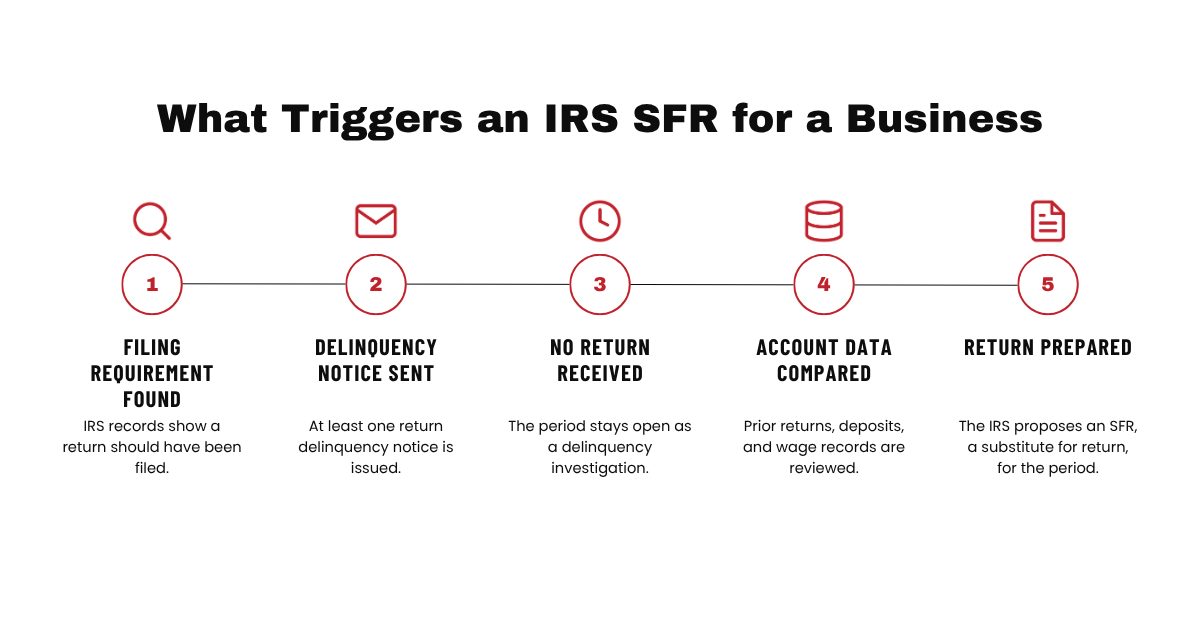
The usual trigger is not a single missed deadline.
It is a missing return that remains unresolved after the IRS identifies a filing requirement and sends one or more delinquency notices.
An Open Taxpayer Delinquency Investigation
For the automated A6020(b) program, the return period generally must be classified as a Taxpayer Delinquency Investigation.
This means the IRS selected the period for delinquency treatment, issued at least one return delinquency notice, did not receive a return, and still considers the filing requirement open.
Common causes include:
Form 941 quarters were not filed.
The business made federal tax deposits but did not file the related return.
A payroll provider prepared a return but it did not post to the IRS account.
The business closed but did not file a final return or close its filing requirement.
The IRS has the wrong filing requirement for the business.
Notices were sent to an old address and were not answered.
The IRS Sees Evidence That a Return May Be Due
The IRS may compare filing requirements, prior returns, payroll deposits, Forms W 2, and other account information.
A missing return combined with deposits or wage information can support the IRS conclusion that the business had employees and was required to file.
That does not always mean the IRS conclusion is correct.
A deposit may have been applied to the wrong period.
Payroll may have been reported under another Employer Identification Number.
The business may have closed before the period began.
The filing requirement may have remained open after the final payroll return.
These issues should be proved with records rather than explained only by telephone.
The exact letter matters because the response procedure can vary depending on whether the case is in the automated campus program or assigned to a Revenue Officer.
Letter 1085 A in an Automated Business Case
The automated program sends one Letter 1085 A that lists the nonfiled returns being requested.
The package may include IRS prepared returns for more than one period.
The business may respond by:
Filing the requested returns.
Calling the number on the letter.
Providing information showing that it was not required to file.
Signing the IRS prepared returns when the figures are accurate.
IRS procedures recognize both taxpayer prepared returns and signed IRS prepared returns as secured returns.
Letter 1085 in a Revenue Officer Case
A Revenue Officer may send or deliver Letter 1085 with proposed IRC 6020(b) returns.
The field collection procedures describe this as a 30 day proposed assessment letter.
If the taxpayer requests an Appeals conference, the case may be forwarded to the IRS Independent Office of Appeals.
Do not assume that every business has the same 30 day period.
Read the date and instructions on the actual letter.
The document you received controls the response date for your case.
What to Check Before Responding
I recommend confirming all of the following:
Business name and Employer Identification Number
Return type
Tax period
Proposed wages or income
Federal tax deposits and payments
Penalties and interest
Address used by the IRS
Response date
IRS unit or Revenue Officer assigned
Whether the return has already been assessed

How the IRS Calculates an SFR Business Return
The IRS does not always have the information needed to prepare an accurate return.
Its procedures therefore permit estimates based on available account data.
How Payroll Wages May Be Estimated
In the automated program, the IRS may derive wages from the tax shown on an earlier filed return or from credits already posted to the missing period.
The system may use the larger result when more than one calculation is available.
In a Revenue Officer case, actual payroll information should be used when available.
When actual information is not available, the field procedures allow calculations based on earlier periods, payroll frequency, wage data, federal tax deposits, and an inflation factor.
The Revenue Officer is directed to document the basis for the proposed assessment.
Why an IRS Estimate May Be Too High
An estimated return may be too high when:
The prior quarter had unusually high payroll.
The business reduced its staff.
The business stopped operating during the quarter.
Deposits were applied to the wrong period.
The IRS assumed payroll continued when it did not.
A payroll provider issued corrected reports that did not post.
The IRS used an incorrect filing requirement.
This answers a common question, can an IRS SFR overstate income and miss deductions?
Yes, an estimated return can overstate the liability when the available IRS information does not match the actual business activity.
For payroll returns, the issue is usually not business deductions.
It is whether the wages, withholding, Social Security tax, Medicare tax, federal unemployment tax, deposits, credits, and filing period are correct.
Example of an Estimated Form 941 Problem
Assume a business had ten employees during the prior quarter but reduced its staff to two employees during the missing quarter.
If the IRS estimates the missing quarter from the earlier return, the proposed wages and tax may be much higher than the actual liability.
The business should not respond with only a statement that the amount is wrong.
It should prepare Form 941 from payroll registers, Forms W 2, bank records, payroll reports, and federal tax deposit history.
The records give the IRS a reason to replace the estimate with actual figures.
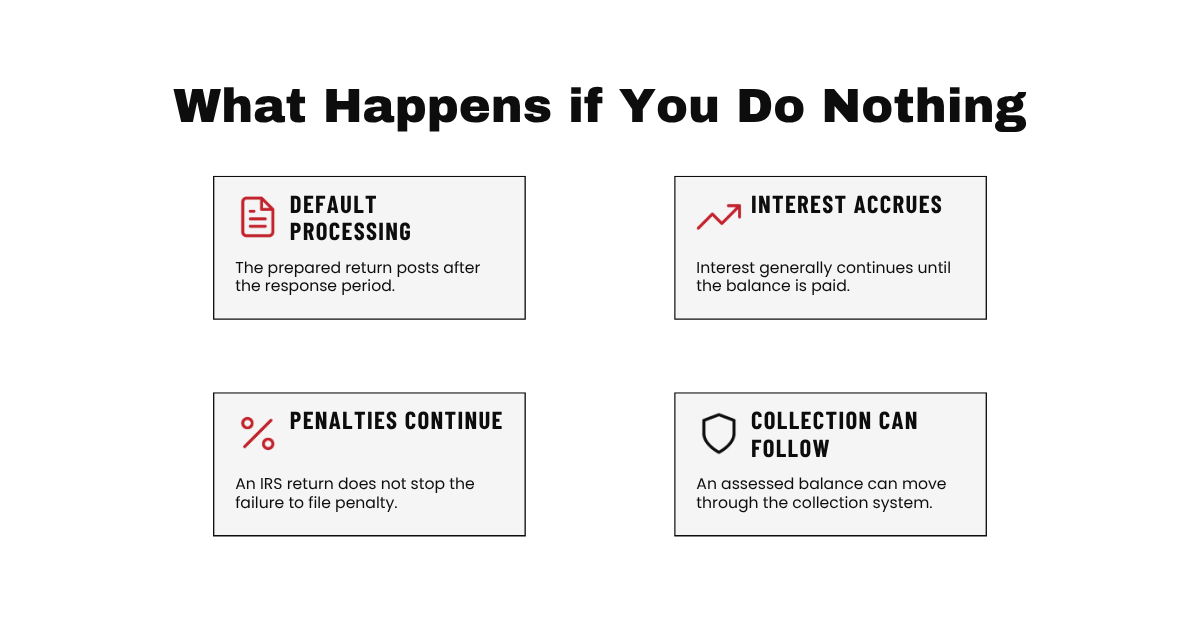
What Happens if You Do Nothing
If the IRS does not receive an acceptable response, it may process the prepared return and assess the proposed tax.
The Default Return May Be Assessed
In an automated case, the account moves toward default processing after the response period expires.
The IRS system then transmits the prepared return for posting to the Business Master File.
In a Revenue Officer case, the officer may process the return when the business has not filed the delinquent return or returned the signed IRC 6020(b) return.
Penalties Do Not Disappear Because the IRS Filed a Return
An IRS prepared return does not relieve the taxpayer of the failure to file penalty.
A valid IRC 6020(b) return can, however, be treated as the taxpayer’s return for certain failure to pay penalties.
Waiting for the IRS to file does not create a penalty advantage.
Interest generally continues until the liability is paid.
Filing your own return may reduce the underlying tax when the IRS estimate was too high, but it does not automatically remove properly assessed penalties or interest.
Penalty relief may be available when the business meets the legal requirements for reasonable cause, administrative relief, or another applicable basis.
The facts and the type of penalty must be reviewed separately.
The Balance Can Move Into Collection
After assessment and notice, the IRS may seek payment.
Depending on the account, the case may remain in campus collection, move to the Automated Collection System, enter the collection queue, or be assigned to a Revenue Officer.
Potential collection actions can include a Notice of Federal Tax Lien or a levy after the IRS completes the notices and procedures required for that action.
A substitute return does not mean a levy will happen immediately.
It can create the assessment that later becomes subject to collection.

Can I Replace an IRS SFR With My Own Filed Return
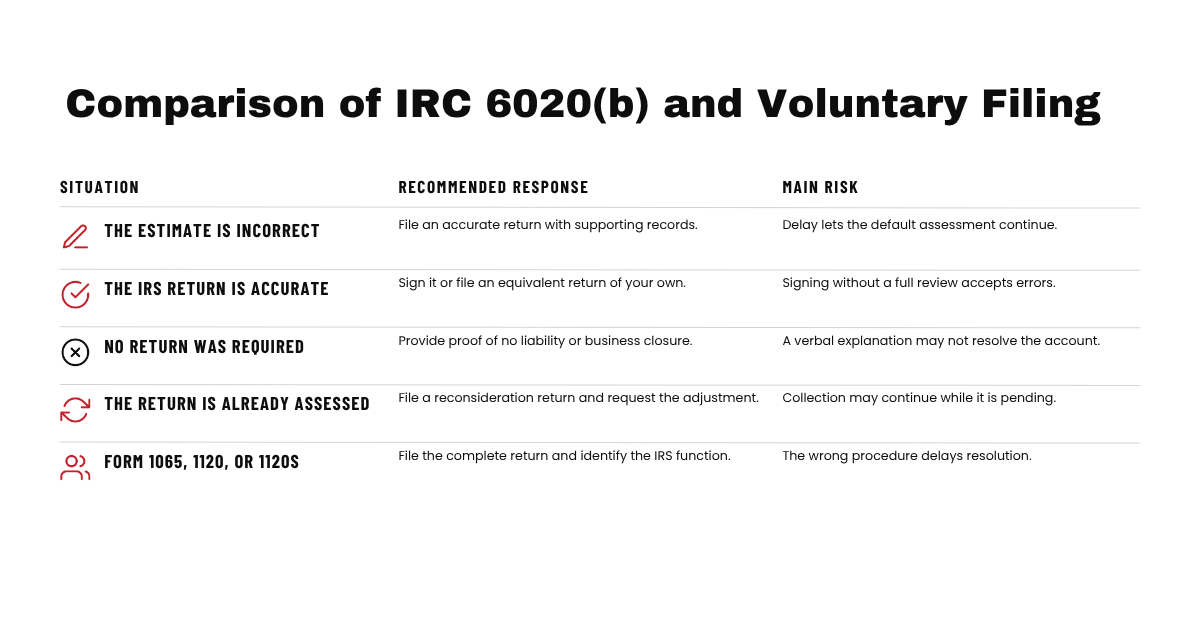
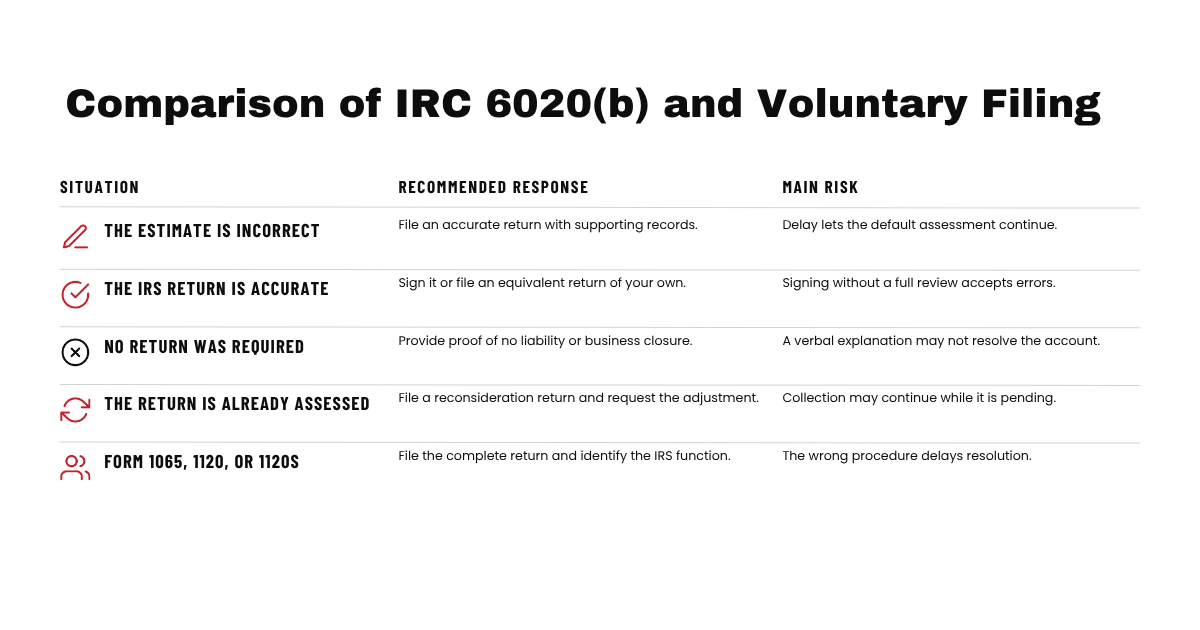
In many cases, you can still file your own accurate return.
The procedural result depends on whether the IRS prepared return is still proposed or has already been assessed.
Filing Before the IRS Default Assessment
When the A6020(b) case is still open, the preferred response is usually a signed, processable return prepared from the actual records.
IRS procedures direct employees to close the automated case when a processable return is received and posted.
This is often the cleanest answer to how to stop the IRS from filing a return for my business.
File the missing return before default processing is completed, respond to the letter, and confirm that the return was received.
Filing After the IRS Has Already Assessed the Return
You can still submit a taxpayer prepared return after the default assessment.
The IRS may treat it as a reconsideration return and adjust the existing assessment when the return supports a different liability.
I do not describe this as an automatic replacement.
The IRS may need to review the return, verify deposits, transfer credits, correct account coding, or process an adjustment.
Filing a return does not mean the account transcript will change immediately.
Your Return Must Be Complete and Signed
The IRS requires a processable return.
A return without a valid signature may be rejected or delayed.
The numbers should also reconcile with payroll records, Forms W 2, Forms W 3, federal tax deposits, and any amended returns.
If the return is inconsistent, the IRS may request more information or refer the matter for examination.
The Assessment Statute Requires Special Attention
An IRS default return does not start the normal assessment statute in the same manner as the taxpayer’s own filed return.
A taxpayer’s later reconsideration return may start the assessment statute period.
This can matter when older returns are involved.
Statute questions should be reviewed based on the form, filing date, assessment history, and account transcript.

How to Get IRS Transcripts for an SFR Business Return
Transcripts are one of the first records I review in an IRC 6020(b) case.
They show what the IRS believes happened on the account.
Ways to Request a Business Transcript
The IRS currently provides three main methods:
View, print, or download transcripts through an eligible Business Tax Account.
Request transcripts by mail using Form 4506 T.
Call the IRS Business and Specialty Tax line.
An authorized tax professional may also obtain transcripts through IRS practitioner systems when a valid Form 2848 or Form 8821 is on file.
Which Transcripts Are Useful
A tax account transcript can show return filing dates, processing dates, payments, federal tax deposits, penalties, interest, adjustments, and the balance due.
An employment tax return transcript can show information reported on Forms 940, 941, 943, and 944 for available periods.
An entity transcript can verify the business name, Employer Identification Number, address, and filing requirements.
A corporate or partnership return transcript may show information from Forms 1065, 1120, and 1120S, although it may not show later adjustments.
What to Look for on the Transcript
I look for:
Whether a return posted
The return processing date
The assessed tax
Federal tax deposits
Credit transfers
Penalty assessments
Interest accruals
Collection status changes
Substitute return indicators
Whether a taxpayer prepared return posted after the default assessment
A transcript should be read together with the actual notice and the business records.
A transaction code alone rarely tells the full story.

How to Respond to an IRS Notice About a Substitute for Return
A useful response is organized by return period and supported by records.
I use the following sequence in most business cases.
Step 1, Verify That the Letter Is Genuine
Confirm the business name, Employer Identification Number, IRS address, telephone number, return periods, and response date.
Compare the letter with the business account transcript.
Step 2, Identify Every Missing Return
Create a list showing the form and period for every open filing requirement.
Do not address only the newest quarter when the letter lists several periods.
For payroll cases, review Forms 940, 941, 943, 944, and 945 as applicable.
Also confirm whether Forms W 2 and W 3 were filed with the Social Security Administration.
Step 3, Reconstruct the Records
Useful records may include:
Payroll registers
Employee earnings reports
Forms W 2 and W 3
Bank statements
Payroll tax deposit confirmations
Business Tax Account payment history
Payroll provider reports
General ledger detail
Prior filed returns
State payroll returns
Business closure records
Proof of a different Employer Identification Number
Step 4, Choose the Correct Response
There are usually three main paths.
First, file your own accurate return when the IRS estimate is incorrect.
Second, sign the IRS prepared return only when it accurately reports the business liability.
Third, provide records showing that no return was required.
Step 5, Submit the Response Correctly
Follow the instructions on the letter.
Keep a complete copy of the response.
Use a delivery method that provides tracking when mailing documents.
Record the date, address, fax confirmation, and name of any IRS employee contacted.
Step 6, Confirm That the Return Posted
Do not assume the matter is closed because the return was mailed.
Check the transcript after a reasonable processing period.
Electronically filed business returns may take approximately two to three weeks before transcript information becomes available.
Processing can take longer when a return requires manual review.
Step 7, Correct Current Compliance
File all current returns and make required federal tax deposits.
Fixing old periods while missing new periods will usually prevent the business from obtaining a stable collection resolution.
Step 8, Address the Remaining Balance
Once the correct returns are posted, review the actual tax, penalties, interest, collection status, and available payment options.
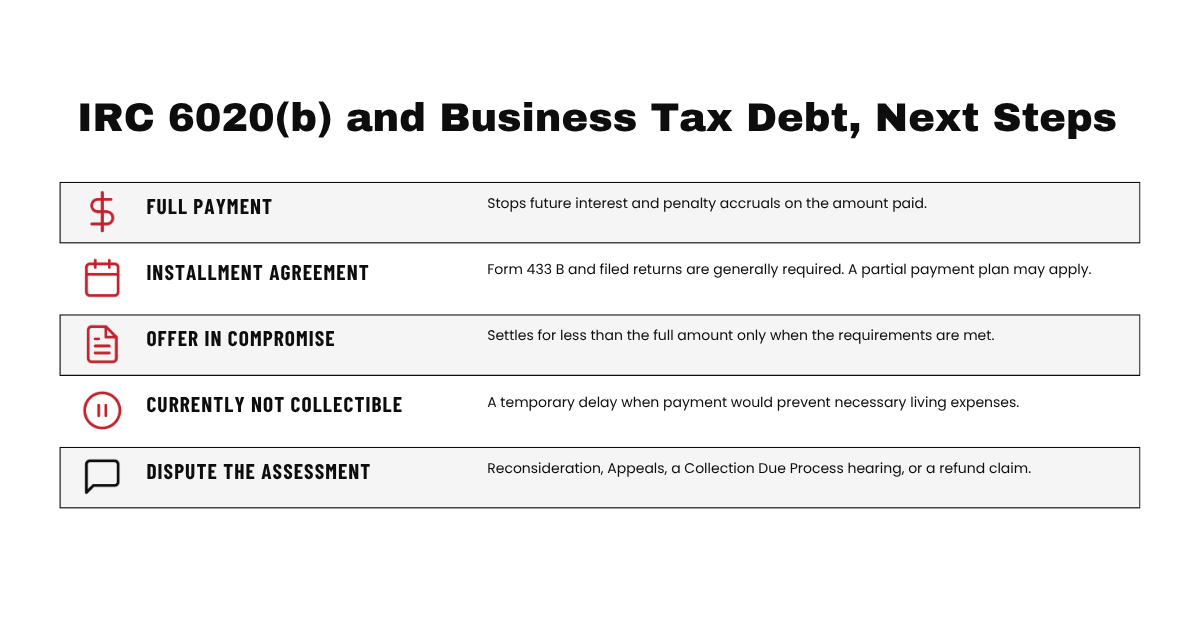
IRC 6020(b) and Business Tax Debt, Next Steps
Correcting the return is only one part of the case.
After the accurate liability is established, the business must decide how to address the remaining IRS tax debt.
Full Payment
Full payment stops future interest and penalty accruals on the amount paid.
When full payment is not realistic, the business should review formal collection alternatives rather than ignore the balance.
Business Installment Agreement
A payment plan may allow the business to pay over time.
The IRS may require financial information, including Form 433 B and supporting records.
All required returns generally must be filed before an installment agreement is approved.
Partial Payment Installment Agreement
A partial payment plan may be considered when the proposed monthly payments will not pay the full balance before the collection period expires.
The IRS generally requires detailed financial disclosure and may review the agreement again later.
Offer in Compromise
An Offer in Compromise may settle a tax liability for less than the full amount when the legal requirements are met.
It is not available simply because the balance is large or the business would prefer a lower payment.
Before the IRS will consider an offer, the taxpayer generally must file all required returns.
A business with employees must also make required federal tax deposits for the current quarter and the two preceding quarters.
The IRS generally evaluates assets, income, allowable expenses, and future ability to pay.
Currently Not Collectible Status
The IRS may temporarily delay collection when payment would prevent the taxpayer from meeting necessary living expenses.
This status is more common for individuals and closed businesses than for an operating employer that continues to accrue payroll taxes.
Penalties and interest may continue, and the IRS may request updated financial information.
Disputing the Assessed Liability
When the assessment is wrong, the first issue may be liability rather than payment.
Depending on the procedural history, a taxpayer may use a reconsideration request, an Appeals process, a Collection Due Process hearing, a refund claim, or another remedy.
The ability to dispute the underlying tax during a collection hearing may be limited if the taxpayer previously had an opportunity to challenge the liability.

How to Prevent the IRS From Filing a Business Return
The best prevention system is simple.
File the return, verify that it posted, and keep current deposits separate from older tax debt.
File Even When You Cannot Pay in Full
Not having the money to pay is not a reason to leave the return unfiled.
Filing establishes the business figures and prevents the IRS from relying entirely on estimates.
Payment options can be reviewed after the correct liability is known.
Reconcile Payroll Every Quarter
Compare payroll registers, Forms W 2, Form W 3, federal tax deposits, and Form 941 before filing.
Resolve differences while records are current.
Monitor IRS Transcripts
Use the Business Tax Account or request transcripts to confirm that returns and deposits posted to the correct periods.
A tax account transcript can show payments, penalties, interest, filing dates, and processing dates.
Keep the IRS Address Current
A missed notice can become a default assessment even when the owner did not intentionally ignore the IRS.
Update the business address and maintain access to mail sent to the prior business location.
File a Final Return When the Business Closes
Check the final return box when appropriate and close payroll accounts correctly.
Otherwise, the IRS may continue to expect quarterly or annual returns.
Do Not Use Current Payroll Taxes to Fund Operations
Payroll taxes withheld from employees are trust fund taxes.
Falling behind can expose responsible individuals to a Trust Fund Recovery Penalty investigation in addition to the business liability.
I based this article on primary IRS and Taxpayer Advocate Service sources rather than general statements from tax relief advertisements.
Primary Authorities Reviewed
Internal Revenue Manual section 5.18.2, which covers the campus automated IRC 6020(b) program for Forms 940, 941, 943, and 944.
Internal Revenue Manual section 5.1.11, which covers Revenue Officer delinquent return investigations, field preparation of IRC 6020(b) returns, Form 1065 procedures, Letter 1085, and Appeals rights.
IRS guidance on failure to file and failure to pay penalties when the IRS prepares a substitute return.
IRS business transcript guidance.
IRS Publication 594 and current Offer in Compromise guidance for collection options and compliance requirements.
Taxpayer Advocate Service guidance concerning collection alternatives, disputed assessments, taxpayer rights, and assistance when normal IRS channels do not resolve the problem.
Common Questions About IRS Prepared Business Returns Under IRC 6020(b)
-
No.
The legal authority comes from the same section of the Internal Revenue Code, but the operational procedures differ.
Individual income tax substitute returns are commonly developed through the individual Automated Substitute for Return program using third party income records.
The campus business A6020(b) program addressed in this article focuses on Forms 940, 941, 943, and 944.
Revenue Officers may use separate field procedures for employment, excise, and partnership returns.
This distinction matters because individual SFR rules concerning filing status, dependents, and personal deductions do not explain how an estimated Form 941 is calculated.
-
Yes.
The IRS procedures allow a business to submit a taxpayer prepared return while the A6020(b) case is open and after a default return has been assessed.
Before assessment, the return may close the open delinquency.
After assessment, the IRS may process it as a reconsideration return and adjust the liability.
The return should be signed, processable, and supported by payroll records.
Filing alone does not guarantee that the default assessment will be adjusted immediately.
Monitor the transcript and follow up when the account does not change.
-
No.
An IRC 6020(b) return is disregarded when determining the failure to file penalty.
A valid IRS prepared return may be treated as the taxpayer’s return for certain failure to pay penalties.
This means waiting for the IRS to file does not create a penalty advantage.
The business may still face failure to file penalties, failure to pay penalties, deposit penalties, and interest, depending on the facts.
-
There is no single timetable that applies to every business.
The IRS generally must assess the liability and send notice and demand for payment before pursuing collection.
The pace depends on the amount, return type, account status, prior notices, and whether a Revenue Officer is assigned.
A default assessment does not mean an immediate levy.
It does mean that the IRS now has an assessed balance that can progress through its collection system.
Responding before the default assessment is usually easier than correcting the liability while collection activity is underway.
-
Do not sign an estimated payroll return showing wages that were never paid.
Prepare the proper zero return when a return was required, or provide records showing that the filing requirement ended before the period.
Useful proof may include the final prior payroll return, payroll closure reports, state payroll account records, bank statements, business dissolution documents, and proof of the date wages were last paid.
-
Forms 1120 and 1120S are not among the four return types processed through the campus A6020(b) program.
Unfiled corporate returns may be handled through a delinquent return investigation and referred to the examination function.
A corporation should file its own complete return and determine whether the IRS is questioning the filing requirement, the S corporation election, reported income, or the amount of tax.
-
Potentially, but correcting the return and restoring compliance usually come first.
The IRS generally requires all required returns to be filed before it will consider an Offer in Compromise.
A business with employees must also make required federal tax deposits for the current quarter and the two preceding quarters.
An offer should not be used to settle an inflated assessment that can first be corrected with accurate returns.
Establish the correct liability, confirm the assessment, and then determine whether the taxpayer meets the financial or legal requirements for an offer.
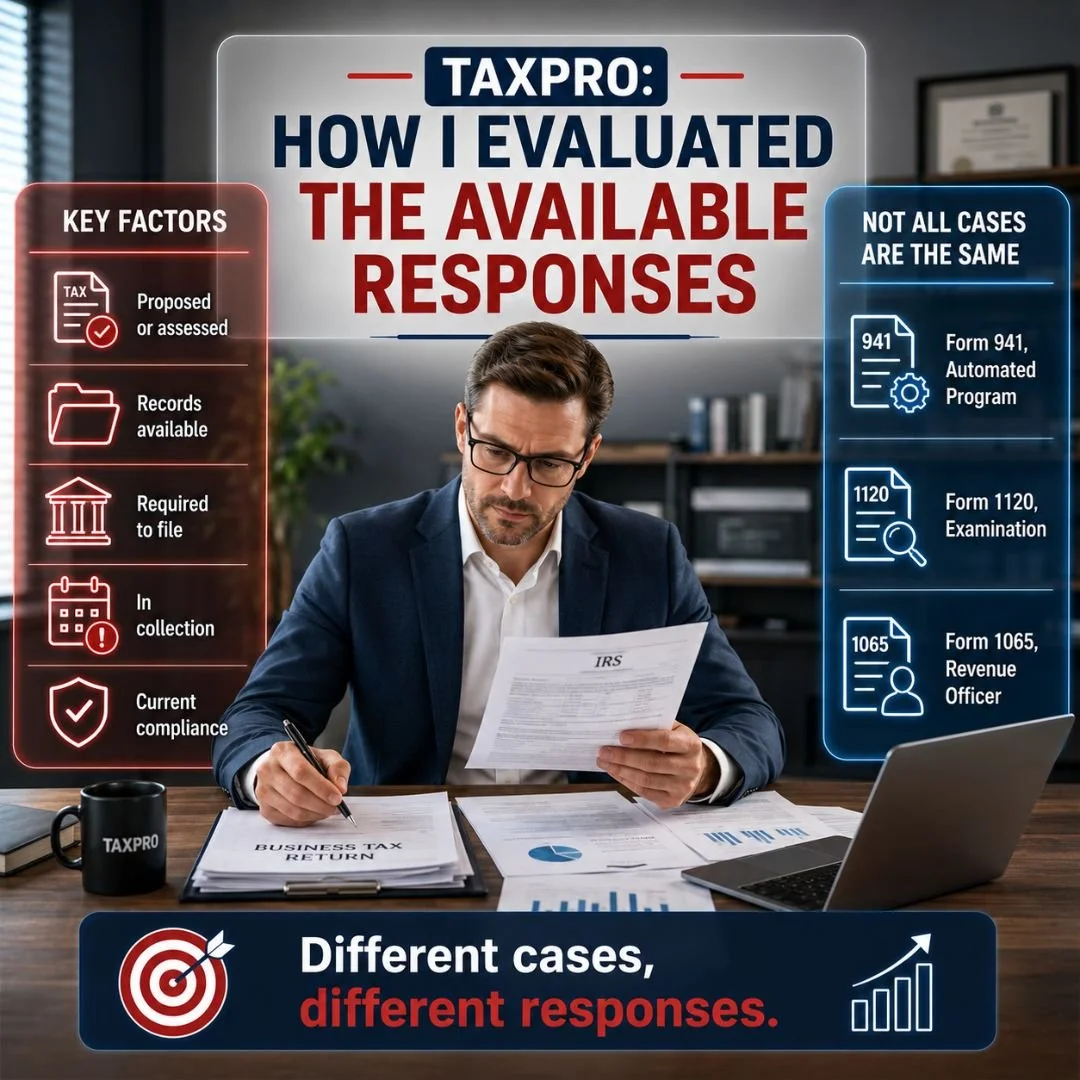
How I Evaluated the Available Responses
I compared each response based on five criteria:
Whether the IRS has only proposed the return or already assessed it
Whether accurate business records are available
Whether the business was legally required to file
Whether the account is already in collection
Whether current filing and deposit requirements are being met
This method avoids treating every substitute return case as the same.
A missing Form 941 assigned to the automated program requires a different response from an unfiled Form 1120 assigned to Examination or a Form 1065 prepared by a Revenue Officer.