
Which IRS Collection Department Is Handling Your Tax Debt?
Meta Description: Learn how ACS, Field Collection, Special Compliance Personnel, and private collection agencies affect your IRS tax debt options.
If you owe the IRS, your account may be handled by the Automated Collection System, an ACS Special Compliance Personnel team, Field Collection with an assigned Revenue Officer, a private collection agency, or an IRS inventory status known as the queue or shelved inventory.
The collection assignment matters because it determines where you send information, who reviews your proposal, whether a specific IRS employee is assigned, and what collection actions may be available to the IRS.
Your assignment does not automatically determine which tax relief option you qualify for. Eligibility for an installment agreement, Currently Not Collectible status, an Offer in Compromise, penalty relief, or another resolution depends on your filing compliance, current tax compliance, income, expenses, assets, tax periods, collection deadlines, and other facts.
I am Sergio Melendez, an Enrolled Agent and Juris Doctor with over 20 years of tax experience. One of the first things I review in an IRS collection case is where the account is assigned. That tells me who has control of the case and how the response should be presented.
The Taxpayer Advocate Service identifies four main IRS routing categories, ACS, Field Collection, the queue, and shelved inventory. Certain inactive accounts may also be assigned to a private collection agency. Special Compliance Personnel work within the ACS collection structure rather than functioning as a separate field collection office.
Brief Summary, Who Is Handling Your IRS Tax Debt?
The Direct Answer
The IRS collection department handling your tax debt may be:
The Automated Collection System, commonly called ACS
Special Compliance Personnel working ACS inventory
Field Collection with an assigned Revenue Officer
A private collection agency working on behalf of the IRS
The IRS collection queue, where a case waits for possible Revenue Officer assignment
Shelved inventory, where no IRS employee is actively working the account
A taxpayer may receive IRS notices in any of these situations. The absence of a named Revenue Officer does not mean the collection case has closed.
Why the Assignment Matters
Each collection area works differently.
ACS is primarily a centralized collection operation. You may speak with different IRS employees when you call.
A Revenue Officer is a specific IRS employee assigned to investigate and work the case.
Special Compliance Personnel are IRS employees working designated ACS collection inventory.
A private collection agency is an outside contractor. It has much less authority than the IRS.
The queue and shelved inventory are account statuses. A specific IRS employee may not be actively assigned, but computer generated collection activity may continue.
What You Should Review First
Before discussing a tax relief proposal, I generally review:
The most recent IRS notice
Every tax year and tax period with a balance
Missing individual or business tax returns
Current estimated tax payments or federal tax deposits
Existing installment agreements
Federal tax lien filings
Final levy notices and appeal deadlines
Collection statute expiration dates
Income, monthly expenses, bank accounts, and property
Whether the assessed tax is correct
How the IRS Routes Tax Debt Cases
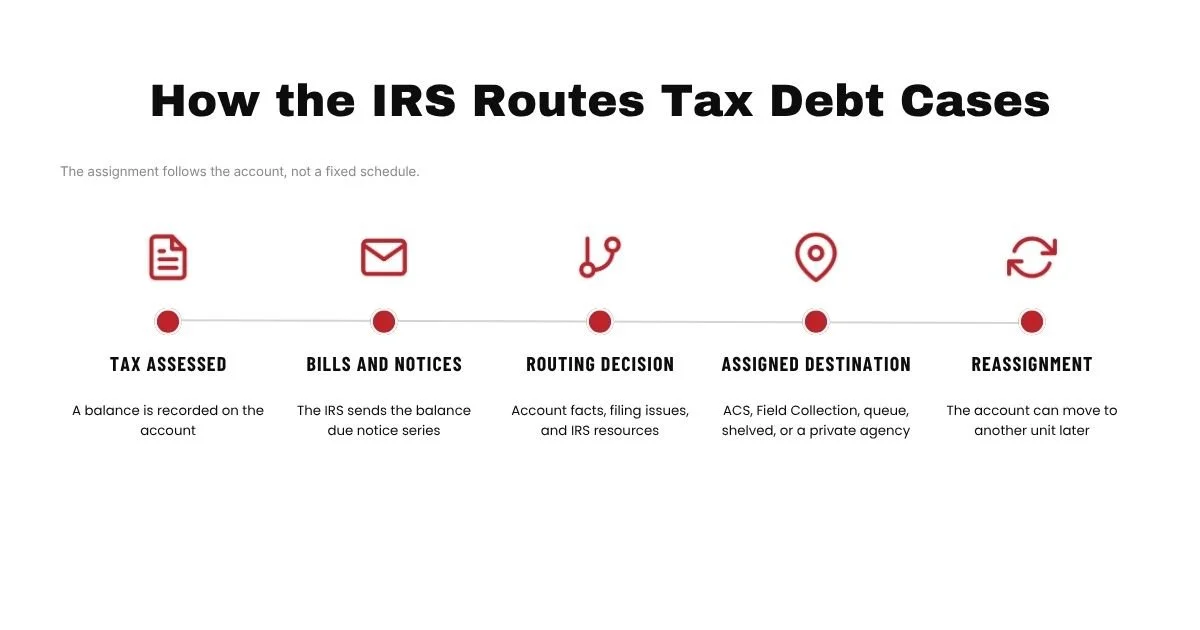
The IRS does not handle every unpaid account through the same collection unit. After a tax is assessed and remains unpaid, the IRS may send a series of bills and collection notices. If the account is not resolved, the IRS may route it based on account characteristics, available collection resources, tax return filing issues, and other internal criteria.
The IRS collection process may include refund offsets, federal tax liens, levies, direct contact from a Revenue Officer, and other collection procedures when the legal requirements for those actions are met. Penalties and interest generally continue to accrue while a balance remains unpaid.
The IRS Notice Stage
Collection usually begins with a bill explaining the tax, penalties, interest, payment due date, and response instructions.
A notice may ask you to:
Pay the balance
Contact the IRS
File missing returns
Provide information
Request a payment arrangement
Exercise appeal rights before a stated deadline
Read the entire notice. The department name, telephone number, mailing address, tax periods, and response deadline may determine the next step.
H3 The Main IRS Collection Destinations
The Taxpayer Advocate Service describes the following routing destinations:
Automated Collection System
Field Collection
Queue awaiting possible Field Collection assignment
Shelved inventory that is not actively worked by an IRS employee
Accounts that qualify under the private debt collection law may also be assigned to a private collection agency.
H3 Your Assignment Can Change
An IRS account can move between collection areas.
An ACS case may be transferred to the queue.
A queued case may later receive a Revenue Officer assignment.
An inactive account may be assigned to a private collection agency if it meets the legal requirements and is not excluded from that program.
A case may also move because the taxpayer requests an appeal, submits an Offer in Compromise, enters an installment agreement, files bankruptcy, disputes the liability, or qualifies for another procedure.
The transfer does not necessarily mean the IRS approved or denied a tax relief option. It may simply mean another unit has procedural responsibility.
H3 Collection Status Is Not the Same as Tax Relief
Being in shelved inventory does not mean the tax was forgiven.
Being assigned to ACS does not mean a levy will automatically occur.
Receiving a Revenue Officer assignment does not mean property will automatically be seized.
Being assigned to a private collection agency does not give that agency the enforcement authority held by the IRS.
The actual risk depends on the notices issued, account history, taxpayer response, collection deadlines, available assets, and the procedures completed by the IRS.
IRS Automated Collection System, ACS
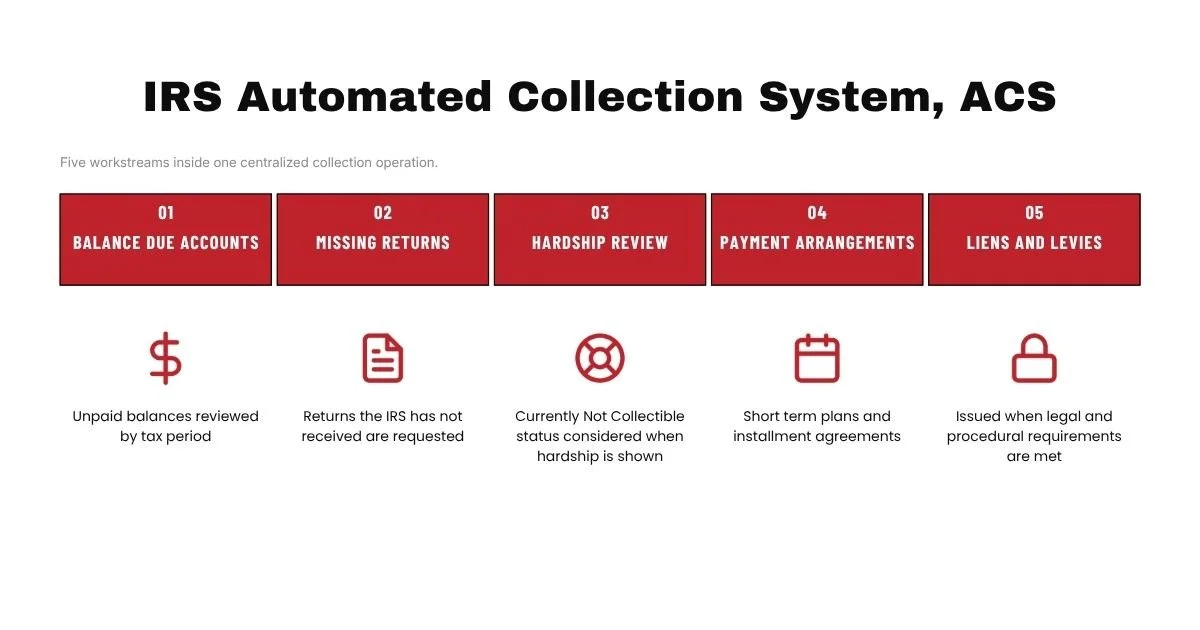
The Automated Collection System is one of the largest IRS collection operations. ACS works balance due accounts and delinquent return cases through centralized systems, notices, telephone contacts, correspondence, and computerized inventory management.
You may call ACS more than once and speak with different employees. That is one of the main differences between ACS and a Revenue Officer assignment.
What ACS Does
ACS and ACS Support employees may:
Review balance due accounts
Request missing tax returns
Discuss payment arrangements
Review certain financial information
Consider Currently Not Collectible status when financial hardship is established
Process correspondence
Issue levies when legal and procedural requirements are met
Request or process federal tax lien filings under IRS procedures
The Taxpayer Advocate Service confirms that ACS can help resolve balances, secure missing returns, place qualifying hardship accounts into Currently Not Collectible status, issue levies, and file liens when there is no taxpayer response.
How ACS Contacts Taxpayers
ACS commonly communicates through mailed notices and telephone contacts.
The notice may contain:
The amount owed
The tax periods involved
A response deadline
An ACS telephone number
Payment instructions
Appeal rights
A warning about possible collection action
The contact number on the notice should generally be used because it routes the taxpayer to the area responsible for that notice.
ACS Liens and Levies
ACS may issue a levy or request a Notice of Federal Tax Lien when IRS procedures allow it.
A federal tax lien is a legal claim against property. A Notice of Federal Tax Lien places the government’s claim into the public record.
A levy is a legal seizure. A levy may reach a bank account, wages, certain federal payments, or other property when the required notices and procedures have been completed.
A levy and a lien are not the same action. Receiving a collection notice does not mean both have already occurred.
Tax Relief Options Through ACS
Depending on the case, ACS may address:
Full payment
Short term payment arrangements
Installment agreements
Partial Payment Installment Agreements
Currently Not Collectible requests
Missing return compliance
Certain penalty requests
Collection appeal requests
Some proposals require financial information, managerial approval, another IRS unit, or additional review.
An ACS employee may also determine that the case must be transferred because it is outside that employee’s authority or requires Field Collection involvement.
Limitations of ACS
ACS is not a single assigned representative who remains with the taxpayer throughout the entire case.
Each employee relies heavily on the IRS account history, transaction records, prior telephone notes, and correspondence controls.
This makes documentation important. Keep a record of:
The date and time of each call
The employee’s name and identification number
What was discussed
What documents were requested
Where documents were sent
Any deadline provided
Any payment or proposal discussed
Any follow up date
A taxpayer should not assume that every IRS employee can immediately see every document sent to another IRS department.
IRS Special Compliance Personnel Program
Taxpayers and tax professionals sometimes refer to this area as the IRS Special Compliance Department. The official term is the Special Compliance Personnel Program.
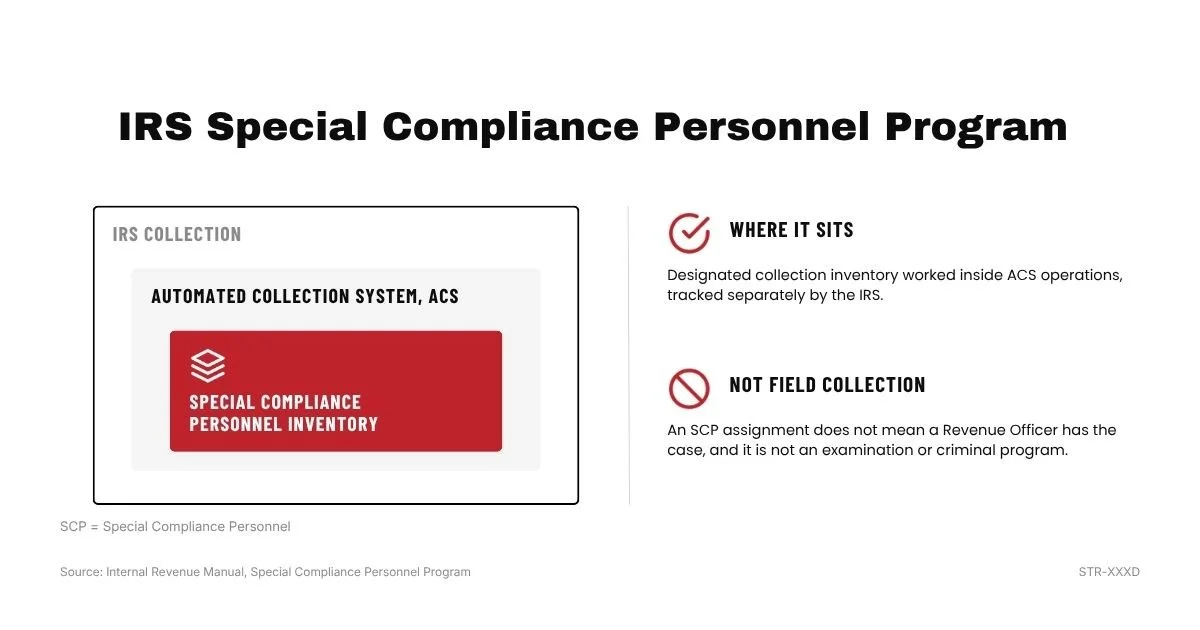
This is an important distinction. Special Compliance Personnel are IRS employees working designated collection inventory within ACS operations. It is not the same as Field Collection, and an SCP assignment does not by itself mean a Revenue Officer has been assigned.
What Special Compliance Personnel Means
The Internal Revenue Manual states that the federal law establishing the current private debt collection program also required the IRS to establish a Special Compliance Personnel Program.
The program uses retained revenue connected to private debt collection to hire ACS personnel who work IRS collection inventory. The IRS separately tracks this inventory because it must report information about the program to Congress.
How Special Compliance Cases Are Identified
IRS employees can identify these cases through internal ACS ownership codes and call site information.
A taxpayer may not see the words Special Compliance Personnel prominently displayed on every notice. In some situations, an IRS employee who does not work SCP inventory must transfer the call or correspondence to the designated team.
This is one reason a taxpayer may experience a transfer even after reaching ACS.
What Special Compliance Personnel May Process
Internal IRS guidance shows that SCP teams may process collection work involving:
Balance due correspondence
Missing return correspondence
Collection financial statements
Installment agreement requests
Certain Collection Appeals Program correspondence
Other designated ACS inventory
Some matters, including certain Collection Due Process requests and Taxpayer Advocate Service requests, are routed to other appropriate IRS functions.
Special Compliance and Financial Reviews
A Special Compliance Personnel case may involve a request for financial information when the taxpayer cannot full pay or is requesting a resolution based on ability to pay.
Depending on the taxpayer, the IRS may request:
Form 433 F
Form 433 A
Form 433 B
Bank statements
Pay records
Business income and expense records
Property information
Loan balances
Proof of monthly living expenses
The requested information should be accurate and supported. Estimates that cannot be explained may create additional questions.
Special Compliance Is Not Field Collection
A Special Compliance Personnel employee generally works through ACS systems.
A Revenue Officer works through Field Collection and is personally assigned to investigate a taxpayer’s case.
Both areas may address unpaid taxes and missing returns, but their contact methods and case management are different.
Do not assume that the words special compliance mean the account has been assigned for a fraud investigation. The Special Compliance Personnel Program described here is an IRS collection staffing program. It should not be confused with other IRS examination or criminal investigation programs.
IRS Field Collection and Revenue Officer Assignment
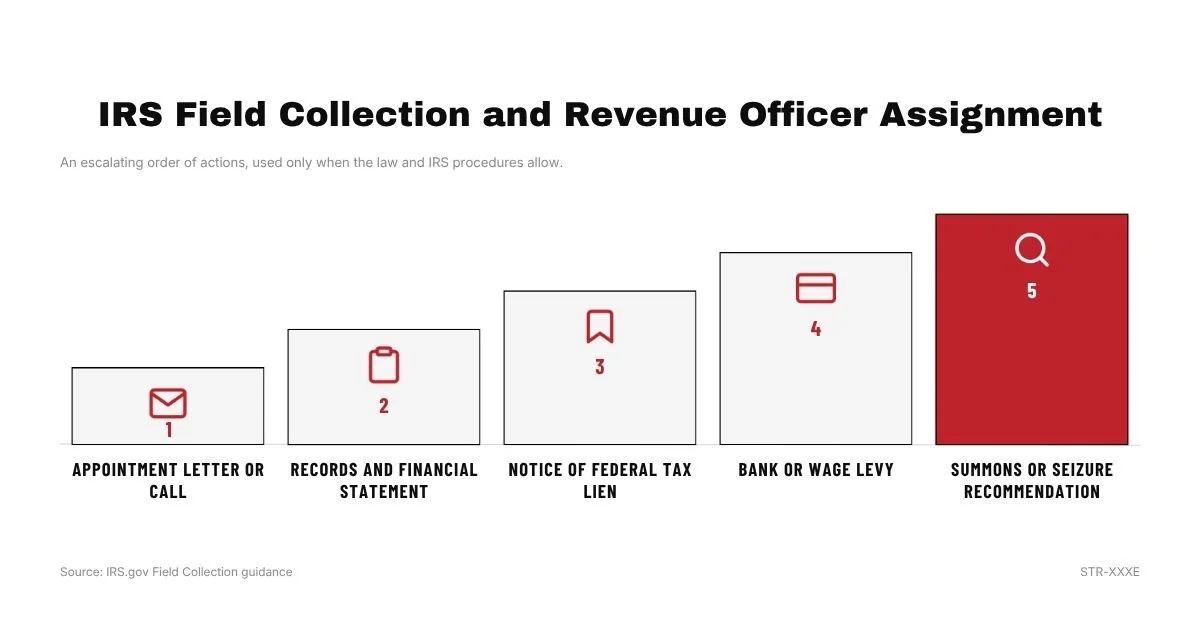
Field Collection involves Revenue Officers who are assigned individual cases.
A Revenue Officer is an IRS civil collection employee. The Revenue Officer may work directly with a taxpayer, business owner, or authorized representative to address balances, missing returns, financial disclosures, payment proposals, and possible enforcement.
Why a Revenue Officer May Be Assigned
The IRS does not publish one simple rule that determines every Revenue Officer assignment.
Field Collection cases may involve facts such as:
Business payroll tax debt
Several missing returns
A significant balance
Repeated collection defaults
Prior unsuccessful contact attempts
Asset or income questions
A case requiring direct investigation
An account transferred from ACS or the queue
Assignment alone does not prove that the IRS will levy or seize property. It means a specific Revenue Officer has responsibility for working the collection case.
How a Revenue Officer Contacts You
The IRS states that unannounced visits are rare. Normally, a Revenue Officer mails an appointment letter or calls to arrange contact before making a visit.
The Revenue Officer should provide identification and explain the reason for the contact. A taxpayer can verify an unexpected contact before providing sensitive information.
Information a Revenue Officer May Request
A Revenue Officer may request records needed to understand collection ability and tax compliance.
These may include:
Bank statements
Pay statements
Accounts receivable
Business financial statements
Property values
Loan statements
Retirement account information
Vehicle information
Monthly living expenses
Business expenses
Missing tax returns
Proof of current estimated tax payments
Proof of current federal tax deposits
The taxpayer may be asked to complete a collection information statement.
The form depends on the type of taxpayer and the issue. Common forms include Form 433 A for individuals and self employed taxpayers, Form 433 B for businesses, and Form 433 F for certain collection cases.
Revenue Officer Enforcement Authority
A Revenue Officer may take collection action when the law and IRS procedures permit it.
Possible actions may include:
Filing a Notice of Federal Tax Lien
Issuing a bank levy
Issuing a wage levy
Serving a summons for records or testimony
Investigating property and income
Recommending seizure action in cases where the legal and administrative requirements are met
The taxpayer generally has notice and appeal rights connected to significant lien and levy actions. The deadline printed on the notice controls the response period.
Business Payroll Tax Cases
Revenue Officers frequently work business collection matters involving unpaid employment taxes.
A payroll tax case may involve:
Form 941 balances
Form 940 balances
Missing payroll tax returns
Unpaid federal tax deposits
Continued accrual of new payroll tax debt
A possible Trust Fund Recovery Penalty investigation
A business may be required to remain current with new payroll tax deposits while addressing older balances.
An installment agreement or other resolution does not excuse current payroll tax obligations. A new balance or missed deposit may cause a proposal to be rejected or an approved agreement to default, depending on the facts and terms.
Tax Relief With a Revenue Officer
A Revenue Officer may consider or coordinate collection alternatives such as:
An installment agreement
A Partial Payment Installment Agreement
Currently Not Collectible status
A proposed Offer in Compromise
Full payment through the sale or refinancing of property
A short period to complete missing returns
An appeal of a collection decision
Approval depends on the legal requirements, financial information, compliance, managerial authority, and other case facts.
The Revenue Officer may also determine that a proposal is not acceptable or request changes before making a final recommendation.
IRS Private Collection Agencies
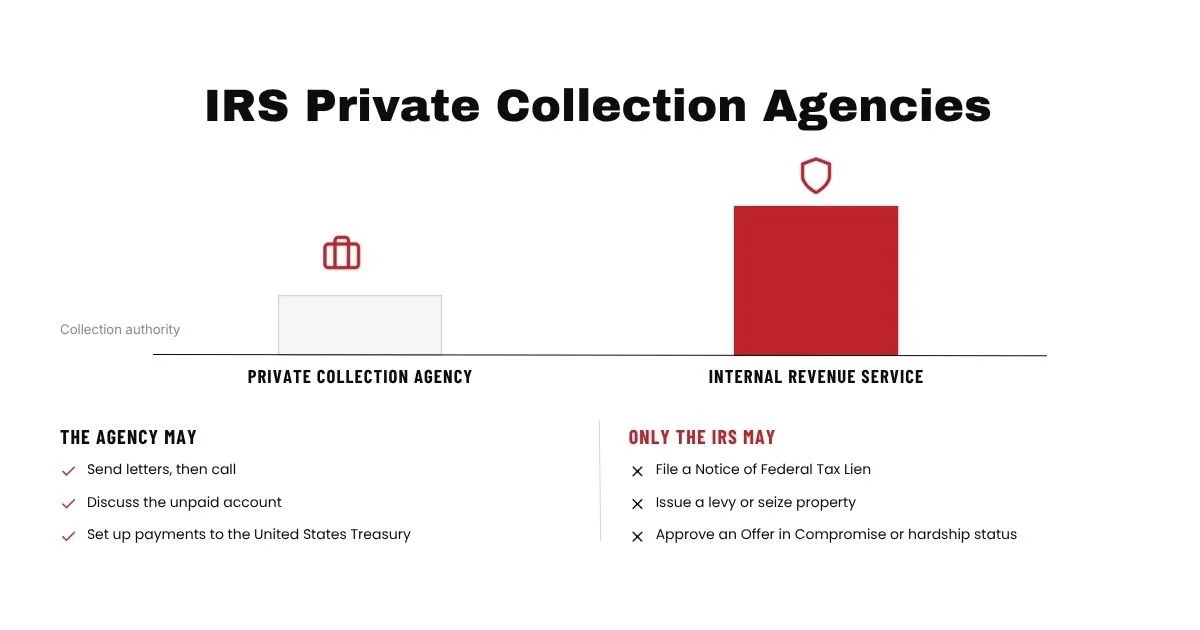
The IRS is required by law to use private collection agencies for certain inactive tax debts.
A private collection agency is not the IRS. It is a contractor working an account that the IRS assigned under the private debt collection program.
Why an Account May Be Assigned
The IRS may assign certain inactive accounts when:
The IRS lacked resources to actively work the account
The IRS could not locate the taxpayer
A specified period passed without assignment to an IRS employee
A specified period passed without taxpayer or representative contact on the account
The IRS excludes several categories from private collection. Current exclusions include certain taxpayers with limited income, taxpayers receiving specified disability benefits, accounts subject to pending or active Offers in Compromise, accounts under installment agreements, cases under levy, certain appeal cases, identity theft victims, and several other protected categories.
How to Verify a Private Collection Assignment
The IRS should send Notice CP40 before the private collection agency contacts you.
The notice identifies the assigned agency and contains a taxpayer authentication number.
The private collection agency then sends its own written confirmation before calling. Both letters should contain information used for identity verification.
An IRS account transcript may also show transaction code 971 indicating referral to a private collection agency and issuance of Notice CP40.
Current Private Collection Agencies
The IRS currently lists:
CBE Group
Coast Professional
ConServe
The list can change. Confirm the current agency list through the IRS private debt collection page before responding to a caller.
What a Private Collection Agency Can Do
A private collection agency may:
Send collection letters
Call after sending the required initial letter
Discuss the unpaid account
Request payment to the United States Treasury
Establish and monitor certain payment arrangements intended to full pay the assigned debt within the allowable collection period
Explain basic payment methods
Payments should be made to the United States Treasury, not directly to the private company.
What a Private Collection Agency Cannot Do
A private collection agency cannot:
Issue a levy
File a Notice of Federal Tax Lien
Seize property
Garnish wages through its own authority
Collect detailed financial information
Decide whether to accept an Offer in Compromise
Place the account into Currently Not Collectible status
Charge a fee for setting up the payment arrangement
The IRS retains legal enforcement authority.
Requesting That the Agency Stop Working the Account
A taxpayer who does not want to work with the assigned private collection agency may submit a written request to the agency.
The IRS states that the request must be made in writing. The taxpayer should keep a copy and proof of delivery.
A written request does not erase the tax debt. The account may return to IRS inventory and may later be handled under IRS collection procedures.
Tax Relief Beyond a PCA Payment Arrangement
A private collection agency cannot approve an Offer in Compromise or Currently Not Collectible status.
When a taxpayer cannot full pay through the arrangement available from the agency, the account may need to return to the IRS so the appropriate collection alternative can be evaluated.
Before choosing that step, review:
Filing compliance
Current estimated tax payments
Current payroll deposits
Income and allowable expenses
Assets and equity
Collection statute dates
The accuracy of the liability
The uploaded GAO report explains that the private debt collection program is one part of the larger IRS collection process. It also describes how revenue from the program supports Special Compliance Personnel who work other IRS collection inventory.
IRS Collection Queue and Shelved Accounts
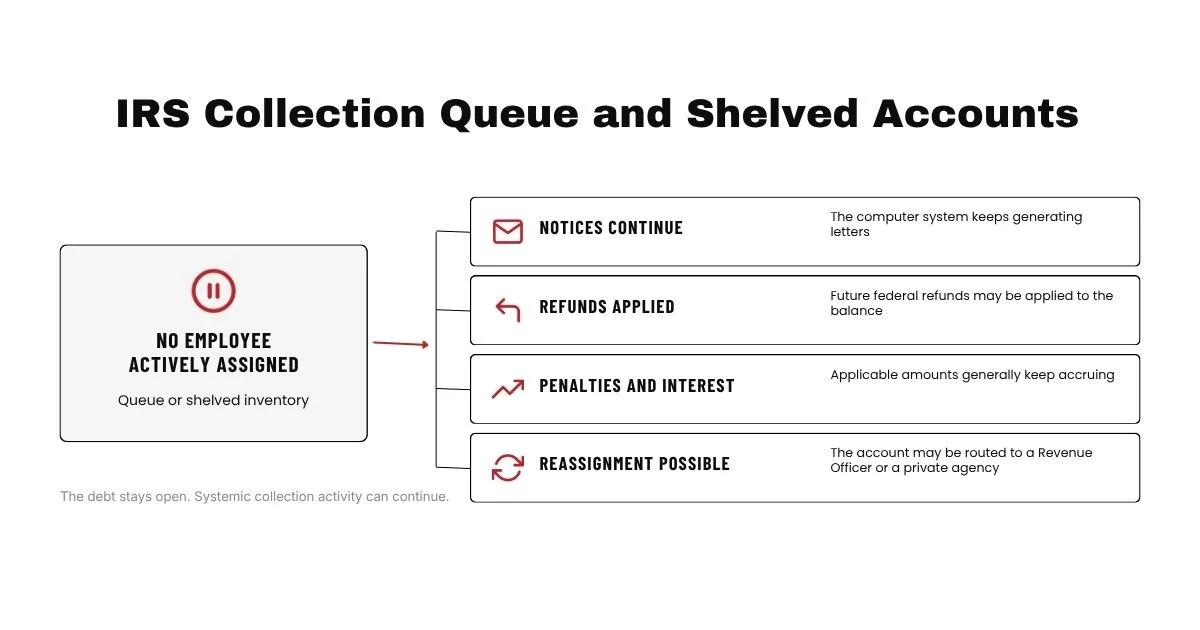
A taxpayer may owe the IRS without having an active ACS employee, Revenue Officer, or private collection agency working the case.
The account may be in the queue or shelved inventory.
These statuses can create a false sense that nothing is happening. Computer generated collection activity may continue even when no employee is personally working the account.
What the IRS Collection Queue Means
The queue is an electronic holding area for cases awaiting possible assignment to Field Collection.
A case in the queue may later be assigned to a Revenue Officer.
While the case waits, the IRS computer system may continue to generate letters and systemic collection actions. The taxpayer should continue reading and responding to every notice.
What a Shelved IRS Account Means
A shelved account is not actively being worked by an IRS employee.
The case remains open. The debt has not been cancelled.
The IRS computer system may still:
Send notices
Apply future federal refunds to the balance
Add applicable penalties and interest
Reevaluate the account for another collection assignment
Route an eligible inactive debt to private collection
The taxpayer should keep the IRS informed of address changes so important notices are not missed.
Why an Inactive Account Should Not Be Ignored
An inactive account may become active again.
Income may increase.
A new return may report wages or business income.
Property may be acquired or sold.
The IRS may change the routing decision.
A Revenue Officer may later receive the case.
The account may qualify for the private collection program.
Waiting without reviewing the account can also allow penalties and interest to continue.
Actions You Can Take While the Case Is Inactive
You do not have to wait for a Revenue Officer assignment before reviewing tax relief options.
Possible steps include:
Filing required returns
Correcting current withholding
Making estimated tax payments
Making current payroll deposits
Reviewing the account balance
Obtaining IRS account transcripts
Checking collection statute dates
Requesting an installment agreement
Requesting Currently Not Collectible status when financial hardship is present
Evaluating an Offer in Compromise
Disputing an assessment through the procedure that applies to that assessment
Making voluntary payments when appropriate
The correct step depends on the full account history and the taxpayer’s financial condition.
How Your Collection Assignment Affects Tax Relief
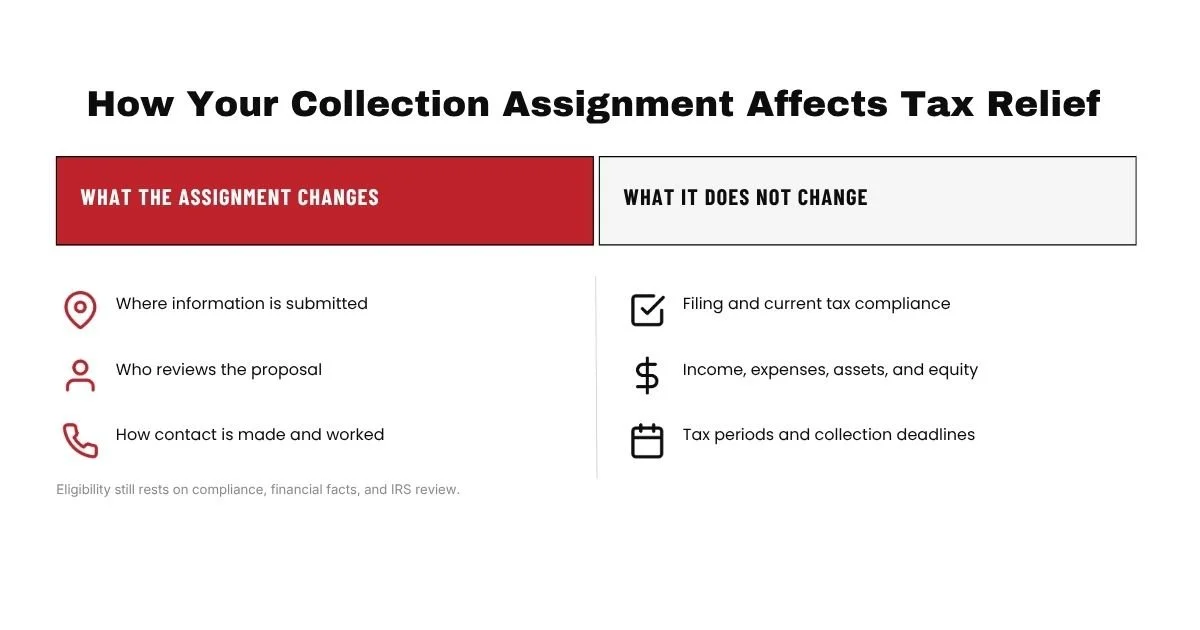
The department handling your case affects the procedure, contact person, submission address, and review process.
It does not rewrite the eligibility standards for tax relief.
A taxpayer who qualifies for a program through ACS would generally need to satisfy the same legal and financial requirements if a Revenue Officer were reviewing the proposal.
Filing and Current Tax Compliance
Most IRS collection resolutions require the taxpayer to address required returns and remain current with new tax obligations.
For an individual, that may mean:
Filing required income tax returns
Correcting Form W 4 withholding
Making required estimated tax payments
For a business, that may mean:
Filing required payroll and income tax returns
Making federal tax deposits
Avoiding new payroll tax balances
Keeping current business records
Filing a return does not mean the taxpayer must immediately full pay every balance. Filing compliance and payment ability are separate questions.
Installment Agreements
An installment agreement allows qualifying taxpayers to make monthly payments over time.
The IRS may approve an agreement based on:
The amount owed
The time remaining in the collection period
Filing compliance
Current tax compliance
Proposed monthly payment
Financial information when required
Prior defaults
The type of tax involved
Penalties and interest generally continue while the agreement is active. The IRS may file a Notice of Federal Tax Lien in some cases. If the taxpayer incurs a new tax balance or misses required payments, the agreement may default under its terms and IRS procedures.
Partial Payment Installment Agreements
A Partial Payment Installment Agreement may be considered when a taxpayer can make monthly payments but cannot full pay the debt before the collection period ends.
The IRS generally requires financial information.
The payment may be reviewed periodically. A later review can result in the payment increasing, decreasing, or remaining the same depending on the taxpayer’s financial condition.
The agreement does not guarantee that a balance will remain unpaid at the collection expiration date. The taxpayer must comply with the agreement, and collection statute calculations must account for any event that suspends or extends the collection period.
Currently Not Collectible Status
Currently Not Collectible status may be available when paying the IRS would prevent the taxpayer from meeting necessary living expenses or create another qualifying hardship.
If approved:
Most active collection may be temporarily delayed
The tax remains owed
Penalties and interest generally continue
Federal refunds may be applied to the debt
The IRS may file a Notice of Federal Tax Lien
The IRS may review the taxpayer’s financial condition later
Collection may resume if payment ability improves
There is no fixed period that applies to every Currently Not Collectible case.
Offer in Compromise
An Offer in Compromise is an agreement that may settle qualifying federal tax liabilities for less than the full amount owed.
Qualification depends on the legal basis for the offer and the taxpayer’s financial condition.
For an offer based on doubt as to collectibility, the IRS generally evaluates:
Cash and bank accounts
Property equity
Vehicles
Investments
Retirement funds
Business assets
Future income
Allowable living expenses
Other collection potential
The taxpayer generally must file required returns, make current estimated tax payments, and make required federal tax deposits when operating a business with employees.
A taxpayer who can full pay through an installment agreement or other means will generally not qualify for an Offer in Compromise based on inability to pay. Acceptance remains subject to IRS review.
A private collection agency cannot approve or reject an Offer in Compromise. The IRS handles that determination.
Penalty Relief
Penalty relief may reduce qualifying penalties when the legal and administrative requirements are met.
Possible grounds may include:
First Time Abatement
Reasonable cause
Statutory relief
Penalty relief does not automatically remove the underlying tax.
The correct procedure depends on the type of penalty, tax period, account history, and reason for the request.
Disputing an Incorrect Tax Balance
A collection department generally works with the assessment already recorded on the account.
If the tax is incorrect, the taxpayer may need a separate procedure, such as:
An amended return
Audit reconsideration
CP2000 reconsideration
Substitute for return reconsideration
Identity theft procedures
Innocent Spouse Relief
A Doubt as to Liability Offer in Compromise
An appeal
The correct method depends on how the tax was assessed and whether prior appeal or court rights were available.
Collection Appeals
IRS collection notices may provide rights through Collection Due Process or the Collection Appeals Program.
The notice deadline matters.
A timely Collection Due Process request may allow the taxpayer to raise collection alternatives and certain other issues before the IRS Independent Office of Appeals.
Levy restrictions and collection statute rules depend on the type and timing of the appeal. Read the notice rather than assuming every appeal has the same effect.

How to Find Which IRS Collection Department Has Your Case
The department can often be identified through the notice, IRS account history, telephone contact, or transcript records.
The answer may require more than one source because an account can contain several tax periods with different statuses.
Review the Most Recent IRS Notice
Look for:
The notice or letter number
The tax periods
The department name
A Revenue Officer’s name
An ACS telephone number
A private collection agency name
A mailing or fax address
A response date
Appeal instructions
Notice CP40
Use the contact information printed on the notice unless you have confirmed that the account has moved to another unit.
Check Your IRS Online Account
An individual IRS Online Account may allow you to:
Review balances
Review payment history
Make payments
View certain notices
Create or manage certain payment plans
Select paperless options for available notices
The online account may not display every internal assignment or all collection history. It is useful, but it should not be treated as a replacement for the complete account transcript or direct IRS contact.
Review IRS Account Transcripts
Account transcripts can show transaction codes, assessments, payments, penalty activity, installment agreement activity, collection holds, and other account events.
A private collection assignment may appear through transaction code 971.
A transcript can help identify account activity, but many internal collection notes are not printed on a standard taxpayer transcript.
Tax professionals with proper authorization may use IRS practitioner systems to obtain transcripts and review account information.
Call the Number on the Notice
When calling, have:
The notice
Identification information
Copies of prior correspondence
Payment records
Filed returns
A list of questions
Pen and paper for notes
Document the employee’s name, identification number, date, time, and instructions.
Do not agree to an unaffordable payment simply because you feel pressured to end the call. A payment proposal should be based on accurate income, expenses, assets, compliance, and collection deadlines.
Look for Revenue Officer Contact Information
A Revenue Officer letter generally identifies the assigned employee and provides direct contact information.
Once a Revenue Officer is assigned, correspondence and proposals should normally be coordinated with that officer unless the notice, manager, Appeals employee, or another IRS function provides different instructions.
Confirm a Private Collection Agency
Do not rely on caller identification.
Confirm:
That you received Notice CP40
That the agency appears on the current IRS list
That you received the agency’s written letter
That the taxpayer authentication number matches the required verification process
That payments are directed to the United States Treasury
A legitimate private collection agency will not demand gift cards or request payment to a personal account.
How Representation Helps Identify the Assignment
An authorized representative may obtain transcripts, review notices, contact the assigned IRS function, communicate with a Revenue Officer, and organize the account history.
Form 2848 is commonly used to authorize an eligible representative before the IRS.
Representation does not create eligibility for a tax relief program. It can help present the facts accurately and follow the correct procedure.
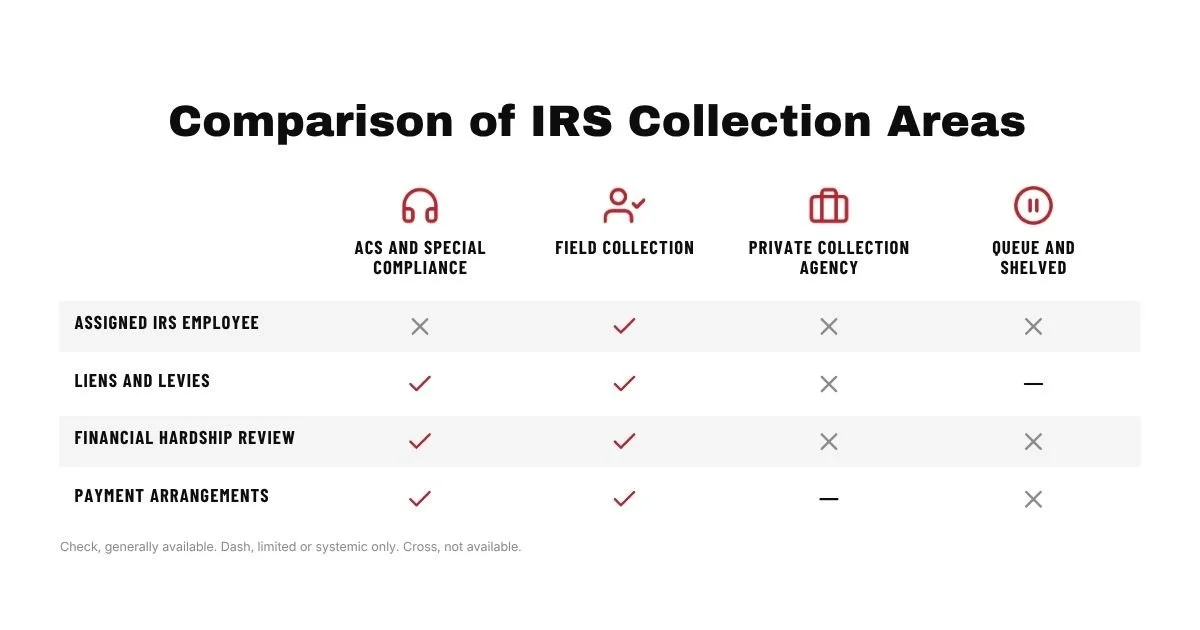
Comparison of IRS Collection Areas
Automated Collection System
Main role:
Centralized IRS collection of balances and missing returns.
Primary contact:
IRS notices, telephone calls, and correspondence.
Specific employee assigned:
Usually no permanent employee assigned to the taxpayer.
Can file liens or issue levies:
Yes, when legal and procedural requirements are met.
May review financial hardship:
Yes.
May consider payment arrangements:
Yes, subject to authority and case requirements.
Main concern:
Different employees may handle different contacts, so accurate documentation is important.
Special Compliance Personnel
Main role:
Designated IRS employees working tracked ACS collection inventory.
Primary contact:
ACS telephone and correspondence channels connected to SCP ownership.
Specific employee assigned:
Generally an ACS team rather than a field Revenue Officer.
Can file liens or issue levies:
Collection actions may be processed within ACS authority and procedures.
May review financial hardship:
Yes, qualifying financial information may be reviewed.
May consider payment arrangements:
Yes, subject to authority and approval requirements.
Main concern:
The program is often mistaken for a separate enforcement department.
Field Collection
Main role:
Direct case investigation by a Revenue Officer.
Primary contact:
Appointment letters, direct telephone contact, correspondence, and scheduled meetings.
Specific employee assigned:
Yes, a Revenue Officer generally has direct responsibility.
Can file liens or issue levies:
Yes, when legal and procedural requirements are met.
May review financial hardship:
Yes.
May consider payment arrangements:
Yes, subject to financial review and applicable approval.
Main concern:
The taxpayer must respond directly, meet document deadlines, and address current compliance.
Private Collection Agency
Main role:
Contact taxpayers regarding certain inactive IRS debts and monitor permitted payment arrangements.
Primary contact:
Notice CP40, agency letter, and later telephone contact.
Specific employee assigned:
An agency representative may handle the contact, but the representative is not an IRS employee.
Can file liens or issue levies:
No.
May review detailed financial hardship:
No.
May approve an Offer in Compromise or Currently Not Collectible status:
No.
Main concern:
Verify the agency and understand that broader tax relief decisions remain with the IRS.
Collection Queue
Main role:
Electronic holding area awaiting possible Field Collection assignment.
Primary contact:
Computer generated IRS notices.
Specific employee assigned:
Usually no.
Can systemic collection activity occur:
Yes.
Main concern:
The taxpayer may believe the case is inactive even though notices and automated actions can continue.
Shelved Inventory
Main role:
Open IRS account not actively worked by an employee.
Primary contact:
Computer generated notices or later reassignment.
Specific employee assigned:
No active employee assignment.
Can systemic collection activity occur:
Yes.
Main concern:
The debt remains open, penalties and interest may continue, and the account may later be reassigned.
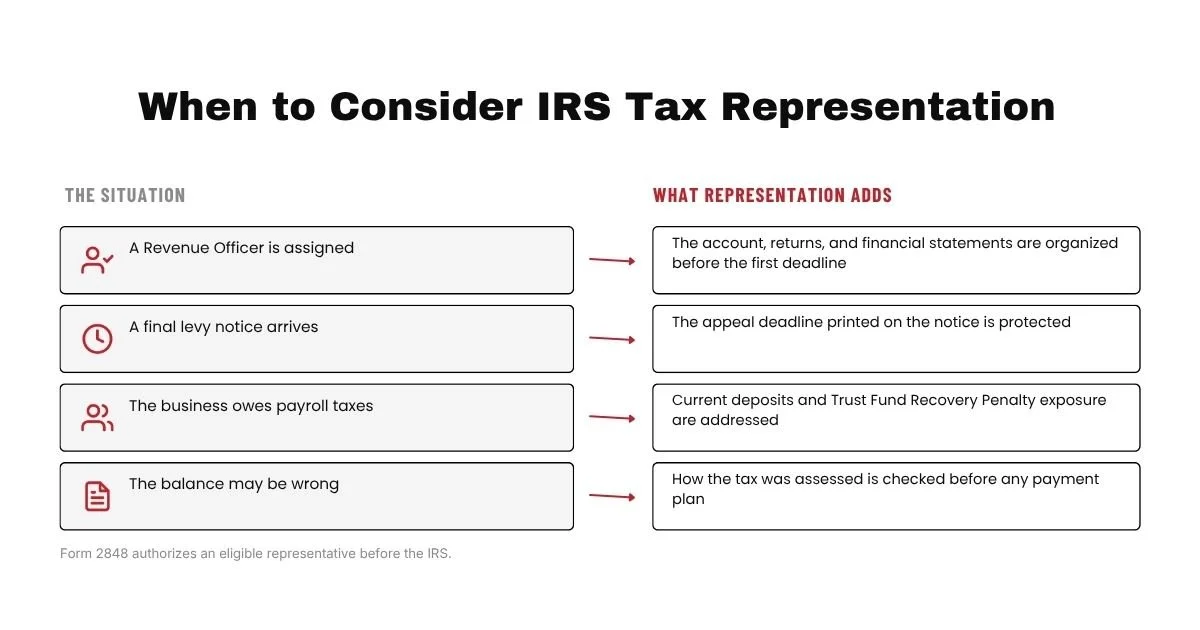
When to Consider IRS Tax Representation
Many taxpayers handle basic IRS payment arrangements on their own.
Representation may become more valuable when the case involves a direct enforcement risk, several tax periods, disputed assessments, financial disclosures, or business payroll taxes.
A Revenue Officer Has Been Assigned
A Revenue Officer assignment creates direct deadlines and document requests.
Representation may help:
Review the account before the first meeting
Organize missing returns
Prepare financial statements
Identify collection statute dates
Communicate with the Revenue Officer
Present a resolution proposal
Respond to lien or levy issues
Exercise appeal rights when appropriate
The IRS Is Threatening a Levy
A final levy notice may provide a limited period for requesting a Collection Due Process hearing.
The exact deadline appears on the notice.
Representation should not delay the taxpayer from filing a time sensitive appeal. A protective filing may be needed before every document is available.
The Business Owes Payroll Taxes
Payroll tax cases may expose the business to enforced collection and may lead to a Trust Fund Recovery Penalty investigation against individuals the IRS believes were responsible and willful.
The business must also address current payroll compliance.
A payment proposal that ignores new federal tax deposits may fail even when the proposed monthly payment appears affordable.
Several Tax Returns Are Missing
The IRS generally expects required returns to be filed before approving many long term collection resolutions.
Before filing, review whether:
The IRS already prepared a substitute for return
The taxpayer has complete records
Income transcripts are needed
Business expenses can be supported
Filing every older year is required
The filing changes the tax debt
Refund statute deadlines are relevant
Filing missing returns without reviewing the account can create avoidable errors.
The IRS Is Requesting Financial Information
Forms 433 A, 433 B, and 433 F require detailed financial information.
The taxpayer should understand:
Which assets must be disclosed
How equity is calculated
Which expenses are allowed
Which expenses require proof
How future income is evaluated
How business and personal finances interact
How the information affects each relief option
The goal is accurate disclosure and a proposal supported by the facts.
The Tax Balance May Be Wrong
Do not choose a payment plan solely because the IRS says a balance is due.
First determine:
How the tax was assessed
Whether the taxpayer received the prior notices
Whether income was duplicated
Whether deductions were omitted
Whether the IRS filed a substitute return
Whether identity theft is involved
Whether a spouse relief claim may apply
Whether appeal or reconsideration procedures remain available
A collection agreement addresses payment. It does not automatically correct an inaccurate assessment.
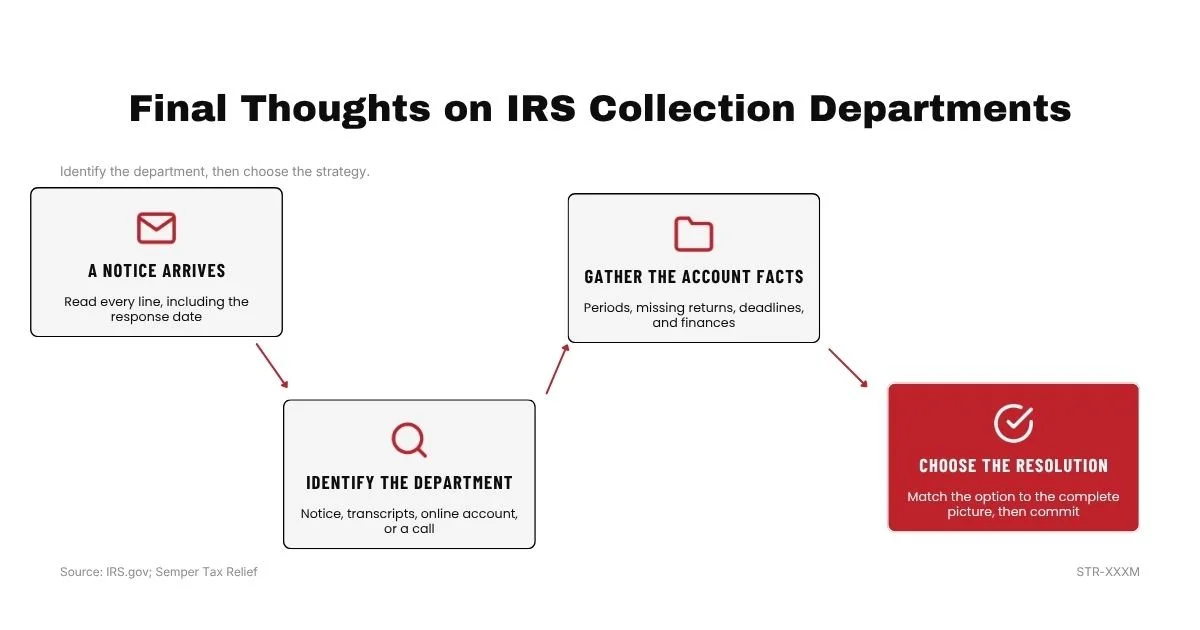
Final Thoughts on IRS Collection Departments
Identify the Department Before Choosing a Strategy
When someone owes the IRS, the first question is often, how much can I afford to pay?
That question matters, but it should not be the first question.
I first want to know:
Which IRS department has the account
Which tax periods are included
Whether returns are missing
Whether a levy notice was issued
Whether a Revenue Officer is assigned
Whether a private collection agency is involved
Whether the debt is correct
How much time remains for collection
Whether the taxpayer is current now
Which resolution fits the complete financial picture
A payment plan may be appropriate for one taxpayer. Another taxpayer may qualify for financial hardship treatment. A third taxpayer may need to dispute the assessment before discussing payment.
About Sergio Melendez
I am Sergio Melendez, an IRS Enrolled Agent and Juris Doctor with over 20 years of tax experience.
My practice focuses on IRS tax debt resolution, unfiled returns, installment agreements, Offers in Compromise, Currently Not Collectible cases, federal tax liens, bank levies, wage levies, payroll tax debt, Revenue Officer cases, collection appeals, and disputed tax assessments.
My approach begins with reviewing the IRS account, identifying the collection department, restoring filing compliance, evaluating collection deadlines, and understanding the taxpayer’s complete financial condition.
Frequently Asked Questions About IRS Collection Departments
-
An ACS notice usually directs you to a centralized IRS collection telephone number rather than identifying an individual Revenue Officer.
You may speak with different employees each time you call.
The IRS account history may show that the tax periods are in ACS status. A tax professional with authorization may also review transcripts and contact the IRS to confirm assignment.
Do not rely on the notice alone when it is several months old. Accounts can transfer between ACS, the queue, Field Collection, and other units.
-
ACS can issue levies when the legal and procedural requirements are met.
The IRS generally must assess the tax, send notice and demand for payment, and issue the required final levy notice before many levy actions.
Certain exceptions apply, and different levy programs have different procedures.
Receiving an ACS notice does not mean a levy has already been issued. Review the notice number, response deadline, and account transcript before deciding what action is required.
-
Special Compliance Personnel are IRS employees who work designated ACS collection inventory.
The program was established under federal law connected to the private debt collection program. Retained revenue from private debt collection supports personnel who work IRS collection cases.
Special Compliance Personnel are not private collectors. They are IRS employees.
An SCP assignment also does not automatically mean the taxpayer is under criminal investigation or that a field Revenue Officer has been assigned.
-
A Revenue Officer may be assigned when the IRS determines the case should be worked through Field Collection.
Possible factors may include payroll tax debt, missing returns, a larger balance, prior unsuccessful collection attempts, repeat noncompliance, or a need for direct financial investigation.
The IRS does not use one public formula that applies to every case.
Once assigned, respond to the Revenue Officer and review the account before proposing a resolution.
-
No.
A private collection agency cannot issue a levy, file a Notice of Federal Tax Lien, seize property, or garnish wages through its own authority.
The IRS retains those enforcement powers.
A private agency may contact you and monitor certain payment arrangements, but it cannot approve an Offer in Compromise or Currently Not Collectible status.
-
You may send a written request stating that you do not want to work with the assigned private collection agency.
Keep a copy and proof of delivery.
The request does not cancel the tax. The account may return to IRS inventory, where the IRS may evaluate it under its normal collection procedures.
Returning the account may be important when the taxpayer needs an IRS decision on hardship status, an Offer in Compromise, a liability dispute, or another issue outside the agency’s authority.
-
Yes.
An account can move between ACS, the queue, Field Collection, Appeals, the Offer in Compromise process, private collection, and other IRS functions.
A transfer can occur because of case routing, a taxpayer request, a filed appeal, an offer submission, bankruptcy, financial hardship, new compliance information, or another procedural event.
Always confirm the current assignment before sending sensitive documents or relying on an older deadline.
-
The underlying tax relief programs are governed by tax law and IRS procedures, but each department has different authority and responsibilities.
ACS and Revenue Officers may address installment agreements and Currently Not Collectible requests.
A private collection agency cannot approve Currently Not Collectible status or an Offer in Compromise.
An Offer in Compromise is reviewed by the appropriate IRS offer function.
Appeals reviews collection alternatives when jurisdiction and procedural requirements are met.
The collection department affects how the proposal is submitted and processed. Qualification still depends on compliance, financial facts, legal requirements, and IRS review.
Get Help Reviewing Your IRS Collection Assignment
An IRS collection department assignment should not be ignored, but it should also not cause you to agree to a resolution before you understand the account.
Review the notice, confirm the assigned department, gather the account records, and evaluate the available options before making a long term commitment.
You can contact Semper Tax Relief to schedule a 10 minute call and discuss the IRS department handling your account, the notices you received, and the next procedural step.