What Happens If a Business Cannot Pay Payroll Taxes
Payroll tax debt is different from every other kind of business tax problem, and I want to be direct about why before we get into the mechanics. The money involved was never fully the business's money to begin with. A portion of it was withheld from your employees' paychecks on the government's behalf.
When that money does not make it to the IRS, the consequences generally move faster and reach further than other business tax issues.
This article walks through what actually happens when a business falls behind on payroll taxes, how the penalties stack, and what resolution paths generally exist.
TLDR
- Payroll tax deposits that are late trigger a tiered Failure to Deposit penalty, generally 2% to 15% depending on how late the deposit is.
- A separate failure-to-file penalty of 5% per month, up to 25%, generally applies if Form 941 itself is filed late.
- Interest accrues daily on top of both penalties.
- The employee-withheld portion of payroll tax is considered a trust fund tax, and unpaid trust fund tax can result in personal liability for owners, officers, or anyone with authority over payroll, through the Trust Fund Recovery Penalty.
- Resolution options generally include an installment agreement, penalty relief, hardship status, or in limited cases an Offer in Compromise, but the IRS generally will not approve any of these unless the business is current on its ongoing payroll deposits.
- This article covers federal payroll tax obligations. California has separate state payroll tax and withholding obligations -
the callout below.
How the Penalties Actually Stack
There are two separate obligations tied to payroll taxes, filing the return and depositing the tax, and they carry two separate penalties. I want to walk through both, because I regularly see business owners who filed Form 941 correctly and on time and were still surprised by a deposit penalty they did not expect.
The Failure to Deposit Penalty
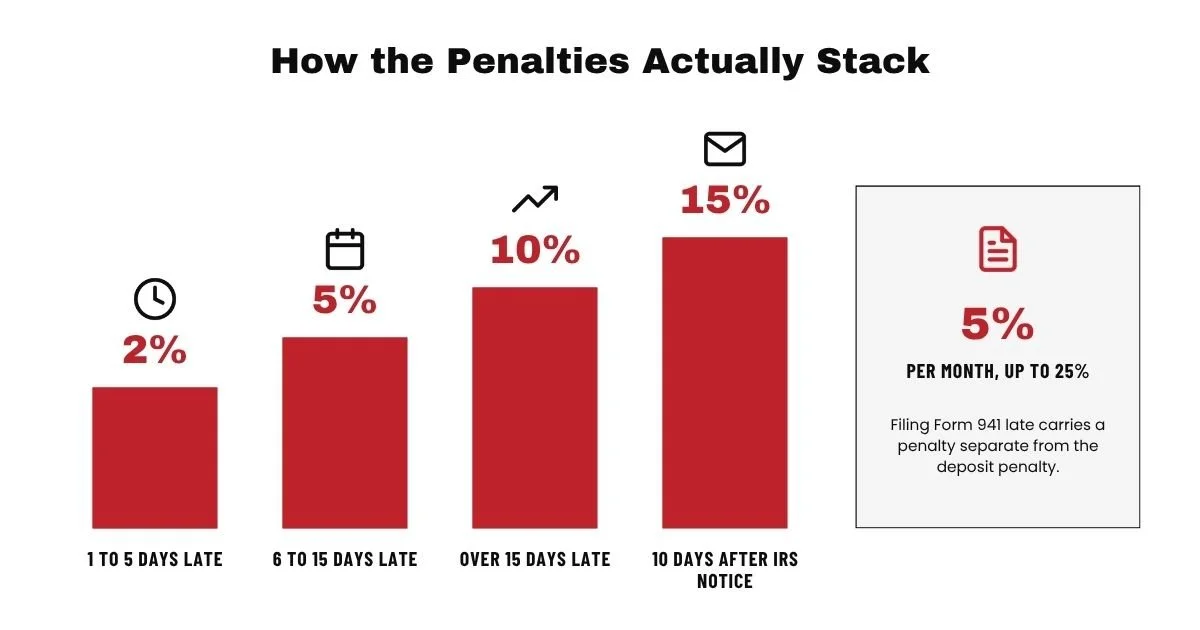
The Failure to Deposit penalty applies when a required payroll tax deposit is made late, and it is tiered based on how many days late the
deposit was:
- 2% for deposits 1 to 5 days late
- 5% for deposits 6 to 15 days late
- 10% for deposits more than 15 days late
- 15% for amounts still unpaid more than 10 days after the date of the IRS's first notice demanding payment
These tiers generally do not stack on top of each other. The rate applied is based on how late the deposit ultimately was when it is resolved, not an accumulation of each earlier tier.
The Failure to File Penalty
Separately, filing Form 941 itself late generally triggers a failure to file penalty of 5% of the unpaid tax per month or partial month, up to a maximum of 25%.
This is why I tell every business owner the same thing regardless of their situation: file Form 941 on time even if you cannot pay what it shows you owe. The filing penalty and the payment penalty are separate, and filing late adds a second, larger penalty on top of whatever payment issue already exists.
Interest on Top of Both
Interest accrues daily on the unpaid tax and on assessed penalties, and the rate resets quarterly.
Why Payroll Tax Debt Becomes Personal
This is the part that separates payroll tax debt from nearly every other kind of business tax problem, and it is the part I spend the most time making sure clients actually understand.
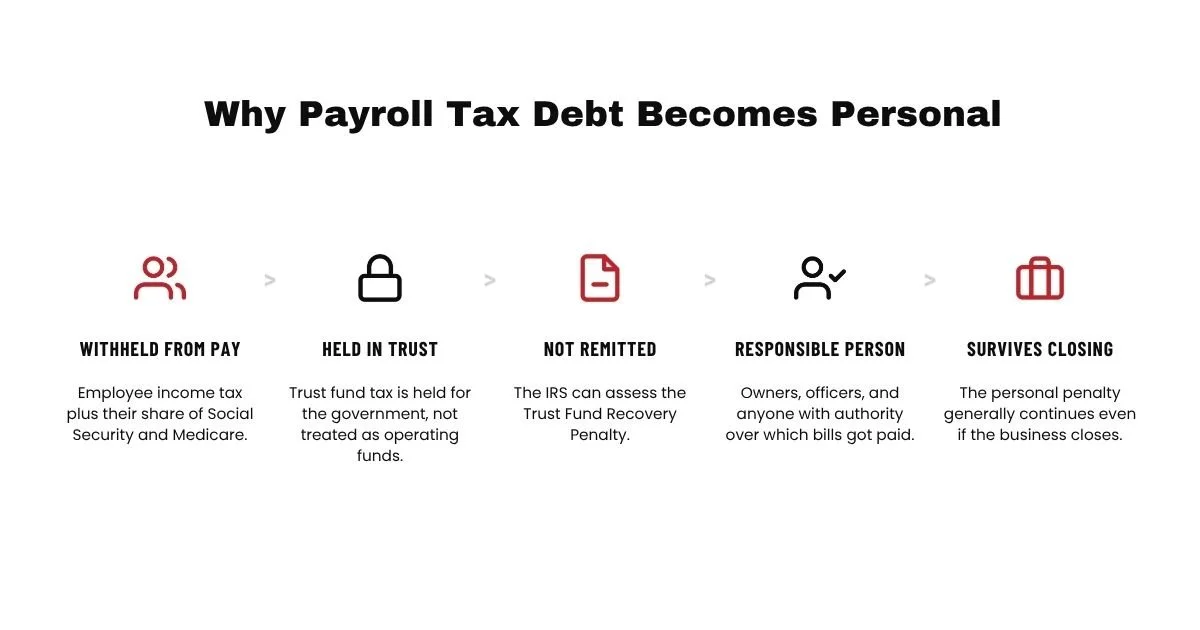
The employee's portion of payroll tax, income tax withholding along with the employee share of Social Security and Medicare, is considered a trust fund tax. It was withheld from your employees' pay and is generally held in trust for the government, not treated as general operating funds.
If those funds are not remitted, the IRS can assess the Trust Fund Recovery Penalty against any responsible person, which can include owners, officers, and anyone else who had authority over which bills got paid, including a bookkeeper who signed checks. This is a personal penalty, separate from the business's liability, and it generally survives even if the business closes.
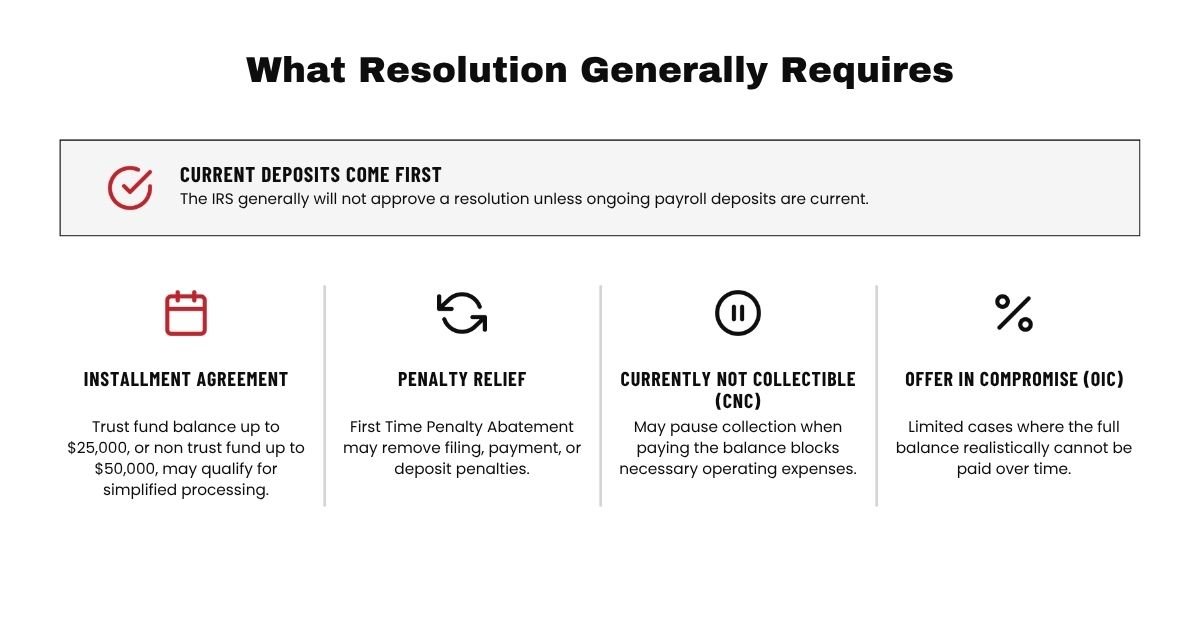
What Resolution Generally Requires
The IRS will generally not approve a resolution for back payroll tax debt unless the business is current on its ongoing payroll deposits going
forward. This creates a two-part problem that has to be solved together: a plan for the old balance, and a restructured process to stay compliant on new deposits.
Installment Agreements
If the business can afford structured monthly payments, an installmentagreement may allow the balance to be paid over time. Businesses with atrust fund balance up to $25,000, or a non-trust fund balance up to $50,000, may qualify for simplified processing without a full financial disclosure.
Penalty Relief
First-Time Penalty Abatement may remove failure-to-file, failure-to-pay, or failure-to-deposit penalties if the business maintained a clean
compliance record for a defined period before the penalty year.
Currently Not Collectible Status and Offer in Compromise
If paying the back balance would prevent the business from covering necessary operating expenses, Currently Not Collectible status may
temporarily pause collection. In more limited cases, where the business realistically cannot pay the full balance even over time, an Offer in
Compromise may be worth exploring, though eligibility requires the business to be current on filings and, if it has employees, current on
recent payroll deposits.

Federal vs California - Do Not Assume the Same Rules Apply
Everything above describes federal payroll tax obligations under the Revenue Code. California businesses also owe state payroll tax and withholding obligations, generally handled through the California Employment Development Department, which is a separate agency running a separate process from both the IRS and the California Franchise Tax Board.
A federal payroll tax resolution does not resolve a state payroll tax balance, and the two generally need to be addressed separately.
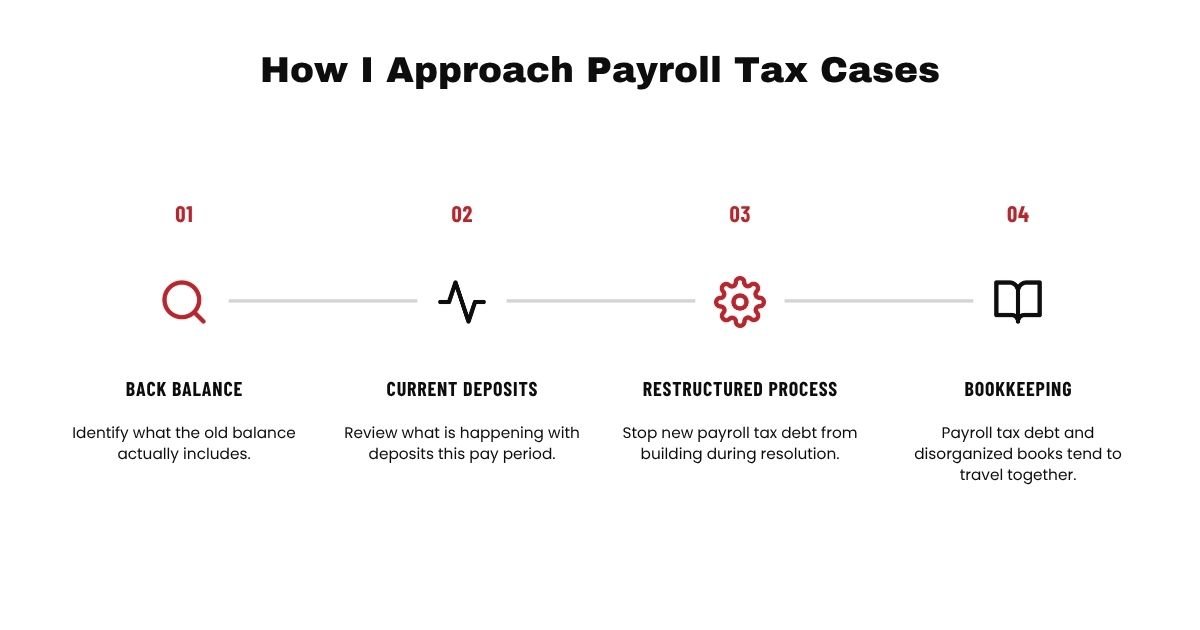
How I Approach Payroll Tax Cases
When a business owner comes to me with payroll tax debt, I am looking at two things at once, not one. What is the actual back balance, and what is happening with current deposits right now, today, this pay period.
Resolving the old balance while new payroll tax debt continues to accumulate does not actually fix anything. It just changes which quarter the problem is sitting in.
This is also usually where I bring bookkeeping into the conversation. In my experience, payroll tax debt and disorganized books tend to travel together. Fixing the resolution without fixing the underlying process that caused it is how the same problem comes back eighteen months later.
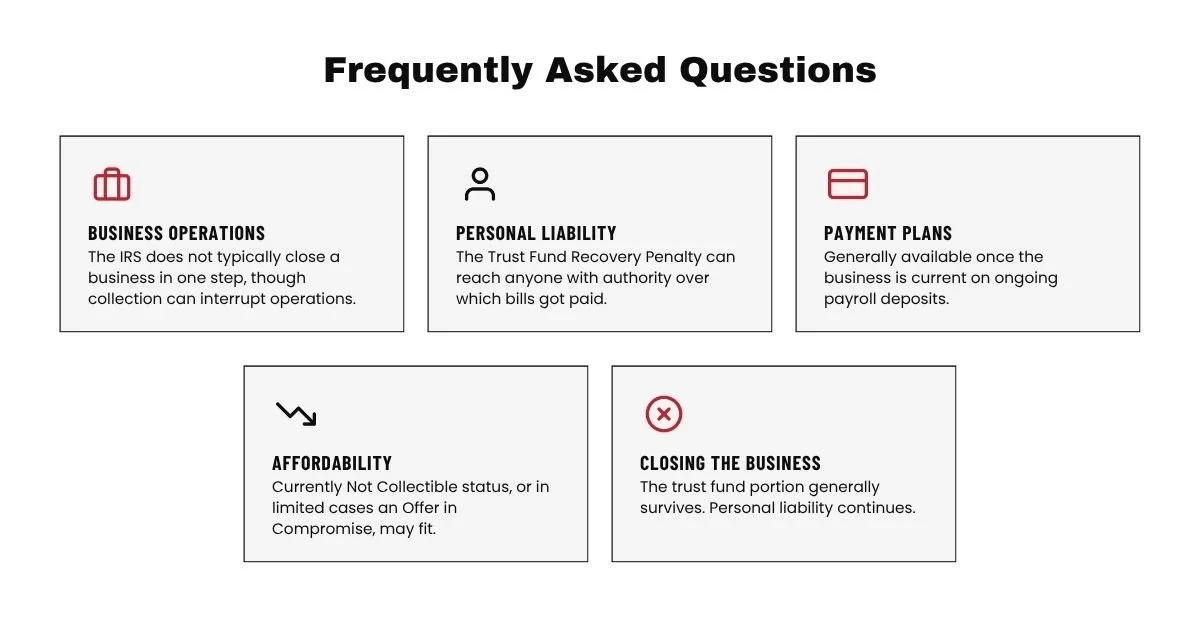
Frequently Asked Questions
-
The IRS does not typically close a business in one step, but enforced collection, a levy on a bank account or receivables, can interrupt operations enough to threaten the business's ability to continue. Acting before that stage generally preserves more options.
-
It depends on your role. The Trust Fund Recovery Penalty can apply to anyone considered a responsible person with authority over which bills got paid, which is not limited to the business owner. This liability is separate from the business entity itself.
-
Generally yes, but the IRS will typically not approve one unless the business is current on its ongoing payroll deposits. A plan for the back balance without a fix for current compliance is usually not approvable.
-
Depending on the numbers, Currently Not Collectible status or, in more limited cases, an Offer in Compromise may be worth exploring. Which one fits depends on the business's actual income, expenses, and asset picture.
-
No, not the trust fund portion. If the Trust Fund Recovery Penalty has been or could be assessed against a responsible person, that personal liability generally survives the business closing.
The Sooner This Gets Addressed, the More Options Exist
Payroll tax debt is one of the few tax problems where waiting genuinely changes the shape of your options, not just the size of the balance.
Penalties escalate on a defined schedule, interest compounds daily, and personal liability exposure does not go away on its own.
I offer a free case review to look at exactly where your business stands, what the back balance actually includes, and what a realistic path forward looks like.