
What Happens If You Owe the IRS and Cannot Pay
If you owe the IRS money you do not have right now, the first thing I want you to know is this. Owing the IRS is not the same thing as being out of options. I say that because most people who come to me after opening a balance due notice assume the worst case is already happening. It usually is not. The IRS moves through a defined notice sequence before it takes enforced collection action, and at nearly every step along the way there is a door you can walk through before things get worse. This article walks through what happens after you owe and cannot pay, what the IRS can and cannot do to collect, and which resolution paths tend to fit which situations.

Summary of Your IRS Tax Debt Options
- Owing the IRS triggers a written notice sequence, not an immediate seizure of assets.
- Interest currently accrues at 7% annually for individuals, compounded
daily, on top of any unpaid penalties.
- The IRS generally offers several paths for taxpayers who cannot pay in
full, including payment plans, hardship status, and settlement through an Offer in Compromise.
- Ignoring the notices is what moves a case toward liens, levies, or wage garnishment. Responding does not.
- Which option fits depends on your income, expenses, assets, and how much you owe.
- This article covers federal IRS procedure. A California FTB balance follows a related but separate process - see the callout below.

What the IRS Does First When You Owe and Cannot Pay
The IRS does not go straight to enforcement. It moves through a defined sequence of written notices, and each one raises the stakes a little more than the last. CP14 is generally the first notice. It is the official bill: it states what you owe, including any penalties and interest already added, and requests payment within 21 days. If the balance goes unaddressed, the sequence generally continues: - CP501 - a reminder notice restating the balance - CP503 - a second reminder, typically with a shorter response window - CP504 - described by the IRS as the "Final Notice," and the point at which the IRS may begin levying a state tax refund
CP504 Is Not the Same as the Final Levy Notice
This distinction matters and it is commonly stated incorrectly, so I want to be precise about it. CP504 warns that a levy may follow and can trigger a levy on a state tax refund, but it is not the notice that starts the 30-day Collection Due Process appeal clock for a full levy on wages or bank accounts. That right generally attaches to a separate, later notice: LT11 (Letter 11), CP90, or Letter 1058.

Interest and Penalties Keep Growing the Whole Time You Wait
This is the part that catches people off guard. The balance on your notice is rarely the balance you will owe by the time you resolve it. For the quarter beginning July 1, 2026, the IRS interest rate on individual underpayments is 7% per year, compounded daily. That rate is recalculated every quarter based on the federal short-term rate, so it can move up or down.
Separately, the IRS generally applies a failure-to-pay penalty on top of that interest, calculated as a percentage of the unpaid balance per month. I bring this up not to alarm you, but because it changes the math on waiting. A balance that feels manageable today may not feel that way in eighteen months if it sits untouched.

What the IRS Can and Cannot Do If You Do Not Respond
If notices go unanswered long enough, the IRS may move toward enforced collection. This generally can include: - Filing a federal tax lien, a public claim against your property - Issuing a levy, which can freeze a bank account or take a portion of wages - In some cases, applying wage garnishment through your employer What the IRS generally cannot do is take these actions without first sending the required notices, including a Final Notice of Intent to Levy that carries the right to request a Collection Due Process hearing. You generally have 30 days from the date printed on that final notice, not the date you receive it, to file Form 12153 and request the hearing. A timely request generally pauses collection while the hearing is pending. That hearing is one of the most overlooked protections taxpayers have. Missing that window is often what turns a resolvable balance into an active levy.
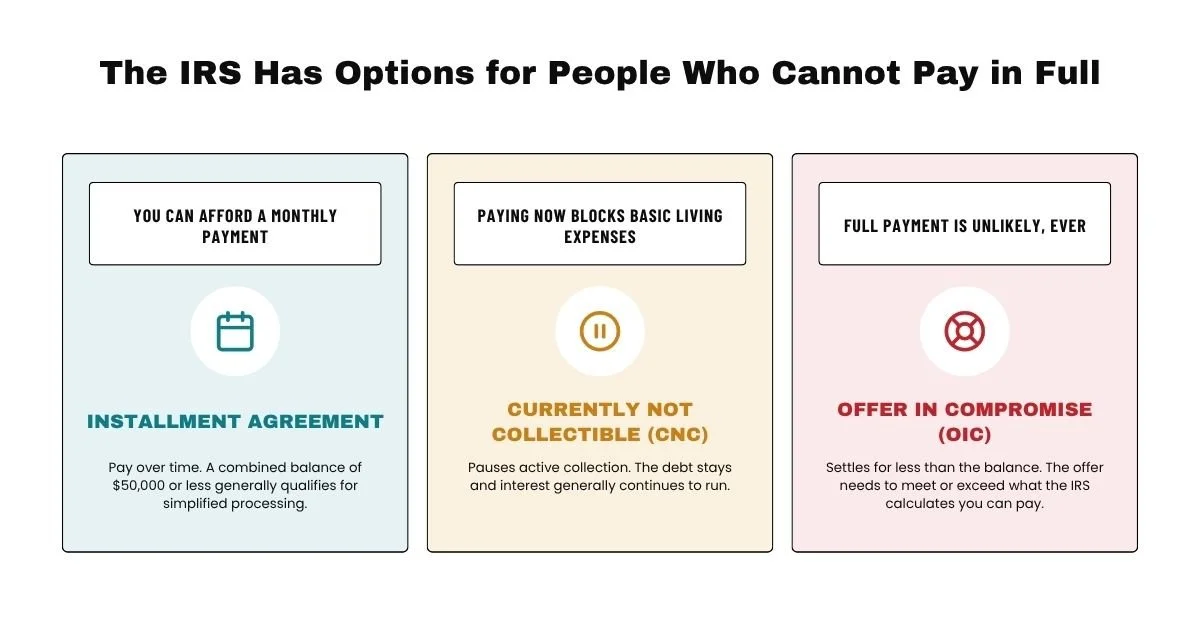
The IRS Has Options for People Who Cannot Pay in Full
This is the part most people do not know until someone tells them. Owing more than you can pay right now does not mean you are stuck paying it all at once.
Installment Agreements
If you can afford a monthly payment, an installment agreement lets you pay the balance over time. Individual taxpayers with a combined balance of $50,000 or less in tax, penalties, and interest generally qualify for simplified processing without submitting a full financial disclosure.
Currently Not Collectible Status
If paying anything right now would prevent you from covering basic living expenses, you may qualify for Currently Not Collectible status. This pauses active collection. It does not erase the debt, and interest generally continues to run, but it can buy real breathing room during a genuine hardship.
Offer in Compromise
If your income, assets, and future earning potential make it unlikely you could ever pay the full balance, an Offer in Compromise may allow you to settle for less than you owe. This is not a program everyone qualifies for, and it is not the instant discount some advertising makes it sound like. The IRS calculates what it believes you can realistically pay, and your offer needs to meet or exceed that number.

Federal vs California - Do Not Assume the Same Rules Apply
Everything above describes the federal IRS process. If part or all of your balance is with the California Franchise Tax Board rather than the IRS, the underlying concepts are similar, a notice sequence, interest that accrues, collection tools like liens and levies, but the notice numbers, response windows, and interest rate all run under California Revenue and Taxation Code, not the Internal Revenue Code. If you owe both the IRS and California FTB, you are generally dealing with two separate collection tracks that do not automatically move together, and resolving one does not resolve the other.
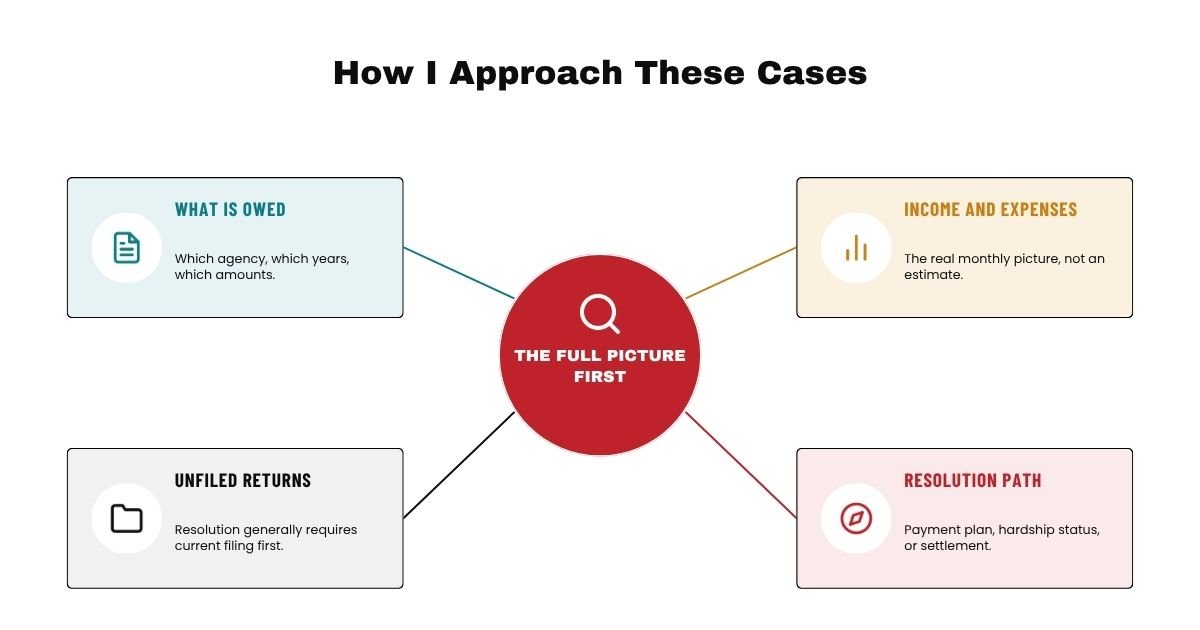
How I Approach These Cases
When someone comes to me after getting a notice like this, my first goal is not to jump to a solution. It is to understand the full picture. What do you owe, to which agency, for which years. What does your income and expense picture actually look like. Are there unfiled returns sitting underneath the balance that need to be addressed first, since the IRS generally will not approve a resolution until you are current on filing. Once I have that picture, the resolution path usually becomes clear. Sometimes it is a payment plan. Sometimes it is hardship status. Sometimes it is worth exploring a settlement. The point is that the right answer depends entirely on your numbers, not on a one-size-fits-all pitch.
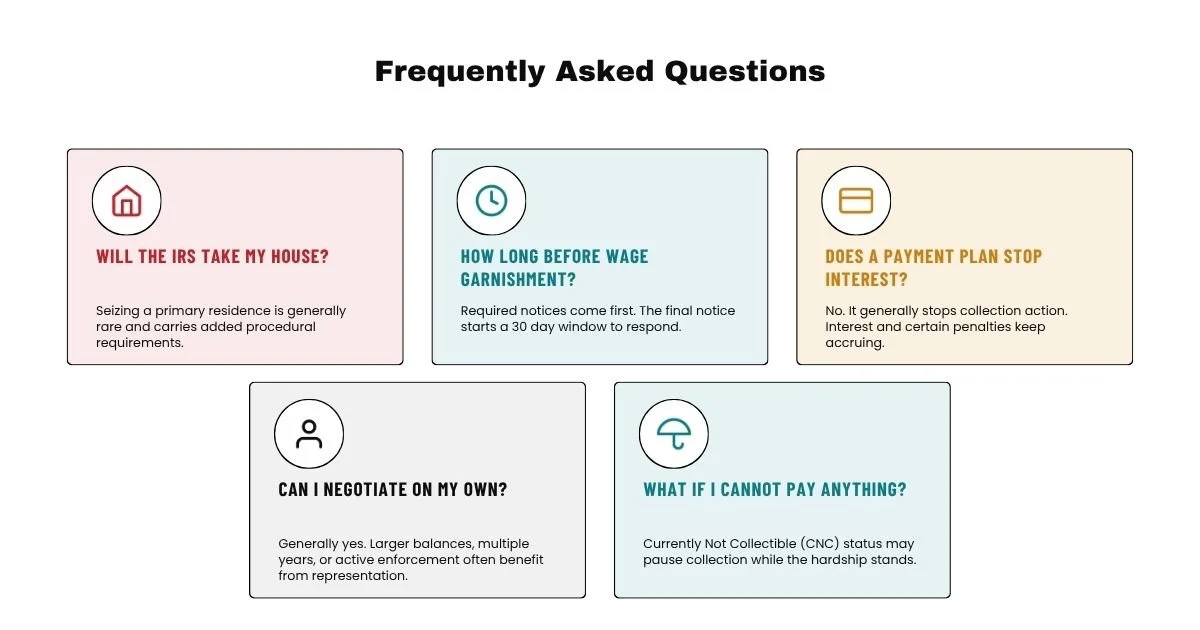
Frequently Asked Questions
-
Seizing a primary residence is generally rare and comes with additional procedural requirements the IRS must meet. Most cases resolve through a payment plan, hardship status, or settlement long before a home is at risk.
-
The IRS generally must send a series of notices, including a Final Notice of Intent to Levy, before wage garnishment can begin. That final notice starts a 30-day window to respond or request a hearing. [Source: IRS.gov, "Letters and notices offering an appeal opportunity"]
-
No. A payment plan generally stops further collection action like levies, but interest and certain penalties typically continue to accrue on the remaining balance until it is paid in full.
-
You generally can. Some taxpayers handle simpler balances on their own successfully. Cases involving larger balances, multiple years, payroll tax debt, or active enforcement tend to benefit from experienced representation, since the paperwork and eligibility rules can be easy to get wrong.
-
That is exactly what Currently Not Collectible status is designed for. If your necessary living expenses use up all of your income, the IRS may pause collection while your situation stands.
-
Not usually a hard deadline in the sense of losing all options, but waiting generally makes the balance larger and can narrow which resolution paths still make sense. The collection statute does eventually expire, generally 10 years from assessment, but that is rarely something to plan around without professional guidance, since certain actions can pause or extend that clock.
The Next Step Is Smaller Than You Think
If you are staring at a balance you cannot pay right now, the hardest part is usually opening the notice, not resolving what is inside it. Once you know what you owe, what caused it, and which resolution path fits your numbers, the rest becomes a process rather than a crisis. I offer a free case review to walk through exactly that. No pressure, no guesswork, just a clear read on where you stand and what your realistic options are.