
IRS Offer in Compromise Guide: Who Qualifies, How to Apply, and What the IRS Reviews
The IRS Offer in Compromise is one of the most talked about tax relief programs, and also one of the most misunderstood. Most people hear the simple version: settle your IRS tax debt for less than you owe. What they usually do not hear is what the IRS actually reviews, how the settlement amount is calculated, and why many applications are rejected before they ever had a real chance.
An Offer in Compromise is not based on how much you owe or how badly you want relief. The IRS looks at your income, expenses, assets, equity, filing compliance, and future ability to pay. If the numbers do not support the offer, the IRS can reject it, keep certain payments submitted with the application, and continue collection activity once the case is closed.
This guide explains who qualifies for an IRS Offer in Compromise, how to apply, what forms and financial documents are required, and what the IRS reviews before making a decision. It also explains what to consider when an Offer in Compromise is not the right option and another tax resolution strategy may work better.
At Semper Tax Relief, our work is based on careful transcript review, financial analysis, and proper case preparation. With Juris Doctor and Enrolled Agent credentials, we handle IRS tax debt settlement cases with a focus on what the IRS actually considers before accepting or rejecting an offer. Before you apply, start by understanding what the Offer in Compromise program is designed to do.
IRS Offer in Compromise Guide Summary TLDR;
An IRS Offer in Compromise allows qualifying taxpayers to settle tax debt for less than the full amount owed.
The IRS does not approve offers based on hardship alone. It reviews income, assets, expenses, compliance, and reasonable collection potential.
The three OIC categories are doubt as to collectibility, doubt as to liability, and effective tax administration.
Most taxpayers apply under doubt as to collectibility, where the IRS decides whether the full balance can realistically be collected.
All required tax returns must be filed before the IRS will process an OIC.
Open bankruptcy, missing tax returns, and current payment noncompliance can disqualify an offer before review.
The IRS calculates the offer amount using asset equity plus future disposable income.
Form 656, Form 433-A OIC or Form 433-B OIC, financial records, fees, and initial payments are usually required.
OIC reviews can take months, and the IRS may request additional documents before making a decision.
If the IRS rejects the offer, the taxpayer generally has 30 days to appeal.
An OIC is not always the best option. Payment plans, CNC status, or other IRS relief programs may fit better.
A strong OIC is based on accurate numbers, complete documentation, and realistic eligibility, not guesswork.
What the IRS Offer in Compromise actually is
An IRS Offer in Compromise (OIC) is a formal agreement between a taxpayer and the IRS to resolve a tax liability for less than the full amount owed. This is not a loophole, and it is not a negotiating trick. It is a statutory program with strict rules and financial tests, and the IRS only accepts an offer when it concludes that the proposed amount represents the most it can reasonably collect given the taxpayer's financial situation.
If you are trying to determine whether an IRS Offer in Compromise is realistic for your situation, start by understanding how the program works before assuming the IRS will accept less than the full balance.
The three grounds the IRS will consider
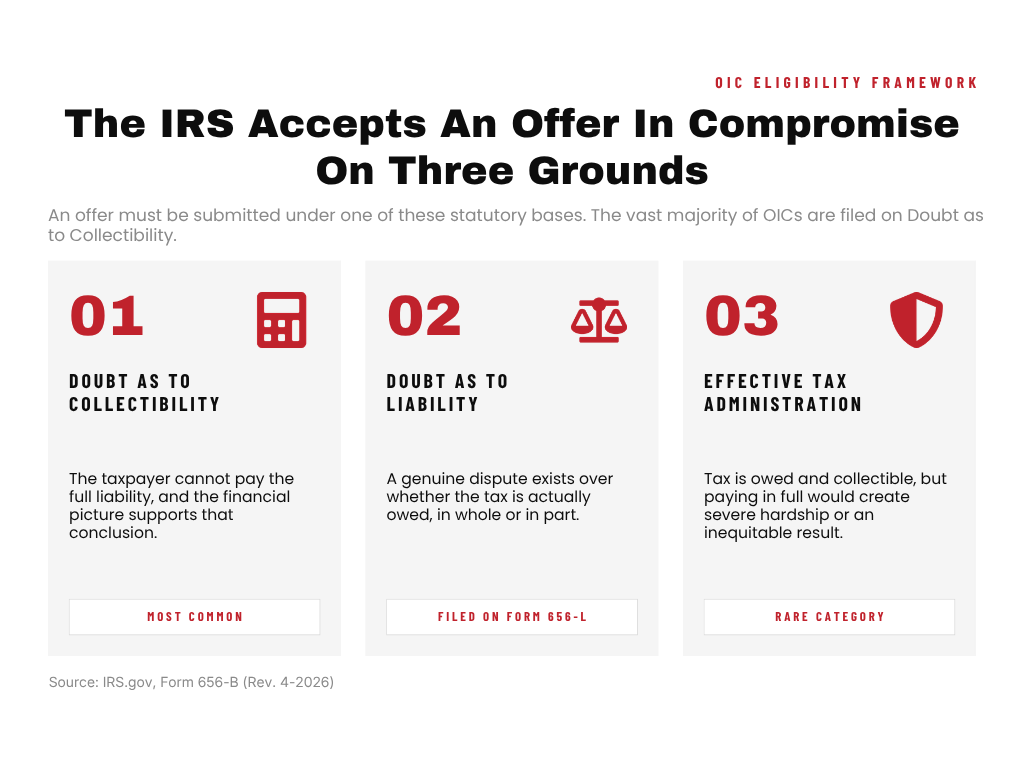
The IRS recognizes three bases for accepting an offer. Doubt as to collectibility is the most common: the taxpayer cannot pay the full amount, and the IRS agrees the financial picture supports that conclusion. Doubt as to liability applies when there is a genuine dispute over whether the tax is actually owed, in whole or in part. Effective tax administration is a rarer category reserved for cases where the tax is legally owed and collectible but paying the full amount would create severe economic hardship or produce a result that is inequitable under the circumstances.
Most readers will fall into the doubt-as-to-collectibility category. The IRS evaluates these cases primarily through a financial calculation called reasonable collection potential (RCP), which determines how much the IRS believes it can realistically recover from your assets and future income.
What settlement amounts actually look like in practice
The IRS does not split the difference and call it a day. Your accepted offer amount is tied directly to your financial data, not to what you think is fair. A taxpayer with $8,000 in back taxes, minimal asset equity, and $200 in monthly disposable income might legitimately offer around $2,400 or less under the lump-sum payment option. A taxpayer with $40,000 in home equity and steady income could find that the IRS calculates an RCP higher than the full debt, making a compromise settlement mathematically unsupportable.
IRS Offer in Compromise eligibility requirements
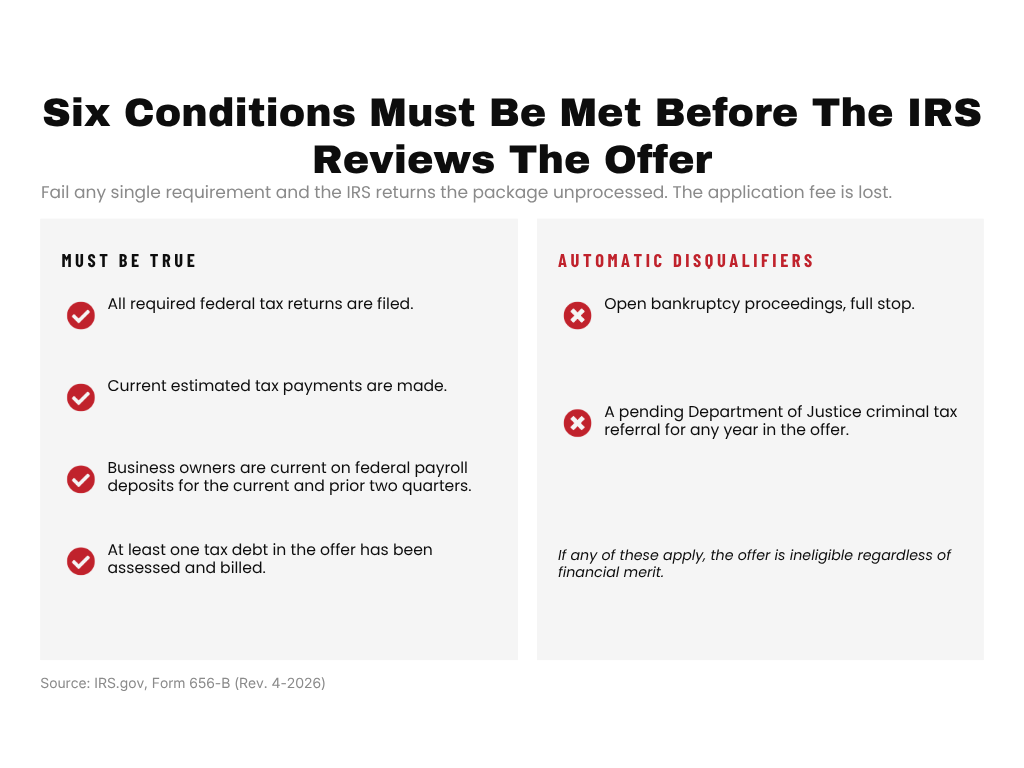
Before the IRS reviews the financial merits of your case, it runs an eligibility check. Failing any single requirement means the IRS returns the offer unprocessed, and you lose the application fee and time spent preparing the package. Run through these conditions before investing in a full submission.
Filing and payment compliance: the non-negotiable baseline
All required federal tax returns must be filed. Current estimated tax payments must be made. Business owners must be current on federal payroll tax deposits for the current quarter and the two preceding quarters. There is no workaround for unfiled returns: the IRS simply will not consider an offer until all required returns are on file. A self-employed taxpayer who skipped two or three years of filing needs to reach full compliance first. The OIC submission comes after that, not before.

Who gets disqualified before the review even begins
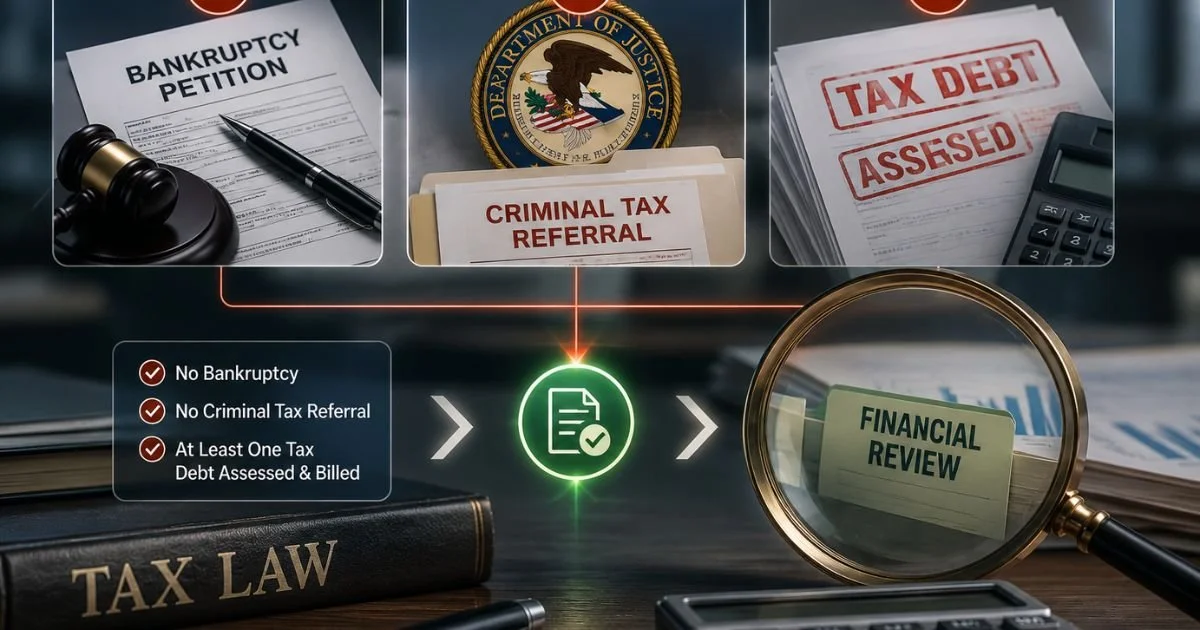
Open bankruptcy proceedings make a taxpayer ineligible, full stop. A pending Department of Justice criminal tax referral covering the tax years in the offer is also disqualifying. Beyond those conditions, the IRS requires that at least one of the tax debts included in the offer has been assessed and billed. If you clear all of these baseline conditions, you move to the financial review, which is where RCP becomes the central question.
How the IRS Offer in Compromise RCP is calculated
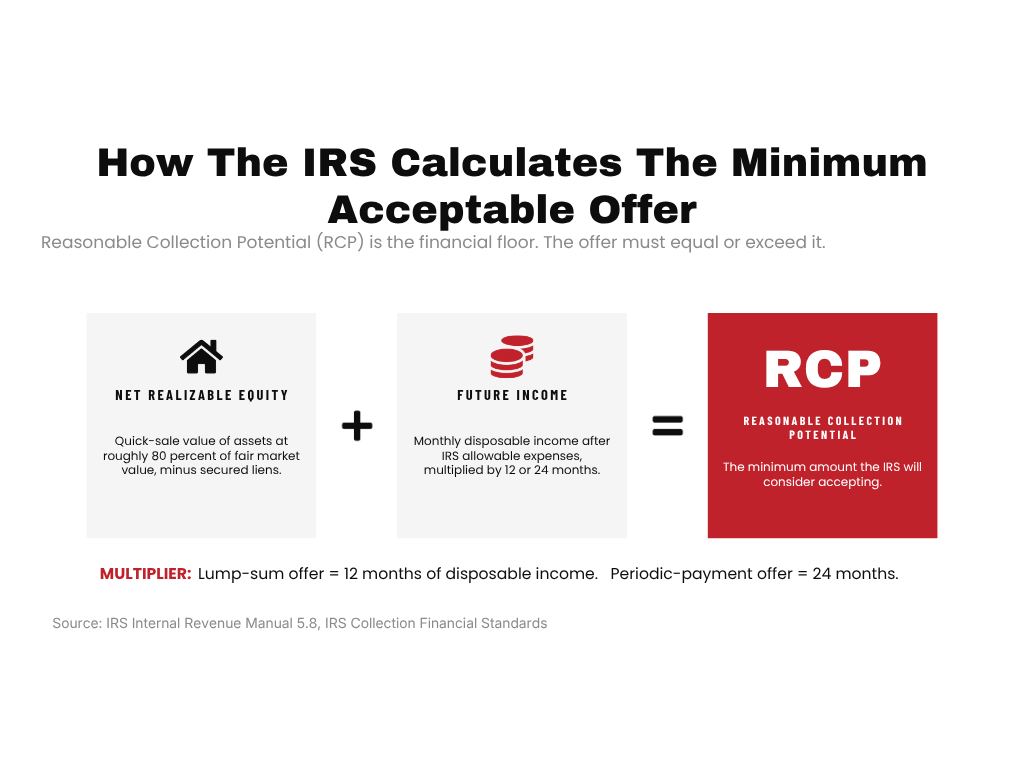
RCP is the financial core of the Offer in Compromise process. It is the IRS's estimate of the maximum it can realistically collect from you based on your assets and future income. Your offer must equal or exceed the calculated RCP to have a legitimate shot at acceptance. Understanding this calculation lets you self-assess before spending money on a submission that may not succeed. For a detailed, practical breakdown of how those numbers are assembled and tested in real cases, see the IRS Offer In Compromise Calculation.
Valuing your assets: the net realizable equity side
The IRS does not use full market value for your assets. It uses quick-sale value, generally estimated at approximately 80% of fair market value, and then subtracts any loans or liens against the asset. Cash is counted at face value. Positive equity across your assets is added together, but negative equity in one asset does not offset positive equity in another. Common assets evaluated include bank accounts, vehicles, real estate equity, and retirement accounts.

Monthly disposable income and allowable expense standards
The income side of RCP starts with your gross monthly income and subtracts allowable living expenses under IRS national and local standards. The IRS sets maximum allowable amounts for categories like
food, housing, and transportation. If your actual expenses exceed IRS standards, the excess is generally
not counted. What remains after subtracting allowable expenses is your monthly disposable income, and
that figure is multiplied by either 12 or 24 months depending on your payment type.
A real-world RCP scenario to gauge where you stand
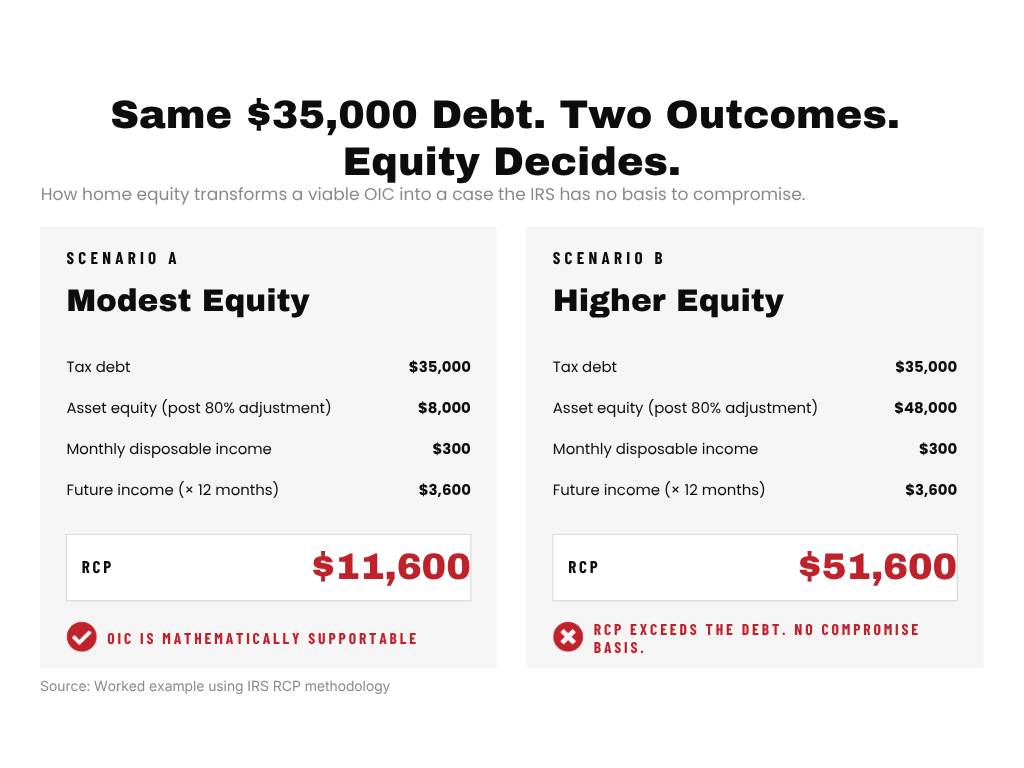
Consider a taxpayer who owes $35,000. Asset equity after quick-sale adjustment and liens totals $8,000.
Monthly income is $3,200. Monthly allowable expenses under IRS standards come to $2,900, leaving $300 in monthly disposable income. Under the lump-sum formula: $8,000 plus ($300 x 12) equals an RCP
of $11,600. Under the periodic-payment formula: $8,000 plus ($300 x 24) equals $15,200. This taxpayer has a financially supportable case for a lump-sum offer around $11,600. Now shift the facts: add $40,000 in home equity after adjustments, and the RCP calculation climbs well above the original $35,000 debt, at which point the IRS has no basis to accept a reduced settlement.
Submitting Form 656: what the application package requires
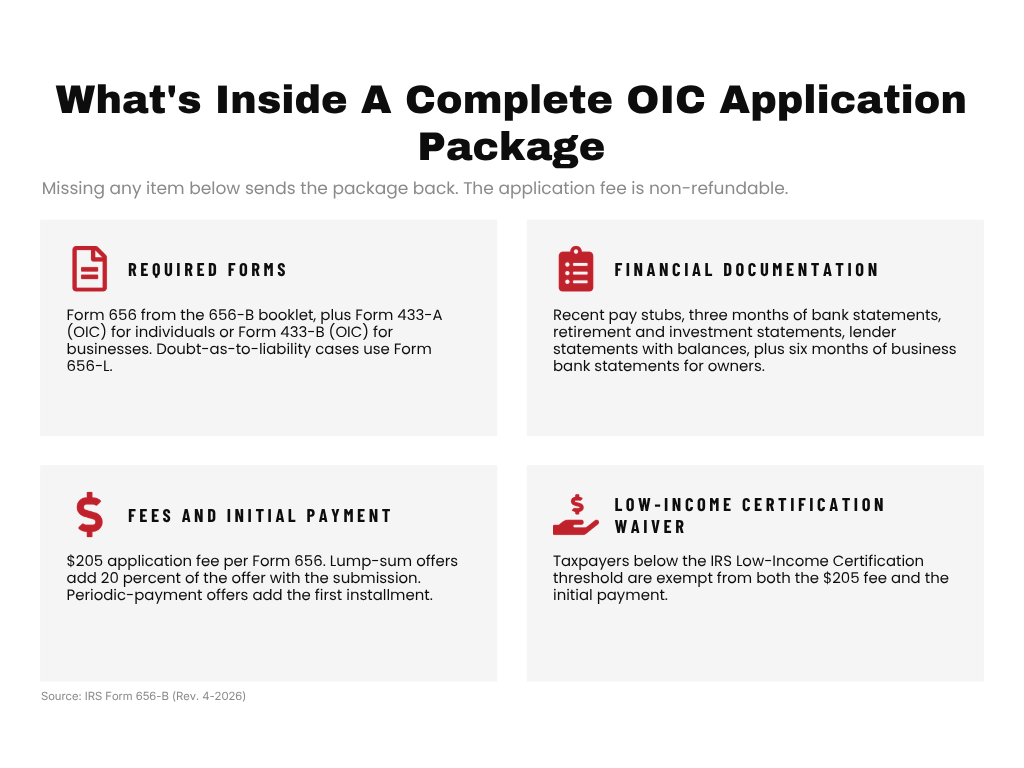
Once you determine eligibility and calculate a supportable offer amount, the application requires specific forms, supporting documents, fees, and an initial payment. Missing any component causes delays or a returned application, so treat this as a hard checklist before sending anything to the IRS.
Once the numbers support an OIC, the next step is learning how to make the offer for the IRS Offer in Compromise using Form 656 and the correct payment option.
Required forms and supporting documents
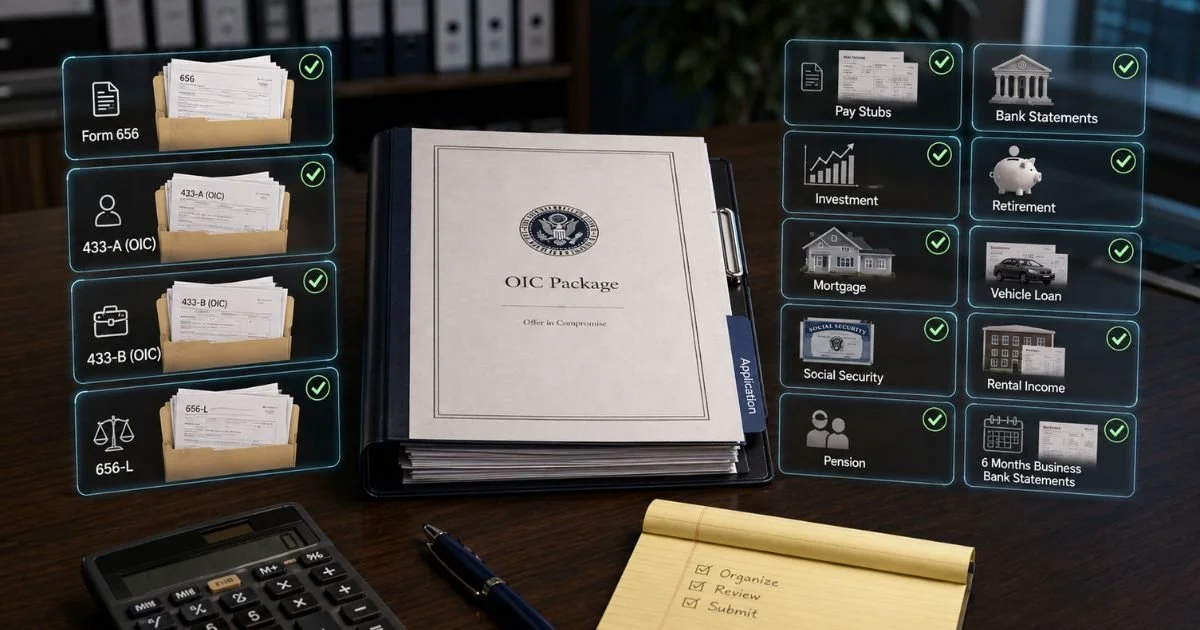
The core submission uses Form 656 from the Form 656-B booklet, paired with Form 433-A (OIC) for individuals or Form 433-B (OIC) for businesses. Doubt-as-to-liability cases use Form 656-L instead. You can review the official Form 656-B booklet here: Form 656-B (Form 656 booklet).
Required supporting documents include recent pay stubs, three months of bank statements for individual accounts, statements for investment and retirement accounts, lender statements for mortgages and vehicle loans showing balances and monthly payments, and documentation for any other income sources such as Social Security, rental income, or pensions. Business owners also need six months of business bank statements.
Your OIC package is only as strong as the proof behind it, so gather your tax relief supporting documents before submitting financial statements to the IRS.
Application fees and the low-income payment waiver
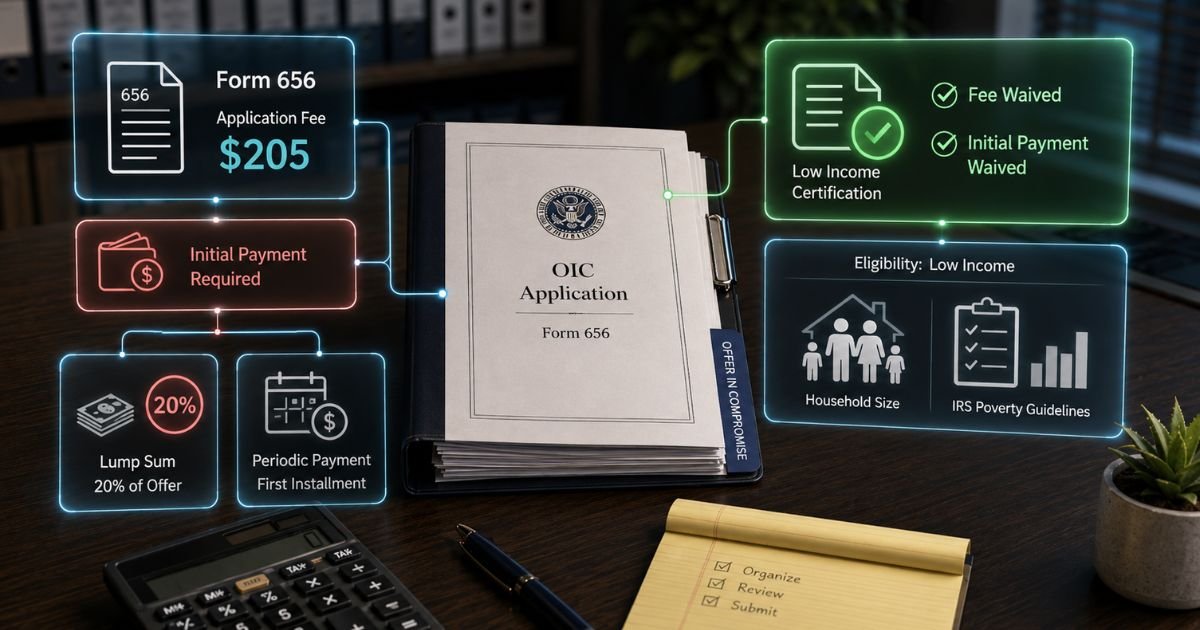
The application fee is $205 per Form 656. A required initial payment accompanies the submission: 20% of the total offer amount for a lump-sum offer, or the first installment payment for a periodic-payment offer. Taxpayers who meet IRS Low-Income Certification guidelines are exempt from both the fee and the initial payment. The low-income threshold is based on IRS poverty guidelines adjusted for household size, so confirm whether it applies before submitting payment.
What happens after the IRS receives the package
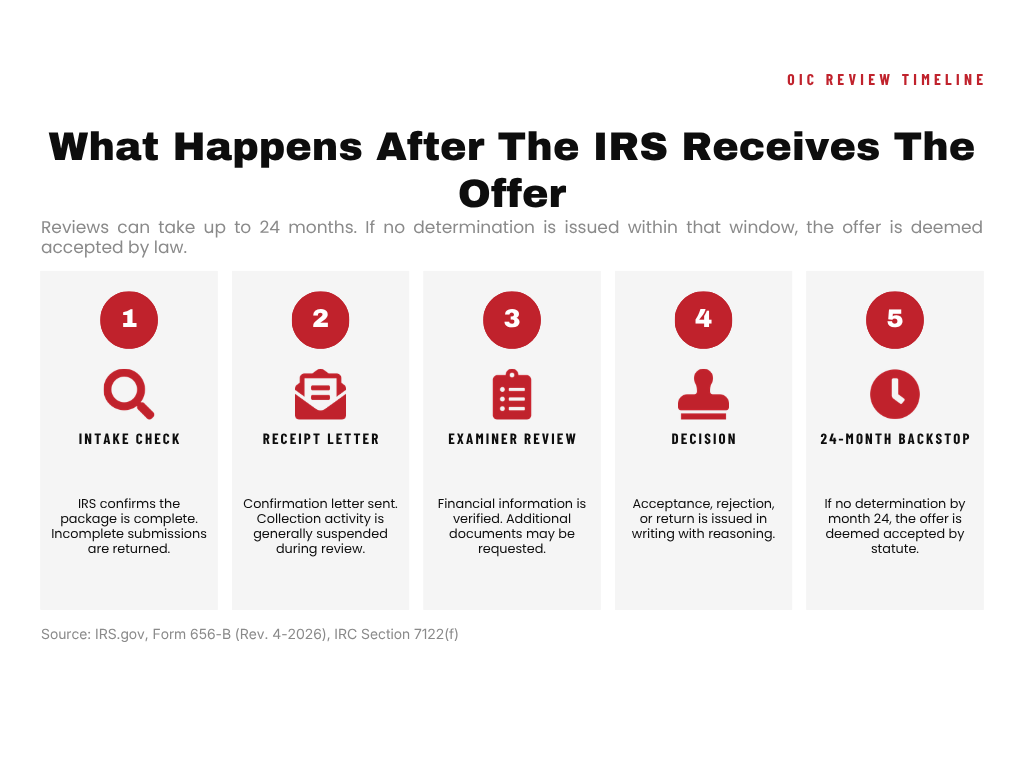
The IRS first reviews the package to determine whether it is processable. If anything is missing or incomplete, the package is returned. If accepted for processing, the IRS sends a letter confirming receipt and providing an estimated contact timeline. Collection activity is generally suspended while the offer is pending, though the IRS is not required to release a levy that was already served before submission. An examiner then reviews the financial information, may request additional documents, and eventually issues a written determination. The IRS states the review can take up to 24 months, though many cases resolve faster.
OIC outcomes: acceptance rates, rejection reasons, and appeals
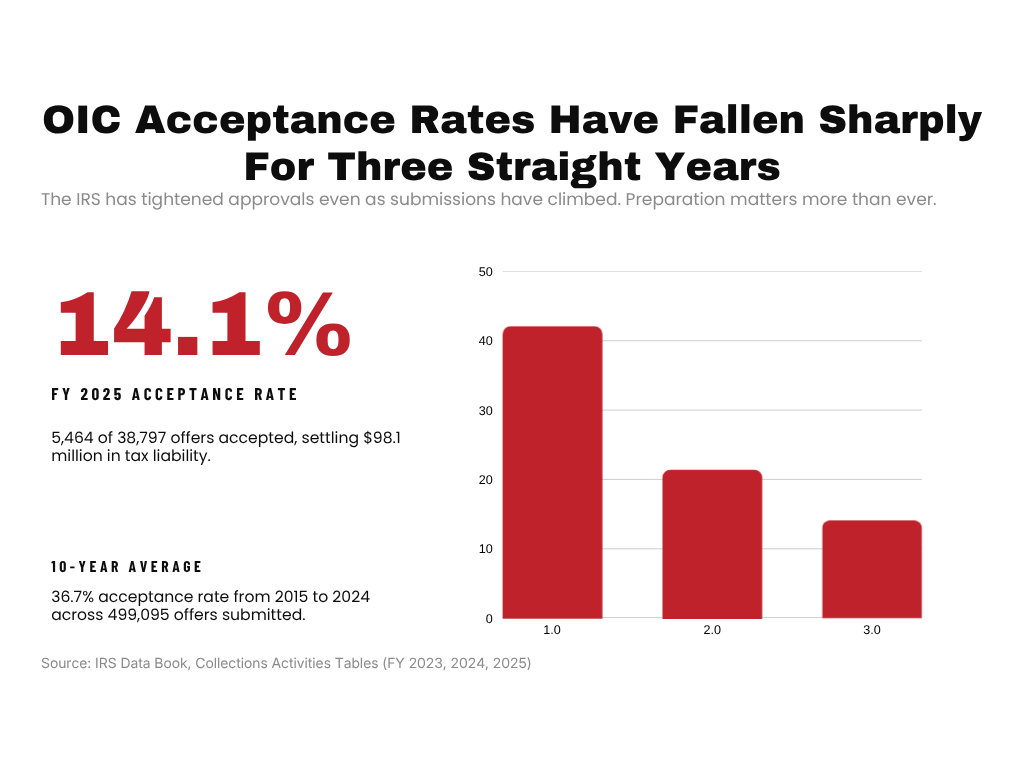
Not every OIC gets approved. Acceptance rates have ranged from roughly 21% to 42% in recent fiscal years. Understanding why offers get rejected helps a taxpayer either strengthen their application or recognize that an OIC is not the right path for their situation. For a clear consumer-oriented explanation of program trends and acceptance context, see this TurboTax guide to Offer in Compromise.
The 30-day appeal window and when it makes sense to use it
If the IRS rejects an offer, the taxpayer has 30 days to file an appeal using Form 13711 with the IRS Independent Office of Appeals. The appeal is worth pursuing when the rejection was based on a disputable RCP calculation or when additional financial documentation can change the outcome. If the IRS does not issue a determination within two years of receiving the application, excluding any appeal
period, the offer is deemed accepted by default.
When an IRS Offer in Compromise is not the right path
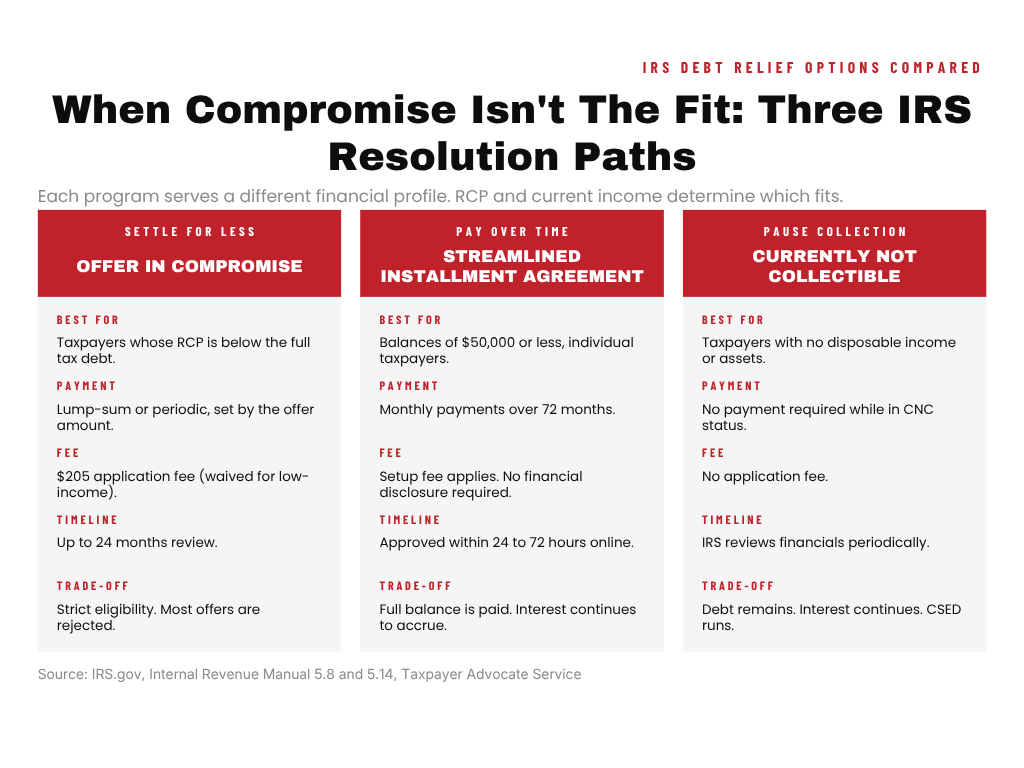
A compromise settlement is not the right tool for every taxpayer with IRS debt. When the RCP calculation shows you can realistically pay the full amount over time, other programs often deliver better outcomes with less complexity and lower upfront cost.
Other IRS debt relief options that may fit better
An IRS installment agreement lets qualifying taxpayers pay their balance over time in monthly payments, with interest accruing but no lump-sum settlement required. For balances between $25,000 and $50,000, the IRS generally offers a streamlined installment agreement repaid over 72 months. Currently-not collectible (CNC) status is available for taxpayers with no disposable income and minimal assets, effectively pausing IRS collection until the financial picture changes.
The IRS Fresh Start Program expanded access to both installment agreements and the Offer in Compromise program, including raised thresholds for OIC eligibility. Each option carries different trade offs, and the right choice depends on your actual financial picture. For additional strategies on addressing IRS back taxes, Semper Tax Relief maintains an in-depth resource in The Ultimate IRS Offer In Compromise Guide.
What a J.D. Enrolled Agent brings to an OIC submission
Self-prepared OIC submissions are allowed, but the stakes are high. An inaccurate RCP calculation, a missing document, or an overlooked compliance issue can result in a returned or rejected application and a lost $205 fee. The team at Semper Tax Relief combines Juris Doctor (J.D.) legal credentials with Enrolled Agent IRS practice authority. That means they can prepare the full OIC package and represent the taxpayer directly before the IRS using Form 2848 Power of Attorney if the case goes to review or appeal. Their verified OIC acceptance results reflect submissions where the financial data was correctly documented and the offer amount was properly supported by the underlying numbers. For taxpayers who have already been through a rejection with another firm or filed on their own without success, a free case review with a credentialed team is a practical starting point.

IRS Offer in Compromise Guide: Who Qualifies, How to Apply, and What the IRS Reviews FAQs
-
To apply, you must complete Form 656 from the Form 656-B booklet, along with the appropriate
Collection Information Statement (Form 433-A OIC for individuals or Form 433-B OIC for businesses).
Submit the completed package to the IRS with the $205 application fee and the required initial payment.
All federal tax returns must be filed and estimated tax payments current before the IRS will process any application. Low-income taxpayers who meet IRS poverty guidelines may qualify to have both the fee and initial payment waived.
-
An IRS Offer in Compromise settles your tax debt for a reduced lump sum or periodic payments less than the full amount owed. An installment agreement does not reduce the balance, it allows you to pay the full liability over time in monthly payments, with interest continuing to accrue. An OIC is the better option when your RCP is genuinely below your total debt. An installment agreement is more appropriate when your finances show you can realistically pay the full balance over 72 months or fewer.
-
The IRS offers a free online OIC pre-qualifier tool at IRS Topic 204: Offer in Compromise that walks you through a basic eligibility and RCP estimate. It is a useful starting point, but the pre-qualifier uses simplified inputs and does not account for every factor an examiner will consider. A professional review using your actual financial statements.
-
The IRS states that OIC reviews can take up to 24 months from the date the application is accepted for processing. Many cases resolve in less time. If the IRS does not issue a decision within two years of receiving the application, excluding any appeal period, the offer is legally deemed accepted.
-
If the IRS rejects your Offer in Compromise, you usually have 30 days from the rejection letter to file an appeal using Form 13711. An appeal may make sense if the IRS used incorrect asset values, overstated your disposable income, missed important financial documents, or calculated your reasonable collection potential higher than it should be.
A rejection does not always mean you have no options. You may be able to correct the financial information, submit additional proof, appeal the decision, or consider another IRS resolution option such as an installment agreement, partial payment installment agreement, or Currently Not Collectible status.
Final Takeaway: Prepare Your Offer in Compromise Correctly.
The decision framework is straightforward. Confirm eligibility first. Calculate RCP honestly using IRS standards, not optimistic estimates. Prepare the Form 656 package completely, with every required document and the correct initial payment.
Set realistic expectations for the timeline: reviews can run up to two years. The outcome depends entirely on whether your financial data supports the offer amount.
The IRS Offer in Compromise is a legitimate, powerful program. It rewards preparation and penalizes guesswork. Whether you self-qualify and move forward or decide that professional representation is the right call, the goal is the same: resolve the debt, restore compliance, and move forward without this hanging over your finances.
At Semper Tax Relief, OIC cases are reviewed with the experience of Sergio Melendez, JD EA, combining IRS representation authority with legal training and tax resolution strategy.