
IRS CP14 Notice Guide: What It Means and What to Do
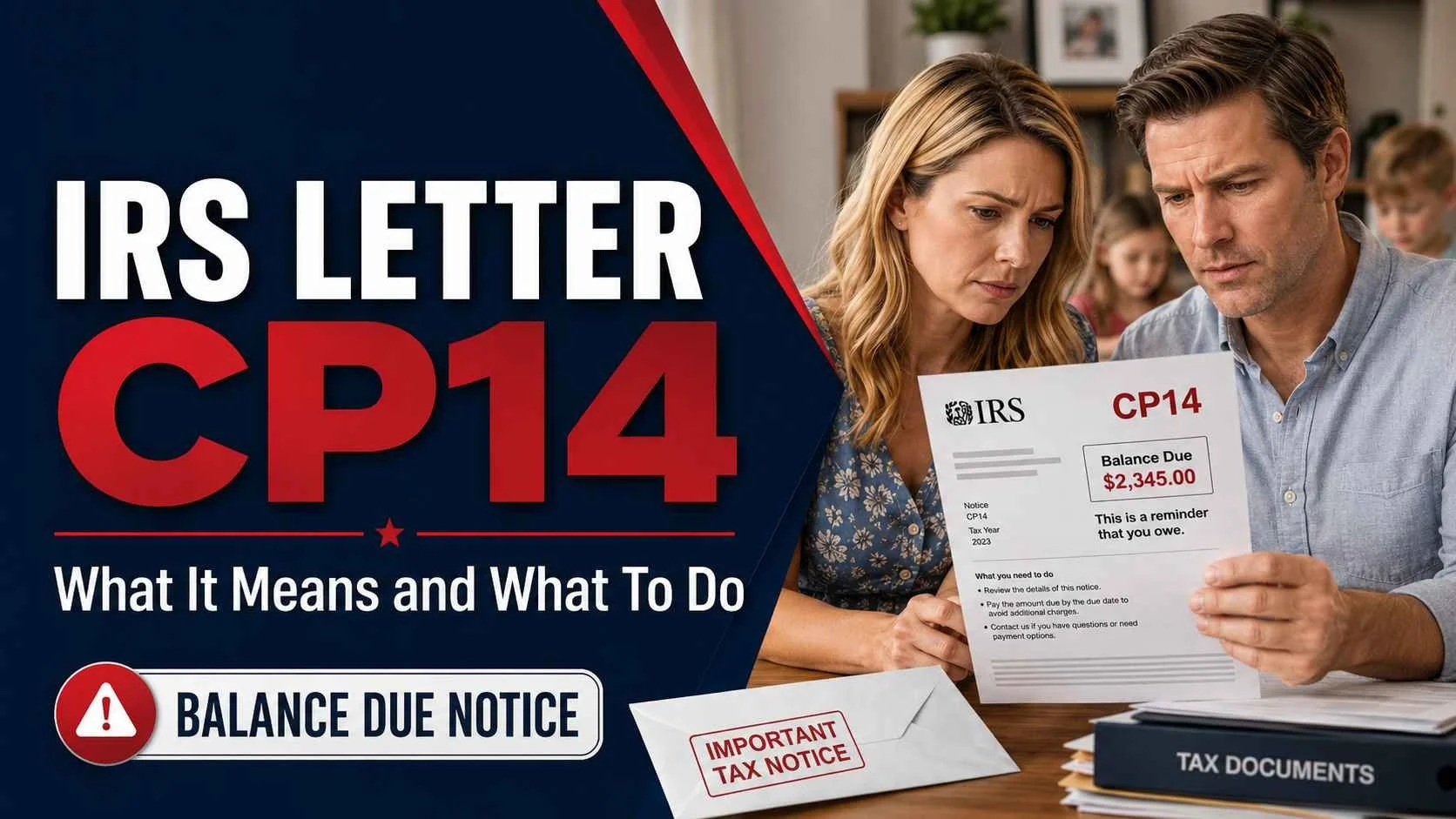
IRS CP14 Notice at a Glance
An IRS CP14 notice is a letter sent to you informing you have a balance due to the IRS.
The notice includes information about the tax year in question, the amount owed, any penalties or interest, and the due date for payment.
If you are not able to pay the full amount by the due date, the IRS may take further action to collect the debt.
You may qualify for Tax Relief or Settlement if you are unable to pay your tax debt
Why did the IRS send me a CP14 Notice?
When you filed a tax return, whether it is for a past year or the current year and there is a balance due of taxes owed, the IRS sends out a letter with the amount due, this is the CP 14.
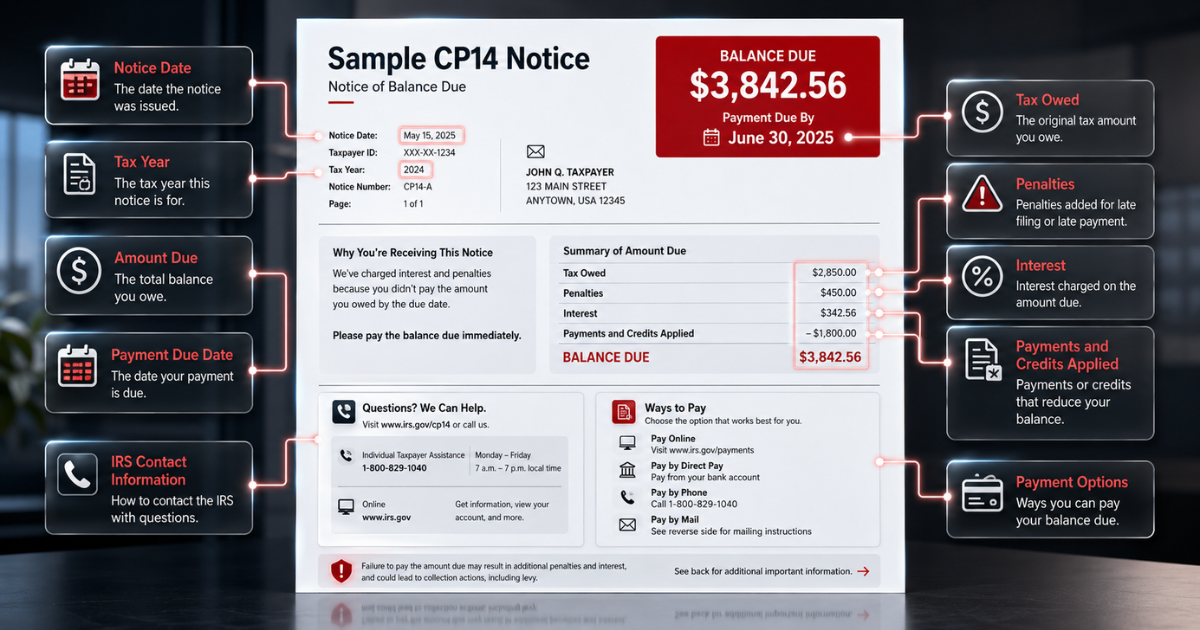
How to Read an IRS CP14 Notice
An IRS CP14 Notice contains several pieces of information that should be reviewed before you make a payment or request a resolution. I recommend reading the entire notice, confirming that it applies to the correct tax year, and comparing the balance with your tax return and payment records. The IRS instructs taxpayers to review the notice carefully, pay by the date shown, request a payment plan if full payment is not possible, or contact the IRS if they disagree.
Confirm the Notice Date and Tax Year
Start by confirming the notice date and the tax year listed on the CP14. The CP14 normally applies to one specific tax period. If you owe for several tax years, you may receive a separate balance due notice for each year.
Make sure the notice matches a tax return you filed. If you do not recognize the tax year, the balance, or the return involved, review your IRS account information before submitting payment.
Review the Billing Summary
The billing summary explains how the IRS calculated the amount due. It may show the original tax assessed, payments and credits applied, penalties, interest, and the remaining balance.
Compare the payments and credits shown on the notice with your records. A missing estimated tax payment, extension payment, withholding credit, or prior payment can cause the balance to appear higher than expected.
Check the Payment Due Date
The CP14 identifies the date by which the IRS is requesting payment. A CP14 generally requests payment within 21 days, although the taxpayer should always follow the exact date printed on the notice. Special rules may apply when the taxpayer qualifies for federally declared disaster relief.
Paying the correct balance by the date on the notice can limit additional interest and late payment penalties. If you cannot pay the full amount, the IRS advises contacting it or requesting a payment plan by the payment due date.
Review the IRS Contact Information
Use the address and telephone number printed on the notice when responding. Different IRS departments and service centers may handle different accounts, so the telephone number on the CP14 is generally the best starting point.
Keep a copy of the notice, any written response, payment confirmations, and the documents you provide to the IRS.
The IRS takes approximately 4-6 weeks to process an e-filed tax return, and upon processing the tax return will send out the CP14 Notice. The processing times may vary with the IRS depending on their current backlog.
If you filed your tax return by mail, the IRS takes a bit longer since the tax return is manually processed. The timeframe may take approximately 3 months to 5 months.
The top left of the IRS CP14’s first page contains the Address of the IRS service center that sent the notice. The Cp14 letter also has the IRS phone number of the service center on the right side.
The other information on top of the first page of the CP14’s right side contains the tax year you owe, and the notice date the IRS issued out the letter to you. If you submitted multiple years of tax returns, all with additional balances, the IRS will send out an individual CP14 for each year there is a balance owed.
What Does the Balance on an IRS CP14 Notice Include?
The balance due totals the amount of tax and the following statutory amounts of Interest & Penalties:
IRS Failure to Pay Penalty
IRS Failure to File Penalty
IRS Interest Charges
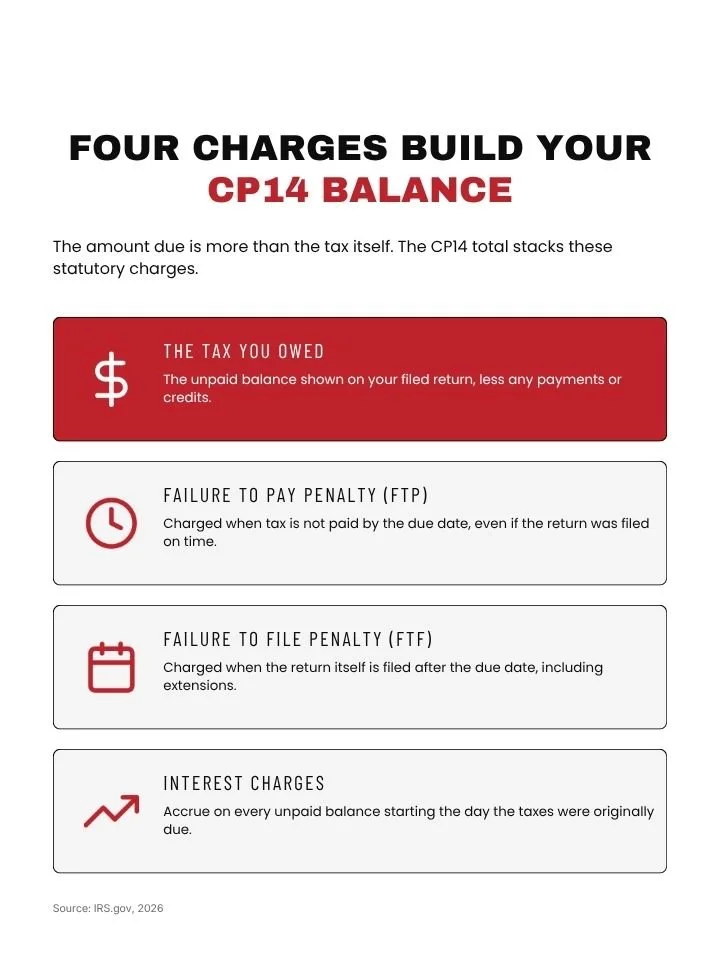
IRS Failure to Pay Penalty
The IRS Failure to Pay Penalty generally starts at 0.5% of the unpaid tax for each month, or part of a month, the balance remains unpaid, up to a maximum penalty of 25%.
That rate can change depending on the status of the account. For an individual who filed the return on time, the penalty may be reduced to 0.25% per month while an approved installment agreement is in effect. The rate can increase to 1% per month after the IRS issues the applicable notice of intent to levy and the required period passes without payment.
IRS Failure to File Penalty
The IRS failure to file penalty is calculated as 5% penalty per month for each month, with a maximum penalty of up to 5 months.
Below is the guidance on how to get the penalties removed or forgiven. So there is some light at the end of the tunnel.
Interest on IRS Debt
Interest is charged on all balances not paid timely to the IRS. Interest starts to get charged beginning on the date when the taxes are due. The interest rates are variable and may change quarterly.
The Calculation of the amount due to the IRS, including all Penalty & interest, is located on the very first page. The Breakdown is on the Billing Summary, which includes the following:
The Taxes you owed
Less any payments & or Credits
Add Failure to Pay Penalty
Add Failure to File Penalty
Add Interest Charges
Total = the amount due per the CP14 letter & the Due date of payment.
The CP14 is the first notice the IRS sends you regarding the balance owed. The bottom of the first page also serves as a payment voucher in case you submit a payment by mail to the IRS.
What If I Already Paid or Believe the CP14 Balance Is Wrong?
A CP14 does not always mean that the taxpayer failed to make a payment. A payment may still be processing, may have been applied to a different tax year, or may have been submitted under the other spouse’s Social Security number on a joint return. Before paying the same balance again, confirm whether the original payment was processed and applied correctly.
Check Whether Your Payment Was Applied
Review your IRS Online Account and compare the account activity with your payment confirmation. Confirm the payment amount, payment date, tax year, and payment type.
If the payment does not appear, gather the bank statement, cancelled check, electronic payment confirmation, or other evidence showing when and how the payment was submitted. The Taxpayer Advocate Service recommends that taxpayers who have proof of payment avoid paying the same tax twice while they investigate whether the payment has posted.
Contact the IRS If You Disagree
If you believe the CP14 is incorrect, call the telephone number shown in the IRS Help section of the notice. Have your CP14 and supporting records available during the call.
The IRS specifically recommends having documents such as cancelled checks and amended returns available when disputing the notice. Depending on the issue, additional records may include payment confirmations, wage statements, estimated tax records, correspondence, or identity theft documentation.
Do Not Ignore the Response Deadline
Even when you believe the notice is incorrect, respond within the time allowed. Explain which part of the balance you dispute and provide copies of the documents supporting your position.
Keep the original documents for your records. If you respond by mail, retain a complete copy of the letter and proof showing when it was sent.
How Can I Resolve the Balance on an IRS CP14 Notice?
You can resolve the balance owed to the IRS in the following 7 ways:
Review the Original Tax Return for Errors
Before choosing a collection resolution, I review whether the balance itself is correct. This includes comparing the CP14 with the filed return, IRS account information, reported income, withholding, estimated tax payments, credits, and prior payments.
An amended return may be appropriate when the original return contained an error or omitted information. An amended return should not be filed merely to delay collection. The proposed correction must be supported by the tax records and applicable law.
Pay the balance in full ( & request penalty forgiveness)
When the balance is correct and full payment is financially possible, paying the IRS can stop the unpaid balance from continuing to grow. The taxpayer should use the correct tax year and payment type and retain the payment confirmation.
Interest generally continues on an unpaid balance after the date shown on the notice. Penalties may also continue until the account is paid or an applicable form of relief is granted.
Temporary time to pay ( & request Penalty Forgiveness)
A taxpayer who expects to pay the balance within a limited period may qualify for a short term payment arrangement. This may provide additional time without establishing a longer monthly installment agreement.
Interest and applicable penalties generally continue while the balance remains unpaid. For that reason, the proposed payment period should be realistic and affordable
Payment Plans ( & request Penalty Forgiveness)
An installment agreement allows a taxpayer to make scheduled monthly payments instead of paying the entire balance at once. The appropriate agreement depends on the total balance, the type of tax owed, filing compliance, and the taxpayer’s financial position.
The IRS generally requires all required tax returns to be filed before approving an installment agreement. In some cases, the IRS may request a financial statement and supporting documents. Penalties and interest normally continue until the balance is fully paid.
Penalty Forgiveness
Some taxpayers may qualify for administrative penalty relief, reasonable cause relief, or a statutory exception. Qualification depends on the type of penalty, compliance history, the reason for the late filing or payment, and the supporting evidence.
Penalty relief does not automatically remove the underlying tax. Interest is generally reduced only when it relates to a penalty that has been reduced or removed.
Offer In Compromise - IRS Tax Debt Settlement
An Offer in Compromise may allow a qualifying taxpayer to resolve a tax liability for less than the full assessed balance. The IRS reviews the taxpayer’s income, expenses, assets, equity, filing compliance, and future ability to pay.
Submitting an offer does not mean the IRS will accept it. The taxpayer must meet the program requirements and provide complete and accurate financial information
Non-Collectible Status - Financial Hardship Status
Currently Not Collectible status may be available when paying the IRS would prevent a taxpayer from meeting necessary living expenses. The IRS may require a financial statement and documentation of income, expenses, assets, and liabilities.
This status temporarily delays collection. It does not erase the tax debt, and penalties and interest may continue. The IRS may review the taxpayer’s financial condition later to determine whether the ability to pay has improved.
What Should I Do First After Receiving a CP14 Notice?
When I review a CP14, I begin by confirming five items, the tax year, the amount of tax assessed, the payments and credits applied, the penalties and interest charged, and the payment due date.
After confirming the balance, the next step is to determine whether the taxpayer should pay, dispute the notice, request a payment arrangement, or review a tax relief option. The correct response depends on whether the balance is accurate and what the taxpayer can realistically afford.
Acting promptly does not mean accepting an incorrect balance. It means reviewing the notice carefully and choosing the appropriate response before the account progresses further into collections.
What Happens When an IRS Balance Is Assigned to ACS Collections?

Receiving a CP14 Notice does not necessarily mean the IRS will immediately levy your bank account or garnish your wages. The CP14 is generally the first bill explaining that the IRS believes you have an unpaid tax balance. However, when the balance remains unpaid and no resolution is established, the account may move further into the IRS collection process and may eventually be handled through the Automated Collection System, commonly called ACS.
What Is the IRS Automated Collection System?
ACS is an IRS collection operation that handles many balance due accounts through centralized call sites and automated systems. ACS employees respond to taxpayers, review collection information, establish qualifying payment arrangements, and take other actions to resolve unpaid tax accounts.
Unlike a local Revenue Officer who may be assigned directly to a more complex case, ACS generally handles cases by telephone, correspondence, and automated account activity. The fact that you have not met a specific IRS employee does not mean collection activity has stopped.
Additional IRS Balance Due Notices May Follow
When the IRS does not receive payment or a response to the CP14 Notice, it may continue sending balance due reminders. These may include notices such as CP501, CP503, and CP504. Each notice generally communicates that the balance remains unresolved and that additional collection action may follow.
Penalties and interest may continue to increase the amount due while the account remains unpaid. The notices may also explain payment options, response deadlines, and the phone number for the IRS department handling the account. Do not assume that a later notice replaces an earlier deadline or that the IRS has closed the account because several weeks have passed without receiving another letter.
ACS May File a Tax Lien or Issue a Levy
If the balance remains unresolved, ACS may use enforced collection tools available to the IRS. Depending on the account and the notices already issued, this may include filing a Notice of Federal Tax Lien or sending a levy to a bank, employer, or another party holding money that belongs to the taxpayer.
A bank levy may require a financial institution to hold and send funds to the IRS. A wage levy may require an employer to continue sending part of the taxpayer’s wages to the IRS until the levy is released, the balance is resolved, or another legal condition ends the levy. Before many levy actions, the IRS must provide the notices and appeal rights required by law.
The Collection Timeline Can Be Different for Every Taxpayer
There is no single collection timeline that applies to every CP14 balance. The timing may depend on the type of tax, the amount owed, prior notices, previous payment arrangements, filing compliance, and the current status of the account.
This is why I recommend reviewing the actual IRS account transcripts and every notice received instead of relying only on the date printed on the CP14. The transcripts can help identify the assessed balance, payments and credits, penalties, interest, collection activity, and the department currently handling the case.
How I Help With an ACS Balance Due Case
When I review an ACS collection matter, I first determine whether the balance is accurate and whether all required tax returns have been filed. I also review the taxpayer’s financial position, prior IRS arrangements, collection deadlines, and available appeal rights.
Depending on the facts, possible resolutions may include paying the balance, requesting additional time to pay, establishing an installment agreement, requesting penalty relief, applying for an Offer in Compromise, or requesting Currently Not Collectible status because of financial hardship. Not every taxpayer qualifies for every option, and the appropriate strategy depends on the account history and the taxpayer’s current ability to pay.
The earlier the account is reviewed, the more opportunity there may be to communicate with ACS and pursue an appropriate resolution before the case progresses further into enforced collection.
In conclusion, take action when the IRS sends the CP14 letter. Respond promptly. Take control of the situation. Review your options and tackle the IRS problem before it gets out of hand.
IRS CP14 Notice FAQs
-
The IRS CP14 notice is a letter from the IRS informing you that you owe money to the IRS for a particular tax year.
-
You received an IRS CP14 notice because the IRS processed your tax return and determined that you owe money for that particular tax year.
-
The IRS CP14 notice will state the original amount of tax owed, any penalties or interest that have been added, and the total amount due.
If you have additional IRS tax balance, the CP14 will not list the amounts. The CP14 notice is only specific to 1 tax year.
-
The IRS CP14 notice will include the due date for payment, which is typically within 21 days of the date on the notice.
-
If you don't pay the full amount owed by the due date, the IRS may take further action to collect the debt, including placing a lien on your property or seizing your assets.
You may qualify for a tax relief program such as the Offer In Compromise, Non Collectible Program or a Hardship payment plan.
-
If you believe the amount of taxe is incorrect, you have the right to dispute the amount with the IRS.
Several options exist to dispute the amounts such as an amended tax return, Identity Theft Claim, or a doubt as to liability program. The burden of proof is up to you to show the IRS.
-
If you can't pay the full amount owed by the due date, review your original tax filings to see if an amended tax return is possible or if one of the following tax relief programs may apply:
1) Temporary time to pay ( & Penalty Forgiveness)
2) Payment Plans ( & Penalty Forgiveness)
3) Penalty Forgiveness
4) Offer In Compromise
5) Non-Collectible Status - Financial Hardship Status
-
A CP14 Notice should not be ignored. If the balance remains unpaid and no resolution is established, the IRS may continue the collection process and send additional notices.
The account may eventually be handled by the IRS Automated Collection System. Depending on the account, the IRS may consider filing a Notice of Federal Tax Lien or taking levy action after providing the notices and taxpayer rights required by law.
There is no single collection timeline that applies to every taxpayer. The timing depends on the amount owed, the type of tax, prior notices, previous payment arrangements, filing compliance, appeal rights, and the current status of the account.
I recommend reviewing the CP14, confirming whether the balance is accurate, and addressing the account before the collection process progresses further.