
What Is an IRS Tax Levy and How Is It Different From a Lien
People use "lien" and "levy" like they mean the same thing. They do not, and the difference matters more than most taxpayers realize when they are trying to figure out how much danger they are actually in.
A lien is a claim. A levy is a seizure. I want to walk through what each one actually does, how the IRS gets from one to the other, and what rights you have at each step along the way.

TLDR
- A federal tax lien is a legal claim against your property. It does not take anything from you directly, but it attaches to what you own.
- A levy is the actual seizure. It can take funds from a bank account, a portion of wages, or other property.
- The IRS generally must send specific written notices before either action, and those notices carry appeal rights.
- A Notice of Federal Tax Lien becomes public record and can affect credit and financing.
- You generally have 30 days from a Final Notice of Intent to Levy to request a Collection Due Process hearing before a levy can proceed.
- This article covers federal IRS procedure. California FTB liens and levies follow a similar but separate process under state law - see the callout below before assuming the same rules apply to a state balance.
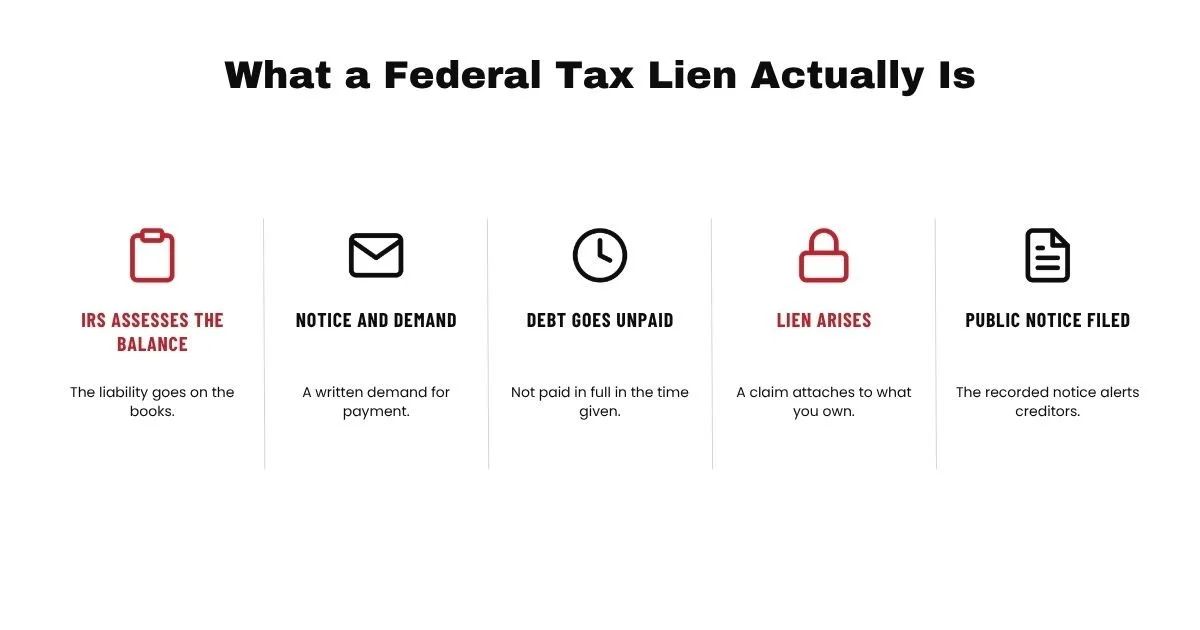
What a Federal Tax Lien Actually Is
A federal tax lien is the government's legal claim against your property when a tax debt goes unpaid. It attaches to real estate, personal property, and
financial assets, including property you acquire after the lien arises.
A lien generally arises automatically once three things have happened:
1. The IRS assesses the liability (puts the balance on the books)
2. The IRS sends a Notice and Demand for Payment
3. You do not pay the debt in full within the time given
Once those conditions are met, the IRS may file a Notice of Federal Tax Lien. That is a public document. It does not take your property, but it puts every creditor, lender, and title company on notice that the government has a claim ahead of most others.
How a Lien Gets Released
Paying the debt in full is the most direct way to resolve a lien. The IRS generally releases the lien within 30 days after the debt is paid.
Short of full payment, there are three other paths worth knowing by name, since taxpayers often hear these terms without understanding what each one actually does:
- Discharge - removes the lien from one specific piece of property
- Subordination - does not remove the lien, but lets another creditor move ahead of the IRS, which can make refinancing possible
- Withdrawal - removes the public notice itself, though the underlying debt is still owed
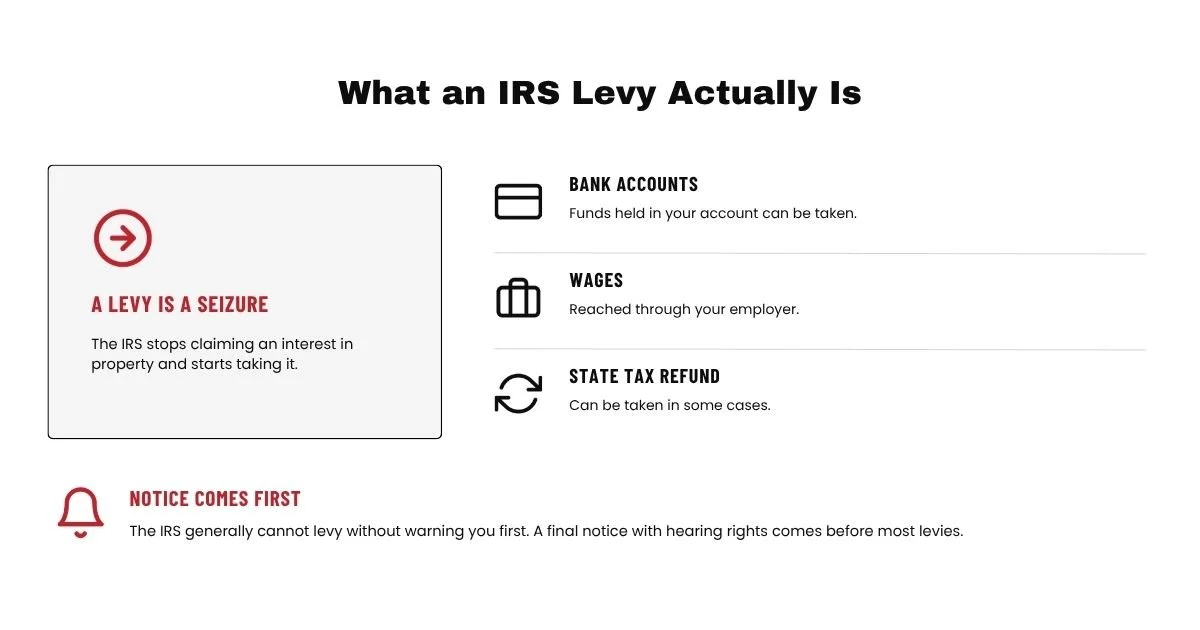
What an IRS Levy Actually Is
A levy is where the IRS moves from claiming an interest in your property to actually taking it. A levy can reach a bank account, wages through your employer, and in some cases a state tax refund.
This is the part that catches people off guard: the IRS generally cannot levy without warning you first. Before most levies, the IRS is required to
send a notice giving you the chance to request a Collection Due Process hearing.
The Notices That Come Before a Levy
Depending on your situation, this final warning may arrive under a few different names, and I want you to be able to recognize them if one lands in
your mailbox:
- CP90 - Final Notice, Notice of Intent to Levy and Notice of Your Right to a Hearing
- LT11 / Letter 11 - Final Notice of Intent to Levy and Notice of Your Right to a Hearing
- Letter 1058 - Final Notice, Reply Within 30 Days
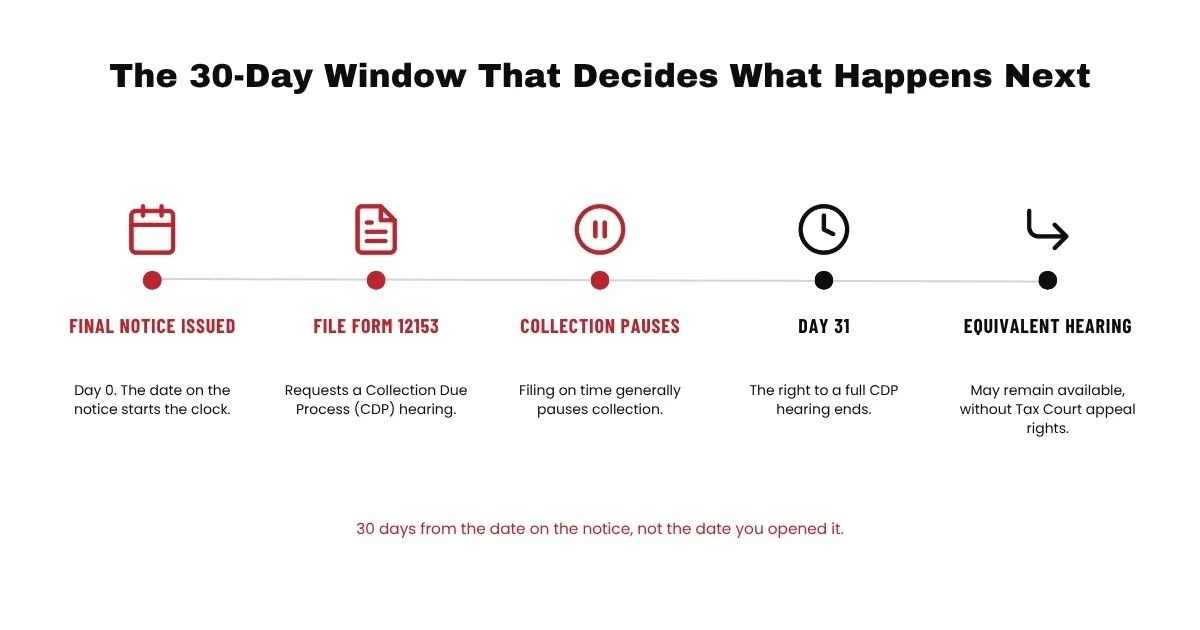
The 30-Day Window That Decides What Happens Next
Once a Final Notice of Intent to Levy is issued, you generally have 30 days from the date on the notice, not the date you opened it, to file Form 12153
and request a Collection Due Process hearing.
Filing that request within the window generally pauses collection while the hearing is pending. Missing the window does not end your options entirely, but it does end your right to a full Collection Due Process hearing. At that point you may still be eligible for what is called an equivalent hearing,
though that path does not carry the same appeal rights to Tax Court.
This is the single most time-sensitive moment in the entire collection process. I say that deliberately. Everything before this point moves slowly.
This 30-day window does not.
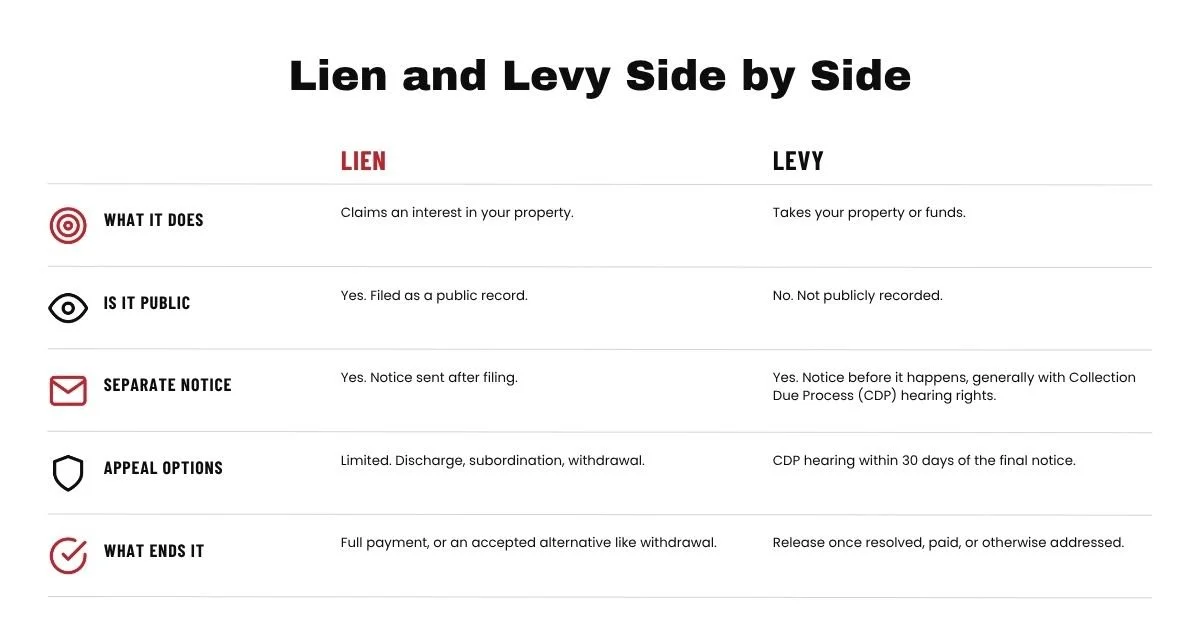
Lien and Levy Side by Side
WHAT IT DOES
Lien: Claims an interest in your property
Levy: Takes your property or funds
IS IT PUBLIC
Lien: Yes, filed as a public record
Levy: No, not publicly recorded
DOES IT REQUIRE A SEPARATE NOTICE
Lien: Yes, notice after filing
Levy: Yes, notice before it happens, generally with CDP hearing rights
CAN YOU STOP IT WITH AN APPEAL
Lien: Limited options - discharge, subordination, withdrawal
Levy: Yes - CDP hearing within 30 days of the final notice
WHAT ENDS IT
Lien: Full payment, or an accepted alternative like withdrawal
Levy: Release once resolved, paid, or otherwise addressed by the IRS

Federal vs California - Do Not Assume the Same Rules Apply
Everything above describes the federal IRS process. If your balance is with the California Franchise Tax Board rather than the IRS, the concepts are similar, a lien claims an interest, a levy takes funds, but the filing process, notice timing, and appeal rights run under California Revenue and Taxation Code, not the Internal Revenue Code.
If you owe both the IRS and California FTB, you are generally dealing with two separate collection tracks that do not automatically move together.
What This Means for You
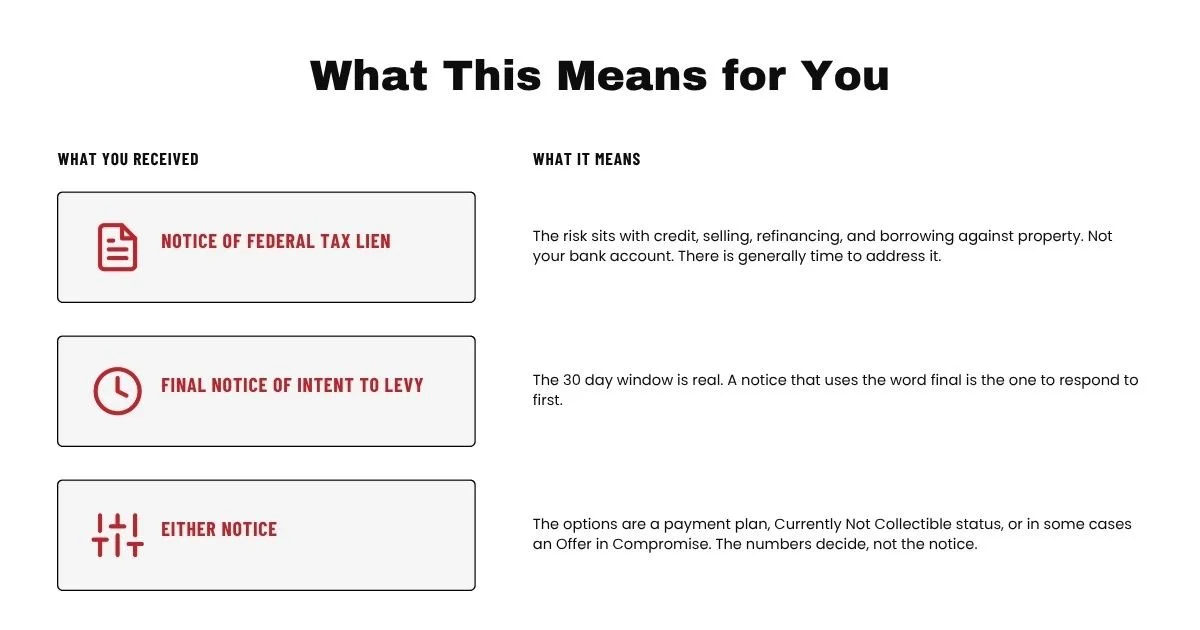
If you have received a Notice of Federal Tax Lien, the immediate risk is to your credit and your ability to sell, refinance, or borrow against property, not to your bank account. There is generally time to address it.
If you have received a Final Notice of Intent to Levy, the calculation changes. That 30-day window is real, and it is the reason I tell people not to sit on a notice that uses the word "final."
In either case, the options tend to be the same ones that show up across most collection situations, a payment plan, Currently Not Collectible status, or in some cases an Offer in Compromise, but which one fits depends on the numbers, not the notice itself.
Frequently Asked Questions
-
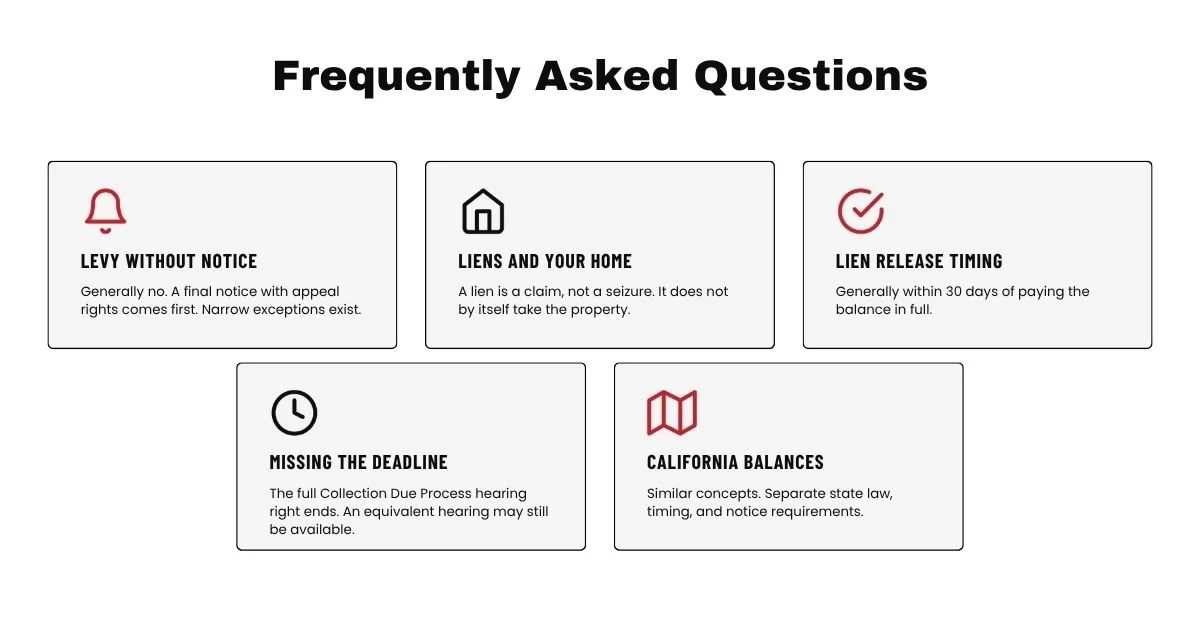
Generally no. The IRS is required to send a final notice with appeal rights before most levies occur. There are narrow exceptions, including certain state refund levies, where notice timing works differently.
-
No. A lien is a claim, not a seizure. It can complicate selling or refinancing property, but it does not by itself result in losing the property.
-
The IRS generally releases a lien within 30 days of full payment.
-
You generally lose the right to a full Collection Due Process hearing, though an equivalent hearing may still be available.
-
No. The general concepts are similar, but the process runs under separate California law with its own timing and notice requirements.
The Next Step
If you are holding a lien notice or a final levy warning right now, the most useful thing you can do is figure out which one it actually is before deciding how urgent your situation is. The two require very different timelines and very different responses.
I offer a free case review to look at exactly that, what notice you have, what deadline you are working against, and which resolution path fits.