IRS Form 433-F: Collection Information Statement for Tax Debt Relief
IRS Form 433-F is a Collection Information Statement used to report your current income, living expenses, accounts, property, debts, and other assets to the IRS.
The IRS reviews this financial information to determine how you may be able to resolve an outstanding tax liability.
Form 433-F may support an installment agreement, Currently Not Collectible status, or a request to release a levy that is causing immediate financial hardship. The form does not approve tax debt relief by itself.
The outcome depends on the accuracy of the form, the documents supporting your figures, your filing compliance, your assets, and the collection option being requested.
I am Sergio Melendez, an Enrolled Agent and Juris Doctor with a tax career that began in 2005. In my work resolving IRS collection matters, I review financial statements as part of a larger analysis that includes account transcripts, filing history, collection status, income, expenses, assets, and the remaining collection period.
Form 433-F is one part of that analysis, but it can have a major effect on the payment the IRS requests.
The current official form available from the IRS is Form 433-F, revised July 2024. The IRS uses the form to gather current financial information from wage earners and self employed taxpayers who owe federal taxes.
Brief Summary
Form 433-F gives the IRS a current picture of your household finances. It is commonly used when a simple payment arrangement is unavailable or when the IRS needs more information before deciding what you can afford.
Key points and takeaways:
• Form 433-F reports income, necessary living expenses, bank accounts, investments, digital assets, real estate, vehicles, credit, and certain business information.
• The IRS may compare your expenses with its Collection Financial Standards.
• The amount you actually spend is not always the amount the IRS will allow in its calculation.
• Assets and available equity can affect the IRS decision even when your monthly budget is tight.
• Form 433-F may be used for an installment agreement, Currently Not Collectible review, or financial hardship analysis connected with a levy.
• Form 433-F is not the financial form used to submit an Offer in Compromise.
• Missing accounts, unsupported expenses, and inconsistent income figures can delay the review or result in a higher proposed payment.
How This IRS Form 433-F Guide Was Researched
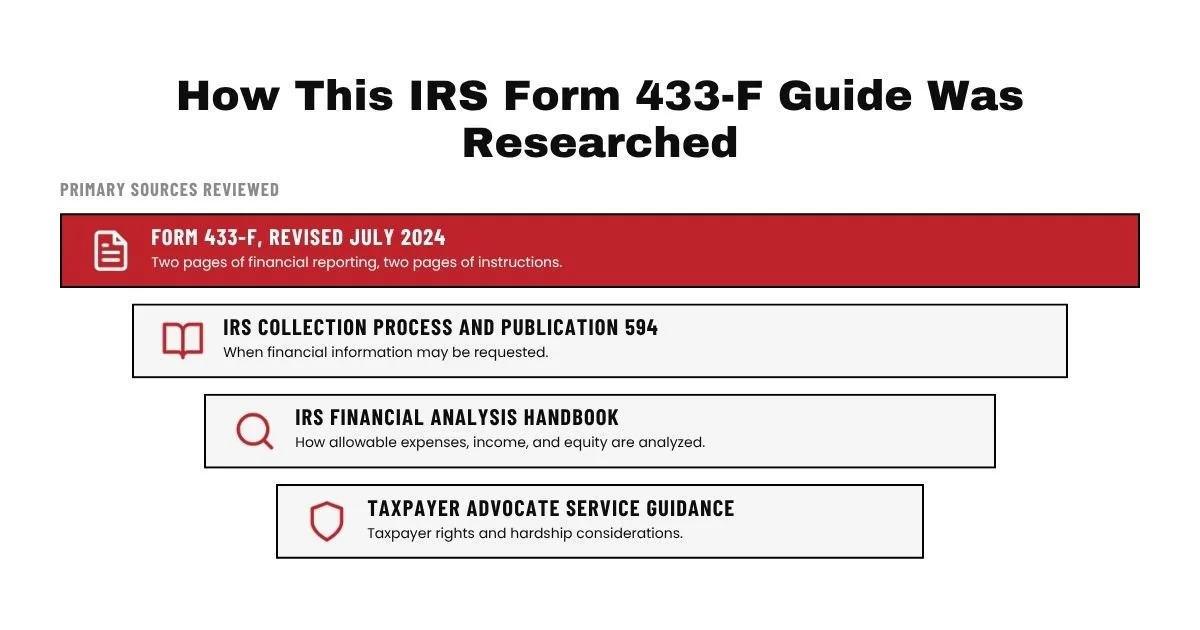
I prepared this guide by reviewing the current Form 433-F and its instructions, the IRS collection process, Publication 594, current IRS payment plan rules, the Collection Financial Standards, Taxpayer Advocate Service guidance, and the IRS Financial Analysis Handbook.
Primary Sources Reviewed
The principal source is Form 433-F, revised July 2024. The form contains two pages for reporting financial information and two pages of instructions.
It identifies the accounts, assets, income, and expense categories that must be reported.
The IRS collection process explains when financial information may be requested and identifies Forms 433-A, 433-B, and 433-F as Collection Information Statements.
The IRS Financial Analysis Handbook explains how collection employees analyze financial information, allowable expenses, income, shared household costs, assets, and equity.
The handbook also explains when Form 433-F may be used by IRS collection functions.
Method Used to Evaluate the Form
I evaluated each section based on four questions:
• What financial fact is the IRS requesting?
• What supporting record may verify that fact?
• How can the information affect ability to pay?
• What errors commonly create an incomplete or misleading financial picture?
This approach keeps the guide focused on the financial analysis rather than treating Form 433-F as a simple data entry exercise.
What Is IRS Form 433-F?
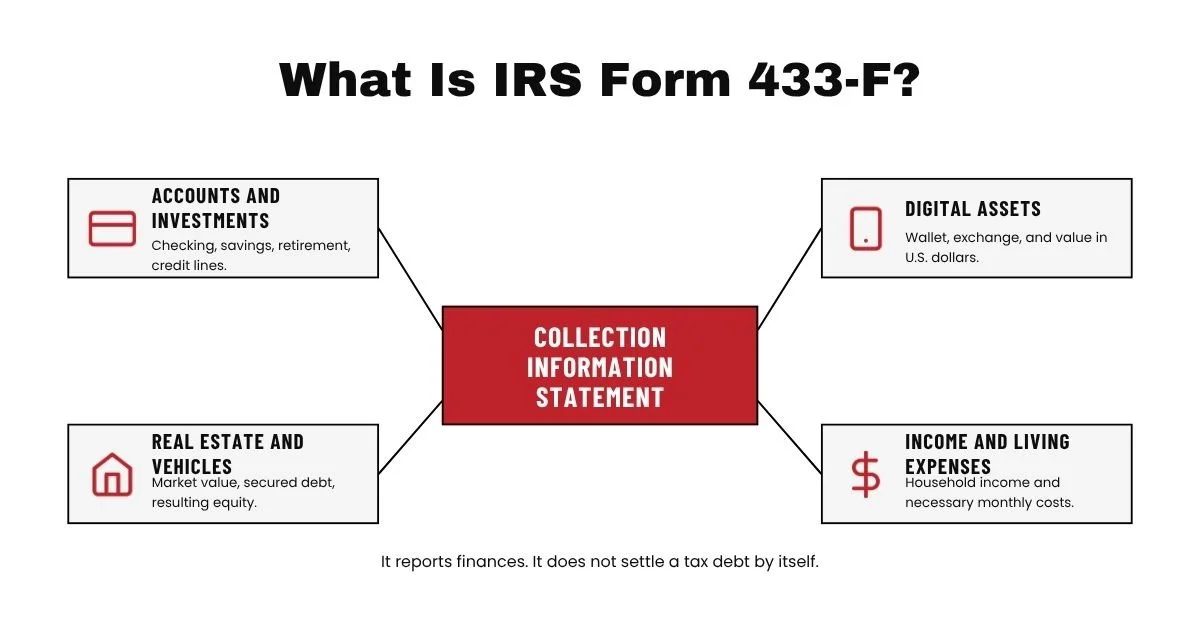
IRS Form 433-F is a Collection Information Statement for individuals. It provides a structured financial disclosure that the IRS can use when evaluating how a taxpayer may satisfy unpaid federal taxes.
The form is sometimes described as an IRS collection form, IRS financial disclosure form, IRS hardship form, or IRS payment plan form.
Those descriptions reflect how taxpayers encounter the form, but its official title is Collection Information Statement.
What Information Does Form 433-F Collect?
The form requests information about:
• Personal and business bank accounts
• Investments and retirement accounts
• Digital assets, including cryptocurrency
• Real estate
• Vehicles and other property
• Credit cards and lines of credit
• Business accounts receivable and merchant accounts
• Employment and household income
• Monthly necessary living expenses
• Household size and spouse information
The taxpayer and spouse sign the form under penalties of perjury, stating that the reported information is true, correct, and complete.
Is Form 433-F a Tax Settlement Application?
No. Form 433-F does not settle a tax debt and does not guarantee acceptance into a payment or hardship program.
It provides financial information that may help the IRS decide whether to request full payment, approve monthly payments, temporarily delay collection, request more records, or consider another collection action.
Is Form 433-F Only for Balances Under $250,000?
There is no general statement printed on Form 433-F saying that every taxpayer who owes less than $250,000 must use it.
The Internal Revenue Manual states that the Automated Collection System and IRS campuses use Form 433-F for individuals.
It also permits revenue officers to use Form 433-F for certain wage earners and self employed taxpayers who have individual tax liabilities with aggregate assessments below $250,000.
The manual does not permit Form 433-F for Offer in Compromise cases.
For that reason, the phrase IRS financial statement form for back taxes under $250,000 describes one possible field collection use. It should not be treated as a universal eligibility rule.
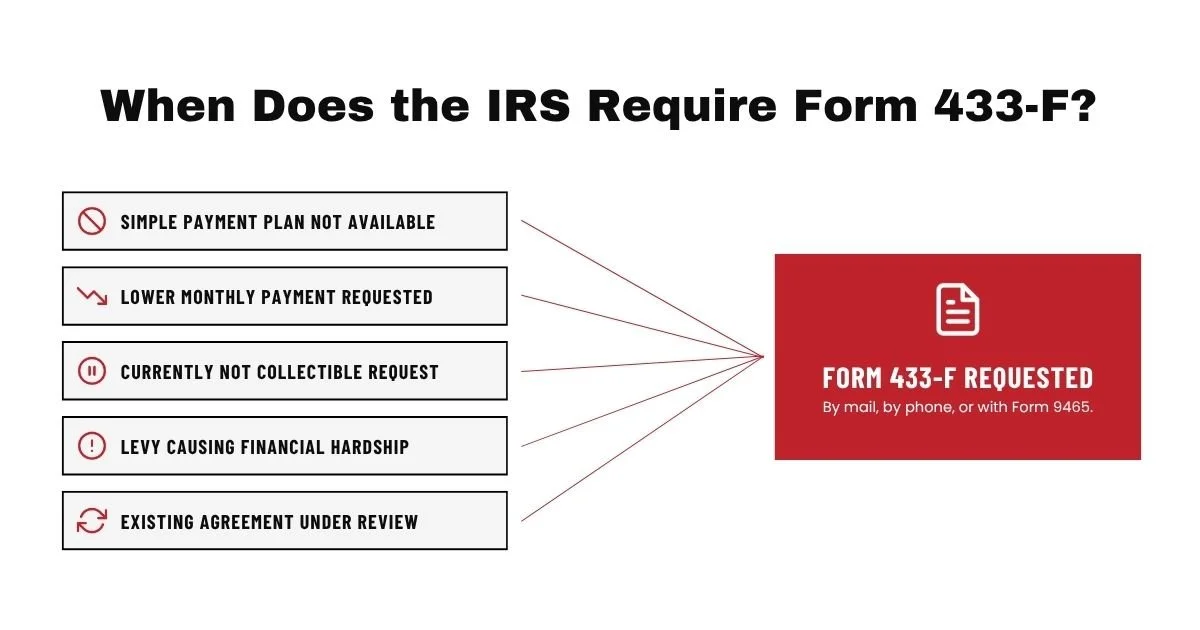
When Does the IRS Require Form 433-F?
The IRS may request Form 433-F when it needs more financial information than a simple payment plan application provides.
You may receive the form by mail, be directed to complete it during a telephone conversation, or be asked to submit it with Form 9465 when requesting an installment agreement.
When a Simple Payment Plan Is Not Available
Many taxpayers can request a payment plan without completing a full financial statement.
An individual may qualify to apply online for a long term payment plan when the combined tax, penalties, and interest are $50,000 or less and all required returns have been filed.
A short term payment plan may be available when the combined balance is less than $100,000.
Those limits do not guarantee approval in every case. The taxpayer must still meet the applicable requirements.
When the taxpayer cannot make the required payment or cannot use the online process, the IRS may direct the taxpayer to provide Form 433-F, Form 433-H, or another Collection Information Statement.
When Requesting a Lower Installment Agreement Payment
The IRS may need Form 433-F when the amount you can afford is lower than the payment required under a simpler installment agreement.
The form lets the IRS review your actual income, necessary expenses, household obligations, and assets before deciding whether a lower monthly payment is appropriate.
When Requesting Currently Not Collectible Status
You may request that active collection be temporarily delayed when paying the IRS would prevent you from covering reasonable basic living expenses.
Before approving Currently Not Collectible status, the IRS may ask for Form 433-F and records verifying your income, expenses, and debts.
Currently Not Collectible status does not eliminate the tax balance.
Penalties and interest may continue. Future refunds may be applied to the debt, and the IRS may file a Notice of Federal Tax Lien.
When a Levy Is Causing Financial Hardship
The IRS may need current financial information when you request a wage levy or bank levy release because the levy is preventing you from paying reasonable basic living expenses.
A wage levy must be released when the IRS determines that it is creating immediate economic hardship.
A bank or other account levy may also be released when immediate economic hardship is established.
The IRS will usually need financial information before making that determination.
A levy release does not erase the underlying tax debt.
When an Existing Agreement Must Be Reviewed
The IRS may request updated financial information if you seek to revise an installment agreement, if an agreement defaults, or if your financial condition has materially changed.
The Financial Analysis Handbook generally expects a Collection Information Statement to contain recent information.
Financial information may need to be updated when it becomes old or when significant changes occur.
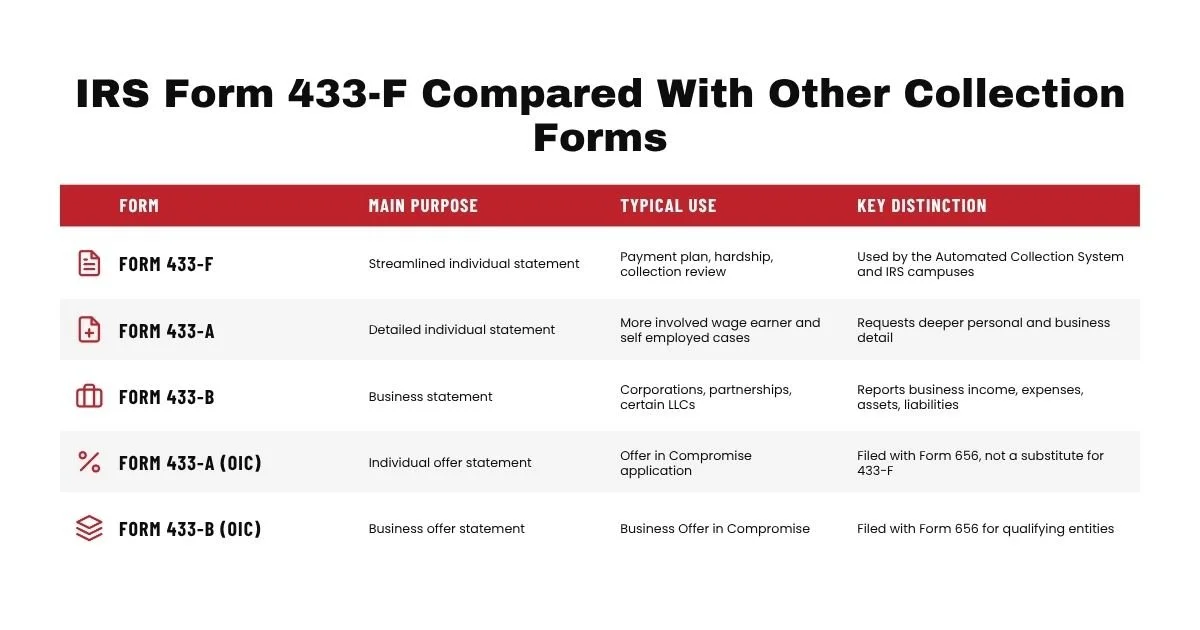
IRS Form 433-F Compared With Other Collection Forms
Several IRS forms use the number 433, but they are not interchangeable.
Using the wrong form can delay the review or leave out information required for the requested tax relief program.
Form Comparison Table
FORM
Form 433-F
MAIN PURPOSE
Streamlined individual Collection Information Statement
TYPICAL USE
Payment plan, hardship, and other collection reviews
IMPORTANT DISTINCTION
Commonly used by the Automated Collection System and IRS campuses for individuals
FORM
Form 433-A
MAIN PURPOSE
Detailed individual Collection Information Statement
TYPICAL USE
More involved wage earner and self employed collection cases
IMPORTANT DISTINCTION
Requests more detailed personal and business information
FORM
Form 433-B
MAIN PURPOSE
Business Collection Information Statement
TYPICAL USE
Corporations, partnerships, and certain limited liability companies
IMPORTANT DISTINCTION
Reports business income, expenses, assets, and liabilities
FORM
Form 433-A (OIC)
MAIN PURPOSE
Individual Offer in Compromise financial statement
TYPICAL USE
Offer in Compromise application
IMPORTANT DISTINCTION
Used with Form 656 and not as a substitute for Form 433-F
FORM
Form 433-B (OIC)
MAIN PURPOSE
Business Offer in Compromise financial statement
TYPICAL USE
Business Offer in Compromise application
IMPORTANT DISTINCTION
Used with Form 656 for qualifying business entities
Difference Between IRS Form 433-A and 433-F
Form 433-F is shorter and is commonly used in individual collection cases handled through IRS telephone and campus operations.
Form 433-A asks for more detailed information about employment, legal matters, assets, transfers, business activity, and household finances.
The current Form 433-A also provides different completion instructions for wage earners and self employed individuals.
The correct form depends on the type of liability, the assigned collection function, the taxpayer’s financial facts, and the relief being requested.
Form 433-F and Offer in Compromise Eligibility
Form 433-F can help you understand whether income and assets may affect a future settlement analysis, but it is not an Offer in Compromise form.
A standard Offer in Compromise application generally requires Form 656 and either Form 433-A (OIC) or Form 433-B (OIC), as applicable.
These forms calculate an offer using specific asset and future income rules that are not contained in Form 433-F.
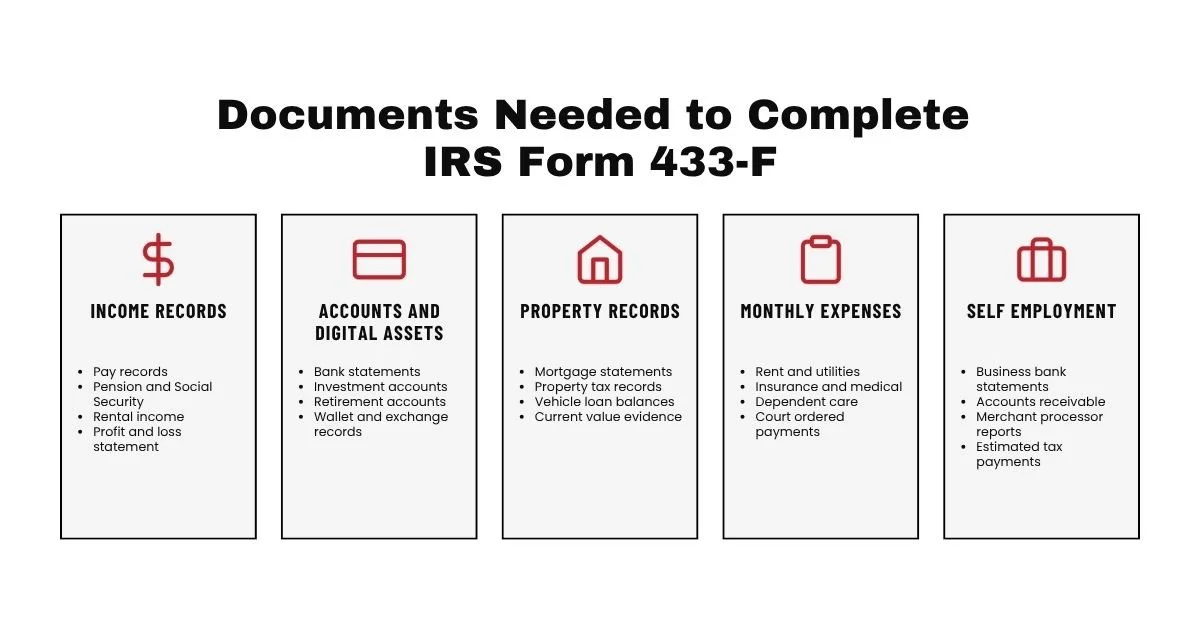
Documents Needed to Complete IRS Form 433-F
Good preparation begins before any figures are entered on the form.
I recommend building a working file that shows the source of each amount.
The IRS may request records supporting income, assets, loan balances, and expenses after reviewing Form 433-F.
Income Records
Gather recent wage statements, pay records, pension statements, Social Security records, unemployment records, rental income records, and documentation of other household income.
Self employed taxpayers should prepare a current profit and loss statement supported by bank deposits, invoices, merchant processor records, and ordinary business expense records.
Bank, Investment, and Digital Asset Records
Gather current statements for checking accounts, savings accounts, online accounts, money market accounts, investment accounts, retirement accounts, and stored value accounts.
Digital asset records should identify the type of asset, wallet or exchange, account information, location, amount owned, and current value in United States dollars.
Real Estate and Vehicle Records
Gather mortgage statements, loan statements, property tax records, insurance records, and reasonable evidence of current market value.
For vehicles and other financed assets, gather the current loan balance, monthly payment, purchase information, and a reasonable estimate of current value.
Monthly Expense Records
Gather records for rent, utilities, transportation, insurance, medical expenses, dependent care, court ordered payments, student loans, state tax agreements, and other necessary expenses.
Keep proof for expenses that are unusual, materially higher than the applicable standard, or required because of a medical, employment, or family circumstance.
Records for Self Employed Taxpayers
Self employed taxpayers may also need accounts receivable reports, merchant processor statements, business bank statements, payroll records, equipment loan statements, and records of current estimated tax payments.
The goal is to reconcile business deposits, gross receipts, ordinary expenses, and the net self employment income reported on Form 433-F.

How to Fill Out IRS Form 433-F Step-by-Step
Complete the form using current records rather than estimates from memory.
When a section does not apply, follow the form instructions and enter the appropriate response instead of leaving unexplained blanks.
Use additional sheets when there is not enough space.
Identify the taxpayer, section, and line connected with each attachment.
Personal and Household Information
Enter your legal name, current address, taxpayer identification information, telephone numbers, county, and household size.
The form asks for the number of people in the household who can be claimed on the current year tax return, including the taxpayer and spouse.
Household size can affect the application of certain IRS expense standards.
If you or your spouse has self-employment income, provide the business name, employer identification number, business type, and number of employees.
Section A, Accounts and Lines of Credit
List personal and business checking accounts, savings accounts, online accounts, mobile payment accounts, and money market accounts.
The instructions state that accounts should be listed even when they currently have no balance.
Bank loans do not belong in this section.
Also list investments such as certificates of deposit, retirement accounts, stocks, bonds, mutual funds, commodities, and other investment interests.
Digital Assets and Cryptocurrency
List digital assets you own or in which you have a financial interest.
Report the type of digital currency or asset, the wallet or exchange, the email connected with the account, where the assets are held, and their current value in United States dollars.
Do not assume that a digital wallet is outside the scope of an IRS financial disclosure.
The current Form 433-F contains a separate digital asset section.
Section B, Real Estate
List your primary residence and all other real estate interests, including rental property, vacation property, vacant land, and timeshares.
Report the monthly payment, financing details, current market value, balance owed, and equity.
Equity generally begins with current market value minus the secured debt reported for the property.
Do not use the original purchase price as the current value unless it remains a reasonable measure of present market value.
Section C, Other Assets
List vehicles, boats, recreational vehicles, whole life insurance policies, valuable collections, equipment, inventory, tools, and other personal or business assets.
The instructions also identify intangible business assets such as domain names, patents, and copyrights.
Report current value, secured debt, and resulting equity.
A monthly loan payment does not replace the requirement to disclose the asset and its value.
Section D, Credit Cards
List credit cards and lines of credit even if no balance is currently owed.
Report the credit limit, balance, and minimum monthly payment.
A credit card payment may appear in your actual household budget, but listing it does not mean the IRS will allow the full payment as a necessary living expense.
Section E, Business Information
Complete this section when you or your spouse is self employed or receives self employment income, including income from online sales.
List accounts receivable owed to you or the business.
The form also asks how much of the receivables is currently available to pay the IRS.
Report merchant accounts and payment processing arrangements, including digital asset wallets or exchanges used by the business.
Section F, Employment Information
Report employer information, pay frequency, gross pay, tax withholding, and length of employment for you and your spouse.
If you attach a current pay record, the form states that you do not need to complete the employment section.
If there is more than one employer, use an additional sheet.
Convert wages to an accurate monthly amount.
Do not assume that two paychecks per month accurately represent biweekly income. Biweekly pay produces twenty six pay periods in a full year.
Section G, Nonwage Household Income
Report monthly alimony received, child support received, net self employment income, net rental income, unemployment income, pension income, interest, dividends, Social Security, and other income.
Net self employment income is generally the amount remaining after ordinary and necessary business expenses.
It should relate to the current profit and loss statement or the applicable tax return schedule.
For rental property, depreciation should not be deducted because it is a noncash expense.
When the rental calculation produces a loss, the Form 433-F instructions direct the taxpayer to enter zero.
Section H, Monthly Necessary Living Expenses
Report expenses as monthly amounts.
The instructions provide conversion methods for bills paid weekly, every two weeks, twice monthly, or quarterly.
Expense categories include:
• Food
• Housekeeping supplies
• Clothing
• Personal care
• Transportation
• Housing
• Utilities
• Medical expenses
• Dependent care
• Current estimated tax payments
• Term life insurance
• Retirement contributions
• Union dues
• Delinquent state taxes
• Qualifying student loans
• Court ordered payments
• Certain other necessary expenses
Report what you actually pay.
The IRS will determine what amount is allowed after applying the applicable rules and Collection Financial Standards.
Signatures and Certification
Review the complete form and attachments before signing.
The taxpayer and spouse certify under penalties of perjury that the statement is true, correct, and complete.
Keep a complete copy of the signed form, every attachment, proof of delivery, and any supporting documents submitted with it.

How the IRS Uses Form 433-F to Calculate Payment Amounts
The IRS does not rely on one figure alone.
It reviews income, allowable living expenses, available cash, asset equity, collection alternatives, and the taxpayer’s ability to pay over time.
A common starting point is monthly household income minus allowable monthly expenses.
The resulting amount may be treated as available monthly income, but the final collection decision can also depend on assets and other case facts.
Actual Expenses Compared With IRS Allowed Expenses
Form 433-F contains separate columns for actual monthly expenses and the amount the IRS allows.
This distinction matters.
A taxpayer may actually spend $1,200 on a listed category while the IRS allows a different amount after applying its standards and necessary expense rules.
National and Local Expense Standards
The IRS uses national standards for food, housekeeping supplies, clothing, personal care, miscellaneous costs, and out of pocket health care.
Local standards apply to housing, utilities, and transportation.
Housing standards depend on location and household size.
Transportation standards account for ownership and operating costs under the applicable rules.
The standards change periodically, so the current official IRS tables should be reviewed when preparing the financial statement.
The Necessary Expense Test
The IRS describes allowable living expenses as costs necessary for the health and welfare of the taxpayer and family, or for the production of income.
An expense may be real without being fully allowed for IRS collection purposes.
Voluntary retirement contributions, unsecured debt payments, private school costs, and other discretionary expenses may receive closer review.
An expense above a standard may still be allowed when documentation shows that it is necessary because of health, family, safety, or employment circumstances.
Household and Shared Expenses
When a spouse or another household member is not liable for the tax debt, the IRS may still review household income and shared expenses to determine the liable taxpayer’s portion of household costs.
This does not automatically make the nonliable person responsible for the tax.
It helps the IRS decide how household resources and shared expenses should be allocated in the financial analysis.
Asset Equity and Available Funds
The IRS also reviews cash, investments, real estate equity, vehicle equity, retirement accounts, digital assets, accounts receivable, and other property.
Collection employees may consider available liquid assets and whether equity can be used to reduce or satisfy the liability before approving certain collection alternatives.
That does not mean every asset must immediately be sold.
The analysis can depend on the asset type, ownership, secured debt, reasonable collection value, income production, and the effect liquidation would have on the taxpayer’s ability to earn income.
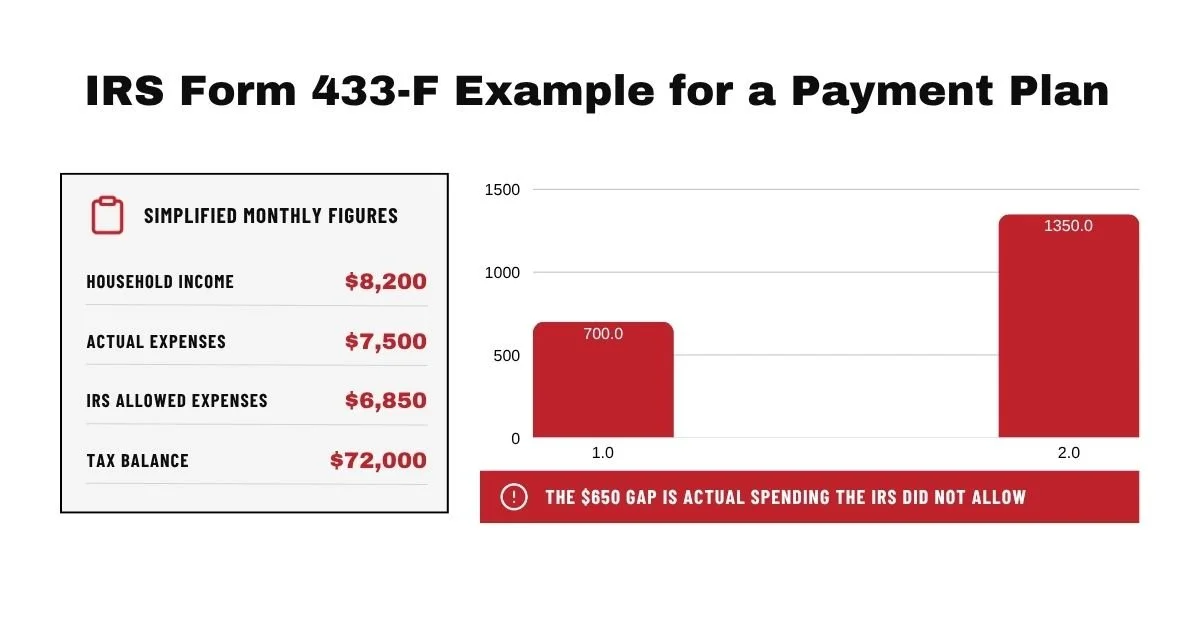
IRS Form 433-F Example for a Payment Plan
Consider a married taxpayer with the following simplified monthly figures:
Total household income: $8,200
Actual household expenses: $7,500
IRS allowed expenses after review: $6,850
Cash in bank accounts: $3,200
Vehicle equity: $1,500
Retirement account value: $18,000
IRS tax balance: $72,000
Based only on monthly cash flow, the IRS calculation could begin with $8,200 of income minus $6,850 of allowed expenses.
That leaves $1,350 in potential monthly ability to pay.
The taxpayer may believe only $700 is available because actual expenses total $7,500.
The difference comes from $650 of actual expenses that the IRS did not initially allow.
How the Result May Change
If the $650 consists of optional spending with no supporting necessity, the IRS may continue to propose a payment near $1,350.
If the amount includes documented medical care, required dependent care, or necessary employment costs, some or all of the disputed expense may be allowed after review.
The IRS may also ask whether funds in the bank or retirement account can be used to reduce the balance.
The taxpayer should evaluate the tax effect, early distribution costs, household needs, and applicable IRS procedures before withdrawing retirement funds.
This example is educational.
A real installment agreement calculation depends on the tax periods, remaining collection time, filing compliance, assets, required current tax payments, and the specific type of agreement being considered.
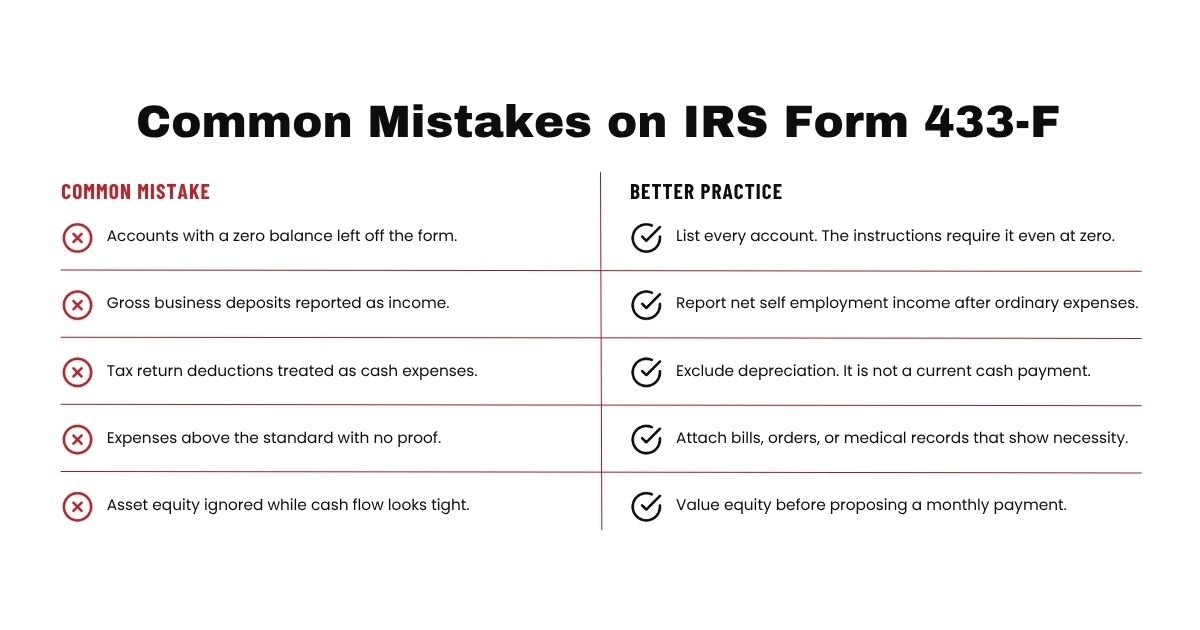
Common Mistakes on IRS Form 433-F
Most Form 433-F problems come from incomplete information, inconsistent calculations, or a lack of supporting records.
Leaving Out Accounts With Small or Zero Balances
The form instructions require accounts to be listed even when the current balance is zero.
Leaving out mobile payment accounts, online accounts, or business accounts can make the financial statement appear incomplete.
Reporting Gross Business Deposits as Personal Income
Gross deposits and net self employment income are different figures.
Business income should be reconciled with ordinary and necessary business expenses.
Personal transfers, loan proceeds, returned payments, and other nonincome deposits may also need an explanation.
Using Tax Return Deductions Without Reviewing Cash Flow
A tax deduction does not always equal a current cash expense for IRS collection purposes.
Depreciation is a clear example.
Form 433-F instructions exclude depreciation when calculating net rental income because depreciation does not represent a current cash payment.
Claiming Expenses Without Documentation
Expenses above the applicable standard may require proof and an explanation showing why the amount is necessary.
A large figure with no bill, statement, contract, medical record, court order, or payment history may be reduced or rejected during the review.
Forgetting Current Tax Obligations
A payment arrangement should account for current withholding or estimated taxes.
A plan that leaves no room for current taxes may lead to a new balance and possible default.
Ignoring Asset Equity
A taxpayer can have little monthly cash flow and still own an asset with significant equity.
Failing to evaluate that equity before submitting the form can lead to an unexpected request for borrowing, liquidation, or a partial payment.
Using Old Financial Information
Income, balances, loan amounts, and expenses can change quickly.
Use current records and update the form when a material change occurs before the IRS makes its decision.
Signing Before Reconciling the Form
Compare the completed form with pay records, bank deposits, loan statements, tax returns, and the profit and loss statement before signing.
Figures that conflict with each other can prompt additional questions and delay the requested relief.
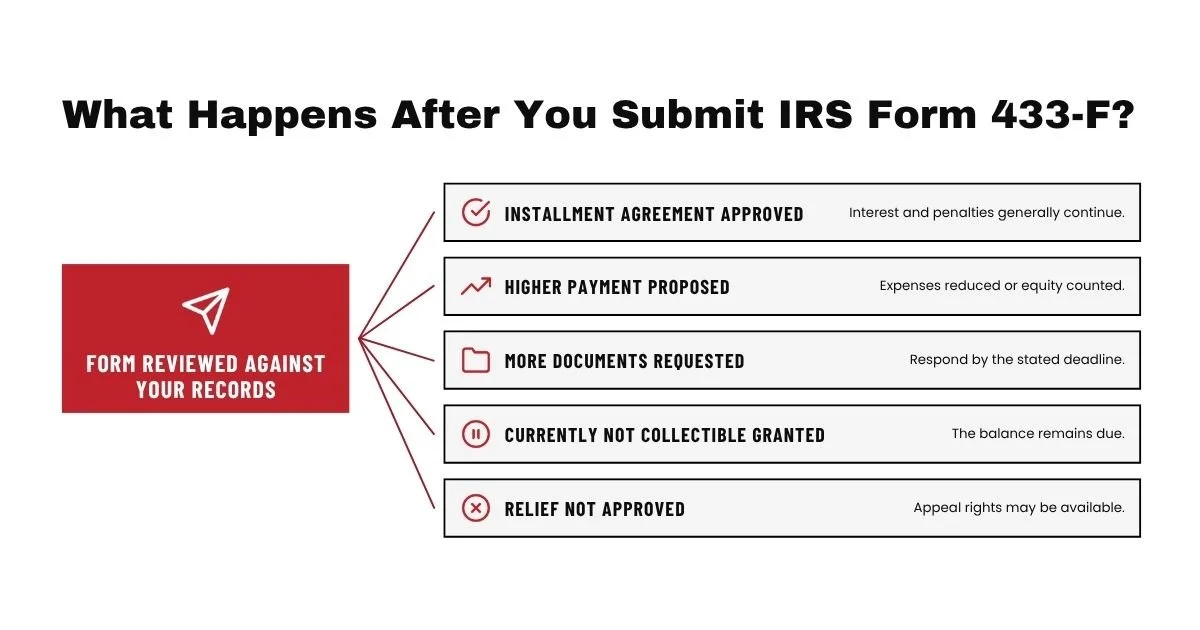
What Happens After You Submit IRS Form 433-F?
The IRS reviews the form and may compare it with supporting documents, filed returns, internal account information, and other available financial data.
The IRS may request additional proof of income, expenses, assets, or debts after completing its initial review.
The IRS Approves an Installment Agreement
The IRS may approve a monthly payment based on the collection option and its analysis of your ability to pay.
Interest and applicable penalties generally continue until the balance is paid.
A Notice of Federal Tax Lien may still be filed in some cases.
The IRS Proposes a Higher Payment
The reviewing employee may reduce certain expenses, include omitted household income, question business deductions, or determine that asset equity should be considered.
You may provide additional records or explain why a disputed expense is necessary.
Keep the discussion focused on verifiable financial facts.
The IRS Requests More Documents
The IRS may ask for updated bank statements, pay records, loan statements, property values, medical records, business records, or proof of recurring expenses.
Respond by the stated deadline and retain proof of what was submitted.
The IRS Grants Currently Not Collectible Status
When the IRS determines that payment would prevent you from meeting basic living expenses, it may temporarily delay active collection.
The debt remains due.
Interest and penalties may continue, future refunds may be applied to the balance, and the IRS may later review whether your ability to pay has improved.
The IRS Does Not Approve the Requested Relief
The IRS may continue collection when it determines that the taxpayer has an ability to pay, has not provided required records, or has not met the conditions for the requested alternative.
Depending on the decision and procedural stage, administrative appeal rights may be available.
Review the written notice and protect every stated deadline.
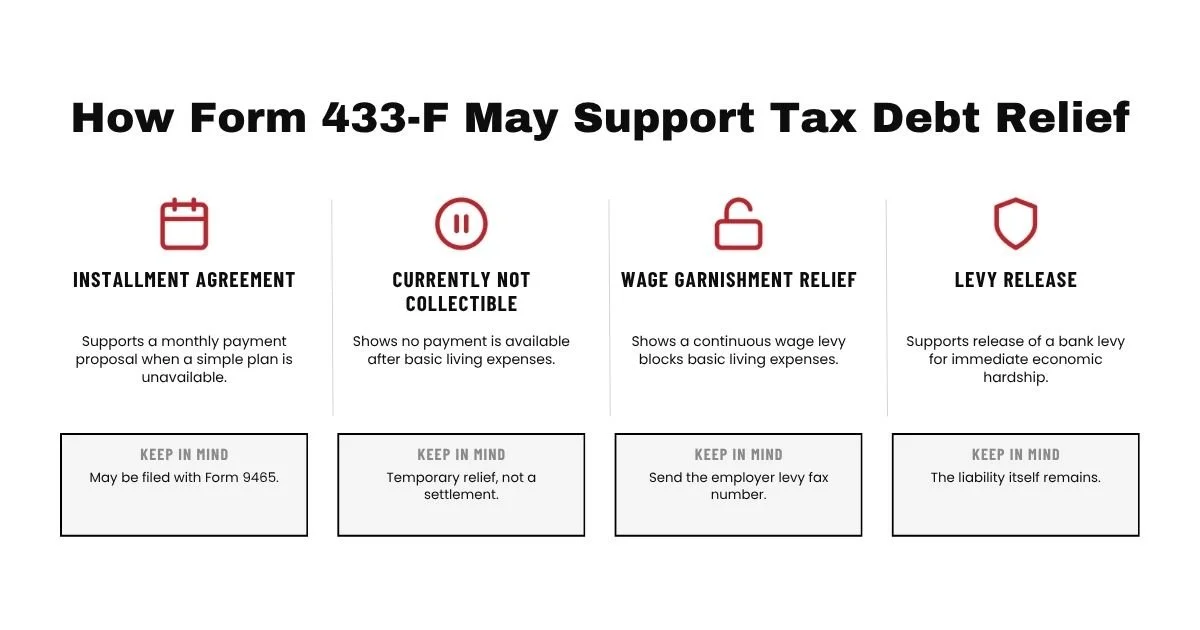
How Form 433-F May Support Tax Debt Relief
Form 433-F can support several IRS collection alternatives, but the financial statement must match the relief being requested.
H3: IRS Form 433-F for an Installment Agreement
Form 433-F may support a monthly payment proposal when a simple payment plan is unavailable or unaffordable.
The form instructions state that a taxpayer requesting an installment agreement may submit Form 9465 with Form 433-F.
Current IRS payment plan instructions should still be checked because the required process depends on the account and request.
IRS Form 433-F for Currently Not Collectible Status
The form may show that no monthly payment is available after reasonable basic living expenses.
Currently Not Collectible status is temporary collection relief.
It is not a settlement, discharge, or cancellation of the tax debt.
IRS Form 433-F for Wage Garnishment Relief
A current financial statement can help show that a continuous wage levy prevents the taxpayer from meeting reasonable basic living expenses.
Contact the IRS immediately when a levy creates hardship.
Provide the employer’s levy processing fax information when available so a release can be transmitted promptly if approved.
IRS Form 433-F for Tax Levy Release
A financial statement may also support the release of a bank or other levy based on immediate economic hardship.
A release addresses the levy, not the underlying liability.
A payment arrangement or another collection resolution will still be needed.
Can I Negotiate With the IRS Using Form 433-F?
Yes, but the negotiation must be based on accurate figures, applicable standards, supporting documents, and the rules for the requested collection alternative.
The most productive disagreements usually concern the correct income amount, whether an expense is necessary, the value or equity of an asset, or whether a proposed payment is sustainable.
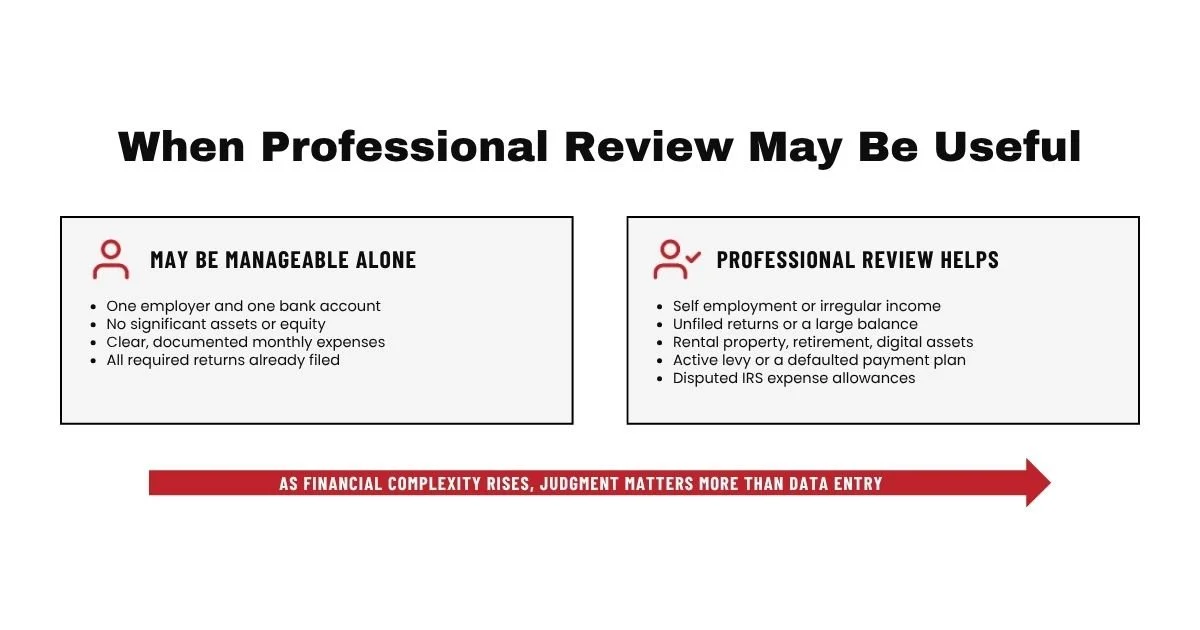
H2: When Professional Review May Be Useful
A straightforward wage earner with one bank account, no significant assets, and clear monthly expenses may be able to complete Form 433-F without representation.
Professional review becomes more useful when the financial statement requires judgment rather than simple data entry.
Financial Situations That May Need Closer Review
Consider obtaining professional advice when the case involves:
• Self employment or irregular income
• Several years of unfiled returns
• Rental property or substantial real estate equity
• Retirement accounts or digital assets
• Business receivables and merchant accounts
• A wage levy or bank levy
• A defaulted payment plan
• A large tax balance
• A spouse who does not owe the tax
• A possible Offer in Compromise
• Disputed IRS expense allowances
Who Can Help Fill Out IRS Form 433-F?
An Enrolled Agent, attorney, or Certified Public Accountant authorized to practice before the IRS may represent a taxpayer when qualified and properly authorized.
Look for a professional who regularly handles IRS collection cases and understands financial analysis, installment agreements, hardship determinations, levies, liens, and collection appeal procedures.
The purpose of professional review should be to identify accurate figures, explain the available options, and prevent an unsustainable proposal.
It should not be used to hide assets, omit income, or inflate expenses.
Frequently Asked Questions About IRS Form 433-F
-
No. Many taxpayers qualify for payment plans without providing a complete financial statement.
Current online criteria generally permit qualifying individuals to request a long term plan when they owe $50,000 or less in combined tax, penalties, and interest and have filed all required returns.
A short term plan may be available for qualifying balances below $100,000.
The IRS may request Form 433-F when you cannot make the required payment, do not qualify for the simpler process, or request a payment based on your actual financial ability.
-
The IRS may request spouse and household income information even when only one spouse owes the tax.
This does not automatically make the nonliable spouse responsible for the debt.
Household information may be used to determine how shared expenses should be allocated and what portion of household costs belongs to the liable taxpayer.
Community property laws, separate expenses, ownership, and the source of income may also affect the analysis.
-
Listing a retirement account does not automatically mean the IRS will seize it or require immediate liquidation.
The account is an asset that may be considered in the financial analysis.
The IRS may examine the account value, access restrictions, taxes, penalties, the taxpayer’s age, necessary living needs, and the effect on future income.
Do not withdraw retirement funds solely because the account appears on Form 433-F.
Review the tax cost and collection consequences before taking action.
-
Report the amount you actually pay.
Then gather documentation showing why the higher expense is necessary.
An expense above a standard may receive consideration when it is required for health, welfare, or the production of income.
Examples can include necessary medical care, required dependent care, employment transportation, safety related housing needs, or another documented circumstance.
The IRS may still limit the expense if the evidence does not establish that the higher amount is necessary.
-
Submitting the form alone does not automatically release a levy.
Contact the IRS immediately, explain the hardship, provide the requested financial information, and give the IRS the employer’s levy processing fax number when possible.
If the IRS determines that the wage levy prevents you from meeting reasonable basic living expenses, the levy must be released.
The tax balance will remain and another resolution will still be required.
-
Use the most current information reasonably available.
The Internal Revenue Manual states that a Collection Information Statement submitted by a taxpayer should generally contain information no older than the prior six months.
Updates may be needed if the information becomes older or if significant financial changes occur.
Bank balances, wages, loan balances, business income, and medical costs can change quickly, so confirm all figures before submitting the form.
-
No. Form 433-F is not the required financial statement for a standard Offer in Compromise based on collectibility or economic hardship.
An individual generally uses Form 433-A (OIC), and a qualifying business entity generally uses Form 433-B (OIC), together with Form 656 and the required documents.
Form 433-F may still reveal issues that affect whether an offer deserves further analysis, such as disposable income or substantial asset equity.
-
Correct the error promptly.
Contact the IRS employee or department handling the case and provide the corrected page, explanation, and supporting record.
Keep a copy of the original submission and the correction.
Identify exactly what changed and why.
A prompt, documented correction is generally better than waiting for the IRS to discover an inconsistency during its review.
Final Review Before Submitting Form 433-F
Before signing, compare the form with the records that support it.
Confirm that every account, asset, income source, and required household expense has been addressed.
Reconcile employment income with pay records.
Reconcile self employment income with the current profit and loss statement and bank activity.
Confirm that property values and loan balances are current.
Review the requested tax relief before deciding what payment to propose.
An installment agreement, hardship request, levy release, and Offer in Compromise use different standards and procedures.
Form 433-F should present an accurate financial picture.
It should not promise more than the taxpayer can maintain, and it should not omit information that the IRS is entitled to review.
Keep the signed form, attachments, supporting documents, proof of submission, and every IRS response together.
The financial statement may become the foundation for the next IRS collection decision.
Clarity first, then the numbers.