How to Resolve IRS Tax Debt for Your Small Business
If you are asking, “How do I resolve IRS tax debt for my small business?” the first thing to know is this: you may have options, but timing matters.
Maybe you opened an IRS envelope and found a CP503 or CP504 notice. Your first instinct may be to set it aside, deal with it later, or hope the problem works itself out.
It will not.
For small business owners already managing payroll, vendors, employees, customers, and cash flow, an IRS notice adds a level of pressure most people were never trained to handle. The balance may grow. The notices may become more serious. And if the issue is ignored long enough, the IRS may move toward enforced collection.
The good news is that the IRS has structured resolution programs for business tax debt. Depending on your situation, you may be able to request a payment plan, penalty relief, hardship consideration, or another business tax resolution option.
The IRS generally wants a realistic path to collection. That is why these options exist. But what usually makes the problem worse is waiting too long, missing response deadlines, ignoring payroll tax issues, or assuming the balance will somehow shrink on its own.
This article explains the main resolution paths available to small businesses, the basic eligibility rules, the forms commonly required, and when professional help becomes especially important.
At Semper Tax Relief, we often see the same pattern: IRS debt and disorganized bookkeeping rarely travel alone. To truly resolve the tax problem, the business usually needs both a tax resolution plan and a clear picture of the books. Fixing one without addressing the other can cause the same problem to come back later.
If your company owes back taxes, review our Business Tax Debt Resolution page to understand how business IRS balances, payment plans, levies, and compliance issues are handled.

TLDR;
Small business IRS tax debt should be addressed before the IRS escalates to liens, levies, or account freezes.
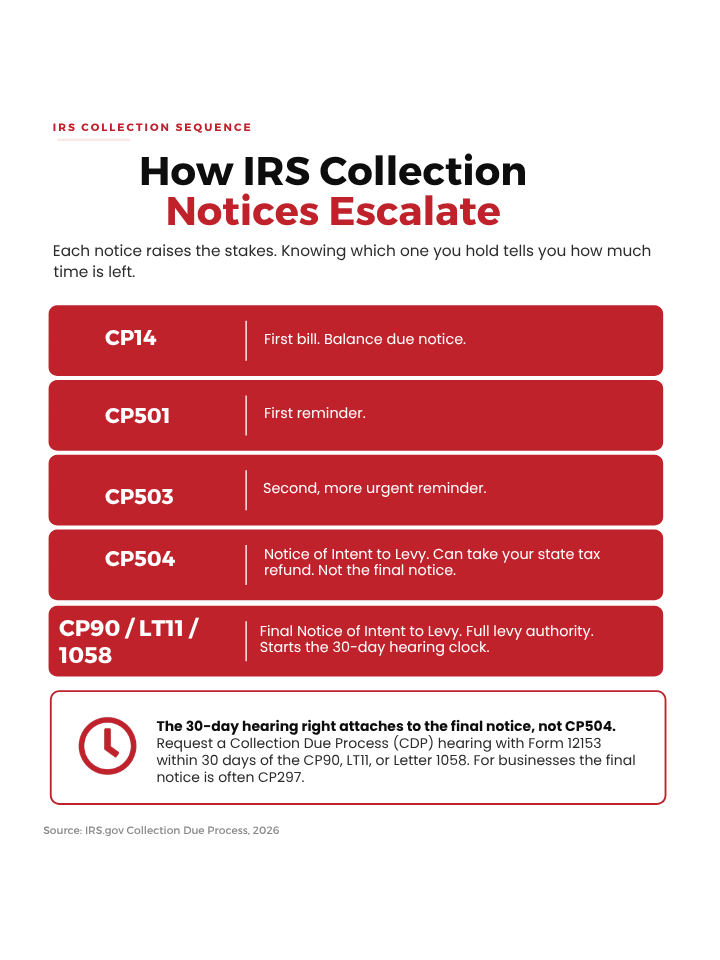
IRS notices like CP503 and CP504 are warning signs that collection action may be moving closer.
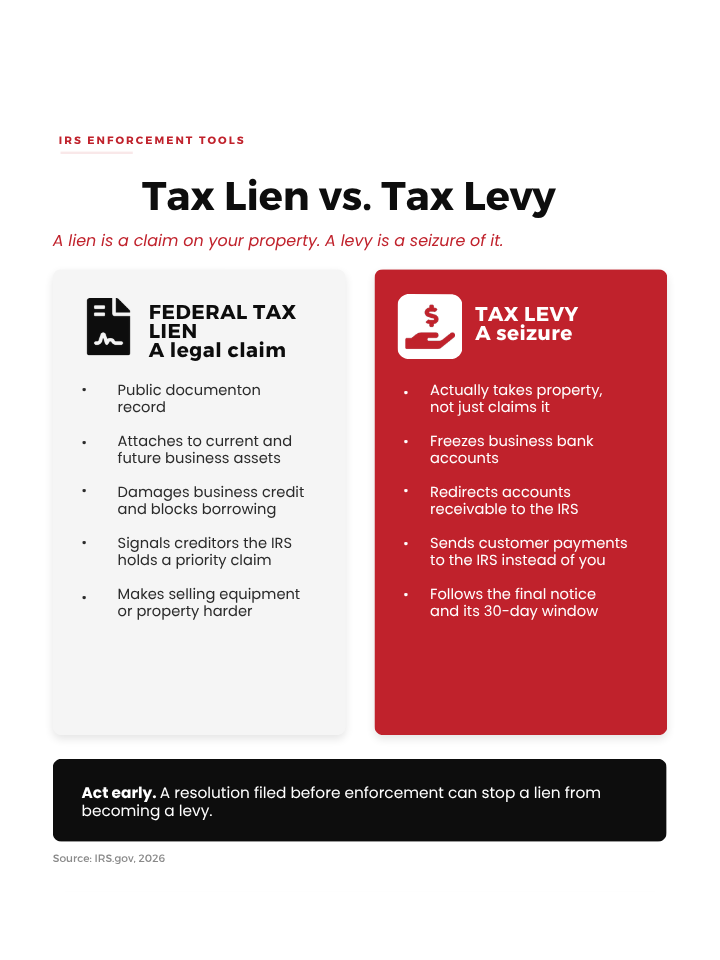
A federal tax lien can hurt business credit and attach to current and future business assets.
An IRS levy can freeze business bank accounts, seize receivables, or interrupt cash flow.
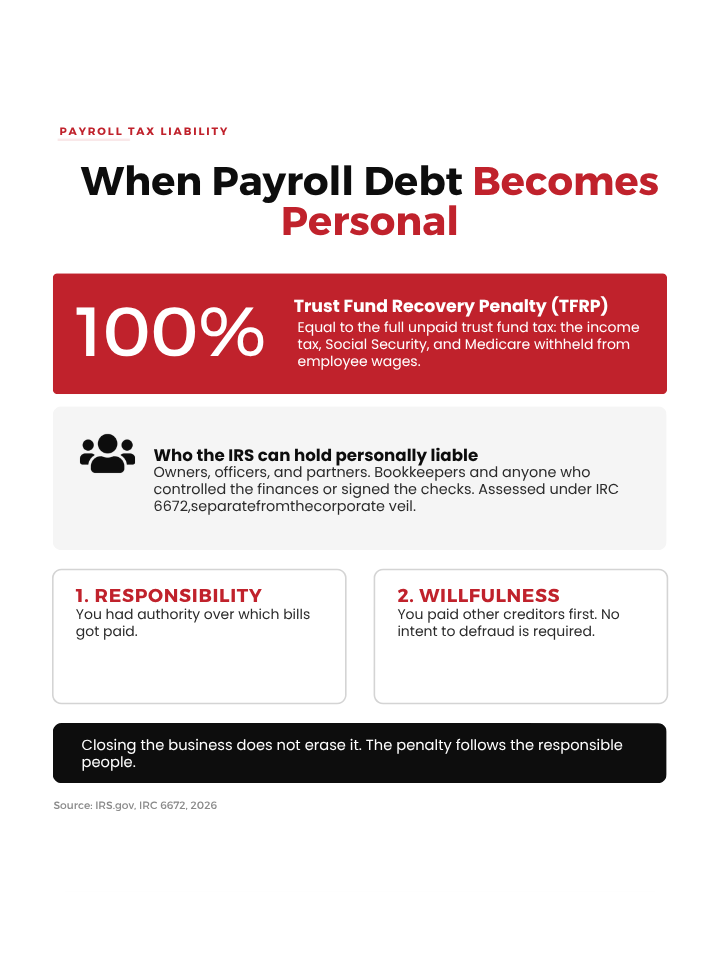
Payroll tax debt is especially serious because the IRS may assess the Trust Fund Recovery Penalty against owners or responsible persons personally.
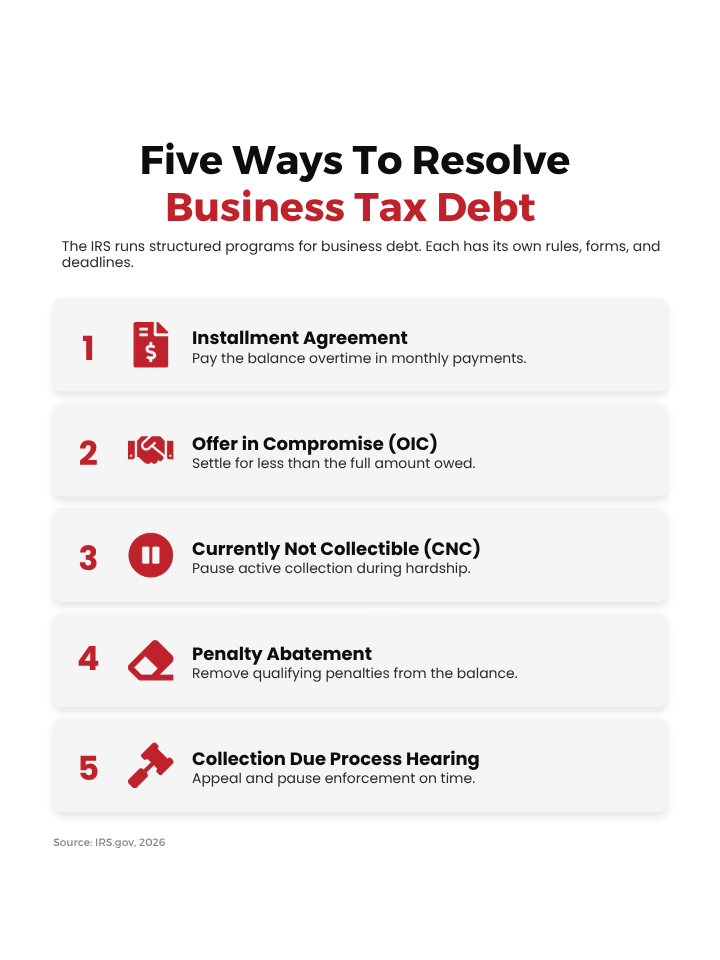
Common business tax debt resolution options include installment agreements, Offer in Compromise, Currently Not Collectible status, and penalty abatement.
A business must usually be current on required tax filings and payroll deposits before the IRS will approve relief.
Form 433-B is often required when the IRS needs a full review of business finances.
An Offer in Compromise may work when the business cannot realistically pay the full balance.
A payment plan may work when the business can afford structured monthly payments.
Bookkeeping cleanup may be necessary when disorganized records caused missed filings, payroll tax problems, or recurring IRS debt.
Professional help is important when there are payroll taxes, active levies, unfiled returns, large balances, or possible personal liability.
What the IRS Can Do to Your Business When Tax Debt Is Ignored
Federal Tax Liens and Your Business Credit
Once the IRS assesses a tax debt and you ignore their demand for payment, they file a Notice of Federal Tax Lien. This is a public document that attaches to all current and future business assets. It damages your business credit, blocks borrowing, and signals every creditor that the IRS holds a priority claim over your property. Selling equipment or real estate becomes significantly more complicated once a lien is on Record.
Bank Levies, Account Freezes, and Seized Receivables
A levy is more aggressive than a lien. Rather than establishing a claim, it actually seizes property. The IRS can freeze your business bank accounts, redirect accounts receivable to the government, and instruct payment processors to send customer payments to the IRS instead of you. The CP504 is the last formal warning before levy action begins. You have 30 days from that notice to request a Collection Due Process
(CDP) hearing, the last real window to pause enforcement before funds are taken. See the IRS guidance on enforced collection actions for details on levy and lien procedures and timing.
If a bank, merchant processor, or receivables source has already received an IRS Notice of Levy, the business needs to act quickly before funds are transferred.
The Trust Fund Recovery Penalty: When Business Debt Becomes Personal
If your business has employees, unpaid payroll taxes carry a consequence most owners don't anticipate:
personal liability. Through the Trust Fund Recovery Penalty (TFRP), the IRS can hold owners, officers, bookkeepers, and anyone who controlled business finances personally responsible for the employee portion of unpaid payroll taxes. The TFRP is a 100% penalty assessed against individuals under a separate statutory mechanism, it imposes direct personal liability on responsible persons without relying on a corporate veil-piercing doctrine. The business closing doesn't erase it.
How Do I Resolve IRS Tax Debt for My Small Business, Resolution Options
Installment Agreements: Paying Over Time
Under the IRS's streamlined Business Simple Agreement framework, businesses with trust fund tax balances up to $25,000 (active businesses) or non-trust fund balances up to $50,000 can set up a simplified payment plan without submitting a detailed financial statement. Payments run until the Collection Statute Expiration Date (CSED), and no direct debit is required at those thresholds under standard terms. Penalties and interest keep accruing throughout the life of the agreement, and missing a payment voids it. For balances above $50,000, the IRS requires Form 433-B and a full review of business finances before approving a regular installment agreement for businesses. The IRS has recently expanded
outreach and options for businesses regarding these simplified plans, see commentary on the simple installment agreement options for more background. If the business can afford monthly payments, IRS payment plans may allow the balance to be resolved without a full settlement request.
Offer in Compromise: Settling the Debt for Less Than You Owe
An Offer in Compromise (OIC) lets a business settle its IRS debt for less than the full amount owed when the IRS determines that full collection is realistically impossible. The IRS calculates your Reasonable Collection Potential (RCP) on Form 433-B by adding equity in business assets to a multiplier of your net monthly income, either 12 or 24 months, a figure the IRS determines during its review based on how the offer is structured. Your offer must equal or exceed that figure. Collection is paused while the offer is under review, but a lump-sum cash offer generally requires an initial payment of 20% of the offered amount at the time of submission, per IRS Form 656 instructions. This is a legitimate path to significant IRS tax debt relief, not a guaranteed outcome.
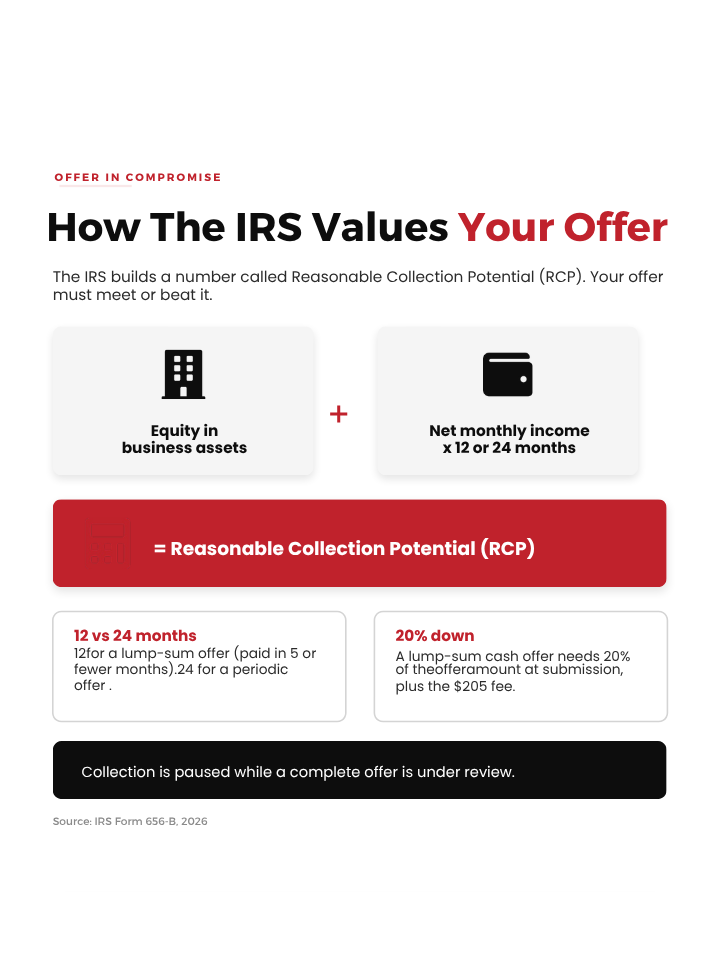
If the business cannot realistically pay the full balance, an IRS Offer in Compromise may be reviewed as a settlement option.
Currently Not Collectible Status and Penalty Abatement
Currently Not Collectible (CNC) status pauses all active IRS collection when paying the debt would
prevent the business from covering essential operating expenses. The debt doesn't disappear, and
penalties and interest keep running, but levies and seizures stop. Importantly, the 10-year collection
statute keeps running during CNC periods, which can work in your favor if it expires before your financial
situation improves. Separately, First-Time Penalty Abatement (FTA) removes failure-to-file, failure-to-pay,
or failure-to-deposit penalties if your business maintained a clean compliance record for the three years
prior to the penalty year. As of 2026, FTA is applied automatically for qualifying penalties on tax years
starting in 2025 and later.
If paying the IRS would prevent the business from covering necessary operating expenses, IRS Currently Not Collectible status may temporarily pause collection.
If penalties make the balance harder to resolve, IRS penalty forgiveness may be reviewed through first-time abatement or reasonable cause relief.
How to Qualify for an Offer in Compromise as a Business Owner
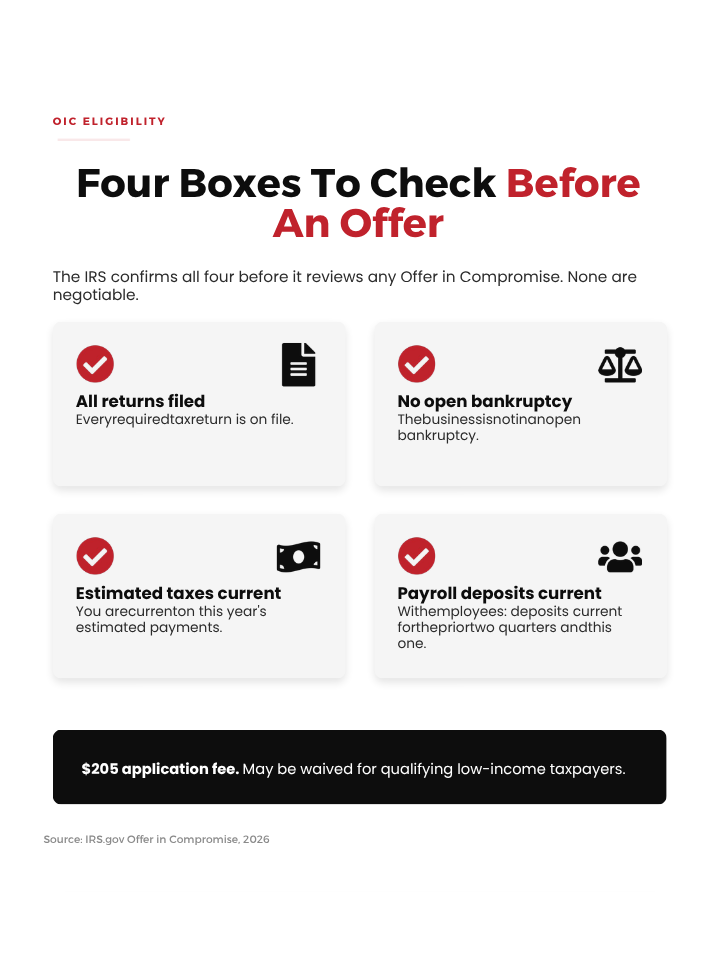
The Eligibility Criteria the IRS Actually Checks
Before the IRS reviews any OIC, four requirements must be met: all required tax returns must be filed; the business cannot be in open bankruptcy; you must be current on estimated tax payments for this year; and if you have employees, federal payroll deposits must be current for the prior two quarters and the current one. None of these are negotiable. The $205 application fee may be waived for qualifying low-income Taxpayers.
The Forms and Documentation You Need to Submit
The application requires Form 656 (the main OIC form) and Form 433-B (OIC), which is the business financial statement used to calculate your RCP. If you carry both business and personal tax debt, two separate Form 656s are required. Supporting documentation must cover business assets, bank statements, income verification, and proof of payroll compliance. You also submit a written statement specifying the basis for your offer: doubt as to collectability, doubt as to liability, or effective tax administration. Incomplete submissions are rejected, so accuracy matters as much as the offer amount itself. For step-by-step help with Form 433-B, see guidance on how to fill out IRS Form 433-B.
Before filing a business OIC, use the IRS Offer in Compromise Calculator to estimate how income, expenses, and asset equity may affect the offer amount.
Setting Up a Business Installment Agreement with the IRS
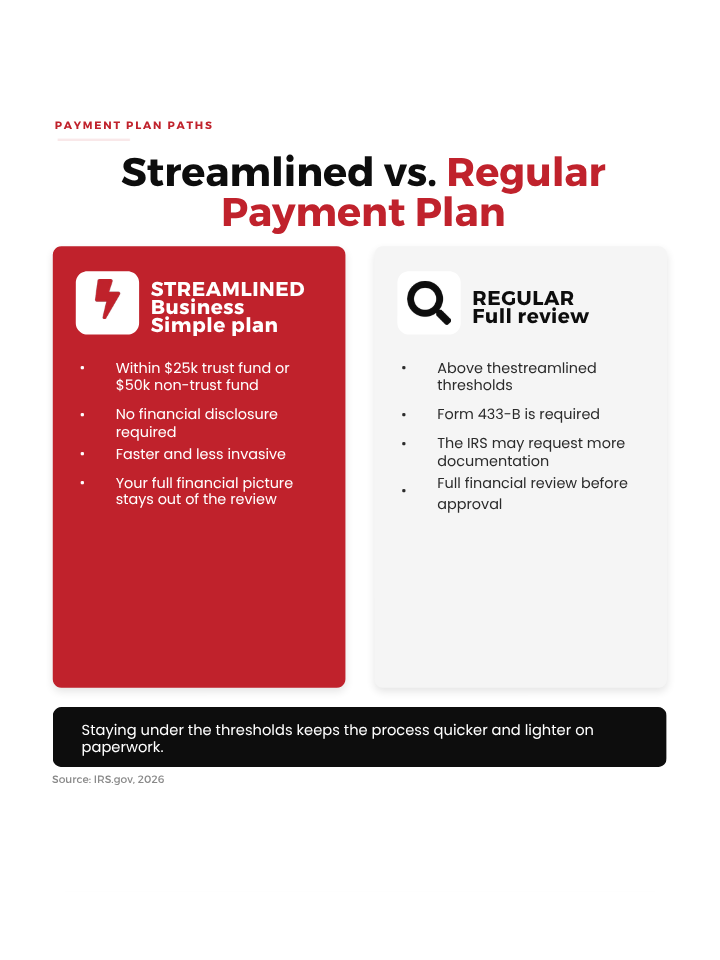
Streamlined vs. Regular Agreement: Which Path Applies
Businesses within the $25,000 (trust fund) or $50,000 (non-trust fund) thresholds qualify for the simplified Business Simple Agreement with no financial disclosure required. Above those thresholds, the IRS requires Form 433-B and may request additional documentation before approving a regular installment plan. The streamlined path is faster, less invasive, and keeps your full financial picture out of the review process.
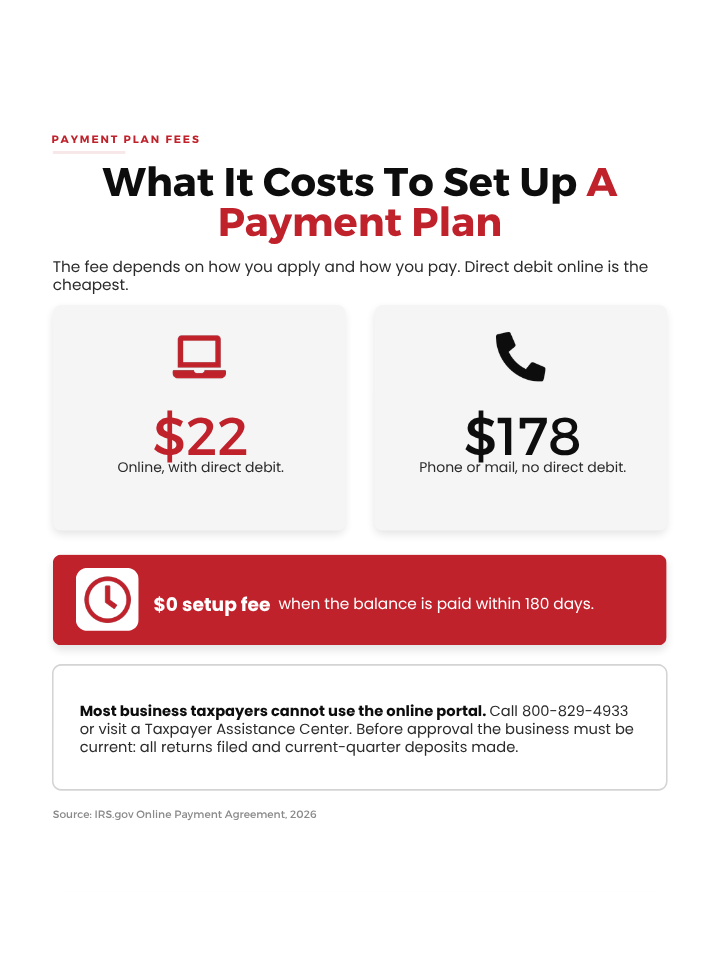
The Application Process, Fees, and What to Watch For
Most business taxpayers cannot use the IRS's online payment agreement portal and must call 800-829-4933 or visit a Taxpayer Assistance Center. Setup fees range from $22 (online, direct debit) to $178 (phone or mail, non-direct debit). There is no setup fee for balances paid within 180 days. Before the IRS approves any plan, your business must be current: all returns filed, all current-quarter deposits made. Applying before reaching compliance typically results in denial.
Payroll Tax Debt and Personal Liability: The Risk Most Owners Underestimate
The "trust fund" portion of payroll taxes is money your business collects from employee wages on behalf of the federal government. If those funds aren't remitted to the IRS, the TFRP can be assessed against any responsible person: owners, partners, officers, and anyone with authority over business finances, including bookkeepers who signed checks. Willfulness doesn't require intent to defraud. If you knew taxes were unpaid and continued paying other creditors, the IRS considers that willful. Business tax lien and levy relief becomes far more complicated once personal TFRP liability enters the picture.
Resolving Payroll Tax Debt While Keeping the Business Current
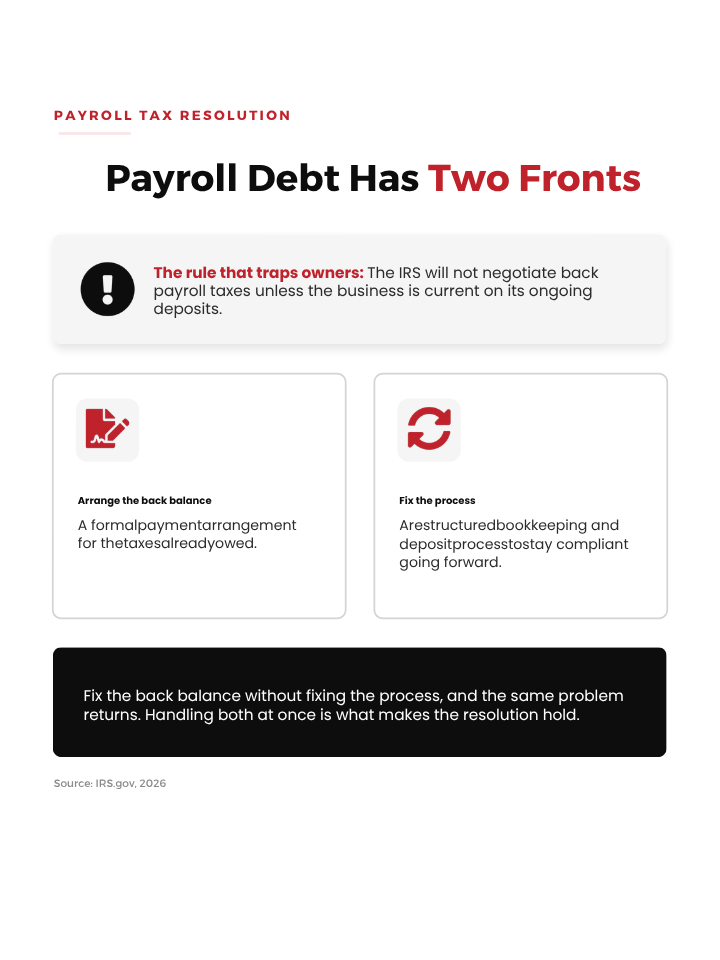
The IRS will not negotiate on back taxes for small businesses with outstanding payroll obligations unless the business is current on its ongoing deposits. This creates a dual requirement: a formal payment arrangement for the back balance, and a restructured financial process to stay compliant going forward. Resolving the back balance without fixing the underlying process creates a significant risk of the same problem recurring. A firm that handles both IRS resolution and business bookkeeping addresses both sides of the problem at once, rather than patching one while leaving the other open.
When to Bring in a Tax Professional and What to Look For Red Flags That Your Situation Is Beyond DIY
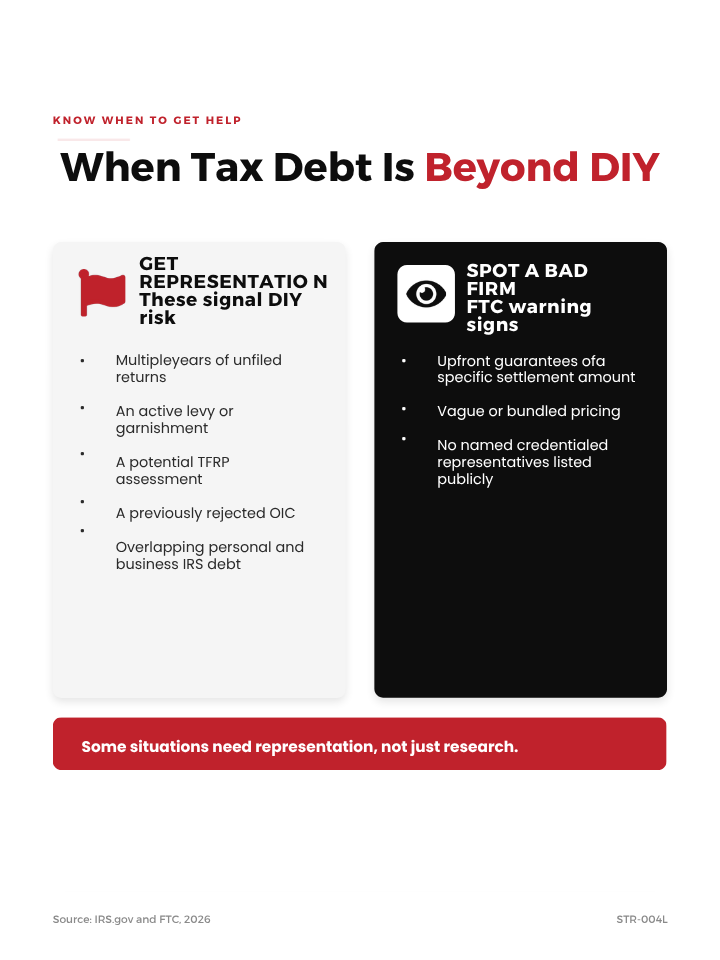
Some situations require professional representation, not just research. If you have multiple years of unfiled returns, an active levy or garnishment, a potential TFRP assessment, a previously rejected OIC, or overlapping personal and business IRS debt, attempting to resolve the matter alone significantly increases the risk of making it worse. Also watch for these warning signs in tax relief firms, upfront guarantees of a specific settlement amount, vague or bundled pricing, and no named credentialed representatives listed publicly. Consumer protection authorities, including the FTC, advise taxpayers to treat these as potential indicators of a predatory operation.
IRS Form 2848 Power of Attorney allows a qualified representative to communicate directly with IRS collections for the business.
What Semper Tax Relief Brings to the Table
Semper Tax Relief is built specifically for situations like the ones described in this article. The firm combines Juris Doctorate credentials with IRS Enrolled Agent status, giving business clients both legal expertise and IRS practice authority under one roof, not two separate engagements. The starting point is a free case review, where your situation is evaluated before any fees are discussed. The firm's bookkeeping services directly address the root cause of recurring tax debt: financial disorganization. For business owners who need both a resolution and a prevention strategy, that combination in one firm is rare.
If disorganized books caused missed filings or unpaid payroll taxes, Catch-Up Bookkeeping Services can help rebuild the records needed for tax compliance.
How to Resolve IRS Tax Debt for Your Small Business FAQs
-
The IRS does not usually “close” a business in one step, but collection action can make it difficult for the business to keep operating. A bank levy, receivables levy, tax lien, or payroll tax enforcement action can interrupt cash flow, block financing, and create pressure that threatens daily operations. The sooner the business addresses the debt, the more options it usually has.
-
Possibly, but an IRS tax lien can complicate the sale. A federal tax lien attaches to business property and may need to be paid, released, discharged, or subordinated before a buyer, lender, or escrow company will move forward. Before selling business assets, the lien issue should be reviewed so the transaction does not stall.
-
If the proposed IRS payment is too high, the business may need to provide financial documentation showing income, expenses, assets, liabilities, and cash flow. The IRS may review Form 433-B or other financial information to determine whether a lower payment, hardship status, or another resolution option is appropriate.
-
It depends on the type of tax debt and whether personal liability has been assessed. Payroll tax debt is the biggest concern because the IRS may assess the Trust Fund Recovery Penalty against responsible persons. Once that personal assessment is made, the IRS can pursue the individual separately from the business.
-
Only if the business can stay current on new payroll tax deposits going forward. The IRS is much less likely to approve a resolution if new payroll taxes continue to accrue. A business with payroll tax debt needs a plan for both the old balance and current compliance, because fixing one without the other usually causes the problem to repeat.
The Path Forward Starts with One Concrete Step
You started this article staring at a notice. You should finish it with a clearer picture of what your options actually are. The IRS has structured programs for business tax debt: payment plans, settlements, collection pauses, and penalty relief. Each comes with specific eligibility rules, forms, and deadlines that determine whether you qualify. The one move that closes off every option is inaction. The collection statute keeps running, enforcement escalates, and the CDP hearing window is only 30 days from the CP504. Every resolution path starts in the same place: know what you owe, get current on filings, and choose the option that fits your actual financial position.
Still asking how do I resolve IRS tax debt for my small business? If your situation involves back taxes, payroll tax debt, multiple years of debt, or active IRS enforcement, the practical first step is a free case review with a credentialed firm that understands both sides of the problem. Semper Tax Relief offers that review at no cost. Take it before the situation forces the IRS's hand.