IRS Fresh Start Program Guide: What It Is and Who Qualifies
You opened an IRS notice, saw a balance you were not ready for, and started searching for help. Now you are trying to figure out whether you need a tax relief company, an Enrolled Agent, a CPA, or a tax attorney. That confusion is common, especially because many tax relief companies advertise big promises without clearly explaining who will actually work on your case.
The real question is not just “tax relief company vs. Enrolled Agent.” The better question is: who is qualified to represent you before the IRS, review your transcripts, explain your options, and negotiate the right tax debt resolution based on your financial situation?
Choosing the wrong help can cost you time, money, and leverage with the IRS. If your case involves unfiled tax returns, wage garnishment, bank levies, tax liens, an Offer in Compromise, or a large IRS balance, you need more than a sales call. You need someone who understands IRS collection rules, compliance requirements, financial disclosures, and resolution strategy.
This guide explains the difference between a tax relief company and an Enrolled Agent, what each can and cannot do, when a CPA or tax attorney may be needed, and how to decide who is best for your IRS tax debt help. Before you hire anyone, you should know who will handle your case, what credentials they hold, and what the next step should look like.

IRS Fresh Start Program Guide Summary TLDR;
The IRS Fresh Start Program is not one application or automatic forgiveness program.
Fresh Start is an IRS framework that made certain tax debt resolution options easier to access.
The main Fresh Start-related options include payment plans, Offer in Compromise, and tax lien withdrawal.
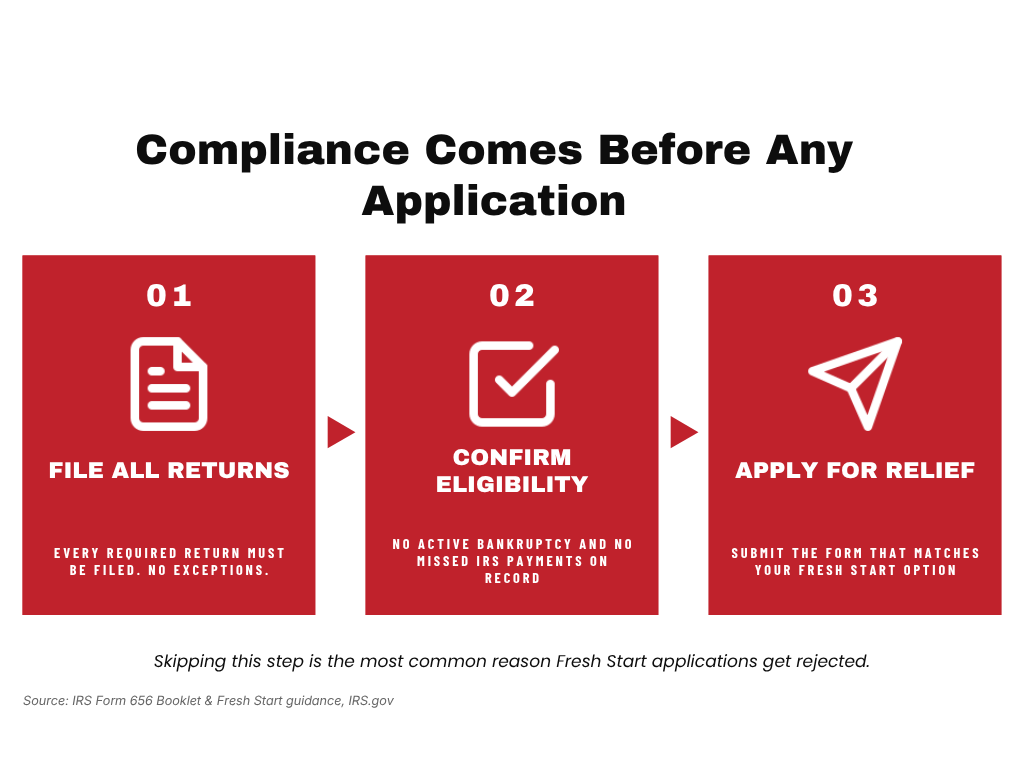
Taxpayers must file all required tax returns before the IRS will approve most relief options.
Streamlined installment agreements may help taxpayers pay IRS debt over time without a full financial review.
An Offer in Compromise may allow qualified taxpayers to settle for less than the full balance owed.
Tax lien withdrawal may help remove the public lien filing when certain payment and balance requirements are met.
The right option depends on the taxpayer’s balance, income, expenses, assets, and filing compliance.
Unfiled returns, active bankruptcy, missed payments, or incomplete documents can stop relief from moving forward.
Professional help may be useful when there are unfiled returns, levies, wage garnishments, large balances, or prior rejected applications.
The safest first step is to get compliant, confirm the IRS balance, gather documents, and choose the relief option that matches the taxpayer’s real financial situation.
What the IRS Fresh Start Program actually is
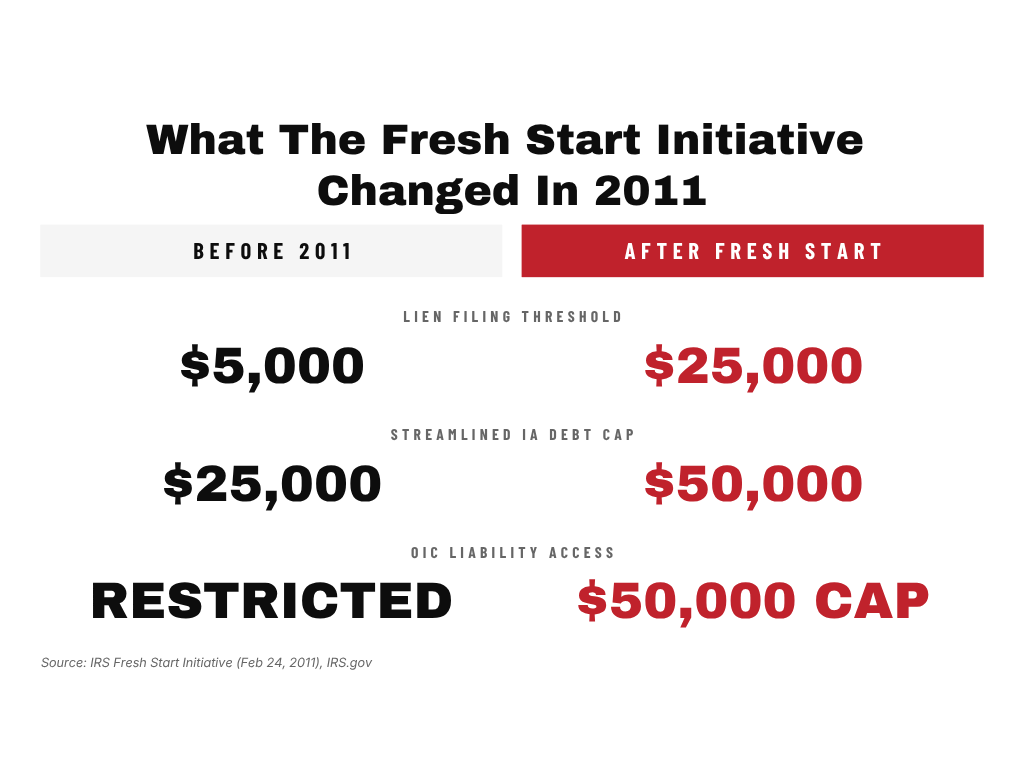
The IRS launched the Fresh Start Initiative on February 24, 2011, as a direct response to the financial hardship many taxpayers were still experiencing in the aftermath of the 2008 recession. Before Fresh Start, IRS thresholds were stricter, tax liens were filed more aggressively at lower debt amounts, and fewer taxpayers could qualify for manageable payment arrangements. The initiative didn't create new laws. It expanded access to tools that already existed by raising the eligibility ceilings and softening some of the conditions attached to them.
What the Fresh Start Initiative actually covers
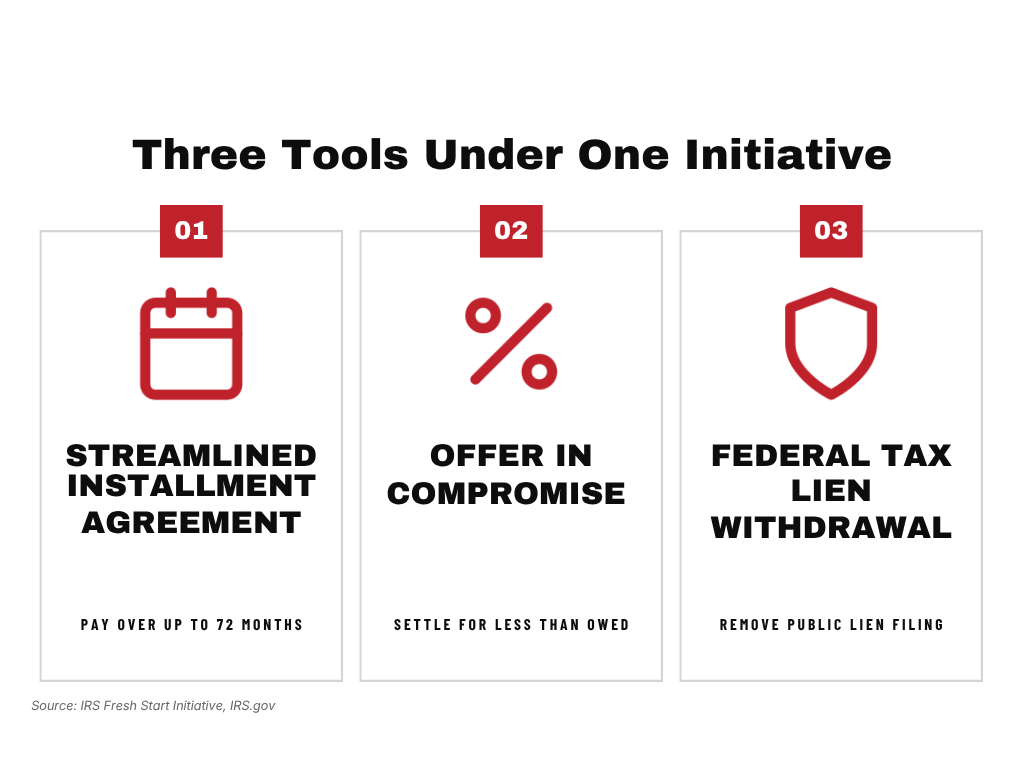
The three main paths the Fresh Start Initiative opened up are streamlined installment agreements, the Offer in Compromise program, and federal tax lien withdrawal. Each one serves a different type of taxpayer in a different financial situation. The sections below break down how each Fresh Start program option works, who it fits, and what the application actually involves.
For a broader breakdown of IRS tax debt options, review the Ultimate IRS Tax Debt Resolution Guide before choosing a Fresh Start path.
The three main relief options Fresh Start unlocks
Each of these tools existed before Fresh Start, but the initiative made them far more accessible. The following sections cover what each one does and when it applies.
Streamlined installment agreements (the 72-month payment plan)
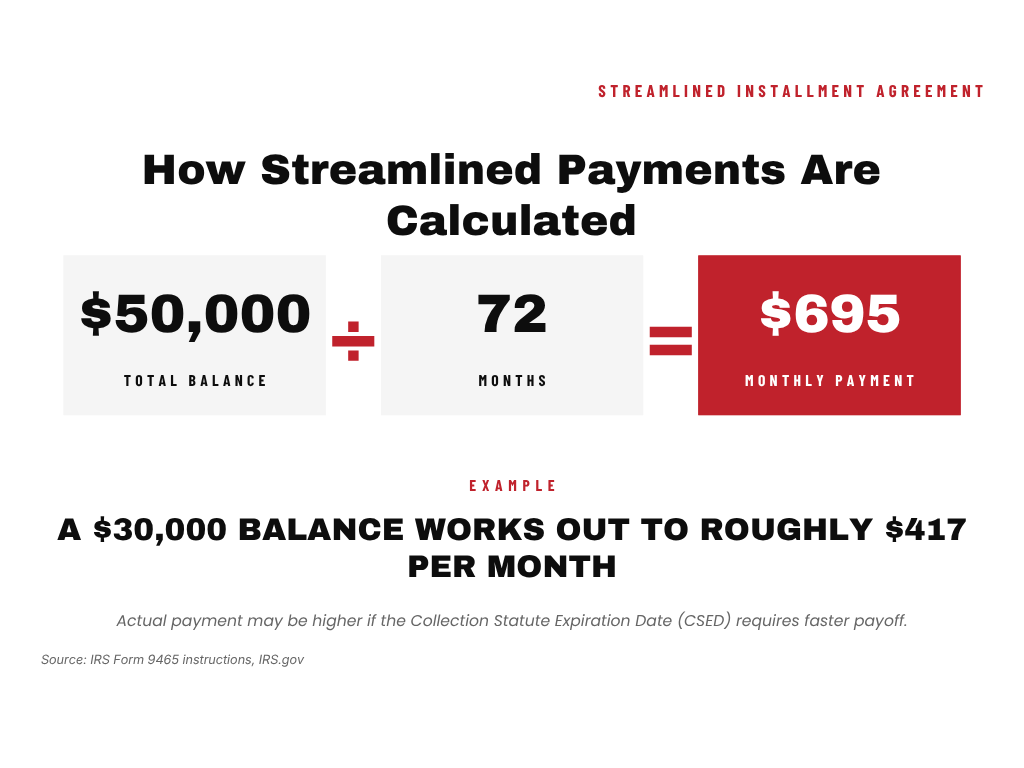
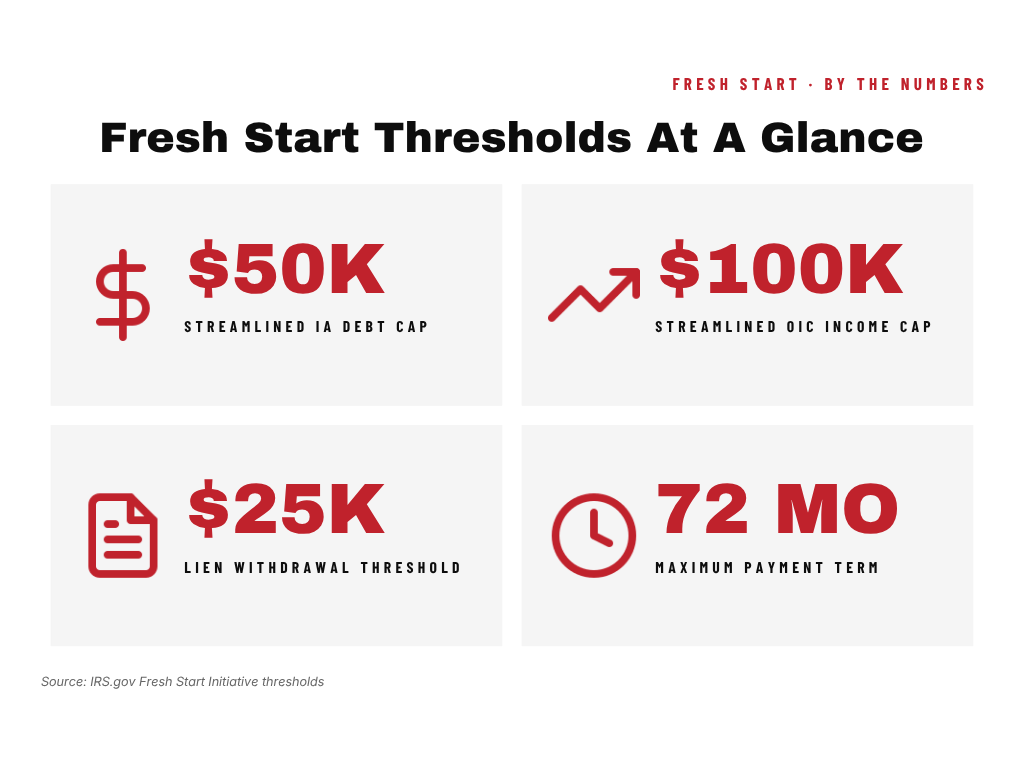
A streamlined installment agreement lets taxpayers with $50,000 or less in combined debt pay off their balance in monthly installments over up to 72 months, without submitting a detailed financial statement to the IRS. The minimum monthly payment formula is straightforward: divide your total balance by 72. For example, a $30,000 balance works out to roughly $417 per month. However, the IRS will also require that payments satisfy the full debt before the Collection Statute Expiration Date, so the actual payment may be higher if less time remains on the statute. Taxpayers who owe more than $25,000 but less than $50,000 must set up a Direct Debit Installment Agreement rather than paying by check, per IRS requirements for streamlined agreements above the $25,000 threshold. Choosing direct debit also opens the door to lien withdrawal for balances under $25,000, a significant secondary benefit that many taxpayers overlook. Applications can be submitted online through the IRS payment agreement tool, which eliminates the need to mail paper forms for most qualifying situations. For more on managing payment arrangements and options, see IRS Payment Plans, Semper Tax Relief | IRS Tax Problems | Business Bookkeeping.
Offer in Compromise (settling for less than you owe)
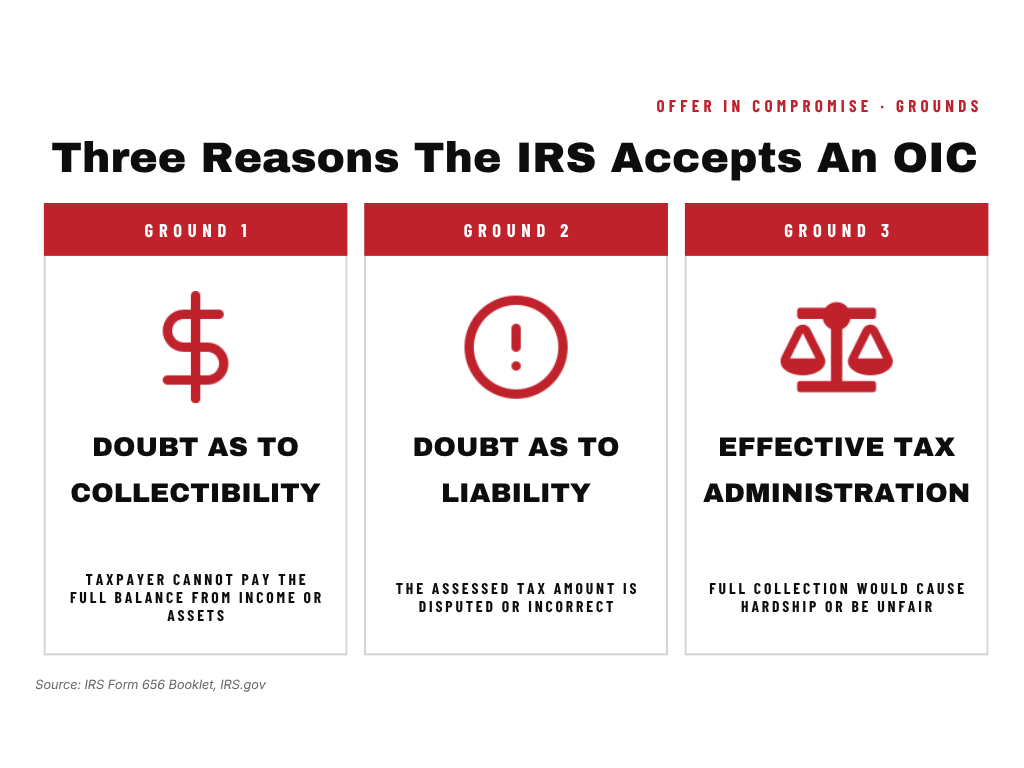
An Offer in Compromise allows qualifying taxpayers to settle their IRS debt for less than the full amount owed. The IRS accepts an OIC when the offer represents the most it can reasonably collect given a taxpayer's income, expenses, asset equity, and overall ability to pay. There are three qualifying grounds: doubt as to collectibility (you genuinely can't pay the full amount), doubt as to liability (the assessed tax amount is disputed), and effective tax administration (collecting the full amount would create an economic hardship or be fundamentally unfair).
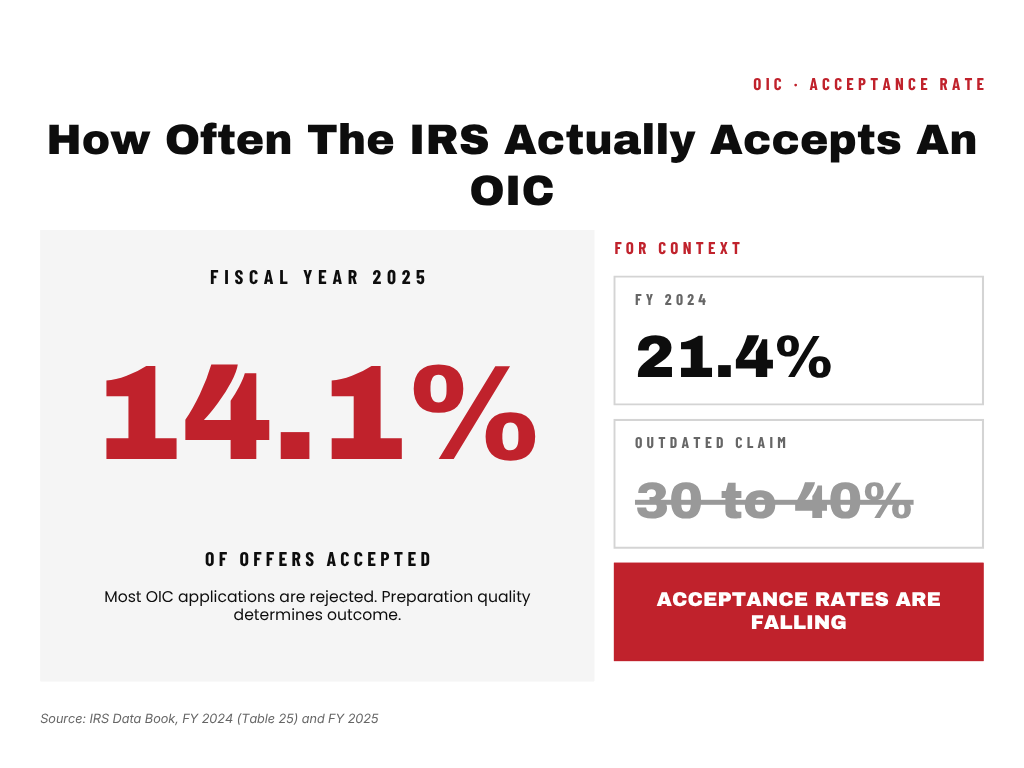
The application package requires Form 656 and Form 433-A(OIC) for individuals, or Form 433-B(OIC) for businesses, along with detailed financial documentation and a nonrefundable application fee. IRS review can take many months, sometimes up to 24 months, depending on workload and complexity. According to IRS Data Book figures, acceptance rates have typically ranged from roughly 30 to 40 percent in recent years, which underscores why this is the highest-stakes option in the Fresh Start toolkit. It carries the strictest qualification bar, but for taxpayers who genuinely can't pay, it represents the most significant potential relief available under the IRS Fresh Start Program. For a plain-language overview of OIC eligibility and process, the Offer in Compromise guide at TurboTax is a helpful secondary resource.
Federal tax lien withdrawal (protecting your credit and finances)
The Fresh Start Initiative raised the threshold for automatic lien filing from $5,000 to $25,000, meaning fewer taxpayers now have liens filed against them in the first place. For those who do have an existing lien, withdrawal becomes available once you enter a Direct Debit Installment Agreement and stay current on payments, provided your balance is at or below $25,000. A federal tax lien is serious because it becomes a public record, can damage credit scores, and can complicate real estate transactions and refinancing. Getting a lien withdrawn removes that public filing, which can improve your ability to sell property, refinance, or obtain credit, in a way that simply paying down the debt does not.
If a federal tax lien has already been filed, IRS tax lien removal options may include withdrawal, discharge, or subordination depending on your facts.
Documents and steps to apply for Fresh Start relief
Incomplete documentation is one of the most common reasons IRS applications stall or get rejected outright. Knowing exactly what you need before you start saves time and prevents mistakes that can damage your standing with the IRS.
Forms the IRS requires for each option
For a streamlined installment agreement, the standard paper form is Form 9465. If you apply online and your balance qualifies, no paper form is required. For an Offer in Compromise, you'll need Form 656 plus Form 433-A(OIC) for individuals. For Currently Not Collectible (CNC) status, the IRS requires a Collection Information Statement, Form 433-F, 433-A, or 433-B, showing that you genuinely cannot make payments given your current income and expenses. The IRS's online payment agreement tool handles most installment agreement requests without requiring mailed forms, which is the fastest path for straightforward cases. For the official filing instructions, consult the IRS instructions for Form 9465.
If you cannot afford monthly payments right now, IRS Currently Not Collectible status may pause collection while your financial hardship is documented.
What supporting documents you'll need to gather
Regardless of which IRS Fresh Start Program option you're pursuing, gather the following before you begin: Most recent filed tax returns All IRS notices you've received Proof of income: pay stubs, recent bank statements, or business profit and loss statements Documentation of monthly expenses: rent, utilities, insurance, and loan payments Bank account routing and account numbers for direct debit setup For an OIC specifically, you'll also need asset documentation including vehicle values, property equity, and retirement account balances. The IRS will use that information to calculate your Reasonable Collection Potential, which is the number your offer needs to meet or exceed to be considered seriously. For a detailed checklist of paperwork you should assemble before applying, see Required Documents for Tax Relief, Semper Tax Relief | IRS Tax Problems | Business Bookkeeping.
Before assuming an OIC will work, use the IRS Offer in Compromise Calculator to estimate whether your income, expenses, and assets support a reduced settlement.
Gather your tax relief supporting documents before applying so the IRS has proof of your income, expenses, assets, and hardship position.
When professional help makes more sense than DIY
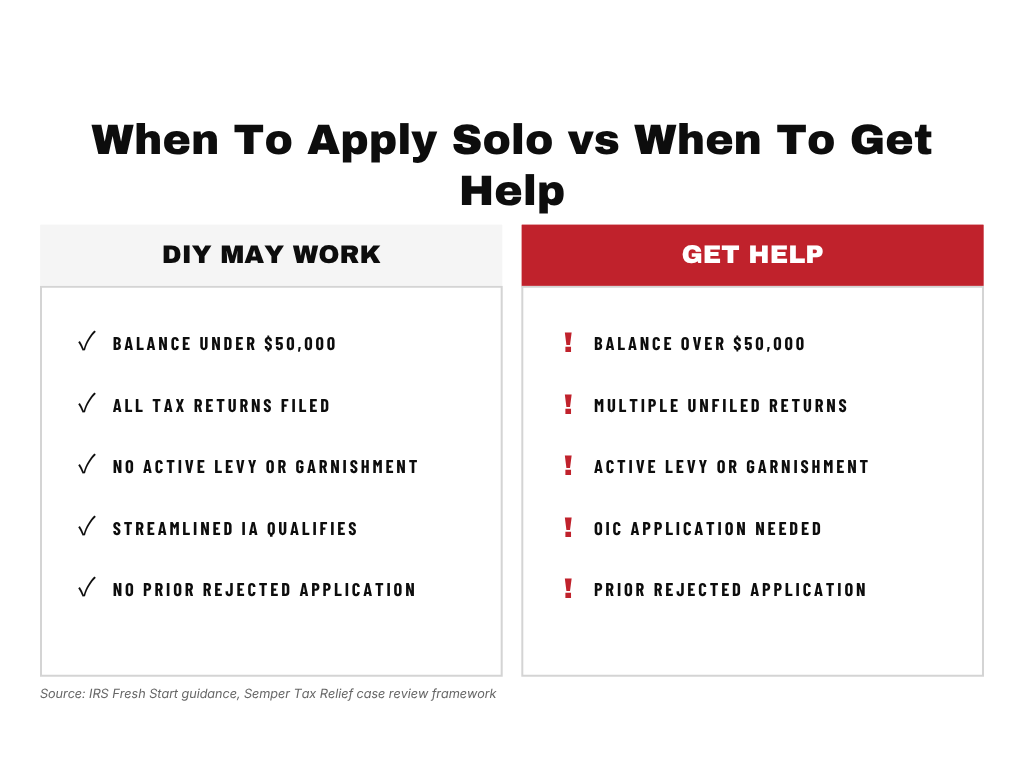
Many taxpayers with straightforward situations can navigate a streamlined installment agreement on their own using the IRS website. But there are situations where a solo application is likely to fail, and understanding which side of that line you're on matters before you invest time in an application with little chance of being approved.
IRS Form 2848 Power of Attorney allows a qualified representative to communicate directly with the IRS and work through payment plans, OIC, CNC, liens, or collection issues on your behalf.
Signs your case is too complex to navigate alone
If you have multiple years of unfiled returns, a levy or wage garnishment already in motion, debt over $50,000 that requires an OIC rather than a payment plan, or a previously rejected application already on your IRS record, the stakes of getting the next step wrong are high. A mishandled OIC submission can reset your timeline, damage your negotiating position, and in some cases result in escalated enforcement. In those scenarios, working with a professional who knows IRS resolution from the inside is the practical choice, not an optional one.
How a free case review from Semper Tax Relief works
Semper Tax Relief offers a free case review that covers your full IRS situation before any fees are discussed. Their team includes an Enrolled Agent with a Juris Doctor (J.D.) degree, meaning they can interpret tax law, assess dispute grounds, and represent you directly before the IRS, all under one roof. An Enrolled Agent can act on your behalf using Form 2848 Power of Attorney, handle all IRS communications, and bring substantive legal analysis to situations that require it. For taxpayers who previously hired another firm and got little to no result, a credentialed second opinion costs nothing and can clarify exactly where you stand and what your realistic options are. If you want a broader primer on resolving IRS debt and how these tools fit together, review the Comprehensive Guide to Resolving IRS Tax Debt, Semper Tax Relief | IRS Tax Problems | Business Bookkeeping.

IRS Fresh Start Program Guide: What It Is and Who Qualifies? FAQs
-
Yes. The IRS Fresh Start Program remains active. The key eligibility thresholds, including the $50,000 streamlined installment agreement ceiling and the $25,000 lien withdrawal threshold, have not changed for 2026. For recent reporting on whether Fresh Start qualifications have shifted in 2026, see this CBS News explainer on Fresh Start qualifications in 2026.
-
To qualify for a streamlined installment agreement under the Fresh Start Initiative, your total tax debt (including penalties and interest) must be $50,000 or less, and all required tax returns must be filed. Taxpayers who owe between $25,000 and $50,000 must use a Direct Debit Installment Agreement.
-
Timelines vary by option. A streamlined installment agreement applied for online can be approved within days for qualifying taxpayers. An Offer in Compromise review can take many months and sometimes up to 24 months, depending on IRS workload and case complexity.
-
Yes, for straightforward situations, particularly streamlined installment agreements, the IRS online payment agreement tool makes self-filing practical. More complex cases involving OIC applications, unfiled returns, or active levies generally benefit from professional representation. For an accessible explanation of streamlined installment agreements and how they work, see the H&R Block definition of streamlined installment agreement.
-
Be careful if a company promises “pennies on the dollar” before reviewing your finances, pressures you to sign immediately, charges large upfront fees without explaining the work, or refuses to name the licensed professional assigned to your case. A legitimate provider should explain credentials, scope, fees, and next steps in writing.
Take the next step with clarity
The IRS Fresh Start Program is real, it works, and it's more accessible than most taxpayers realize. Whether your situation calls for a streamlined installment agreement, an Offer in Compromise, or a federal tax lien withdrawal, each Fresh Start program option has specific eligibility requirements and a defined process. The $50,000 debt threshold is the central qualification bar for the most widely used option, and getting into filing compliance is always the required first step before any resolution can move forward. If you're unsure which option fits your situation, or if your case involves the kind of complexity that makes a DIY application risky, Semper Tax Relief's free case review is the fastest way to get a clear, honest answer about where you actually stand and what the IRS Fresh Start Program can realistically do for you.