Estimated Tax Payments and IRS Compliance, What Self-Employed Taxpayers in Collections Need to Know
If you are self-employed and working through a tax debt with the IRS, there is a compliance requirement that catches a lot of people off guard. It has nothing to do with the balance you already owe. It has to do with the estimated tax payments you are supposed to be making right now, for the current year, while your case is being worked.
In my experience reviewing collections cases, this is one of the most common reasons a resolution request stalls or comes back rejected. The taxpayer assumes that because they are negotiating a settlement or a payment plan on old debt, the current year is somehow on pause. It is not. The IRS treats ongoing compliance as a gate you have to clear before it will even evaluate your request, not a detail to clean up later.

What Form 1040-ES Estimated Tax Payments Cover
Form 1040-ES is how self-employed individuals pay federal income tax and self-employment tax on income that has no withholding attached to it. If you are a W-2 employee, your employer handles this automatically out of every paycheck. If you run your own business, freelance, or work as an independent contractor, that job falls to you, and the IRS expects it done quarterly, not once a year at filing time.
This matters specifically for tax relief cases because most people who end up owing the IRS a large balance got there the same way, by underpaying or skipping estimated taxes for one or more years. If that pattern continues into the year you are trying to resolve, it tells the IRS the underlying problem has not been fixed yet.
The Compliance Gate Most Self-Employed Taxpayers Do Not See Coming
Offers in Compromise
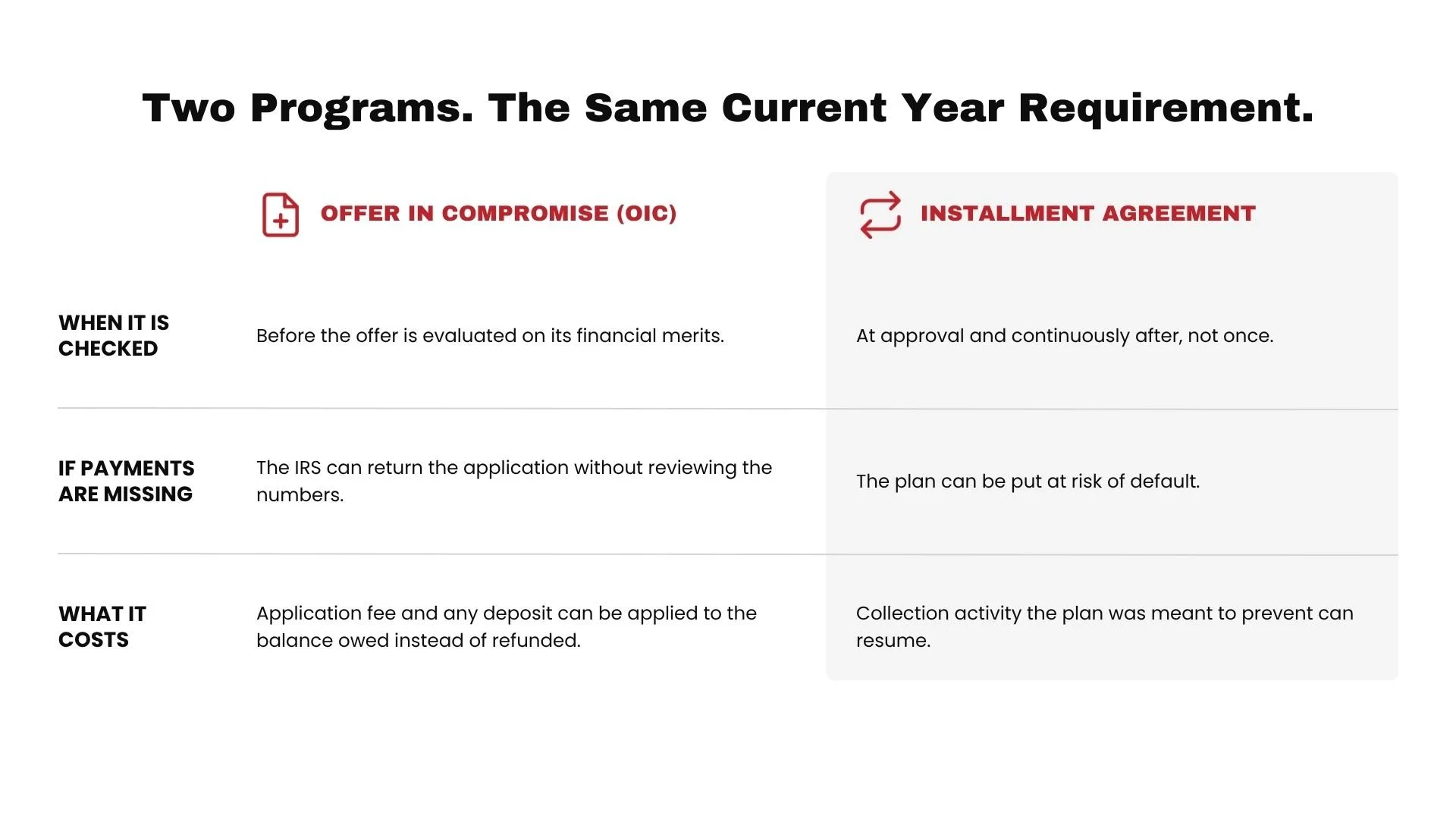
An Offer in Compromise is not evaluated on its financial merits until a set of threshold requirements is met first. According to the IRS, one of those requirements is that the taxpayer must have made all required estimated tax payments for the current year before the offer is submitted. If that box is not checked, the IRS can return the application without ever reviewing the numbers, and the application fee and any deposit included can be forfeited toward the balance owed rather than refunded.
Installment Agreements
Payment plans carry the same underlying expectation. Compliance is treated as ongoing, not a one time check at approval. Falling out of current year estimated payment compliance after a plan is already in place can put that plan at risk of default, which then reopens the door to collection activity the plan was meant to prevent.
How IRS Collections Actually Reviews This
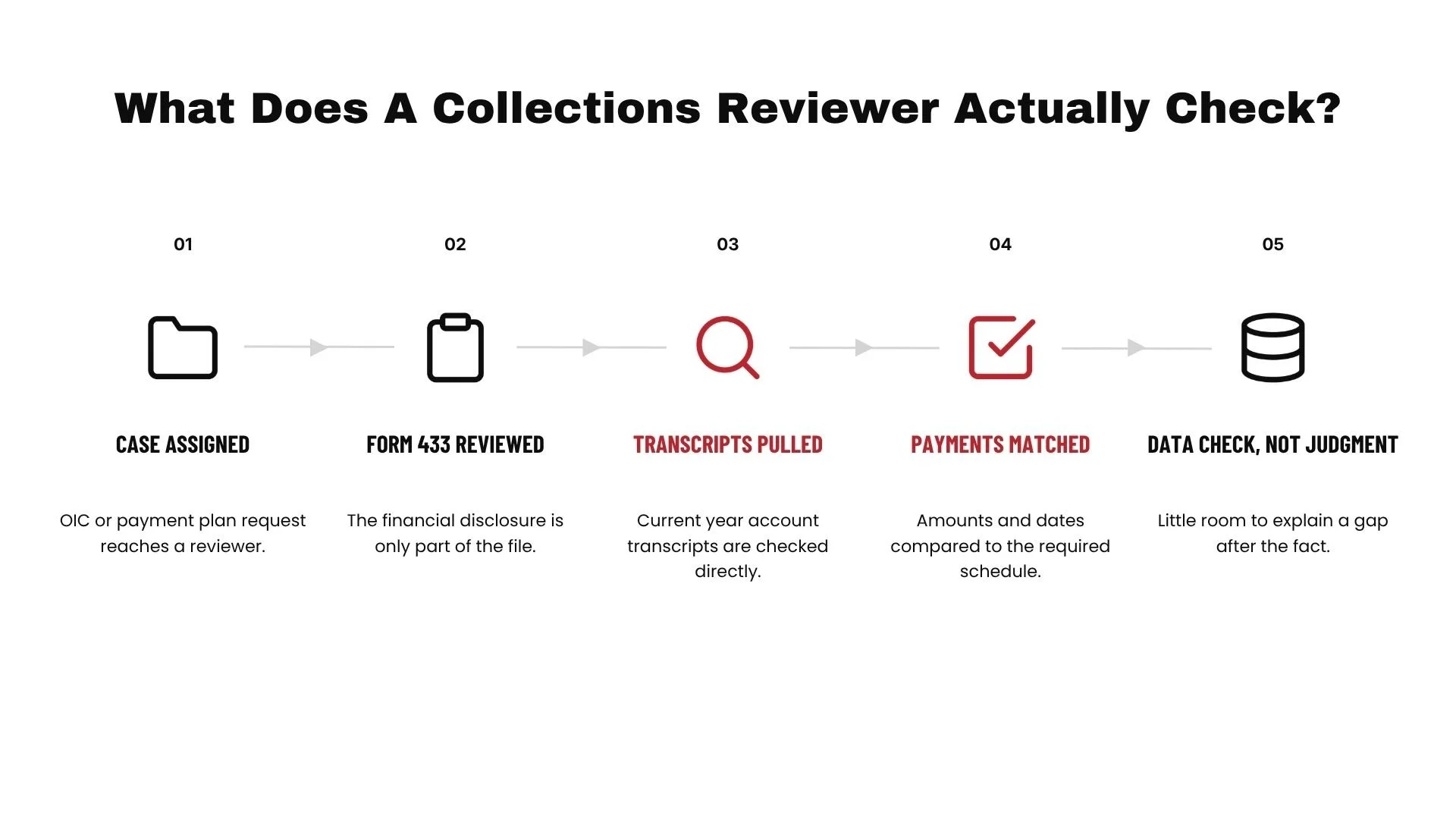
When a case is being worked, whether it is an Offer in Compromise or a payment plan, the assigned function is not just looking at your Form 433 financial disclosures. It is also pulling your account transcripts for the current year to confirm estimated payments are being made on the schedule the safe harbor rules require. This is a data check, not a judgment call, which means there is generally little room to explain it away after the fact. The cleanest path is making sure the payments are actually made, on time, before the case reaches that review point.
For self-employed taxpayers specifically, reviewers tend to look at this closely because self-employment income is the profile most associated with the original balance due in the first place. Consistent, on time estimated payments in the current year can function as evidence that your situation has stabilized. Missed or partial payments can raise the opposite signal.
Why This Hits Self-Employed Taxpayers Harder
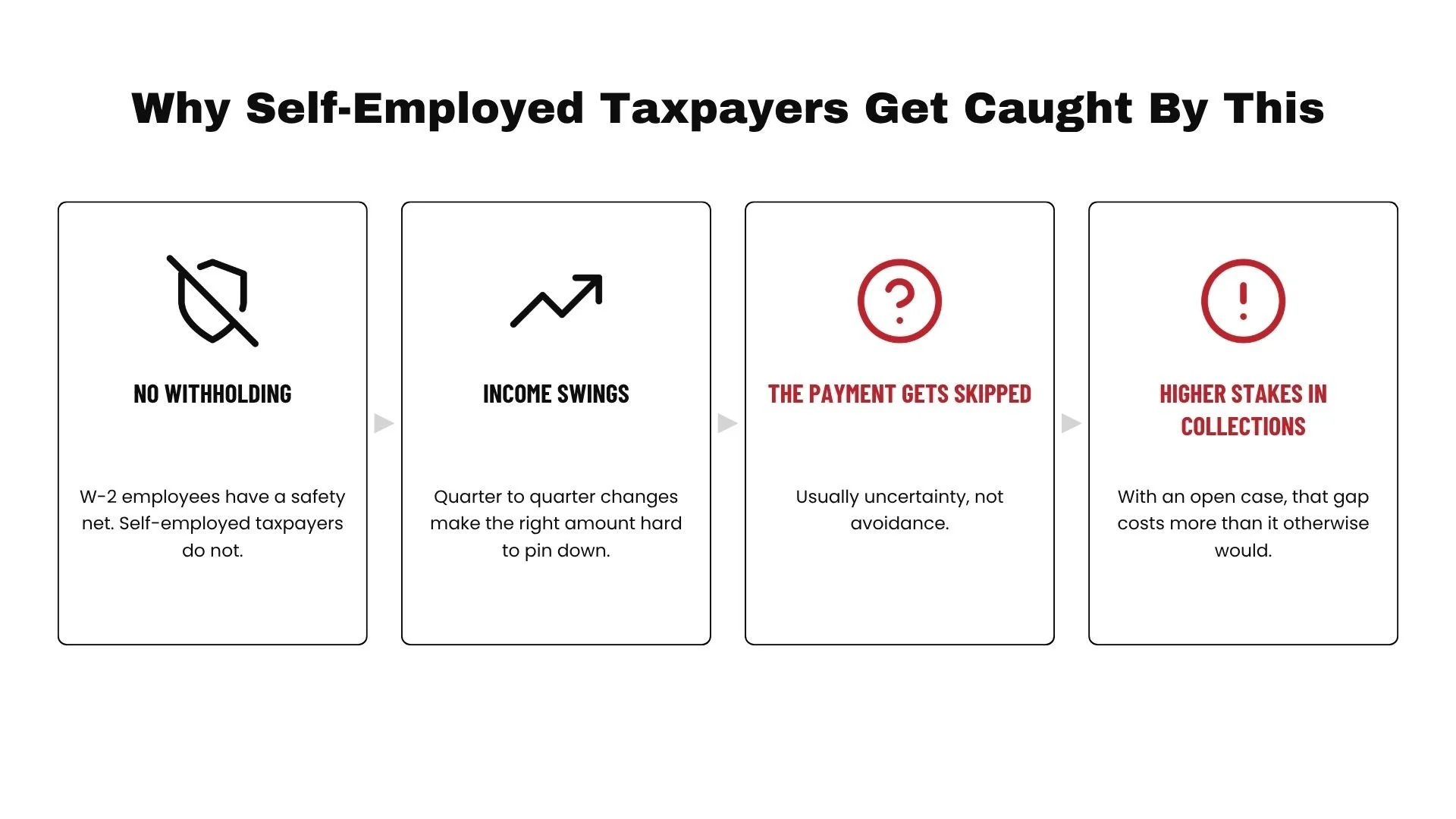
W-2 employees rarely think about this because withholding does the work for them. Self-employed taxpayers do not have that safety net, and income can swing quarter to quarter in a way that makes calculating the right payment feel like guesswork. That uncertainty is often exactly why the payments get skipped, not out of avoidance, but because the taxpayer is not sure how much to send or assumes it can be sorted out at filing time. When there is an open collections case, that assumption is a lot more costly than it would be otherwise.
2026 Quarterly Due Dates and the Safe Harbor Rule
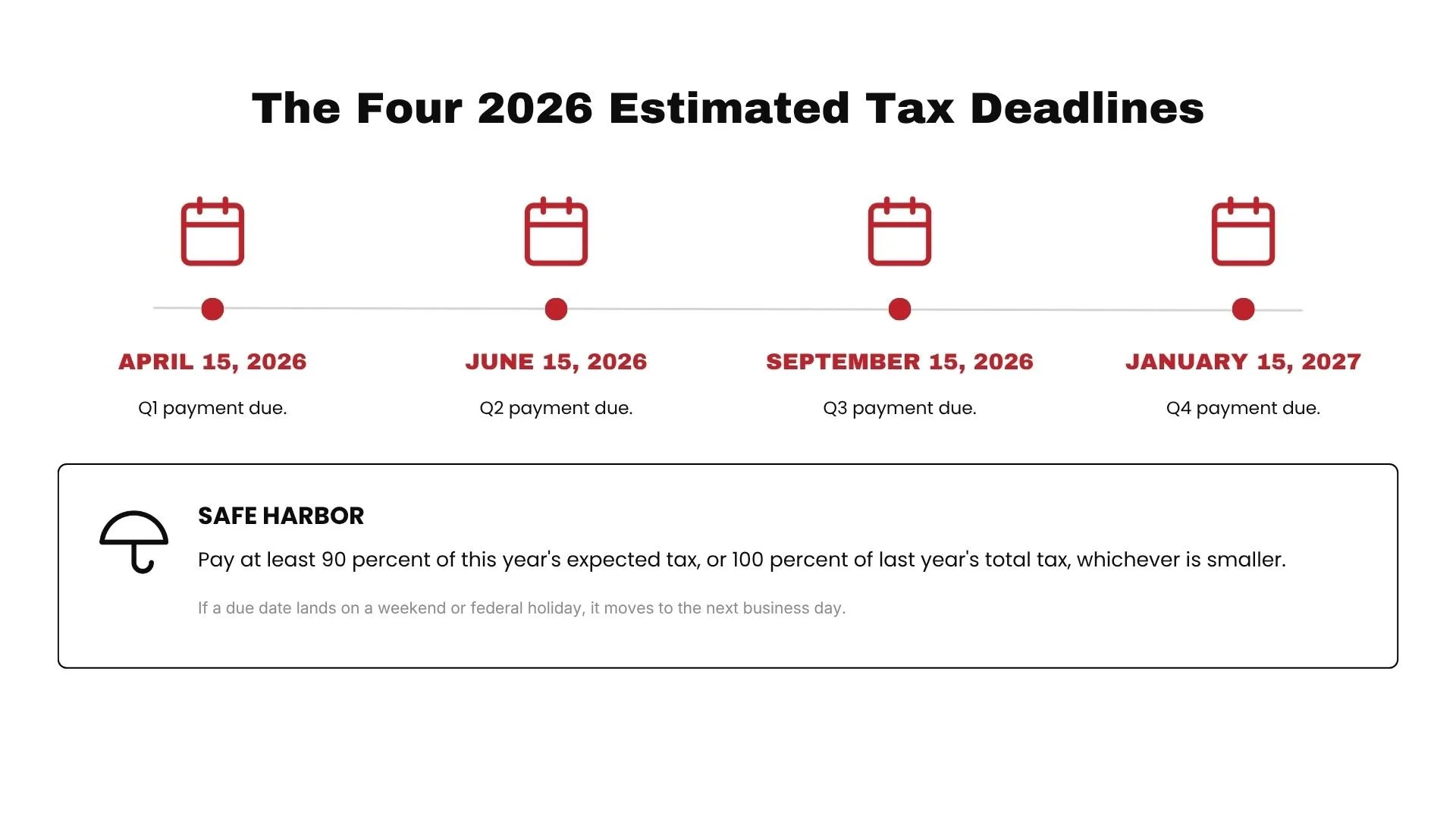
For calendar year taxpayers, the 2026 estimated tax due dates are April 15, June 15, September 15, and January 15, 2027. If a due date falls on a weekend or federal holiday, it moves to the next business day.
To stay in the IRS safe harbor and avoid an underpayment penalty, your total estimated payments and any withholding generally need to equal at least 90 percent of the tax you expect to owe for the current year, or 100 percent of the total tax shown on your prior year return, whichever is smaller.

What Happens If You Fall Behind While Your Case Is Pending
If a quarterly payment is missed after an Offer in Compromise has been submitted or accepted, or after a payment plan is in place, it does not automatically mean the case is over. But it does put you back in a compliance review, and it can slow down or jeopardize the resolution you have been working toward. Getting caught up as quickly as possible, and documenting that you did, is generally the best available response once a payment has been missed.
A Practical Compliance Checklist Before You Apply
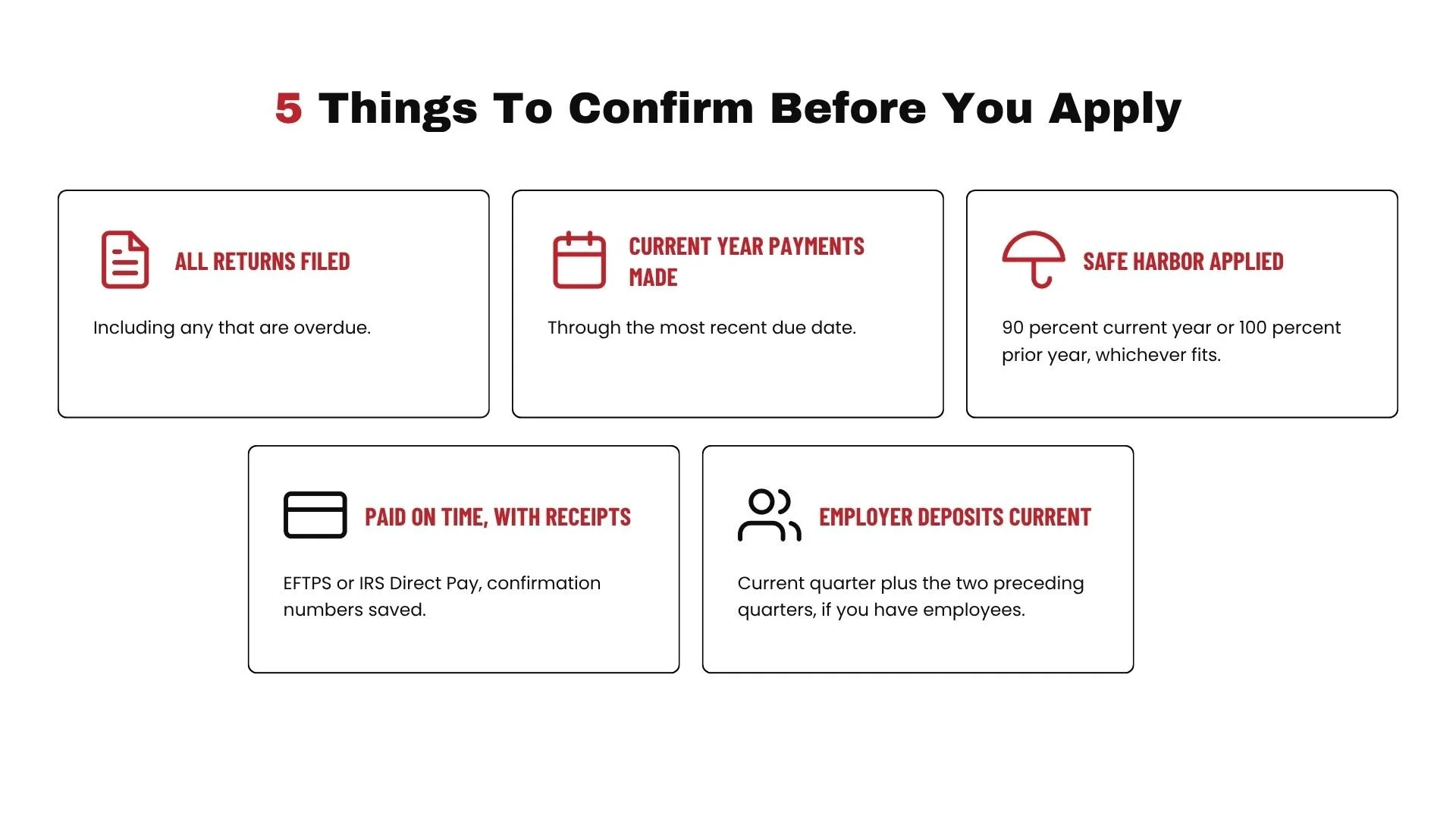
Before submitting an Offer in Compromise or requesting a payment plan, it is worth confirming the following:
- All required federal tax returns are filed, including any that are overdue
- Current year estimated tax payments are made through the most recent due date
- Payments are calculated using either the 90 percent current year or 100 percent prior year safe harbor, whichever fits your situation
- Payments are being made on time through EFTPS or IRS Direct Pay, with confirmation numbers saved
- If you are a business owner with employees, federal tax deposits for the current and two preceding quarters are current as well
Estimated tax payments can feel like a side issue when you are focused on resolving a much larger balance, but the IRS does not treat it that way, and neither should you. If you are not sure whether your current year payments meet what a program like an Offer in Compromise or a payment plan requires, that is worth reviewing before you apply, not after a rejection.
Frequently Asked Questions
-
You may need to make estimated tax payments if you are self employed and expect to owe enough federal income tax when you file your return. Unlike a traditional employee, you may not have an employer withholding federal income tax from every paycheck.
Estimated payments can cover both income tax and self employment tax. Whether you are required to make them depends on your expected tax, withholding, refundable credits, and other circumstances.
If you already owe the IRS, staying current with your present tax obligations can also be important when requesting or maintaining certain IRS collection alternatives.
-
Missing an estimated tax payment does not automatically create an IRS collection case. However, you may be subject to an estimated tax underpayment penalty depending on how much you paid, when you paid it, and whether an exception applies.
The bigger problem I often see is that missed estimated payments continue throughout the year. When the tax return is eventually filed, the taxpayer may have another balance due on top of an existing IRS tax debt.
If you already owe back taxes, address the current year at the same time you work on the older debt. Otherwise, you can resolve one problem while creating another.
-
It can be difficult to obtain or maintain certain IRS collection resolutions when you are not current with required estimated tax payments.
When I review a tax relief case involving a self employed taxpayer, I look at more than the old IRS balance. I also want to know whether required returns are filed and whether the taxpayer is staying current with present tax obligations.
For example, current compliance can affect an Offer in Compromise and other collection arrangements. The exact requirements depend on the resolution being requested and the taxpayer's circumstances. -
Possibly, yes. An installment agreement for old tax debt does not replace your obligation to pay current taxes.
This is an important distinction. Your monthly installment agreement payment generally applies to the existing balance included in the agreement. Estimated tax payments address your current year tax obligation.
If you are required to make estimated payments and stop making them, you could owe another balance when you file your next return. A new balance can also create problems with an existing installment agreement. -
There is no single percentage that works for every self employed taxpayer or business owner.
Your estimated payments generally depend on your expected income, deductions, credits, self employment tax, other taxes, and any withholding or payments already being made.
The IRS provides estimated tax worksheets that can help calculate the amount. If your income changes substantially during the year, the calculation may need to be updated rather than continuing to send the same amount every quarter. -
This is where I would want to look at the entire financial picture instead of treating each tax problem separately.
You may have an old IRS balance, current estimated tax obligations, business expenses, household expenses, and limited cash available to cover all of them. Simply putting every available dollar toward the old IRS debt may leave you unable to stay current with the present year.
The appropriate approach depends on your financial circumstances and the IRS resolution you are pursuing. If you are already in collections, reviewing both current compliance and the older tax debt can help determine what needs attention first.
-
Proper estimated payments can substantially reduce the chance of reaching the end of the year with an unexpected federal income tax balance, but they do not guarantee that you will owe nothing.
Income can increase, deductions can change, or your original estimate may simply be too low. That is why I recommend reviewing the numbers during the year, especially for business owners and self employed taxpayers whose income changes from month to month.
If you already have IRS tax debt, preventing a new balance is particularly important. Tax relief should address the old problem while also helping you avoid repeating the same cycle.
Conclusion.
Quarterly estimated tax payments can help prevent a new IRS balance while you work on resolving older tax debt. If you already owe the IRS, I look at both your past debt and current tax compliance before evaluating a resolution.
At Semper Tax Relief, I can review your IRS account, compliance, and available options. Schedule a free case review to discuss where your case stands and what steps may be available.